|
Sh

Sha'ar Hashamayim

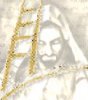
(sha-ar hash-shah-MY-eem) n. The gate to heaven; Bet-El (Bethel); When Jacob awoke from his dream of the sullam (ladder) to heaven (Gen. 28), he was so awestruck that he called the place "the house of God" (bet Elohim) and the "Gate of Heaven" (sha'ar hashamayim). Yeshua (Jesus) referenced this ladder when he met Nathanael (John 1:51).
In this passage He makes explicit reference to Jacob's dream in Bet 'El. Just as Jacob saw the ladder (sullam) ascending to heaven with the angels of God ascending and descending upon it, so Yeshua tells Nathanael that He is the very Ladder to God, the true sha'ar hashamayim - the Way into heaven (John 14:6). For more, see parashat Vayetzei.
Sha'arei Mavet

(sha-a-ray MAH-vet) n.pl. The Gates of Death (Psalm 107:18)
Sha'arei Shalom

(sha-a-ray shah-LOHM) n.pl. Gates of Peace; a common name for many synagogues.

These are the things that you shall do: Speak the truth to one another; render in your gates judgments that are true and make for peace. (Zech. 8:16)
Sha'arei Tzedek

(sha-a-ray TZE-dek) n. Gates of Righteousness.

pitkhu-li sha'arei-tzedek, avo-vam odei Yah - Open to me the gates of righteousness, that I may enter through them and give thanks to the LORD. (Psalm 119:18).
Sha'arei Tziyon

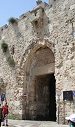
(sha-a-ray tsee-YOHN) n.pl. Gates of Zion; The Zion Gate (Hebrew: שער ציון, Sha'ar Zion) is one of eight gates built into the walls of the Old City of Jerusalem (also called David's Gate, sha'ar David).

"The LORD loveth the gates of Zion more than all the dwellings of Jacob" (Psalm 87:2).
Sha'atnez

(SHA'-AHT-nayz) n. Any fabric made of wool mixed with linen. Two verses in the Torah prohibit a Jew from wearing fabric containing a combination of wool and linen. The first is in Leviticus 19:19, "A shaatnez garment should not cover you," and the second is in Deuteronomy 22:11, "Do not wear shaatnez, wool and linen together" (the word sha'atnez is considered an acronym for the Hebrew words "shua" = combined "tavei" = spun, "nuz" = woven). Shaatnez is sometimes considered to be a metaphor against mingling the holy and the profane. Wool blankets, sweaters, pants, women's apparel, linen suits, blouses, etc., may not be composed of shaatnez but must be checked by a specially trained tester.
Shabbat

(shab-BAHT) n. Shabbat; Sabbath; Day of rest. (Ex. 20:8). Observed from sunset Friday evening to sundown Saturday evening, marked by rest, worship, and study. One who traditionally observes the legal requirements for Shabbat is called Shomer Shabbat. One of the aseret hadibrot, or Ten Commandments (Ex. 20:2-17; Deut. 5:6-21) requires the sanctification of this day.
Shabbat Bereshit
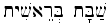
(shab-BAHT be-ray-SHEET) n. The first Sabbath after Simchat Torah on which the portion of Bereshit (Genesis) is read. The one called to do Aliyah on this day is called the "Bridegroom (chatan) of Genesis."
Shabbat Bread

(KHAL-lah) n. Shabbat Bread; Sabbath Bread; "Cake," "loaf." A braided loaf of egg bread, traditionally used for Shabbat and the holidays. Challah is meant to remind us of the manna that fell from the sky during the time of the Exodus from Egypt, and since a double portion fell the day before the Sabbath, it is customary to use two loaves of bread during holiday observances.
The word "challah" comes from the Scriptures. The Torah commands that a loaf of bread made from "the first of your dough" was to be given as a contribution (terumah) to the priests: "Of the first of your dough you shall present a loaf (i.e., challah: חַלָּה) as a contribution; like a contribution from the threshing floor, so shall you present it" (Num. 15:18-21). After the destruction of the Second Temple, it became customary for Jews to twist off a small portion of dough (minimally the size of an olive) to burn in an open flame as an offering to God (this custom is called "hafrashat challah"). Technically speaking, the separated piece of dough is the "challah," though most people call the bread on the Sabbath table "challah" as well...
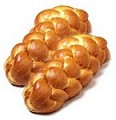
The "twists" or "braids" you see in the bread used for the Sabbath are meant to remind us that the loaf was made from a batch of dough that was first offered to God. In this way, the "challah loaf" on the Shabbat Table represents a firstfruit offering (bikkurim) before the LORD, which is another symbol of Yeshua and his sacrifice for us (1 Cor. 15:20). As the Bread of Life - lechem ha-chayim - Yeshua is our everlasting sustenance (John 6:35). Only Yeshua can truly satisfy the spiritual hunger within our hearts...
Shabbat Chazon
(shab-bat kha-ZOHN) n. "The Sabbath of Vision." The Sabbath preceding the Fast of Av (Tishah B'Av) during the Three Weeks of Sorrow is called Chazon since the Haftarah read is from the first chapter of Isaiah revealing the coming destruction of the Temple.
Shabbat HaChodesh

(shab-bat ha-KHOH-desh) n. "Sabbath of the Month." The sabbath before the 1st of Nissan, the start of the biblical year (Ex. 12:1-20). This is one of the Four Shabbatot, or special Sabbaths, that occurs before Passover and is attended with special ritual at the synagogue.
Shabbat HaGadol

(shab-BAHT hag-gah-DOHL) n. Shabbat Hagadol; "The Great Sabbath"; Sabbath preceding Pesach. Called "great" (gadol) because it began the story of the passage of the Jews from slavery into freedom, and it was the Shabbat when the Jews of Egypt sprinkled lamb's blood on doorposts to prevent the Angel of Death from stopping by their households during the last plague. It was in Egypt that Israel celebrated the very first Shabbat Ha-Gadol on the tenth of Nissan, five days before their redemption. On that day, the Children of Israel were given their first commandment which applied only to that Shabbat, but not to future generations: On the tenth day of this month [Nissan]... each man should take a lamb for the household, a lamb for each home (Exodus 12:3).
Shabbat Machar Chodesh

(shab-baht mah-khar KHOH-desh) phr. "Shabbat of tomorrow's moon." If a Sabbath occurs precisely one day before the new moon (i.e., Rosh Chodesh), it is called Shabbat Machar Chodesh and a different Haftarah (1 Sam. 20:18-42) is read.
Shabbat Mevarkhim

(shab-baht me-var-KHEEM) phr. "Sabbath of Blessing." The last Sabbath of the month before the appearance of the new moon (i.e., Rosh Chodesh) is called Shabbat Mevarkhim (שַׁבַּת מְבָרְכִים, "Sabbath of Blessing"), and an additional prayer is recited asking God to bless the coming month.
Shabbat Parah

(shab-baht pah-RAH) phr. "Sabbath of the Red Cow." The additional (musaf) portion recalls the Red Heifer sacrifice (Num. 19) and the making of the ashes for ritual purification. Read on the sabbath after Purim. This is one of the Four Shabbatot, or special Sabbaths, that occurs before Passover and is attended with special ritual at the synagogue.
Shabbat Rosh Chodesh

(shab-baht rohsh KHOH-desh) phr. "Sabbath of the New Moon." A Sabbath day that also occurs precisely on the new moon (i.e., Rosh Chodesh). It is customary for an additional Torah reading (Num. 28:9-15) and haftarah (Isa. 66:1-24) to be recited during services.
Shabbat Shabbaton

(shab-BAHT shab-bah-TOHN) n. A "high" sabbath (lit. "Sabbath of sabbaths"). A high Sabbath is a day of shabbaton (rest) that may occur on any day of the week besides the weekly sabbath day. Shabbaton may indicate a festival day of the Jewish calendar in which work is prohibited.
Shabbat Shalom

(shab-baht sha-LOHM) phr. "Good Sabbath!"
Shabbat Shekalim

(shab-baht she-kah-LEEM) phr. "Sabbath of Shekels" (from a custom that originated from the half-shekel tax used to maintain the mishkan (and later the Temple)). Read on Sabbath before the 1st of Adar. The Maftir (additional reading) from Exodus (30:11-16) describes the census of every Jew and the obligation to give a half-shekel terumah (contribution) during the month of Adar to pay for the public korbanot (sacrifices) offered in the Bet Hamikdash (Temple) in Jerusalem. For us, it might be a time to remember those who offer personal sacrifices so that we also might draw closer to God. This is one of the Four Shabbatot, or special Sabbaths, that occurs before Passover and is attended with special ritual at the synagogue.
Shabbat Shirah

(shab-baht shee-RAH) "The Sabbath of the Song." When the Torah reading for the week is parashat Beshalach (usually in Shevat/late winter), the famous Shirat Hayam, the "Song the Sea," is chanted at services. This is a song of praise the Israelites sang after they crossed the Red Sea, and the Shabbat has come to be called Shabbat Shirah ("Sabbath of the Song").
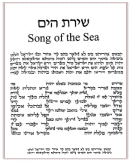
Notice that the Hebrew text for the song is stylized in different ways according to different soferut (scribal) traditions. The sages count 198 words in this song, which is the numerical value for the word tzchok (צחק), a word that means "laughter" and is the word used to describe Sarah's response when she finally gave birth to Isaac (Gen. 21:6). According to Rabbi Bahye, the laughter in Isaac's name comes from Abraham's joy (Gen. 17:17). The joy of Isaac's birth, then, is linked with the "birth" of the nation of Israel at the time of the Exodus.
Shabbat Shuvah

(shab-baht shoo-VAH) n. "Shabbat of Return." The Sabbath between Rosh Hashanah and Yom Kippur, during the Ten Days of Awe. The Shabbat Shuvah haftarah reading begins with the words Shuvah Yisrael "Return O Israel," from the prophecy of Hoshea.
Shabbat Walking Limit

(e-ROOV) n. (עֵירוּב) A Rabbinic law that draws a symbolic line or "fence" around an area so that the area may be considered as one's "own yard," thus permitting the carrying of things within it without fear of desecrating the Sabbath. This concept is ultimately derived from the Torah: Numbers 2:2 reads, "Every one of the Israelites must camp under his standard with the emblems of his family; they must camp at some distance (מִנֶּגֶד) around the tent of meeting." Moreover, the instructions that the cities of the Levites were to include a pastureland that measured 2,000 cubits in every direction from the city (Num. 35:5) is cited as futher evidence of the prescribed limit. Finally, in the Book of Joshua, the people were further instructed to keep 3,000 feet away from the Ark of the Covenant (Josh. 3:4), which the rabbis later interpreted to mean that there should a "walking limit" (eruv) of no more than 3,000 feet beyond one's house on the Sabbath.
Shabbat Zachor

(shab-baht zah-KHOHR) phr. "Sabbath of Remembrance," read on the sabbath before Purim. The additional (musaf) portion recalls the enmity of the Amalkites (Deut. 25:17-19). This is one of the Four Shabbatot, or special Sabbaths, that occurs before Passover and is attended with special ritual at the synagogue.
Shabbaton

(shab-bah-TOHN) n. 1) Rest; cessation from work; a vacation; 2) One of the seven annual Sabbaths (4 of which are known as Shabbat Shabbaton).
Shabbetai Tzvi

(sha-be-tie tse-VEE) n. שַׁבְּתַי צְבִי; Also spelled "Sabbatai Zevi," "Sabbatai Sevi," and so on. A late medieval Kabbalist (1626-1676) who claimed to be Jewish Messiah. Shabbetai was the founder of the Jewish "Sabbatean" movement, influenced by the esotericism of Rabbi Isaac Luria. At the age of forty, he was forced by the Ottoman Sultan Mehmed IV to convert to Islam, and many of his followers converted with him, thereby defaming the Name of God. (Indeed, one of the things Sabbatai did to "convince" the Jews that he was the Messiah was to pronounce the Sacred Name of God, something forbidden to do except by the High Priest). He was later excommunicated from the Jewish community because of his eccentric views.
Shacharit

(sha-cha-REET) n. The morning Prayer Service performed in the synagogue. Shacharit is the daily morning tefillah (prayer service). The word shacharit comes from the Hebrew word shachar, or morning, denoting that shacharit is to be prayed in the morning. It is said that Abraham invented Shacharit by regularly praying to God in the morning (Issac is likewise said to have invented Minchah (afternoon service), and Jacob the Ma'ariv (evening service)).
Shadchan

(shad-KHAN) n. Plural: Shadchonim (שַׁדְּכֳנִם). A marriage broker; a "matchmaker." See Shidduch, below.
Shaddai

(shad-DAI) n. Shaddai; Almighty; see the Names of God.
Shaliach

(shah-LEE-akh) n. Messenger; Delegate. Emissary. A person sent forth as an agent to perform a task for a Principal. In Jewish understanding the identity of the agent becomes that of the Principal when the agent performs the task given to him by the Principal. Plural form is Sh'lichim.
Shaliach Tzibbur

(shah-LEE-akh tseeb-BOOR) n. Prayer leader;. Traditionally, a Jewish prayer service is chanted. The shaliach tzibbur functions as the representative of the community who recites the prayers on behalf of the people. Some prayers are said by everyone, and some are recited aloud by the shaliach tzibbur, to which the congregation responds "Amen" (the chazzan (cantor) is specially trained in the Jewish music (cantillation) and liturgy for this role).
Shalom

(shah-LOHM) n. Peace; Wholeness; well-being; wellness. Also used as a general greeting or farewell. Shalem is the adjectival form. Shalom Bayit refers to peace in the home.
Shalom Aleichem

(shah-lohm a-LAY-khem) n. Shalom Aleichem, lit. "may you have peace." 1) A traditional greeting between Jews, to which the proper response is 'Aleichem Shalom,' ('and peace upon you'), 2) A song sung on Shabbat before dinner, welcoming HaShem's angelic representatives to the table and wishing them a safe journey when they leave, 3) A Yiddish author.
Shalom Penimi (Inner Peace)

(sha-LOHM pe-nee-MEE) n. שָׁלוֹם פְּנִימִי Inner peace; sheket nafshi; quietness of soul; tranquility; serenity; peace within the heart.
Shalosh Esreh Middot Rachamim

(she-lohsh es-ray meed-DOHT ra-cha-meem) n. Thirteen attributes of God's mercy: Yod-Gimmel Middot Shel Rachamin. After the grievous sin with the golden calf, Moses despaired of the Jews ever being able to find favor in God's eyes again. God, however (as explained in the Talmud (Tractate Rosh Hashanah 17b)) donned a tallit, and, in the role of a chazan, showed Moses the order of the thirteen attributes of rachamim (mercy). God proclaims thirty-two words (Exod. 34:6-7) that have become known in Jewish tradition as the Shelosh Esreh Middot Rachamim, the Thirteen Attributes of God's Mercy:
"And the LORD passed by before him, and proclaimed, The LORD, The LORD God, merciful and gracious, longsuffering, and abundant in goodness and truth, keeping mercy for thousands, forgiving iniquity and transgression and sin, and that will by no means clear the guilty; visiting the iniquity of the fathers upon the children, and upon the children's children, unto the third and to the fourth generation." (KJV)
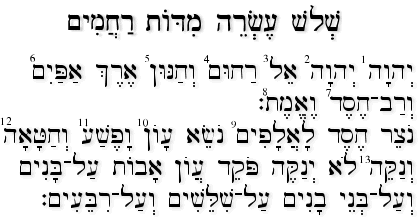
According to traditional interpretations, the thirteen attributes are articulated as follows:
- The LORD (YHVH) - I, the LORD, am the merciful Source of life
- The LORD - The repetition of God's name indicates that God is merciful to a person after he sins if he shows true teshuvah (repentance)
- El - God the Mighty: God is the rightful Judge (el)
- Rachum: God the compassionate, merciful to the poor and downtrodden
- Vechanun: God is gracious and generous even to the undeserving
- Erech Apayim: God is slow to anger and patient in waiting for our repentance;
- Verav Chesed: God is abundant in kindness to both the righteous and the wicked;
- Ve'emet: God is truthful and faithful in carrying out promises;
- Notzer Chesed La'alafim: God extends kindness for a thousand generations, taking into account the merit of our worthy ancestors (Zechut Avot);
- Nosei Avon: God forgives iniquity, defined in the tradition as wrongful deeds committed with premeditation;
- Vafesha: God forgives transgression, defined as wrongful deeds committed in a rebellious spirit;
- Vechata'ah: God forgives sin, those wrongful deeds that were inadvertent;
- Venakeh: God will cancel all punishment for those who are truly repentant.
The Shelosh Esrei Middot formula is recited on Yom Kippur, and also during the Torah service on the High Holy Days, Pesach, Shavuot, and Sukkot.
Shalosh Regalim

(shah-lohsh re-ga-LEEM) n. Shalosh Regalim (also transliterated as Shelosh Regalim). n. Three annual pilgrimage festivals: Pesach, Shavu'ot, and Sukkot (Ex. 23:14). Three required celebrations in Jerusalem according to the instructions of the Torah. "Three times every year shall your menfolk appear before the Lord your God in the place that He will choose, in the feast of Pesach, in the feast of Shavuot, and in the Feast of Sukkot." (Deuteronomy 16:16)
Shalosh Seudot

(shah-lohsh se-oo-DOHT) n. The three traditional meals of the Sabbath (on Friday evening, on Saturday morning (kiddush) and the Saturday afternoon meal). Note that this term is often used to refer to the last meal of the Sabbath day (i.e., the afternoon meal (after mincha prayers), though technically this third meal is called seudah shlishit.
Shalvah

(shal-VAH) n. Serenity; peace; tranquility.
Shamash

(SHAM-mahsh) n. 1) Synagogue caretaker or custodian; deacon; 2) Servant candle for Chanukkah menorah.
Shamayim

(shah-MAI-yeem) n. Heaven; sky; Malkhut Shamayim is the Kingdom of Heaven.
Shame

(boo-shah). n. Shame, embarrassment (often the result of lashon hara).
Shanah

(shah-NAH) n. Year. Rosh HaShanah is the Jewish New Year.
Shanah Meuberet

(shah-NAH me-oo-BEH-ret) n. Jewish Leap Year; A "pregnant" year. A year with with an additional month (called Adar I) added to the usual 12 (developed to synchronize the solar seasons with lunar months). Adar I is inserted before the month of Adar (which is then renamed Adar II for the leap year). Adar II is the "real" Adar in leap years, so Purim, for example, is celebrated in Adar II on leap years. The inserted month occurs in the 3rd, 6th, 8th, 11th, 14th, 17th and 19th years of a 19 year cycle.
With the extra month of Adar I, a Jewish leap year contains 54 weeks, but non leap years have only 50 weeks. On the week of Passover and the week of Sukkot, different Torah portions are read, so that leaves 52 weeks for the 54 readings (2 weeks have double portions), and on non leap years only 48 weeks for the 54 (6 weeks have double portions). Confused? Check a good Jewish calendar to make sure you're on the right date!
Shanah Tovah

(shah-nah toh-VAH) phr. Lit. "Good Year," "Happy New Year!" Usually said during Rosh HaShanah. L'Shanah Tovah Tikatevu is a phrase customarily said on the Jewish New Year and means "May you be inscribed (in the Book of Life) for a good year!"
Sharon

(shah-rohn) n. Sharon. A geographical region of Israel.
Shas

(shahsh) n. Talmud. Abbreviation for Shisha Sidarim, the six orders of the Mishnah that form the basis of the Talmud. Shas and Chumash with Rashi is considered a good Jewish religious education.
Shatnez
(SHA'AT-nayz) n. Any fabric made of wool mixed with linen. Two verses in the Torah prohibit a Jew from wearing fabric containing a combination of wool and linen. The first is in Leviticus 19:19, "A shatnez garment should not cover you," and the second is in Deuteronomy 22:11, "Do not wear shatnez, wool and linen together" (the word sha'atnez is considered an acronym for the Hebrew words "shua" = combined "tavei" = spun, "nuz" = woven). Shatnez is sometimes considered to be a metaphor against mingling the holy and the profane. Wool blankets, sweaters, pants, women's apparel, linen suits, blouses, etc., may be composed of shatnez.
Sha'ul

(sha-'OOL) n. Saul. "also known as Paul" (Acts 13:9). Messiah's emissary to the gentile world. Rabbi Shau'l is widely known for being the emissary to the gentiles.
Shavua

(shah-VOO-ah) n. Week. See the Jewish Calendar.
Shavua Tov

(shah-VOO-ah TOHV) phr. "Good week!"
Shavu'ot

(shah-voo-OHT) n. Shavuot; Pentecost; Feast of Weeks; Weeks. The Festival commemorating giving of the Torah at Har Sinai to Israel. Observed on the fiftieth day after the first day of Pesach. Shavu'ot is the concluding festival of the Spring season, a festival of the offering of the first fruits, and a picture of the resurrection of Yeshua the Messiah as the Firstfruits (1 Cor. 15:20).
She'arit Yisrael
(she-ay-REET yees-rah-AYL) n. Remnant of Israel; descendants of Israel; from the Hebrew ver sha'ar, meaning to remain, survive, to leave behind. The Remnant of Israel is a sovereignly chosen subset of ethnic Israel that has been faithfully preserved by the LORD over the centuries. The Scriptures make a distinction between being an ethnic Jew (i.e., one born Jewish) and one who is considered to be a member of she'arit Yisrael, the faithful remnant of Israel. This can be seen in the following:
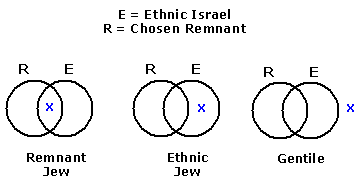
In the New Testament, the metaphor of the Olive Tree (Romans 11) indicates clearly that the Church is incorporated into the remnant of Israel. The Gentile Church must repent regarding its arrogant attitude toward the Jewish people and express profound gratitude to God for their miraculous preservation over the centuries. Moreover, the Gentile Church should stand with ethnic Israel by considering them as "eschatological brethren," that is, future followers and partakers of the LORD Jesus Christ. For "the gifts and calling of God are irrevocable" (Rom. 11:29), and "if their rejection means the reconciliation of the world, what will their acceptance mean but life from the dead? (Rom. 11:15).
The overarching plan of God is to redeem both Jews and Gentiles by means of the unconditional covenants and promises given to the faithful patriarchs of Israel. The Gentile Church does not exist instead of Israel (replacement theology); nor does it exist outside of Israel (separation theology); but rather it is incorporated within the faithful remnant of Israel.
Shechitah

(she-chee-TAH) n. The ritual slaughtering of animals and birds according to Jewish dietary laws. Before slaughtering the animal must be healthy, uninjured and viable. Slaughtering is meant to be humane and to be as painless as possible to the animal. It is performed by a trained shochet (butcher) who quickly severs the carotid arteries and jugular veins using an sharp blade so that the blood will quickly drain out. The lungs are examined for scabbing or lesions, and if detected, the animal is declared unkosher. "Glatt" means "smooth" and refers to the lack of blemish in the internal organs of the animal. If the hindquarters of the animal are to be eaten, they must be stripped of veins, fat, suet, and sinews to qualify the meat as kosher. The blood must also be drained from the meat in compliance with the Torah's prohibition against the eating of blood. Purging the blood from the meat is generally done by letting the meat soak for around 30 minutes, covering it with salt and then allowing it to drain (this process is called kashering).
Shed / Shedim

(shed / she-deem) n. Demons.
She'elah / She'elot

(she-ay-LAH / she-ay-LOHT) n. Question(s); Questions given to a rabbinical authority regarding Jewish observance or halakhah.
Shehecheyanu

(she-he-khe-YAH-noo) n. The Shehecheyanu blessing. Customary blessing said upon any special occasion.
Shekel

(SHE-kel) n. Money; Kesef; silver; mammon.
Shekhinah

(she-khee-NAH) n. Also spelled shechinah; Divine Presence; Inspiration. Sometimes used to refer to the Presence of God and specifically when it dwelt (rested) between the Keruvim (Cherubim) over the Seat of Atonement of the Ark of Testimony in the Kodesh Hakodeshim (Holy of Holies); at other time the Shekhinah represents the pillar of cloud and fire that accompanied the Presence of the LORD in the wilderness or that manifested itself in the Mishkan and Temple.
The word shekhinah (שְׁכִינָה) comes from the root shakhan (שָׁכַן), "to dwell," as does the Hebrew word mishkan (מִשְׁכָּן), i.e., "tabernacle," the sacred place where the manifest Presence of God revealed at Sinai would "dwell" among the Jewish people. "And let them make me a sanctuary (מִקְדָּשׁ) that I may dwell (וְשָׁכַנְתִּי) in their midst (Exod. 25:8). "I will dwell among the people of Israel (וְשָׁכַנְתִּי בְּתוֹךְ בְּנֵי יִשְׂרָאֵל) and will be their God" (Exod. 29:45). Since the mishkan (tabernacle) represented God's dwelling place, it became associated with the Presence of God Himself, usually associated with clouds of glory or holy fire. This is particularly the case regarding the Ark of the Covenant (אָרוֹן הָבְרִית) and its sacred cover called the kapporet (כַּפּרֶת) located within the Holy of Holies (קדֶשׁ הַקֳּדָשִׁים).
The very first instance of the Hebrew verb shakhan occurs in Gen. 3:24, in reference to the cherubim that would dwell (וַיַּשְׁכֵּן) east of the garden of Eden to guard access to the Tree of Life (עֵץ הַחַיִּים). There is a connection between the Shekhinah Presence and abiding in God's Presence: For example, Psalm 37:27 says: "Turn away from evil and do good; so shall you dwell forever (וּשְׁכן לְעוֹלָם). Regarding God's manifest Presence the verb is used to state that God "inhabits eternity" (שׁכֵן עַד) and dwells (אֶשְׁכּוֹן) in a high and holy place with those of a broken spirit (Isa. 57:15). Concerning the future state (i.e., Millennial Kingdom), God's Presence will be manifest in Zion: "Thus says the LORD, 'I will return to Zion and will dwell in the midst of Jerusalem (וְשָׁכַנְתִּי בְּתוֹךְ יְרוּשָׁלָםִ). Then Jerusalem will be called the City of Truth, and the mountain of the LORD of hosts will be called the Holy Mountain' (Zech 8:3).
Shelita

(she-lee-TAH) acr. Often transliterated as Sh'lita. Acronym for a Hebrew phrase "May he live a long and good life, Amen" [She'yikhye Lirot Yamim Tovim ve'arukim], said by ultraorthodox when mentioning the name of a revered rabbi. (Example: "Note that the Rebbe sh'lita has instructed and requested all of Bar Mitzvah age and older to regularly put on tefillin.") .
Shelom Bayit

(sh'loh BAY-eet) phr. Keeping peace in the home/family.
Shelomoh

(sh'loh-moh) n. Shlomo. Solomon. The son of King David by Bathsheba and 3rd king of Israel; author of Proverbs and Song of Songs and Ecclesiastes. Also transliterated as Shlomo, Shlomoh, Sh'lomoh, Shelomoh.
Shelosh Regalim

(she-lohsh re-ga-LEEM) n. Shelosh Regalim (also transliterated as Shalosh Regalim). n. Three annual pilgrimage festivals: Pesach, Shavu'ot, and Sukkot (Ex. 23:14). Three required celebrations in Jerusalem according to the instructions of the Torah. "Three times every year shall your menfolk appear before the Lord your God in the place that He will choose, in the feast of Pesach, in the feast of Shavuot, and in the Feast of Sukkot." (Deuteronomy 16:16)
Sheloshah Amudim
(shloh-shah a-moo-DEEM) n. A maxim (given in Pirkei Avot 1:2) that states that the spiritual life is composed of a three-part balance:
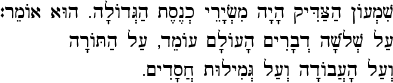
Shimon ha-Tzaddik hayah misyarei kheneset ha-gedolah. Hu omeir:
al sheloshah devarim ha'olam omed: al ha-Torah
v'al ha'avodah v'al gemilut chasadim.
Simon the Righteous was from the remnant of the Great Assembly. He used to say:
'On three things the world stands: On the Torah, on service to God (avodah), and on acts of loving kindness (gemilut chasadim).' Avot 1:2
Like a chair that requires at least three legs to function, so we must engage in the study of Scripture, serve the LORD with passion, and truly love another. Please note that each of these "pillars" is repeated in the teachings of the Brit Chadashah (study [Acts 17:11, 2 Tim 2:15], serve God [Matt. 4:10, Matt. 6:24, 1 Thess 1:9, 2 Tim 1:3], and love one another, even as Yeshua loved us [John 13:34-5, John 15:17, Rom. 12:10, Rom. 13:8, etc.).
Sheloshah Avot

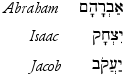
(shloh-shah ah-VOHT) n. The three fathers of the Jewish people: Abraham, Isaac, and Jacob.
Sheloshim

(she-loh-SHEEM) n. Thirty (שְׁלוֹשִׁים); The thirty days of mourning customarily observed as part of the Jewish grieving process.
Shelosh Esreh Middot (shel rachamim)
(she-lohsh es-ray meed-DOHT) n. Shelosh Esrei Middot (שְׁלשׁ עֶשְׂרֵה מִדּוֹת) Yod-Gimmel Middot Shel Rachamin. After the Jews had committed the grievous sin with the golden calf, Moses despaired of the Jews ever being able to find favor in God's eyes again. God, however (as explained in the Talmud (Tractate Rosh Hashanah 17b)) donned a tallit, and, in the role of a chazzan, showed Moses the order of the thirteen attributes of rachamim (mercy). God proclaims thirty-two words (Exod. 34:6-7) that have become known in Jewish tradition as the Shelosh Esrei Middot, the Thirteen Attributes of God's Mercy:
"And the LORD passed by before him, and proclaimed, The LORD, The LORD God, merciful and gracious, longsuffering, and abundant in goodness and truth, keeping mercy for thousands, forgiving iniquity and transgression and sin, and that will by no means clear the guilty; visiting the iniquity of the fathers upon the children, and upon the children's children, unto the third and to the fourth generation." (KJV)
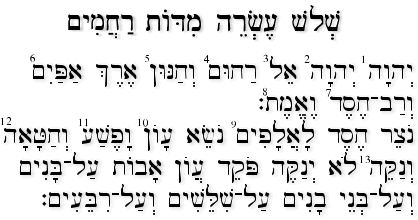
According to various traditional interpretations, these thirteen attributes of God's Name may be understood as follows:
- Adonai (יהוה) - I, the LORD, am the Compassionate Source of all of life and Ground of all being; I am the breath of life for all of creation. I am the God of all possible worlds and Master of the universe. Everything that exists is an expression of my loving will and kindness: עוֹלָם חֶסֶד יִבָּנֶה / olam chesed yibaneh: "The world is built with chesed" (Psalm 89:3[h]). Since the relative difference between existence and non-existence is infinite, God's creation represents infinite kindness, and since you exist, you likewise are expression of God's kindness and love. You do not exist because God needs you but soley because your life is willed by God as an expression of His love.
- Adonai (יהוה) - Though the LORD created the universe "very good" (טוֹב מְאד), He remained the Compassionate Source of life even after mankind sinned, and therefore the Name is repeated to refer to His loving relationship with alienated, fallen creation. I, the LORD, am also compassionate to one who has sinned and repented (i.e., the Creator gives us free will and the good gift of teshuvah). God created mankind for the sake of teshuvah - that is, our return to Him. God desires atonement with mankind even after sin and therefore continues to give existence to the world. "He makes his sun rise on the evil and on the good, and sends rain on the just and on the unjust" (Matt. 5:45). Moreover, as the Savior and Redeemer of the world through Yeshua, the LORD reveals kindness even to the evil, and even partakes of its presence by means of His sacrificial love on the cross. Since teshuvah can only exist after the advent of sin, Yeshua is called the Lamb slain from the foundation of the world (Rev. 13:8; Eph. 1:4; 1 Pet. 1:20).
In this connection, it should be noted that while God "wills" evil (in the sense of allowing the actions of the wicked to occur), he does not desire it. The sages note that while the Creator supports the existence of both the wicked and the righteous, he loves the righteous, and only their actions are desired by Him (Psalm 1:6). God wills the brokenness of the sinner so that the soul can return to Him by experiencing His salvation, love, and blessing.
- El (אֵל) - I, the LORD, am God the Almighty and Omnipotent;
- Rachum (רַחוּם) - I, the LORD, am merciful (rachamim (רַחֲמִים) means "mercy" and rechem (רֶחֶם) means "womb");
- Chanun (חַנּוּן) - I, the LORD, am gracious; I pour out my favor freely to all of creation. (Chen (חֵן) is the word for "grace");
- Erekh Apayim (אֶרֶךְ אַפַּיִם) - I, the LORD, am slow to anger and patient (the word erekh means "long" and af (אַף) means "nose." The idiom erekh apayim means "long suffering, patient");
- Rav Chesed (רַב־חֶסֶד) - I, the LORD, am abundant in love (חֶסֶד) to both the righteous and the wicked;
- Rav Emet (רַב־אֱמֶת) - I, the LORD, am truthful and faithful in carrying out promises;
- Notzer Chesed La'alafim (נצֵר חֶסֶד לָאֲלָפִים) - I, the LORD, retain chesed (love) for thousands of generations, taking into account the merit of our worthy ancestors (called zechut avot);
- Nosei Avon (נשֵׂא עָוֹן) - I, the LORD, forgive iniquity (avon), defined in the tradition as wrongful deeds committed with perverse premeditation; I "carry iniquity away" (nasa) for the penitent;
- Nosei Pesha (נשֵׂא פֶשַׁע) - I, the LORD, forgive transgression (pesha), defined as wrongful deeds committed in a rebellious spirit;
- Nosei Chata'ah (נשֵׂא חַטָּאָה) - I, the LORD, forgive sin (chet), defined as those wrongful deeds that were inadvertently committed;
- Nakkeh (נַקֶּה) - I, the LORD, will not cancel punishment, but I will clear the guilt for those who genuinely return to Me in teshuvah.
The Shelosh Esrei Middot formula is recited on Yom Kippur, and also during the Torah service on the High Holy Days, Pesach, Shavuot, and Sukkot.
Sheloshet Yemei Hagbalah

(she-LOH-shet ye-MAY hag-bah-LAH) n. On the third day of month (of Sivan) the LORD instructed Moses to "set a boundary" (hagbalah) for the people around the mountain in preparation for the coming revelation to be given three days later (Exod. 19:9-15). These three days are called the "Three Days of Separation" (i.e., Shloshet Yemei Hagbalah: שְׁלשֶׁת יְמֵי הַגְּבָּלָה) during which the people prepared for the revelation to come on Sivan 6th (i.e., Shavuot): "Make yourselves ready by the third day" (Exod. 19:11,15).
Shem Hameforash

(shem ham-me-foh-RAHSH) n. Sacred Name of God; YHVH; Spoken only 10 times once per year, at Yom Kippur by the Kohen Gadol (Yoma 39b), and in an undertone to conceal it from the rest of the people who might overhear it.
Shema

(she-MA') n. Shema. "Hear!" The first word in the Jewish confession of faith proclaiming that God is one. (see Deut. 6:4). The Shema is the central prayer in the Jewish prayerbook (Siddur) and is often the first verse of Scripture that a Jewish child learns. During its recitation in the synagogue, Orthodox Jews pronounce each word very carefully and cover their eyes with their right hand. Many Jews recite the Shema at least twice daily: once in the morning and once in the evening; it is also sometimes said as a bedtime prayer ("the bedtime Shema"). The complete Shema is composed of three parts.
Shemei Hashamayim

(she-may ha-shah-MA-yeem) n. Highest Heaven. The third heaven.
Shemini Atzeret

(she-mee-nee a-TSE-ret) n. Shmini Atzeret. The seven days of Sukkot that end with Hoshana Rabba are immediately followed by another holiday called Shemini Atzeret, referred to in the Torah (Numbers 29:35) simply as "the eighth day of assembly." In Israel, Shemini Atzeret and Simchat Torah are both celebrated on Tishri 22, but in the Diaspora, Shemini Atzeret is observed on Tishri 22 and Simchat Torah on Tishri 23.
Shemirat HaGuf

(she-mee-raht ha-GOOF) n. The mitzvah regarding taking care of (watching) one's body (health). This involves a number of different principles, including dietary law, personal hygeine, abstaining from drunkenness and fornication, and so on.
Shemirat HaLashon
(she-mee-raht hal-lah-SHON) n. Watching your words; guarding your tongue; watching what you say. The Chofetz Chaim wrote an extensive book concerning the laws of righteous speech. Shemirat Ha-Lashon concerns Lashon Hara ('evil speech') and Rechilut ('gossip').
Shemirat HaTeva

(she-mee-raht hat-TE-vah) n. (שְׁמִירַת הַטֶּבַע) Guarding nature, in terms of ecological concern, based on the original mandate given to Adam and Eve in the orchard: וַיִּקַּח יְהוָה אֱלהִים אֶת־הָאָדָם וַיַּנִּחֵהוּ בְגַן־עֵדֶן לְעָבְדָהּ וּלְשָׁמְרָהּ, "The LORD God took the man and put him in the garden of Eden to work it and keep it" (Gen. 2:15).
Shemitah

(she-meet-TAH) n. Also spelled Shemittah. The "Sabbatical Year"; the 7th year in the cycle to leave land fallow. The laws of shemitah apply to the land of Israel -- and to farmers. It falls every 7th year in a 49-year cycle that operated during biblical times. On this cycle, the 7th, 14th, 21st, 28th, 35th, 42nd, and 49th years were shemitah. The Jubilee year ("Yovel") then follows the completion of the 49-year cycle. There are three main places in the Torah where shemitah is mentioned:
1) Parashat Mishpatim: "Do not oppress the stranger, for you know the soul of the stranger, for you were strangers in the land of Egypt. Six years shall you sow your land and gather in its produce. And in the seventh year release it and leave it alone, so that the poor of your people may eat; and what is left shall be left to the beast of the field. So shall you do to your vineyard and your olive trees." (Ex. 23:9-11.)
2) Parashat Behar: "Speak to the children of Israel, saying: When you come in to the land which I gave to you, the land shall rest a Sabbath to HaShem. Six years shall you sow your field, and six years shall you prune your vineyard, and gather its produce. And in the seventh year the land shall have a Sabbatical, a Sabbath to HaShem; you shall not sow your field nor prune your vineyard. You shall not reap the growth of your harvest nor gather in the grapes of yield; the earth shall have a Sabbatical." (Lev. 25:2-5.)
"...And should you say, 'What will we eat in the seventh year? We will not be planting nor gather our produce!' I will command My blessing in the sixth year, and it will make produce for the three years. . . And the land will not be sold in permanence, for Mine is the land, and your are sojourners and residents with Me." (Lev. 25:20-21, 23.)
3) Parashat Re'eh: "At the end of every seven years you shall grant a release. And this is the manner of the release: every creditor shall release what he has lent to his neighbor. He shall not exact it of his neighbor, his brother, because the LORD'S release has been proclaimed. Of a foreigner you may exact it, but whatever of yours is with your brother your hand shall release. But there will be no poor among you; for the LORD will bless you in the land that the LORD your God is giving you for an inheritance to possess. (Deut 15:1-4)."
"For the poor shall never cease from the land, therefore I command you saying, open your hand wide to your poor brother" (Deut 15:11).
Determing the Shemitah
To determine the shemitah year, take the current Jewish year and divide by seven; if there is no remainder, it is a shemitah year; otherwise it is not. For example, if the Jewish year is 5768, you divide by 7 to get 824 with no remainder, so it's a Sabbatical year. The next year (that begins with Rosh Hashanah) is 5769. Divide that by 7 gives 824 with a remainder of 1, indicating one year past the last Shemitah. Since the Jewish year begins at Rosh Hashanah, each Shemitah begins on Rosh Hashanah and ends just before the next Rosh Hashanah begins.
Shemoneh Esreh

(she-moh-neh es'reh) n. Shemoneh Esreh; Central prayer of the synagogue service. Also called the Amidah (standing). Originally, the Shemoneh Esreh consisted of eighteen benedictions; in its present form, however, there are nineteen. The addition of the paragraph concerning the slanderers and enemies of the people (birkat haminim) was made toward the end of the 1st century at the direction of Rabban Gamaliel II, the head of the Sanhedrin at Yavneh, and was directed against the Notsrim (messianic believers), as well as others.
Shemot

(she-MOHT) n. pl. Names; 1) Exodus. The story of the liberation of the Jewish people from their bondage in Egypt and the giving of the Mosaic covenant to Israel.
Shemot HaElohim
(she-MOHT ha-e-loh-HEEM) n. pl. The names and Titles of God.
Shemuel

(she-moo-EL) n. Shmuel. Samuel. 1) The book of Samuel, part of the Nevi'im in the Tanakh; 2) Samuel, the great prophet, priest, and judge of Israel. Also transliterated as Sh'muel.
Sheol

(she-'OHL) n. Sheol. Hell; Grave; depth. The Hebrew word "Sheol" (שְׁאוֹל) technically refers to a landfill (i.e., grave), and by extension, to the underworld (Hades) or the abode of the dead. Both the good and the evil go to Sheol before being appointed to another destination (Gen. 37:25; Num. 16:30).
Note: the word Gehenna (Jer. 32:35) refers to a vision of Hell. The valley of Hinnom in Jerusalem was a location southwest of Jerusalem where children were burned as sacrifices to the "god" Molech. It later became a garbage dump with a continuous burning of trash. Therefore, it was used biblically to illustrate the abode of the damned in Christian and Jewish theology. Gehenna is mentioned in Mark 9:43ff and Matt. 10:28 as the place of punishment of unquenchable fire where both the body and soul of the wicked go after death. It is the future abode of Satan and his angels (Matt. 25:41). In rabbinic literature, Gehenna is a place of restorative suffering, similar to the Catholic idea of purgatory. The preponderance of rabbinic thought seems to suggest that people are not tortured in hell forever; the longest that one can be there is said to be 12 months. Some Kabbalists consider Gehenna to be a "spiritual forge" where the soul is purified for its eventual re-ascent to Gan Eden [paradise], where all imperfections are purged.
Shepherd

(ro-EH) n. Shepherd; leader (Psalm 23).
Shephatim

(she-fah-TEEM) n. Judgment; punishment.
Sheva

(she-VA') n. Sheva (vowel mark). The sheva can be vocal or "moving" (sheva na) or silent or "resting" (sheva nach).
 |
Sheva Mitzvot B'nei Noach

(SHE-va meetz-VOTE be-nay NO-akh) n. Sheva mitzvot b'nei Noach. Seven Laws given to the children of Noah considered binding on all people, at all times, as universal obligations. The Children of Noah are the Gentiles, comprising the seventy nations of the world. They are commanded concerning the Seven Universal Laws, also known as the Seven Noahide Laws. These include:
- Avodah Zarah: Prohibition on idolatry.
- Birchat HaShem: Prohibition on blasphemy and cursing the Name of G-d.
- Shefichat Damim: Prohibition on murder.
- Gezel: Prohibition on robbery and theft.
- Gilui Arayot: Prohibition on immorality and forbidden sexual relations.
- Ever Min HaChay: Prohibition on removing and eating a limb from a live animal.
- Dinim: Requirement to establish a justice system and courts of law to enforce the other 6 laws.
When a Gentile resolves to fulfill the Seven Universal Laws, his or her soul is elevated. This person becomes one of the "Chasidei Umot Haolam" (Pious Ones of the Nations) and receives a share of the World to Come.
Note that this entire idea is a patently false teaching, since NO ONE can come to the Father without the Son of God, Yeshua, as his or her Advocate and Savior, and whoever does not honor the Son does not honor the Father, YHVH [John 5:23; John 14:6, etc.]).
Sheva na

(she-va NA') Vocal or moving sheva.
Sheva nach

(she-va NAKH) Silent or quiescent sheva.
Sheva Brachot

(she-va' be-rah-KHOT) n. Seven blessings; Blessings recited over wine during a wedding ceremony. Also a party for the newlyweds during the first week of marriage.
Shevach La'el

(she-vakh lah-el) phr. Thank God.
Shevarim

(she-va-REEM) n. Shevarim. Along with Tekiah and Teru'ah, a sequence of shofar blasts. Shevarim "fragments" are three broken blasts of the shofar.
Shevat

(she-VAHT) n. Shevat. 5th month; see the Jewish Calendar.
Shevet

(SHE-vet) n. Rod; Staff; Tribe (of Israel); scepter (a ceremonial or emblematic staff held by a royal representative that represents divine power). עד כּי־יבא שׁילה...לא־יסוּר שׁבט מיהוּדה -- lo-yasur shevet mi-Yehudah...ad ki yavo shiloh -- "The scepter (shevet) will not depart from Judah... until Shiloh comes" (49:10). The term "Shiloh" was understood by the early rabbis and Talmudic authorities as referring to the Messiah (Targum Onkelos, Targum Pseudo-Jonathan, and Targum Yerusahlmi), and this was interpreted to mean that the kingship would remain until the coming of the Mashiach. Historically speaking, the scepter (shevet) departed from Judah in AD 6-7 after the Romans installed a procurator as the authority in Judea (replacing the Sanhedrin), but indeed the Mashiach had come and was in their midst as Yeshua mi-netzeret (Jesus of Nazareth).
Shidduch

(shee-DOOKH) n. Shidukh; A match or arranged marriage (arranged by the Shadkhan or matchmaker).
Shiloh

(SHEE-loh) n. The first capital of Israel (Josh 18:1, 1 Sam 1:3, Psalm 78:60; Jer. 7:12. etc.). In traditional Jewish thinking, Shiloh also refers to the Messiah who is a descendant of Judah and who is a king of the Jews. This is based on Gen. 49:10 that refers to the "rod" (shevet) of kingship that belongs to Judah until Messiah appears.
The word shiloh has been disputed among scholars. Some have said that the word may be a variant of the word she-lo which means "that is his," so the meaning of the verse may be "until he comes to whom the rod of kingship belongs," i.e., authority belongs to Judah until the Messiah appears. Others have said that since shiloh has the final Hey with a mappiq as a prepositional function of "to" or "towards," it actually means toward Shiloh, the very first capital of Israel in the Promised Land. In either case, however, the idea has to do with the authority invested in Judah as divine regent until the Messiah appears.
Historically speaking, if we understand the regency of Judah to be invested in the Great Sanhedrin (after the last independent King of Judah Zedekiah was deposed), the scepter (shevet) would have departed from Judah in AD 6-7 after the Romans installed a procurator as the authority in Judea (thus replacing the Sanhedrin). However, the prophecy of Jacob did not fail, since the Mashiach had indeed come and was in their midst as Yeshua mi-netzeret (Jesus of Nazareth) at that time. In other words -- Yeshua is indeed the King of the Jews, though at present He is not physically reigning on David's throne (this will occur at His Second Coming when he returns to Jerusalem at the end of olam ha-zeh (this present age) to establish the Kingdom of God upon the earth).
Shimon

(sheem-'ohn) n. Simeon. "Heard." The 2nd son of Jacob by his wife Leah and progenitor of the tribe of Simeon. Also the name for Peter in the Brit Chadashah (Matt 4:18).
Shimshon

(sheem-SHOHN) n. Samson. Judge of Israel (Judges 13-16).
Shin

(sheen / seen) n. Shin / Sin; 21st letter of Hebrew alphabet having the sound of "sh" as in shy (or "s" as in sun). Originally a pictograph representing a mouth. Gematria = 300.
Shir HaShirim

(sheer hash-shee-REEM) n. Song of Songs, one of the five scrolls (part of the Ketuvim). Written by King Solomon and considered an allegory of the relations between Adonai and Israel (and Messiah's love for the Church). Read during Pesach (Passover). Shir Hashshirim means "Song of (all) songs."
Shir Shel Yom

(sheer shel YOHM) n. Psalm of the day.
Shirat Hayam

(shee-RAHT hai-YAHM) n. "The Song of the Sea" (שִׁירַת הַיָּם), referring to the great hymn of praise (recorded in Exodus 15:1-19) regarding the Exodus from Egypt (the song is also called Az Yashir Moshe). Note that in Christian tradition Shirat Hayam is sometimes called "The Song of Moses," though this is a misnomer since Moses' song is actually recorded in Parashat HaAzinu. The triumphant hymn begins: "The Lord is my strength and song, and he is become my salvation" / עָזִּי וְזִמְרָת יָהּ וַיְהִי־לִי לִישׁוּעָה (Exod. 15:2). The Shabbat on which Beshalach is chanted is called Shabbat Shirah ("Sabbath of the Song"), though Orthodox Jews chant Shirat Hayam every day (i.e., during morning services) to fulfill the commandment to "remember the day of your departure from the land of Egypt all the days of your life" (Deut. 16:3). Note that Shirat Hayam is also sung on the 7th day of Passover, as a memorial of the deliverance by God through the waters of the Sea of Reeds (i.e., Yam Suf: יָם סּוּף).
Notice that the Hebrew text is stylized in different ways according to different soferut (scribal) traditions. The sages count 198 words in this song, which is the numerical value for the word tzchok (צחק), a word that means "laughter" and is the word used to describe Sarah's response when she finally gave birth to Isaac (Gen. 21:6). According to Rabbi Bahye, the laughter in Isaac's name comes from Abraham's joy (Gen. 17:17). The joy of Isaac's birth, then, is linked with the "birth" of the nation of Israel at the time of the Exodus.
Shirat Yisrael

(shee-RAHT yis-rah-AYL) n. Jewish Music; Songs of Israel.
Shiur

(shee-'OOR) n. [שִׁעוּר] Lesson. Torah study session, usually led by a rabbi. Also: a religious class, often informal. Shiurim (שִׂעוּרִים) is the plural.
Shivah

(SHEE-vah) n. Shivah (שִׁבְעָה). Seven-day mourning period. "Sitting Shivah" is a custom of sitting on a low stool during the grieving process. Shivah means "seven." Jewish mourning which is divided into five stages:
- Aninut. This is the period between death and burial.
- Lamentation. This period consists of the first three days following burial.
- Shivah. This stage covers the seven days following burial and includes the three-day period of lamentation.
- Sheloshim (שְׁלוֹשִׁים). Thirty days (counting the seven days of shivah) following burial.
- A year of mourning. The twelve-month period (counted from the day of burial) during which things return to normal.
Kaddish is recited at every prayer service, morning and evening, Shabbat and holiday, on days of fasting and rejoicing. Yizkor (יִזְכּר) is a ceremony recalling all the deceased during a communal synagogue service. Yahrzeit (יאָרציַיט) is a personal memorial anniversary; it may be observed for any relative or friend, but it is meant primarily for parents.
Shivah asar beTamuz

(sheev-'ah AH-sar be-ta-MOOZ) n. 17th of Tamuz. Fast day commemorating the breaking down of the wall of Jerusalem by Nebuchadnezzar and the cessation of Temple worship during the siege of Titus.
Shivat ha-minim
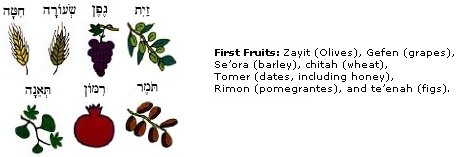
(shee-vat ham-mee-NEEM) n. שִׁבְעַת הַמִּינִים "The Seven Species." Seven types of fruits and grains enumerated in the Torah (Deut. 8:8) as being special products of the Land of Israel. Sometimes referred to as bikkurim, since the first fruits of these species were to be consecrated to the LORD as a token of appreciation for the care of the Promised Land. See the articles on Shavuot for additional information, as well as parashat Ki Tavo.
Shivim Panim laTorah

(sheev-'eem pah-neem la-TOH-rah) phr. "The Torah has 70 faces." A phrase used to indicate different levels of interpretation of the Torah. See Pardes.
|
Shlemut

(sh'lay-MUT) n. Wholeness; Completeness; Healing. Sometimes spelled shleimut, shleimus, etc.
Shnei Luchot Avanim
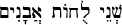
(she-NAY loo-KHOHT a-vah-NEEM) Phr. Shnei luchot avanim. The Two Tablets of Stone on which Adonai wrote Aseret Hadevarim (the Ten Words or Ten Commandments). These tablets were smashed by Moses after the Sin of the Golden Calf. However, Adonai mercifully let Moses inscribe a second set after a 40 day period of teshuvah.
The two tablets (shnei luchot avanim) are also refered to as the two tablets of testimony (shenei luchot ha'edut), or "tables of stone" (luchot even) written with the finger of God.
Shoah

(SHOH-ah) n. Shoah. From the Hebrew word meaning destruction. Usually used to refer to the systematic Nazi destruction of European Jewry which began in 1933 when Adolph Hitler was appointed Chancellor of Germany. This horrendous evil reduced the world's Jewish population by over one third. Also called haShoah.
Shofar

(sho-FAHR) n. Shofar; Ram's Horn; also trumpet. A hallowed out ram's horn, reminding us of the ram offered by Avraham instead of his son (Gen. 22:13); historically used to herald freedom and assemble the community, it is now used for the month preceding Rosh Hashanah as well as during the Yamim Noraim (High Holy Days, or Days of Awe) to call us to repentance. It is a symbol of revelation and redemption, as sounded at Sinai (Ex. 19:16, 19). Interestingly, the word shofar (שׁוֹפָר) comes from a root (שָׁפַר) that means to "beautify," alluding to the beautification of our ways as we turn to God in teshuvah. "In this month (i.e., the seventh month of Tishrei) you shall amend (shapperu) your deeds. The Holy One, blessed be He, said to Israel: 'If you will amend (shippartem) your deeds I shall become unto you like a horn (shofar). As the horn takes in the breath at one end and sends out at the other, so will I rise from the Throne of Judgment and sit upon the Throne of Mercy and will impart for you the Attribute of Justice (Elohim) into the Attribute of Mercy (YHVH).' (Vayikra Rabbah: 29:6)
Shofet

(SHOH-fet) n. A judge; from shafat, meaning to judge or govern.

Elohim shofet tzaddik - God is a righteous Judge (Psalm 7:11).
Shofetim

(shoh-fe-TEEM) n. Judges: Book of the Nevi'im in the Tanakh. The story of how Adonai raised up twelve remarkable individuals (called judges or shofetim) to deliver Israel from her enemies. Shoftim also refer to the judges of Israel (see parashat Shoftim for more information).
Shomer Negiah

(shoh-mer ne-gee-AH) n. Shomer Negiah is a concept in Jewish law (halakhah) that prohibits any degree of physical contact with, or touching of, a member of the opposite sex, except for one's spouse and immediate family. Shomer means "guards"and negiah means "touch," so shomer negiah is a term used to describe one who "guards the touch" or simply "adheres to restrictions of touch." It is a concept related to tzeniut (modesty). An Orthodox Jew, for example, will not even shake hands with a man/woman other than his/her spouse, since this would violate the principle.
Shomer Shabbat

(shoh-mer shab-BAT) n. Sabbath observer; someone who keeps Shabbat laws in a traditional way.
Shomron

(shohm-ROHN) n. Samaria. Capital of the Northern Kingdom of ancient Israel. The later Samaritans were a mixed ethnic group descended from Jews deported by the Assyrians in the 8th century B.C. and other peoples ruled by the Assyrians, followed a religion combining pagan and Jewish elements. By the first century most Jews regarded them as pariahs. Eg., Matt. 10:5.
Shoresh

(SHO-resh) n. Shoresh; Root; origin; radical of a verb or word.
Shoteir

(shoh-TAYR) n. Official officer. A general term, widely used for an official in many areas of government and society, but particularly as police or enforcers of the laws and decrees of the shoftim (judges). Plural is shoterim.
Showbread, Table of

(shool-khan hap-pah-NEEM) Table of showbread; also shulchan lechem panim
(Exodus 25:30).
Shtei Ha-Lechem

(shtay hal-LE-kehm) n. "The two breads." A special Korban (offering) to mark the 50th day (Jubilee) of the growing season celebrated by the fesitival of Shavuot. The waving of the two loaves (i.e., shtei ha-lechem, שְׁתֵּי הַלֶּחֶם) was the only time leavened bread was used by the priests for the avodah.
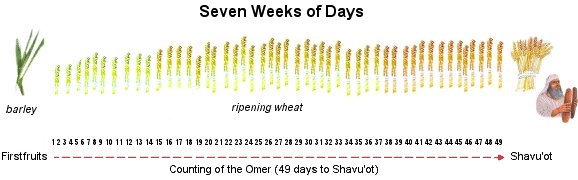
See Sefirat Ha-Omer
Though the Jewish sages did not fathom the use of the otherwise forbidden leaven in the offering (Lev. 2:11), prophetically shtei ha-lechem represents the "one new man" (composed of both Jew and Gentile) offered before the altar of the LORD (Eph. 2:14). The countdown to Shavuot therefore goes beyond the revelation of Torah given at Sinai and points to the greater revelation of Zion. Yeshua removes our tumah and makes us tahor by His sacrifice as the true Passover Lamb upon the Cross; Shavuot is the fulfillment of the promise of the Holy Spirit's advent to those who trust in Him. "Counting the Omer" is about being clothed with the Ruach HaKodesh (Holy Spirit) to encounter the resurrected LORD of Glory.
Shulamite Woman

(shoo-lam-MEET) n. The heroine of Shir HaShirim, the Song of Songs. We do not know her name, though she doubtless represents either the Bride of Mashiach or Israel.
Shulchan Aruch

(shool-khan 'a-ROOKH) n. Shulchan Aruch. "Prepared Table" by Rabbi Joseph Karo (1488-1575). A practical guide to traditional Jewish observance. A compendium of areas of the halachah.
Shum davar

(shoom dah-vahr) phr. "Nothing." (Mah osah hayom? ~ )
Shuruq

(shoo-ROOK) n. Shuruq; U-class vowel mark with an "oo"sound. Shuruq is a long vowel.
Shushan Purim

(shoo-shahn poo-REEM) n. Celebration of Purim as a second day after the regular Purim celebration (customary in Jerusalem).
|