|
S

Sabba

(SA-bah) n. Grandfather. (Savta is grandmother.)
Sabbatai Zevi

(sha-be-tie tse-VEE) n. שַׁבְּתַי צְבִי; Also spelled "Shabbetai Zevi," "Sabbatai Sevi," and so on. A late medieval Kabbalist (1626-1676) and false Messiah. Shabbetai was the founder of the Jewish "Sabbatean" movement, influenced by the esotericism of Rabbi Isaac Luria. At the age of forty, he was forced by the Ottoman Sultan Mehmed IV to convert to Islam, and many of his followers converted with him, thereby defaming the Name of God. (Indeed, one of the things Sabbatai did to "convince" the Jews that he was the Messiah was to pronounce the Sacred Name of God, something forbidden to do except by the High Priest). He was later excommunicated from the Jewish community because of his eccentric views.
Sabbath

(shab-BAHT) n. Shabbat; Sabbath; Day of rest. (Ex. 20:8). Observed from sunset Friday evening to sundown Saturday evening, marked by rest, worship, and study. One who traditionally observes the legal requirements for Shabbat is called Shomer Shabbat. One of the aseret hadibrot, or Ten Commandments (Ex. 20:2-17; Deut. 5:6-21) requires the sanctification of this day.
Sabbath Boundary

(ay-ROOV) n. A Rabbinic religious legal fiction of drawing a symbolic line or "fence" around an area so that the area may be considered as one's "own yard," thus permitting the carrying of things within it without fear of desecrating the Sabbath.
Sabbath Delight

(OH-neg shab-BAHT) n. Shabbat party. The informal gathering for conversation and community after Sabbath services. Hebrew for "joy of the Sabbath."
Sabbath Meals

(shah-lohsh se-oo-DOHT) n. The three traditional meals of the Sabbath (on Friday evening, on Saturday morning (kiddush) and the Saturday afternoon meal). Note that this term is often used to refer to the last meal of the Sabbath day (i.e., the afternoon meal (after mincha prayers), though technically this third meal is called seudah shlishit.
Sabbath Soul

(ne-shah-MAH ye-tay-RAH) n. Sabbath soul. Extra blessing given during Sabbath observance.
Sabbatical Year

(she-NAHT she-meet-TAH) n. Shenat Shemittah (שְׁנַת הַשְּׁמִטָּה). Sabbatical Year; 7th year in the cycle to leave land fallow. The laws of shemittah apply to the land of Israel -- and to farmers. It falls every 7th year in a 49-year cycle that operated during biblical times. On this cycle, the 7th, 14th, 21st, 28th, 35th, 42nd, and 49th years were shemittah. The Jubilee year ("Yovel") then follows the completion of the 49-year cycle. There are three main places in the Torah where shemitta is mentioned:
1) Parashat Mishpatim: "Do not oppress the stranger, for you know the soul of the stranger, for you were strangers in the land of Egypt. Six years shall you sow your land and gather in its produce. And in the seventh year release it and leave it alone, so that the poor of your people may eat; and what is left shall be left to the beast of the field. So shall you do to your vineyard and your olive trees." (Ex. 23:9-11.)
2) Parashat Behar: "Speak to the children of Israel, saying: When you come in to the land which I gave to you, the land shall rest a Sabbath to HaShem. Six years shall you sow your field, and six years shall you prune your vineyard, and gather its produce. And in the seventh year the land shall have a Sabbatical, a Sabbath to HaShem; you shall not sow your field nor prune your vineyard. You shall not reap the growth of your harvest nor gather in the grapes of yield; the earth shall have a Sabbatical." (Lev. 25:2-5.)
"...And should you say, 'What will we eat in the seventh year? We will not be planting nor gather our produce!' I will command My blessing in the sixth year, and it will make produce for the three years. . . And the land will not be sold in permanence, for Mine is the land, and your are sojourners and residents with Me." (Lev. 25:20-21, 23.)
3) Parashat Re'eh: "At the end of every seven years you shall grant a release. And this is the manner of the release: every creditor shall release what he has lent to his neighbor. He shall not exact it of his neighbor, his brother, because the LORD'S release has been proclaimed. Of a foreigner you may exact it, but whatever of yours is with your brother your hand shall release. But there will be no poor among you; for the LORD will bless you in the land that the LORD your God is giving you for an inheritance to possess. (Deut 15:1-4)."
"For the poor shall never cease from the land, therefore I command you saying, open your hand wide to your poor brother" (Deut 15:11).
Determing the Shemittah
To determine the shemittah year, take the current Jewish year and divide by seven; if there is no remainder, it is a shemittah year; otherwise it is not. For example, if the Jewish year is 5768, you divide by 7 to get 824 with no remainder, so it's a Sabbatical year. The next year (that begins with Rosh Hashanah) is 5769. Divide that by 7 gives 824 with a remainder of 1, indicating one year past the last shemittah. Since the Jewish year begins at Rosh Hashanah, each shemittah begins on Rosh Hashanah and ends just before the next Rosh Hashanah begins.
Sabra

(tsah-BAHR) n. Sabra; Israeli-born person.
Sacrifice (korbanot)

(kohr-BAHN) n. Sacrifice; Offering; Gift. (Matt 5:23). The Hebrew word comes from the root korav meaning to "come close," specifically, to come close to God. The offering was meant to bring someone who was far near once again. Korbanot is the plural.
There are five types of korbanot discussed in the Torah. Here are additional details regarding each type of sacrifice:
- Olah ("ascending offering"): This was a nedavah (freewill) sacrifice that was consumed entirely by the fire on the altar. The sacrificial victim must be an animal or a bird that is without defect. As the animal is slaughtered, the kohen catches its blood in a pan and sprinkles it (zerikat hadam) on the altar. The animal is then cut up, salted, and entirely burned. Normally, semichah (leaning of the hands on the head of the animal) and viduy (confession of sin) accompanies this sacrifice (though in the case of a bird olah, semichah is not performed). This parashah adds that Olah sacrifices must only be offered during daylight hours and must burn through the night. The kohanim, therefore, needed to be present at the mishkan around the clock, tending to the sacrifices and ensuring that the fire for the mizbeach (altar) would never go out.
- Minchah ("meal offering"): This was a nedavah (freewill) offering of flour (prepared with fine flour, olive oil and frankincense), usually brought by a person of modest means. Part of the meal offering is burned on the altar, and the remaining part is eaten by the kohanim (the word "mincha" means gift). Note that any flour offering must be baked quickly to prevent the dough from rising (i.e., unleavened bread). Like the animal sacrifices, minchah offerings must also be salted.
The Kohen Gadol (High Priest) was required to offer minchah offerings. First, he was required to offer minchat chinuk, a special offering that was given in the morning and afternoon on the first day of his avodah (service) as High Priest. Second, he was required to offer daily minchah as long as he served as High Priest.
- Shelamim ("peace offering"): This was a nedavah (freewill) offering (eaten by the one bringing it) given as a way of expressing thanks to God on joyous occasions. Semichah is performed, though instead of viduy, praise to the LORD is offered. The offerer must "wave" the offering before the LORD (tenufah) and part of the meat given to the kohanim (priests).
Shalmei Todah ("thank offerings") were to be given whenever a Jew had reason to recite Birkat HaGomel for deliverance from some danger. This offering included no less than 40 loaves of bread (10 with chametz, 30 without) that had to be consumed within 24 hours. The requirement for so much food was so that family and friends would come together and celebrate the goodness of the LORD for His acts of mercy and deliverance.
- Chatat ("sin offering"): This was a chovah (required) offering to make atonement for certain sins committed unintentionally by an individual (by the High Priest, the entire community, the king, or the ordinary Jew). Note that there is no explicit sacrifice for deliberate, intentional, and willful sins against the LORD, but instead punishment by an early death. Note that the blood for the sin offering was used in the mishkan, though the flesh and hide were to be burned outside the camp.
- Asham ("guilt offering"): This was a chovah (required) offering as part of the penitence required for certain improper acts (e.g., retaining another's property by swearing falsely). (In each case, the wrongdoer was required to restore the property plus an additional 20% to its rightful owner before he could offer this sacrifice and receive forgiveness.) Note that the blood for the guilt offering was used in the mishkan, though the flesh and hide were to be burned outside the camp.
The Chatat and Asham offerings were to be made at the same place (i.e., the north side of the mizbeach) as the Olah offering, suggesting that this was to spare any embarrassment for the Jew who came to confess sin (viduy) and be reconciled to God. If someone saw his friend offering korban, he would then not know if it were for Olah or for Chatat or Asham.
Sacrifice (Zevach)

(ZAY-vakh) n. Zevach refers specifically to an animal offering (such as a lamb) that is slaughtered (as opposed to a Minchah [grain] or bird offering). Zevach is also used to signify a Korban Shelamim (fellowship or peace offering) that is eaten (Ex 18:12), called zivchei shelamim. Korban is more general term than Zevach. Zevach is offered upon the mizbe'ach (altar, from the same root (Zayin-Vav-Chet). Metaphorically, zevachim (pl.) can be righteous (zivchei tzedek) or not.
Sacrifices (laws of)

(ze-va-KHEEM) n. Animal sacrifices and the laws pertaining to animal sacrifices (Shechitat Kodashim). A tractate in Talmud.
Sacrifices of God

(zeev-khay e-loh-HEEM n. Sacrifices of God.

zivchei elohim ruach nishbarah
the sacrifices of God are a broken spirit (Psalm 51:19a)
Sacrifices of Praise

(zeev-khay toh-DAH) n. Sacrifices of praise. Sacrifices of thanksgiving. Psalm 107:22; Heb. 13:15.

zivchei todah leilohim tamid
the sacrifice of praise to God continually (Heb 13:15)
Sacrifices of Righteousness

(zeev-khay TZE-dek) n. Right sacrifices. Sacrifices of righteousness. "Just" sacrifices. Chesed.

zivchu zivchei-tzedek uvitchu el-Adonai
Offer sacrifices in righteousness and trust in the LORD (Psalm 4:5).
Sadducees

(tsad-doo-KEEM) n. pl. Sadducees, a sect within Judaism that flourished from the Second Century BC until the destruction of the Second Temple in AD 70. One of the two main groups in the religious establishment of Yeshua's time (the other being the Pharisees (Perushim)). The Tzaddukim tended to be more Hellenistic and more willing to cooperate with the Roman conquerors than the Perushim.
Sages (Early)

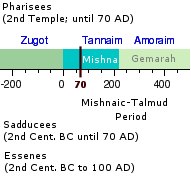
(cha-khah-MEEM) n. pl. The early Jewish sages draw their roots from the time before the return of the exiles from Babylon, after the destruction of the First Temple. Ezra the Scribe and the the Great Assembly (כְּנֶסֶת הַגְּדוֹלָה) were the precursors of the Pharisees (i.e., Perushim, from פרוש parush, meaning "separated," a school of thought that flourished during the Second Temple Era (536 BC–70 AD)). The Sadducees (Tzadukim) were a Hellenized sect within Judaism that flourished from the Second Century BC until the destruction of the Second Temple in AD 70. The sages of Jewish tradition also include the Zugot (142-40 BC), five "pairs" of leaders who established schools and were instrumental in the activities of the Sanhedrin. After the fall of the Temple the Tannaim (70-200 AD), and the Amoraim (200-500 AD) arose to fill the void in Temple-less Judaism.
Salt (Covenant of)

(be-REET mel-AKH) n. Covenant of Salt (Num. 18:19). Metaphor of the preservative power of salt, an everlasting covenant, reliable. Salt is a symbol of eternity because of its preservative properties, opposed to chametz (leavening). Salt does not ferment and preserves food against rot. Specifically, brit melach refers to the provision for the Kehuna (priesthood) of the Torah and their provision through ma'aser from the people.
Samaria

(shohm-ROHN) n. Samaria. Capital of the Northern Kingdom of ancient Israel. The later Samaritans were a mixed ethnic group descended from Jews deported by the Assyrians in the 8th century B.C. and other peoples ruled by the Assyrians, followed a religion combining pagan and Jewish elements. By the first century most Jews regarded them as pariahs. Eg., Matt. 10:5.
Samekh

(SAH-mekh) n. Samekh. Samech. 15th letter of the Hebrew alphabet having a sound of "s" as in son. Originally a pictograph representing a staff. Gematria = 60.
Samaritans

(ha-shom-roh-NEEM) n. The Samaritans; (adj. shomroni: שׁוֹמְרוֹנִי, from the Hebrew term שַמֶרִים, "Keepers of the Torah"). The Samaritans claimed they are direct descendants of Joseph, or rather, the tribes of Ephraim and Manasseh (the first tribes to be taken captive and put into exile). The Talmud refers to them as Kutim (כותים), an imported group brought in to become vassals by the hands of the Assyrians. The Samaritans developed their own version of Judaism that the returning exiles from Judah found abhorrent. It is likely that the Samaritans were the ones who opposed the rebuilding of the Temple during the time of Zerubbabel. Ezra the Scribe later adopted the "square script" of the Torah to distinguish it from the earlier script used by the Samaritans in their Torah.
According to Samaritan tradition, Mount Gerizim (גְּרִזִים) was the original holy place of the Jews from the time that Joshua conquered Canaan. Mount Gerizim was the called the "Mount of the Blessing," as opposed to Mount Ebal (עֵיבָל), the "Mount of the Curse" (Deut. 11:29; 27:12; Josh. 8:33). The Samaritans also claimed that Gerizim was the location of the Akedah of Isaac (as opposed to Moriah). Archaeological excavations at Mount Gerizim indicate that a Samaritan temple was built there in the first half of the 5th century BC.
Samson

(sheem-SHOHN) n. Samson. Judge of Israel (Judges 13-16).
Sanhedrin

(san-HED-reen) n. The word sanhedrin (סַנְהֶדְרִין) means "sitting together" and refers to any assembly of judges in court of law. Technically speaking, a "sanhedrin" can range from in size from a simple Bet Din - a religious court ("house of judgment") that consisted of three judges - to the Great Sanhedrin, or Supreme Court of Israel, that consisted of 71 judges. (See entries below)
Sanhedrin Gedolah
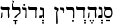
(san-HED-reen ge-doh-LAH) n. The "Great Sanhdrin" (סַנְהֶדְרִין גְדוֹלָה) was comprised of 71 judges (corresponding to the 70 elders who helped Moses judge the people) who convened at the Tabernacle (Temple) to decide the most important or difficult cases (Num. 11:16). This was the "Supreme Court" of Israel. The Sanhedrin sat in session only while the offerings and rituals of at the altar were being performed. The head of the Sanhedrin Gedolah was the Nasi, or "president," who served the role of Moses. Of the 70 judges, the most qualified was chosen to serve as the Nasi's assistant, called Av Bet Din ("father of the court"). The 69 other judges (three sets of 23) were seated in order of age, the older judges sitting closer to the center of the chamber where the Nasi presided. Seats were arranged in the shape of an arc so that everyone could see one another as cases were discussed. Most of the Great Sanhedrin were composed of priests and Levites who served at the Sanctuary and were given priority over other Israelites (see Deut. 17:9), though after the Macabees, the Pharisees assumed more control of the high court.
The Great Sanhedrin was responsible for appointing the Kohen Gadol (High Priest) and for the establishment of the lesser courts of 23 judges (Sanhedrin Ketanah). Later they were responsible for validating the appointment of a king of Israel. In criminal matters they decided cases of a city given over to idolatry, the status of false prophets, "rebellious elders" (zaken mamre), the guilt or innocence of unfaithful spouses (sotah), and proceedings in connection with the discovery of a corpse. No non-mandatory wars could be waged without their authorization. In religious matters they settled disputes of ritual and decided the time of the festivals through the official proclamation of the "new moon."
The Anshei Knesset HaGedolah (אַנְשֵׁי כְּנֶסֶת הַגְּדוֹלָה, "The Men of the Great Assembly"), as noted in the Mishnah (Ab. i. 1), were those who occupied a place in the chain of authority between the last of the Jewish Prophets (Haggai, Zechariah, and Malachi) and the earliest named sages of Jewish tradition. Ezra the Scribe is thought to be the founder of the Great Assembly. The Great Sanhedrin served as a continuation of the function of the Council of the Elders, and served as the highest court of ancient Israel (from about the third century BC until the Romans destroyed Jerusalem in 70 AD, in fulfillment of Yeshua's prophecy). Since there is no Temple today, a Sanhedrin cannot be convened.
During the Second Temple period, the Great Sanhedrin was regarded as the final authority on Jewish law and any scholar who went against its decisions was put to death as a zaken mamre ("rebellious elder"). Note that the zaken mamre did not incur the death penalty unless he had been previously ordained by the Great Sanhedrin. His death was to be publicly executed and was intended to function as a warning not to rebel against the supreme court. The Great Sanhedrin lost its authority to inflict capital punishment around 30 AD, when the Imperial Roman government exercised legal hegemony over the region of Palestine and all capital cases were required to be submitted to the Roman proconsul for adjudication. After the Temple was destroyed in AD 70, so was the Great Sanhedrin. A Sanhedrin in Yavneh took over many of its functions, under the authority of Rabban Gamliel. The rabbis in the Sanhedrin served as judges and attracted students who came to learn their oral traditions and Pharisaical scriptural interpretations. From Yavneh, the Sanhedrin moved to different cities in the Galilee, eventually ending up in Tiberias. Various smaller Sanhedrins existed in the Diaspora until the abolishment of the rabbinic patriarchate around 425 A.D.
The Illegal Trial of Yeshua
The gospels record information about the "trial" of Yeshua before the Great Sanhedrin of the later Second Temple period which demonstrated that the corrupt court acted illegally under the terms of justice defined by the Torah and Jewish legal precedent. Yeshua was (1) arrested illegally; (2) examined by Annas in a secret night proceeding; (3) the indictment against Him was false; (4) the Sanhedrin court illegally held its trial before sunrise; (5) the Sanhedrin illegally convened to try a capital offense on a day before an annual Sabbath; and (6) the trial concluded in just one day; (7) He was charged on the basis of invalid testimony (false witnesses); (8) He was convicted of blasphemy based on his own testimony, though this was legally insufficient; (9) He was not allowed to defend his statement that He was the indeed the Messiah, the Son of God; (10) the High Priest tore his clothes to prejudice his peers, though the Torah forbids this (Lev. 10:6); and (11) the initial charge of blasphemy was illegitimately switched to that of sedition against Rome.
Sanhedrin Ketanah

(san-HED-reen ke-tah-NAH) n. "Small" (or "minor") sanhedrin, referring to an assembly of 23 judges appointed in every city having 120 men (or more) in the land of Israel. This assembly became known as the Sanhedrin Ketanah (סַנְהֶדְרִין קְטָאנָה) in relation to the Sanhedrin Gedolah (סַנְהֶדְרִין גְדוֹלָה) that convened at the Tabernacle/Temple. 23 judges were required based on the definition of a "community" (edah) as consisting of 10 people (Num. 14:27). In cases determining the status of someone who fled to a city of refuge, one "edah" was required to argue for guilt, while another was required to argue for acquittal, which makes 20 judges. However, in capital cases, a majority of two is required (a majority of one is insufficient), so that required 22 judges. Finally, to avoid the possibility of a stalemate, an extra judge was needed, to yield a total of 23 judges for a valid Sanhedrin Ketanah. In addition, two scribes were required to independently record the court's proceedings. Only men of wisdom and understanding were chosen to be members of the sanhedrin ketanah.
Samuel

(she-moo-EL) n. Samuel. 1) The book of Samuel, part of the Nevi'im in the Tanakh; 2) Samuel, the great prophet, priest, and judge of Israel. Also transliterated as Sh'muel.
Sar Shalom

(sar-shah-LOHM) n. Prince of Peace; a title for the Messiah. See the Names of God. Sar means Prince; Ruler; Leader; Captain; or Minister.
Sarah

(SAH-rah) n. Sarah. "Princess." Wife of Abraham and matriarch of the Hebrews (Gen. 17:15). (Sarai. "My princess," is the original name of Sarah the wife of Abram
(Gen. 11:29).
Satan

(sah-tahn) n. Satan; Accuser. In the Tanakh, "the satan" appears as a prosecutor in the heavenly court among "the sons of God" (Job 1-2; Zech. 3:1-3) and later as a tempter (1 Chron. 21:1; cf. 2 Sam. 24:1). Although the Hebrew Bible says virtually nothing about Satan's origin, the pseudepigraphal writings contain much legendary material about his fall from heaven and the establishment of a hierarchy of demons and devils. By the time the New Testament was written, Satan was understood to head a kingdom of Evil and to seek the corruption of all people, including the Messiah (Matt. 4:1-11; Luke 4:1-13). Satan (the "Opposer" or "Adversary") is also "the Evil One" (Matt. 6:13; 13:19; Eph. 6:16; 1 John 2:13; 5:18-19), "the Devil" (Matt. 4:1; 13:39; 25:41; John 8:44; Eph. 4:27), and the primordial serpent who tempted Eve (Rev. 12:9). Setani is the adjective.
Saul

(sha-'OOL) n. Saul. "also known as Paul" (Acts 13:9). Messiah's emissary to the gentile world. Rabbi Shau'l is widely known for being the emissary to the gentiles (also the name of the first king of Israel).
Savior

(mo-SHEE-ah) n. Deliverer. One who "makes wide" or "makes sufficient." One who gives freedom from distress and the ability to pursue one's way. Often understood in a "this-worldly" manner of political deliverance, the word is also used to ultimately portray Adonai's deliverance and salvation of the Israel of God. Derived from the Hebrew verb Yasha'. Note that the Name for Jesus - Yeshua - is derived from this same root. See Names of God.
Savlanut

(sav-lah-NOOT) n. Patience; Derived from savlan, "long-suffering."
Savta

(SAV-tah) n. Grandmother. (Sabba is grandfather.)
Scapegoat
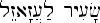
(sah-'eer la-e-za-EL) n. Scapegoat. (Lev. 16:8). According to Leviticus 16, a sacrificial goat on whose head Israel's high priest placed the people's collective sins on Yom Kippur, after which the goat was sent out into the desert to Azazel (possibly a demon).
Schaeffer, Francis
n. American Evangelical philosopher and Presbyterian pastor (1912-1984). Known for his establishment of the L'Abri community in Switzerland. Wrote twenty-two books, which cover a range of spiritual issues. Though was a "foundationalist" in his thinking, for some reason Schaeffer completely misunderstood Soren Kierkegaard and interpreted his thought like other so-called "existentialists" that became popular in the 60's in the US. That's a real tragedy as far as I am concerned. Shaeffer should have seen the German transcendental rationalist Immanuel Kant as the one who moved culture "below the line" (of grace/nature), not Kierkegaard. Other than that, Schaeffer was am incisive social critic and had a prophetic voice of his own.
Scarlet Thread

(khoot shah-NEE) n. The scarlet cord that Rachav (Rahab) dangled from her window to be delivered from God's judgment. The theme of the "scarlet cord" runs from Gen. 3 to the Cross of Yeshua to Revelation.
Dr. W. A. Criswell said, "Rahab the harlot is an example of the grace of God at work. Her salvation was not based on her character or merits: she lived in a doomed city, practiced a condemned profession, engaged in subversive activities, and falsified [lied about] her actions. Nevertheless she…acted upon faith, and was spared the judgment of God which was executed at the hands of the Israelites. In addition to her deliverance, Rahab was rewarded beyond measure when she married into the household of Nahshon…By Salmon, Rahab became the mother of Boaz and ancestress of David in the Messianic line [of those who were the ancestors of Jesus]. As one of four women listed in the genealogy of Matthew 1, Rahab is in the company of Tamar, who was also a harlot, and Ruth, who was a virtuous Ger Tzedek."
Scepter

(SHE-vet) n. Rod; Staff; Tribe (of Israel); Scepter (a ceremonial or emblematic staff held by a royal representative that represents divine power). עד כּי־יבא שׁילה...לא־יסוּר שׁבט מיהוּדה -- lo-yasur shevet mi-Yehudah...ad ki yavo shiloh -- "The scepter (shevet) will not depart from Judah... until Shiloh comes" (49:10). The term "Shiloh" was understood by the early rabbis and Talmudic authorities as referring to the Messiah (Targum Onkelos, Targum Pseudo-Jonathan, and Targum Yerusahlmi), and this was interpreted to mean that the kingship would remain until the coming of the Mashiach. Historically speaking, the scepter (shevet) departed from Judah in AD 6-7 after the Romans installed a procurator as the authority in Judea (replacing the Sanhedrin), but indeed the Mashiach had come and was in their midst as Yeshua mi-netzeret (Jesus of Nazareth).
 |
Scribe(s)

(soh-fer / soh-fe-REEM) n. Scribe(s); Writer(s). The earliest sages were called soferim (literally 'those who count') because they would count all the letters in the Torah (Kiddushin 30a). Later the term became a general designation for scholars and copyists in both Talmudic and later literature. In early times the Sofer was a scholar, but later on (by the 1st century) he primarily served as a teacher of children. Soferim is also a tractate from Talmud that explains the halakhah for writing holy books.
Schoolhouse

(bayt SE-fer) n. School; schoolhouse; "house of books."
Scroll

(me-geel-LAH) n. Scroll; Sefer; from galal, to roll. The scroll form of documents persisted through the days of the Qumran community (i.e. A. D. 68). The plural is meggilot.
S''D

(see-ya'-ta deesh-MAI-ya) n. phr. [Aramaic] "Help from Heaven." Abbreviated as S"D.
Sea of Reeds

(yam SOOF) n. The Sea of Reeds; When Israel left Egypt, pursued by the Egyptian army, God instructed Moses to raise his arm over the Sea of Reeds which then parted. After the Israelites escaped to dry land, the sea closed over the Egyptians.
Seder

(SAY-der) n. Seder. Order; Arrangement; ceremonies of the Passover meal. The Passover Seder is a ceremonial meal in which the story of the exodus from Egypt and songs are read out from a Haggadah (narrative). Note that the word Seder can also be used to describe the order of rituals at other meals; for example, the Shabbat seder, or the Tu B'shevat seder.
Seder Plate

(ke-ah-RAH) n. Also transliterated as Karah, Ka'arah, etc. Seder Plate; the central object of the Passover table. The seder plate has six dishes around a bowl of salt water where each dish contains a food that is used while telling the story of Passover during the reading of the Haggadah. These foods include:
- Beitzah - A roasted egg
- Karpas - Parsley (or vegetable)
- Ze'roa - Roasted shank bone (or chicken bone)
- Charoset - Chopped apples and nuts
- Maror - Bitter herb (horseradish)
- Chazeret - Romaine lettuce
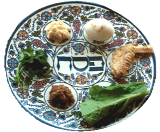
For more information, see the Passover Pages.
Sefer

(SE-fer / se-fah-REEM) n. Book(s). The Jews are sometimes referred to as Am hasefer: People of the book.
Sefer Hachayim

(SE-fer ha-CHA-yeem) n. The allegorical book in which God records the names and lives of the righteous (tzaddikim). According to the Talmud it is open on Rosh Hashanah (the Book of the Dead, sefer hametim, is open on this date as well) and God then examines each soul to see if teshuvah is sh'leimah (complete). If a person turns to God and makes amends to those whom he has harmed, he will be given another year to live in the following (Jewish) year. On the other hand, if he does not repent, then the decree may be given that he will die during the coming year... In Jewish tradition, Yom Kippur is essentially your last appeal, your last chance to change "the judgment of God" and to demonstrate your repentance and make amends. The books are "written" on Rosh Hashanah, but our deeds during the Ten Days of Awe can alter God's decree. The actions that change the decree are teshuvah (repentance), tefilah (prayer) and tzedakah (good deeds). The books are then "sealed" on Yom Kippur.
The Psalmist speaks of the Book of Life in which only the names of the righteous are written and from which the unrighteous are blotted out (Ps. 69:28). The prophet Daniel wrote: "Every one that shall be found written in the book . . . shall awake to everlasting life" (Dan. 12:1). Other references include:
"And the LORD said to Moses, "Whoever has sinned against Me, I will blot him out of My book." If one dies without forgiveness of their sins their name vanishes out of the record book of life." Exod. 32:33
"Thine eyes did see my substance, yet being unperfect; and in thy book all my members were written, which in continuance were fashioned, when as yet there was none of them." God knows who are his, even before they are born, everyone who lives is written in the book of life." Ps. 139:16
Paul recognized those who labored with him in the gospel, "with Clement also, and the rest of my fellow workers, whose names are in the Book of Life." Phil 4:3
"He that overcometh, the same shall be clothed in white raiment; and I will not blot out his name out of the book of life, but I will confess his name before my Father, and before his angels." Rev.3:5
All those who truly belong to Yeshua are written in the "Lamb's book of life " (Phil. 4:3; Rev. 3:5; 13:8; 17:8; 20:12, 15; 21:27; 22:19).
Sefer HaSefarim

(SE-fer ha-se-fah-REEM) n. The Book of Books -- the Bible; Kitvei HaKodesh; the Jewish Scriptures.
Sefer Torah

(SE-fer TOH-rah) n. Sefer Torah. A handwritten copy of the Torah (the first five books of the Jewish Bible) that meets extremely strict standards of production (collectively called the laws of soferut). There are over 4,000 "laws" or rules used by scribes to prepare a kosher scroll. For instance, the Torah must contain exactly 304,804 well-formed letters in 248 amudim (columns). Each yeriah (sheet of parchment) must come from the hide of a kosher animal that has been specially prepared for the purposes of writing. Special inks are used and whenever a scribe writes any of the seven Names of God, he must say a blessing (l'shem k'dushat Hashem) and dip his quill in fresh ink.
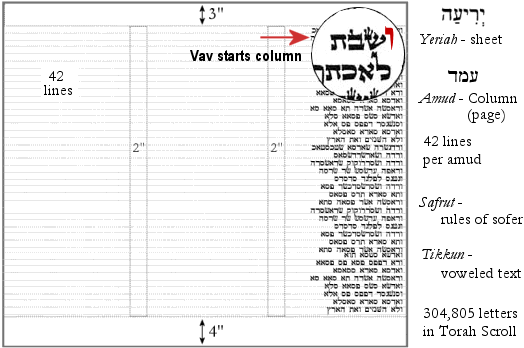
The Torah scroll is mainly used in the ritual of Torah reading during Jewish services (Mondays, Thursdays, Shabbat, and on holidays). The megillat Torah (Torah scroll) is kept in the Aron Kodesh (holy ark) of the synagogue. The plural is sifrei Torah. The script style for a Sefer Torah can vary according to the calligrapher (i.e., sofer): Arizal, Bet Yosef, Sefard, etc. The text of the Torah is also printed (for non-ritual or study functions) in book form, commonly called the Chumash (five fifths).
Sefirat HaOmer

(se-fee-RAT hah-OH-mer) n. Count of the 'omer for 49 days between Pesach and Shavu'ot (Lev. 23:16). The word "Sefirah" basically means "counting" or "the count."
Sefirah (pl. Sefirot)

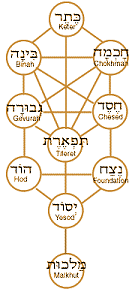
(se-fee-RAH / se-fee-ROHT) n/pl. "Enumeration," from sofer, to count (also "emanation"). A Kabbalistic attempt to reconcile the philosophical problem of the One and the Many. In mystical lore, a channel of Divine energy or life-force. In the process of creation an intermediate stage was emanated from God's infinite light to create what we experience as finite reality. These channels are called the Ten Sefirot or Ten Divine Emanations which are the basic terms and concepts of the inner wisdom of the Torah which is called Metaphysical Kabbalah.
The Ten Sefirot are:
- Keter - Crown; Divine Plan; God's Self-Consciousness
- Chochmah - Wisdom; Yesh me'ayin - being from nothingness (ex nihilo)
- Binah - Understanding; revelation as outworking of love
- Chesed - Kindness; everlasting love
- Gevurah - Strength; intentionality
- Tiferet - Beauty in the universe
- Netzach - Victory; resurrection
- Hod - Awe; surrender
- Yesod - Foundation; 1st principles of human knowledge
- Malkhut - Kingdom; physical revelation in space-time
Rabbi Isaac Luria substitutes the sefirah Keter with Da'at (knowledge), which is then said to be the mystical state of unity of the 10 Sephirot (sometimes called the Tree of Life).
Segol

(se-GOHL) n. Segol. Hebrew vowel mark of the E-type.
Segullah

(se-goo-lah) n. Segullah (סְגֻלָּה). 1. An action that is supposed to lead to a change in one's fortunes, caused by the performance of a special mitzvah. Sometimes superstitiously regarded as spiritual elixir or "good luck" mitzvah. 2. A mystical teaching of Torah that is thought to bring down blessing (a ~ for parnassah). 3. Something teasured or set apart as valued. The Torah refers to the people of faith as am segulah (עַם סְגֻלָּה), a "treasured" nation (Exod. 19:5; Deut. 7:6, 14:2, 26:18).
Seh HaElohim

(seh ha-e-loh-HEEM) n. The Lamb of God (John 1:29); a Title for the Messiah Yeshua. See the Names of God.
Sekhel

(SE-khel) n. Sechel. Common-sense. Sichlut halev (seekh-LOOT h-levl) means paying heed, behaving wisely, using good judgment and intelligence.
Selah

(se-LAH) interj. Selah. Perhaps related to a shoresh (salah) meaning to lift up (as voices) before a pause. Occurs 71 times in the Psalms, three times in Habakkuk. From salah, "to lift up" (the voice). Selah might have been a musical mark suggesting a forte of voices just before a reflective instrumental interlude. Upon selah, the singers would pause and only the instruments were heard.
Self Control

(hatz-NAY-ah LE-khet) n. Self-control; this phrase comes from Micah 6:8 - v'hatznea lekhet im eloheykha - "to walk humbly with your God."
Self-Righteousness

(tzad-kah-NOOT) n. Personal integrity and self-righteousness; self-justification.
Self Sacrifice

(me-see-raht NE-fesh) n. Total self-sacrifice, including death by martyrdom (kiddush HaShem). Three cases require a Jew to sacrifice his own life rather than violate a Torah prohibition: 1) forced worship of idols, 2) forced sexual immorality, and 3) murder - 'Rather than slay another person, you must permit yourself to be slain.' Maimonides adds that the public desecration of God's Name is another case where it is better to sacrifice your life than to obey. Mesirat Nefesh is sometimes contrasted with Pikuach nefesh, the saving of life even at the expense of other commandments given in Scripture.
Selichah - Selichot

(se-lee-KHAH / se-lee-KHOHT) n. Forgiveness; esp. forgiveness by God. Forgiveness is obtained by exercising emunah in the sacrifice of Yeshua as the kapparah for your sins, and by evidencing wholehearted teshuvah or repentance in one's daily life. Selichot (pl) are prayers for forgiveness, esp. said in the month of Elul, before the coming "Days of Awe" (the 10 days from Rosh Hashanah to Yom Kippur).
Semichah

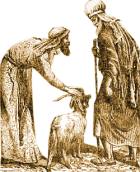
(se-mee-KHAH) n. Semichah. 1) Laying on our hands (upon the head of the sacrifice); 2) Ordination (as of a Rabbi).
Sephardic

(se-fah-ra-DEE) n./ adj. Sephardic. Spanish.
Septuagint

(tar-GOOM ha-sheev-EEM) n. "Translation of the Seventy" (LXX) or "Septuagint." The most important ancient translation of the Tanakh is the Greek Septuagint, originally produced for Greek-speaking Jews in Egypt. It is considered one of the greatest Jewish contributions to Hellenistic culture. Parts of it date from as early as the third and second centuries B.C.E. The title "Seventy" refers to the tradition that the translation was the work of 70 translators (or 72 in some traditions). Initially the Septuagint was widely used by Greek - speaking Jews, but its adoption by the Christians, who used it in preference to the Hebrew original, aroused hostility among the Jews, who ceased to use it after about 70 A.D. Philo and Josephus show a reliance on the Septuagint in their citations of Jewish scripture as does the New Testament. Of the approximately 300 quotes in the New Testament, approximately 2/3 come from the Septuagint (not the Masoretic text). It should be noted that the Septuagint includes some books not found in the Hebrew Bible (i.e., the Apocrypal Books included in the Catholic Scriptures).
It is generally agreed that the original Hebrew text that was the basis of the Septuagint differed from ancestors of the Masoretic text, though fragments of the Dead Sea scrolls actually agree with the Septuagint rather than the Masoretic Text readings. In other words, there were different Hebrew sources for the Masoretic Text and the LXX. These issues notwithstanding, the text of the LXX is generally close to that of the Masoretic version.
Serenity

(shal-VAH) n. Serenity; peace; tranquility.
Servant Candle

(SHAM-mahsh) n. Servant candle for Chanukkah menorah; also a caretaker at a synagogue.
Seudah / Seudot

(se-oo-DAH / se-oo-DOHT) n./n. pl. A festive meal, often eaten in commemoration of a ritual event (such as Bar Mitzvah) or a festival (such as a Passover seder).
Seudah Hamafseket

(se-oo-DAH ham-mahf-SE-ket) n. The concluding meal before the Yom Kippur fast. The Rabbis reasoned that since it is a mitzvah to fast on the Tishri 10, so is it a mitzvah to eat on the ninth (Tractate Yoma 81b). The meal, which is similar to a traditional Sabbath meal, takes place before sunset and before Erev Yom Kippur synagogue services.
Seudat Mitzvah

(se-oo-DAHT meets-VAH) n. A commanded meal. An obligatory festive meal following the performance of some mitzvah (commanded ritual event), such as circumcision (seudah brit milah), redemption of the firstborn (seudah pidyon haben), and so on. The plural form is seudot mitzvot. Note that the name for the Last Supper of Jesus is ha-seudat hacharonah.
Seudat Shabbat

(se-oo-DAHT shab-BAHT) n. A Shabbat meal. Three meals are required on the Sabbath, including seudat shlishit (the third meal of Shabbat, late afternoon).
Seven Species
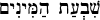
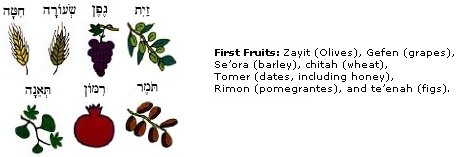
(shee-vat ham-mee-NEEM) שִׁבְעַת הַמִּינִים n. "The Seven Species." Seven types of fruits and grains enumerated in the Torah (Deut. 8:8) as being special products of the Land of Israel. Sometimes referred to as bikkurim, since the first fruits of these species were to be consecrated to the LORD as a token of appreciation for the care of the Promised Land. See the articles on Shavuot for additional information, as well as parashat Ki Tavo.
|
Seven Universal Laws

(SHE-va meetz-VOTE be-nay NO-akh) n. Sheva mitzvot b'nei Noach. Seven Laws given to the children of Noah considered binding on all people, at all times, as universal obligations. The Children of Noah are the Gentiles, comprising the seventy nations of the world. They are commanded concerning the Seven Universal Laws, also known as the Seven Noahide Laws. These include:
- Avodah Zarah: Prohibition on idolatry.
- Birchat HaShem: Prohibition on blasphemy and cursing the Name of G-d.
- Shefichat Damim: Prohibition on murder.
- Gezel: Prohibition on robbery and theft.
- Gilui Arayot: Prohibition on immorality and forbidden sexual relations.
- Ever Min HaChay: Prohibition on removing and eating a limb from a live animal.
- Dinim: Requirement to establish a justice system and courts of law to enforce the other 6 laws.
When a Gentile resolves to fulfill the Seven Universal Laws, his or her soul is elevated. This person becomes one of the "Chasidei Umot Haolam" (Pious Ones of the Nations) and receives a share of the World to Come.
Note that this entire idea is a patently false teaching, since NO ONE can come to the Father without the Son of God, Yeshua, as his or her Advocate and Savior, and whoever does not honor the Son does not honor the Father, YHVH [John 5:23; John 14:6, etc.]).
Seventeenth of Tamuz

(shev-ah ah-sahr be-ta-MOOZ) n. 17th of Tamuz. A fast day (tzom) commemorating the breaking down of the wall of Jerusalem by Nebuchadnezzar and the cessation of Temple worship during the siege of Titus.
Seventy Faces of Torah

(sheev-'eem pah-neem la-TOH-rah) phr. "The Torah has 70 faces." A phrase used to indicate different levels of interpretation of the Torah. See Pardes.
Sever Panim Yafot

(SE-ver pah-neem yah-FOHT) phr. "Being of cheerful countenance." The mitzvah of living a life that exudes joy and emunah.
Sicha

(see-KHAH) n. [שִׂיחָה]. Conversation; discussion. Sichot (plural) are study groups focused on discusing matters of Torah.
Sichlut ha-lev

(seekh-LOOT ha-LAYV) n. Showing sechel or common-sense. Paying heed, behaving wisely, using good judgment and intelligence. One of the classic middot.
Sidon

(tsee-DOHN) n. Sidon. Town on the coast north of Tyre (Matt.11:21).
Siddur

(seed-DOER) n. Siddur. Prayer book. Arrangement of the book begins with Shacharit, Minchah, and Ma'ariv services, then Shabbat and festival services. A Machzor is a prayerbook used for holiday services. Prior to the Gaonic era, all prayers were known by heart and prayer books appear not to have existed. The earliest prayer book, that of Rav Amram Gaon, dates from the ninth century. The Ashkenazim use four main types of prayer books; the Sephardim use the Tefillat ha-Hodesh for daily and Sabbath prayer and individual books for festivals. The Chassidim and the other movements have their own prayer books.
Sidrah

(SEED-rah) n. Sidrah. "Order." Bible-portion; Parasha; One of 54 divisions of the Torah which are read at the synagogue consecutively until the entire Torah is completed. Here is a list of the weekly Torah readings (note that there are additional readings for holidays):
- Bereishit (Genesis)
- Noach
- Lekh Lekha
- Vayeira
- Chayei Sarah
- Toldot
- Vayeitzei
- Vayishlach
- Vayyeshev
- Mikeitz
- Vayigash
- Vayechi
- Shemot (Exodus)
- Va'eira
- Bo
- Beshalach
- Yitro
- Mishpatim
- Terumah
- Tetzaveh
- Ki Tisa
- Vayakhel
- Pequdei
- Vayikra (Leviticus)
- Tzav
- Shemini
- Tazria
- Metzora
- Acharei Mot
- Kedoshim
- Emor
- Behar
- Bechukotai
- Bamidbar (Numbers)
- Nasso
- Beha'alotkha
- Shelach
- Korach
- Chuqat
- Balaq
- Pinchas
- Mattot
- Masei
- Devarim (Deuteronomy)
- Va'etchanan
- Eiqev
- Re'eh
- Shoftim
- Ki Teitzei
- Ki Tavo
- Nitzavim
- Vayeilekh
- Ha'azinu
- Vezot Haberakhah
Sifrei

(seef-ray) n. (סִפְרֵי) The Sifrei (sometimes spelled Sifre) refers to two works of midrash halakhah, or classical Jewish legal Biblical exegesis, based on the book of Numbers and Deuteronomy (i.e., the Sifre to Numbers and the Sifre to Deuteronomy). The core material was redacted from earlier sources around the middle of the 3rd century AD.
Sifriyah

(seef-ree-YAH) n. Library.
Silluq

(seel-LOOK) n. Silluq; Cantillation sign; accent mark in the Masoretic text used for chanting Tanakh. See Accent Marks.
Silver Rule

(ve-a-HAV-ta le-ray-a-kha kah-moh-kha) phr. You shall love your neighbor as yourself; the second great mitzvah; the "silver rule" of the mitvot. Love for others is the basis for all other commandments. This phrase comes from the Shema (Lev. 19:18).
Simanim

(seem-mah-NEEM) n. Symbolic foods served at the beginning of a Rosh Hashanah seder meal that are used as an occasion to symbolically bless the New Year. After lighting the yom tov candles and performing kiddush, it is customary to recite a short prayer about the symbolism of each food before eating it. Some of the foods are sweet for a sweet year (i.e., apples and honey); some grow abundantly to symbolize an abundance of merits (i.e., pomegranates or fish), and some are a play on words. For instance, when we eat leeks, which in Aramaic are karsi, we associate them with the Hebrew word karat - to cut down - i.e., "May our enemies be cut down." The most common example is apples and honey, of course. After reciting the blessing over the apples (borei pri ha'etz), we pray, "May it be your will, LORD our God and God of our fathers, that you renew for us a good and sweet year."

Simchah

(SEEM-khah) n. Joy; Gladness; Happiness; cheerfulness.
Simchat-Torah

(seem-khat TOH-rah) n. Simchat Torah; festival of the Torah; "Joy of the Torah." The last day of the festival of Sukkot during which the final (weekly) portion of the Torah is concluded and the first one is begun. The festival is marked by rejoicing and congregational dancing around the Sefrei Torah.
Simon

(sheem-'ohn) n. Simeon. "Heard." The 2nd son of Jacob by his wife Leah and progenitor of the tribe of Simeon. Also the name for Peter in the Brit Chadashah (Matt 4:18).
Sin (the letter)

(sheen / seen) n. Sin; 21st letter of Hebrew alphabet having the sound of "s" as in sun. Originally a pictograph representing a mouth. Gematria = 300.
|
Sin of the Spies
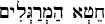
(khet ha-me-ra-glim) n. The Sin of the Spies. Chet Ha-Meraglim (חֵטְא הַמְרַגְּלִים). The Sin of the Spies occurred when ten of the tribal leaders of the Exodus generation were commissioned to "scout the land" but returned with a pessimistic and negative report, insisting that it would be impossible for the Jewish People to conquer and occupy the Promised Land. Only Yehoshua and Calev keep faith in the LORD's promise and did not suffer judgment from this act of lashon hara (against God).
Sinai

(see-NAI) n. Sinai (סִינַי); a (nondescript) mountain in the desert between Egypt and Israel where Israel received the Torah from God through Moses. Some scholars think that the word is derived from seneh (סְנֶה), a thornbush, because this lowly vegetation commonly grows on the arid mountains of this region. God spoke to Moses "in a flame of fire from the midst of the thornbush" (בְּלַבַּת־אֵשׁ מִתּוֹךְ הַסְּנֶה), suggesting God's condescension and humility. Sinai is also referred to as Chorev (חרֵב), a word that refers to the dry and desolate land of the region. Both the nondescript location of Sinai and the lowly thornbush are thought to represent the middah of humility. The Sinai peninsula is a peninsula in northeastern Egypt; at north end of Red Sea. Sinai also refers to the Covenant that God made with the children of Israel stipulating blessings for obedience and cursings for disobedience.
The Older and New Covenants do not coexist. The Sinaitic Covenant, the Older Covenant (brit yashanah), ceased at the death of Yeshua ha-Mashiach. The symbolism of the Sinaitic Covenant did not cease until the destruction of the Second Temple and the demise of the Levitical priesthood. In some first-century Christian theologies, particularly in early Ebionite circles, the Older Covenant was still regarded as binding on the life of the follower of the Messiah. To the adherents of this view, the Older and New Covenants coexisted; the New simply "renewed" the Older Covenant without nullifying it. Compare: Jeremiah 31:31-34 with Hebrews 8:8-12.
Sinat Chinam

(seen-at kheen-NAHM) n. Baseless hatred; literally, "hatred of [their] grace (chen)." The Talmud (Yoma 9b) says: מפני מה חרב מפני שהיתה בו שנאת חנם, "Because of what was (the Second Temple) destroyed? Because sinat chinam was in it." Baseless hatred is considered as bad as the three cardinal sins of idolatry, immorality, and bloodshed which destroyed the First Temple. In essence, sinat chinam is the rejection of God's grace, especially as it is evidenced in the lives of those He created....
Sivan

(see-VAHN) n. Sivan. 3rd month of the Biblical calendar, 9th month of Jewish calendar.
Siyag LaTorah

(see-yag la-toh-RAH) phr. "A fence around the Torah," taken from Pirke Avot 1:1: "Moses received the Torah from Sinai and conveyed it to Joshua; Joshua [conveyed it] to the Elders; the Elders [conveyed it] to the Prophets; and the Prophets [conveyed it] to the Men of the Great Assembly. They said three things: "Be deliberate in judgment; develop many disciples; and make a fence for the Torah (סִיָג לַתּוֹרָה)." The idea of the "fence" comes from rabbinical reflection on nazirite vow, which forbade the nazir to drink fermented drink, but went beyond this restriction to forbid eating grapes or even raisins.
Siyyum

(seey-YOOM) n. (Scribal arts) Siyyum. Celebration over the completion of a Sefer Torah scroll (called a siyyum haTorah). When a torah is finished it marks a great accomplishment and mitsvah and will be marked by communal festivities known as a siyyum hatorah (completion of the torah). Various customs have developed over the years to mark this simchah.
Skeptic

(a-pee-koh-ROHS) n. A term designating a person who leaves the rabbinic tradition. Also, a skeptic regarding the basic Jewish articles of faith.
Skullcap

(keep-PAH) n. Kippah. Skullcap; The Talmud states, "Cover your head so that the awe of heaven will be upon you." A shullcap is worn as a sign of respect in the synagogue (and sometimes by orthodox outside of the synagogue). A Kippah is also called a yarmulke (Yiddish), which may derive from the phrase, yireh Melech - "awe of the King." Note that there is no Torah commandment to wear a kippah, and therefore there is no blessing prescribed when putting one on your head.
Sod

(SOHD) n. Secret. In the realm of interpretation, sod refers to the most "hidden" or "secret" level of a given pasuk (e.g., Gematria or Pictographic meanings).
Sodom

(se-DOHM) n. Sodom. City near the Dead Sea destroyed by God (Gen. 10:19, 19).
Sof

(SOHF) End. Finish; Ein Sof means "without end" and is a Kabbalistic Name for God.
Sof Pasuk

(sohf pa-SOOK) n. End of verse marker ( : ) that looks like a colon in the Masoretic text of the Tanakh.
Sofer / Soferim
(soh-fer / soh-fe-REEM) n. Scribe(s); Writer(s). The earliest sages were called soferim (literally 'those who count') because they would count all the letters in the Torah (Kiddushin 30a). Later the term became a general designation for scholars and copyists in both Talmudic and later literature. In early times the Sofer was a scholar, but later on (by the 1st century) he primarily served as a teacher of children. Soferim is also a tractate from Talmud that explains the halakhah for writing holy books.
Soferut

(so-fe-ROOT) n. The laws pertaining to the work of a certified STA"M scribe; the various laws concerning the scribal arts of writing Sefrei Torah, tefillin, and mezuzot. There are over 4,000 "laws" or rules used by scribes to prepare a kosher scroll. For instance, the Torah must contain exactly 304,804 well-formed letters in 248 amudim (columns). Each yeriah (sheet of parchment) must come from the hide of a kosher animal that has been specially prepared for the purposes of writing. Special inks are used and whenever a scribe writes any of the seven Names of God, he must say a blessing (l'shem k'dushat Hashem) and dip his quill in fresh ink.
Sofit

(soh-FEET) adj. / n. Final (letter); ending letterform of the five Hebrew letters Kaf, Mem, Nun, Pey, and Tsade.
Solitude

(be-dee-DOOT) n. Solitude; silence; shtikah.
Solomon

(sh'loh-moh) n. Solomon. The son of King David by Bathsheba and 3rd king of Israel; author of Proverbs and Song of Songs and Ecclesiastes. Also transliterated as Shlomo, Shlomoh, Sh'lomoh, Shelomoh.
Son of Man

(bar e-nash) n. (Aramaic) Son of Man; The Messiah as seen by Daniel the prophet (Daniel 7:13-14), who "was given dominion, and glory, and a kingdom, that all the peoples, nations, and languages should serve him: his dominion is an everlasting dominion, which shall not pass away, and his kingdom that which shall not be destroyed." One of the titles of the Messiah. Bar enosh, like Hebrew ben adam, can also mean "son of man," or "typical man," or simply "man." Yeshua is all of these: the Messiah, a typical (ideal) man, one schooled both in heaven and on earth to be a man. Yeshua refers to himself frequently by this title, stressing his full identification with the human condition, as taught in Rom.5.12-21, 8.3-39; 1 Cor. 15.21-49; Phil. 2.5-11; Heb. 2.5-18, 4.15.
Song of the Sea

(shee-RAT hai-YAHM) n. "The Song of the Sea" (שִׁירַת הַיָּם), referring to the great hymn of praise (recorded in Exodus 15:1-19) regarding the Exodus from Egypt (the song is also called Az Yashir Moshe). Note that in Christian tradition Shirat Hayam is sometimes called "The Song of Moses," though this is a misnomer since Moses' song is actually recorded in Parashat HaAzinu. The triumphant hymn begins: "The Lord is my strength and song, and he is become my salvation" / עָזִּי וְזִמְרָת יָהּ וַיְהִי־לִי לִישׁוּעָה (Exod. 15:2). The Shabbat on which Beshalach is chanted is called Shabbat Shirah ("Sabbath of the Song"), though Orthodox Jews chant Shirat Hayam every day (i.e., during morning services) to fulfill the commandment to "remember the day of your departure from the land of Egypt all the days of your life" (Deut. 16:3). Note that Shirat Hayam is also sung on the 7th day of Passover, as a memorial of the deliverance by God through the waters of the Sea of Reeds (i.e., Yam Suf: יָם סּוּף).
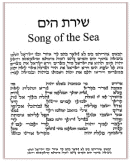
Notice that the Hebrew text is stylized in different ways according to different soferut (scribal) traditions. The sages count 198 words in this song, which is the numerical value for the word tzchok (צחק), a word that means "laughter" and is the word used to describe Sarah's response when she finally gave birth to Isaac (Gen. 21:6). According to Rabbi Bahye, the laughter in Isaac's name comes from Abraham's joy (Gen. 17:17). The joy of Isaac's birth, then, is linked with the "birth" of the nation of Israel at the time of the Exodus.
Song of Songs

(sheer hash-shee-REEM) n. Song of Songs; Song of Solomon; Canticles; one of the five scrolls (part of the Ketuvim). Written by King Solomon and considered an allegory of the relations between Adonai and Israel (and Messiah's love for the Church). Read during Pesach (Passover). Shir Hashshirim means "Song of (all) songs."
Songs of Israel

(shee-RAT yis-rah-AYL) n. Jewish Music; Songs of Israel.
Sorcery

(kee-SHOOF) n. Sorcery; witchcraft, soothsaying (all pagan/occult). Sorcerers were outlawed in Israel and subject to the death penalty. Sorcerers gained their supposed power from the powers of tumah (impurity). However, no weapon or spell cast against a true child of Adonai can be harmed by this, since ein 'od milvado - there is no power other than that of the Living God, who is Almighty and blessed forever.
Sotah (law of)

(soh-TAH) n. "Straying woman." The Torah provided a means of testing a woman's fidelity to her husband in cases where there was reasonable doubt. This is called the law of the "Sotah," or the wife suspected of unfaithfulness by her husband (Num. 5:12-31).
In an unusual ritual, a husband would bring his wife to the kohanim and present a "jealousy" offering (actually, an offering of barley rather than wheat, without added oil and spices as was customary for the minchah offering). A kohen would then take the offering and put it in the woman's hand and the woman was required to make an oath of her innocence before the LORD.
After this, the kohen would prepare "bitter water" that the woman would be required to drink. The priest would take an earthen drinking vessel and fill it with water taken from the Kiyyor Nechoshet (bronze laver or wash basin), mixing some dust from the mishkan floor and stirring it into the water. The priest would write on a scroll a curse that described the woman's punishment, written with the sacred Name of God, and immerse it in the water so that the words of the oath "rubbed off" (dissolved) into the water of the drinking vessel.
Finally she was made to drink "bitter waters." If she was indeed guilty of adultery, she would die a painful death: her body would swell, her face would become ashen, and her limbs would weaken. If she was vindicated, however, the water would not harm her at all, and she would be given a special blessing that she would no longer have pain during childbirth. Note that the Talmud (Sotah 27b) states that though it is the woman who was made to drink the bitter waters, the death sentence was also given to her male partner in adultery.
Soul

(NE-fesh) n. Nefesh; self; soul; innermost part. In Kabbalistic anthropology, there are actually five levels or types of soul:
- Nefesh (נֶפֶשׁ): the lower or "animal" aspect of the soul, common to other creatures.
- Ruach (רוּחַ): the middle soul or "spirit" that is able to distinguish right from wrong.
- Neshamah (נְשָׁמָה): the higher soul or "super-soul" that is the locus of rationality and spiritual life. The "Neshamah Yeterah" is the "additional soul" that a Jew can experience during Shabbat.
- Chayyah (חַיָּה): The soul beginning to apprehend the divine unity; the soul created before Adam's transgression (Gen. 2:7).
- Yechidah (יְחִידָה): the highest plane of the soul when the ego loses all differentiation with the divine unity.
Soul Searching

(khesh-bone ha-NE-fesh) n. Soul-searching; self-accounting; spiritual accounting; traditionally associated with the teshuvah season between Rosh Hashanah and Yom Kippur.
Spirit

(ROO-akh) n. Ruach. Wind; Breath; Air; Spirit. In Kabbalistic anthropology, ruach refers to the middle soul or "spirit" that is able to distinguish right from wrong.
Spirit of the LORD

(ROO-akh Adonai) n. The Spirit of YHVH; see Judg. 3:10; 11:29; 13:25; 14:6, 19; 15:14; 1 Sam. 10:6; 16:13; 19:9; 2 Sam. 23:2; 1 Kgs 22:24; 2 Kgs 2:16; 2 Chr. 18:23; 20:14; Isa. 11:2; 40:7, 13; 59:19; 63:14; Ezek. 11:5; Hos. 13:15; Mic. 2:7; 3:8.
Spirit of Wisdom

(ROO-akh chokh-MAH) n. Spirit of wisdom (gift from God).
Spirituality

(roo-khahn-nee-YOOT) n. Spirituality.
Statutes

(khook-KEEM) n. (sing. chok) Divine decrees; Statutes given without a reason (i.e., fiats or statutes). As such they are sometimes called "supra-rational" decrees. The classic example is the chok (sing.) regarding the Red Heifer, which, legend has it, defied even the wisdom of King Solomon. Other examples include dietary law or the laws concerning family purity. These laws can seem irrational to human reason. The chukkim are one of the two main subcategories of the concept of mitzvot (commandments).
Still Small Voice
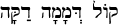
(kohl de-mah-mah dak-KAH) phr. "the sound of a whisper." A "still, small voice." The sound of thin silence. The Voice of the LORD spoken to Eliyahu ha-Navi (Elijah). Adonai shows that He is more than just a natural force (as was Baal) by speaking kol demamah dakkah. 1 Kings 19:12
Stone Tablets
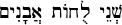
(she-NAY loo-KHOHT a-vah-NEEM) Phr. Shnei luchot avanim. The Two Tablets of Stone on which Adonai wrote Aseret Hadevarim (the Ten Words or Ten Commandments). These tablets were smashed by Moses after the Sin of the Golden Calf. However, Adonai mercifully let Moses inscribe a second set after a 40 day period of teshuvah.
The two tablets (shnei luchot avanim) are also refered to as the two tablets of testimony (shenei luchot ha'edut), or "tables of stone" (luchot even) written with the finger of God.
Study of Torah

(Lee-mood TO-rah) n. "The study of Torah." The Torah commentator Rashi says that the phrase, "if you walk in my decrees" refers to labor in the study of Torah (i.e., limud Torah: לִימוּד תוֹרָה), since we cannot mindfully observe God's decrees (chukkim) and commandments (mitzvot) without first studying Torah... As it says in our Sciptures: "Make yourself diligent (σπούδασον σεαυτὸν) to be genuine before God, a workman that is unashamed, living the message of truth accurately" (2 Tim. 2:15). "If you will walk" is an invitation to grow in grace and understanding of God's truth.
Stumbling Block

(leef-nay ee-ver) A hortatory phrase meaning "before the blind" derived from the Torah commandment: וְלִפְנֵי עִוֵּר לא תִתֵּן מִכְשׁל, "You shall not put a stumbling block (i.e., mikshol: מִכְשׁל) before the blind (Lev. 19:14). Causing another person to stumble - whether literally or metaphorically - is considered a serious sin in Jewish ethical thought. Seducing others, lying, deceiving, flattering others, etc., all are species of the principle of lifnei iver.
Success!

(hatz-lah-KHAH) n. Success! b'hatzlachah means "good luck!" Bracha v'hatzlachah means "blessing and good success," as an otative blessing to others...
Suffering

(yees-soo-REEM) n. pl. Suffering; tribulation; testing. Tzuris with a purpose.
Sukkah

(SOOK-kah) n. Sukkah; Hut; Tent; Tabernacle. Temporary structure built for the celebration of Sukkot in recognition of the temporary dwellings built by the Jews as they journeyed from Egypt to Canaan.
Sukkot

(soo-KOHT) n. Sukkot. Feast of Tabernacles; Fall festival; celebrating the forty years when the people of Israel lived in booths or tents in the desert. Sukkot is one of three pilgrim festivals when Jews were expected to go up to Jerusalem. Also called Chag Ha-Asif (Festival of the Ingathering).
Sympathy

(a-ha-DAH) f. n. Sympathy; pity; understanding.
Synagogue

(bayt k'NES-set) n. Synagogue (also the name for the Israeli Parliament). A Jewish house of worship. Traditionally the first synagogues were established during the Babylonian exile (after the destruction of the Temple).
<< Return
|