|
|
|
|
|
|||||||||||||||||
 |
|||||||||||||||||||||
|
|||||||||||||||||||||
 |
|||||||||||||||||||||
|
Learn Hebrew |
|||||||||||||||||||||
















|
|
||
 |
|||
 |
|||
|
|
 |
|
||||||
|





|
|||||||||||||||||||||||||||||||||
|
|
|
|
|
|
|
|
|
||||||||||||||||||||||||||||||||||||||||||||||||||||||||||||||||||||||||||||||||||||||
|
P
Page of Talmud
The study of the inner secrets of Torah (sod) is called Kabbalah.
Pareve (pahrv or PAHR-veh) n. Neutral foods that can be eaten with either dairy or meat meals. Hebrew word for "neutral" foods that are neither meat nor dairy, such as fish, fruits, vegetables, and eggs.
Parochet  (pah-ROH-khet) n. Curtain in the Temple before the Ark of the Law; Curtain, specifically the one dividing the Holy of Holies from the rest of the Temple or Tabernacle. There were actually two such curtains: the first separated the Holy Place from the outer court (Ex. 26:36–37, 36:37–38), whereas the second separated the Holy of Holies from the Holy Place (Ex. 26:31–33, 36:35–36). The curtain covering the Ark of the Torah in a modern synagogue is also called a parochet. Parochet prices vary between $750 and $4,500 All Prices vary according to size, types of materials and complexity of embroidery.
Parshanut  (par-sha-NOOT) n. Exegesis; Commentary. A commentator is called a Parshan (פַּרְשָׁן). Weekly Torah readings are called parashiot. The plain (historical-grammatical) reading of a text is called pashut (פָּשׁוּט) and the exegesis, interpretation, or commentary is called Parashanut. An elegant and simple reading is pashtut (פַּשְׁטוּת).
Pasek  (pa-sek) n. Punctuation mark (|) used as a "separator" in the Masoretic text of Biblical Hebrew. The Westminster Leningrad Codex contains over 500 paseqs though the meaning in most cases is uncertain.
Pascal Lamb  (kor-bahn PAY-sakh) n. "Paschal Lamb." The "Passover sacrifice" that was to be roasted and eaten with unleavened bread (i.e., matzah) and maror (bitter herbs). The sacrificial lamb (seh) was to be a male, one year old, and without blemish (tamim). The maror is a reminder of the bitter slavery in Egypt. Anything left over from the meat is to be burnt in the morning. On the night of Nisan 14 the sacrifice was eaten (see John 6:53). The Passover meal was to be consumed "in haste" since the Israelites must be ready to begin their exodus the following day.  The blood of the lamb sprinkled on the doorposts (mezuzot) of the Israelites was to be a sign (ot) to the Angel of Death when passing through the land to slay the firstborn of the Egyptians that night, that he should pass by the houses of the Israelites. 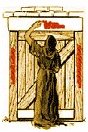
Passover  (PE-sakh) n. Pesach; Passover; The feast of Passover, celebrating the Exodus of the Jewish nation from Egypt under the leadership of Moses. Pesach, along with Shavu'ot and Sukkot, is one of the three pilgrim festivals (shalosh regalim) when Jews were to come to Jerusalem. A picture of God's salvation given through Yeshua the Messiah.
Passover Charity  (ma-'oht cheet-TEEM) n. pl. "Coins for Wheat". Shulchan Aruch, Orach Chaim 429 states that money should be set aside for others to enjoy Pesach (Passover). Traditionally, maot chittim provided flour for the needy for baking matzah for Passover, however, this evolved into an all-inclusive charity for distributing food and clothing during Pesach. 
Passover Haggadah 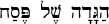 (hag-gah-DAH shel PAY-sakh) n. A book containing the story of the Passover that is read during a seder.
Passover Seder  (SAY-der layl PE-sakh) n. Seder. Order; Arrangement; ceremonies of the Passover meal. The Passover Seder is a ceremonial meal in which the story of the exodus from Egypt and songs are read out from a Haggadah (narrative).
Pasuk / Pasukim  (pah-SOOK / pe-soo-KEEM) n. Verse(s). Bible verse(s). Cp. Pereq.
Patach  (pat-TAHKH) n. Patach; vowel sign. In the Nikkud, Patach represents a (short) "ah" sound. See A-type vowels.
Path of Life  (oh-rakh KHIE-yeem) n. The path of life; also spelled as Orach Chayim. A section of Rabbi Jacob ben Asher's compilation of Halakha (Jewish law) that deals with aspects of the Jewish calendar and mo'edim. In the Scriptures, Orakh Chayim refers to the path of obedience to the Torah and commandments of Adonai. The phrase itself occurs in Psalm 16:11, Prov. 5:6 and 15:24. Ultimately the path of life leads to obedience to the Mashiach Yeshua, who is the way, the truth, and the life (John 14:6).
Patience  (sav-lah-NOOT) n. Patience; Derived from savlan, "long-suffering."
Patriarchs  (shloh-shah ah-VOHT) n. The three fathers (avot) of the Jewish people: Abraham, Isaac, and Jacob. 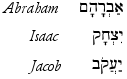
Paul  (POH-lohs) n. Paul, the apostle. Known as Rav Sha'ul.
Peace  (shah-LOHM) n. Peace; Wholeness; well-being; wellness. Also used as a general greeting or farewell. Shalem is the adjectival form. Shalom Bayit refers to peace in the home.
Peacemaker  (roh-DAYF shah-LOHM) n. A pursuer of peace; Peacemaker. "Blessed are the peacemakers, for they shall be called sons of God" (Matt 5:9):  Redifat Shalom means "pursuing peace."
Peace Offerings  (zeev-khay she-lah-MEEM) n. Peace sacrifices or offerings. Sacrifices of fellowship. See Korbanot.
Peculiar People  ('ahm se-gool-LAH) n. A treasured and befitting nation by virtue of deeds and actions; a special title given to Israel as a nation (see Exod. 19:5; Deut. 7:6; 14:2; 26:18) and also to Christians who serve the Lord Jesus (Yeshua). Note that chosenness does not imply superiority. "Choosing" is invariably perceived as a verb and part of what it means to be such a people. That is, the ones who are choosing Adonai and His ways are both am hanivchar and am segullah. Therefore the Apostle Peter refers to Christians as "a chosen race, a royal priesthood, a holy nation, a people for his own possession" (1 Peter 2:9, cp. Ex. 19:6, Deut. 7:6). This is clearly a reference to Gentiles who come to faith in Yeshua, since he adds: "Once you were not a people, but now you are God's people" (1 Pet. 2:9-10), something he would not have said to ethnic Jews. The Apostle Paul likewise understands true Christians to be "chosen people" (Eph 1:4; 2 Thess. 2:13). All true Christians are in b'kehunat Mashiach - in the priesthood of Messiah Yeshua and therefore have direct access to God. This priestly lineage began with Malki-Tzedek (Melchizedek), culminated in Yeshua, and is passed directly to the believer by means of his or her justification and identification with the Lord, "who gave himself for us, that he might redeem us from all iniquity, and purify unto himself a peculiar people (am segulah), zealous of good works" (Titus 2:14).
Pedigree  (yee-KHOOS) n. Distinguished birth; Pedigree; as in, "Rav Sha'ul had outstanding "yichus."
Pedut  (pe-DOOT) n. Redemption; ransom; Transfer of ownership from one to another through payment of a price or an equivalent substitute (as in the redemption of a slave). When Adonai delivered Israel from servitude to Egypt, He did so at the "price" of the slaughter of all the firstborn (bechorim) of Egypt, man and beast (Exodus 4:23; 12:29). Consequently, the Exodus event was to be commemorated by the Jewish people through the consecration of an the firstborn of man and beast to the Lord (Exodus 13:12). The Jewish people were the firstborn of God (Exodus 4:22) and had been redeemed by the LORD (Deut. 15:15; 24:18). Later this idea of redemption for service included the idea of deliverance from sin (Psalm 130:7-8). Redemption becomes a spiritual concept that is for the entire world through the ransom of Yeshua the Mashiach for the sins of the world. This is called pedut olam (everlasting redemption) in Hebrews 9:12. See Pidyon.
Pe'ah  (PAY-ah) n. "Edge" or "corner." The commandment to leave grain at the edge of a field so that it can be harvested by the poor (Lev. 19:9). Every farmer was required to put aside a corner of his field (pe'at sadekha) for poor people to glean from the harvest. This mitzvah is called pe'ah. Generally a farmer would leave 1/50th of his crops as pe'ah for the poor. Other commandments for farmers include leket - leaving stalks for the poor and shikchah - leaving harvested bundles for the poor that were accidentally left behind during the harvest.
Pele' Yoetz  (PE-le' yoh-AYTZ) n. Wonderful Counsellor; a direct reference to the deity of Yeshua the Messiah found in Isaiah 6:9. (Note that Pele Yoetz is also the name of a Chassidic scholar).
Peniel  (pe-noo-AYL) n. Peniel = "facing God." The place named by Ya'akov when he wrestled with God and located on the north bank of the Jabbok close to the Jordan (Gen 32:30).
Pentecost  (shah-voo-OHT) n. Shavuot; Pentecost; Feast of Weeks; Weeks. The Festival commemorating giving of the Torah at Har Sinai to Israel. Observed on the fiftieth day after the first day of Pesach. Shavu'ot is the concluding festival of the Spring season, a festival of the offering of the first fruits, and a picture of the resurrection of Yeshua the Messiah as the Firstfruits (1 Cor. 15:20).
Pentateuch  (KHOO-mahsh) n. Chumash; Pentateuch; the first five books of Moses, usually bound in a codex (book) form and accompanied with commentary. The five books of Moses; the Torah. From the Greek, meaning "five scrolls."
People of the Book  ('ahm has-SE-fer) n. People of the book; the Jews.
Peor (Baal)  (ba-ahl pe-OHR) n. "Lord of Peor," referring to Mount Peor on the east of the river Jordan. A false local semitic deity worshipped by the ancient Canaanite nations as well as other Mesopotamian cultures. Ba'al Pe'or could mean 'Lord of the Opening,' referring to rites involving defecation and other practices. The god is himself also called "Peor" by abbreviation. Peor was the name of a mountain in Moab from which the rasha Bil'am vainly attempted to curse the people of Israel.
Perishut  (pe-ree SHOOT) n. Abstinence; detachment; purity that leads to tahara (purity).
Permitted  (moot-TAHR) adj. The word mutar (מֻתָּר) is used to imply the freedom or permission to do something in halachic discussions (the antonym asur (אָסוּר) means "forbidden" or "prohibited"). For example, the presence of blood spots found in eggs raises the question of whether they are "asur or mutar" for consumption in light of the laws of kashrut.
Personal Hygeine  (she-mee-raht ha-GOOF) n. The mitzvah regarding taking care of (watching) one's body (health). This involves a number of different principles, including dietary law, personal hygeine, abstaining from drunkenness and fornication, and so on.
Peru-urevu  (pe-ROO oo-re-VOO) n. "Be fruitful and multiply." Sometimes transliterated as pru uvru and used as a synonym for human procreation. This is the very first mitzvah (commandment) given to mankind (Gen. 1:28). This is also the first place in Scripture where God spoke to and blessed mankind. The commandment of pru uvru has led to various halakhic discussions regarding family planning, using contraceptives, the ideal size of the Jewish family, and so on.
Pesach (PE-sakh) n. Pesach (פֶּסַח); Passover; The feast of Passover, celebrating the Exodus of the Jewish nation from Egypt under the leadership of Moses. Pesach, along with Shavu'ot and Sukkot, is one of the three pilgrim festivals (shalosh regalim) when Jews were to come to Jerusalem. A picture of Yeshua the Messiah's Salvation.
Pesach Sheini  (pe-sakh shay-NEE) n. ,פֶּסַח שֵׁנִי lit. "Second Passover"; Sometimes called Pesach Katan ("little Passover"). A "Second Passover" observed 30 days after the normal date for Passover (on Iyyar 14). This day served as a "second chance" for those who were unable to observed Passover on the eve of the "first" Passover (i.e., on the 14th of Nissan), usually because of ritual impurity (Num 9:2-13). Unlike the regular Passover, however, unleavened bread was not required to be eaten the week following Pesach Sheni. Today, some mark the date by eating matzah in a way analogous to eating the afikoman-matzah at the Passover seder.
Peshat  (pe-SHAHT) n. P'shat. Literal, plain-sense meaning of a text. See Pardes.
Pey / Fey  (pey / fey) n. Pey / Fey. 17th letter of the Hebrew alphabet having a "f" as in food sound (with a dagesh, "p" as in park). Originally represented by a pictograph meaning "mouth," "work," or "speech." Gematria = 80. Fey also has a sofit (final) form.
Peyot HaRosh  (pe-oht hah-ROHSH) n. Earlocks; Sidelocks; peyot (פֵּאוֹת), from the singuar (pe'ah) that means corner, side or edge (i.e., of a field, as in agricultural laws), though this terms was taken to mean the hair in front of the ears extending to beneath the cheekbone (Talmud - Makkot 20a regarding Lev. 19:27). According to Maimonides, cutting the sidelocks was a pagan practice. Note that the verse: "You shall not round the corners of your heads, neither shalt thou mar the comers of thy beard" (Leviticus 19:27) is not understood by the sages not to mean that it is wrong for a man to be cleanshaven, but only that sidelocks should be allowed to grow and not be cut. There are many different "styles" of peyot (twisted, braided, curled, straight, etc.), with various mystical explanations offered to justify each style by those who wear them for religious reasons... 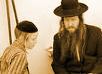
Pharisees  (pah-ROOSH / pe-roo-SHEEM) n. sing. Pharisee; pl. Pharisees; Perushim; from פרוש parush, meaning "separated." A school of thought among Jews that flourished during the Second Temple Era (536 BC–70 AD). Ezra the Scribe and the men of the Great Assembly (כְּנֶסֶת הַגְּדוֹלָה) are considered the precursors of the Pharisee movement. The Perushim and the Tzedukim (Sadducees) were the two main groups of the religious establishment in the time of Yeshua. The Perushim focused on the Torah and what it requires of ordinary people, rather than on the Temple ritual. When the Temple was destroyed in 70 AD, the Perushim developed their tradition into the basis for Jewish life everywhere; this tradition is the core of the Talmud and of modern religious Judaism. In other words, the Pharisaic sect was re-established as Rabbinic Judaism after the destruction of the Jewish Temple. 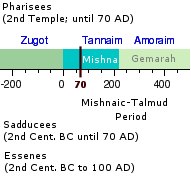
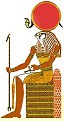
Pharaoh  (par-'oh) Pharaoh. From the Egyptian for "great house," a term originally referring to the royal palace and applied by extension to the king. The dead Pharaoh was known as Osiris, while the living Pharaoh was the embodiment of Horus, and thus considered a "god."
Philemon  (pee-lei-MOHN) n. A short letter in the B'rit Chadashah containing a request from Rav Sha'ul to Philemon asking him to forgive a slave for escaping.
Philistine  (pe-LEESH-tee) n. Philistine. A a member of an Aegean people who settled ancient Philistia around the 12th century BC.
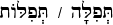
Phylacteries  (te-fee-LEEN) n. Tefillin (תְּפִילִּין); "Phylacteries"; two black leather boxes containing scrolls with Bible passages on them (Exod. 13:1–16; Deut. 6:4–9, 11:13–21). During synagogue prayers men affix one to their hand and arm and the other to their forehead, in obedience to Deut. 6:8. For more information, click here. Note: The Greek word τὰ φυλακτήρια was transliterated as "phylacteries" by translators of the English New Testament. It does not appear in the LXX (Septuagint) but the word ἀσαλευτόν does, which was used to translate the Hebrew word "totafot" (frontlets) in the verse "And it shall be for a token upon thine hand, and for frontlets between thine eyes (לְטוֹטָפת בֵּין עֵינֶיךָ): for by strength of hand the LORD brought us forth out of Egypt" (Exod 13:16). The word "tefillin" (תְּפִילִּין) is probably Aramaic, not Hebrew, though it is obviously related to the Hebrew word "tefillah" (prayer). The word tefillin does not occur in the Torah itself, but rather in the Oral Torah and traditions of the sages/rabbis. The idea that "totafot between your eyes" (Exod. 13:9, 6, Shema: Deut. 6:8, 11:18) refers to the elaborate rules and ceremonies attached to modern tefillin usage is a rabbinical invention. Metaphorically, of course, the idea of totafot means practicing the Presence of the LORD in every moment of our day… Jesus said, "But they do all their deeds to be noticed by men; for they broaden their phylacteries and lengthen the tassels of their garments" (Matt. 23:5). Most likely this was intended to be a warning that one shouldn't affect religiosity before men in a vain attempt "to be seen" as righteous/zealous.
Pidyon  (peed-YOHN) n. Ransom money.
Pidyon HaBen  (PEED-yohn ha-BEN) n. "Redemption of the (firstborn) son." Originally the firstborn son (bechor) was the priest (kohen) of the Jewish family, required to offer avodah (sacrifice) on behalf of the family (Exodus 13:1-2, 24:5). God said "the first issue of every womb among the Israelites is Mine" (Exodus, 13:2). Thus firstborn sons were sanctified and obligated to serve as kohanim (priests) before the LORD. We see evidence of this in the lives of the early patriarchs, Abraham, Isaac, and Jacob (who received the blessing of the firstborn through transfer from Esav). And because firstborn sons (bechorim) were consecrated as kohanim, during the Exodus from Egypt God spared them when He issued the 10th makah (plague), the death of the firstborn. After the Exodus from Egypt, however, the Israelites committed the grievous Sin of the Golden Calf, of which only the tribe of Levi was not guilty. Consequently the LORD decreed that the Levites were to take the place of the bechorim of Israel (Num. 3:11-12). But since the firstborn son is technically a (disqualified) Kohen, he had to be replaced by a Kohen from the tribe of Levi, and therefore God required that all firstborn sons (who were not themselves Levites or Kohens) must be redeemed from service to God by means of paying five shekels of silver (see Num. 18:15). It is customary for a firstborn male (whose father or mother are not a Kohen or Levi) to undergo Pidyon HaBen, meaning "Redemption of the (firstborn) son." The ceremony of redeeming the firstborn occurs on the 31st day after birth (Ex. 13:13; Num. 18:16), though the ritual cannot be performed on Shabbat because it involves the exchange of money. When the son has established a claim to viability, the father is obligated to "redeem" him by giving five "shekalim" to a Kohen. This ritual symbolically relieves the child from service in the priesthood because Jews who are descendants of Aaron were given the responsibility in his place (Num. 3:12-14). For more information, click here. The narrative in Luke chapter 2 indicates that Mary and Yosef went up to Jerusalem for pidyon haBen ceremony of Yeshua and remained there ten days until it was time for Mary's purification (40 days after the birth of a son, as described in Leviticus 12:1-8).
Pidyon Shevuyim  (PEED-yohn she-voo-YEEM) n. Ransom of (Jewish) captives. Setting captives free (as by ranson money or other means).
Pikuach Nefesh  (peek-koo-akh NE-fesh) n. A fundamental rabbinic principle of the saving of a human (Jewish) life. For the sake of Pikuach Nefesh, any holiday prohibition may be broken. Pilgrimage Festival  (she-lohsh re-ga-LEEM) n. Shelosh Regalim. n. Three annual pilgrimage festivals: Pesach, Shavu'ot, and Sukkot (Ex. 23:14). Three required celebrations in Jerusalem according to the instructions of the Torah. "Three times every year shall your menfolk appear before the Lord your God in the place that He will choose, in the feast of Pesach, in the feast of Shavuot, and in the Feast of Sukkot." (Deuteronomy 16:16)
Pilpul  (PEEL-pool) n. Debate, esp. regarding Halakhah or legal matters. Pilpel means "pepper."
Pirkei Avot  (peer-kay a-VOHT) n. Pirkei Avot, literally "Chapters of the Fathers," (or "Ethics of the Fathers") is a section of the Mishnah, one of the most fundamental works of the Jewish Oral Law. This is the key work of the Oral Law devoted entirely to the behavior of man, and how he can ameliorate his condition. Collection of maxims of the sages from the Mishnah (Hillel, Akiva, etc.). For example, "He (Hillel) used to say, 'If I am not for myself, who will be for me? But if I am only for myself, then what am I? And if not now, when?' " Here's another example: "Simon the Just was of the remnants of the Great Assembly. He used to say: On three things the world stands: on the Torah, on the (Temple) Service, and on Deeds of Loving-Kindness."
Piyyutim  (pee-yoo-TEEM) n. pl. Liturgical poems recited during special services. Many piyyutim are acrostics of the Hebrew alphabet or an acrostic of the author's name. The best-known piyyut is perhaps Adon Olam ("Master of the World"), often sung at the conclusion of many synagogue services and during the bedtime shema.
Plagues of Egypt  (ma-koht meetz-RIE-eem) n. The plagues of Egypt. The ten calamities that befell Egypt by the hand of the God of Israel as recounted in the Book of Exodus, Chapters 7–12. The Plagues of Egypt are also called the "Ten Plagues" (i.e., eser ha-makot: עֶשֶׂר הַמַּכּוֹת). These include:
Exodus 12:12 God says, "... on all the gods of Egypt I will execute judgments." Thus the plagues are thought to be symbolic of the defeat of various gods venerated in ancient Egyptian mythology (and occultism in general):
Some commentators ask whether the plagues were intended more for the Israelites than for the Egyptians, since the Israelites had been oppressed by the powers of Egypt to the point of being "without the breath of hope."
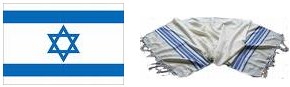
The Tallit actually inspired the design of the Israeli flag: The word "tallit" itself does not occur in the Torah (though the verb טָלַל appears and means "to cover over" (Neh. 3:15; Gen. 19:8)). Ruth asked Boaz to "cover" her with his garment because he was a near kinsman (Ruth 3:9). The base word (טל) means "dew" and the word Tallit was perhaps chosen because it alludes to the morning dew in the wilderness that was accompanied by manna (Exod. 16:13-14; Num. 11:9). The unity of brethren is also likened to the dew (Psalm 133:3) as well as the favor of God (Prov. 19:12). The use of the Tallit concerns the display of "fringes" or tzitzit, which were the essence of the requirement given in Numbers 15, Deut. 22:12. The Tallit was sometimes used to indicate the social status of the wearer. The Pharisees sometimes wore extra long fringes to affect a display of piety - a practice that Yeshua condemned (Matt. 23:5). Yeshua himself likely wore tzitzit as evidenced by Matt 9:20 and the word κρασπέδου, as translated from the Hebrew צִיצִת. For more information, click here.
Priest  (KO-hayn) n. Kohen. Cohen. Priest. A priest and his descendants, traditionally considered to be direct descendant from Aaron, but first used in the Tanakh in reference to Malki-Tzedek (מַלְכִּי־צֶדֶק), the high priest of El Elyon (God Most High) and the King of Salem (Gen. 14:18).
Priest of the Most High  (koh-hayn le-ayl ayl-YOHN) n. Priest of the Most High God (as was Malki-Tzedek in Genesis 14:18). All believers in Yeshua the Mashiach are called kohanim (priests) of kehunat kadosh (the holy priesthood).
Priesthood  (ke-hoon-NAT KOH-desh) n. Holy priesthood. "Ye also, as lively stones, are built up a spiritual house, an holy priesthood, to offer up spiritual sacrifices, acceptable to God by Jesus Christ." 1 Peter 2:5 "But you are a chosen race, a royal priesthood, a holy nation, a people for his own possession, that you may proclaim the excellencies of him who called you out of darkness into his marvelous light." 1 Peter 2:9
Priesthood of Yeshua  (ke-hoon-NAT ma-SHEE-ach) n. A priest after the order of Yeshua, who was Himself prefigured in the person of Malki-Tzedek.
Priestly Blessing  (beer-kaht koh-ha-NEEM) n. Priestly blessing. Also called the "Aaronic" blessing (see Num. 6:24-6). Click here.
Pri ha-Ruach  (pe-ree ha-ROO-akh) n. "But the fruit of the Spirit (פְּרִי הָרוּחַ) is love, joy, peace, long-suffering, generosity, acts of kindness, faithfulness, humility, and modesty – against such there is no Torah" (Gal. 5:22-23). The Fruit of the Spirit are those middot hav-lev (qualities of heart) derived from the power of the Ruach Ha-Kodesh (Holy Spirit) working within the heart of faith. The priot (fruits) listed in Galatians 5:22-23 represent nine visible attributes of a true follower of Yeshua (Jesus): 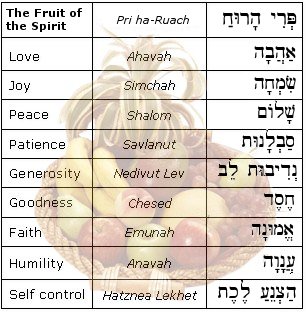 Comments:
If there is no seed, there is no fruit; and the type of seed always determines the type of fruit (1 Pet. 1:23; 1 John 3:9). We can sow to the flesh – and reap corruption, or we can sow to the Spirit, and reap life everlasting (Gal 6:7-8). Therefore the formation of "Messiah-like character" is the result of disciple (παιδεία), a word that means to instruct or rear a child (παιδεύω). Indeed, in some cases the word can mean to "whip" or "scourge" someone in punishment. In Hebrew, the word is musar (מוּסָר) which is related to the idea of moral instruction and guidance which is intended to inculcate Jewish values and the "fruit of righteousness" (פְּרִי לִצְדָקָה).
Prince of Peace  (sar-shah-LOHM) n. Sar-Shalom; a title for the Messiah. See the Names of God.
Procreation (pe-ROO oo-re-VOO) n. "Be fruitful and multiply." Sometimes transliterated as pru uvru and used as a synonym for human procreation. This is the very first mitzvah (commandment) given to mankind (Gen. 1:28). This is also the first place in Scripture where God spoke to and blessed mankind. The commandment of pru uvru has led to various halakhic discussions regarding family planning, the use of contraceptives, the ideal size of the Jewish family, and so on.
Promised Land  (hah-E-retz ha-moov-TA-khat) n. Haaretz Hamuvtachat. The Promised Land; the land promised to Avraham, Yitzchak, Ya'akov (and their descendants) to inherit the land of Eretz Israel (the land of Israel). This is also sometimes spelled Ha'aretz Hamuvtachat. 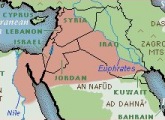
Prophet  (nah-VEE) n. Prophet; a spokesperson for YHVH who delivered his God's messages and expressed his intentions toward the world (Deut. 13:1-5; 18:9-22; Amos 3:7; etc.). Plural form nevi'im.
Prophets  (ne-vee-EMM) n. Prophets. Second main division of the Tanakh. The Nevi'im, or Hebrew prophetical books, are subdivided into two major parts: four books of the "Former" prophets and 15 books of the "Latter" prophets. Weekly readings are called Haftarah portions:
|
|||||||||||||||||||||||||||||||||||||||||||||||||||||||||||||||||||||||||||||||||||||||||||
|
Hebrew for Christians |
|||||||||||||||||||||||||||||||||||||||||||||||||||||||||||||||||||||||||||||||||||||||||||
|
|||||||||||||||||||||||||||||||||||||||||||||||||||||||||||||||||||||||||||||||||||||||||||