|
A well-known Jewish midrash says that the LORD initially offered the Torah to each of the 70 nations, but none accepted it without first asking what it was about. After hearing the various commandments, each nation had some excuse or another for not accepting it (for example, God offered Torah to the Ishmaelites, but they declined the offer because of its prohibition of theft, since their trading practices required it). God finally turned to the nation of Israel, who said kol asher diber Adonai na'aseh ("all that the LORD says we will do"). Note something remarkable here: Unlike the other nations, Israel chose Torah before knowing its contents (Exodus 19:8). In fact, even after Moses had explained the extent of Torah's demands, all Israel said kol asher diber Adonai na'aseh v'nishma ("all that the LORD says we will do and obey") (Exodus 24:7). The heart of the Jew unquestioningly says "Yes" to the LORD like a child who trusts his father... (halevai - may we all so live!).
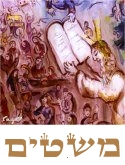
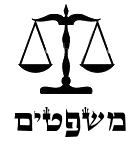
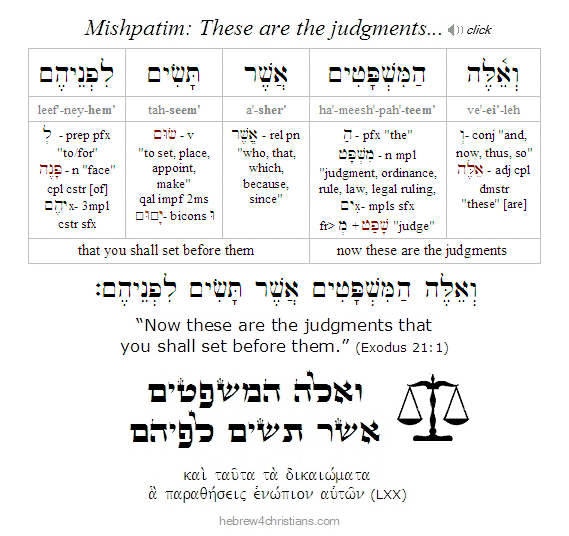
The word mishpatim means "rules" or "ordinances" and is derived from the Hebrew word shaphat ("to judge"). Parashat Mishpatim is sometimes called Sefer HaBrit ("the Book of the Covenant"), since it contains over 11.5% of all of the mitzvot (commandments) found in the entire Torah (53 of 613). These mishpatim include a wide range of civil laws, criminal laws, ritual laws, financial laws, and family laws (these civil laws are sometimes referred to as bein Adam L'Chavero - "between man and his fellow man."
For instance, slavery was socially tolerated - but it was to be practiced in a humane and orderly manner. If a Jewish male was sold into slavery as restitution for a theft, he must be freed after no more than six years of servitude. If he got married during his servitude, his master was required to support his wife and children. On the other hand, if the master gave the slave a wife during his servitude, she and the children would remain with the master after he was freed (unless the man decided to remain with them, in which case he would make a solemn declaration before a bet din (lawcourt) and have his ear bored with an awl to indicate that he is now part of the master's clan [eved nirtzah]).
If a Jewish girl was sold into slavery by her father, she was not automatically freed after six years of servitude but must be redeemed from her master (the sages state that a man could sell his daughter until she reached 12 years of age, but only if it was for her benefit, i.e., with the intent that she was to be married to her master (or the master's son). If she displeased her master, she could not be resold to a foreigner, but must be redeemed (i.e., purchased back) by her own relatives. If she was married to the master (or his son), then she was to be treated as a freeborn Jewish woman, with all of the same rights attending to that role in Jewish society.
If a master struck and killed his non-Jewish slave, he was to be punished by the bet din. However, if the slave died several days after the beating, he was not found liable, because it is assumed that he did not intend to actually kill the slave. If the slave was permanently injured by the beating, however, he was to be set free.
Some laws carried the death penalty. These included premeditated murder, cursing one's parents, kidnapping, practicing witchcraft, engaging in bestiality and offering sacrifices to idols. According to various chaza'l (Jewish sages), the famous statement ayin tachat ayin, shen tachat shen ("eye for eye, tooth for tooth") actually refers to the administration of equitable justice in redress of damages, and not corporal punishment (Bava Kama 83b).
Other laws and ordinances concern cases of personal injury, the treatment of strangers (gerim), widows and orphans; laws about loans (which must be interest-free between Jews), and various other matters including the dedication of the firstborn (bechorim) to the LORD, the prohibition of bearing false witness in courts; the restriction against eating treif (the meat of an animal torn by beasts in the field); the law of the Shemittah (7th) year (during which the land was to lie fallow); the complete abstention from work on Shabbat; the three pilgrimage festivals (shelosh regalim): Pesach, Shavuot and Sukkot; the prohibition of boiling a kid in its mother's milk (from which all sorts of restrictions were derived in the later rabbinical formulations of kashrut), and so on.
After giving these various mitzvot, the LORD promised Moses that His Angel (malakh Adonai) would guard and protect the Israelites until they arrived in the land of Canaan, but on the condition that the people obey his voice. This Angel would drive out the enemies of Israel and assure their victory in the Promised Land (as Messianic believers we hold that Malakh Adonai was none other than Yeshua the Mashiach in His pre-incarnate state).
As mediator of the covenant, Moses next reported to the Israelites all the words of the LORD and all of the mishpatim, and the people responded in unison, kol hadevarim asher diber Adonai na'eseh: "all the words which the LORD has said we will do." He then wrote down the words of the covenant (sefer habrit), built an altar at the foot of Mount Sinai with twelve pillars (one for each tribe of Israel), and ordered sacrifices to the LORD to be made. He then took the sacrificial blood from the offerings, threw half upon the altar, and read the covenant to the people. The people ratified the covenant with the words kol asher diber Adonai na'aseh v'nishma ("all that the LORD says we will do and obey"). Upon hearing their ratification, Moses took the other half of the sacrificial blood and threw it on the people saying, "Behold the blood of the covenant that the LORD has made with you in accordance with all these words."
Next, Moses, Aaron (and his sons Nadab and Abihu), and seventy of the elders of Israel ascended Mount Sinai to eat a "covenant affirmation meal" between klal Yisrael and the LORD. It was there that the elders beheld the awesome glory of Elohei Yisrael (the God of Israel), under whose feet was "a pavement of sapphires, like the very heaven for clearness."
After returning from the mountain with the elders, the LORD commanded Moses to go back up to receive luchot ha'even (the tablets of stone) inscribed with the Ten Commandments. Followed by Joshua (who remained down below), Moses re-ascended the mountain, which was still covered by a shining cloud of fire. On the seventh day there, he heard the Voice of the LORD calling to him from the midst of the cloud of glory, and then entered into the Presence of the LORD. He remained on the mountain for a total of forty days and forty nights while the Israelites waited for him at the camp down below.
A Note about the Oral and Written Torah
The Jewish sages traditionally count 53 distinct commandments in this portion of the Torah, easily making it one of the most "legalistic" (i.e., law-focused) sections of the entire Bible. Civil laws, liability laws, criminal laws, agricultural laws, financial laws, family purity laws, Sabbath laws, and holiday laws are all given in this portion. These various social and civil laws are called "mishpatim" (מִשְׁפָּטִים), the plural form of the masculine noun mishpat (מִשְׁפָּט), meaning a "judgment," "ordinance," "law" or legal ruling. The word derives from the verb shafat (שָׁפַט) meaning to judge or govern. A shofet (שׁוֹפֵט) is the Hebrew word for "judge," and the LORD is called Ha-Shofet kol ha'aretz (הֲשׁפֵט כָּל־הָאָרֶץ) -- the "Judge of all the earth" who loves justice (Gen. 18:25, 37:28, Psalm 50:6, 94:2).
In this connection we note that the application of the mishpatim became the basis for the tradition application of Jewish case law as well as for halakhah. Recall that the idea of establishing a legal system with courts, judges, and officers was derived from Yitro's advice given to Moses in last week's Torah portion: Moses chose God-fearing men from all over Israel and appointed them as leaders over the people. He put them in charge of groups of one thousand, one hundred, fifty, and ten (see Exod. 18:25).
 |
In rabbinic Jewish thinking there are actually two Torahs: The written Torah (Torah shebikhtav) and the Oral Torah (Torah sheb'al peh):
- Written Torah refers to the five books of Moses, usually taking the form of a sefer torah (torah scroll) or Chumash (book form of the first five books of Moses).
|
|
- Torah shebikhtav
|
|
- Oral Torah refers to the word-of-mouth tradition of learning something. The idea is that God first spoke words to Moses, and then Moses responded. That is, before the actual writing down of the words of God (Torah shebikhtav) there was this dialog (Torah sheb'al peh). In Rabbinic tradition, oral Torah is considered more vital than the written Torah.
|
|
- Torah sheb'al Peh
|
|
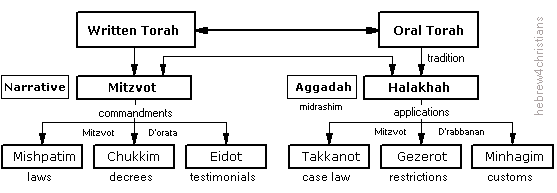
The rabbis say that oral Torah was also received by Moses from God on Mount Sinai and carries as much authority as the written Torah. However, this Torah was passed down through the centuries by word of mouth rather than the written word. Eventually this oral material was written down, beginning around the year 200 AD and culminating in the "written oral Torah" called the Talmud (תַּלְמוּד, "learning") which consists of the Mishnah (מִשְׁנָה, "repetition") and its commentary called the Gemarah (גְּמָרָה, "study"). Note that the Oral Torah is 50 times the size of the Written Torah"
 |
Because it derives from the discussions of the Mishnah, the Talmud is also traditionally called Shas (ש"ס), an acronym for shisha sedarim, the "six orders" of the Mishnah. There exist two versions of Talmud: the Jerusalem Talmud (or "Yerushalmi"), which was compiled around 350 AD, and the Babylonian Talmud, or "Bavli" (the most frequently used version), which was compiled around 500 AD.
Within the Mishnah are two different types of literature. The first is known as halachah, or legal literature. Halachic literature interprets written Torah and seeks evidence to establish judicial laws, both civil and religious, that consist of codes of behavior and religious practice and procedures (for instance, the laws of marriage and divorce, the ethics of giving charity, etc.). The second type of literature is know as Aggadah and is all material contained in the Talmud that is not halachah. It consists of the "wise sayings or tellings" of the sages. Aggadah includes stories, parables, theological or ethical statements, and homilies. Note that within the Talmud itself, both aggadah and halachah may be found mixed together, often with aggadah used to teach a principle based upon a halachic text.
Note: When Parashat Mishpatim coincides with Shabbat Shekalim, a different Haftarah portion is read (i.e., instead of Jeremiah 34:8-22; 33:25-26, we read 2 Kings 12:1-7).
|