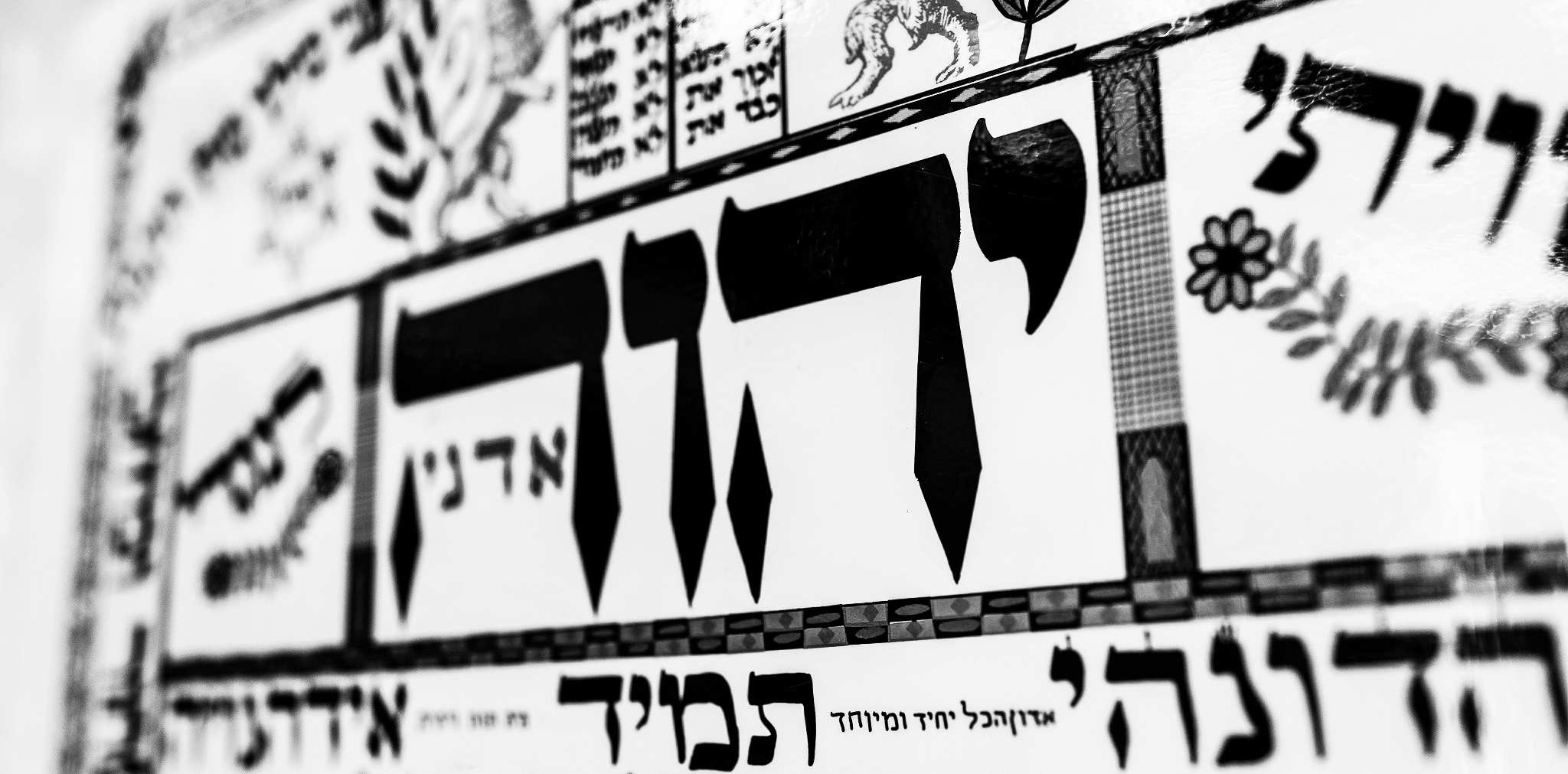
 Some people make it the business of theology to know God’s Name, but God begins by first asking for our name instead. Recall that Jacob had disguised who he really was in the hope of obtaining the blessing (Gen. 27), though his duplicity forced him into an exile that lasted until he was finally willing to be honest with himself. And like Jacob, each of us must answer God’s question: “What is your name?” (Gen. 32:27). When we “wrestle through” this question to face who we really are, we encounter God and find our blessing, that is, our true identity. Each of us has to go through the process of being renamed from “manipulator” (i.e., Ya’akov) to “one in whom God rules” (i.e., Israel). But note the order: it is only when we “tell God our name,” that is, own who we really are, that He meets with us “face to face” (Gen. 32:30). You will not be able to say, “I will not let you go unless you bless me,” until you are willing tell God your name (Gen. 32:26-27).
Let me add that while “telling God your name” can be painful and even frightening, it is not the last word about who you really are. We are faced with an inner dualism as we struggle to take account of our lives. On the one hand, we need to confess the truth of our sinfulness, brokenness, and so on, while on the other we must endure ourselves and find faith that God’s blessing nevertheless belongs to us, despite the mess we’ve made of our lives…. We have to be willing to accept God’s new name for us and to believe that God will miraculously transform our inner nature for good. We are renamed from Yaa’kov to Israel, though we still know ourselves as both. Jacob was renamed “Israel” but afterward he walked with a limp, seeing both the new and the old natures within him. Jacob still struggled, though his struggle was now focused on walking as God’s beloved child in this world: the limp was given to help him lean on the Lord for support.
Part of spiritual growth involves learning to “endure yourself.” Many are able, it seems, to receive the hope that they are forgiven for their past sins, but they are subsequently scandalized by encountering their own inner struggles, and they eventually despair over their ongoing weakness… Tragically, some are even tempted to regard the warfare within the heart as a sign of being devoid of all saving grace! We must remember, however, that there is a real struggle between the desires of the flesh and the desires of the Spirit (Gal. 5:17). We must never move away from simple trust in the message of God’s unconditional love demonstrated at the cross; we must never seek to legitimize our place in God’s heart. When we walk by the Spirit, we are no longer under the law (Gal. 5:18), which is to say, we no longer need to justify ourselves but instead trust in God’s power to transform us. Just as we are saved by the love of God, so are we changed, so do we grow.
…
Telling God your Name Podcast:

…
 From our Torah portion this week (i.e.,
 Before he could return from his exile, Jacob had to face his fears and wrestle with God. The outcome of the struggle was a blessing, as signified by a new name, “Israel” (יִשְׂרָאֵל), meaning one who who perseveres (שָׂרָה) with God (אֵל). Jacob finally prevailed with God when the power of his faith overcame the pain of his past… Jacob’s story teaches that before we can return from our place of exile, we have to face our fears and wrestle over who we really are.
 The Spirit of the LORD speaks to the heart of faith: “Fear not, for I have redeemed you; I have called you by name, and you are mine” (Isa. 43:1). God has personally redeemed you, friend; he calls you by name, and you belong to Him. Faith finds its place in God’s heart. The Lord loves you with an everlasting love (אהבת עולם) and draws you close (Jer. 31:3). He will never leave nor forsake you, even if you might face waters that seem to overwhelm or fires that seem to devour (Isa. 43:2). The will of your Heavenly Father will never lead you to a place where his love will not there sustain you.
 “Our Lord Jesus oftentimes said, ‘This I am. This I am. I am what you love. I am what you enjoy. I am what you serve. I am what you long for. I am what you desire. I am what you intend. I am all that is'” (Julian of Norwich). Amen to such beautiful words. And we should attend to stirring of our hearts, our deepest desires, since they ultimately find their end in God. As C.S. Lewis noted, our longing for a love which no experience in this world can fully satisfy is a sign that were made for God’s eternal love.
 When Yeshua said that the truth would “set us free” (ἐλευθερώσει), he was referring to the acceptance of the Witness of Divine Reality (i.e., the Word, Breath, Spirit, Voice, Message, Meaning, and Love of God) that delivers us from the lies we habitually tell ourselves (or that we receive from others). If you “persevere in my word” (μείνητε ἐν τῷ λόγῳ τῷ ἐμῷ) he said, “then you are my disciples indeed, and you will know the truth, and the truth will set you free” (ἡ ἀλήθεια ἐλευθερώσει ὑμᾶς, John 8:31-32). In other words, as we identify with his vision and redemptive mission, we will “be free indeed” from the tohu va’vohu (Gen. 1:2) – the “chaos and unreality” – that inescapably besets the way of the lie… We will be delivered from vanity and delusions of this world and its diseased affections; we will be set free from the need to justify ourselves by religion (perfectionism); we will no longer crave other people’s approval; we will not be moved by the mass media and its pressures; we will find courage to face our challenges without resorting to escapism; and we will learn how to experience peace even when we encounter frustrations.
 It is good to praise and trust in the LORD despite our afflictions, and indeed, suffering itself presents an invitation to come before God in prayer (James 5:13). Suffering offers us a nisayon (נִסָּיוֹן), a test, for our hearts to be exercised in ways otherwise rendered impossible should the path of our lives be attended without real struggle…
 The Torah teaches that a personal, all-powerful, and all-loving God exists and solely created the universe “yesh me’ayin” (יֵשׁ מְאַיִן), or out of nothing. As his crowning creative achievement, God created free moral agents – both angels and man – who could choose to do what is good or what is evil. For reasons that are not entirely clear, however, some of the angels chose to rebel against God (chief among them Lucifer, later renamed Satan), and these angels, in turn, conspired to seduce human beings to do likewise. When Adam and Eve disobeyed God’s moral law, they effectively joined the angelic rebellion. The consequence of this was catastrophic, and the mankind “fell” away from God as their King into a state of alienation and exile called “spiritual death.”
 During an intense bout of sickness that nearly took her life, Julian of Norwich said that God showed her a “little secret” about an ordinary hazelnut. As she considered the vision of the hazelnut, she wondered, “What may this be?” and God answered her heart’s pondering: “It is all that is made…”
 Many of our deepest anxieties come from the fear of death, whether we are conscious of this or not… Death represents fear of the unknown, fear of being abandoned, fear of being rejected, fear of being separated from others, and so on. I am so glad Yeshua gives us eternal life, which for me is not so much about immortality of the soul as it is being loved and accepted by God… That is what “at-one-ment” means, after all (John 17:22-23). Because God loves and accepts us, we trust Him to be present for us, even in the darkest of hours, on the other side of the veil, where he there “prepares a place for us” (John 14:2). As Yeshua said, “I tell you the solemn truth, the one who hears my message and believes the One who sent me has eternal life (חַיֵּי עוֹלָם) and will not be condemned, but has passed (i.e., μετά + βαίνω, lit., “crossed over” [עָבַר]) from death to life” (John 5:24). God’s love “crosses over” from death to life and now forever sustains me.