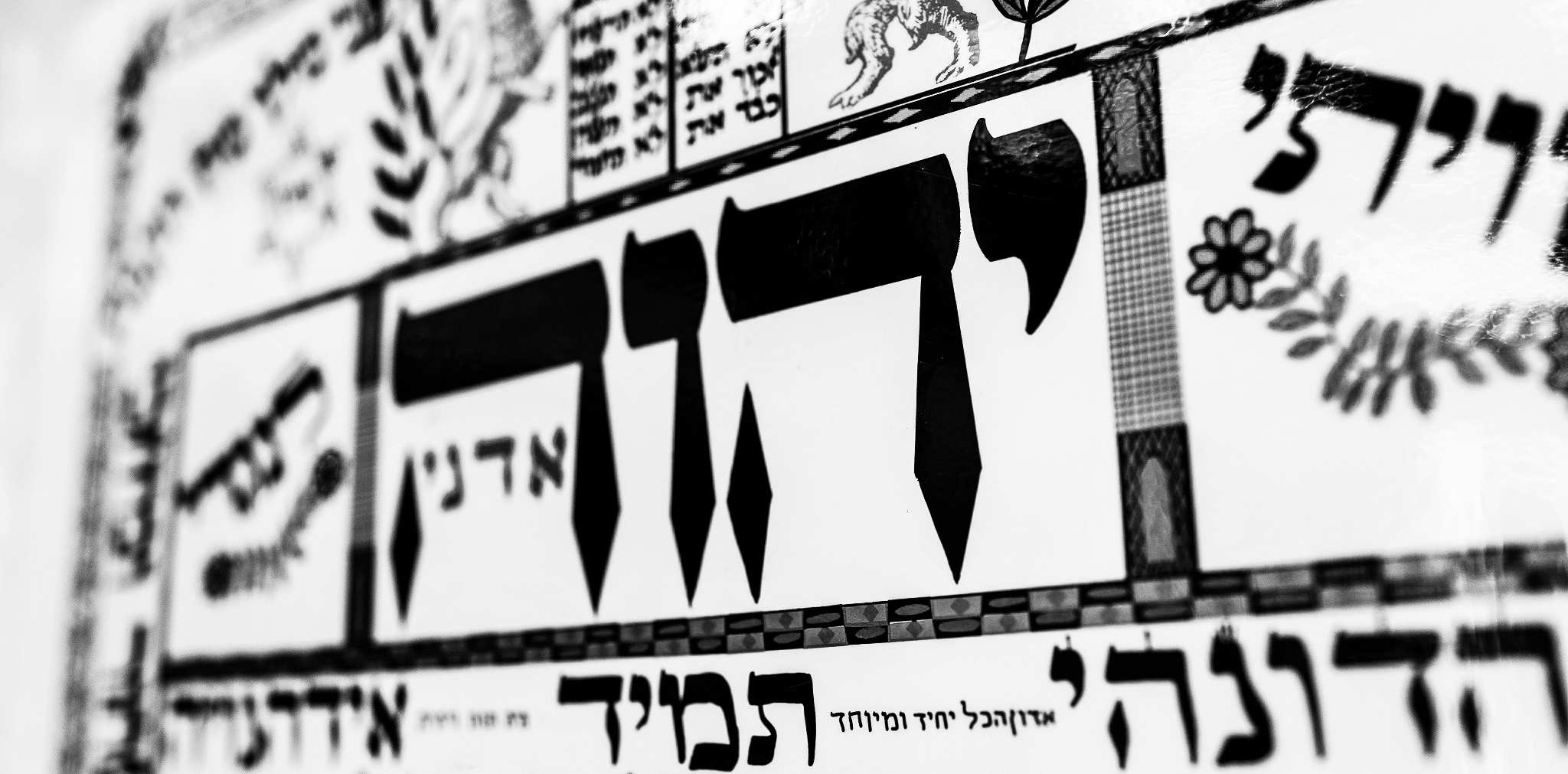
In the Scriptures God’s Name is revealed as YHVH (יְהוָה), which means “He is Present.” The Name is formed from the words hayah (“He was”), hoveh (“He is”), and yihyeh (“He will be”): הָיָה הוֶה וְיִהְיֶה, indicating God’s omnipresence. Note that all the letters of the Name are “vowel letters,” which mean they evoke breath and life. This is the Name revealed to Moses thousands of years before the advent of other religions (Exod. 3:14), and indeed it is the Name associated with the nishmat chayim (נִשְׁמַת חַיִּים), the “breath of life,” imparted to Adam in the orchard at Eden (Gen. 2:4). It is therefore the original Name of God “breathed out” to mankind. The Name Yeshua (יֵשׁוּעַ) means “YHVH saves.” There is no other Savior beside Him, there is no other Name, there is no other LORD. “For I am the LORD your God, the Holy One of Israel, your Savior.” Only Yeshua the Messiah can deliver you from the wrath to come (1 Thess. 1:10).
Many people live in regret over the past or in dread of the future. The Hebrew name of God, the Tetragrammaton (יהוה), means: “He is Present.” We can only find God now, today, at this hour. Today if you hear His voice… Yeshua said, “The kingdom of heaven is within you” (מַלְכוּת הָאֱלהִים בְּקִרְבְּכֶם), that is, is to be found within the heart of faith (Luke 17:21).
The question is asked why the Torah was written without vowels, punctuation marks, and so on. The lack of vowels implies that we must bring breath (i.e., ruach, spirit) to our reading of the words; the lack of punctuation implies that we must be humble and rely on others to help us read with understanding. In other words, we must bring our heart to the reading and be open-minded to receive revelation.
We need the power of the Holy Spirit to read correctly, and the Holy Spirit reveals the Living Word and glory of Yeshua: “It is the Spirit who gives life; the flesh is no help at all. The words that I have spoken to you are spirit and life” (John 6:63).
It is written in our Torah: “Take care, lest you forget the covenant of the LORD your God, which he made with you, and make a carved image, the form of anything that the LORD your God has forbidden you… ‘You shall not make for yourself a carved image (לא־תַעֲשֶׂה־לְךָ פֶסֶל) or any likeness of anything that is in heaven above, or that is on the earth beneath, or that is in the water under the earth” (Deut. 4:23; 5:8). Literally this refers to the ancient practice of bowing before “mediating forces” of God, often symbolized by art and ritual, as a token of respect or as a means of finding “acceptance” within a group. We are not to imitate such customs of the pagan world around us; on the contrary, we testify of the One True God and repudiate the need for intermediaries between God and man… On a different level, “bowing before an idol” means passively yielding to the world and its ideals rather than submitting to the truth. When we seek to fit in, to feel like we belong, and follow the trends and passions of the crowd, we express idolatry of heart. Most intimately, an idol is a source of desire, happiness, and security apart from the LORD. Your “god” is whatever your heart admires, follows and loves… If you have “other gods” before the LORD, then something is wrong, since we were created by God to find life in Him alone. “Surely you don’t think the Scripture speaks vainly when it says: the spirit which He sent to live in us wants us for himself alone?” (James 4:5) “Grace will save a man… but it will not save him and his idol” (A.W. Tozer). Therefore, my dear friends, flee from idolatry (1 Cor. 10:14).
It is written in our Torah, “The LORD your God will return as you return (ושׁב יהוה אלהיך את־שׁבותך), and will have mercy upon you, turning to gather you back…” (Deut 30:3). This has both a present and prophetic application. First, in the present hour, if you turn to God, he will show you compassion, and he will “gather back” all those distant and fragmented parts of yourself into shalom and wholeness. He will restore your lost days; he will bring you out of exile and give you comfort in Yeshua. He makes all things new. “Draw near, therefore to God, and he will draw near to you” (James 4:8). Second, the LORD will return to earth as the Jewish people return from their captivity, and he will restore Zion during the time of the final redemption. The LORD will turn captivity into mercy; he will turn in his compassion to his people. As it is written: “I will be found by you, declares the LORD… (והשׁבתי אתכם אל־המקום) and I will bring you back to the place…” (Jer. 29:14).
The language of the Torah here is emphatic: “even if your exile is at the farthest edge of heaven (בקצה השמים), from there the LORD your God will gather you…” (Deut. 30:4). Note that this prophecy is written in the singular and therefore pertains to each individual exile. God will “gather you,” that is, he bring you back to make you whole. Even if your exile (singular) is to the uttermost, the LORD will take you and deliver you, as it is written, “He is able to save to the uttermost (σῴζειν εἰς τὸ παντελὲς) those who draw near to God through him, since he always lives to make intercession for them” (Heb. 7:25). As long as you have breath within you and an iota of hope in Him, God will bring you through the darkness.
No one wants to admit that they are needy, broken, weak, and so on, and indeed such a confession is blasphemy to the heart of the proud. The truth, however, is that we are indeed all these things, and Yeshua told us we were blessed if we understood this (Matt. 5:3-6). The is great danger to pretend you are strong and capable of living life on your own terms, since eventually you will be blindsided by the truth about your condition. On the other hand, the confession of our weakness opens the way to God’s power, as Yeshua said to Paul in his affliction: “My grace is sufficient for you, for my power is made perfect in weakness” (2 Cor. 12:9). Paul came to see that the various trials and afflictions in his life taught his profound dependence on God: “for when I am weak, then I am strong.”
Access to this grace, however, comes at the expense of our pride. We must humbly confess who and what we are, and therefore we must entirely abandon hope in our own strength and virtues. “We are only as sick as the secrets we keep,” especially those secrets we keep from ourselves – those self-deceptions and illusions we use to defend ourselves.
Suppose, for instance, that you have the bad habit of complaining and even cursing when you are beset by troubles, and you want to stop doing these behaviors. You may resolve to be more optimistic and grateful, or you may read self-help books — or even take anger management classes — but nothing will do you any lasting good until you know “in your bones” that you are powerless to change your heart. That is the first step to being set free. Or suppose that you are habitually unhappy, troubled, anxious, and in pain, yet you want to find inner peace and joy. Again, apart from the miracle of God there is no lasting remedy. You must be honest with yourself and confess the truth of your condition, asking God to do in you what you cannot do for yourself. As Yeshua said: “What is impossible with man is possible with God.” So in this way God uses your sins to correct you or bring you to the end of yourself, and in that way awareness of your personal weakness is a blessing from God.
Do you sometimes have trouble trusting God? Do you wrestle with fear, anxiety, or worry? Does an inexplicable dread or sense of hopelessness sometimes oppress you? Do you secretly wonder what’s wrong with you – and whether you are truly saved, after all? Please hang on. Doubting and questioning are often a part of the journey of faith, and we don’t have to be afraid of our questions, concerns, and difficulties… Being full of “certainty” is not the same as being full of faith, after all, since many sincere people are sincerely self-deceived, while many others experience fear, loneliness, and trouble as a result of their faith. There is so much we simply do not know, and it is dishonest to pretend otherwise. God knows your heart and its struggles; he knows all your secret fears. Thankfully, there is a special prayer included in the holy Scriptures for those times when we feel especially unsteady or insecure: “Lord, I believe, help thou my unbelief…” (Mark 9:24) Here we may bring our (lack of) faith to God for healing….
We should not be scandalized that we sometimes struggle with our faith. After all, Yeshua constantly questioned his disciples: “Do you now believe?” (John 16:31). And that’s why we are commanded to “put off” the old nature and to “put on” the new nature — because God knows we are fickle admixtures, contradictions, carnal-yet-spiritual, inwardly divided souls that need to learn to trust in the miracle of God with all our hearts….
Of course it’s easy to believe when things are going well, when faith “makes sense” or provides you with a sense of community, etc., but when things are difficult, when there are disappointments, pain, grief, losses, etc., then you need to trust in the unseen good, the “hidden hand” of God’s love, despite the trouble of your present circumstances. This is part of faith’s journey: leaning on God’s care, despite the “valley of the shadow of death,” despite the tests… The way may sometimes be difficult, but “the tested genuineness of your faith — more precious than gold that perishes though it is tested by fire — will be found to result in praise and glory and honor at the revelation of Yeshua the Messiah” (1 Pet. 1:7).
Our Torah portion this week (i.e., parashat Kedoshim) reveals that the “appointed times” (i.e., mo’edim: מוֹעֲדִים) were given by God to help us turn away from the omnipresent urge within the human heart to embrace vanity: “Every one of you shall revere his mother and his father and guard (שָׁמַר) my Sabbaths (שַׁבְּתתַי)… Do not turn to worthlessness (i.e., אֱלִיל) or make for yourselves any molten gods” (Lev. 19:3-4). In other words, the Biblical holidays – including the weekly Shabbat, the monthly Rosh Chodesh, and so on – were intended to help us to sanctify (“set apart,” “make holy”) the times and seasons in order to remind us of God’s Presence (Psalm 104:19). Therefore they are called mikra’ei kodesh (מִקְרָאֵי קדֶשׁ), “times in which holiness is proclaimed” (Lev. 23:2).
The Torah’s declaration that these days are holy implies that they are set apart for special activities, such as celebrating God as our Creator (Shabbat), our Redeemer (Passover), our Resurrection (Bikkurim/Firstfruits), our Lawgiver (Shavuot/Pentecost), our King (Teruah/Rosh Hashanah), our High Priest (Yom Kippur/Day of Atonement), our Shelter (Sukkot/Tabernacles), and so on. In this connection it should be noted that it is a mistake to assume that the divine calendar was somehow abrogated after the cross of Yeshua, since all of the Jewish holidays center on Him, and indeed the advent of the Ruach Ha-Kodesh (Holy Spirit) occurred after his resurrection following the 49-day countdown to the jubilee of Shavuot (see Acts 1:8; 2:1-4).
It is written in our Scriptures: “The wicked in his proud countenance does not seek; God is not in any of his thoughts” (Psalm 10:4). Indeed the willful denial of reality is an affront to heaven, contempt shown for the gift of life, and sacrilege of all that is worthy (Psalm 14). It is sheer folly to regard life apart from the fear of the LORD, for that is reishit chokhmah – “the beginning of wisdom” (Psalm 111:10).
The existence of God is the First Principle of all sound reasoning regarding reality. The so-called “postmodern world” is notorious for failing to explain anything of substantive meaning. Everything is left unexplained; no “narrative” is permitted (except the dogmatic narrative that there is no narrative, of course); no logical connections to a “real world” are sound; there is no “story” to our lives, and therefore postmodernism entirely misses the essential point of everything.
King David asked, “Who shall abide before the Presence of the LORD?” and the Spirit replied: “the one who walks blamelessly and does what is right and speaks truth in his heart” (Psalm 15:2). It is the one who is honest – “the one who speaks truth within his heart” (דבֵר אֱמֶת בִּלְבָבוֹ) that dwells in the “tent of the LORD,” for God is called the God of Truth (אֵל אֱמֶת), the Faithful God (אֵל אֱמוּנָה).
In heaven there is only the language of truth, and truth is the language of heaven. The “pure in heart” – that is, those who accept the truth of their inner condition, who acknowledge their lost condition, mourning over their lives, and who humbly find themselves starving for God’s deliverance – these are the ones who shall behold God (Matt. 5:2-6).
In this connection Blaise Pascal wrote: “I can feel nothing but compassion for those who sincerely lament their doubt, who regard it as the ultimate misfortune, and who, sparing no effort to escape from it, make their search their principal and most serious business. But as for those who spend their lives without a thought for this final end, I view differently. This negligence in the matter where they themselves, their eternity, their all are at stake, fills me more with irritation than pity: yea, it astounds and appalls me…” (Pascal: Pensees).
In the Torah we are told to count forty nine days – seven weeks of days – from the day following Passover until Shavuot (i.e., Weeks or “Pentecost”). This period of time is called Sefirat HaOmer (ספירות העומר), or the “counting the [barley] sheaves” (see Lev. 23:15-16; Deut. 16:9). In somewhat abstract terms, it’s as if there is a dotted line pointing directly from Passover to Shavuot – a “Jubilee” of days – representing the climax of Passover itself. The early sages identified this climax as the revelation of the Torah at Sinai — which indeed did happen exactly 49 days after the Passover in Egypt — but the New Testament identifies it as the outpouring of the Holy Spirit (רוח הקודש) that ratified the reality of the New Covenant of God at Zion. In other words, the redemption process that began at Passover was therefore completed at Shavuot, and that “completion” was the revelation of God’s love and deliverance for the entire world. And though the Jewish sages did not fathom the use of the otherwise forbidden leaven in the offering (see Lev. 2:11), prophetically the waving of two loaves during Shavuot pictured the “one new man” (composed of both Jew and Gentile) standing before the altar of the LORD (Eph. 2:14).
The countdown to Shavuot therefore goes beyond the giving of Torah at Sinai and points to the greater revelation of Zion. Shavuot is the fulfillment of the promise of the Holy Spirit’s advent to those who are trusting in Messiah (Acts 2:1-4). “Counting the Omer,” then, is about receiving the Holy Spirit to experience and know the resurrected LORD of Glory. You can “count” on that, chaverim!
In this connection note again that the climax of the 49 days was not the giving of the law at Sinai (i.e., matan Torah), but rather the revelation of the altar (i.e., the“Tabernacle”) and its subsequent fulfillment in the sacrificial death of Yeshua as our Lamb of God. Moreover, it was during this time that Yeshua made His post-resurrection appearances to His disciples and indeed ascended to heaven during this period… Of particular importance is 1) the beginning of the count of the omer since it signified the waving of the firstfruits and therefore the resurrection of Yeshua (1 Cor. 15:20); 2) the 40th day of the Omer (Mem B’Omer), when Yeshua ascended back to heaven, and 3) the climactic 49th day of the Omer (Shavuot) when the Holy Spirit was given to the disciples in fulfillment of the promise of Yeshua that we would not be left comfortless (Acts 2:1-4). Shavuot, then, marks the time of “Jubilee” of the Spirit, when are clothed with power to serve the LORD without fear…
Note: Some people get a bit “OCD” about the 49 day countdown, making it into a religious ritual with “kabbalistic” overtones, but the Torah simply says to count down the days until Shavuot, or Pentecost, since this has major implications regarding the advent of Messiah and the promise of the New Covenant…. For more on this subject, see: “Sefirat HaOmer: Counting the Sheaves to Shavuot.“
The name for ancient Egypt in Hebrew is “mitzrayim” (מִצְרַיִם) a word that can be translated as “straits” or “narrow places” (i.e., -מ, “from,” and צַר, “narrow”), suggesting that “Egypt” represents a place of constriction, tribulation, oppression, slavery, and despair. The Hebrew word for salvation, on the other hand, is “yeshuah” (יְשׁוּעָה), a word that means deliverance from restriction, that is, freedom and peace. As it is written: “From my distress (מִן־הַמֵּצַר), i.e., from “my Egypt,” I cried out to the LORD; the LORD answered me and set me in a wide open place” (Psalm 118:5).
But why, it may be asked, did God tell Jacob: “Do not be afraid to go down to Egypt” (Gen. 46:3)? Why did God allow this excursion into “heavy darkness” that Abraham clearly foresaw (Gen. 15:12-13)? What is there about “Egypt” that prepares us to take hold of our promised inheritance? Joseph become a prince of Egypt; however, he was still captive to Pharaoh, and later, after he died, a “new Pharaoh arose” that did not acknowledge his contribution to Egyptian history (Exod. 1:8). All that remained of Joseph were his bones – a chest of bones that were carried out by Moses (and later buried by Joshua in Shechem). The “bare bones” of Joseph represented the essence of his faith, as he foresaw the time when God would rescue the family from Egypt and raise him up in the land of promise (Gen. 50:24-26; Heb. 11:22).
A general principle of spiritual life is that the “the way up is the way down” (John 12:24). As Yeshua said, “Whoever would be first among you must be slave of all” (Mark 10:44). Becoming nothing (i.e., ayin) in this world is the condition for seeing something in the world to come. Unless a seed falls to the ground it abides alone (John 12:24). But we become “nothing” by trusting in the promise of God, not by trying to do it ourselves…
The purpose of life here below is to carry us to the highest degree of taedium vitae (“weariness of life”). When God does everything to rob a person of any inclination to live, yet that person persists in faith that God is love, such a one has become ripe for eternity.” – Kierkegaard, Journals (July 2, 1855)
This is not another venture of the ego. Life in the Spirit means trusting that God will do within you what you cannot do for yourself, to set you free from the bondage of yourself… From our point of view we take hold of what God has done for us by “letting go” of our own devices (Phil. 2:13); we let go and trust and are carried by the “Torah of the Spirit of life” (i.e., תּוֹרַת רוּחַ הַחַיִּים, Rom. 8:2). From heaven’s point of view God administers “severe mercy” by afflicting us with vanity, trails of various kinds, lamentation, and disquiet of heart, in order to turn us away from all we desire or hope to find in this life as our good. Such “taedium vitae” is a great gift to the trusting soul, even if (at the present time) it may seem to suggest the distance and disregard of God’s own heart.
The way is not trying but trusting; not struggling but resting; not clinging to life, but letting go… allowing trouble to pass as dark shadows that flit over the vista of transience.
God’s way of deliverance is entirely different than man’s way. Man tries to enlist carnal power in the battle against sin (i.e., religion, politics, etc.), but God’s way is to remove the flesh from the equation. The goal is not to make us stronger and stronger, but rather weaker and weaker, until the ego is crucified and only the sufficiency of the Messiah remains. Then we can truly say, “I have been crucified with Messiah. It is no longer I who live, but the Messiah who lives in me. And the life I now live in the flesh I live by faith in the Son of God, who loved me and gave himself for me” (Gal 2:20). The word “Hebrew” (עִבְרִי) means one who has “crossed over” (עָבַר) to the other side, as our father Abraham did when he left the world of Mesopotamia (Gen. 14:13). Likewise it is on the other side of the cross that we experience the very power that created the universe “out of nothing” (i.e., yesh me’ayin: יֵשׁ מֵאַיִן) and that raised Yeshua the Messiah from the dead.
The receiving of the Torah (קבלת תורה) must take place each and every day, as it says, “Trust in the LORD ‘bekhol libekha’ (בְּכָל־לִבֶּךָ) – with all your heart; and know Him ‘bekol derakhekha’ (בְּכָל־דְּרָכֶיךָ), in all your ways” (Prov. 3:5-6). The revelation of Torah is described as a “loud and never-ending voice” (Deut. 5:22), though it is our constant responsibility to “shema” – to take heed and receive the invitation of God’s heart.
It is written in our Scriptures: “Trust in the LORD with all your heart, and do not rely on your own understanding” (Prov. 3:5). The Hebrew word for trust is “bittachon” (בִּטָחוֹן), from a root word (בָּטָח) that means “to lean upon,” to feel safe and secure (Psalm 31:19). Bittachon expresses the emotional conviction that you are welcome and accepted before God, and that you have access to his heart (Heb. 4:16; 1 Pet. 5:7). We trust with “all of our heart” when we let go of our need to control (or understand) things and instead rely on God’s ability to take care of us. Trusting God means knowing “in your kishkas,” that is, in your guts, that God is taking care of you (Rom. 8:28); it is the comfort of being made safe in his love…
“In all your ways know Him, and he will direct your paths” (Prov. 3:6), and that means you are to know God in whatever “way” you happen to find yourself in, which includes ways of joy and happiness, but also ways of struggle, ways of sinfulness, and ways of heartache… In all these ways we are to know him…. And just as we are to trust God with all of our heart and abandon ourselves to his care, so we are “know God” in all our goings, opening our heart to his loving presence and trusting in his guidance for our lives. The Good Shepherd will lead us down the right paths for the sake of his beautiful name (Psalm 23:3). Amen.
 In the Scriptures God’s Name is revealed as YHVH (יְהוָה), which means “He is Present.” The Name is formed from the words hayah (“He was”), hoveh (“He is”), and yihyeh (“He will be”): הָיָה הוֶה וְיִהְיֶה, indicating God’s omnipresence. Note that all the letters of the Name are “vowel letters,” which mean they evoke breath and life. This is the Name revealed to Moses thousands of years before the advent of other religions (Exod. 3:14), and indeed it is the Name associated with the nishmat chayim (נִשְׁמַת חַיִּים), the “breath of life,” imparted to Adam in the orchard at Eden (Gen. 2:4). It is therefore the original Name of God “breathed out” to mankind. The Name Yeshua (יֵשׁוּעַ) means “YHVH saves.” There is no other Savior beside Him, there is no other Name, there is no other LORD. “For I am the LORD your God, the Holy One of Israel, your Savior.” Only Yeshua the Messiah can deliver you from the wrath to come (1 Thess. 1:10).

 It is written in our Torah: “Take care, lest you forget the covenant of the LORD your God, which he made with you, and make a carved image, the form of anything that the LORD your God has forbidden you… ‘You shall not make for yourself a carved image (לא־תַעֲשֶׂה־לְךָ פֶסֶל) or any likeness of anything that is in heaven above, or that is on the earth beneath, or that is in the water under the earth” (Deut. 4:23; 5:8). Literally this refers to the ancient practice of bowing before “mediating forces” of God, often symbolized by art and ritual, as a token of respect or as a means of finding “acceptance” within a group. We are not to imitate such customs of the pagan world around us; on the contrary, we testify of the One True God and repudiate the need for intermediaries between God and man… On a different level, “bowing before an idol” means passively yielding to the world and its ideals rather than submitting to the truth. When we seek to fit in, to feel like we belong, and follow the trends and passions of the crowd, we express idolatry of heart. Most intimately, an idol is a source of desire, happiness, and security apart from the LORD. Your “god” is whatever your heart admires, follows and loves… If you have “other gods” before the LORD, then something is wrong, since we were created by God to find life in Him alone. “Surely you don’t think the Scripture speaks vainly when it says: the spirit which He sent to live in us wants us for himself alone?” (James 4:5) “Grace will save a man… but it will not save him and his idol” (A.W. Tozer). Therefore, my dear friends, flee from idolatry (1 Cor. 10:14).
 It is written in our Torah, “The LORD your God will return as you return (ושׁב יהוה אלהיך את־שׁבותך), and will have mercy upon you, turning to gather you back…” (Deut 30:3). This has both a present and prophetic application. First, in the present hour, if you turn to God, he will show you compassion, and he will “gather back” all those distant and fragmented parts of yourself into shalom and wholeness. He will restore your lost days; he will bring you out of exile and give you comfort in Yeshua. He makes all things new. “Draw near, therefore to God, and he will draw near to you” (James 4:8). Second, the LORD will return to earth as the Jewish people return from their captivity, and he will restore Zion during the time of the final redemption. The LORD will turn captivity into mercy; he will turn in his compassion to his people. As it is written: “I will be found by you, declares the LORD… (והשׁבתי אתכם אל־המקום) and I will bring you back to the place…” (Jer. 29:14).
 No one wants to admit that they are needy, broken, weak, and so on, and indeed such a confession is blasphemy to the heart of the proud. The truth, however, is that we are indeed all these things, and Yeshua told us we were blessed if we understood this (Matt. 5:3-6). The is great danger to pretend you are strong and capable of living life on your own terms, since eventually you will be blindsided by the truth about your condition. On the other hand, the confession of our weakness opens the way to God’s power, as Yeshua said to Paul in his affliction: “My grace is sufficient for you, for my power is made perfect in weakness” (2 Cor. 12:9). Paul came to see that the various trials and afflictions in his life taught his profound dependence on God: “for when I am weak, then I am strong.”
 Do you sometimes have trouble trusting God? Do you wrestle with fear, anxiety, or worry? Does an inexplicable dread or sense of hopelessness sometimes oppress you? Do you secretly wonder what’s wrong with you – and whether you are truly saved, after all? Please hang on. Doubting and questioning are often a part of the journey of faith, and we don’t have to be afraid of our questions, concerns, and difficulties… Being full of “certainty” is not the same as being full of faith, after all, since many sincere people are sincerely self-deceived, while many others experience fear, loneliness, and trouble as a result of their faith. There is so much we simply do not know, and it is dishonest to pretend otherwise. God knows your heart and its struggles; he knows all your secret fears. Thankfully, there is a special prayer included in the holy Scriptures for those times when we feel especially unsteady or insecure: “Lord, I believe, help thou my unbelief…” (Mark 9:24) Here we may bring our (lack of) faith to God for healing….
 Our Torah portion this week (i.e.,
 It is written in our Scriptures: “The wicked in his proud countenance does not seek; God is not in any of his thoughts” (Psalm 10:4). Indeed the willful denial of reality is an affront to heaven, contempt shown for the gift of life, and sacrilege of all that is worthy (Psalm 14). It is sheer folly to regard life apart from the fear of the LORD, for that is reishit chokhmah – “the beginning of wisdom” (Psalm 111:10).
 In the Torah we are told to count forty nine days – seven weeks of days – from the day following

 The name for ancient Egypt in Hebrew is “mitzrayim” (מִצְרַיִם) a word that can be translated as “straits” or “narrow places” (i.e., -מ, “from,” and צַר, “narrow”), suggesting that “Egypt” represents a place of constriction, tribulation, oppression, slavery, and despair. The Hebrew word for salvation, on the other hand, is “yeshuah” (יְשׁוּעָה), a word that means deliverance from restriction, that is, freedom and peace. As it is written: “From my distress (מִן־הַמֵּצַר), i.e., from “my Egypt,” I cried out to the LORD; the LORD answered me and set me in a wide open place” (Psalm 118:5).
 The receiving of the Torah (קבלת תורה) must take place each and every day, as it says, “Trust in the LORD ‘bekhol libekha’ (בְּכָל־לִבֶּךָ) – with all your heart; and know Him ‘bekol derakhekha’ (בְּכָל־דְּרָכֶיךָ), in all your ways” (Prov. 3:5-6). The revelation of Torah is described as a “loud and never-ending voice” (Deut. 5:22), though it is our constant responsibility to “shema” – to take heed and receive the invitation of God’s heart.