|
|
 |
|
|
|
|
Weekly Torah Reading
|
|
|
|
Parashat Ha'azinu ("Give ear!")
|
|
|
Click on the links to display the Scriptures:
|
|
|
|
|
|
|
|
Torah Reading Overview
|
|
|
|
In last week's parashah (Vayeilech), Moses finished his long address to the people of Israel and commissioned Joshua to be his successor. The LORD then foretold that after Moses' death the Israelites would "whore after foreign gods" and break covenant with Him. In light of this, Moses was instructed to teach the Israelites a great prophetic song called the "Ha'azinu."
|
|
|
|
|
|
|
|
|
The Ha'azinu is one of two songs in the Torah attributed to Moses, the other being Shirat ha-yam (the Song of the Sea) in Exodus 15. Unlike the earlier song of praise to the LORD for the great miracle of redemption, this song functions as a "witness" to testify against the Israelites, and is intended to prophetically teach the people about the dire consequences of apostasy from the LORD. The words of the later prophets, especially Jeremiah and Isaiah, may have been modeled after Moses' great song recorded in this chapter of Torah.
Note that since Ha'azinu is always read during the High Holidays, often during Shabbat Shuvah ("the Sabbath of Return"), it is therefore sometimes the last portion of the Torah Reading Cycle for the year (the final portion, Zot Ha-Berakhah, is only read on Simchat Torah). The sages make the connection: Even though from the beginning of our history we have abandoned God and have been punished, our punshment always comes to an end and atonement is provided for the Jewish people. Therefore we must return to the LORD, who has makes atonement (kapparah) for us...
Moses begins his great oracular song by calling upon the heavens and the earth to be witnesses to his prophetic warnings. He then contrasts the LORD's faithfulness with the corrupt ways of His chosen nation. If the children of Israel would simply inquire of the older generation, they would understand how the LORD had chosen them from among all the nations to be His own special witnesses in all the earth. But "Jeshurun grew fat, forsook the God who made him, and spurned the Rock of his salvation." Therefore, the LORD hid His face from Israel and declared:
They have made me jealous with what is no god; they have provoked me to anger with their idols. So I will make them jealous with those who are no people (בְּלא־עָם); I will provoke them to anger with a foolish nation (בְּגוֹי נָבָל). (Deut. 32:21)
Moreover, on account of their disobedience, the LORD would drive them into galut (exile) by sword and persecution. Both young and old will be ravaged by disease and the cruelty of many enemies. In fact, were it not for the LORD's concern for His reputation among the nations, He would have finally destroyed the Jews from the face of the earth (Deut. 32:26-27). Israel should, therefore, realize that it only through the LORD's gracious providence that they are sustained as a people to this very day.
Despite the calamities and misfortunes the Jewish people would suffer during their long exile, the Ha'azinu ends with the promise that the LORD would avenge the blood of His servants and be finally reconciled with his chosen people and the land given to Abraham. God's faithful love for the people of Israel is assured. The portion ends with the Moses ascending Mount Nebo so that he could see the Promised Land before he died.
 |
Note: In v32:44 we read that Moses and Joshua taught the ha'azinu to Israel, though the text reads Hoshia bin Nun instead of Yehoshua in this verse. According to Rashi, the Torah calls Joshua by his former name (i.e., the name before it was changed to Yehoshua just before the Sin of the Spies) to reveal his great humility. This interpretation agrees with the significance of the Yod that was appended to his name. When Moses finished reciting the song, he told the people to take his warnings to heart and to admonish their children, for their very life at stake (Deut. 32:45-47).
כִּי לא־דָבָר רֵק הוּא מִכֶּם כִּי־הוּא חַיֵּיכֶם
וּבַדָּבָר הַזֶּה תַּאֲרִיכוּ יָמִים עַל־הָאֲדָמָה
kee-lo-da·var rek hoo mee·kem, kee-hoo chai·ye·khem
oo·va·da·var haz·zeh ta·a·ree·khoo ya·meem al-ha·a·da·mah

"For it is no empty word for you, but your very life,
and by this word you shall live long in the land"
(Deut. 32:47)
|
|
|
 |
|
|
|
You're always listening
to someone...
|
|
|
|
|
Every year just after the solemn time of Rosh Hashanah we read parashat Ha'azinu, the great prophetic song that Moses was commanded to teach the Jewish people before he died. In the Sefer Torah (Torah Scroll), the song is written in a stylized two-column format with extra spaces. Each line of the shirah (song) is matched by a second, parallel unit (Talmud: Shabbat 103b).
 |
Ha'azinu reminds us that who we listen to ultimately decides our fate. It begins, "Give ear, O heavens (הַאֲזִינוּ הַשָּׁמַיִם), and I will speak, and let the earth hear (וְתִשְׁמַע הָאָרֶץ) the words of my mouth" (Deut. 32:1). The appeal to heaven and earth as "witnesses" links man's condition within the divinely decreed order of the universe. We are "bound" by the witness of heaven (special revelation) and earth (natural revelation), two entirely faithful testimonies of Reality. The song is didactic, intended to teach us something. It begins quietly: "like gentle rain upon the tender grass, and like showers upon the herb...." The Spirit here appeals to the humble to drink in the message given from above. Heed first the kol demamah dakkah, the "still small voice" (קוֹל דְּמָמָה דַקָּה) and receive the proclamation of the Name of the LORD and His greatness (Deut. 32:3, see also Exod. 34:6-7). Understand His attributes (middot): the LORD is the Rock (הַצּוּר), his deeds are perfect, and all His ways are just. He is the Faithful God, without iniquity, forever true and upright (Deut. 32:3-4).
The world has its message or its "song," chaverim, which is invariably focused on fear and egotistic self-preservation. We are tempted, are we not, to listen and accept such propaganda without serious reflection.... After all, we are always listening to someone, but the all-important question is to whom? The inner voice of your soul gets its messages from somewhere. Tragically, many of our opinions are formed by heeding to the "voice of the world," i.e., the crowd, the songs and movies of pop culture, and especially the propaganda (um, "news") that is designed to manipulate and enslave the masses....
Who are you listening to? The word ha'azinu (הַאֲזִינוּ) comes from verb azan (אָזַנ), as does the Hebrew word for "ear" (i.e., ozen: אזֶן). The Midrash Rabbah says that the ear (אזֶן) gives life to all the organs of the body. How so? By listening (שׁמע, shema) to the Torah. This idea is repeated in the New Testament: "Faith comes from listening to the Word of God" (Rom. 10:17). The Word of God (דְּבַר־אֱלהִים) is our very life, chaverim. Listening to other voices (regardless of how seemingly well-intended) means cutting yourself off from the Source of life itself.... Hearing and obeying are linked, and "hearing" the messages of this corrupt world can eventually make you into an enemy of God Himself (James 4:4). The world always speaks its message to members of its "crooked and twisted generation" (Deut. 32:5). How else do politicians gain their audiences?
So what's the message of this prophetic song? What's it all about? Well, Ha'azinu is essentially about Israel's history: past, present and future. It begins with Creation itself and the establishment of the 70 nations (Deut. 32:7-8). It goes on to say that the LORD chose Israel as the "portion" of His people (Deut. 32:9). God found them in a desert land and protected them "as the pupil of His eye" (v.10). He was like an eagle brooding over its nest, "fluttering over its young," covering them with its wings, and carrying them over the high places. In poetic terms, the LORD suckled them with "honey out of the rock" and fed them the fat of lambs (v. 11-14).
But Jeshurun (יְשֻׁרוּן, a term of endearment for Israel from yashar, meaning "upright") "grew fat and kicked," forsaking the God who made him, and "made fun of" (נבל) the Rock of his Salvation (צוּר יְשֻׁעָתוֹ) (v. 15). Israel then turned to other so-called gods, even sacrificing to demons ("no-gods"), disregarding the message of the fathers (v. 17). Israel "forgot" the LORD who gave them life (v. 18). This provoked Him to "hide His face from them" (see the article on hester panim, the Divine Absence, for more information). The Jews would be sent into exile and provoked relentlessly by a "nation of fools" (Deut. 32:21; see Rom. 10:19, Hos. 1:9-10) -- perhaps an ironic play on Israel's "making fun of" the Rock. Misfortune and disaster would be the reward of their forgetfulness. Indeed, God would have destroyed Israel completely were it not for the sake of His Name and reputation among the nations (v. 26-27). The LORD, however, would never allow Israel's enemies to think their strength was behind His chastisement of His people.... No, and despite their worldly claims to the contrary, their Day of Calamity is soon at hand: God Himself will exact vengeance and recompense upon the nations in the latter days (v. 35).
In the "end of the End of Days," when God sees "that their power is gone and nothing is left," He will recall His mercy and pour out comfort upon His people Israel. Then He will judge the earth and the dreadful "Day of the LORD" (יוֹם יְהוָה) will come. The nations will be judged with catastrophic judgments (v. 37-43). God will avenge the blood of His children, repay all those who hate Him, and atone for Israel (וְכִפֶּר) on that great and awesome day (v. 43). This is ultimate fulfillment of Yom Kippur, friends....
Are you listening, chaverim? Bring greatness to the Name of the LORD by keeping His word within your hearts. "For it is no empty word for you, but your very life, and by this word you shall live." (Deut. 32:47):
Study Torah! Take hold of truth. Gain da'at Torah - a Torah perspective - and read between the lines of the world's "news." Do not heed the messages of this world and live in its present despair (or promise, as the case may be). Quit playing charades. Take heed rather of the message of life.
Time is short and the days are evil. There will be a day of Reckoning. On that Day, what you valued most will be exposed once and for all. The masks will all come off. The truth of what you worship will be manifest to all. You will then give account for how you spent your life, what messages you believed, and what voices you heeded....
|
|
|
|
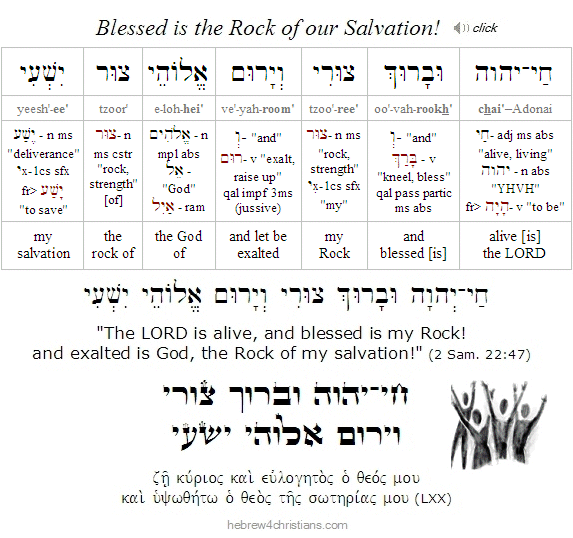
The Haftarah for Parashat Ha'azinu is another song, namely, King David's hallel for the LORD's deliverance from his enemies. Hunted by Saul, without apparent means of escape, David cried out to God in profound anguish. The LORD intervened and rescued him, leading him to extol the LORD as his Rock, Refuge, Shield, Source of Confidence, and Courage.
חי־יהוה וברוך צורי
וירם אלהי צור ישׁעי
chai-Adonai · oo·vah·rookh · tzoo·ree
ve·yah·room · E·lo·hei · tzoor · yeesh·ee
"The LORD is alive, and blessed is my Rock,
and exalted is God, the Rock of my salvation" (2 Sam. 22:47)
This song is prophetic of the day when all Israel shall be saved after the Great Tribulation, when Yeshua Ha'melekh (King Jesus) delivers Israel from all her enemies.
Ha'Azinu and Shabbat Shuvah
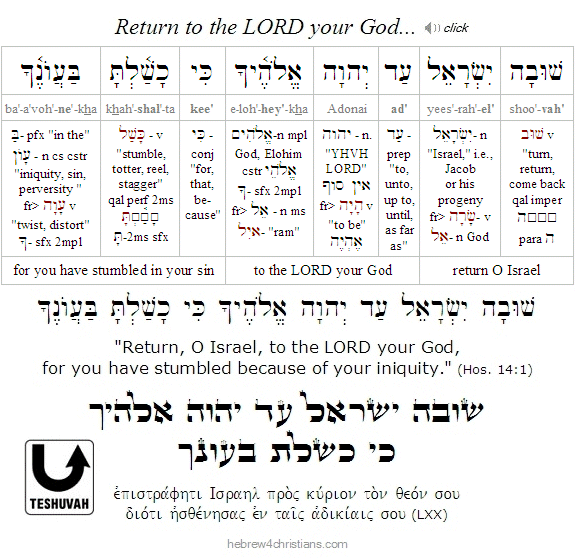
The Sabbath between Rosh Hashanah and Yom Kippur is called Shabbat Shuvah - "the Sabbath of Return," and we read passages that call us to return to the LORD during this time. This Shabbat is called "shuvah" because the Haftarah begins, Shuvah Yisrael ad Adonai Elohekha (שׁוּבָה יִשְׂרָאֵל עַד יְהוָה אֱלהֶיךָ): "Return, O Israel, unto the LORD your God!"
שׁוּבָה יִשְׂרָאֵל עַד יְהוָה אֱלהֶיךָ
כִּי כָשַׁלְתָּ בַּעֲוֹנֶךָ
קְחוּ עִמָּכֶם דְּבָרִים
וְשׁוּבוּ אֶל־יְהוָה אִמְרוּ אֵלָיו
כָּל־תִּשָּׂא עָוֹן וְקַח־טוֹב
וּנְשַׁלְּמָה פָרִים שְׂפָתֵינוּ
shoo·vah Yees·rah·eil ad Adonai E·loh·hey·kha
kee khah·shal·ta ba·a·voh·ne·kha
ke·choo ee·ma·khem de·vah·reem
ve·shoo·voo el Adonai, eem·roo e·lahv
kohl tee·sah ah·vohn ve·kach-tohv
oo·ne·sha·le·mah fah·reem se·fah·tei·noo
"Return, O Israel, to the LORD your God,
for you have stumbled because of your iniquity.
Take with you words
and return to the LORD; say to him:
"Completely forgive our iniquity; accept our penitential prayer,
that we may offer the praise of our lips as sacrificial bulls."
(Hosea 14:1-2)
Note that when Ha'azinu is read on Shabbat Shuvah, a different haftarah portion is read (instead of 2 Sam. 22:1-51), though it is somewhat complicated: Ashkenaz read Hosea 14:1-9 and Joel 2:15-27, whereas Sephardim read Hosea 14:1-9 and Micah 7:18-20.
|
|
|
|
The reading from the Brit Chadashah harkens back to the shirah of Moses, and in particular to Deuteronomy 31:21, "So I will make them jealous with those who are no people; I will provoke them to anger with a foolish nation."
On account of the sovereign purposes of the LORD, ethnic Israel, beloved as she is of God, has undergone a partial hardening until all of those whom the LORD has called from among the nations have been "grafted in" to the Olive Tree of God. During this age of grace, those who were called "not My people" are intended to "provoke Israel to jealousy" by means of the message, "Thou art My people." (see Hosea 2:23).
After the age of grace is complete, all Israel will indeed be saved (Rom. 11:26), and the original covenant nation will be fully restored and redeemed. Yom Kippur will be a fulfilled festival on that great day. Then the words of the prophets will be proven true and God will be vindicated. Israel will be adorned with honor and blessing above all the nations of the earth, and our "eschatological brethren" will finally be home from their long exile!
Blessing:
|
|
|
|
 |
|
|
|
|
|
Related Discussion:
|
|
|
|
|
|
|
Hebrew Audio Files:
|
|
|
|
|
Click the following links to hear the desired chapters read from this week's Torah:
|
|