 In this present world it is a struggle not to be afraid… We see through a glass darkly; our heart’s desire is often thwarted; we often walk in uncertainty; our prayers may seem to go unanswered. There are many tribulations, sorrows, and pains; we are grieved and often feel lonely; we sometimes struggle to hold fast to our confession and hope; we feel alarmed over the insanity and depravity that pervades the culture around us; we feel powerless to stop the juggernaut of unrestrained evil, yea, we lament over the battle within our own hearts — our own inner fears, outrage, and wretchedness.
We may wonder why God does not directly intervene to help in the midst of our plight; we may pray anguished prayers beseeching heaven’s intervention to deliver us from evil. Many of our brothers and sisters around the world are undergoing persecution, being murdered for the sake of their faith; others languish in prison or “reeducation” camps, being labeled as “enemies of the State,” brutalized, ostracized, marginalized, rejected, and forsaken of the common welfare of others. We shed tears over the burning of churches; we are repulsed by acts of violence against God’s people; we protest that Christians are regarded as political enemies for honestly questioning the logic and veracity of governmental mandates. We are often misunderstood, or worse, vilified for honoring the truth. We are made outsiders, segregated outside the camp, maligned as lepers and deplorables… Indeed, the world system hates us, and for the sake of our faith “we are being killed all the day long; we are regarded as sheep to be slaughtered” (Psalm 44:22; Rom. 8:36).
So where is God in the midst of our alienation and tribulation? As followers of Yeshua we are called to walk in the truth, to do justice, and to walk humbly with our God. More: we are to die to ourselves, love our enemies, and be faithful to God even in martyrdom. In these darkened days, however, this means walking through the darkness of the valley of the shadow of death, for it is apparent that worldly culture has decisively rejected the truth of God and regards those who esteem it as its enemies. “The kings of the earth set themselves, and the rulers take counsel against the Lord, and against his Messiah, saying ‘Let us break their bonds apart and cast away their cords from us'” (Psalm 2:3-4). Prophetically, we know what is on the horizon; we foresee the terrors of the “End of Days.”
The test of faith in our circumstances, as has always been for God’s people, is to remain steadfast in our conviction of God’s love despite the darkness that surrounds us (Isa. 50:10). The test is summed up by C.S. Lewis this way: “We’re not doubting that God will do the best for us; we’re wondering how painful the best will turn out to be” (Collected Letters). We can’t stay in the limbo of such questioning forever, however; we must shake off our misgivings and find settled determination to press on in faith: Our Lord has a crown and a kingdom prepared for us, and he will give us what we need in the way to attain unto it.
There is a difference between knowing about God in your head and knowing God in your heart… Unlike a merely intellectual idea of faith that passively assents to theological propositions or creeds, trusting in the Lord (i.e., bittachon: בִּטָחוֹן) is an emotional commitment to God’s presence in the midst of the sorrows of our lives; it is the struggle of hope that affirms we are not truly alone, abandoned, helpless… Trust goes beyond the “head knowledge” to engage God personally, existentially, and from within the whirlwind of harrowing pain and pain’s fearful loneliness. Authentic theology is “dialogical” — a conversation of the heart with God – seeking, yearning, protesting, lamenting, and struggling with life’s inscrutabilities and unfathomable questions as it appeals to God for the assurance and comfort of the Holy Spirit. Trust finds courage to voice to our sorrow and fears, inviting God into the midst of our brokenness, often yielding to tearful silence in unknowing expectation. As Dorothy Soelle wrote: “Prayer is an all-encompassing act by which people transcend the mute God of an apathetically endured reality and go over to the speaking God of a reality experience with feeling in pain and happiness” (Soelle: Suffering). This is perhaps the deepest meaning of the Shema – to listen for God’s heart in the midst of your struggle; learning to encounter God’s love in the place of your brokenness and need (Job 13:15).
Hebrew Lesson:

- Psalm 44:22 Hebrew page (pdf)
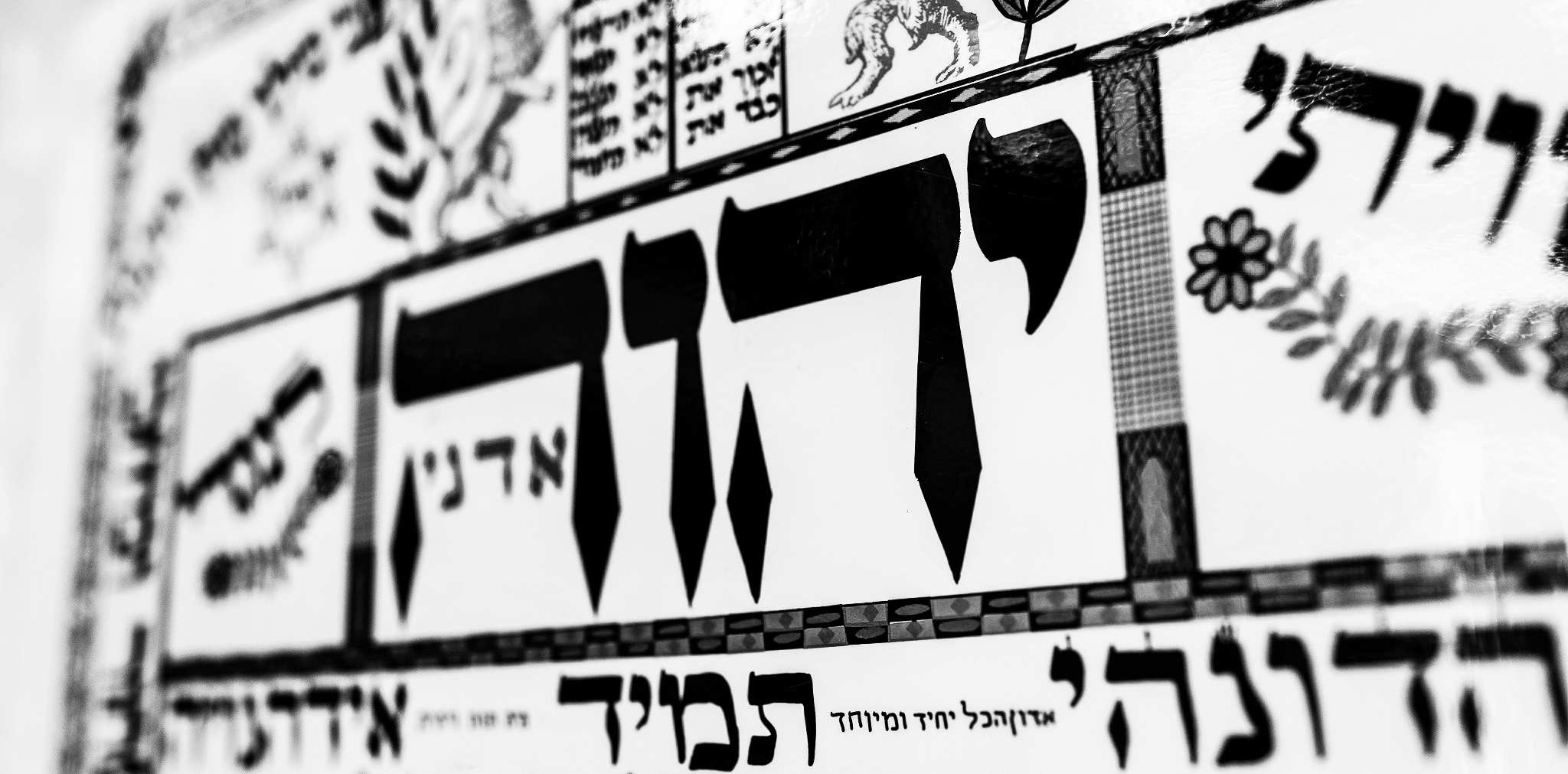
Reflecting on the role of suffering in the heart of faith, Dietrich Bonhoeffer (1906-1945) – who was murdered by the Nazis – once wrote: “Here is the decisive difference between Christianity and all religions. Man’s religiosity makes him look in his distress to the power of God in the world: God is the deus ex machina [i.e., “quick fix”]. The Bible [on the other hand] directs man to God’s powerlessness and suffering: only a suffering God can help” (Letters and Papers from Prison). Bonhoeffer’s comment alludes to the difference between an “Elohim” (אֱלהִים) conception of God as the omnipotent power and Judge of reality, and the “YHVH” (יהוה) conception of God as the compassionate Source and Breath of life – the Suffering God who empties himself to partake of our condition – to know our pain, to bear our sorrows, to heal us from the sickness of spiritual death, and to touch us in the loneliness of our exile… The Spirit enables us to “groan” in compassion, directing us away from the impulse to “kill the pain” to accept it as part of our lament and need for connection with God.
.
 Some people tend to blame God for their troubles. They get angry. They ask “Why me?” Their hearts turns hard and they become bitter over the course of their lives… I suppose such people assume that if they are generally well-mannered and occasionally helpful to others, they have the “right” to expect a life of relative ease, and if that does happen, they feel disappointed with God. As Tevye ironically said to God (in the Fiddler on the Roof): “It may sound like I’m complaining, but I’m not. After all, with Your help, I’m starving to death.”
 The nature of beauty has been an enduring mystery to artists and philosophers over the millennia, and various attempts have been made to define it. For example, some have defined beauty as an order, arrangement, and harmony of some kind (understood either as objective qualities inherent in something beautiful, or as a subjective sentiment of a person experiencing something that is esteemed as beautiful, and most often as a combination of both). In other words, something is regarded as beautiful because it possesses a certain arrangement of qualities that evoke pleasure or satisfaction in the mind or heart of a person.
 (Originally published July 11, 2020)

 Though it is important to guard our sincere convictions and to be passionate about what we believe, we must nevertheless be careful to walk in humility before the mystery of life… After all, much is inscrutable to us, much is beyond our understanding, and therefore, if we are honest, we should be reverent before the “sacred secrecy” of everything. Fanaticism and intolerance (whether secular or religious) is motivated by willful ignorance of the marvelous complexities that pervade existence. The fanatic invariably seeks to reduce life to a simple formula, recipe, and a generalization. The humble person, on the other hand, freely confesses that they “walk by faith, not by sight” — by hearing the Word of God and heeding what the Spirit of God is saying to the heart… For now we “see through a glass darkly,” which literally means “in an enigma” (ἐν αἰνίγματι). An enigma (or riddle) is an analogy given through some resemblance to the truth, though quite often the correspondences are puzzling and obscure. Hence, “seeing through a glass darkly” means perceiving obscurely or imperfectly, looking “through” something else instead of directly apprehending reality. We see only a reflection of reality, and our knowledge in this life is indirect and imperfect. This is contrasted with the “face to face” (פָּנִים אֶל־פָּנִים) vision and clarity given in the world to come, when our knowledge will be clear and distinct, and the truth of God will be fully manifest and no longer hidden. Being “face to face” with reality means being free of the riddles, the analogies, the semblances, etc., which at best adumbrate our way.. Such reflection should make us humble whenever we share our faith. “Now we know in part, but then shall we know in whole” (1 Cor. 13:12). Let therefore repeat that an honest theology must find a place for mystery, for “seeing through a glass darkly,” and for the apprehension of awe and wonder.
 If you have read the gospels, you are surely familiar with a disciple of Yeshua named “Thomas Didymus,” sometimes referred to as “Doubting Thomas.” Recall that when Thomas had first heard the testimony of the other disciples that Yeshua was raised from the dead, he was apprehensive and vowed to suspend his judgment until he had sufficient evidence to believe the matter for himself: “Unless I see the wounds from the nails in his hands, and put my finger into the wounds from the nails, and put my hand into his side,” he said, “I will never believe it!” (John 20:25). You know the rest of the story. When Yeshua later appeared to the disciples and this time Thomas was present, he said to him: “Put your finger here, and examine my hands. Extend your hand and put it into my side. Do not be become faithless, but believe” (John 20:27).
 In our Torah portion for this week,
  The Torah of Moses teaches that a defect-free male lamb must be sacrificed and roasted at the appointed time every year, eaten with matzah and bitter herbs, as a memorial of the redemption from Egypt (Num. 9:2, Deut. 16:1-8) — yet today, after the ministry and sacrificial death of Yeshua as the Lamb of God, we no longer perform the sacrificial rite of the Passover given to the Levites on behalf of Israel. We do not offer a lamb for sacrifice not because there is no Temple to offer such sacrifices, but because we have a greater priesthood based on the sworn oath of God that predates the Levitical priesthood in the life of the Messiah (Psalm 110:4). This is explained in the Book of Hebrews, chapter seven, which explains that “if perfection had been attainable through the Levitical priesthood (for under it the people received the law), what further need would there have been for another priest to arise after the order of Melchizedek, rather than one named after the order of Aaron? But when there is a change in the priesthood, there is necessarily a change in the law as well” (Heb. 7:11-12). The bottom line is that the promised new covenant (בּרית חדשׁה) of God centers on the sacrificial ministry of Yeshua as our Great High Priest, and this covenant provides a new way – “not according to the covenant made with the fathers at Sinai after the Exodus” – to be in right relationship with God (Jer. 31:31-34; Heb. 8:1-13). “And when Messiah had offered for all time a single sacrifice for sins, he sat down at the right hand of God, waiting from that time until his enemies should be made a footstool for his feet. For by one offering He has perfected forever those being sanctified” (Heb. 10:14).
 To be a human being is a paradox, caught between the realms of the infinite and nothingness; a union of endless possibility yet terminating limitation. Man desires to live forever but is conscious that one day he will die. He is an incongruity – a mix of flesh and spirit, saint and sinner, good and evil, angel and animal… A spirituality that demands for us to be always happy, always “up,” is therefore dishonest, since the truth is grounded in what is real, and that includes both the miserable and the tragic as well as the joyful and sublime. It’s not that there is no difference between good and evil within the heart, but both are part of who we really are. It is the bittersweet struggle, the process of walking as “saintly sinners,” “holy fools,” “dying immortals,” and so on, that defines us. We must embrace our brokenness, in order to become whole; there is no healing without true confession of our need. Therefore we come to the paradoxical cross – the place of utter pain, separation, and death – to find healing, acceptance and life.
 C.S. Lewis once made the helpful distinction between “looking at” and “looking along” a sunbeam (Lewis: “Meditation in a Tool Shed,” 1945). In the former case the mind looks “at” the beam itself, from a supposedly “transcendental” perspective, as if it could objectively describe the thing in descriptive terms, as a “fact” or by reducing the phenomena to simpler, more “natural” terms (e.g., defining light as waves or particles or energy). In the latter case, the mind see “along” the beam in relationship with it, seeing by its means, as part of his horizon of experience, not focusing on it (as a fact) but experiencing other things through its agency, and interpreting them in a semantic world of interrelated meanings. Now Lewis’ point was that modern scientific humanism assumes it provides a “truer” interpretation of experience by looking “at” things, as for example, when it “reduces” (i.e., explains away) religious experience as a matter of genetics, sociology, psychology, or some other “natural” paradigm. Of course such a presupposition is without real warrant, since “looking at” something involves its own way of “looking along” the axis of assumptions hidden within its own methodology…. In short, there is no true “looking at” things as an independent observer, since everyone is affected by their own biases and assumptions they bring to experience. Such awareness should instill within every soul a deep sense of humility. Nevertheless, in questions of faith we are both look at and look along the contours of life to make inferences to the best explanation, and therefore as Lewis succinctly said, “ ‘I believe in Christianity as I believe that the sun has risen: not only because I see it, but because by it I see everything else.’ We (all of us) walk by faith, not by sight, and the only real question is what direction are we looking…