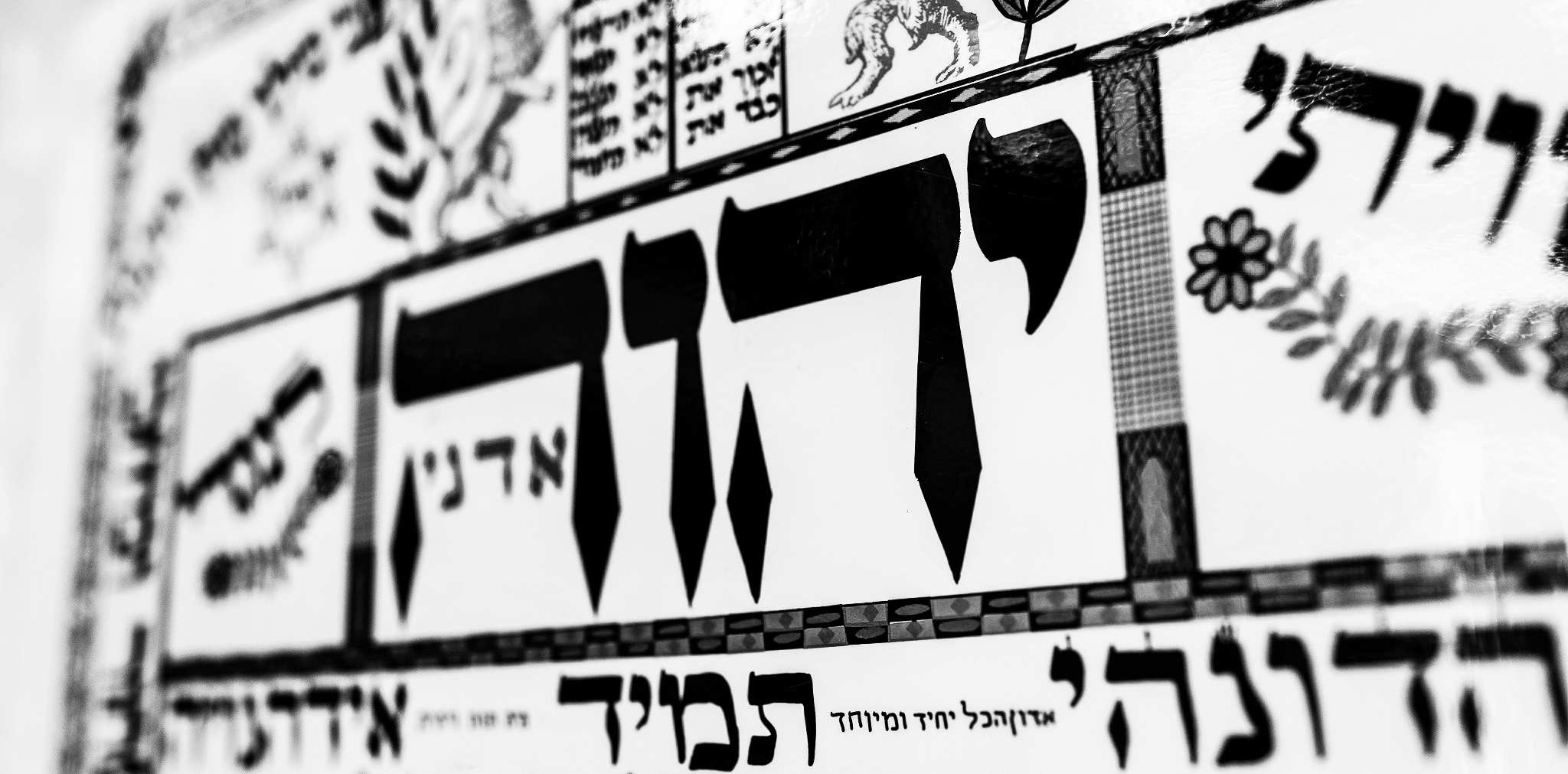

At Sinai we heard the voice of God (קוֹל אֱלהִים) speaking from the midst of the Fire (Deut. 4:33), an event that foreshadowed the great advent of the King and Lawgiver Himself, when the Eternal Word (דְבַר־יְהוָה) became flesh and dwelt with us (Phil. 2:6-7; John 1:1,14). Any theology that regards God as entirely transcendent (i.e., God is beyond any analogy with the finite) will have a problem with divine immanence (i.e., God is inherent and involved within the finite), since the highness, holiness, and perfection of God will make Him seem distant, outside of us, far away, and unknown…
Incarnational theology, on the other hand, manifests the magnificent humility and nearness of God to disclose the divine empathy. Indeed, the LORD became Immanuel (עִמָּנוּ אֵל), “God with us,” to share our mortal condition, to know our pain, and to experience what it means to be wounded by sin, to be abandoned, alienated, forsaken. It is God’s own bittul hayesh (בִּטּוּל הַיֵּשׁ) – his self-nullification for the sake of love and truth. The “Eternal made flesh” bridges the gap between the realm of Ein Sof (אין סוף), the infinitely transcendent One, and the finite world of people lost within their sinful frailty. Of course we believe Adonai Echad (יְהוָה אֶחָד) – that the “LORD is One” – both in the sense of being exalted over all things but also in the sense of being compassionately involved in all things (Rom. 11:36). We therefore celebrate the giving of the Torah both at Sinai and especially at Bethlehem with the birth of Messiah. We celebrate that God is indeed the King and Ruler over all, but we further affirm that God’s authority and rule extends to all worlds – including the realm of our finitude and need…
As I’ve mentioned elsewhere, the climax of Sinai was the revelation of the Sanctuary. The two tablets of the law, summarizing the Ten Commandments, were stored inside the famous Ark of the Covenant (אֲרוֹן בְּרִית־יְהוָה), a sacred “three-in-one” box placed in the innermost chamber of the Tabernacle called the Holy of Holies (קדֶשׁ הַקֳּדָשִׁים). As such, the Ark served as kisei ha-kavod (כִּסֵּא הַכָּבוֹד), the Throne of Glory itself. Upon the cover (or crown) of the Ark (i.e., the kapporet) were fashioned two cherubim (i.e., angel-like figures) that faced one another (Exod. 25:17-18). According to the Talmud (Succah 5b), each cherub had the face of a child – one boy and one girl – and their wings spread heavenward as their eyes gazed upon the cover (Exod. 25:20). It was here that God’s Voice would be heard during the Yom Kippur service, when sacrificial blood was sprinkled upon the crown to symbolize the atonement of sin secured through Messiah, the Word that became flesh for us… In the very heart of the Sanctuary, then, we see the Word of God and the sacrificial blood.
The LORD God Almighty was clothed with human skin: our flesh, our bones… The miracle of the incarnation is the Absolute Paradox, as Kierkegaard said, wherein the infinite and the finite meet in mystery of the Divine Presence. Here God “touches a leper,” eats with sinners and prostitutes, sheds human tears, and suffers heartache like all other men… The gloriously great God, the very Creator of the cosmos, has “emptied Himself” to come in the form of a lowly servant (δοῦλος) – disguised to the eyes of the proud and hardhearted, but is revealed as High Priest to those who are genuinely broken and in profound need. The LORD God is God over all possible worlds, and that includes both the celestial realms of the heavens but also the world of the fallen, the ashamed, the alienated, and the lost… God’s infinite condescension reveals and augments the majesty of His infinite transcendence. There is no world – nor ever shall there be such – where the LORD God Almighty does not reign and have preeminence.
Do not suppose for a moment that the Torah of Moses does not teach “incarnational” theology. Since God created human beings in his image and likeness, the “anthropomorphic language” of Scripture is meaningful. The LORD reveals himself in human terms – using human language, expressing human emotions, and so on, as it says: Moses spoke to God panim el panim – “face to face” (Deut. 34:10). The Torah always has to take on human form – the Word made flesh – for the sake of human beings who live in flesh and blood reality…
The greatest expression of God’s word is found in the Presence of Yeshua. This is the Word of God that “tabernacles” with us, full of grace and truth (John 1:14). Yeshua is the “Living Torah,” Immanuel (עִמָּנוּ אֵל), “God with us,” who enters our world to rescue us from death. Our Scriptures state that “in these last days God has spoken to us by his Son, whom He appointed the Heir of all things, through whom also He created the worlds” (Heb 1:2). Note that the Greek construction for the phrase translated, “by his son” is ἐλάλησεν ἡμῖν ἐν υἱῷ, which literally means “he spoke to us in Son” — that is, in the language or voice of the Son of God Himself… God speaks the language “of Son” from the midst of the fire revealed at Zion. “Therefore, since we are receiving a kingdom that cannot be shaken, let us be thankful, and so worship God acceptably with reverence and awe (μετὰ αἰδοῦς καὶ εὐλαβείας) – for our God is Esh Okhelah – a Consuming Fire” (Heb. 12:28-29).
Hebrew Lesson
Isaiah 7:14b Hebrew reading:

- Isaiah 7:14b Hebrew page (pdf)
Addendum: Consider further the metaphorical and anthropomorphic language of the Scriptures: God “sees,” God “hears,” the “hand of the LORD” saves, etc. Without an implied incarnational theology, there would be no language that we could comprehend about God who is the Infinite One that transcends all things… God gets angry; God feels sorrow; God is jealous; God is a lover, etc. all these metaphors bring the language of heaven into the world of humanity… The Spirit that imparts revelation does so inside a human brain and is translated into human apprehension. Yeshua is the Substance of the shadowy talk of analogical language; he embodies God-life before us…. Yeshua is the Word of God made flesh — able to touch us, know us, share in our suffering, heal us of our sin-sickness, etc.
 In our Torah portion for
 Last week’s Torah (i.e.,
 In our Torah reading for this week, called


 Many of our deepest anxieties come from the fear of death, whether we are conscious of this or not… Death represents fear of the unknown, fear of being abandoned, fear of being rejected, fear of being separated from others, and so on. I am so glad Yeshua gives us eternal life, which for me is not so much about immortality of the soul as it is being loved and accepted by God… That is what “at-one-ment” means, after all (John 17:22-23).
 Let me begin this entry by quoting a passage of Scripture from the New Testament that admonishes us to remember our shared heritage with the Jewish people:
 In this special “High Holiday” audio presentation, I discuss the holiday of
 In this “Shavuah Tov” audio broadcast I discuss both the Jewish High Holidays — and how they relate to us as followers of Yeshua the Messiah — as well as the weekly Torah portion we will read for Shabbat Shuvah, namely parashat Vayeilech. I hope you will find it helpful. L’Shanah Tovah u’Metukah b’Yeshua Meshicheinu, chaverim! – “to a good and sweet year in our Messiah Yeshua, friends.”
 In this audio podcast I discuss the the 40 day “Season of Teshuvah” or repentance leading up to the