|
Jewish Holiday Calendar
For February 2026 site updates, please scroll past this entry....
The Torah divides the calendar into two symmetrical halves: the Spring and the Fall, indicating the two advents of Messiah. The Biblical year officially begins during the month of the Passover from Egypt (called Rosh Chodashim, see Exod. 12:2), and the spring holidays of Passover, Unleavened Bread, and Firstfruits both recall our deliverance from Egypt and also our greater deliverance given by means of the death, burial, and resurrection of the Messiah, the great Passover Lamb of God. Yeshua was crucified on erev Pesach, buried during Unleavened Bread, and was resurrected on Yom Habikkurim (Firstfruits). The holiday of Shavuot (i.e., "Pentecost") both commemorates the revelation of the Torah at Sinai as well as the revelation of the Ruach HaKodesh (Holy Spirit) at Zion.
The intermediate months of summer end with the advent of the sixth month of the calendar, called the month of Elul, which recalls the time Moses interceded on behalf of Israel after the sin of the Golden Calf. To commemorate this time of our history, we likewise focus on teshuvah (repentance) in anticipation of Rosh Hashanah and especially in anticipation of Yom Kippur, the great "Day of Atonement." In Jewish tradition the 30 days of Elul are combined with the first ten days of the seventh month (called the "Days of Awe") to set apart "Forty Days of Teshuvah" leading up to the Day of Forgiveness for Israel. Immediately following Yom Kippur, the mood changes as we begin preparing for a joyous week-long celebration called Sukkot (i.e., "Tabernacles") that concludes with the holiday of Simchat Torah.
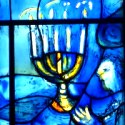
The winter holidays (חגי החורף) remember special times when God acted on behalf of His people so that they would triumph over their enemies, and therefore they prophetically picture the final victory in the world to come:
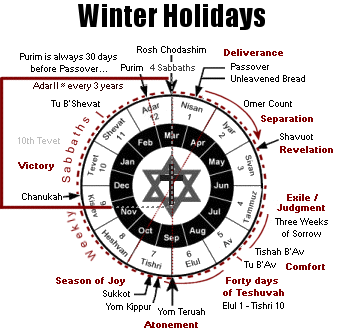 |
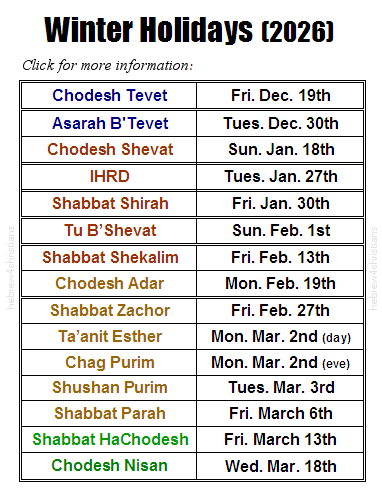
The Winter Holidays:
Note that in accordance with tradition, the following holiday dates begin at sundown:
- Month of Tevet (Fri., Dec. 19th [eve] - Sun. Jan. 18th [day])
- Four Sabbaths: Miketz, Vayigash, Vayechi, Shemot, Va'era
- Dates for Chanukah (continued):
- 7th Chanukah candle: Sat. Dec. 20th [i.e., Tevet 1]
- 8th Chanukah candle: Sun. Dec. 21st [Tevet 2] Zot Chanukah
- Last day of Chanukah: Mon. Dec. 22 until sundown
- Winter Solstice: Sun. Dec. 21st (Tevet 2)
- Christmas - Mon. Dec. 25th (Tevet 5, 5786)
- Asarah B'Tevet - Tues. Dec. 30th (dawn), fast for Jerusalem
- Secular New Year: Mon. Jan. 1st, 2025 (Tevet 12, 5786)
- Month of Shevat (Sun. Jan. 18th [eve] - Mon. Feb. 19th [day])
- Month of Adar (Mon. Feb. 19th [eve]) - Wed. March 18th [day])
- Month of Nisan (Wed. March 18th [eve]) - Thurs. April 16th [day])
- Note: The Spring Holidays begin on Rosh Chodesh Nisan:
- Rosh Chodesh Nisan - The Biblical New Year (Wed. March 18th, 1 Nisan, 5786)
- Four Sabbaths: Vayikra, Tzav (HaGadol), Sabbath of Passover, Shemini (parah)
 |
 |
February 2026 Updates
Note: If any page content appears to be missing, please refresh the page...
Robes of His Righteousness...
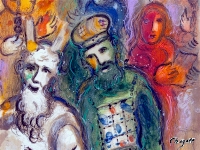
The following is related to this week's Torah reading, parashat Tetzaveh...
02.27.26 (Adar 10, 5786) The special vestments of the priests -- namely the beautifully crafted apron (ephod) made of gold and blue, purple and scarlet, and adorned with engraved onyx stones; the breastplate (choshen) that was held over the ephod by golden chains, and its twelve precious gemstones engraved with the names of the children of Israel; the robe (me'il) made of blue linen (techelet) and its hem of embroidered pomegranates with bells of gold dangling from the border; the linen sash (avnet) and tunic (ketonet), and the crown (mitznefet) with its headband (tzitz) of pure gold and blue thread inscribed with the words "Holy to the LORD" -- all these together were designed by God to be "for glory and for beauty" (לְכָבוֹד וּלְתִפְאָרֶת), as it says in Exodus 28:2.
Many of the same materials used to create the Mishkan (Tabernacle) were used to create these vestments, which suggests that our bodies are to be clothed in God's holiness and the "robes of his righteousness" as we serve within his habitation (Isa. 61:10). The various colors, the use of gold, the jewelry with names of beloved children, and the head covering that proclaims holiness to the LORD, further pictures Yeshua as He served within God's house to secure our place in heaven. Likewise we are called to be a "kingdom of priests" (ממְלֶכֶת כֹּהֲנִים), a holy people (גוֹי קָדוֹשׁ), called by God to serve as a light to the nations (אוֹר לגּוֹיִם) - shining forth Gods' love and truth to others (Isa. 49:6; 1 Pet. 2:5-9). Indeed we are called to "be My salvation to the ends of the earth' (לִהְיוֹת יְשׁוּעָתִי עַד־קְצֵה הָאָרֶץ).
To serve as His priests, we must "abide in the light" or become conscious of the divine light within our hearts (Isa. 2:5; John 8:12). Like the sacred flame of the menorah, this "flame of awareness" is precious - illuminating the truth of what is most real -- not only the superficial matters of life but the deeper things of who we really are -- beloved children of God, given eternal life, chosen to serve God and to be with him forever (Rev. 18:16). "For God who commanded light to shine out of darkness has shone in our hearts to give the light of the knowledge of the glory of God in the face of Yeshua the Messiah" (2 Cor. 4:6).
We must be careful to distinguish between the "natural light" and the spiritual light, because the exigencies of the moment can blind us to the light of the eternal... We must therefore repeatedly seek the divine light - first within us - and secondly the "deeper light" that penetrates the vain dramas and cares of this fleeting world. In this way we practice God's presence, knowing Him in all we do, and attaining sacred wisdom whereby our "eyes of the heart" (ὀφθαλμοὺς τῆς καρδίας) are enlightened to know what is "the hope of His calling, the riches of the glory of His inheritance in the saints, the exceeding greatness of His power toward us who believe" (Eph. 1:17-19). Halleluyah!
The scene of the priest arrayed in his beautiful garments, serving God in the "beauty of his holiness" pictures heavenly reality, wherein we will forever be in God's House, covered with the ceremonial robes of his kindness and favor, knowing Him as his beloved children who reflect the love and glories of the Lord forever. Amen!
Hebrew Lesson
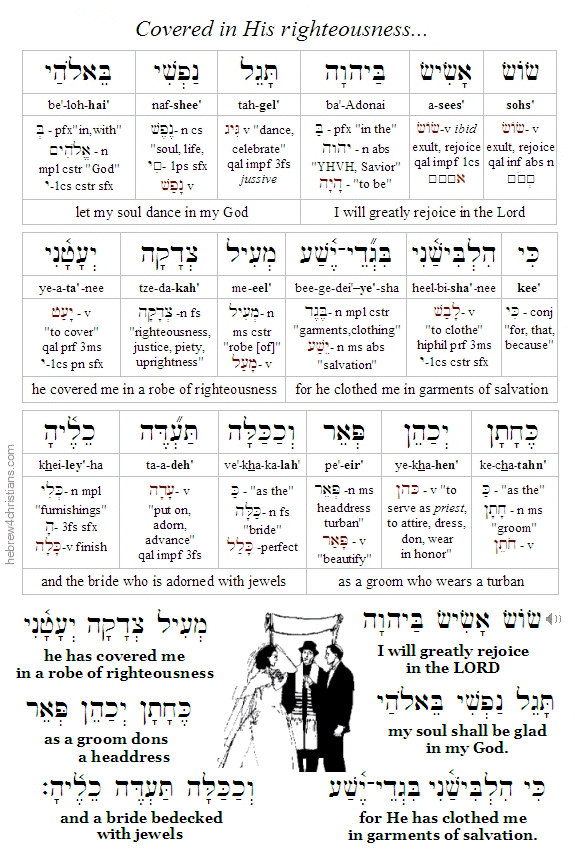
Isaiah 61:10 reading (click for audio):
 |
The Friend of Sinners...
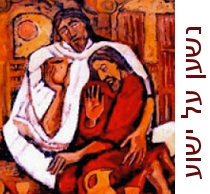
"God be praised that it is not because of my worthiness that God loves me. Otherwise, I might at any moment die of fear lest the next moment I cease to be worthy." - Kierkegaard
02.27.26 (Adar 10, 5786) "The Son of Man came ... and they say, 'Look at him! A glutton and a drunkard, a friend of tax collectors and sinners!'" (Matt. 11:19). People -- and especially the religious people -- were scandalized by Yeshua because he was a "friend of tax collectors and sinners!" Yet what sickness of heart is this, to despise those who are sick? It is a sorrow of heart to realize that religion often creates an "in-group" mentality that attains its status at the expense of the "outsider," the "stranger," the "sinner," and so on... The prayer of the self-righteous is always: 'God, I thank you that I am not like other people: extortionists, unrighteous people, adulterers – or even like this tax collector" (Luke 18:11).
The religious leaders of Yeshua's day were offended because he "welcomed sinners" and enjoyed eating meals with them (Luke 15:2). We can almost hear their disapproving whispers and their dismissive accusations: "How could a good Jew behave like this? Does he not understand the call to personal holiness? Does he not know the Torah of "clean" and "unclean"? If a man is known by the company he keeps, we know enough about Yeshua to know that he's not truly pious..." And to this very day the self-righteous find offensive the idea that God welcomes the sinful, the needy, the broken, the despised, and the "outsider" into His presence... As Yeshua said, "those who are well have no need of a physician," and indeed offering them God's cure will always be regarded as a kind of poison...
We greatly rejoice that God indeed is the friend of sinners; He is the Good Shepherd who seeks and saves the lost. Thank the Lord that he comes not for the "righteous" but for those who are brokenhearted, for those mortally wounded by their own sin... Any so-called theology or religion that repudiates or minimizes God's love for the sinful, the needy, the broken, is little more than a shrine to human pride and vanity... On the contrary: the heart of the Compassionate One always welcomes a sinner who sincerely turns to Him.
Hebrew Lesson
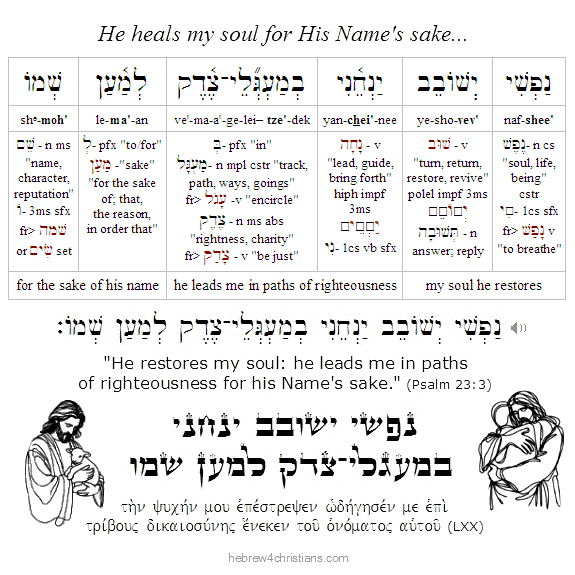
Psalm 23:3 reading (click):
 |
The thief on the cross...
02.27.26 (Adar 10, 5786) Spiritually speaking, the unnamed thief on the cross represents everyone who is in pain and facing his own demise who looks only to Yeshua for their salvation. Unto such a soul the Lord replies: "Today you will be with me in paradise."
It would be a worthwhile use of our time to imagine the various circumstances of the thief's life that providentially led him to that moment on the cross to meet Yeshua in that darket of hours. Undoubtedly Yeshua had foreknown the story of this man's life all along and awaited him.... But it was on the cross when the thief both confessed his sin and saw the glory of God's love in the bloodied face and eyes of Yeshua. What dreadful joy he must have felt when the Lord reassured him by saying he was forgiven and received in heaven. "Today you will be with me in paradise."
Purim Haggadol Prophecy...
"Faith is the assurance that the best and holiest dream is true after all." - Frederick Buechner
02.27.26 (Adar 10, 5786) Both Chanukah and Purim are holidays that celebrate God's victory over the forces of darkness... Just as the prophet Daniel foresaw the events of Chanukah, that is, the rise of "Epihpanes," the "Messiah of Evil" who will one day attempt to "assimilate" all of humanity into a "New World Order" (Dan. 9:27, 2 Thess. 2:3; Rev. 13:7-9, etc.), so Purim foretells how this wicked one will attempt to destroy the Jewish people during the End of Days (אַחֲרִית הַיָּמִים), though he will be destroyed by his own wicked devices.
The Midrash Esther says that Purim, unlike many of the other holidays, will be celebrated even after the final redemption after the End of Days. This is because the story of Purim -- i.e., God's covenantal faithfulness and defense of His people -- will be magnified in the deliverance that leads to the establishment of the Messianic Kingdom upon the earth. Indeed, the Second Coming of the Messiah will be regarded as the final fulfillment of Purim! So while it is a often seen as time of unbridled celebration in Israel (ad lo yoda), the holiday of Purim has a very sober prophetic message that foretells the glorious end of this age.
Here is a vision of the coming "Purim haGadol," the great deliverance to come:
"Then I saw heaven opened, and behold, a white horse! The one sitting on it is called Faithful and True (נֶאֱמָן וְיָשָׁר), and in righteousness he judges and makes war. His eyes are like a flame of fire, and on his head are many diadems, and he has a Name written that no one knows but himself. He is clothed in a robe dipped in blood, and the Name by which he is called is the Word of God (דְּבַר הָאֱלהִים). And the armies of heaven, arrayed in fine linen, white and pure, were following him on white horses. From His mouth comes a sharp sword with which to strike down the nations, and He will rule them with a rod of iron. And He will tread the winepress of the fierce fury of the wrath of God, the Ruler over All (παντοκράτωρ), the LORD God Almighty (יְהוָה אֱלהֵי צְבָאוֹת). On his robe and on his thigh he has a Name written, the King of kings (מֶלֶךְ הַמְּלָכִים) and the Lord of lords (אֲדנֵי הָאֲדנִים). And with the breath of his lips He will slay the wicked" (Rev. 19:11-16).
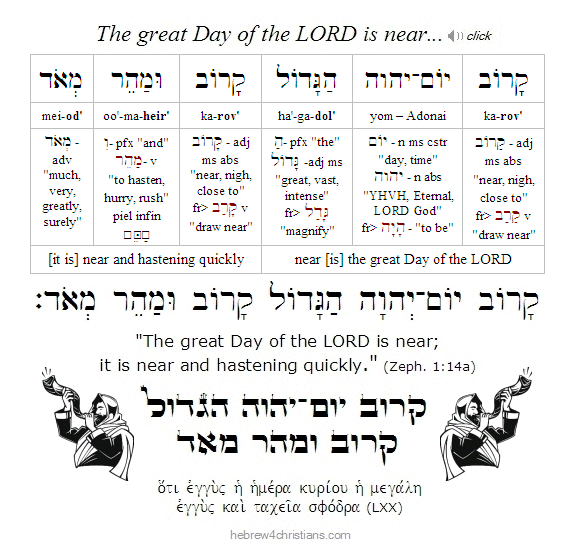
Amen! May that day come speedily, and in our time...
Hebrew Lesson
Zeph. 1:41a reading (click):
The Secret Place of Prayer...
"When you pray, enter into your closet, and when you have shut the door, pray to your Father who is in secret; and your Father who sees in secret shall answer you openly." - Matt. 6:6
02.26.26 (Adar 9, 5786) Yearning, wish, hope... The inner groan of heart, the "private language" of our secret fears, sorrows, and delights. Prayer is bound up with the mystery of who we are and who God is - it is our "word" combined with his in covenant conversation. It is the voice of "neshama yeterah," our redeemed soul in God's presence.
Often we find our voice to pray when we are desperate, or when we are in a state of heart that has abandoned itself in search of an answer to our question. For our need evokes the question and reveals our insufficiency, our frailty, and the vastness of our finitude.
Asking God for help is the confession that we are not-God, that we are powerless to remedy the sickness, that we cannot take away the pain, or assuage the fear, or raise the dead - either of our own hearts or the hearts of others. Asking God for help is to connect with who we really are - lost, afraid, confused, sometimes sad, lonely, insecure, lustful, impatient, and so on.
In our desperation we may feel hopeless and exhausted, or even (secretly) rageful at God for the sorry mess of our lives (or indeed, the sorry mess of the universe itself). We may struggle to trust or understand why or for what reason our heart is broken and made desolate. But despite all this, our prayer confesses the goodness of God and believes that he listens to us in the groans and sighs of our lives.
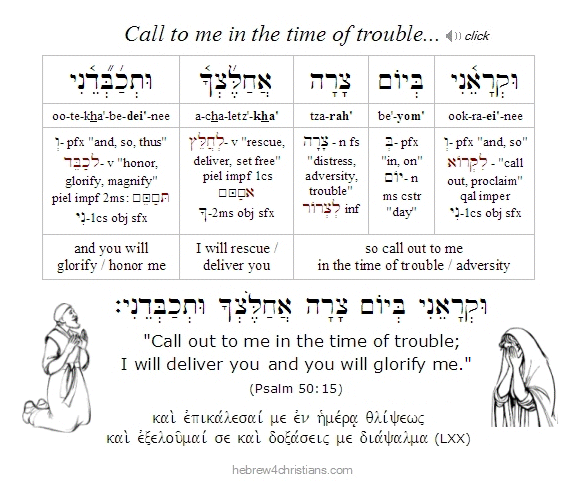
I mentioned recently that we should be careful what we wish for, because we just may get it... Can we secretly pray for something that would destroy us? This is why it is so important to know what it is that we are asking or praying for in the first place. "Search me O God, and know my heart; test me, and know my thoughts, and see if there is any idolatrous way in me, and lead me in the way of everlasting truth" (Psalm 139:23-24).
"Lord, teach us to pray," the disciples once asked Yeshua, and he answered by saying first "enter into your closet," that is, make space to get alone with God and appeal to him as your heavenly (or true) Father who knows all about you but who loves you just the same... It is in the sacred place where you know yourself as beloved and chosen...
That's part of the paradox of prayer: in our apparent nothingness and our misery we are transformed into God's very children. It takes courage to let God know the secrets of your heart - your fears, disappointments, your faithlessness, and so on. It takes honesty and a desire to be who you really are before the LORD.
"Your Father knows what things you need before you ask Him." This is another paradox. If he knows already, then why ask at all? What's there to talk about? But we ask because he already knows what we need. We don't pray to change God's mind but to empty ourselves of our fears and to know that we are his beloved. Though he knows the number of the hairs on your head, you confess your need to him, you open your heart to him and acknowledge the secrets he knows. "And your Father who sees your secrets will reward you openly."
"Real speaks to real," which means that we can't talk with God if we are hiding the truth from ourselves. "Thank you, God, that I am not like other men..." is a prayer God hears but does not answer, for it is based in self-deception and illusion. People who are "content" with their lives and don't yearn for deliverance from themselves cannot know the power of God. We need God to even know that we need him, but once we understand our great need for him we know that he will meet our true need....
Some people may say they need God but they don't really want to know him after all. What does God need? Does he have a "prayer" within his own heart for us? Yeshua teaches that he does. His prayer is that you would know the love of God revealed in his life given for you, that is, for you "to know the love of Christ that surpasses knowledge, so that you may be filled with all the fullness of God" (Eph. 3:19). As he prayed: "This is eternal life, that they know you, the only true God, and Yeshua the Messiah whom you have sent" (John 17:3).
People pray to God, but to whom does God pray? And for what might He pray? Or do you think that the Almighty has no desires of His own, no yearning of heart, no prayer? The sages of the Talmud believed that God indeed addresses himself: Yehi ratzon milfanai, "May it be acceptable before me, may it be My will, that my compassion overcome my anger, and that it may prevail over my justice when my children appeal to me, so that I may deal with them in mercy and in love" (Berachot 6a). This is the deeper unity of the Name YHVH (יהוה), the Savior and LORD, revealed to Moses after the sin of the Golden Calf (Exod. 34:6-7), and this is the essential meaning of the cross of Yeshua, where the LORD passionately "prayed within Himself" so that His compassion would overcome His fearful judgment for our sins.
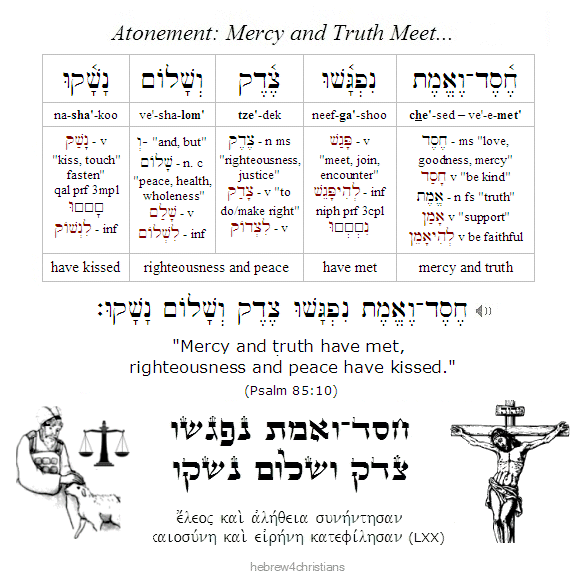
Only the cross of Yeshua allows God's righteousness and mercy to "kiss" (Psalm 85:10; 89:14); only the cross reveals the true Holy of Holies where the blood was placed over the Ark of the Law; only the cross intimates the Inner Sanctum of God's heart. Because of the cross, a holy God is able to truly love and help the trusting sinner (Rom. 3:26). It is written: "Righteousness and justice are the foundation of your throne (צֶדֶק וּמִשְׁפָּט מְכוֹן כִּסְאֶךָ); steadfast love and faithfulness go before you" (Psalm 89:14). Because of Yeshua, God is vindicated as entirely just - and the Justifier of those who trust in His redemptive love (Rom. 3:24-26). Yeshua is the prayer of God the Father's on behalf of His children...
The will of God - his heart's yearning and desire, his very prayer - is for his children to receive his love (2 Pet. 3:9; 1 Tim. 2:4; John 3:16; Ezek. 18:23). As Yeshua prayed, "Holy Father, keep them in your Name, which you have given me, that they may be one, even as we are one... I in them and you in me, that they may become perfectly one, so that the world may know that you sent me and loved them even as you loved me" (John 17:11,23). Yeshua died on the cross to bear the shame for your sins, to be sure, but he did this so that you could be accepted and securely loved forever.... It is the love of God that is the goal of all things, after all. When Yeshua cried out, "It is finished" and breathed his last breath as He died for our sins upon the cross, the greatest exhalation of the Spirit occurred, the greatest sigh, the greatest utterance was ever declared. The sacrificial death of Yeshua for our deliverance was God's final word of love breathed out to those who are trusting in Him.
Hebrew Lesson
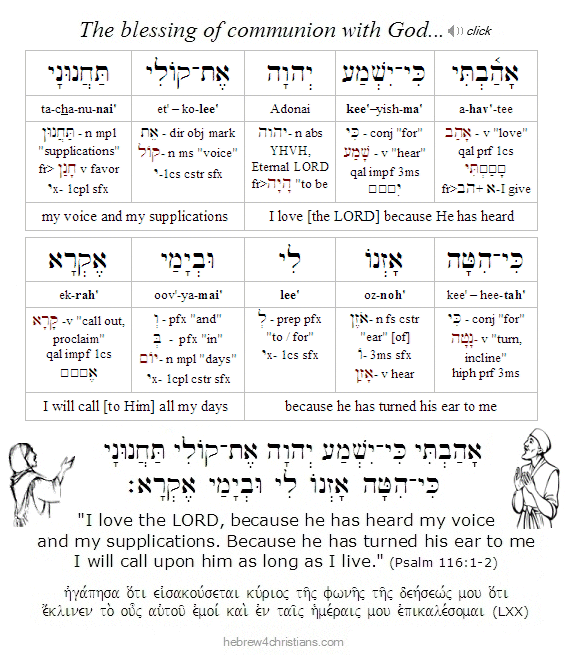
Psalm 116:1-2 reading (click for audio):
 |
Purim and Deliverance...
02.26.26 (Adar 9, 5786) The holiday of Yom Kippur (the Day of Atonement) is also known as Yom Kippurim in the Torah (יוֹם כִּפֻּרִים, see Lev. 23:28), which can be read as Yom Ke-Purim, a 'day like Purim' (i.e., יוֹם, "day" + כְּ, "like" + פֻּרִים, "purim"). Both Purim and Yom Kippur celebrate our deliverance from the great enemies of sin and death, and both holidays foreshadow the great purim (deliverance) we have in Yeshua our LORD.
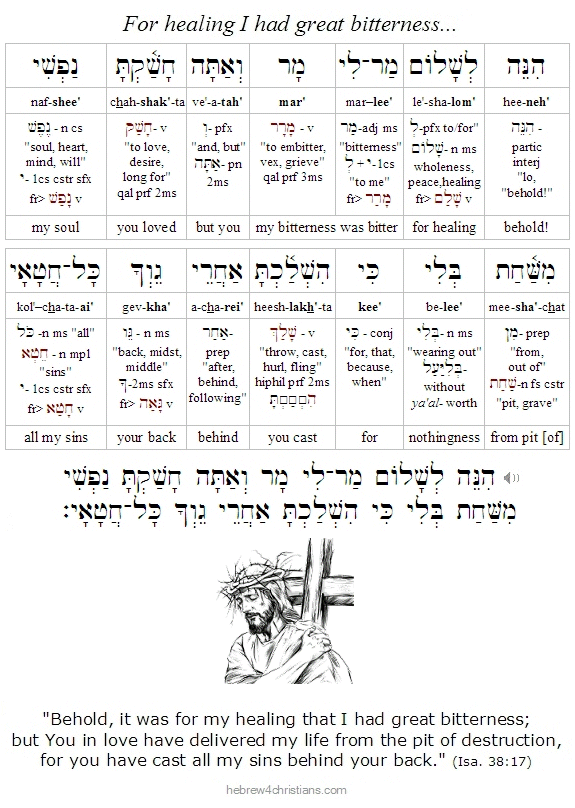
It is written in the prophets: "Behold, it was for my healing that I had great bitterness; but You in love have delivered my life from the pit of destruction, for you have cast all my sins behind your back" (Isa. 38:17). In this great verse, we read that God loves the soul "from the pit of nothingness," which pictures a loving father running to rescue his child from being swallowed alive by the earth (the Hebrew verb chashak (חָשַׁק) suggests pulling someone up out of a hopeless pit). That God casts all our sins behind His back figuratively denotes oblivion – none of our former sins will be brought to remembrance again. This is similar to the image given by Micah: "He will turn again, and have mercy on us: he will put away our iniquities: and he will cast all our sins into the bottom of the sea" (Micah 7:19).
הִנֵּה לְשָׁלוֹם מַר־לִי מָר
וְאַתָּה חָשַׁקְתָּ נַפְשִׁי מִשַּׁחַת בְּלִי
כִּי הִשְׁלַכְתָּ אַחֲרֵי גֵוְךָ כָּל־חֲטָאָי
In Jewish thinking, any deliverance can be regarded as a "purim," and therefore the "ultimate" expression of Purim is to be forgiven and accepted by God on account of the victory of love over judgment secured by Yeshua the Messiah at the cross... Our deliverance depends not only on the substitutionary death of Yeshua as our kapparah (atonement), but also on the substitutionary life He lived (and still lives) on our behalf. Yeshua fulfills the Torah on our behalf. The cure for our lawlessness is not more laws but a deeper sense of God's grace given to us in Yeshua, who kept the law perfectly and ransomed us from its righteous judgment.... Because of Yeshua we have grace and peace (shalom) with God.
Revelation and Awe...
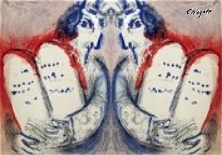
"Two things fill the mind with ever new and increasing admiration and awe, the oftener and the more steadily we reflect on them: the starry heavens above and the moral law within."- Kant
02.25.26 (Adar 8, 5786) While at Mount Sinai the Ten Commandments were dramatically uttered amidst thunder, lightning, smoke, and the roar of the heavenly shofar, they essentially restate spiritual and moral truth intuitively known by all people (see Rom. 1:19-32).
In light of this, we may wonder why God made such a terrifying presentation of principles he had implanted within the souls of those he created in his image, and especially to the direct descendants of Abraham, Isaac, Jacob, Joseph, and Moses... After all, God's truth may be spoken using a "still small voice" rather than in fiery displays (1 Kings 19:12).
In reply, it may be said that while most people intuitively understand the whisper of "right and wrong," they often suppress the voice of conscience because they do not genuinely fear God, and therefore they fail to connect the significance of their choices with the Divine Lawgiver who is the Source of moral reality. They separate, in other words, the idea of transcendental "Supreme Being" (i.e., the cosmic Creator) from the Source of immanent value and meaning (i.e, the Judge of all).
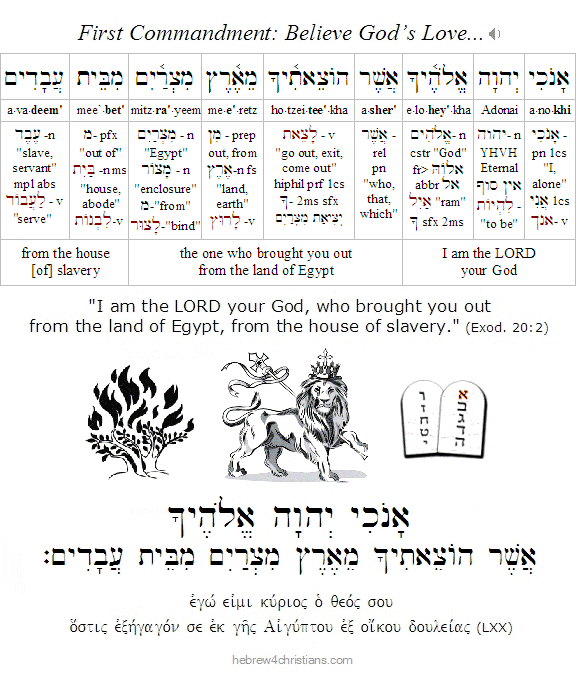
The First Commandment, however, reminds us: "I AM (anokhi) the LORD (YHVH) your God (Elohim)," which identifies divine power with righteousness and holiness. The drama of the revelation at Sinai was therefore intended to instill yirat haShem - the awe of God - within the heart, connecting the Supreme Power with moral truth and its implications (i.e., conscience).
The Israelites drew back in fear because they realized that the Holy One himself was present in their private thoughts, attitudes, and motives of the heart, and this produced a sense of dread within them (Exod. 20:19). "There is no creature hidden from His sight, but all things are naked and open to the eyes of Him to whom we must give account" (Heb. 4:13). Moses reassured them, however, by saying that the surrounding terrors - which undoubtedly resembled the wonders they had earlier witnessed in Egypt - would do them no harm if they would heed the Voice of the LORD. In other words, the terrifying glory of Sinai was meant to impart a sense of reverence and to help the people know that the LORD God is both the Lawgiver and the Source of all power and glory...
Hebrew Lesson
Psalm 97:6 Hebrew reading:
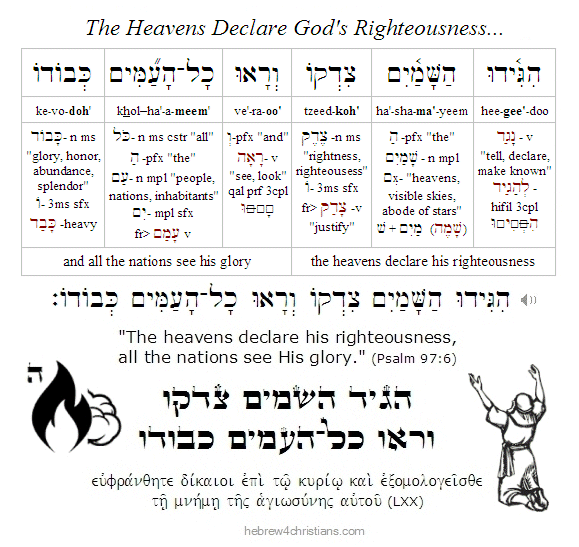 |
Note: Of course this week's Torah portion (Tetzaveh) reveals the marvels of the Mishkan, where the Altar of God's Atonement (Mercy) was first given to Israel, and which finds its ultimate expression in the cross of Messiah...
The Tragic-Comedy of Purim...
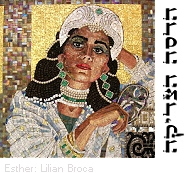
"God created man because He loves stories." - Elie Wiesel
02.25.26 (Adar 8, 5786) In the movie the Fiddler on the Roof, you might recall the scene when a young man named Labish approaches the dear and wise old Rabbi of Anatevka and asks him, "Is there a proper blessing for the Czar?" Everyone is shocked at the very idea. A blessing for the czar? The kindhearted Rabbi responds that indeed there is indeed a proper blessing for the czar: "May God bless and keep the Czar -- far away from us!" (Amen!)
The holiday of Purim is one of the most joyful of the Jewish year, though it arose from a tragic-comedy tale about how a life-threatening crisis for the Jewish people was averted through an ironic sequence of providential reversals... We remember that long ago, in the city of Shushan (in ancient Persia), a political sycophant named Haman attempted to blame the Jews for "being different" and initiated a pogram for their extermination. The Jews were saved through the collaborative intervention of a queen named Esther (Hadassah) and her cousin Mordechai, both of whom were enabled by God to overturn the evil decree of the King of Persia (the story is told in the Book of Esther). Throughout the centuries, in various places, many others have likewise tried to destroy the Jewish people, but none has succeeded. עַם יִשְׂרָאֵל חַי / am Yisrael chai: "The people of Israel live!" God's sovereign hand works all things together for good, even if at times things appear bleak and desperate (Rom. 8:28).
Hebrew Lesson
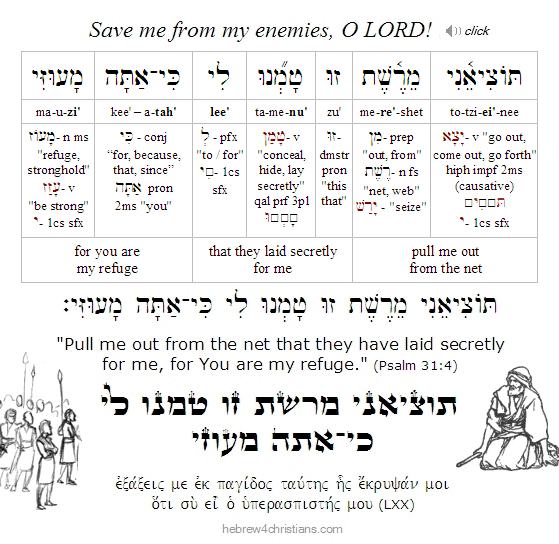
Psalm 31:4 reading (click for audio):
 |
The name Purim (פּוּרִים) refers to the "lots" (i.e., dice) that Haman used to determine the "best day" to carry out his nefarious plan (there is irony regarding the word, however, since the word "pur" (פּוּר) also can refer to being "crushed" or "brought to nothing"). Haman's dice rolled "Adar 13," but since the Jews were delivered on the following day, the holiday is celebrated on the 14th of Adar. In other words, Adar 14 was ironically transformed from a day of potential tragedy and grief into a time of great rejoicing! (In Israel, Purim is observed a day later still (i.e., on Adar 15th) and is called Shushan Purim, since the deliverance of the Jews of Shushan did not occur until the 15th.) Among other things, the irony of the Book of Esther reveals that there is no "chance" in God's universe, since He is the Master over all of creation and supervises all it outcomes - even the "roll of the dice" (Prov. 16:33).
Like all the other holidays, various traditions have developed over the centuries. During the holiday of Purim it became customary to dress up in costume and listen to the Book of Esther (i.e., megillat Esther, מְגִלָּת אֶסְתֵּר, or "the megillah") recited from the Hebrew scroll (before we hear the Megillah read, we recite three Purim blessings). Some people dress as the noble Mordechai, others as the foolish king Ahashuerus, others as beautiful Esther, and some even as the wicked villain Haman. Part of the fun is that we are told that it's very important that we hear every word recited clearly, so we must keep very quiet as the story is being read. However, whenever we hear the name "Haman," we whirl groggers (ra'ashanim), blow whistles, stamp our feet, and make such a commotion that we can't hear his name. This is the only time we are encouraged to be boisterous when the Scriptures are being read.
After reading the Megillah, many communities put on their own "purimspiel" (Purim play) to reenact the dramatic story, with children dressed up as the characters of the play... Others put on "Purim puppet shows" at this time. It is a time of merrymaking and fun. Later we eat a festive meal (called a seudah, סְעֻדָּה) and enjoy three-cornered pastries called oznei Haman (אָזְנֵי הָמָן), or "Haman's Ears," for dessert (legend says that Haman's ears were twisted and triangular in shape). In Yiddish, these are called a hamantaschen (המן־טאַשן) and are often filled with prunes, chopped nuts, apricots, apples, cherries, chocolate, and so on. Eating Haman's Ears fit the delicious irony recounted in the Book of Esther....
Note that the Purim holiday begins Monday March 2nd at sundown this year.
 |
Priests of His light...
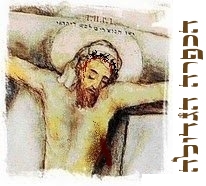
02.24.26 (Adar 7, 5786) Our Torah for this week (i.e., parashat Tetzaveh) describes the ceremony of consecration to the priesthood. We are chosen to be a "kingdom of priests," a set-apart people, and a light to the nations (Exod. 19:6; Isa. 42:6; 1 Pet. 2:9).
In this connection note that the first responsibility given to the priests was to care for the ner tamid (נר התמיד), the light of the Menorah (Exod. 27:20-21), which represents our consciousness of the Divine Presence (Psalm 18:28; 36:9).
The challenge we all face is to remain "in the light as God is in the light" and not to be seduced by the world of fleeting appearances (Isa. 2:5; 1 John 1:7, 2:17). God's eternal light radiates through all things (Isa. 6:3; Psalm 139:11-12), just as the great "yehi ohr" (יְהִי אוֹר) - "Let there be light" - is the first word spoken to creation (Gen. 1:3). To serve as a priest means being so filled with the truth that you radiate peace; your inner light shines and you glorify your Father in heaven (Matt. 5:16). That is how we draw others to the truth, by receiving and revealing the beauty of the LORD (Psalm 27:4).
Of course being a "witness to the light," that is, being a "priest," does not mean you are a "perfect person" who walks about with a "blissed-out" attitude despite the various trials and tests we all face in this life. No, we all still sin, and we therefore need to confess the truth of our condition to abide in the light (1 John 1:9; James 5:16).
Like everything else in Scripture, here we encounter paradox, as Yeshua taught: "Blessed are the impoverished in spirit (πτωχοὶ τῷ πνεύματι), for theirs is the kingdom of heaven; blessed are the ones who mourn (οἱ πενθοῦντες), for they shall be comforted; blessed are the meek (οἱ πραεῖς), for they shall inherit the earth" (Matt. 5:3-5). Yea, "God chose what is foolish in the world to shame the wise; God chose what is weak in the world to shame the strong, God chose what is low and despised in the world, even things that are not, to bring to nothing things that are, so that no human being might boast in the presence of God" (1 Cor. 1:27-29).
The Hebrew word for priest (i.e., kohen: כּהֵן) likely comes from the word ken (כֵּן) meaning "yes" and the word kivun (כִּווּן) meaning to "direct" or "lead," which implies that a priest helps direct a person toward affirming the Reality and Truth of God. The role of a priest is to draw people to God, then, but how is that possible if the mediator cannot genuinely understand our sorrows and struggles?
What draws others to God is his love, but how can we come to believe in that love were it not for the priesthood of the leper, the priesthood of the outcast, the priesthood of the reject? Even so Yeshua was afflicted with all our infirmities and therefore sympathizes with our brokenness and frailty (see Heb. 4:16).
As a priest of brokenness, you are called to be a wounded healer, and you can testify of God's saving grace and love for you despite your sorrow, anger, weaknesses, and failures... Accepting God's compassion for you - just as you are - allows you to show grace and kindness to others who are also hurting, and therefore you can serve as a priest of God. The mishkan, like ourselves, is relatively small, and the challenge is to apply its inner beauty to be reflected to the world around us (Matt. 5:16).
The various vestments for the priests, which the sages note resemble the descriptions of the furnishings for the Mishkan itself, remind us that we are sanctified to be "midash me'at," or a particular habitation for the divine presence. Indeed are we not told that our bodies are "temples of the Holy Spirit that is within you, that you have of God, and that you are not your own?" (1 Cor. 6:19).
If the priests of the Mishkan provide a pattern for the servants of the Lord, then the various vestments, the ephod, breastplate, robes, and the crown prophetically foretell our service before the Lord. The colors and materials that adorn tent are reflected by the Holy Light that shines upon and within us. Every detail is meant to reveal God's beauty and purposes...
Across our foreheads is written קדש ליהוה, meaning "holy unto the LORD," a designation that declares that we belong to God's sacred love (Lev. 19:2; 1 Pet. 1:16). We serve in our love for divine beauty, for the beauty of the Lord establishes the work of our hands (Psalm 90:17), and the habitation of the Lord is the beauty of His holiness (Psalm 27:4).
So let us be encouraged, dear friends... "For the commandment is a lamp and Torah is light, and the reproofs of discipline are the way of life" (Prov. 6:23). Here we may understand the "reproofs of discipline" as the (ongoing) process of consciously turning away from darkness (of fear, anger, etc.) to the behold the divine light. We have to start here, after all... The way of life is teshuvah (repentance, turning to God), which is painful to the lower nature, but is necessary condition to walk in the light. Confession brings light into our hearts (James 5:16; 1 John 1:5-9), and the end of our struggle is healing and life. Faith is the victory...
Hebrew Lesson
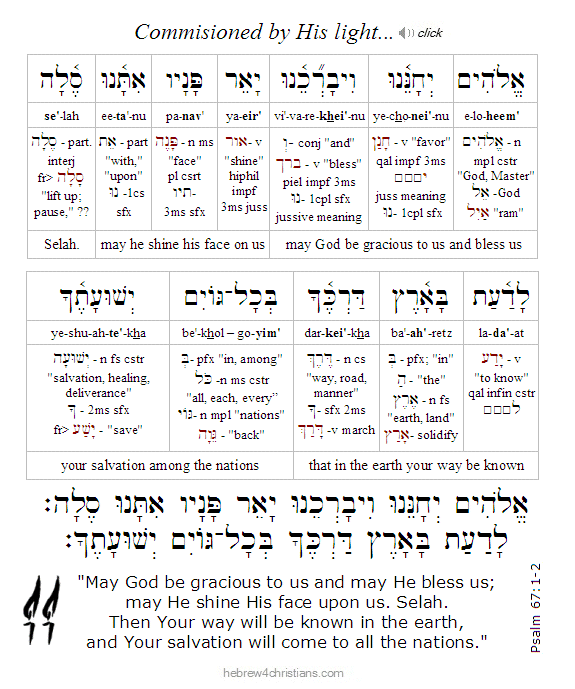
Psalm 67:1 Hebrew reading:
 |
The One Thing Necessary...
"To become sober is: to come to oneself in self-knowledge and before God as nothing before him, yet infinitely, unconditionally engaged." - Kierkegaard
02.24.26 (Adar 7, 5786) Sometimes we evade the "difficult words" of Scripture by ignoring them, excusing ourselves because we are unsure (or unwilling) to understand what they mean to us... Such words may make us feel uncomfortable, anxious, and even afraid. This is particularly so when it comes to the teachings of Yeshua himself who says to those with "ears to hear" to love the Lord with all their being and to seek first the Kingdom of God. These words are not difficult for us to understand as much as they are difficult for us to obey, and they are perhaps difficult for us to obey because we do not have the courage to truly believe...
Are you able to obey the teachings of God? Consider the famous Sermon on the Mount where Yeshua summarized the meaning of the law given in Torah. "Seek God first in your life; do not lie; do not be angry; do not seek retaliation; love those who hate you; do not judge others; do not lust after others; do not covet things; and so on. Yeshua went beyond the "letter of the law" to reveal its intent, namely, how to exist as an authentic child of God.
Yeshua claimed that he is the only way to come to God: "Unless you believe that I AM (i.e., ki eheyeh: כּי אֶהְיֶה), you will die in your sins" (John 8:24). He said he was the embodiment of God upon earth: "I and the Father are one." Such words scandalize human reason, but so much the worse for relying on reason to reveal the mysteries of God. "You can enter God's Kingdom only through the narrow gate. The highway to hell is broad, and its gate is wide for the many who choose that way. But the gateway to life is very narrow and the road is difficult, and only a few ever find it" (Matt. 7:13-14). Only a few? Another difficult word. "There is a loss that is eternally irreparable; thus eternity -- even more frightful -- far from wiping out the recollection of what is lost, is an eternal recollection of what is lost!"
The imperatives of Scripture to do and to obey God's will present a conflict between the selfishness of what we "naturally" want for ourselves and what God wants for us, and the essential struggle, and the threshold question, is whether you will surrender your will to God...
You are asked to "count the cost" of what it means to follow Yeshua, and that calls for a complete abandonment of everything you have, everything you are, and everything you may ever hope to be -- all for the sake of Him. Note that I did not say for the sake of heaven, or for the sake of your comfort, or for the end of all your sorrows and fears, but everything for the sake of him alone, for the sake of who He is and for the blessedness of being known by Him.
If you were to ask "why?" or "what's in it for me?" you risk missing the essential reason for both your existence and for the need of His presence altogether... God is not a means to "your best life now," but is the goal or end of life itself, and that life extends and echoes beyond the reach of the life you have begun on this earth. The Lord is the reason and fulfillment of your existence altogether: "the end of life is to know God and to worship Him forever..."
The reason for living is to know God and to be known by Him, and the heartstrings of this relationship is what matters most of all...
We tend to over-complicate things in the name of wisdom, but there is something more basic at work here, and that is the sheer simplicity of the will -- to believe in God's love, to hope against hope, to abandon ourselves to God's care.
"If you want to follow me, you must hate everything else by comparison - your father, your mother, your wife and children, your brothers and sisters - yea, even your own life" (Luke 14:26). These too are difficult, nay impossible, words for us hear unless we receive the very words of God's love and passion from the cross as his personal call for you... There he groans for you; do you not also cry out for him? God's call must be heard personally, not as love's poetic musing in the abstract. The relationships we have with our family, our friends, and even with ourselves are certainly the most intimate we know, yet the love of God surpasses them all and is the ultimate relationship of our lives... This is because God is inescapably present, the ground of our being, the source and end of our lives. God is always in relationship with us, for he upholds our existence itself, but we are not always in relationship with Him.
We are a divided house that cannot stand; we are at war within ourselves. Sick at heart we may profess we believe in God's mercy and love, yet we withhold it from ourselves. The truth of our inner condition is tragic. "To despair over one's sins indicates that sin has become or wants to be internally consistent. It wants nothing to do with the good, does not want to be so weak as to listen occasionally to other talk. No, it insists on listening only to itself, on having dealings only with itself; it closes itself up within itself, indeed, locks itself inside one more enclosure, and protects itself against every attack or pursuit by the good by despairing over sin" (Kierkegaard).
Some people try to hold on to the gospel but the weight of their sadness crushes the life out of them. But even sorrow, no matter how haunting, is something that must be abandoned to receive God's love as the primary connection we have to life. The miracle of the gospel is that God's love for you is ultimate reality itself.
In a sense such truth cannot be stated, only lived and known as it is lived. "Before it is a word the gospel that is truth is silence, a pregnant silence in its ninth month, and in answer to Pilate's question, Jesus keeps silent, even with his hands tied behind him managed somehow to hold silence out like a terrible gift" (Buechner). What is truth? Life is truth, and that includes the life of your own, the life "inside" the world you are, that is, the life of your faith, your heart, your soul, even the breath you are taking now...
"Lead us not into temptation," but is this not the prayer to be made "simple," without duplicity, and to be wholehearted -- because if there be no ambivalence within you, no hesitation, but only this inner "yes," are you not set free to love God with all your heart?
"One thing have I desired of the Lord, that I will seek" (Psalm 27:4). We are to love God first, because with God we have everything - including love for father, mother, wife and children, brothers and sisters - yea, even our own life - but without God we have nothing but an empty soul, even if it seem we have everything the world and its vanities may afford... "And what do you benefit if you gain the whole world but lose your own soul? Is anything worth more than your soul?" (Mark 8:36-37).
"Purity of the heart is to will one thing," Kierkegaard said, and the one thing to be purely willed is to exist in the love of God. He understood the "self" - that is, what is most essential about what you really are - to be a "dialectical relationship" you have with your own inner life, namely, with your thoughts, your feelings, and so on. He famously said: "The self is a relation which relates to itself, or that in the relation which is its relating to itself. The self is not the relation but the relation's relating to itself" (Sickness unto Death). Now this might seem like a nonsense statement, but what he meant was that you are always having a conversation with yourself, and there - in that "dialog" or "dialectic" - you are always deciding what matters most to you, what you want, what you choose to believe, and so on.
Healing comes through teshuvah, or returning to God as the true love and authority of our lives. In the midst of the crazy inner dialog of the self, you turn to the Lord in surrender to his love and will. This opens your heart to God's presence. This is the deeper meaning of "Shema," listening to God and surrendering to his blessing. Doing so yields "shalom" because you are resting in God's wisdom and care for your life instead of anxiously debating about what to do in the midst of the ambiguity and confusion of your inexplicable world.
There are difficult words in the Scriptures, but there is no need to evade them or to pretend that we cannot understand. The difficult words are not just difficult, they are impossible, for they are spoken to reveal to us our great need for God's miracle. Who then can be saved? "With man it is impossible, but not with God. For all things are possible with God." Yielding to God, seeking Him first in all things, trusting in his love demonstrated at the cross, is the way to know the Father's heart. May your turn to Him now...
Hebrew Lesson
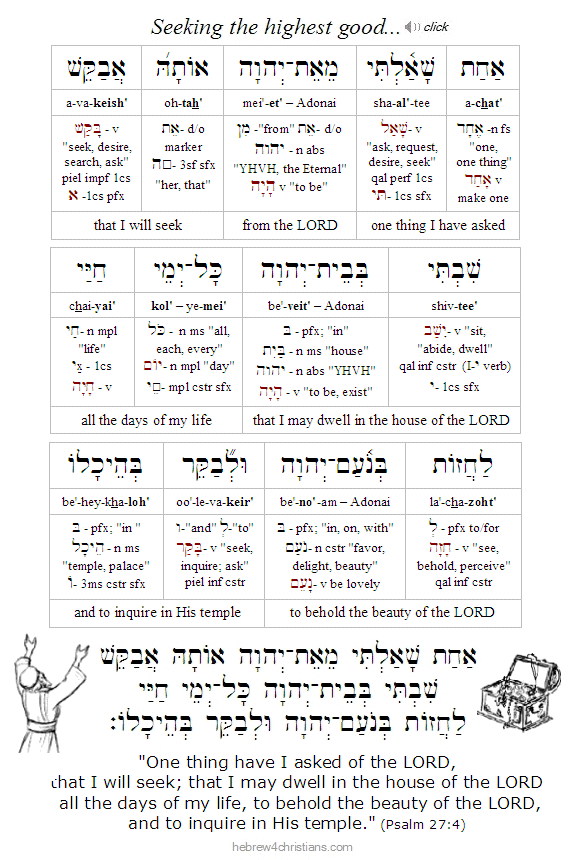
Psalm 27:4 reading (click for audio):
 |
Wounds and Loneliness...
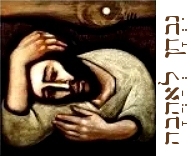
02.24.26 (Adar 7, 5786) The late Henri Nouwen said that there are two great fears (or wounds) that we all face. The first is the fear that we were not wanted at the time of our birth into this world, and the second is that we will not be wanted at the time of our death.
"Not being welcome is your greatest fear. It connects with your birth fear, your fear of not being welcome in this life, and your death fear, your fear of not being welcome in the life after this. It is the deep-seated fear that it would have been better if you had not lived" (Inner Voice of Love).
If you carry a wound of abandonment within your heart - if you live in dread over your worth as a human being, seriously wondering whether it would have been better had you never been born, then you know the taste of hell itself - the emotional prison of feeling lost, defective, rejected, shameful - unable to love or to be loved...
Is not the lament of the lonely heart to find a sense of welcome, or acceptance, or peace within? Is it not the heart's cry for connection? Yet even the very gospel message cannot make traction within a heart lost to its own shame... Therefore the miracle of salvation is profoundly connected with faith that you are loved and lovable - despite yourself - and that this love derives from the core of all that truly exists.
Is this not "home" in the spiritual sense? Is this not "Zion, the perfection of holiness?" That God prepares a table for you in the presence of your enemies, yea, those enemies of self-rejection, abandonment, fear, and shame? And that there - in the midst of your lost and forlorn condition you are found, treasured, and celebrated? Is not that "place" God's very heart - Jesus dying upon the cross, gasping for each breath - knowing all about your sins and dying for you anyway?
In the Torah (i.e., parashat Eikev), Moses asks us to soften our hearts by remembering that we are beloved of God (see Deut. 10:12-16). He reminds us that the though Lord is "the God of gods" (אֱלהֵי הָאֱלהִים) - the power that transcends the gods of our idolatry (i.e., our fears, our disordered attachments, our shame), and the "Lord of lords" (אֲדנֵי הָאֲדנִים) - the Center and Authority of what is most real, he nevertheless cares for the lowly orphan and the grieving widow - he reaches out to the needy and the abandoned - and he desires to console the "stranger," the one shattered of heart, who has no sense of belonging, no pride of tribe, nor place to lay his head (see Deut. 10:17-18). God cares about those who are lost, hurting, and alone; indeed, he came to seek and to save such from their despair...
But how does God reach the bound soul that "walks alone among the tombs, cutting himself in his torment?" How can he heal the deep trauma, the disassociated and broken of heart? How else but by the miracle of his intervention, quickening an otherwise numb and dead heart to come to life, to find hope, and to begin to believe that - despite everything that has happened - she was wanted all along, from the very beginning, and that the wound of her sorrow was given so that he could find out who she really is and where she really belongs... The wound you were given is part of your story, and healing comes from accepting God's love for you -- and understanding how the Lord goes through the wound with you and for you...
Life in this fallen world is likened to a vapor or a passing shadow (Psalm 144:4). Nothing abides; good things here never last; and we labor under the unmentionable anxiety that death will separate us from everyone and everything we love. However, death is not the end for the us, for "love is stronger than death, passion fiercer than the grave; its flashes are flashes of fire, the very flame of the LORD" (Song 8:6).
"What will death be like?" they asked the Master. "It will be as if a veil is ripped apart and you will say in wonder, "So it was you all along!" (De Mello). Death is a most poignant homecoming, a place of joyful welcome, wherein all shall be well for ever. The righteous have an everlasting foundation in the faithful heart of God. Faith in the LORD believes that a single supreme, all-knowing, all-powerful and benevolent spiritual Power directs all things, and that Messiah is the beginning, middle, and end of all conscious meaning, truth, and substance, as it is written: כִּי הַכּל מִיָּדוֹ הַכּל בּוֹ וְהַכּל לוֹ הוּא, "For from him and through him and to him are all things" (Rom. 11:36). A life of faith in the one true God imparts the blessing of shalom (inner peace) and assures the heart that all shall be made well by the love of God.
So then, "if we live, we live to the Lord, and if we die, we die to the Lord. So then, whether we live or whether we die, we belong to the Lord" (Rom. 14:8). For the believer in Messiah, death does not define us, and indeed, we trust that God will attend to us in the moment of our utmost extremity (John 5:24; 11:25-26). If we desire eternal life with all our hearts and remember our end before the Lord, we will set free from the fear of death. Amen v'amen.
Hebrew Lesson
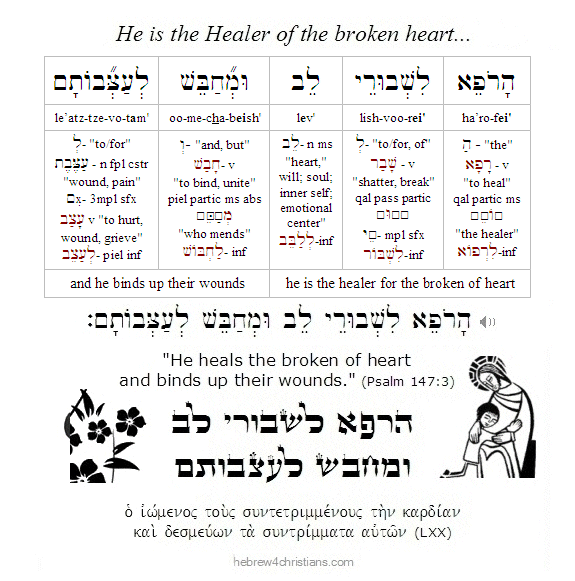
Psalm 147:3 reading (click for audio):
 |
Names upon his Heart...
The following is related to this week's Torah reading, parashat Tetzaveh...
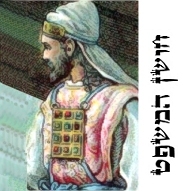
02.23.26 (Adar 6, 5786) The two onyx stones attached to the shoulder pieces of the High Priest's vest (i.e., ephod: אֵפד) were meticulously inscribed with the names of the twelve tribes of Israel: "Take two onyx stones, and engrave on them the names of the sons of Israel, six of their names on the one stone, and the names of the remaining six on the other stone, in the order of their birth. As a jeweler engraves signets, so shall you engrave the two stones with the names of the sons of Israel. You shall enclose them in settings of gold filigree. And you shall set the two stones on the shoulder pieces of the High Priest's vest (i.e., ephod: אֵפד), as stones of remembrance for the sons of Israel. And Aaron shall bear their names before the LORD on his two shoulders for remembrance" (Exod. 28:9-12).
Likewise the twelve precious stones arrayed on the breastplate (i.e., choshen: חשֶׁן) that hung over the front of the High Priest's robe were inscribed with the names of the twelve tribes of Israel: "You shall make a breastpiece of judgment (i.e., choshen ha'mishpaht: חשֶׁן הַמִּשְׁפָּט) in skilled work... and you shall set in it four rows of three precious stones enclosed with gold in their settings. There shall be twelve stones with their names according to the names of the sons of Israel. They shall be like signets, each engraved with its name, for the twelve tribes... "So Aaron shall bear the names of the sons of Israel in the breastpiece of judgment upon his heart, when he goes into the Holy Place, to bring them to regular remembrance before the LORD" (Exod. 28:15-29).
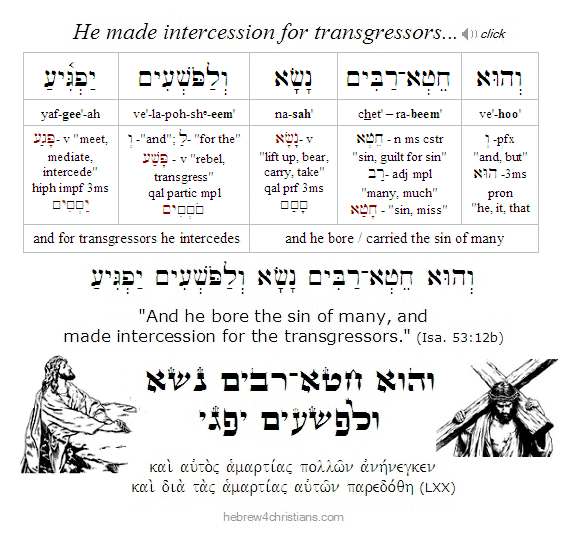
The sages comment that just as a father carries his young child on his shoulders, or a shepherd his lamb, so the High Priest carried his people before the LORD in intercession. Similarly, at the cross Yeshua carried our names on his shoulders, bearing the burden of our sins on on breast as he cried out in prayer for us before the Father. As our great High Priest of the New Covenant, Yeshua "bore the judgment of the people upon his heart" as he made intercession for them (Isa. 53:12; Rom. 8:34).
Hebrew Lesson
Isa. 53:12b Hebrew reading:
 |
Having "Ears to Hear..."
"When you read God's word, continually say to yourself, 'It is I to whom it is speaking, it is I to whom it is speaking..." - Soren Kierkegaard
02.23.26 (Adar 6, 5786) As it was when Yeshua was here on earth teaching and sacrificing his blood to make God's consummate point about our need for his love, so it is universally true that the Word of God speaks to the individual heart, that is, the one who has "ears to hear" what the Spirit is saying...
Now the "Word of God" includes more than just the "red letter" quotes of the Savior, of course, but encompasses all of the Scriptures that have been providentially preserved and sanctioned by those endowed with wisdom to establish and ratify the canon of the Bible. This is the essential context for the "red letters" themselves, and without it we would not understand the overall message. For those interested in how the canon of the Bible was established by the Jewish people (including the first followers of Yeshua the Messiah), there are a number of scholarly resources. Here I simply trust Yeshua's endorsement of the canon of Scripture of his day, namely the threefold division of the Law (Torah), the Writings (Ketuvim), and the Prophets (Nevi'im) that was handed down from the elders of Israel and the men of the Great Assembly (Luke 22:44; Matt. 7:12). Similarly I trust the threefold witness of the disciples following his resurrection who recorded the Gospel narratives, the Writings (epistles), and the (Revelation).
All of the Bible is "inspired by God and profitable for doctrine, for reproof, for correction, for instruction in righteousness" (2 Tim. 3:16), and this includes its historical narratives as much as it its ethical teachings, its prayers, poems, sermons, parables, prophecies, as well as its theological and pastoral letters. In other words, while the Bible is a collection of various "historical books" written over different times and in different places, it composes a "grand composition" or unified story given by the Spirit of God that has been written down and meticulously preserved for every generation to read and internalize. This is a matter of faith and revelation, though thousands of years of personal testimony of the veracity of its message attest to its credibility and sanctity...
There is a timelessness to the Scriptures for those who read it as "contemporaries" and engage its meaning as relevant to their lives. As I mentioned the other day, this "interpretive principle" is valid because we are given "eternal life" and understand the presence of Christ to be contemporaneous with our lives today. He is alive today, now, this hour. He ever lives to make intercession for us. He is with is always and will never leave nor forsake us...
To illustrate the contemporaneousness of the words of Scripture, let's consider the infamous account of King David's adulterous affair with a woman named Bathsheva, and David's unsuccessful attempts to cover up the affair that finally led him to conspire with his general Joab to have her husband Uriah killed in a battle. Some time later Joab sent a messenger to David saying that Uriah had been killed, and later still David summoned Bathsheva (who was pregnant with his child) to come live at his palace as his wife (see 2 Sam. 11:1-27).
Recall that God then sent the prophet Nathan to confront David about his crime. Nathan told David the story of two men in one city, the one rich, and the other poor. "The rich man owned a great many sheep and cattle, but the poor man owned nothing except one little lamb he had bought. He raised that little lamb, and it grew up with his children. It ate from the man's own plate and drank from his cup. He cuddled it in his arms like a baby daughter." When a traveler came to visit the rich man, however, he was unwilling to take one of his own flock to prepare a meal for his guest but instead took the poor man's lamb and slaughtered it for the man who had come to him. Upon hearing this David was outraged and vowed that the rich man who did this deserved to die because he had shown no pity (2 Sam. 12:1-6).
Nathan then said, "You are the man." Thus says the LORD God of Israel: I anointed you king over Israel, and I delivered you from the hand of Saul. I gave you your master's house and his wives and the kingdoms of Israel and Judah. And if that had not been enough, I would have given you much, much more. Why, then, have you despised the word of the LORD and done this horrible deed? For you have murdered Uriah the Hittite with the sword of the Ammonites and stolen his wife. Now therefore, the sword shall never depart from your house, because you have despised Me, and have taken the wife of Uriah the Hittite to be your wife. This is what the LORD says: "Because of what you have done, I will cause your own household to rebel against you. I will give your wives to another man before your very eyes, and he will go to bed with them in public view. You did it secretly, but I will make this happen to you openly in the sight of all Israel" (2 Sam. 12:7-12).
David's repentance for his crime is recorded in Psalm 51...
Regarding this story from Scripture Soren Kierkegaard lamented that many people are as detached from the point as was King David - until they realize "you are the man..." He wrote: "The authority of the Gospel does not speak to one person about another, does not speak to you, my listener, about me, or to me about you, no, when the Gospel speaks it speaks to the single individual, It is not speaking about us human beings, you and me, but to us as human beings, to you and me" (Works of Love: 1847).
Is the moral of the story to teach that God is righteous to judge sin, as David's judgment of the fictional rich man was really upon himself, and God ratified his realization, or is the moral to warn the individual not to pass judgment on others while blind to his own sin? Does it speak to your heart when you catch yourself indignant over the hypocrisy or malice of others? Or when you judge others for their weaknesses and failures in order to justify your own lukewarm spirituality?
Yeshua lifts the veil from the hidden heart. "But I say, if you are even angry with someone, you are subject to judgment! If you call someone an idiot, you are in danger of being brought before the court; but if you curse someone, you are in danger of the fires of hell" (Matt. 5:22). Anger hidden within the heart is as worthy of punishment as murder was declared to be in Torah.
When we read the bible "objectively," like a secular historian or a professor of world religion might, we try to understand what is saying in terms outside of ourselves, regarding other people, at other times, and in very different circumstances, and yet how we read it and "speak back" (or interpret) the words within our heart reveals more about us than anything else. And that this the cunning trap of Scripture, that like Nathan's parable, you are the one to whom it is speaking. As Kierkegaard also said: "When you read God's word, continually say to yourself, 'It is I to whom it is speaking, it is I to whom it is speaking - for this is earnestness, precisely this is earnestness" (For Self Examination).
This is what our hearts seek, do they not? A personal and passionate engagement with God? Assurance that our lives spent here were not empty and vain. Engaging the Scriptures as the living word of God demands passionate, inward, and subjective commitment to one's existence, with the task of becoming their true self before God. This is "education for eternity" where the language of imperative bespeaks the language of God's passion.
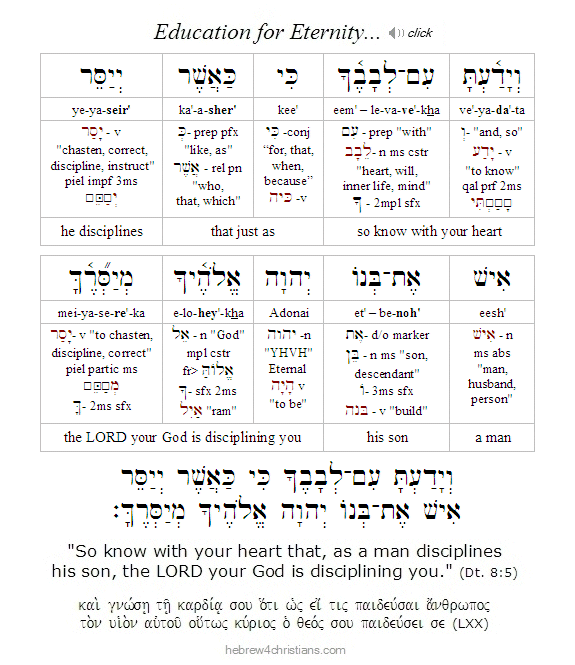
It is written in the Torah: "Know within your heart that, as a man disciplines his son, so the LORD your God disciplines you" (Deut. 8:5). This verse expresses the idea of "musar" (מוסר), or moral education intended to develop godly character within us. This admonition occurs elsewhere in the wisdom literature: "My son, despise not the chastening (i.e., musar) of the LORD; neither be weary of his correction (i.e., tokhechah). For whom the Lord loves he corrects; even as a father the son in whom he delights" (Prov. 3:11; see also Heb. 12:5-6).
In light of Torah we infer that God disciplines us because we are his children, for the sake of our growth and maturity, and not for vindictive reasons. God's correction indicates that he feels responsible for our character development, as a good father feels responsible for the character development of his child. Correction from the Lord is ultimately "soul-building," since it enables us to be partakers of His holiness -- and is grounded in His love and concern for us as our Heavenly Father (see Heb. 12:5-11).
So hang in there dear friend. Persevere to the end. "For the moment all discipline seems painful rather than pleasant, but later it yields the peaceful fruit of righteousness to those who have been trained by it" (Heb. 12:11). May God help us in our "education for eternity."
Hebrew Lesson
Deut. 8:5 Hebrew reading (click):
 |
The Will to Believe...
"When you have to make a choice and don't make it, that is in itself a choice." - William James
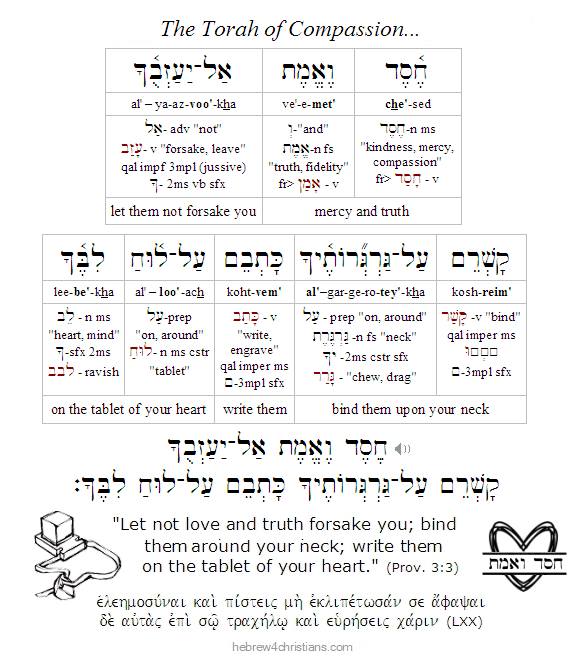
02.23.26 (Adar 6, 5786) The central issue of our spiritual life is the willingness to do God's will, or the willingness to believe, since these amount to the same thing.... Believe what? That God is real, that He has (personally) called you by name, that he has particularly redeemed you by Yeshua's own blood poured out for your sins, and that therefore that your identity and life are forever bound up with his mercy and truth... Perhaps this message seems too good to be true, and yet it is the heart's duty to take hold of hope and to refuse to yield to despair, as it is written: "Let not love and truth forsake you; bind them around your neck; write them on the tablet of your heart" (Prov. 3:3).
The spiritual danger is being "pulled apart" in opposite directions, dissipating the soul so that it will not be unified, focused and directed. Both loving and hating the good is a state of painful inner conflict, ambivalence, and self-contradiction. "Who can bring a clean thing out of an unclean? there is not one" (Job 14:4), yet this is our starting point: "I find it to be a law that when I want to do right, evil lies close at hand" (Rom. 7:21). We are often willing and unwilling, or neither willing nor unwilling, and this makes us inwardly divided, weak, fragmented, anxious, and "soulless." An honest faith that "wills one thing" binds the soul into a unity, or an authentic "self." As King David said, "One thing have I asked of the LORD, that will I seek after: that I may dwell in the house of the LORD all the days of my life, to gaze upon the beauty of the LORD and to inquire in his temple" (Psalm 27:4).
Healing a divided heart comes from making a decision: "Draw near to God, and he will draw near to you" (James 4:8). There are no conditions given here -- other than your raw need to connect with God for help. "Purify your hearts, you double-minded ones" (δίψυχοι, lit. "two-souled ones"); make up your mind and be unified within your heart: "How long will you go limping between two different opinions?" (1 Kings 18:21). You are invited to come; God has made the way; your place at the table has been set and prepared...
Our Heavenly Father "sees in secret.." As William James once said: "The deepest thing in our nature is this region of heart in which we dwell alone with our willingnesses and our unwillingnesses, our faiths and our fears" (James: Is Life Worth Living, 1896). Or as Albert Camus later wrote, "There is but one truly serious philosophical problem, and that is suicide. Judging whether life is or is not worth living amounts to answering the fundamental question of philosophy" (Myth of Sisyphus, 1942).
It is there, in the secret place of the heart, that the sound of the "knock" is either heard or disregarded (Rev 3:20); the stakes are nothing less than everything. May the Lord give us the willingness to do His will and the courage to believe in His love. And may God deliver us from doubt and from every other fear. May we all be strong in faith, not staggering over the promises, but giving glory to God for the miracle of Yeshua our LORD. May we all be rooted and grounded in love so that we are empowered to apprehend the very "breadth and length and height and depth" of the love of God given to us in Messiah, so that we shall all be filled with all the fullness of God (Eph. 3:14-19). Amen.
Hebrew Lesson
Proverbs 3:3 reading (click):
 |
Crushed for the Light...
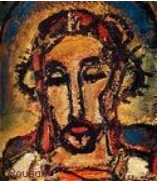
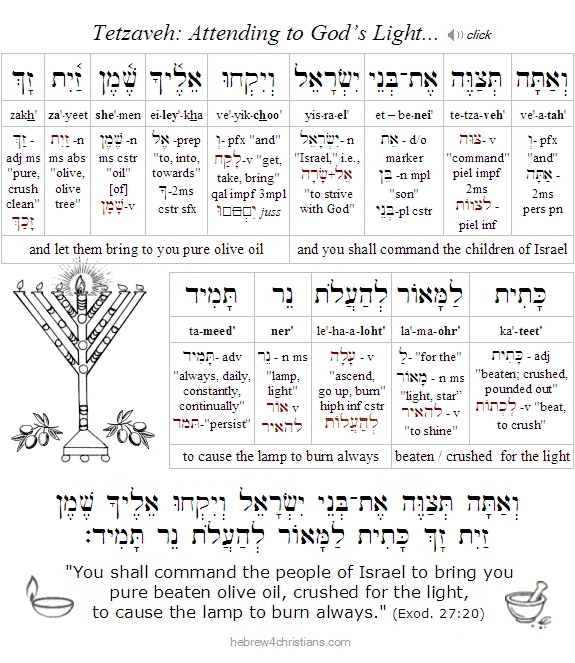
02.22.26 (Adar 5, 5786) From our Torah portion for this week (Tetzaveh) we read: "You shall command the people of Israel that they bring to you pure olive oil "crushed" for the light, that an eternal or continual lamp (i.e., ner tamid: נר תמיד) may be set up to burn" (Exod. 27:20).
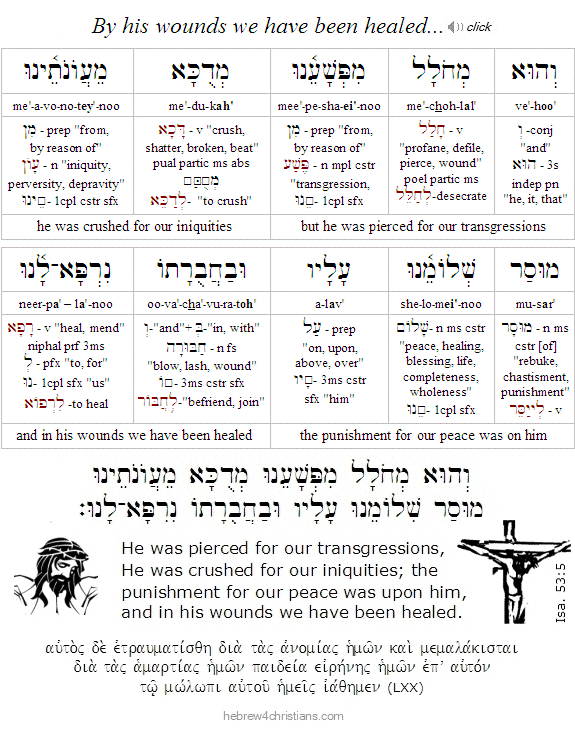
The Hebrew word for "pure" olive oil is zakh (זך), which refers to the clearest oil derived from squeezing out (or crushing) the very first drop from the choicest olive. The purest of oil was obtained by a process of "crushing for the light" (כתית למאור), which symbolizes the Light of the World, the One Crushed for our iniquities, the "Man of Sorrows" (אישׁ מכאבות) who offered himself up for our healing and illumination (Isa. 53:1-5).
Some things are seen only through the process of tribulation, breaking, and surrender. When we kindle this lamp, we are able to see the truth; we perceive how God's heart was crushed for the sake of our salvation...
Hebrew Lesson
Isaiah 53:5 Hebrew reading:
 |
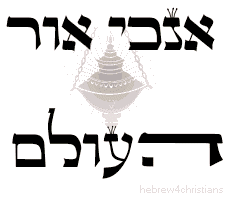
Attending to God's Light:
Parashat Tetzaveh...
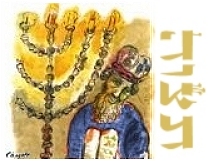
"All truth and understanding is a result of a divine light which is God Himself." - Augustine
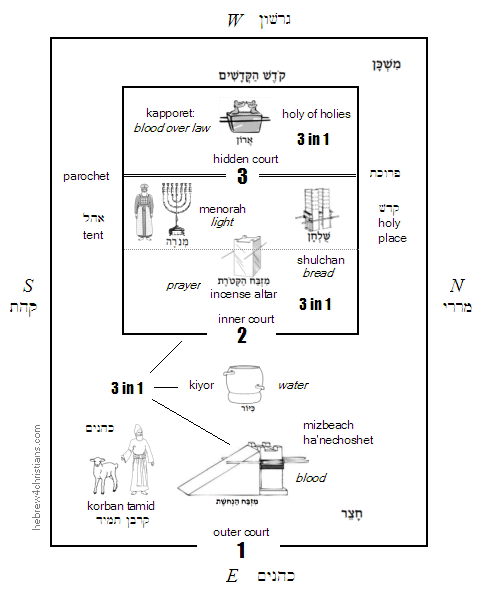
02.22.26 (Adar 5, 5786) Shavuah tov, friends. Last week's Torah reading, parashat Terumah (תרומה), explained that God had asked for a "donation" (i.e., terumah) from the people for the sake of creating a portable, tent-like sanctuary called the Mishkan (משׁכּן), or "Tabernacle." God then showed Moses the pattern (תּבנית) according to which the Mishkan and its furnishings were to be made. First the Ark of the Covenant (ארון בּרית־יהוה) and its golden cover (called the kapporet: כּפּרת) would occupy an inner chamber of the tent (אהל) called the Holy of Holies (קדשׁ הקדשׁים). Within an adjoining chamber of the tent called the Holy place (הקדשׁ), a sacred Table (שׁלחן) would hold twelve loaves of unleavened bread (לחם פּנים) and a seven-branched Menorah (מנורה) would illuminate the tent. God gave precise dimensions of the tent with the added instruction to separate the Holy of Holies by a hanging veil called the parochet (פּרכת). The entire tent was to have a wooden frame (מסגּרת) covered by colored fabric and the hide of rams and goats. Outside the tent an outer court (חצר) was defined that would include a copper sacrificial altar (מזבח נחושת) and water basin (כּיּור נחשׁת). The chatzer, or outer court, was to be enclosed by a fence made with fine linen on silver poles with hooks of silver and sockets of brass.
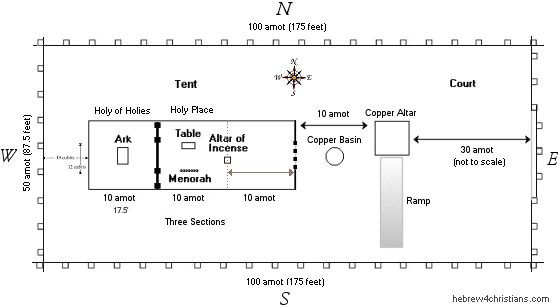 |
Our Torah reading for this week, parashat Tetzaveh (תצוה), continues the description of the Mishkan, though the focus shifts to those who will serve within it, namely the kohanim (כּהנים), or the priests of Israel. First Moses was instructed to tell the Israelites to bring pure olive oil (שׁמן זית זך) for the lamps of the Menorah, which the High Priest (הכּהן הגדול) was instructed to light every evening in the Holy Place. Next God commanded Moses to ordain Aaron and his sons as priests and described the sacred garments (בּגדי־קדשׁ) they would wear while they were serving in the Mishkan.
 |
All priests were required to wear four garments – linen breeches, tunics, sashes, and turbans, but in addition to these the High Priest (Kohen Gadol) was to wear a blue robe that was decorated with pomegranates and golden bells. Over this robe, an ephod (אפוד) – an "apron" woven of gold, blue, purple, and crimson – was to be worn, upon which was attached a "breastpiece" (חשׁן) inlaid with precious stones inscribed with the names of the 12 tribes of Israel. The ephod also contained a pouch holding two unique gemstones called the urim v'tummin (אורים ותומים), usually translated as "lights and perfections." According to the Targum Jonathan, when a matter was brought to the High Priest for settlement, he would sometimes hold the urim (from אוֹר, "light") and tummin (from תָּם, "integrity" or "completeness") before the Menorah in the Holy Place and the Shekhinah would light up various letters inscribed on the gemstones to reveal the will of God. Finally, the High Priest would wear a golden plate (i.e., tzitz zahav: צּיץ זהב) engraved with the words, "Holy to the LORD" (קדשׁ ליהוה) upon the front of his turban.
The priests were to be ordained in a seven-day consecration ceremony that involved washing, dressing, and anointing them with oil and blood, followed by the offering of sacrifices. The priests were instructed to present burnt offerings twice a day upon the copper altar. The portion ends with a description of the Golden Altar (מזבּח הזהב) also called the Altar of Incense (מזבּח הקטרת) upon which incense (i.e., ketoret: קטרת) was offered twice a day by the priests when the Menorah lamps were serviced. In addition, the blood of atonement was to be placed on its corners once a year, during the Yom Kippur ritual.
The Light of the Servant...
"The spirit of prayer is for all times and occasions; it is a lamp that is to be always burning, a light to be ever shining: everything calls for it; everything is to be done in it and governed by it, because it is and means and wills nothing else but the totality of the soul - not doing this or that, but wholly given up to God to be where and what and how He pleases." - William Law
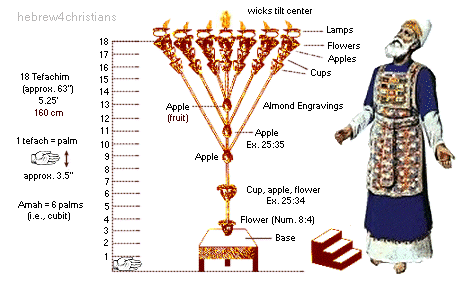
02.20.26 (Adar 3, 5786) One of the main components of the Mishkan (i.e., Tabernacle) was the Menorah (מְנוֹרָה), a beautifully designed lampstand that illuminated the Holy Place. Our Torah portion this week (Terumah) reveals that all its intricate parts (i.e., its seven branches with seven lamps, nine flower blooms, eleven fruits, and twenty two cups) were formed from a single piece of pure gold (זָהָב טָהוֹר) that was "beaten" or "hammered" into shape (Exod. 25:36). The gold color is symbolic of the divine substance (gold has a hint of the color of blood combined with the pure white). The six lamps of the menorah faced the central lamp, called the shamash or "servant," so called because it bore the flame from which the other lamps were kindled.
|
The seven lamps of the menorah were lit daily, "from evening until morning," starting from the central lamp (i.e, the shamash) and then moving right to left (Exod. 27:21). According to the Talmud (Shabbat 22b), while all the lamps received the same amount of olive oil, the "westernmost" lamp (according to Rashi, the center lamp, due to its orientation) miraculously never ran out of oil, even though it was kindled first in the sequence. When Aaron would rekindle the lamps every evening, he saw the shamash still burning, so he simply refilled it with oil and trimmed its wick. This miracle is also said to have occurred during the Temple period, though it abruptly ended about 40 years before the destruction of the Second Temple (c. 30 AD), after the death of Yeshua the Messiah, the true Servant and Branch of the LORD. As it is attested in the Talmud: "Our Rabbis taught: During the last forty years before the destruction of the Temple the lot ['For the Lord'] did not come up in the right hand; nor did the crimson-colored strap become white; nor did the westernmost light shine" (Yoma 39a).
The Scriptures declare that God is light, and Yeshua is the true Light of God (1 John 1:5; John 1:9). The light from the menorah reveals spiritual light. It was hidden from view from the outside of the Tabernacle, but was seen while inside the holy chamber, before the holy place of sacrificial atonement. The light itself came from the burning of pure and beaten olive oil - a symbol of anointing and the Holy Spirit (רוּחַ הַקּדֶשׁ). It enabled service to God to be performed, though it was not a light to be used for profane purposes. Notice that the six lamps faced the central lamp - a picture of Yeshua, the Light of the World whose arms and legs were "hammered" for our sins.... He is the suffering servant (shamash) who lightens everyone in the world; He is the central light that upholds the other branches (John 15:5).
Hebrew Lesson
Psalm 36:9 Hebrew reading:
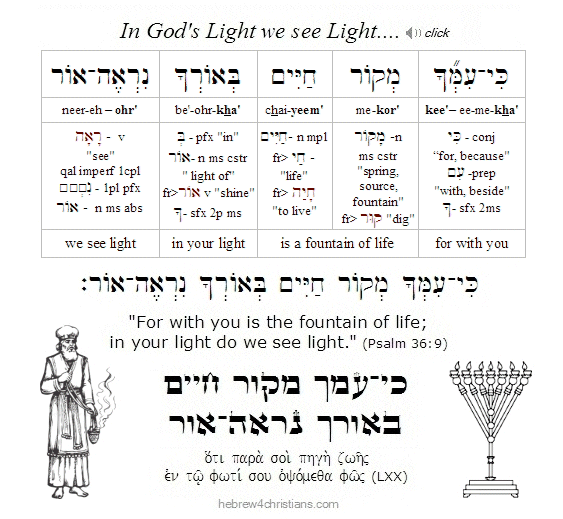 |
For more on this fascinating subject, see "A Closer Look at the Menorah."
Half-Cubits and Mystery...
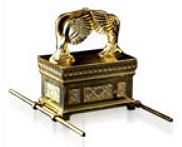
"A genuine faith resolves the mystery of life by the mystery of God." - Reinhold Niebuhr
02.20.26 (Adar 3, 5786) The renowned "Ark of the Covenant" (ארון ברית־יהוה) was constructed using fractional measurements (i.e., "half-cubits") to specify its length, width, and height: "They shall make an Ark of acacia wood (ועשׂוּ ארוֹן עֲצֵי שִׁטִּים); two cubits and a half (אַמָּתַיִם וָחֵצִי) shall be its length, a cubit and a half (ואַמָּה וָחֵצִי) its breadth, and a cubit and a half its height" (Exod. 25:10). Regarding these specifications, the sages comment that the "half-cubit" is symbolic of our fractional understanding, alluding to mystery and even paradox.
"You shall overlay it with pure gold, inside and outside shall you overlay it (a three-in-one chest), and you shall make on it a crown of gold (זֵר זָהָב) around it" (Exod. 25:11). The heart of the Tabernacle held the law of God, a picture of Yeshua who bore the law of God within his heart (Matt. 5:17-18). And though the Ark was made of wood from the common thorntree, it was covered both inside and out with pure gold and bore a "crown" where the sacrificial blood was offered for atonement, a picture of Yeshua who clothed himself in our humanity, bore the crown of thorns, and shed his blood for our eternal atonement (Heb. 9:12).
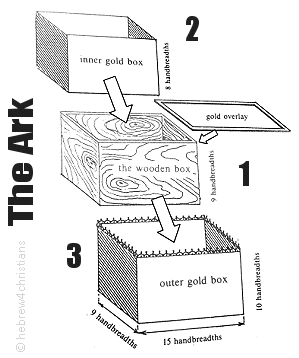 |
Note that the Hebrew text says "they shall make an ark of acacia wood" (Exod. 25:10). Unlike other furnishings of the Tabernacle that were made by Betzalel, the text uses the plural verb here: "they shall make an ark" (וְעָשׂוּ אֲרוֹן), which implies that every person had a part in upholding the Torah. More - each person had a part in the place of blood atonement offered upon the kapporet - the cover of the Ark - which again symbolizes that Yeshua offered his life for the sins of the whole world (1 John 2:2). Shalom chaverim.
Hebrew Lesson
Psalm 85:10 reading (click for audio):
Reading with the Spirit...
"For me, reason is the natural organ of truth; but imagination is the organ of meaning. Imagination, producing new metaphors or revivifying old, is not the cause of truth, but its condition." - C.S. Lewis
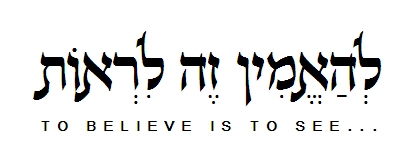
02.20.26 (Adar 3, 5786) To hear God's voice in Scripture we need to "suspend" our ordinary ideas about time and imaginatively interact with the texts as if we were present when the events that were recorded had originally occured. This approach is valid because we are given eternal life that is linked to the timeless truth of God.
For instance, when we read that God asked Abraham to sacrifice his son Isaac upon an altar, we should use empathy and imagination to understand how insanely difficult this must have been for them. Even if we have read the narrative several times before and know the "end of the story," it's important to "forget" the outcome so that we can get some idea of what this ordeal may have been like for both Abraham and Isaac. (I once worked with a man who told me that he tried reading the Bible but found it boring, so he skipped to the back of the book, saw that "God won," and flippantly declared that everything worked out for the best!)
Try to imagine the long three day journey to Moriah. Listen to the braying of the donkeys and notice the somber dismay creasing over Abraham's face. Consider his unspoken words; think of Isaac's squelched questions, sense the cloud of heaviness they both were under, and feel the insane contradiction Abraham must have felt inside as he foresaw himself lifting up his knife to plunge into the heart of his miraculously begotten son and promised heir.... Try to understand why God would require such a thing from his loyal friend. Are you not left in speechless awe and terror as you draw closer to foot of the mountain?
Watch Abraham take the wood for the burnt offering and lay it on the back of his son; look at how he holds the torch of fire and his knife just as they begin ascending the mountain together. Glance at Isaac's face. In the tension, overhear Isaac asking his father: "I see the fire and have the wood, but where is the lamb for the burnt offering?" Listen as Abraham mysteriously replies, "My son, God will provide for Himself the lamb for a burnt offering..."
As they finally reach the place that God told him, watch as Abraham quickly makes an altar and carefully arranges the wood. Look around for the lamb Abraham spoke about... See Isaac looking about anxiously and wondering what was happening. Listen as Abraham tells Isaac to lay down on the altar. Watch as he binds his son's arms and feet. You marvel that Isaac is not resisting his father but instead surrenders his life into his father's hands...
In the awful silence, in the climactic moment, you watch as Abraham lifts up his knife to kill his son. Is he looking into his son's eyes or upward to heaven? Is he weeping or resigned in helplessness that mirrors Isaac's bond? Is Isaac silent? Are his eyes open and searching his father's face? You don't know; your vision is obscured because of the intense anxiety of the moment. Watch in horror as Abraham takes deep breath and is ready to do the unthinkable...
At the last moment you suddenly hear the voice of an Angel calling out from heaven saying, "Abraham, Abraham!" Within a hairsbreadth of plunging down his knife, Abraham is stopped by the Word of God. It was the Lord. "Do not harm the young man! Do not do anything to him, for now I know that you fear God because you did not withhold your son, your only son, from me."
Look at incredible relief he is feeling... Look at Isaac exhaling deeply and thanking God with a shudder for his gracious intervention. Watch as Abraham spots a ram caught in a thicket by his horns. Listen as he tells Isaac this would be the lamb that God would provide for the sacrifice! See Abraham take the lamb and then sacrifice it in place of his son.
You are astonished over all of this, stunned and amazed. As the lamb lay burning on the altar, you are again overwhelmed as the Angel calls out to Abraham a second time, saying: "By myself I have sworn, says the LORD, because you have done this thing, and have not withheld your son, your only son -- that blessing I will bless you, and multiplying I will multiply your descendants as the stars of the heaven and as the sand which is on the seashore; and your descendants shall possess the gate of their enemies. And in your Seed all the nations of the earth shall be blessed, because you have obeyed My voice."
You pause in awe over the blessing of the Lord and the glorious promise that was given. You marvel over Abraham's amazing courage and celebrate his unshakable faith. You rejoice over the promise of the Seed to come that will bless all the nations of the earth because of Abraham's willingness to surrender everything - including his beloved and promised son - to God. You quietly worship and praise God for revealing to you the coming of Yeshua...
Now this attempt to be "contemporary" with Abraham also applies to being contemporary with Yeshua our Lord, the Promised Seed of Abraham, not only in the historic sense of witnessing his miracles, listening to his teaching, and seeing him crucified as the Lamb of God, but also in his present reality by means of his resurrection from the dead. Faith that Christ is risen from the dead is central to our faith, and it implies not only that he overcame sin and death for us, but that he is alive now, he is present in our lives, and that we can connect with his heart by listening to him... Our faith understands that he ever lives to make intercession for us (Heb. 7:25). We have access by faith to His Presence; we come boldly before the throne of grace.
In light of these considerations we do not regard the Scriptures to be a collection of literature handed down from the dust of ancient history but rather to be the timeless and unified story of God's redemption and love for us, particularly as revealed in the life and present reality of Yeshua the risen Lord of Glory. The Scriptures are the "living word" of God, given by the breath of God's Spirit. As Yeshua told his contemporaries: "Abraham rejoiced to see my day, and he saw it and was glad" (John 8:56). And as he also said to those who questioned his claim to be the Messiah: "If you believed Moses, you would believe me, because he wrote about me. But if you do not believe his writings, how will you believe my words?" (John 5:46-47).
The Scriptures provide timeless truth, eternal parables that find application in every generation, and that includes our generation today, and particularly those who receive the Presence of Yeshua to be the ultimate concern of their lives....
The work of faith is to receive the life of Christ at this time and to live our present hour in everlasting and abiding relationship with Him. That is the idea of "sanctification," or being set apart to mediate God's presence on earth. We are "jars of clay," fragile, imperfect, and temporary containers that hold the eternal treasure of God. We have a short allotment of time to live within the bounds of the infinite, and therefore the goal of our lives is to sanctify the Lord and to walk in his light until one day we shall see God face to face (Psalm 17:15).
We love the Scriptures because they enable us to see beyond the veil of this world into the mysteries, beauty, and wonders of eternal life and the world to come. Moreover by them we are strengthened by hearing the Voice of God himself. His is alive! He is risen! He is present now! We call upon him in "real time" and our call echoes into eternity! Let us stay strong and engage the Scriptures as participants of God's great story of salvation. Amen.
Hebrew Lesson
Psalm 73:23 reading (with comments):
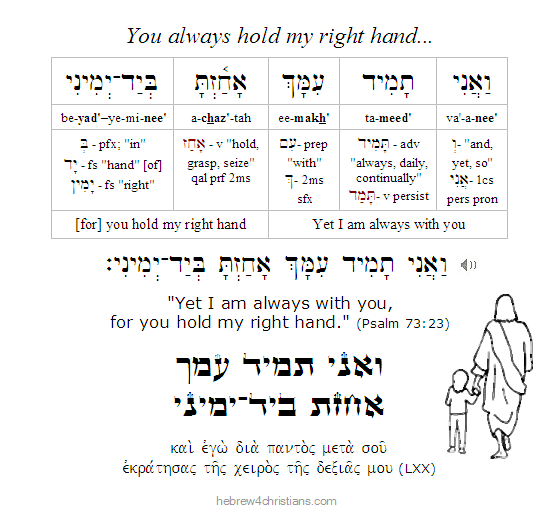 |
Truth of the Sacred...
02.19.26 (Adar 2, 5786) In our Torah portion this week (Terumah) we read: "Let them make me a mikdash ("holy place," "sanctuary"), that I may dwell in their midst" (Exod. 25:8). Though this verse refers to the physical mishkan (i.e., "Tabernacle"), it more deeply refers to the duty of the heart to sanctify the Name of God and bring a sense of holiness to the inner life. This requires that we focus the mind and heart to honor the sacredness of life, taking "every thought captive" to the truth of God in Messiah (2 Cor. 10:5).
Since our minds and hearts are gateways to spiritual revelation, we must be careful to not to abuse ourselves by indulging in sloppy thinking or unrestrained affections. God holds us responsible for what we think and believe (Acts 17:30-31), and that means we have a duty to honor moral reality and truth. There is an "ethic of belief," or a moral imperative to ascertain the truth and reject error in the realm of the spiritual. Since God holds us responsible to repent and believe the truth of salvation, He must have made it possible for us to do so ("ought" implies "can"). And indeed, God has created us in His image and likeness so that we are able to discern spiritual truth. He created us with a logical sense (rationality) as well as a moral sense (conscience) so that we can apprehend order and find meaning and beauty in the universe He created. All our knowledge presupposes this. Whenever we experience anything through our senses, for example, we use logic to categorize and generalize from the particular to the general, and whenever we make deductions in our thinking (comparing, making inferences, and so on), we likewise rely on logic. We have an innate intellectual and moral "compass" that points us to God.
Hebrew Lesson:
Exodus 25:8 Hebrew reading:
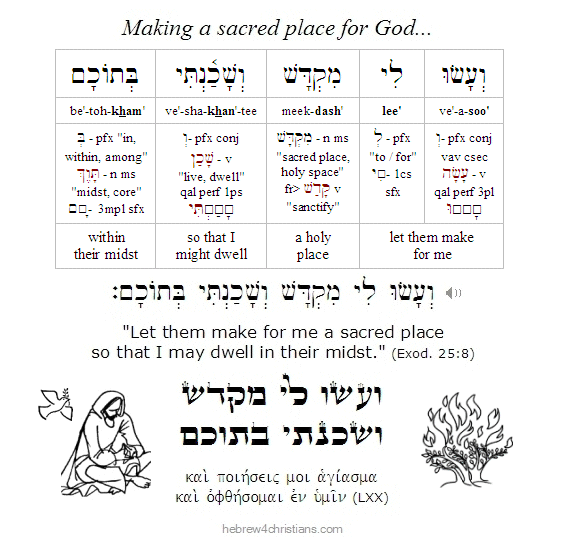 |
Since we all necessarily must think in order to live, we should value clear thinking. This should be obvious enough, though people often make various errors and misjudgments because they devalue the effort required to carefully think through a question. As William James once said, "A great many people think they are thinking when they are merely rearranging their prejudices." When it comes to questions about the gospel, however, God regards such carelessness to be blameworthy. Again, the LORD holds us accountable for what we think and believe, especially when it comes to the reality and mission of His Son.
The truth about God is always available to human beings, if they are willing to look for it. The Divine Light that was created before the sun and the stars represents God's immanent presence that "lights up" all of creation - including our minds (Gen. 1:3). As Paul stated, "the invisible things of Him from the creation of the world are clearly seen so that people are without excuse" (Rom. 1:19-20). The heavens are constantly attesting to the reality of God's handiwork (Psalm 19:1). All of creation "shouts out" that there is a God. Since an infinite series of causes is impossible, the Cosmological argument for the existence of a First Cause is intuitively known to be warranted...
The witness of God's truth is foundational to all of our thinking as well. If you regress far enough in a chain of reasoning, you will always encounter first principles, intuitions, axioms, and "apprehensions" of the laws of thought. This is how language works, or rather, how our mind necessarily discovers truth about reality. For example, the law of contradiction (or identity) is not discovered in experience, but is brought to experience by the operation of the mind. All reasoning is ultimately grounded on foundational first principles that are regarded as self-evident and that are known through the light of the mind itself. Even the pagan Greeks understood this. For instance, Aristotle said that both deduction and induction ultimately were based on the "intuitive grasp" of first principles of thinking itself.
 |
It's important to realize that no one "invented" the rules of logic (such as the law of identity, the law of contradiction, valid rules of inference, etc.); no, these are self-evident and presupposed in all forms of intelligible thinking about anything at all. In other words, God created the mind so that true thinking is possible. If you are reading these words, you are presently using logic. You are identifying and combining letters, interpreting their meaning, making connections and comparisons, and therefore making inferences. There is no way to argue that logic is "artificial" or culturally relative. No one can consistently use logic to argue against its universal validity. The revelation (not the invention) of logical first principles is part of God's "signature," if you will, of how the mind is wired to correspond to reality. Reason discovers order in the universe but does not create it ex nihilo. If you deny this, you have opted out of the realm of thought altogether and entered the realm of the absurd.
Likewise we have intuitive awareness regarding the existence of moral truth (i.e., the standard of justice and moral law), aesthetic truth (i.e., ideals of beauty, goodness, worth, and love), metaphysical truth (i.e., cause and effect relationships), and so on. Even scientific truth is based on principles that transcend the discipline of science itself (for example, the assumption that knowledge is "good" and should be obtained is not an empirical statement). The human mind naturally uses these sorts of categories in its thinking all the time, but each of these are ultimately derived from the rational mind of God Himself.
God created people so that they could discern truth about reality. The mind functions according to logical laws because it is made in the image and likeness of God Himself... God Himself is the ground of all logic, since He created reality and structured the world to be knowable according to its laws. As it is written: "In the beginning was the word/logic (ὁ λόγος), and the λόγος was with God, and the λόγος was God" (John 1:1). God created a world that exhibits order and great beauty. And since human beings were created b'tzelem Elohim, in the image of God, our thoughts (and the words used to formulate our thoughts) as well as our actions are likewise intended to exhibit order and beauty. "For the fruit of light (καρπὸς τοῦ πνεύματος) is found in all that is good and right and true" (Eph. 5:9). Therefore "whatever is true... think on these things" (Phil. 4:8).
Followers of Yeshua are commanded to love the truth and to think clearly about their faith. The ministry of reconciliation itself is defined as "the word of truth, by the power of God, through weapons of righteousness" (2 Cor. 6:7). Indeed, the word of truth (τὸν λόγον τῆς ἀληθείας) is a synonym for the "gospel of salvation" itself (Eph. 1:13; Col. 1:5; James 1:18). We are saved by Yeshua, who is the "way, the truth, and the life" (John 14:6). God commands all people to believe this truth (Acts 17:30-31; 1 Tim. 2:4). People perish because "they refuse to love the truth and so be saved" (2 Thess. 2:10-12). Therefore we see that the issue of truth is central to salvation itself....
Hebrew Lesson
Psalm 25:10 reading (click):
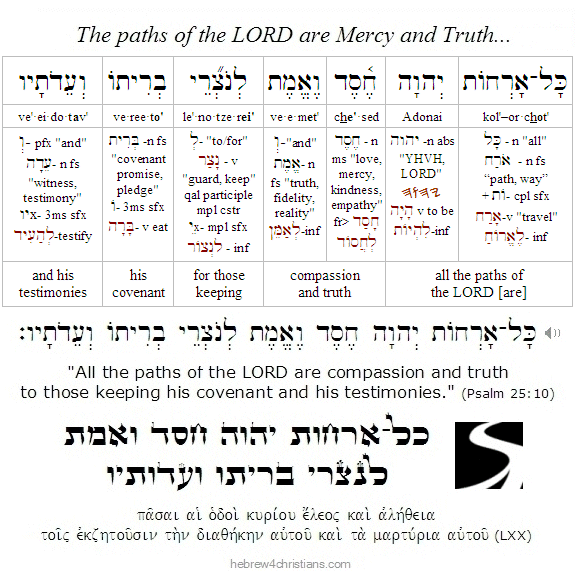 |
For more on this topic, see the article "Metanoia: Teshuvah of the Mind."
Audio Discussion:
Providence and Purim...
The holiday of Purim begins Monday March 2nd at sundown this year...
02.19.26 (Adar 2, 5786) Much is made over the fact that the book of Esther is the only book of the Bible that does not explicitly mention the Name of God. However, the idea of God's sovereignty and divine providence (i.e., hashgachah, הַשׁגָחָה) is clearly implied throughout the entire story. Indeed the sages teach that the message of Purim concerns the kingship of God (ממלכת האל), with the word "the king" (המלך) appearing over 100 times and the word "kingdom" (מלכות) appearing ten times in the scroll. In most cases the word "king" refers to King Achashverosh, though the sages say that when Achashverosh is not explicitly named, it may also refer to the King of the Universe.
The phrase hester panim (הסתר פנים) means "hiding of the face" and is often used when discussing the Book of Esther. In this sense of the term, hester panim is somewhat like the sun on an overcast day: Just because you don't see it doesn't mean it isn't there. God's providential love is at work at all times, whether we perceive it or not. This is suggested in the name of the scroll itself: the phrase Megillat Esther (מגילת אסתר), literally "the Scroll of Esther," can be rearranged to say megillat ha'seter (מגילת הסתר), "the concealed scroll."
In light of this nes nistar (נס נסתר), or "hidden miracle" of the Jew's deliverance, Esther and Mordecai ordained that Purim should be observed as a "day of feasting and merrymaking" and of sending gifts to the poor (Esther 9:22,28). By the way, Purim (פורים) was so named because Haman had cast lots (purim) to determine the day on which to destroy the Jews.
So what does Purim teach us? Well first of all it teaches that the LORD is in control of everything, even if may seem otherwise. Nothing happens apart from God's sovereign will, and therefore everything works together for the ultimate good for those who trust in Him (Rom. 8:28). The term hashgachah pratit (השׁגחה פרטית) refers to God's personal supervision of our lives (hashgachah means "supervision," and pratit means "individual" or "particular"). Since He is the Master of the Universe (אדון עולם), God's supervision and providence reaches to the smallest of details of creation - from subatomic particles to the great motions of the cosmos. God not only calls each star by its own name (Psalm 147:4), but knows each particular lily and sparrow (Matt. 6:28-30, 10:29). And of course God knows and sees you...
Each person created in the likeness of God is under the direct, personal supervision of God himself, and as Yeshua said, even the hairs on your head are all numbered (Matt. 10:30). The God of Israel is called אלהי הרוּחת לכל־בּשׂר / Elohei ha-ruchot lekhol-basar: "The God of the spirits of all flesh" (Num. 16:22), and that means He is LORD even over those who vainly attempt to suppress His Presence and reality. Second, Purim teaches that God's plans for Israel will never (ever) fail and that those who disregard Israel in their theology do so at their peril. Third, the story of Esther provides a warning for those tyrants and princes of this world who oppress God's people: Like the false usurper Haman, you are likewise doomed to failure, and the LORD will vindicate all who trust in Him for deliverance.
There is great comfort when we understand that God has complete authority over everything in the universe -- including our ultimate welfare (John 10:27-28). When we pray to the LORD God of Israel, we intuitively understand that He is completely sovereign and Lord over all things... All power, glory, authority, and dominion is His alone, and all that is in the heaven and in the earth is His (1 Chron. 29:11-12). We do not worry that He is somehow incapable of handling our troubles or that He is unable to help us. No, we acknowledge that the God most High (אל עליון) sustains all things by the Word of His power (Col. 1:17). He is "the blessed and only Sovereign, the King of kings (מלך המלכים) and the Lord of lords" (1 Tim. 6:15). Whenever we think clearly in light of Scripture, we realize the truth about God's glory and power...
Hebrew Lesson
Proverbs 16:9 reading (click):
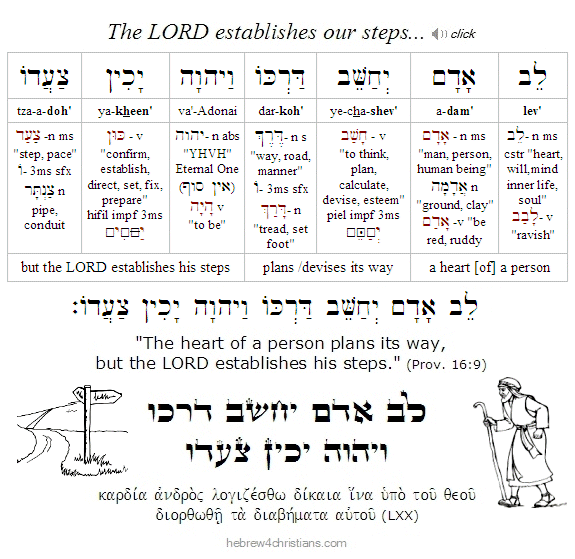 |
מקדש הלב
Shrine of the Heart...
02.19.26 (Adar 2, 5786) The sages have said that salvation may be likened to spiritual rebirth that delivers us from the "narrow places of Egypt" (i.e., from mitzrayim: -מ, "from," and צַר, "narrow") into newness of life... The first step of lasting deliverance (יְשׁוּעָה) is to receive the great revelation: "I AM the Lord your God," which begins the healing process (Exod. 20:2). We are set free from our bonds to surface appearances when we are made fully conscious of God's Presence, since we then understand everything in holy relationship with Ultimate Reality, the Ground and Source of all life (Acts 17:28).
As is written in our Scriptures: "We look not to the things that are seen but to the things that are unseen: For the things that are seen are transient, but the things that are unseen are eternal" (2 Cor. 4:18). Therefore the Lord says in our Torah portion, "Make for me a sacred place (מִקְדָּשׁ) so I can dwell within you" (Exod. 25:8). Each of us is created to be "mikdash ha'lev" (מקדש הלב) that is, a sacred place for God (1 Cor. 3:16; 1 Cor. 6:19). Making a sanctuary of the heart means choosing to stay connected with reality, attuning the heart to hear the Voice of the Spirit, and consciously walking before the Divine Presence.
Hebrew Lesson
Psalm 89:2 Hebrew reading:
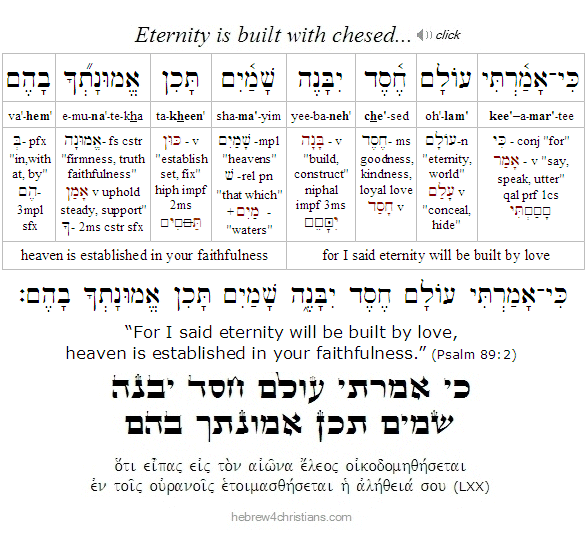 |
The Hebrew word terumah (תּרוּמָה), the name of our Torah portion, means "gift" or "contribution," which first of all refers to the decision to give of our hearts to enshrine God's Presence. We "set the LORD always before us"; we abide in the Vine and remain connected to Him (Psalm 16:8; John 15:5). It two-way partnership: we first believe God's invitation to abide within his heart and live as his beloved child, and then we make a sacred place for Him within our heart as the place of his dwelling (Rev. 3:20).
King David wrote, עוֹלָם חֶסֶד יִבָּנֶה / olam chesed yibaneh: "The (eternal) world is built with love" (Psalm 89:2), and so indeed is God's place within our hearts... We make God lovely and beautiful and wonderful and precious to us; we enshrine him and lift up our souls unto him in adoration and thanks. When we are willing to take part in the building of the sanctuary, God reveals to us "the pattern," that is, the inspiration that evidences His presence in our lives. As Yeshua said, "Let your light so shine" (Matt. 5:16).
|
The Beauty of the LORD...
02.19.26 (Adar 2, 5786) The nature of beauty has been an enduring mystery to artists and philosophers over the millennia, and various attempts have been made to define it. For example, some have defined beauty as an order, arrangement, and harmony of some kind (understood either as objective qualities inherent in something beautiful, or as a subjective sentiment of a person experiencing something that is esteemed as beautiful, and most often as a combination of both). In other words, something is regarded as beautiful because it possesses a certain arrangement of qualities or characteristics that evoke pleasure or satisfaction in the mind or heart of a person.
The Scriptures teach us, however, that beauty is part of the very composition of things; the design and form of whatever exists, and that the revelation of beauty attests to the glory of God. Beauty is not simply "in the mind of the beholder," but is objectively real, as part of the very structure of reality. Consider, for example, the flower that blooms, the bird that sings, the star that shines, and the sunset that suffuses the evening skies. "The heavens declare the glory of God, and the firmament proclaims his handiwork; day to day pours out speech, and night to night reveals knowledge" (Psalm 19:1-2).
The beauty of the natural world is grounded in mind of God, since God actively created and designed creation for his purposes and pleasure (see Gen. 1:1, 31; Rev. 4:11). The creation bears witness to the brilliance of the Creator, and the imprint of God's handiwork is evident in the concinnity, order, and marvels of the natural world itself. This is particularly evident in the case of man, who is endowed with a conscience, or an intuitive "moral compass" that discerns the demands of justice and understands right and wrong. The conscience serves as an inner witness that speaks peace, harmony, and goodness when the moral law is observed, and unhappiness, disorder, and evil when it is disregarded or suppressed. As I've mentioned before, the ancient Greek mindset regarded what is beautiful as what is good, whereas the Hebrew mindset regarded what is good as what is beautiful. The difference is one of orientation. Doing our duty before God, obeying "the moral law within," is what is truly beautiful, not merely appreciating symmetry, order, harmony, and so on. Beauty is a type of the good, in other words, and justice expresses the truth of the good in relation to oneself and others. Beauty is also a type of truth, since what is beautiful expresses and reveals truth, whereas what is not truly beautiful expresses what is false. The heart attests to the reality of the Creator and realizes its ontological indebtedness to God (Rom. 1:20).
Theologically, the "beauty of the LORD" (נעם־יהוה) can be understood as the effulgence of God's manifold perfections, everything about his heart and character that evokes ecstatic wonder, solemn awe, and irresistible attraction in his conscious creatures. It is the brightness and loveliness of God, the "charm of his unsurpassed excellence," his perfect justice and infinite compassion for his creation. The LORD is "the Rock, his work is perfect, for all his ways are justice. A God of faithfulness and without iniquity, just and upright is he" (Deut. 32:4). The beauty of the LORD is likened to the purity of Divine Light, the radiance and splendor that is incomprehensibly mysterious and good. The New Testament says "For God, who said "Let light shine out of darkness," is the one who shined in our hearts to give us the light of the glorious knowledge of God in the face of the Messiah" (2 Cor. 4:6). Yeshua is the Divine Light; the Radiance and Beauty of God manifest in the flesh (1 Tim. 3:16). "He is the radiance of the glory of God (הוּא זהַר כְּבוֹדוֹ) and the exact imprint of his nature, who upholds the universe by the word of his power" (נוֹשֵׂא כל בִּדְבַר גְּבוּרָתוֹ; Heb. 1:3). "All things were made by him; and without him was not any thing made that was made" (John 1:3).
So how do we wake up to the beauty of the LORD? How do we come to "see the invisible blessing" that pervades all things? How may we encounter the truth that "the whole world is filled with the irrepressible glory of the LORD" (Isa. 6:3)? .
Frederick Buechner once described a "holy hush" that came over a boisterous crowd of people when they first encountered the giant redwood trees at Redwood National Park. As the people began to take in their surroundings, everything seemed to change - the loud chatter faded; the light, the atmosphere, and especially the awe of being in the presence of these enormous and ancient trees (some of which had been standing since the time of Yeshua), induced a sense of smallness and humility before the glory that surrounded them.
You may have experienced this sort of awe also, perhaps while observing the starry night sky, or while watching the sun set over the mountains or upon the rim of the Grand Canyon, or when witnessing the birth of a baby, or when listening to music that touched your heart and brought tears to your eyes, and so on. Such experiences are sometimes called "self-transcendent," since they move us outside of our ordinary consciousness in an encounter with something great, breathtaking, wonderful, and sublime...
Encountering the glory of the LORD evokes conflicting emotions within the heart, a powerful combination of fear and attraction that is sometimes called the "numinous." The LORD our God is beautiful beyond anything we can imagine, yet were we to directly encounter him we would be so overwhelmed that we would "fall to the ground as one dead" (Rev. 1:17); nonetheless he puts his hand upon us and says, "Don't be afraid; for I am with you." By his gracious touch, then, we are able to look upon the radiance of his presence, to receive the vision of his majesty and transcendent beauty and loveliness. And the amazing thing is that this is what he wants; this is the very desire of his heart, after all, the prayer to the Father that we should behold his glory (see John 17:22-24). And this, I believe, is part of what is meant when it is said that we are made temples of the Holy Spirit (1 Cor. 3:16). " You yourselves are like living stones being built up as a spiritual house, to be a holy priesthood, to offer spiritual sacrifices acceptable to God through Yeshua the Messiah" (1 Pet. 2:5).
This topic relates to our Torah reading for this week, parashat Terumah. As we are drawn by God's grace to love the Lord and to understand how truly beautiful and wonderful and kind he is to us, we will be willing to worship him and celebrate his loving glory. To be alive before God is to be alive to his beauty. Your heart will flutter in joyful excitement to sing: "Give unto the LORD the glory due unto his name; bow down to the LORD in the beauty of holiness" (Psalm 29:2). We sanctify the LORD God within us by affirming his superlative beauty, his infinite goodness, the greatness of his power, the perfections of his justice and truth, his unfathomable kindness, and his unsurpassing and everlasting love. The recognition of the beauty of the LORD is the awareness of his holiness, wherein our heart will esteem his sacred glory as our most precious and extraordinary gift. The beauty of the LORD our God is the heart of love and life and wisdom and truth, the Supreme Being of which no greater can be conceived, for ever and ever. יהי שם ה' מבורך: "Blessed be the name of the LORD." Amen.
Hebrew Lesson
Isaiah 6:3 Hebrew reading:
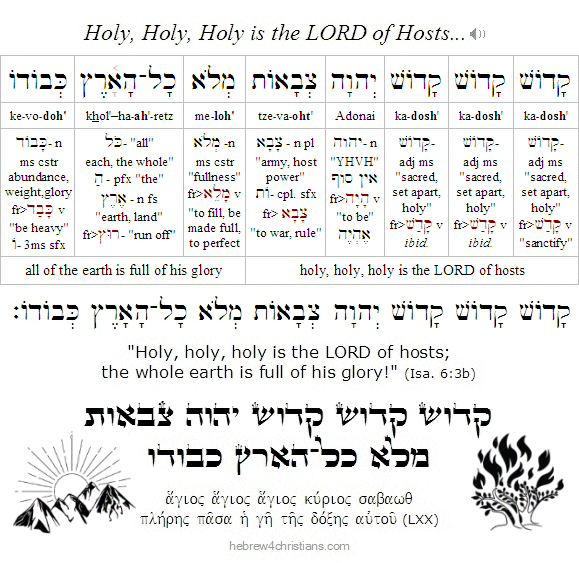 |
Personal Note: I have been experiencing vertigo, chest pain, and exhaustion over the last few days and am considering going to ER to get checked out. Please remember me in your prayers chaverim. Thank you so much.
Prayer as Listening...
"If I were a physician, and if I were allowed to prescribe just one remedy for all the ills of the modern world, I would prescribe silence. For even if the Word of God were proclaimed in the modern world, how could one hear it with so much noise? Therefore, create silence." - Kierkegaard
02.18.26 (Adar 1, 5786) To hear God's voice in the Scriptures, and to receive it as a personal word for you, requires solitude, silence and a listening heart. Quietude enables us to be receptive and awake to the divine presence, for God is the Living Word that speaks to every generation, though he is heard only to those have an "ear to hear" what the Spirit is saying...
Our silence is a matter of worship, for how can we truly hear the word of God when we are full of ourselves? It is when we turn away from the chatter of our soul that we are able to truly listen. Being still and silent confesses our faith that God is present. Your silence honors him in the depths of your heart.
When we pray and seek God, the first temptation is to forget who God is, and we may busy ourselves with anxious words and various requests. We may also use "vain repetitions" or "empty babblings" that are common among those who do not yet truly know God's heart. But Yeshua said that your heavenly Father sees in secret and knows what you need before you ask him, and therefore the only important thing is to seek Him and his blessing (Matt. 6:32-33). We do not need words to speak with God more than we need the will to be present and focused on him. "Let every man be swift to hear, slow to speak, slow to wrath."
"Come unto me, all you who are weary and heavy laden, and I will give you rest" (Matt. 11:28). "Be still and know that I am God" (Psalm 46:1). God will keep you in perfect peace as you lean upon him in trust (Isa. 26:3). "For thus says the Lord GOD, the Holy One of Israel: "In returning and rest you shall be saved; in quietness and confidence shall be your strength" (Isa. 30:15). Yea, "the work of righteousness will be peace, and the effect of righteousness will be quietness and assurance forever" (Isa. 32:17).
When we quiet our minds and turn to God, the focus shifts away from ourselves to the one who loves us and gives himself for us. The "eyes of our heart" will be opened; we will let go of our desire to be in control and understand that God is all we need...
Of course we sometimes use words when we, but these words echo the deeper truths of what the Spirit is saying to us... We might say, "O Lord, I come to you and believe you are the Shepherd of my life. You alone can help me; you alone know what I need before I even ask, and you therefore know how I need you, O God, more than all else. Forgive me for losing sight of you, for my unbelief. I believe; help Thou my unbelief. As it is written, "strengthen, O God, what you have done for us" (Psalm 68:28). Carry me close to your heart; help me to rest in your presence and to honor your great name.
The Psalms of the Scriptures are Spirit-filled words of intercession given on our behalf, and they provide great Torah about our communion with the Lord. For example, consider Psalm 23. It begins with a metaphor: יְהוָה רֹעִי לֹא אֶחְסָר׃ -"The Lord is my shepherd; I shall not want" (Psalm 23:1). The Spirit uses David's heart to reveal God's character to us. God is my shepherd. He calls me his own and knows who I am. He watches over me and guides the course of my life. He always meets my needs. "The Lord tends his flock, gathering the lambs in his arms and carries them close to his heart" (Isa. 40:11).
David continues his song: "He makes me lie down in green pastures; he leads me beside the still waters" (Psalm 23:2). He leads me to Elim, to places of his rest, to beautiful green pastures with refreshing waters, and there he makes me lie down in sweet surrender in his presence. He knows what I need.
"He restores my soul" (Psalm 23:3). Beside the still waters he tenderly heals me, returning my heart to hope and blessing me with his strength. He does this by speaking his love and care to my soul, calling me by name, and showing me that I belong to him. נַפְשִׁי יְשׁוֹבֵב -He returns my soul: he brings me back to life...
"He leads me in paths of righteousness for the sake of his name." In his healing I am led further in the ways of his truth and love, and he lifts me up "for his name's sake," that is, because of who He is, the One who is "merciful and gracious, longsuffering, and abounding in steadfast love and faithfulness" (Exod. 34:6). It is His righteousness that upholds and justifies my existence. He opens to me the "paths of pleasantness and peace" (Prov. 3:17).
"Yea, though I walk through the valley of the shadow of death, I will fear no evil, for you are with me; your rod and your staff comfort me" (Psalm 23:4). I will fear no evil because the Lord is with me, and nothing can separate me from his love (Rom. 8:35-36). Death is a "shadow," not ultimately real or all-consuming for those who are born from above. In this world I still must walk through the shadowy vale, but I am not consumed by it, and the rod of God's strength comforts me.
God will lead me in paths of his righteousness even when that path veers through darkness and gloom. Though I cannot see in that darkness, he is present to guide me still...
Therefore I will fear no evil, nor be in dread, for God is with me and will never leave nor forsake me. I am not alone; not even as I face my own death and take my last breath, for God is there with me in the darkest hour, when I am brought to the precipice, in my helplessness and frailty, for then God is with me in a special way to collect my soul; he will not forsake me in my moment of utmost need. "The Lord is my light and my salvation, whom shall I fear? The Lord is the strength of my life, of whom shall I be afraid?" (Psalm 27:1). Because his lovingkindness is better than life; my lips shall praise Him, even from the dust of death itself...
"You prepare a table before me in the presence of my enemies; you anoint my head with oil; my cup runs over" (Psalm 23:5). The Lord himself sets a table before me in the presence of my great enemy - death itself and the devil who feeds on the ravages of lost hope. He then anoints my head with oil and fills my cup with overflowing life and blessing. "What shall I render unto the LORD for all his benefits toward me? I will lift up the cup of salvation (כּוֹס־יְשׁוּעוֹת), and call upon the name of the LORD" (Psalm 116:12-13). Amen. This is a picture of a great banquet, a celebration of God's faithfulness, in the face of the fangless specter of death itself. Praise God! Death is swallowed up by his invincible life!
"Surely goodness and mercy follow me all the days of my life," despite the waning shadow of death, God's love will follow or "pursue" me to hold me fast -- the Hebrew word (רָדַף) means to "chase" or pursue after something to securely take hold of it. "And I will live in the house of the Lord forever" (Psalm 23:6). This is my final end - to be in the presence of God forever and ever, returning to my true home in heaven, the habitation where God's glory dwells and where I am fully and forever welcomed as his beloved child.
I started this article by stressing the importance of quietude in our relationship with God. "Hear O Israel" is the essence of the matter. When we quiet our hearts and turn to the Lord we will find him present, as it says, "You will search for me and find me when you search for me with all your heart" (Jer. 29:13). Note that this is the search of the heart, the place of our inmost passion, and not the search of the head or the way of religious rituals. Being still and silent confesses our faith that God is truly present. Silence honors him from the depths of the heart. Yes, we still articulate words when we pray, but our words form a response to what we have heard from the Spirit. God calls to us and we answer him, and that is always the order. And that is the meaning of teshuvah, or turning to God, which is the meaning of the Shema: "Hear O Israel, the LORD is our God, the Lord alone, and you shall love the Lord your God with all your heart, with all your soul, and with all your strength" (Deut. 6:4-5).
Amen, may God be pleased to help us listen to his heart.
Hebrew Lesson
Isaiah 30:15b reading (click):
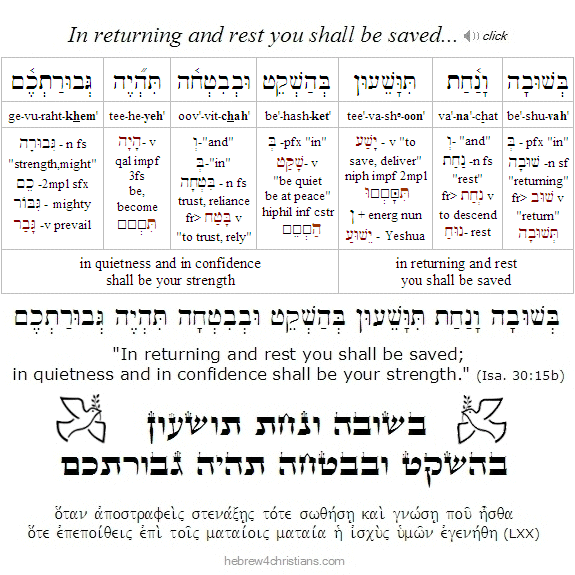 |
The Pattern of Healing...
"We need to hear the Gospel every day, because we forget it every day." - Luther
02.17.26 (Shevat 30, 5786) The Torah portion for this week is called Terumah (תְּרוּמָה), a word that means "contribution," "gift," or "freewill offering." It begins with the LORD asking for gifts "from every man whose heart moves him" to provide materials for the Mishkan Kodesh (Holy Tabernacle), a tent-like structure that would symbolize His Presence among the Israelites during their sojourn to the land of Canaan. Gold, silver, brass, red and purple yarns, fine linens, oils, spices, precious stones, etc., all were needed. No gift was considered too small, and whoever felt prompted by the LORD to give did so freely, without compulsion. God's house is always built by love freely given....
The word mishkan (מִשְׁכָּן) comes from a root (שָׁכַן) meaning "to dwell." This holy tent/compound was intended to provide a place of sacrifice and fellowship with the LORD God of Israel. Since the Mishkan represented God's dwelling place, it became associated with the Shekhinah (שְׁכִינָה), or manifest Presence of God Himself. This is particularly the case regarding the famous Ark of the Covenant (i.e., aron ha-brit, אָרוֹן הָבְרִית) and its sacred cover called the Kapporet (כַּפּרֶת) located within the inner sanctum of the Mishkan called the Holy of Holies (i.e., kodesh ha'kodashim: קֹדֶשׁ הַקֳּדָשִׁים). (Note that the term "Mercy Seat" comes from Martin Luther's translation of the Bible into German, where he understood the meaning of the kapporet to be the location or "seat" of mercy.) Upon the Kapporet were set two cherubim (כְּרֻבִים) -- angel-like figures with open wings and "baby faces." It was from between these faces that the LORD later directly spoke to Moses, it was here that sprinkled sacrificial blood would appeal to God's forgiveness during the appointed time of Yom Kippur.
Atonement is about righting the wrong that separates us from God, repairing the breach caused by our sin, and being healed from the curse of death. We all desperately need this healing, yet our own hearts are the source of the trouble (Matt. 15:19-20). The holiness and justice of God (אלהִים) requires that sin be punished by death, but God is also merciful and gracious (יהוה), and therefore He instituted a system of animal sacrifices and blood rituals to provisionally "atone" for sin (i.e., restore the broken relationship with God). Since the life of the flesh is in the blood (Lev. 17:11), and the penalty for sin is death, the shedding of blood represents atonement (i.e., kapparah: כַּפָּרָה) for sin.
Since it is written that "the soul that sins shall die" (Ezek. 18:4) and "the life is in the blood" (Lev. 17:11), a sacrificial animal's blood sprinkled upon the Kapporet symbolically represented the life of the people who were condemned to die, and this provided a means by which God could extend His forgiveness while remaining entirely holy and just. The substitutionary shedding of blood, the "life-for-life" principle, is essential to the true "at-one-ment" with the LORD God, and the blood rituals all prefigure the greater atoning sacrifice of Yeshua on the cross at Moriah. The passion of Yeshua, in other words, is the ultimate High Priestly work of presenting blood upon the Heavenly Kapporet of God.
It is interesting to note that the word used in the Greek Septuagint to translate the Hebrew word kapporet ("i.e., cover") is hilasterios (ἱλαστήριος). The New Testament picks up this usage in Romans 3:25: "God put forward Yeshua as a propitiation (ἱλαστήριον) through faith in His blood." In other words, the sprinkling of Yeshua's blood - represented by His Passion upon the cross - was "presented" upon the Heavenly Kapporet, before the very Throne of God Himself. Yeshua here functions as the great High Priest after the order of Malki-Tzedek (i.e., Melchizedek) who provides everlasting forgiveness for our sins (Heb. 9:7-10:10). Because of His sacrifice, the parochet - the wall-like covering separating the Holy of Holies - was rent asunder and God's love was let loose upon the world! Baruch haShem!
It is vital to remember that the detailed instructions for constructing the Mishkan were "according to the pattern (תַּבְנִית) given" to Moses at Sinai (Exod. 25:9, Heb. 8:5). In other words, the outer court (חָצֵר), the Bronze Altar for sacrifices (מִזְבֵּחַ הַנְחשֶׁת), the vessels, the inner tent with its furnishings such as the Table of the Bread of Presence (הַשֻּׁלְחָן לֶחֶם פָּנִים), the golden Menorah (מְנוֹרָה), the altar of incense (מִזְבַּח הַקְּטרֶת), and the innermost Holy of Holies (קדֶשׁ הַקֳּדָשִׁים) with the Ark of the Covenant were first shown to Moses before they were created. They were copies or "shadows" that were intended to prefigure the eternal reality of the Heavenly Tabernacle itself (Heb. 8:5, 10:1).
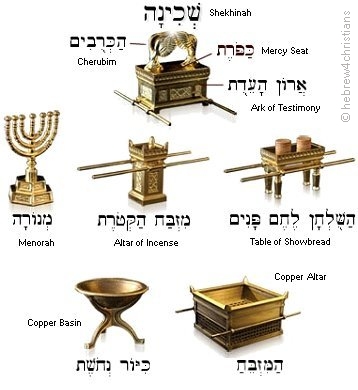 |
Among other things this lends credence to the idea of "Oral Torah," that is, that Moses was given additional revelation at Sinai that was not included in the written Torah, and this also explains how Moses foreknew that the Messiah would die for the sins of Israel (see John 5:46). After all, the God who spoke to Moses out of the Burning Bush, "the Voice of the Living God speaking from the midst of the fire" (Deut. 5:26), and the Word spoken from between the faces of the cherubim, was none other than YHVH (יהוה) come in the flesh.
יְהִי שֵׁם יְהוָה מְברָךְ / yehi shem Adonai mevorakh: "Blessed be the Name of the Lord."
According to Midrash, the purpose of the Kapporet was to protect man from the judgment of God as represented by the judging angels, the cherubim. These angels are God's own messengers who must report the truth and cannot deviate from that truth. However, there is a deeper truth than the "mechanical" reporting of facts (i.e., reports about our sins and guilt), and that truth centers on God's sacrificial love and mercy. The sacrificial blood sprinkled on the Kapporet - representing the innocent taking the place of the guilty - transcends the issue by removing the curse of the Law from the guilty (cp. Gal. 3:13). This is the "deeper magic" of the sacrifice upon the Stone Table, as C.S. Lewis portrays it in the Chronicles of Narnia. The Kapporet therefore foreshadows the cross of Yeshua, and His shed blood is the means whereby a holy God can righteously forgive our sin. Just as the sins of the nation were atoned for by the sprinkling of the blood on the Kapporet, so the shedding of Yeshua's blood atones for the sins of the entire world.
The sacrificial system of the Mishkan or "Tabernacle" (and later the Temple) was a temporary arrangement until the coming of Messiah, the Promised Deliverer (Gal. 3:24-25; Rom. 10:4; Heb. 9:1-12). The atonement or purification obtained by animal sacrifices was provisional and symbolic, "for it is impossible for the blood of bulls and goats to take away sins" (Heb. 10:4; Micah 6:6). For eternal remedy, for the spiritual life of the soul, something far greater was needed, namely, the sacrifice of God Himself. Consequently, when Yeshua came into the world, he said, "Sacrifices and offerings you have not desired, but a body have you prepared for me," and "'Behold, I have come to do your will, O God, as it is written of me in the scroll of the book" (see Heb. 10:5,7).
Beware those who would have you return to the terms of the covenant at Sinai (Gal. 3:1). God made a new covenant, not like the covenant made at Sinai (see Jer. 31:31-33). The New Testament teaches that Yeshua came to die "for our sins" under the law and to heal us from the plague of spiritual death (Heb. 7:27, 9:26; 1 John 3:5). Our sin separates us from God, but Messiah's sacrifice draws us near (Heb. 7:19). The message of the gospel is that the Voice of the LORD - the very Word spoken from between the cherubim who hovered above the kapporet (the cover of the Ark of the Covenant) - "became flesh" and "tabernacled among us" (ἐσκήνωσεν ἐν ἡμῖν) for the purpose of becoming our substitutionary sacrifice for the guilt and defilement caused by our sins (John 1:1,14). Yeshua was "born to die" (Heb. 10:5-7), and his life and mission was lived in relation to His sacrificial death (Mark 8:27-33). As the Apostle Paul put it: This is of "first importance": Yeshua was born to die for our sins, to make us right with God, and was raised from the dead to vindicate the righteousness of God (1 Cor. 15:3-4). His sacrificial death eternally draws us near to God, and we can come boldly, that is, without affectation (παρρησία), before God's Presence on the basis of His shed blood for our sins...
Hebrew Lesson
Psalm 79:9 reading (click):
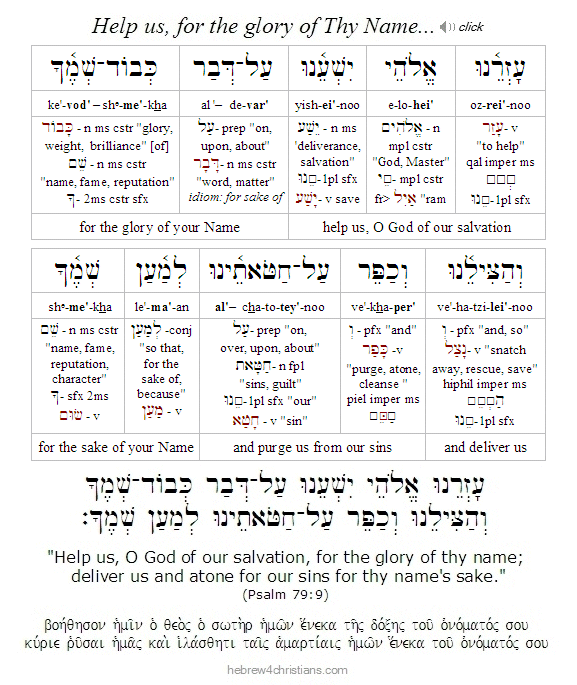 |
Miracles of an Ordinary Kind...

"Every sparrow is unlike every other sparrow despite the similarities..."
02.17.26 (Shevat 30, 5786) We tend to look for God in the extraordinary, in the great and imposing, in "signs and wonders," but Yeshua regularly pointed to ordinary things to reveal truths about the kingdom of God. For example, he said the kingdom was like a mustard seed that grew into a tree that the birds would come to roost (Luke 13:18-19). Yeshua didn't point to the cedars of Lebanon or to a high mountain, but to a lowly plant - something altogether unremarkable and ordinary - to reveal the transcendent. This parable, like many others, is intended to help see with new eyes. Teshuvah ("repentance") means changing our vision, turning around, and experiencing the wonder that is right before our eyes. "The Kingdom of God is within (ἐντὸς) you" (Luke 17:21). What the world esteems as ordinary is really miraculous, and what the world esteems as extraordinary is really unremarkable.
"Truly, I say to you, unless you turn and become like children, you will never enter the kingdom of heaven" (Matt. 18:3). A child's heart is unprotected, open, free of the designs and defenses of the world of men. Such a heart welcomes the gift of life and takes hold of it with eager simplicity. The parables of Jesus constantly upend our usual way of seeing by challenging us to experience life in a new way. We are to be reborn; we are to rise up from a lifetime of sleep and walk in the power of resurrected life.
"There are three stages in one's spiritual development," said the Master. "The carnal, the spiritual and the divine." "What is the carnal stage?" asked the eager disciples." "That's the stage when trees are seen as trees and mountains as mountains." "And the spiritual?" "That's when one looks more deeply into things—then trees are no longer trees and mountains no longer mountains." "And the divine?" "Ah, that's Enlightenment," said the Master with a chuckle, "when trees become trees again and mountains, mountains." - Anthony DeMello
As I've said before, spiritual fruit does not immediately crop up but requires time and its own season... The process of spiritual growth is mysterious and divine, As Yeshua said: "the Kingdom of God (מַלְכוּת הָאֱלהִים) is like someone who spreads seed on the ground. He goes to sleep and gets up, night and day, and the seed sprouts and grows, though he does not know how. By itself (αὐτομάτη, i.e., "automatically") the soil produces a crop, first the stalk, then the head, then the full grain in the head. And when the grain is ripe, he comes in with his sickle because the harvest has come" (Mark 4:26-29). The "ordinary" process of the growth of a seed is regarded as genuinely miraculous... With God all things are possible - and that includes the miracle of our newness of life. It is the fruit of the Spirit, after all, and that means that its source and end is found in God's love...
Hebrew Lesson
Psalm 25:9 reading (click):
Being Rich toward Heaven...
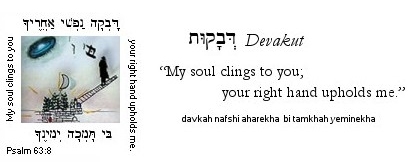
02.16.26 (Shevat 29, 5786) In our Torah for this week (i.e., Terumah) we read: "Take for Me an offering…" (Exod. 25:2). The midrash says that this teaches that when you give tzedakah (charity) to those in need, you take God to yourself, as it is written: "For the LORD stands to the right of the needy" (Psalm 109:31), and "whoever shows pity to the poor lends to the LORD, and his kindness will be repaid to him" (Prov. 19:17).
It may seem counter-intuitive to carnal and worldly reasoning, but when you give to others, you will receive even more in return (Mal. 3:10). Indeed the person who seeks treasure for himself is not rich toward God, since we can only keep what we give away in kindness (Luke 12:21). As our Lord taught: "Give, and it will be given to you. Good measure, pressed down, shaken together, running over, will be put into your lap. For with the measure you use it will be measured back to you" (Luke 6:38).
מַלְוֵה יְהוָה חוֹנֵן דָּל
וּגְמֻלוֹ יְשַׁלֶּם־לוֹ

"Whoever shows pity to the poor lends to the LORD,
and his kindness will be repaid to him."
(Prov. 19:17)

"Take for me an offering..." (Exod. 25:2). The Torah here indicates that the LORD is our great Kohen Gadol (High Priest), for He asked for terumah (an offering or contribution) just as the earthly kohen was given terumah from the yearly yields of the farmers...
יְהִי רָצון מִלְּפָנֶיךָ ה' אֱלהֵינוּ וֵאלהֵי אֲבותֵינוּ
שֶׁתְּחַדֵּשׁ עָלֵינוּ אֶת הַחדֶשׁ הַזֶּה לְטובָה וְלִבְרָכָה
Getting reading for Purim...
The advent of the new moon of Adar this evening reminds us that the festive holiday of Purim will begin in a couple weeks, namely on Monday, March 2nd this year...
02.16.26 (Shevat 29, 5786) The Scriptures state that the holiday of Purim "should be remembered and kept throughout every generation, every family, every province, and every city; and that these days of Purim should not cease from among the Jews, nor the memorial of them perish from their seed" (see Esther 9:28). According to Jewish tradition, we remember the miracles of Purim by means of four mitzvot (i.e., blessings): 1) remembering the appointed time as directed by the Scriptures (Esther 9:26-28); 2) performing acts of tzedakah and kindness (i.e., misloach manot: מִשְׁלוֹחַ מָנוֹת, Esther 9:22); 3) hearing the story of Esther read (i.e., Megillat Esther); and 4) enjoying a Purim holiday meal together.
The Midrash Esther says that Purim, unlike many of the other holidays, will be celebrated even after the final redemption after the End of Days. Maimonides says that the Book of Esther will enjoy the same status as the Torah of Moses in the world to come (Mishneh Torah, Megillah). This is because the story of Purim -- i.e., God's covenantal faithfulness and defense of His people -- will be magnified in the deliverance that leads to the establishment of the Messianic Kingdom upon the earth. Indeed, the Second Coming of the Messiah will be regarded as the final and everlasting fulfillment of Purim (Rev. 19:11-16).
Purim is all about God's irrepressible, insuperable and sovereign love for His people. Though the wicked seem to sometimes have the upper hand in olam ha-zeh (this present hour), we need not fret or become anxious (Psalm 37:1, Prov. 24:19, Phil. 4:6). God is in control and His love and purposes overrule the counsel of the wicked. He will one day speak to the princes of this dark world in His wrath and terrify them in His fury (Psalm 2:5). God's great vision for Zion, the "City of the Great King," will never fail, friends, nor will His love for those who are trusting in Him. God's sovereign love is our great hope. As King David said, בָּרְכוּ־נָא אֶת־יהוה אֱלהֵיכֶם / Barekhu-na et-Adonai Elohekhem: "Now bless the LORD your God" (1 Chron. 29:20).
Chodesh Adar tov and "Happy Purim" (פּוּרִים שָׂמֵחַ) chaverim!
Hebrew Lesson
Esther 9:28 reading (click):
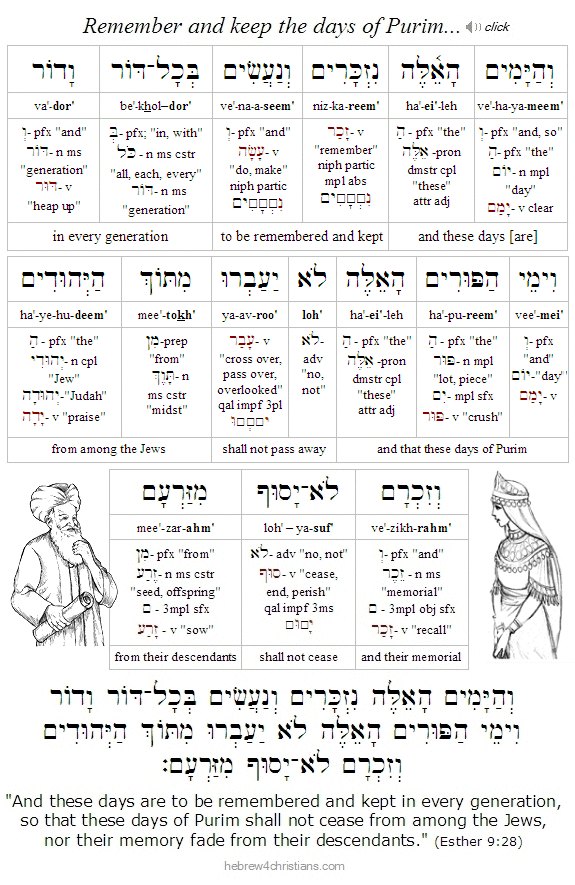 |
For more on this topic see the article: "Should Christians Celebrate Purim?"
Trusting love for you...
"When you think of what you are, and despair; think of what He is, and take heart." - Spurgeon
02.16.26 (Shevat 29, 5786) "Father forgive them, for they know not what they do" (Luke 23:34). Yeshua's intercession is not just for the sins we have consciously committed but to the sins done in the blindness of our unconscious; his sacrifice was offered not just for our known acts of sin, but for the wayward condition of our darkened hearts... This is essential. When God forgives our sin, it goes beyond forgiveness of the sinful behavior to the innate and underlying sickness of the heart. Divine forgiveness is remedy for our alienation, our lostness. It is healing of our deepest self, our secret heart, the "who we are" place of our new creation. If God accepts us at all, he accepts us completely, and that means we are made righteous by means of his love and grace.
Teshuvah ("repentance") is not about becoming better but about becoming different. It is about newness of life. As Yeshua said, "Unless you are born again, you cannot see the kingdom of heaven." Believe that you have received it and it will be yours (Mark 11:24).
Hebrew Lesson
Psalm 63:3-4 Hebrew reading:
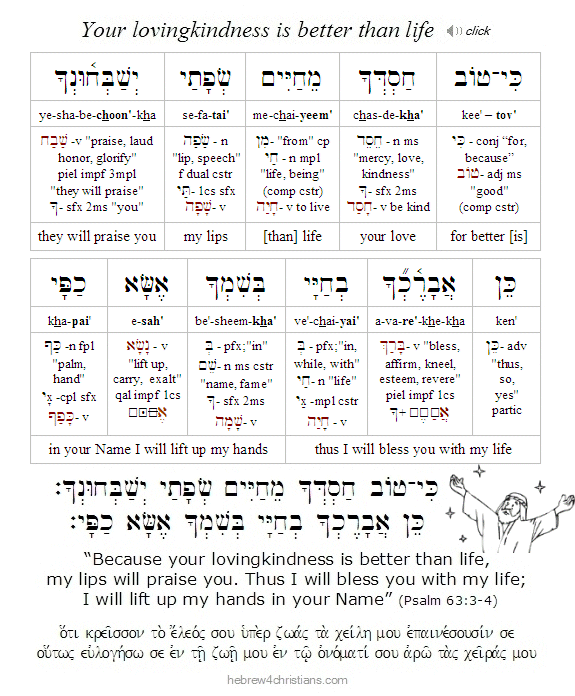 |
Eternal life is found in the one who "loved me and gave himself for me" (Gal. 2:20). I put no trust in religion, nor in the reformation of my character, nor in my will to believe, but solely in the great kindness of Yeshua who heals me from the ruin of myself.
Love's Promised Healing...
02.15.26 (Shevat 28, 5786) In his famous "Sermon on the Mount," Yeshua revealed the inner condition of the heart, despite the various pretenses that people may contrive to evade the truth.... "You have heard that it was said, "Do no murder," but I say to you, harbor no anger; you have heard "do no adultery," but I say to you harbor no lust..." You have heard it said, "Do not break an oath," but I say to you swear no oath at all, but let your word be enough.
Yeshua brings the Torah inside, to the heart, to reveal our great need. A person who makes an oath assumes he can keep the law, that he can control the impulses and sickness of his own deceptive heart. That is the source of the problem (Jer. 17:9; Eccl. 9:3; Mark 7:21). The Lord reveals what we are inside so that we may realize our need for deliverance from ourselves. What we really need is a miracle on the order of splitting the sea or raising the dead, namely, a new heart (לֵב חָדָשׁ) and a new spirit (רוּחַ חֲדָשָׁה) put within us. For those of you who might struggle with pride, fear, anger, lust, and hardness of heart, please take hold of hope. God can turn "stone to flesh" and make you fully alive by His power.
The heart (lev) is the inner person, the seat of the emotions, thought, and will. A new heart (lev chadash) represents the transformation of the whole of your inner nature - with the impartation of new appetites, new passions, new desires, etc. (Psalm 51:10). A new spirit (ruach chadashah) implies the renewal of your inner life – the rebirth of your will. This is the "law of the Spirit" (תוֹרַת רוּחַ הַחַיִּים) and the new principle of eternal life (Rom. 8:2).
The "stony heart" (lev ha'even) represents unfeeling, self-serving numbness of being. This heart is the locus of yetzer hara, the inner selfish impulse that is the common heritage of the "natural man." The Targum renders this as, "I will break the heart of the wicked, which is hard as a stone.'' A hard heart has a form of "sclerosis" that makes it closed off and impermeable to love from others, and especially from God. Scripture uses various images to picture this condition, including a "heart of stone" (Ezek. 36:26, Zech. 7:12), an "uncircumcised heart" (Jer. 9:26), a "stiff neck" (Deut. 31:27), and so on. Stubbornness is really a form of idolatry, an exaltation of self-will that refuses to surrender to God.
The heart of flesh (lev basar) represents an inner life of genuine feeling and joy that makes a fit habitation for the radiance of the Divine Presence. After all, the word for "grace" (χάρις) is directly linked to the word for "joy" (χαρά). This heart is soft and tender - a spiritual and sanctified heart - that is submissive to the will of God. It is upon the inner "tablets" of this heart that the Torah of God truly written (Jer. 31:33).
There aren't two gospel messages: one for the sinner and the other for the saint... The message of the gospel is always "good news" to those who are sin-sick and riddled with guilt and shame, and it is always "bad news" for those who deny their inner condition before God and believe that they can justify themselves. In other words, there's no "gospel" message apart from the message of the cross of Yeshua, and the cross represents the end of the ego and its devices. We don't get saved in order to follow the path of self-righteousness; we get saved to be witnesses of God's righteousness... We love God because He first loved us (1 John 4:19).
May it please God to give us all soft hearts and renewed spirits that are empowered to love in the truth and to walk before His Presence... May He perform a divine "heart transplant" so that we may feel the heartbeat of the Spirit within us. Amen.
Hebrew Lesson
Ezekiel 36:26 reading (click for audio):
Parashat Terumah:
Enshrining God's Presence...
The Kotzker Rebbe said that where we read, "this is my God, and I will praise him, my father's God, and I will exalt Him" (Exod. 15:2), we may be understood this to mean, "this is my God, and I will make a dwelling for Him within me..."
02.15.26 (Shevat 28, 5786) Last week's Torah (i.e., Mishpatim) explained how the Israelites entered into covenant with the LORD at Mount Sinai. The terms of the covenant were written down in Sefer HaBrit ("the Book of the Covenant"), which contained a variety of laws (מִשְׁפָּטִים) to govern the Jewish people in the Promised Land. When the people agreed to obey the terms of the covenant, Moses took sacrificial blood and sprinkled it on them saying, "Behold the blood of the covenant that the LORD has made with you in accordance with all these words" (Heb. 9:18). Moses then re-ascended the mount to receive the tablets of stone inscribed with the Ten Commandments and to learn additional Torah from the LORD.
Now the goal of the Sinai revelation was not only the giving of the Ten Commandments to the Israelites but more importantly enshrining the Divine Presence within their hearts... Therefore in our Torah portion for this week (i.e., parashat Terumah), we read how God asked the people to offer "gifts from the heart" to create a "place" for Him: "Let them make for me a holy place that I may dwell in their midst" (Exod. 25:8). The Hebrew word for "holy place"is mikdash (מִקְדָּשׁ), which comes from the root word kadash (קָדַשׁ), "to be set apart as sacred." A mikdash is therefore a "set apart space," or a "holy place" that represents something profoundly treasured - a place of beauty and worship, a refuge, a place of rest. Other words that share this root idea include kedushah (holiness), kiddushin (betrothal), kaddish (sanctification), kiddush (marking sacred time), and so on. When God said, "Let them make for me a mikdash," then, he was inviting the people to make a symbolic sacred place for His Presence to be manifest, the Holy of Holies representing God's Throne...
The LORD then showed Moses the three-in-one pattern (i.e., tavnit: תַּבְנִית) according to which the sacred place of the mikdash was to be surrounded by a mishkan (מִשְׁכָּן), or a tent-like dwelling place set apart for the Divine Presence. First an ark of acacia wood was to be overlaid with pure gold inside and out. The ark was to be fitted with gold rings and gold covered poles to make it portable. The two tablets of the law were to be stored inside the ark. Two cherubim (angel-like figures) were to placed facing each other over a cover of the ark called the kapporet (i.e., "Mercy Seat"). The ark was to be housed within an inner chamber of the tent called the Holy of Holies. Adjacent to the Holy of Holies was a second chamber called the Holy Place. This chamber would contain a table overlaid with pure gold that held twelve loaves of bread along with a golden, seven-branched menorah. The Holy of Holies was separated from the Holy Place by an ornamental veil called the parochet before which a golden altar of incense would be placed.
The various "materials" required to make the mishkan (and mikdash), namely, the gold, silver, brass, red and purple yarns, fine linens, oils, spices, precious stones, and so on, were to be supplied from the people by means of free-will offerings given to honor the LORD. Collectively these offerings were referred to as terumot (תְּרוּמוֹת), meaning consecrated "donations" or "contributions" (from the verb רוּם meaning to raise or lift up) though later the word generally referred to various tithes given to the priests.
Hebrew Lesson
Exodus 25:2a Hebrew reading:
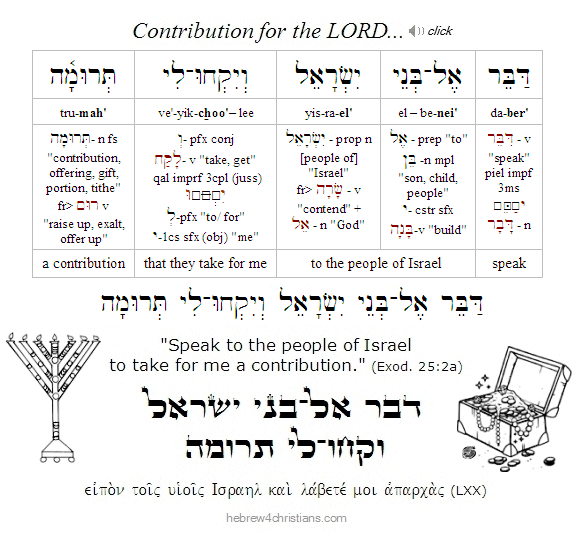 |
The LORD then described the pattern of the tent of the Tabernacle (i.e., ohel: אֹהֶל) along with its exact dimensions. The tent was designed to be portable, with a wooden frame covered by richly colored fabric and the hide of rams and goats. The outer court was to include an altar with horns of copper at each corner. The portion ends with a description of the outer court, which was to be entirely enclosed by an ornamental fence made with fine linen on silver poles with hooks of silver and sockets of brass.
Tripartite Structure of the Mishkan
Surrendering your Destiny...
"Just as the sinner's despair of any hope from himself is the first prerequisite of a sound conversion, so the loss of all confidence in himself is the first essential in the believer's growth in grace." - A.W. Pink
02.13.26 (Shevat 26, 5786) Someone once wrote me and asked whether they were beyond the hope of redemption because they wrestled with ongoing depression and despair... If the life of a follower of the Messiah is to be marked by unspeakable joy, a heart overflowing with "living waters," and inner peace, doesn't emotional pain, a sense of emptiness, and numbness of heart indicate the absence of genuine regeneration?
My response to this honest question was that the struggle itself indicates the presence of real faith, and it is therefore likely that this person was going through a "dark night of the soul," that is, a time of testing and refinement... I counseled him that we are to trust God in the darkness and abandon everything to Him -- even our eternal destiny -- regardless of the ambiguity and sorrows of the present moment.
We must offer up our heart to God and let whatever happens to us happen. By God's grace we are what we are (χάριτι δὲ θεοῦ εἰμι ὅ εἰμι). As Job in his great anguish of soul said: "Behold, [even if] he slays me, I will hope for him; I will argue my ways before Him" (Job 13:15). In effect Job laid down his life to be slain and made appeal to God's mercy and truth, despite the mystery and agony of his suffering...
Hebrew Lesson
Job 13:15 reading with comments (click):
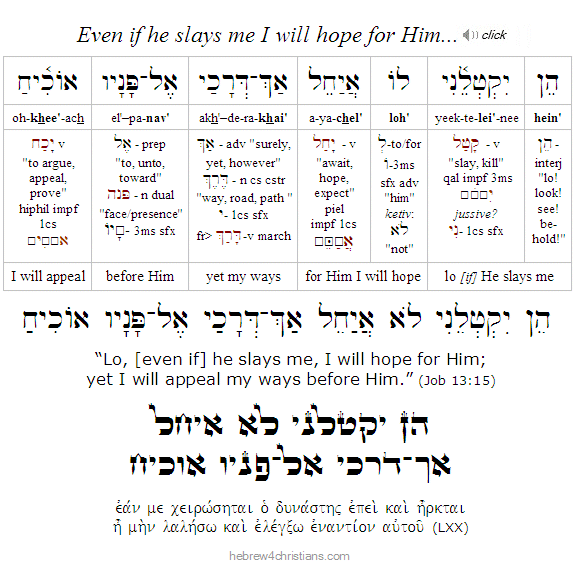 |
The Torah of Mercy...
"I've always been bad. Probably I shall be bad again, punished again. But the worse I am, the more I need God. I can't shut myself out from His mercy." - Evelyn Waugh
02.13.26 (Shevat 26, 5786) It has been said that grace is getting what you don't deserve, whereas mercy is not getting what you do... Yeshua said, "Blessed are the merciful, for they shall receive mercy" (Matt. 5:7). This is not a reciprocal law like karma, i.e., you get in return what you first give, since we cannot obtain God's mercy as reward for our own supposed merit (Rom. 4:4). No, we are able to extend mercy to others only when we are made merciful ("full of mercy"), that is, when we first receive mercy as the gift of God (Eph. 2:8; Rom. 5:15). After all, you can't give away what you don't have, and if we have no mercy for others, it is likely that we have not received it ourselves, as the parable of the Good Samaritan reveals (Luke 10:25-8). Your forgiveness is your forgiveness, that is, as you forgive, so you reveal your heart. What you do comes from what you are, not the other way around. We are first changed by God's grace and then flow works of love. We judge others mercifully, with the "good eye," because we come to believe that we are beloved by God.
When Yeshua rebuked the "holier-than-thou" attitude of some people, he said: "Go and learn what this means, 'I desire mercy, and not sacrifice.' For I came not to call the righteous, but sinners" (Matt. 9:13). The pattern therefore abides: First you realize you are broken, impoverished of heart, and you mourn over your sinful condition (Matt. 5:3-4); then you hunger and thirst for God's righteousness, that is, for his healing and deliverance, and finally you learn to trust the mercy of God, that is, you come to accept that you are accepted despite your unacceptability (Matt. 5:5-6). As you begin "suffer yourself" and forgive your own evil, you are enabled to extend this mercy to others (Matt. 5:7). In this way you begin to see God in your relationships and obey the heart of truth (Matt. 5:8; 1 Sam. 15:22).
Though we love and honor truth, we must be careful never to use it as a weapon to judge or wound others. The failure to extend mercy, to demand your "rights" or hold on to grudges, implies that you are relating to God as Judge rather than as Savior (James 2:13). If we condemn what we see in others, we have yet to truly see what is within our own hearts; we have yet to see our desperate need for God's mercy for our lives. If you don't own your own sin, your sin will own you. Being merciful is a response to God's love and therefore is essential to genuine teshuvah (repentance). Walking in love is the deepest expression of truth, since love heals untruth and embraces hope for what is presently broken (1 Cor. 13:7). In light of this, take a moment to ask the LORD to help you relinquish the pain of your past by being full of mercy toward yourself and others. Honor God's love for you by forgiving yourself and showing compassion and mercy to others in your life...
Hebrew Lesson
Hosea 6:6 Hebrew reading (click):
Heart of the Stranger...
"One Torah shall be for the native-born and for the stranger... " (Exod. 12:49)
02.13.26 (Shevat 26, 5786) The sages note that when a mitzvah is repeated in the Torah, it is a sign of its importance. For instance, in parashat Mishpatim the Israelites were commanded not to oppress or wrong "the stranger" (הַגֵּר) because they were once outsiders, marginalized, "despised and rejected of men" themselves (Exod. 22:21). They were again admonished to remember their former lost estate by recalling "the heart of the stranger," that is, what it feels like be an outsider, without a homeland or heritage, to wander hopelessly as a lost person (Exod. 23:9). God wants his people to have empathy for others by being willing to regard and esteem their needs, feelings, and dignity...
In practical terms, however, this commandment is easier said than done because our own sense of woundedness and "Egyptian thinking" can get in the way. "Hurt people hurt people," the saying goes, and therefore it is common for us to "pass down" more than to "pass over" the pain we feel inside. Indeed, because of the wounds we carry, "scar tissue" can form around the heart that desensitizes the soul from the suffering of others. It is a "defense mechanism" of sorts, though such hardening of heart can lead to the denial of the inner life of others which continues the cycle of estrangement....
The Torah is clear, however, that we have the responsibility to show compassion to the stranger, and that includes those we might instinctively regard as our enemy. "Do not oppress the stranger, for you know the heart of the stranger (וְאַתֶּם יְדַעְתֶּם אֶת־נֶפֶשׁ הַגֵּר) - for you too were strangers in the land of Egypt" (Exod. 23:9). The sense of this commandment pivots on our ability to sympathetically relate to others: "for you know the heart of the stranger." When we encounter an outsider, we are to know their soul - their pathos, their hopes, their dreams - and thereby nullify their otherness by means of empathy.
Not only does doing so potentially bring healing and peace to the other, but it provides us with an opportunity to heal suffering parts of our own hearts. This is part of the reason why anonymous support groups such as A.A. work. As we hear about the hidden suffering of others, we discover we share the same language of pain and share a deeper need of the heart. We are not alone - "the stranger" within us steps out into the light. We share the burdens of the other and so fulfill the Torah of Messiah (Gal. 6:2). Compassion is a two-way movement of heart - embracing both our own suffering and the suffering of others. "Remember what it was like for you to be a stranger." When you have compassion over your own sense of estrangement, loneliness, and pain, you take a step toward understanding what others likewise may be experiencing. As the philosopher Plato once said: "Be kind. Every person you meet is fighting a difficult battle."
There is another level to this subject as well, and that has to do with self-acceptance and finding inner peace. "Loving the stranger" includes loving those parts of your self that you deny, censor, or despise. Yes, we all have character defects and hidden sins, but we nevertheless must forgive ourselves as we forgive others. Many of our sins find "justification" in self-rejection and shame. Our sinful impulses have a "voice" that need to be heard, however, for they are part of ourselves. Correcting these impulses doesn't mean denying them but bringing them to the light of truth, and asking the LORD for healing.
I am not saying that sin is not a real problem and that repentance is not necessary, of course, nor am I suggesting that disordered love is not inherently self-destructive; I am only saying that we must bring "all our heart" to God -- our "good" heart as well as our bad, and in the midst of that ambiguity and double heartedness we then confess our great need for God's intervention and love. As it is written in our Scriptures: "Trust in him at all times, O people; pour out your heart before him; God is a refuge for us. Selah" (Psalm 62:8).
Hebrew Lesson
Psalm 38:9 reading (click for audio):
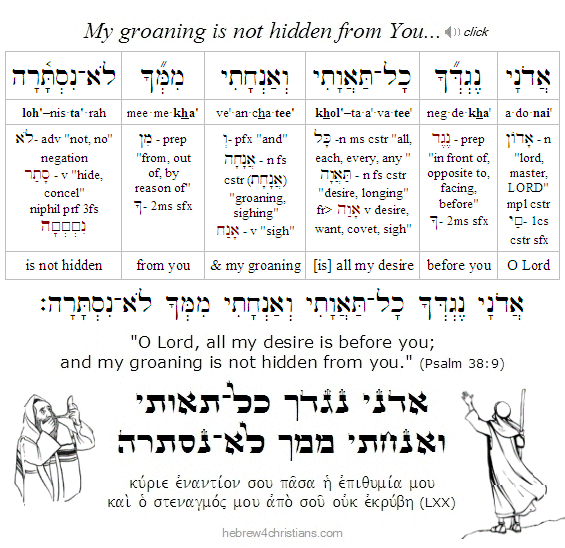 |
The Work of Faith...
02.12.26 (Shevat 25, 5786) In our Torah reading this week (i.e., Mishpatim) we read that when the people gathered before Moses to receive the covenant, they said in unison: "All that the LORD has spoken we will do and we will hear (Exod. 24:7)." Note the order: first comes the decision to obey (i.e., נַעֲשֶׂה, "we will do"), and then comes understanding (i.e., נִשְׁמָע, "we will hear"). As Yeshua said, "If anyone's will is to do God's will, he will know," and "if you know these things, blessed are you if you do them" (John 7:17; 13:17).
The heart of faith is willing to do what God asks before hearing what exactly is required. Many people operate the other way round, sitting in judgment of God's word, demanding to understand why they should obey. You cannot understand the Lord apart from trust, however, and that is categorically true of all forms of knowledge.
We are to be "doers of the word and not hearers only, deceiving ourselves" (James 1:22). We don't audit the words of Scripture since we ourselves are under examination! The Scriptures demand us to respond, choose, decide. The word is like a shofar blast rousing us to action. We are to be doers, not just passive hearers. The Greek verb is emphatic: "Be doers!" (γίνεσθε) means "be born! come alive! do, live, exist before God! This is a call to creative action, to newness of life!
The Scriptures state that "if anyone is a hearer of the word and not a doer, he is like a man who looks intently at his natural face in a mirror. For he looks at himself and goes away and at once forgets what he was like" (James 1:23-24). If we just hear the truth but do not act upon it, we are likened to someone who carefully looks at his face in a mirror but then promptly forgets what he looks like after he steps away... Likewise those who only hear the word but do not bring it to life in their deeds forget who they are and why they were created (Eph. 2:10; Titus 2:14; Col. 1:10). When we look into the mirror of truth we see our need for teshuvah and turn to God for the healing miracle he provides (Heb. 4:12).
There is a deeper law, however, a "mirror" that reveals something beyond our passing image. When we look intently into the "perfect law of liberty" (תּוֹרַת הַחֵרוּת וּמַחֲזִיק) - the law of faith, hope, and love for our Savior - we find blessing in our deeds (James 1:25). Note that the verb translated "look into" the law of liberty is the same used when John stooped down to "look inside" the empty tomb of Yeshua (John 20:5). The deeper law reveals the resurrection power of God's invincible love. The Torah of the New Covenant also has many mitzvot, though these are based on the love God gives to us in Yeshua: "This is my Torah: that you love one another as I have loved you" (John 13:34).
We are set free from the verdict of the law to serve God without fear, on the basis of his saving love and grace given in Yeshua (Gal. 5:1), but our freedom is not meant to violate the Ten Commandments or to engage in licentiousness (Gal. 5:13; Matt. 7:21). The moral law speaks, as it were, to young children who need a guardian until they can attain to their place as hiers (Gal. 3:24). Mature sons and daughters do not not need the law but operate on a different level, and enjoy a different relationship with the Master of the house. Serving God this way results in holy passion. The verse, "the appearance (i.e., mareh: מַרְאֵה) of God's glory was like a consuming fire" (Exod. 24:17) may be read, "the mirror (or reflection) of God's glory..." When we act as God's children, full of faith in his love, and walking before the power of his presence, our hearts reflect his passion, too.
As a brief excursus, let me ask how you can "do the word" and live in harmony with the divine commandments... The dividing line between faith and works is often difficult to discern, after all, and indeed Yeshua told us that faith in Him is itself a type of "work" (John 6:29). Studying the Scriptures, praying, trusting God in the midst of our pains and struggles, and worshiping are all in a sense "works," yet they express the inner reality of faith....
Here is the conundrum: Do we "do the word" by means of our own resolution (i.e., will) to act, or is a deeper miracle of transformation first necessary? If the latter, is the miracle entirely sufficient, or do we need to add something else for it to come into being? The Scriptures command us to be "slow to anger" and "put away wrath," and yet how is that possible apart from God's help, after all? How can we manage destructive emotions that sometimes arise within the heart? How do we "put away" fear? On the other hand, how can we be commanded to love? to be joyful? full of faith?
These considerations reveal the divine-human partnership: We "work out our own salvation with fear and trembling, for it is God who works in you, both to will and to work for his good pleasure" (Phil. 2:12-13). In the end we are faced with paradox: We are utterly dependent upon God to work within our hearts for salvation, yet we are also entirely responsible for working out that salvation in our daily lives (Isa. 26:12). "With man this is impossible, but with God all things are possible" (Mark 10:27).
Hebrew Lesson
Deut. 6:18a reading (click for audio):
The "Torah of grace" (תורת חסד) teaches us to deny ungodliness and worldly lusts and to live soberly, righteously, and godly in the days of our sojourn, as we look for our blessed hope - the glorious appearance of the great God and our Savior Yeshua the Messiah, who has redeemed us from all lawlessness (ἀνομία) to purify for himself a "chosen people" (λαὸν περιούσιον), zealous of good works... Note here that the grace of God is manifested in the exercise of our good works (i.e., ma'asim tovim: מעשים טובים), and that a little later Paul wrote: "This is a faithful saying, and these things I want you to affirm constantly, that those who have believed in God should be careful to maintain good works" (Titus 3:8). Amen, "For we are His workmanship, created in Yeshua the Messiah for good works, which God has before ordained that we should walk in them" (Eph. 2:10).
"Work out your own salvation with fear and trembling, for it is God who works in you both to will and to do his good pleasure" (Phil. 2:12-13). So let us be careful to "work out" what God has "worked in" to our hearts by letting our light so shine that God receives the glory from what we do with our lives (Matt. 5:16). Amen.
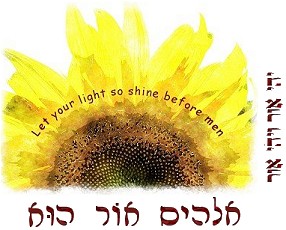 |
|
The End of Ourselves...
02.12.26 (Shevat 25, 5786) I didn't want to get out of bed, even though sleep itself often affords little relief for my anguish of heart. I didn't feel hopeless regarding matters of faith in God, though I was exhausted over myself... As I began to awaken, I briefly reflected on my spiritual progress only to discover the same old self with the same old questions... "Wherever you go, there you are," I thought. Despair began to seep in when I realized that I'm still bound to many things that I have long prayed I no longer would be... Will I ever change?
I'm not sure I understand all this, of course. As I laid immobilized in bed, I wondered if there is hidden pride lurking within my heart as I gazed upon the void of the ceiling... I began to feel a bit sorry for myself. I offered an edgy prayer: "Dear Lord, am I trying to justify my existence? Am I hoping to be something I am not through my faith in you? I know that I am not what I should be and I feel angry at myself. Perhaps I am angry at you, too... Yet I'm powerless to change my heart. I keep treading the same old ground; I keep praying, yet forgive me, I lament what I am in this present moment of darkness..."
Everything my heart desires is not here, is not yet, stored away in a future promised land, while everything here ineluctably dissipates into the dust of death. There is subliminal sorrowing, an ongoing grief as we say various goodbyes to all that we know and love here. Family, friends, spouses, pets, careers, memories of long lost days, lost dreams, pining hope... Eventually we must come to say goodbye even to our own lives, powerless, dependent, a mere shadowy semblance. Indeed this sort of "farewell" seems to be essential to the practical application of the gospel. "Thou He slay me, yet will I trust in Him."
After I finally roused myself from the bed that held me like a coffin, I spoke to the Lord further about this. In self-reproach I asked, "What's wrong with me, Lord? What's my problem? Why have I these dark reflections? There must be some light here, even here, something I may learn from you. In this tedium, this dark monotony, I stretch my hands out in hope to you, for you are ever present... Have I put hope in the wrong things or grieved for what is of no substance? But did you not weep real tears when you came before the tomb of Lazarus?
I judge myself and repent in dust and ashes. I confess my sin, and yet I feel uneasy, not because of the Lord, heaven forbid, but because I have not lived as I should, for I am of little faith, despite the light of the glories of God's love given in Yeshua. I savor the old regret, woefully conscious of how I have resisted God's will and held on to my sickness of heart over the years... In the wake of my life I see shattered pieces, loss, sadness, and remorse. I have prayed countless times for deliverance from myself, and while I surely believe God hears me, how He hears is unknown to me, and how he answers my prayers is likewise a mystery. As C.S. Lewis once said, "We are not necessarily doubting that God will do the best for us; we are wondering how painful the best will turn out to be."
"In my flesh is no good thing" said the Apostle Paul. We may want to do what is good but we are powerless to do it. Asks the Savior: "For what profit is it to a man if he gains the whole world, and loses his own soul? Or what will a man give in exchange for his soul?" The things are this world are glittering distractions, puffery, vanity, and useless in relation to finding spiritual life. We simply cannot heal ourselves nor even exist apart from a blessed intervention that can change us forever and ever...
Kierkegaard summed up the problem of man: "To be in despair is to be damned in this sense: not to be able to die and yet not to be able to live. The torment of despair is that the person cannot rid himself of himself, cannot break out of the cage of his self-consciousness." This despair comes first of all from refusing to accept what we are, for we only find "rest in peace" when we abandon ourselves to God and know ourselves through his love.
We can only escape from the ubiquity of death by surrendering ourselves to it, like Isaac who lay on the altar, and let go of all our earthly hopes and fears, dreams and nightmares -- everything that we are. "Whoever loves his life loses it, and whoever hates his life in this world keeps it unto eternal life." The cup is set before us: "Not my will, but thine be done." And where that leaves us, whatever becomes of us, is in God's hands.
There is life on the other side of the cross, as the resurrection of our Lord vindicates us, and it is the power of his life, known and imparted by God's grace - that overcomes the despair and contradictions within our soul. Though we walk through the "valley of the shadow of death," we know God to be with us to comfort us. We only find peace by tethering our heart to God's promise in Yeshua; everything we are and all that we ever hope to be is found in Him.
Kierkegaard defined the "self" as a "synthesis" of the infinite/finite, the temporal/eternal, and freedom/necessity, all in relationship to God, who is the Source and End of self-conscious life. People will be in a state of "despair" when they attempt to deny any one of these paradoxes and thereby choose to understand themselves apart from relationship with God. We all stand at the "crossroads" of the eternal and the temporal, and we can only know ourselves for what we are when we surrender to God for each unrepeatable choice of our lives...
He wrote of healing: "When is despair completely eradicated? It occurs when the self, in relating to itself and in wanting to be itself, is grounded nakedly in the power that established it. In other words, when it is related openly to and dependently on God. To transcend despair is neither to become finite nor to become infinite but to become an individual in their synthesis, which God alone holds together. In so far as the self does not become itself in this way, it is not itself. And not to be oneself, as God created you, is despair."
Do you believe in miracles? There is the story of the Velveteen Rabbit that teaches that a thing must be loved before it becomes lovable. The same message is found in the story of the "Beauty and the Beast." And that's the message of the gospel, of course, namely that by the power of God's love we are transformed to be his beloved people forever and ever. Amen.
Hebrew Lesson
Deut. 18:13 Hebrew reading:
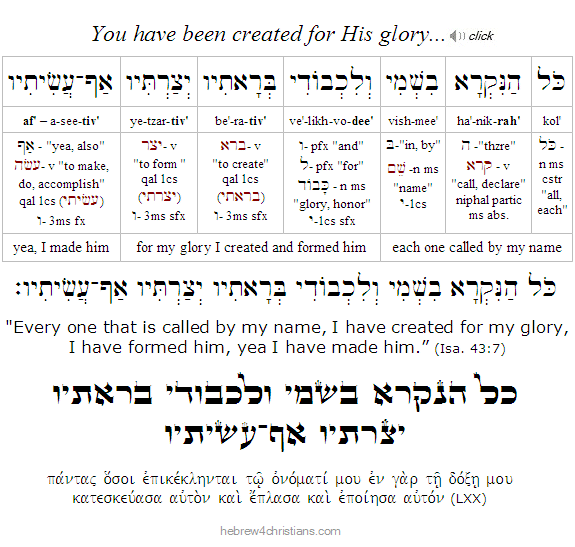 |
A Consuming Fire...
02.11.26 (Shevat 24, 5786) From our Torah portion this week (Mishpatim) we read: "Now the appearance of the glory of the LORD was like a consuming fire on the top of the mountain in the sight of the people of Israel" (Exod. 24:17). Now some people regard this fire as a threat, even a sign of God's judgment, though it is better to regard it as a sign of God's glorious passion. After all, the pillar of fire had led the people out of bondage, just as it later dwelt between the cherubim upon the Ark of the Covenant. Indeed the fire that fell upon followers of Yeshua at Pentecost was the same manifestation of the glory of God's passionate love that was revealed at Sinai. Our God is a "consuming fire" (i.e., esh okhelah: אֵשׁ אכְלָה), which means that He is full of passion and zeal that your heart fully belongs to Him...
כִּי יְהוָה אֱלֹהֶיךָ אֵשׁ אֹכְלָה
הוּא אֵל קַנָּא
kee · Adonai · e·lo·hey'·kha · esh · oh·khe·lah
hoo · el · ka·nah

"For the LORD your God is a consuming fire,
he is a zealous God." (Deut. 4:24)

The metaphor that God is a Consuming Fire suggests that He is both indescribable and passionately concerned with our devotion to Him. "Therefore let us be grateful for receiving a kingdom that cannot be shaken, and thus let us offer to God acceptable worship, with reverence and awe, for our God is a consuming fire" (Heb. 12:28-29). We are promised a kingdom that cannot be shaken, wherein the Fire that consumes will consume all things that are not established by our Heavenly Father... "Know therefore today, and lay it to your heart, that the LORD is God in heaven above and on the earth beneath; there is no other. Therefore you shall keep his statutes and his commandments, which I command you today..." (Deut. 4:39-40). Our lives on the altar ascend to God in praise.
With your whole Heart...
02.11.26 (Shevat 24, 5786) In our Torah portion for this week (i.e., parashat Mishpatim) we read, "Keep yourselves away from a false matter" (Exod. 23:7). Regarding this note that the Hebrew word for falsehood (or lie) is sheker (שֶׁקֶר), which can be rearranged to spell kesher (קֶשֶׁר), meaning a band, gang, or group of people... The power of the lie is often found in the "group" rather than in the individual, and if enough people in a group repeat something untrue, eventually the individual's conscience will be overruled and the truth will be lost... This is a common methodology regularly employed by mass media for purposes of social engineering and political propaganda.
Regarding the duty to be "people of truth," Abraham Twerski said that we should always act in a way that will lead us to "hide," and that includes hiding within the anonymity of the crowd. Why do so many political agitators and self-styled "revolutionaries" wear a mask to hide their face? "Think about what you are about to do. Is there a possibility that you may at some time have to deny that you did it? If so, then do not do it" (Twerski on Chumash).
Each of us must individually strive to be yashar (יָשָׁר) - upright and honest - free from the complications and devious speech that attends to lies. We are to be "simple" (תָּמִים) with the LORD our God (Deut. 18:13), which requires that we are first willing to be rigorously honest with ourselves. The truth is straightforward and confessed without artifice, but the lie is a simulation or spurious "duplication." This applies especially with our relationship with God, who is called the God of Truth (אֵל אֱמוּנָה). "No person is saved except by grace; but there is one sin that makes grace impossible, and that is dishonesty; and there is one thing God must forever and unconditionally require, and that is honesty" (Soren Kierkegaard).
Regarding our duty to speak truth (החוֹבה לְדּבּר אמת), the midrash teaches that the Hebrew word for "truth" (i.e., emet: אֱמֶת) is composed of the first, near-middle, and last letters of the alphabet, whereas the three letters that spell "falsehood" (i.e., sheker: שֶׁקֶר) all stand next to one another. The sages say this suggests that truth creates a firm foundation, secure, strong, and trustworthy, while falsehood is unstable. As it is written, "truth stands forever, falsehood has no legs." In other words, the way of truth is "self-authenticating" and made secure, whereas the way of falsehood is "unlivewithable" and made unsteady... The "double-minded" person is unstable in all his ways" (James 1:8)
Hebrew Lesson
Deut. 18:13 Hebrew reading:
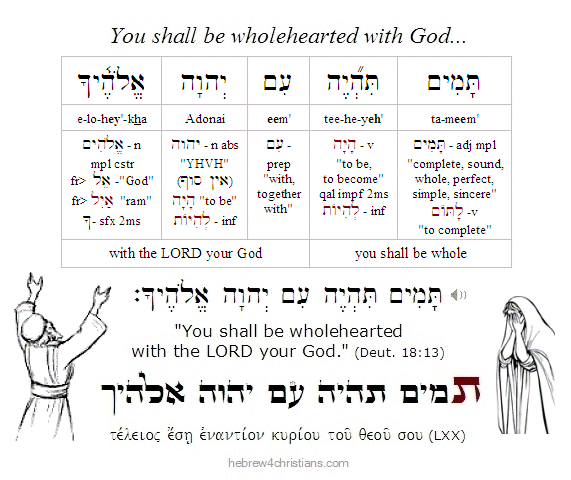 |
Through the Veil...
When Mother Teresa was asked, "What do you say when you pray?" she answered, "I listen." When she was then asked, "What does God say?" she replied, "He listens."
02.10.26 (Shevat 23, 5786) When we pray we may find ourselves quite distracted, and in our attempt to focus on God we may encounter roiling turbulence of our soul. But it is there, in the midst of such commotion, that we realize the frailty of our will and our need for God's intervention to "hold us together."
The sages have likened such distraction as a "gate" that needs to be overcome by quieting the heart so that the will is "brought together" to express its inner groan or cry that often transcends words. This is done in solitude where the intimate dialog between the soul and God takes place. Being transparent and present before God leads to assurance. Your Father, who seeks in secret, will reward you openly (Matt. 6:6).
The more difficult distractions of the soul, and the more dangerous, are those that draw our attention away from the consciousness of God's presence while we become immersed in the busyness and the habitual routines of our daily lives. Habit, especially, is a cunning form of distraction, as Kierkegaard wrote: "By sitting still, the more one sits still, the closer one comes to feeling ill." That is the temptation of addiction, to lose ourselves in sickness. When we live in habituated consciousness, we lose our sense of wonder and our expectations blind us to possibilities. Think of how our culture has become obsessed with its various internet devices designed to insulate us from reality...
On the other hand, and the hidden blessing of our cultural boredom, is the despair of life it induces, the taedium vitae ("weariness of life") that rises like gorge within the soul, revealing our need to be delivered from the madness of our illusions. Our digitally fabricated world has become a virtual prison for the postmodern age. Weariness over the world open up horizons where we may remember what is most essential, after all.
"Open Thou my lips, and my mouth shall show forth thy praise" (Psalm 51:15). This is the requisite prayer before we pray, the prayer to be sanctified by God's intervention. This is the prayer that we be given the desire to pray at all -- the willingness to be willing, the confession that we are lost within ourselves, apathetic, asleep, unresponsive to God's deeper call... "Lead us not into temptation" by helping us realize that you are the only thing that really matters. As Thomas Merton once wrote: "Prayer and love are really learned in the hour when prayer becomes impossible and your heart turns to stone."
"Since you have been raised to new life with Christ, set your sights on the realities of heaven, where Christ sits in the place of honor at God's right hand. Think about the things of heaven, not the things of earth, for you have died to this life, and your real life is hidden with Christ in God" (Col. 3:1-3). Center your heart upon God, for He is always present and with you. You do not ascend to heaven in your own best efforts, but receive the blessing by faith, and the "eyes of your understanding" will thereby be opened (Eph. 1:3-11). "I have set the LORD always before me, because He is at my right hand I shall not be moved" (Psalm 16:8).
Faith is not some kind of "whistling in the dark" to avoid or escape the realities around us. Everything crumbles in this world; everything irresistibly dissipates back to dust. We are surrounded by the whirlwind of infinity; everything is incscrutable, a "great cloud of unknowing." Despite this God says: "I am the LORD, I change not: therefore ye children of Jacob are not consumed" (Mal. 3:16). The LORD is the same yesterday, today, and forever, and that means he is fully present for you in spite of your struggle, in moments of tedium, in passing glimpses that reveal the toll of vanity, when you have no idea what to do with yourself and indeed, whether your life has any significance at all.
God was present in the darkness of your womb, present when you were born into this world. You were no accident; no random fortuity of nature... God has laid the foundations, the beginning from the end, and in his providential wisdom he has shined forth light to dispel your fear; he carries you unto the end of his perfections, and his place for you will not fail.
The promise of the LORD is invincibly certain. When He first signed the covenant he knew that his own blood would be given to ratify its terms, life for life, and he allowed himself to be rent asunder so that you would be accepted as God's treasured child.
The love of God is the same today as it was then, for "I am the LORD, I change not..." Indeed He knew you before you were born just as he knows you now and just as he will know you forever and ever. He loves you with an "everlasting love" that irresistibly draws you to him (Jer. 31:3) and he ever lives to make intercession for you (Heb. 7:25). Nothing can separate you from the reality and power of his insuperable love (Rom. 8:35-39).
Even if we, with eyes ablur with tears, hearts fragmented, times unseen, days forsaken to grief, dreams lost to ephemeral vanity, even then is God present for us, calling us to life despite our darkness, despite the anxious struggle of enduring ourselves, and even then does he guide us through the valley of the shadow of death to reach the coming day of our everlasting healing. "For if we live, we live to the Lord; and if we die, we die to the Lord. Therefore, whether we live or die, we are the Lord's."
Faith sees the invisible blessing; we look not to the things that are seen but to the things that are unseen. "For the things that are seen are transient, but the things that are unseen are eternal... For the invisible things of Him from the creation of the world are clearly seen, being understood by the things that are made, even his eternal power and Godhead. Therefore we are strangers and exiles on the earth, looking forward to the city that has foundations, whose designer and builder is God" (2 Cor. 4:18; Rom. 1:20; Heb. 11:10,13).
Our father Abraham was promised descendants as numerous as the stars in the sky and the sand on the seashore, despite the fact that he was an old man and his wife had long past the age of bearing children. Abraham believed in the One who gives life to the dead and calls into existence the things that do not exist: "He staggered not at the promise of God through unbelief but was strong in faith, giving glory to God; and being fully persuaded that, what He had promised, He was able also to perform: And therefore it was imputed to him for righteousness" (Rom. 4:19-22).
Therefore let us "lift our eyes to the heavens, and look at the earth beneath; for the heavens vanish like smoke, the earth will wear out like a garment, and they who dwell in it will die in like manner; but my salvation will be forever, and my righteousness will never be dismayed" (Isa. 51:6). Amen, O LORD, "keep my soul, and deliver me: let me not be ashamed; for I put my trust in thee" (Psalm 25:20).
Hebrew Lesson
Isaiah 41:13 reading (click for audio):
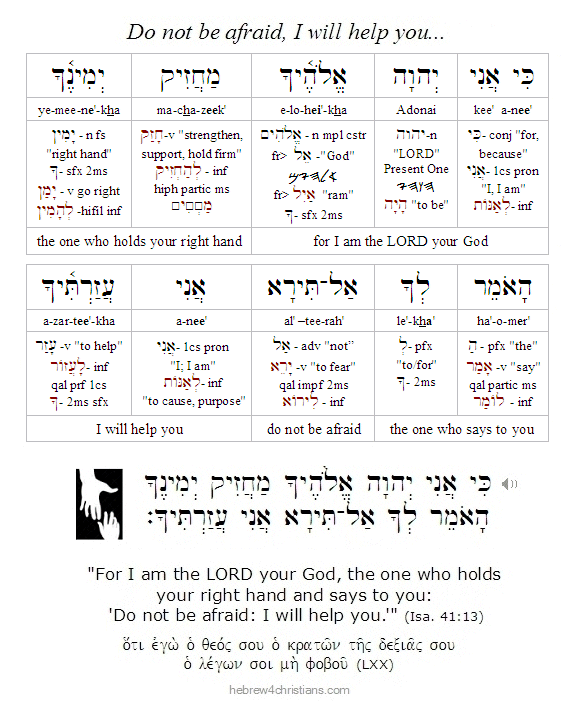 |
Connecting with God's Will...
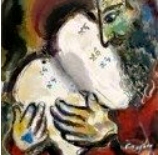
"Reason is itself a matter of faith. It is an act of faith to assert that our thoughts have any relation to reality at all." - Gilbert K. Chesterton
02.10.26 (Shevat 23, 5786) In general, people don't like to be told what to do but would rather make their own judgments... However the various moral rules of Torah may be likened to guideposts along the way, warning us about dangers up ahead. And just as a physical law like gravity describes material reality, so a moral law describes spiritual reality. We can no more deny moral reality than we can deny physical reality, though the effect of violating moral truth is not physical but spiritual - affecting our inner life, our conscience, our sense of value, and so on. In either case, however, we deny reality at our own peril.
Many "laws" serve as empirical generalizations, of course. In science, for instance, we inductively sample phenomena and then universalize our hypothesis as a "law" that is (tentatively) applicable in all similarly controlled conditions -- at least until proven otherwise. In the case of moral reality, however, our methods of knowing are different. We do not use inductive reasoning to see what is right or wrong, but instead use moral principles that are "hard-wired" into our souls that we bring to experience...
We do not have to empirically determine through observation whether murder is wrong, for instance, since we know it is wrong both by revelation ("Thou shalt not murder"), and by the light of moral intuition as well. In some cases Biblical revelation is intuitively obvious. For example, premeditated murder of another person is morally wrong in any conceivable circumstance. The same made be said of torture, sexual crimes, treason, deception, and so on. The rational test here may be expressed by Immanuel Kant's "categorical imperative," that is, to see if you can consistently will your action to be a universal law of nature or not. Stealing, for instance, is irrational because if everyone were to steal, the concept of private property would be destroyed. Likewise lying is irrational because it presupposes the validity and significance of truth, and if everyone lied, then truth itself would be meaningless. This is the basis, after all of both the "Silver Rule" ("Do not do to others what you would not want done to yourself") and the "Golden Rule" ("Do to others as you would want done to yourself"). In both cases reciprocity is universalized and the test is to see if the action is devoid of special pleading and the biases of self-interest.
No culture in the history of the world has ever celebrated traitors, cowards, liars, thieves, political tyrants, murderers, rapists, those who brutalize the innocent, and so on. And every culture has instinctively valued life, truth-telling, courage, honor, generosity, and so on. C.S. Lewis calls the belief that "certain attitudes are really true, and others really false, to the kind of thing the universe is and the kind of things we are" the Tao, or the "Way" that is intuited by simple refection about the nature of reality.
Now on the other hand, there are some (very) qualified exceptions to our basic moral intuitions. For instance, the moral universal to "always speak truth" may be "broken" (or temporarily suspended) for the sake of a more important truth. For instance, if we deceived a psychopath armed with an axe who sought to murder someone, we would be exempt from the basic rule to always speak the truth by misleading him. In Jewish thought this is called "pikuach nefesh" (פיקוח נפש), which means "saving a soul." This principle is grounded in the verse from the Torah that says: "You shall keep my statutes and my judgments; which if a person does them he shall find life in them: I am the LORD" (Lev. 18:5).
There are "weightier matters" of Torah that imply showing mercy rather than following the "letter of the law" (Matt. 23:23; Micah 6:8). Yeshua often used the Sabbath day as a test case, and he pointed to commonsense exceptions to the law when mercy was needed more than religious practices (Hosea 6:6). He mentioned giving water to a thirsty donkey or rescuing a sheep that fell into a well as examples (Luke 13:15, Matt. 12:11). And Yeshua regularly denounced those Pharisees who fancied themselves to be "gatekeepers" of Torah as prime examples those who miss the point. He said, "The Sabbath was made for man, and not man for the Sabbath: therefore the Son of man is Lord also of the Sabbath" (Mark 2:27-28). To make his point, he went into a synagogue and publicly instructed a man with a withered hand to stand up. Yeshua then said to the Pharisees present: "Is it lawful on the Sabbath to do good or to do harm, to save life or to kill?" But they were silent. After looking around at them in anger, grieved by the hardness of their hearts, he said to the man, "Stretch out your hand." He stretched it out, and his hand was restored." Upon seeing this, the Pharisees "left immediately and began plotting how they could kill him" (Mark 3:1-6).
Mishpatim (מִשְׁפָּטִים) refer to judgments we inevitably must make in life, and what is required is practical discernment, that is, being able to balance the ideals of justice and love. It is often a struggle to strike the right balance, and the temptation is to lean to one side or the other. We might stress strict justice in the heat of outrage over a transgression, or we might stress unconditional love because of our own need for forgiveness. The Torah, however, as well as Yeshua, emphasizes kindness over matters of justice. For instance in our Torah portion we read: "If you lend money to any of my people who are poor among you, you shall not be like a moneylender to him; you shall not charge him interest. If you ever take your neighbor's garment as a pledge, you shall return it to him before the sun goes down, for that is his only covering, it is his garment for his skin. What will he sleep in? And it will be that when he cries to Me, I will hear - כִּי־חַנּוּן אָנִי - for I am gracious" (Exod. 22:25-27). Note that empathy for the needs of others is important, for the "essence of the Torah is mercy."
There are so many law, rules, ordinances, and "mishpatim" given in Torah that it almost seems overwhelming, though I think this is intended to wake us up to how delicate the balance must be to ensure godly choices. All our social interactions require careful discernment and wisdom from God. Our choices and actions have eternal significance and the mishpatim remind us of this truth. Just as the Shema invites us to love God in every experience, so the mishpatim invite us to do so in all our choices...
Moral and social rules speak to our need for boundaries, for sacred space, safety, and provide the means to show respect to one another. That's the "spirit of the law," the deeper reason for its expression. The "role of the rule" is to promote and upbuild life; a righteous interpretation of the use of a rule helps us discern how to limit and redirect our impulses to express godly character. "If we live in the Spirit, let us also walk in the Spirit" (Gal. 5:25).
Hebrew Lesson
Leviticus 18:5 reading (click for audio):
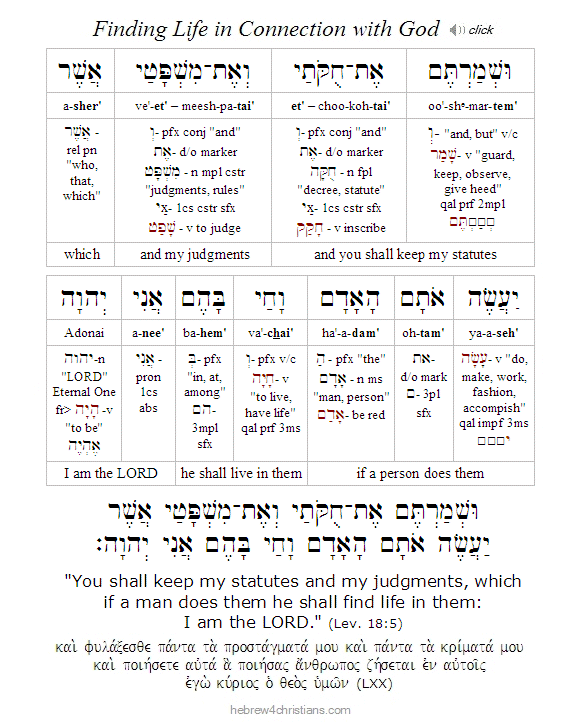 |
Note: A somewhat mixed case, involving both physical and spiritual reality, is given in our Torah reading this week: "You shall be sacred to me (קדֶשׁ תִּהְיוּן לִי); therefore you shall not eat any flesh that is torn by beasts in the field" (Exod. 22:31). Why not eat such meat? Because it may both cause physical sickness (i.e., disease) while it also violates the dignity of our life, causing spiritual sickness, too.
Seek First God's Kingdom...
"Seek first the kingdom of God and His righteousness... " - Yeshua (Matt. 6:33)
02.10.26 (Shevat 23, 5786) When we worry, are we not afraid that God will leave us unprotected and vulnerable? Are we not questioning his heart for us? Are we not asking, as the people of Israel once did as they thirsted in desert places: הֲיֵשׁ יְהוָה בְּקִרְבֵּנוּ אִם־אָיִן - "Is the LORD with us or not?" (Exod. 17:7). Indeed, does not the recurring presence of worry within our hearts amount to a confession of our unbelief?
The Scriptures warn us not to "spy after our heart and after our eyes" (Num. 15:39). The Torah mentions the heart first and then the eyes to indicate that the eyes follow the heart. We see as we believe with our heart: "According to your faith be it done unto you." When the spies said, "We are not able to go up (לא נוּכַל לַעֲלוֹת)... for they are stronger than us" (Num. 13:31), they revealed their unwillingness to believe in God's promise, or, to put it another way, they revealed their faith in God's inability to deliver on his word.... Indeed, the Hebrew word for "than us" (מִמֶּנּוּ) can also mean "than Him," suggesting that the spies believed that even God would be unable to uproot the Canaanites. According to their faith, so it was done; by believing that it was impossible, they lost the possibility of God's promise...
Are we truly seeking God "first" or are there other things that have a higher priority in our hearts? Do we wonder if God is to be trusted in the "desert experiences" of our lives? Do we think that God has been unfair to us? Have we sometimes lamented that our way is too hard for us, and more than we can bear? "Lord, I knew you to be a hard man, reaping where you have not sown, and gathering where you have not scattered seed" (Matt. 25:24).
It is possible to misjudge God and misinterpret our relationship with him. "We walk by faith, not by sight." This is true for all people, since every soul lives by faith of some kind or another. Our ability to know him is based on the blessing of the Spirit, not on our own merits. How can we, broken vessels, seek first the kingdom of God, apart from faith in him? Is that not presupposed in all our seeking of the heart? It is faith in God's promises, and faith that God will keep his promises to us, that is the key to seeking first God's kingdom. Those who do not seek do not believe that God is the ultimate concern of their lives.
Faith sees what is possible and refuses to yield to the artificiality of mere appearance. Indeed, appearances are often a test of our courage. We may never know how often a test was given and - just before victory was manifest - the heart grew faint and was lost to fear. "According to your faith be it done to you" is a spiritual principle that applies to everyone. In that sense, it is not that we have faith that matters (since we all do), but whether our faith is grounded in the promises and power of the LORD God of Israel, or something else....
When God told Abram to "get out of your land," he called him to focus on heavenly places – to find his identity there. "Seek ye first the kingdom of God and his righteousness" (Matt. 6:33). The "righteousness of God" is his love, mercy, glory, and goodness. Therefore King David says, אַחַת שָׁאַלְתִּי מֵאֵת־יְהוָה - "One thing have I asked of the LORD, that will I seek after: that I may dwell in the house of the LORD all the days of my life, to behold the beauty of the LORD, and to enquire before his presence" (Psalm 27:4). Likewise, followers of Yeshua no longer find their identity in this world but rather through their spiritual union with the resurrected LORD (Gal. 2:20; 6:14; Eph. 1:3; 2:6)... Therefore we are told to "seek the things that are above (τὰ ἄνω ζητεῖτε) where the Messiah is seated at the right hand of God; focus your thoughts on the things above - not on things here on earth - for you have died, and your life has been hidden (κέκρυπται) with Messiah in God. Then when the Messiah, who is your life, appears, you too will appear with him in glory" (Col. 3:1-4).
Hebrew Lesson
Psalm 16:8 reading (click for audio):
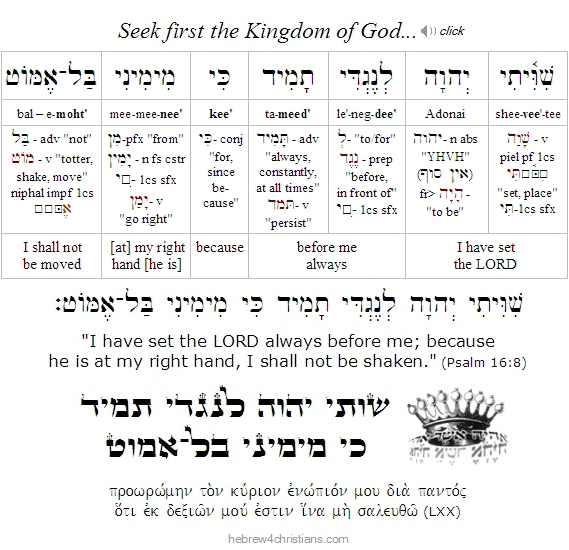 |
The Mitzvah Connection...
02.10.26 (Shevat 23, 5786) The Hebrew word "mitzvah" (מִצְוָה) is often translated as "commandment," though its basic idea is about connection to God (i.e., the root צוה means to bind or unite). Being connected with the Almighty means talking with him, relating to him as your heavenly Father, and trusting that he esteems you as his beloved child. Whatever else you may think about the commandments of God, this idea of a love connection is foundational and essential. The very first of the Ten Commandments is anochi Adonai Elohekha, "I am the Lord your God," which invites you to open your heart to receive the touch of the Spirit of God. There is no love like that of the Lord, but you can't feel that love if you don't speak to Him, pouring out your heart and clinging to the truth of his love for you....
Pouring out your heart to God in an honest and earnest way is called hitbodedut (הִתְבּוֹדְדוּת). After we "talk our hearts out" before the Lord, in our emptiness we can begin to truly listen, as it says, "In returning and rest you shall be saved; in quietness and in trust shall be your strength" (Isa. 30:15). Only after we sigh deeply and surrender are we receptive to the voice of the Spirit's whisper. "Blessed are all those who wait for Him" (Isa. 30:18). We wait, we abide, even when God takes his time or does not immediately intervene. We do not lose heart, for we find strength when we trust in God's love... The Light of the world still shines: Yeshua, be my inner word, my heart, and my groaning for life today, and forevermore, amen.
Since the essence of Torah is connection to God, the greatest blessing is to be filled with a steadfast desire to draw close to him, to experience hunger and thirst (visceral yearning) for God's presence and touch. Holy desire – expressed in the yearning of heartfelt prayer – is therefore a state of true blessedness, and the more desperate our need for God the more blessed we are. It is our desire, our holy need, that creates a bond between our soul and its Creator, and that is the deeper meaning of mitzvah... "Blessed are those who hunger and thirst for righteousness, for they shall be satisfied" (Matt. 5:6).
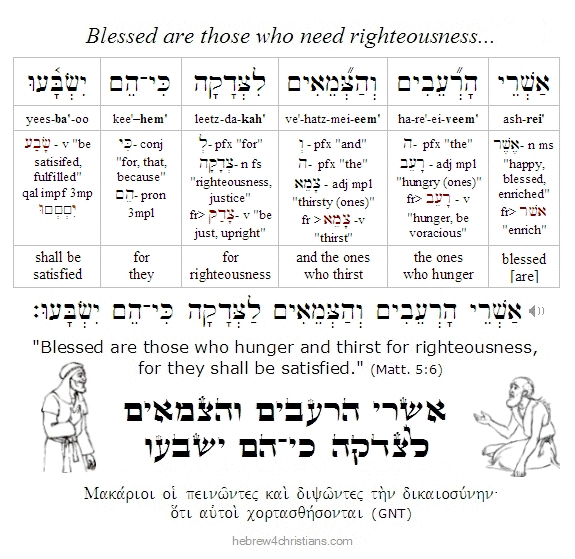 |
No Fear in Love...
02.10.26 (Shevat 23, 5786) This week's Torah reading (i.e., parashat Mishpatim) concerns various social and civil laws of ancient Israel. Regarding the opening statement of the portion: "And these are the judgments (הַמִּשְׁפָּטִים) which you shall set before them" (Exod. 21:1), the sages state that this means there must be the recognition of basic social obligation between man and his fellow man before the obligation between man and God can be affirmed (see Matt. 5:23-24). This foundational idea may be summed up as, "respect precedes Torah" (דרך ארץ קדמה לתורה), since without any form of brotherhood, unity, or basic civility, we are left with anarchy, anomie, and despair...
As we move closer to the prophesied "End of Days" (אַחֲרִית הַיָּמִים), the world is becoming more and more a place of anarchy, anomie, and despair. Civil law is flouted and every person does "what is right in his own eyes." The storm clouds are gathering, chaverim....
Nonetheless Scripture admonishes us: "There is no fear in love, but perfect love casts out fear" (1 John 4:18). Fear and faith are antithetical, but if you're anything like me, you struggle with fear. The Greek New Testament says that "perfected love" (ἡ τελεία ἀγάπη) "casts out fear" since it is rooted in the idea of punishment (κόλασις). The verse goes on to say that the one who keeps fearing has not been brought to maturity with regard to love.
My fears often center on the future, for example, health concerns, matters of providing for my family, being a good parent, husband, persevering in my faith, etc. The prospect of the "End of Days" makes me more than a little concerned about the moral and spiritual condition of this country. I sometimes find myself anxiously thinking of my childrens' future. Regardless, there is one thing we can (and must) do to fortify ourselves in these perilous times, and that is to renew our faith and to reaffirm our convictions. "When in the dark night of suffering worldly wisdom cannot see a handbreadth ahead of it, then faith can see God, since faith sees best in the dark" (Soren Kierkegaard). "Faith sees best in the dark," which is to say that it closes its eyes to this world and its thinking to apprehend the truth of eternity. As it is written: "For we walk by faith, not by sight" (2 Cor. 5:7). If you feel tempted to surrender to the despair of worldly thinking, redouble your efforts to study the Scriptures and hold to the truth that sets you free. Make time to study the Torah and the words of Yeshua our Savior!
Hebrew Lesson
Psalm 46:1-2 Hebrew reading:
Gift of a New Heart:
The Tenth Commandment...
02.09.26 (Shevat 22, 5786) The last of the Ten Commandments is the decree not to "covet" or to eagerly want things that are not yours. Note that the Hebrew word translated "covet" in many translations (i.e., chamad: חמד) usually refers to selfish desire or lust (e.g., "lust not after her beauty in thine heart..." Prov. 6:25), and thus speaks directly to the heart's innermost intention, which, even if unacknowledged by ourselves, is always revealed before God: "Your Father who sees in secret" (Matt. 6:6).
On the other hand, selfish desire can - if we are willing to be honest with ourselves - reveal to ourselves the condition of our hearts and thus mark our need for deliverance from the power of sin. As the Apostle Paul wrote to the believers in Rome: "I had not known sin ...except the law had said, 'Thou shalt not covet'" (Rom. 7:7). Inner peace or contentment is the blessing that comes from surrendering your desires to God, letting go of your envy, and receiving your daily bread with humility and gratitude... It is the way to simchah (שִׂמְחָה), or "happiness."
Hebrew Podcast
Exodus 20:17 Hebrew reading:
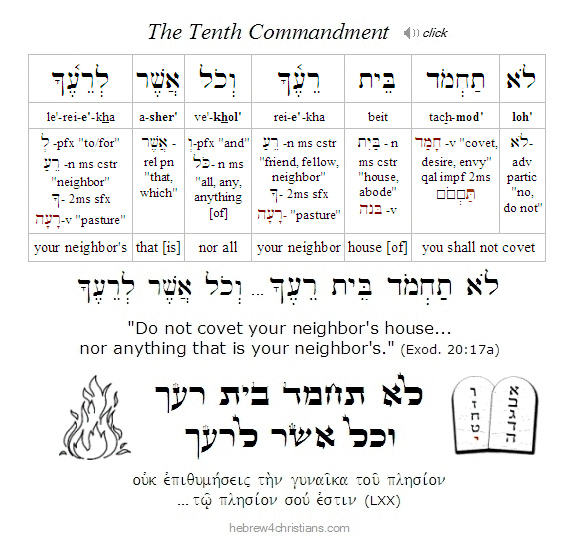 |
Bear Witness to the Truth:
The Ninth Commandment...

02.09.26 (Shevat 22, 5786) The Ninth Commandment prohibits swearing falsely against your neighbor in matters of law and civil proceedings, but, on a deeper level, it implicitly indicates the responsibility to be a witness of the truth at all times. Note that the Hebrew word for "truth" (emet) is composed from the first, the middle, and the last letters of the Hebrew Alphabet, thus indicating that it encompasses the first things, the last things, and everything in between. Thus, in relation to our neighbor (who is really everyone), we are to be truthful and bear witness to the truth in all our moments of life.
Hebrew Lesson
Exodus 20:16 Hebrew reading:
Love gives to others:
The Eighth Commandment...
02.09.26 (Shevat 22, 5786) The Eighth Commandment against stealing (לא תגנב, Exod. 20:15) corresponds to the third commandment not to profane God's name. Stealing, in the sense of the Hebrew word ganav (גנב), refers to both the act of carrying off by stealth that which is not one's own (i.e., theft), but also to the deceptive inner disposition that accompanies the action (genevat da'at: גְנֵבַת דַעַת). And ultimately that deceptive inner disposition is a form of self-deception. After all, none of us categorically "owns" anything, since God alone is the Creator and Giver of all of life. Stealing arrogantly (and vainly) attempts to seize some "thing" and to claim it for oneself - blindly disregarding the fact that "in Him we live and move and have our being" (Acts 17:28).
Hebrew Lesson
Exodus 20:15 Hebrew reading:
The Sanctity of love:
The Seventh Commandment...
02.09.26 (Shevat 22, 5786) The sages say that the Seventh Commandment prohibition against adultery (לא תנאף, Exod. 20:14) corresponds to the Second Commandment prohibition against idolatry. Adultery refers to sexual union between a married person and someone other than his or her spouse (fornication, on the other hand, is also prohibited in the Scriptures though it is a broader term that refers to any sort of sexual contact outside the covenant of marriage). The penalty for adultery is severe (see Deut. 22:22, Lev. 20:10).
From the verse, "The adulterer waits for twilight saying, No eye shall see me" (Job 24:15), the Talmud infers the adulterer to be a practical atheist, since he does not say, "No man shall see me, but no eye - neither the eye of one below nor the eye of Him above."
Adultery is a grave sacrilege, since it not only violates the sworn promise of parties to a sacred covenant, but perverts the picture of our union with God Himself. As Paul wrote to the believers at Ephesus, "We are members of his body, of his flesh, and of his bones. For this cause shall a man leave his father and mother, and shall be joined unto his wife, and they two shall be one flesh. This is a great mystery: but I speak concerning Messiah and the church" (Eph. 5:30-32). This is why apostasy is likewise likened to spiritual adultery...
Hebrew Lesson
Exodus 20:14 reading (click for audio):
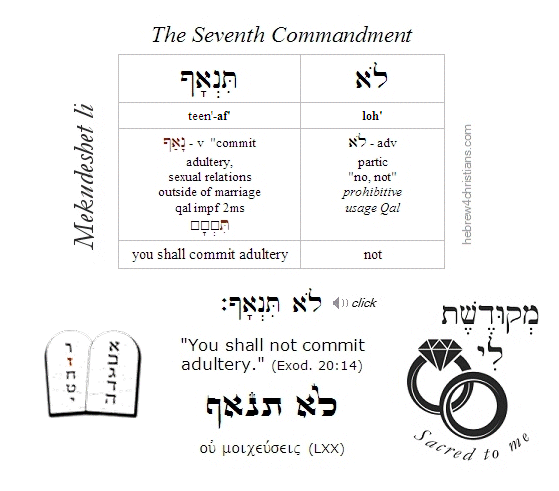 |
This Week's Torah:
Parashat Mishpatim...
After the LORD spoke the Ten Commandments to Israel, he called Moses up to Sinai for 40 days and 40 nights to teach him details of the commandments and how they were to be applied. The sixth section of the Book of Exodus provides a sampling of these various rules (called "mishpatim" in Hebrew) that God explained to Moses at that time.
02.08.26 (Shevat 21, 5786) Recall that last week we learned that exactly seven weeks after the Exodus from Egypt (i.e., 49 days from the first Passover), Moses gathered the Israelites at the foot of Mount Sinai to enter into covenant with the LORD. In a dramatic display of thunder, lightning, billowing smoke and fire, the LORD descended upon the mountain and recited the Ten Commandments (or Ten Declarations) to the people. Upon hearing the awesome Voice of God, however, the people shrank back in fear and begged Moses to be their mediator before God. The people then stood far off, while Moses alone drew near to the thick darkness to receive further instructions from the LORD.
In this week's Torah reading (i.e., Mishpatim, i.e., Exod. 21:1-24:18) we learn about these additional instructions that Moses received on the mountain. The Jewish sages traditionally count 53 distinct commandments in this portion of the Torah, easily making it one of the most "legalistic" (i.e., law-focused) sections of the entire Bible. Civil laws, liability laws, criminal laws, agricultural laws, financial laws, family purity laws, Sabbath laws, and holiday laws are all given in this portion. These various social and civil laws are called "mishpatim" (מִשְׁפָּטִים), the plural form of the masculine noun mishpat (מִשְׁפָּט), meaning a "judgment," "ordinance," "law" or legal ruling. The word derives from the verb shafat (שָׁפַט) meaning to judge or govern. A shofet (שׁוֹפֵט) is the Hebrew word for "judge," and the LORD is called Ha-Shofet kol ha'aretz (הֲשׁפֵט כָּל־הָאָרֶץ) -- the "Judge of all the earth" who loves justice (Gen. 18:25, 37:28, Psalm 50:6, 94:2).
In this connection we note that the application of the mishpatim became the basis for the tradition application of Jewish case law as well as for halakhah. Recall that the idea of establishing a legal system with courts, judges, and officers was derived from Yitro's advice given to Moses in last week's Torah portion: Moses chose God-fearing men from all over Israel and appointed them as leaders over the people. He put them in charge of groups of one thousand, one hundred, fifty, and ten (see Exod. 18:25).
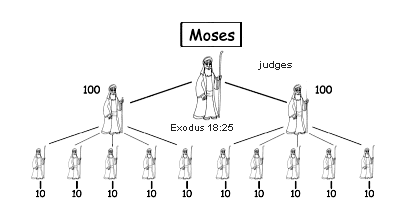 |
According to Jewish legal tradition, mishpatim are called ethical judgments (or laws) given for a clearly specified reason (i.e., logical laws), as opposed to chukkim (חֻקִּים) which are divine fiats or "decrees." An example of a mishpat would be the commandment to give charity or the prohibitions against theft and murder. These mitzvot (commandments) are inherently rational since the denial of their validity would make civil life impossible. In other words, the legal framework for Israel's society was derived from the Ten Commandments and the further instructions given to Moses, and these additional instructions were codified into case law and legal discussions as part of the oral Torah of Israel:
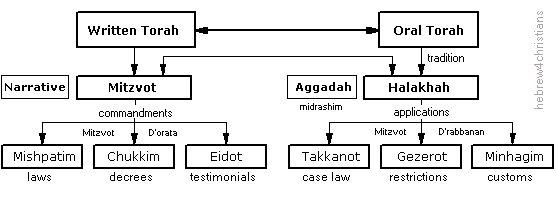 |
After receiving these additional rules, Moses descended Sinai and went before the people to explain the words of the LORD. Upon hearing the details, the people responded in unison, "all the words which the LORD has said we will do" (כּל־הַדְּבָרִים אֲשֶׁר־דִּבֶּר יְהוָה נַעֲשֶׂה). Moses then wrote down the words of the covenant into a separate scroll (sefer habrit), built an altar at the foot of Sinai, and ordered sacrifices to the LORD to be made. He then took the sacrificial blood from the offerings, threw half upon the altar, and read the scroll of the covenant to the people. The people ratified the covenant by saying, "all that the LORD says we will do and obey" (i.e., na'aseh ve'nishmah: נַעֲשֶׂה וְנִשְׁמָע). Upon hearing this, Moses took the other half of the sacrificial blood and threw it on the people saying, "Behold the blood of the covenant that the LORD has made with you in accordance with all these words" (Heb. 9:18). After this ceremony, Moses, Aaron, and seventy of the elders of Israel ascended Mount Sinai to eat a "covenant affirmation meal" between Israel and the LORD.
Upon returning from the mountain with the elders, the LORD commanded Moses to go back up to receive the tablets of stone inscribed with the Ten Commandments. On the seventh day there, he heard the Voice of the LORD calling to him from the midst of the cloud of glory, and then entered into the Presence of the LORD. He remained on the mountain for a total of forty days and forty nights receiving further revelation about the Mishkan (i.e., Tabernacle) while the Israelites waited for him at the camp down below.
Hebrew Lesson
Exodus 21:1 Hebrew reading:
The Sixth Commandment:
Do no Harm...
The following is related to Parashat Yitro and the giving of the Ten Commandments at Sinai...
02.06.26 (Shevat 19, 5786) The Mechilta (a halakhic midrash on Exodus) teaches that the Ten Commandments were divided into two groups with the first five on one tablet and the second five on the other, and that these correspond to one another so that, for instance, the Sixth Commandment (לא תרצח, "you shall not murder"; Exod. 20:13) is linked to the first commandment to believe in God (Exod. 20:2). Since man is made in the image of God, his life is infinitely precious, and only God Himself has the right to give and take life.
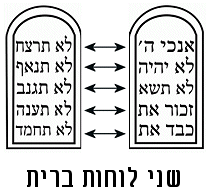 |
In the Mishnah it is written, "Why was only one man (i.e., Adam) created by God? - to teach that whoever takes a single life destroys thereby a whole world; and whoever saves one life, the Scripture accounts it as though a whole world had been saved (Sanhedrin 4:5). But murder can be figurative as well as literal. The Talmud notes that shaming another publicly is like murder, since shame causes blood to leave the face. Moreover, gossip or slander are considered murderous to the dignity of man. The Ethics of the Fathers states, "The evil tongue slays three persons: the utterer of the evil, the listener, and the one spoken about." Yeshua also linked the evil intent of our words with murder (see Matt. 5:21-22; 15:19).
Hebrew Lesson
Exodus 20:13 Hebrew reading:
The Heart of the Law
and the Law of the Gospel...
02.06.26 (Shevat 19, 5786) During His earthly ministry, was Yeshua (i.e., Jesus) instructing us to become followers of Moses? Did He come and die on the Cross so that we could be forgiven and therefore "start over" by keeping the Law (and its 613 commandments)? Is the gospel message really a sort of "reformation" of Temple Judaism? Did Yeshua come to renew the covenant made with Israel at Sinai or did he come to give us a new and better covenant that would somehow supersede it (Heb. 8:6)? In the light of his teaching, it appears that the answer to each of these questions is both a "yes" and "no."
When Yeshua proclaimed, "Do not think that I have come to destroy the Law or the Prophets; I have not come to destroy them but to fulfill them" (Matt. 5:17-20), he was actually amplifying the message of both Moses and the prophets, though his interpretation was contrary to various "traditional" views of his day. "You have heard that it was said [in the law, or by your sages...] ... BUT I SAY unto you..."
As a good Jewish teacher, Yeshua continually affirmed the inner meaning of the Torah, especially the Shema and the related obligation to love others (Matt. 22:36-40). In that regard His doctrine was surely a continuance of the Torah's foundational message. However, Yeshua clearly extended the reach of the Torah to include the inner heart attitude of the person. Observing the law was not a matter of adhering to various external codes of conduct but involved the rigorous self-examination of the heart and soul.
The law forbade murder, for example, but Yeshua extended the scope of the law to reach the intent of the heart: "You have heard it said (i.e., by Moses himself as he quoted the words of YHVH) 'You shall not murder...' but I say unto you that whoever is angry with his brother without a cause is liable to excommunication; whoever insults his brother is liable to punishment, and whoever calls his brother a fool is in danger of the fires of Hell" (Matt. 5:21-22). As someone once put it, murder is just anger "communicated really well..."
Likewise, the law forbade the act of adultery, but Yeshua focused not on the external action but rather the heart condition: "You have heard it said, (i.e., by Moses himself as he quoted the words of YHVH) 'You shall not commit adultery.' But I say to you that everyone who looks at a woman with lust in his eye has already committed adultery with her in his heart." When Yeshua explained that the law's intent was to prevent even looking with lust upon a woman, for all the more reason it should be obvious that we refrain from physical acts of adultery or fornication. Dealing with the inner heart attitude that gives rise to the lustful look therefore obviates the need to forbid the outer practice of the flesh (and therefore fulfills the intent of the law against adultery).
In matters relating to 1) divorce (i.e., Deut. 24:1-4), 2) the taking of oaths (Deut. 6:13; 10:20; Num. 30:2; Exod. 20:16), 3) the exercise of retribution (Exod. 21:23-24, Lev. 24:19-20; Deut. 19:21), and 4) the obligation to hate one's enemies (Deut. 7:2, 13:15-17, 20:16, Psalm 137:9, etc.), Yeshua actually circumvented the written words of Torah by denying matters that were technically permissible according to the "letter of the law" (Matt. 5:31-47). We see this clearly in the case of divorce, for instance. When the Pharisees asked him whether it was permissible to put away one's wife (Deut. 24:1-4), Yeshua answered: "Because of your hardness of heart Moses allowed you to divorce your wives, but from the beginning it was not so" (Matt. 19:8). Note that this was a "concession" added by Moses that was not genuinely God's will, and indeed the rigor of Yeshua's interpretation superseded that of Moses himself, who permitted divorce as a concession to human frailty and evil. Indeed, in each of these examples (divorce, taking oaths, retaliation, tribal loyalty), Yeshua's interpretation was more demanding and rigorous than the laws written in the Torah of Moses.
By expounding the requirements of the law with such rigor, Yeshua was claiming equal authority with YHVH Himself (יהוה). After all, each antecedent clause, "You have heard that it was said..." referred to an explicit utterance made by God Himself at Sinai. Yeshua then authoritatively extended the reach of the commandment by identifying its underlying ethical intent. This is what he meant by "fulfilling" the Law, or reaching the goal of the Torah's message. The time of "circumcision of the heart" was at hand (Deut. 30:6). The message of the law was to be written on hearts of flesh, not tablets of stone (Jer. 31:33, 2 Cor. 3:3,6).
The law of God - in particular, the moral aspect of the law - is indeed "holy, just, and good," though it is powerless to change the heart. This is not because the law is sinful, but rather because it reveals the presence of sin in our hearts. The law simply demands that we live as morally perfect agents -- regardless of our heredity, infirmities, social status, education, and so on. Like a flawless mirror, the law reflects back to us the truth of our moral and spiritual condition, and thereby reveals our need for deliverance from ourselves. The "problem of the law" is that it is "weak" on account of human "flesh," and therefore remedy had to be sought through other means (Rom. 8:1-4). This is the ultimate gospel message itself - that God sent His Son to both save us from the just verdict of the law (through Yeshua's substitutionary sacrifice) and to provide the heart's means to serve Him in the truth (through the agency of the Holy Spirit, given to those who trust in Him).
To underscore the need for personal deliverance, Yeshua was once asked by "a rich young ruler" what "good deed" must be done to inherit eternal life (Matt. 19:16-22). Yeshua answered with the statement, "Keep the commandments," and then provided the mitzvot listed in the second half of the tablets (that is, the commandments that dealt with social relationships). When he was further asked, "What else do I lack?" Yeshua told him to sell everything and give the proceeds to the poor. The "one thing missing" in this man's observance was the heart -- namely, love and genuine compassion for the poor. Such love was not something that could be gained by merely "following the rules" but required a radical heart change. Again, Yeshua was calling for religious observance that was far more rigorous than was conventionally understood by the Jewish leaders of His day. It's the inner intent of the commandments that matter, not mere conformity to an external ideal. "You therefore must be perfect, as your heavenly Father is perfect (Matt. 5:48).
Sometimes those who advocate "Torah observance" for the Christian seem to protest that the gospel message is often presented as a sort of "get out Hell free card" or a means of obtaining a "cheap grace" that encourages a lackadaisical performance of religious obligation. Such people -- well meaning as they may be -- have yet to fully hear the words of Yeshua regarding the righteousness required by the law itself: "Unless your righteousness exceeds that of the scribes and Pharisees, you will never enter the kingdom of heaven" (Matt. 5:20). Was Yeshua then suggesting that his followers were to be more scrupulous than the hand-washing Pharisees or the nitpicking scribes of his day? Were his followers to be marked by fastidious attention to the law's every detail, painstakingly adhering to the percentages of "mint and cumin" that should be designated as a tithe (Matt. 23:23)? Or was he rather suggesting that the righteousness of Messiah required "taking up the cross" and following Him in faith and self-sacrifice?
Let's return to the story of the "rich young ruler" who asked what "good deed" must be done to inherit eternal life. As the story goes, after the man heard Yeshua's demand for self-sacrifice, "he went away sorrowful, for he had great possessions." Yeshua then said to his disciples, "Truly, I say to you, only with difficulty will a rich person enter the kingdom of heaven." The disciples were astounded at Yeshua's comment and exclaimed, "Who then can be saved?" Yeshua replied to them, "With man this is impossible, but with God all things are possible" (Matt. 19:22-26). Those who advocate the observance of the law as a means of justification (or sanctification) before God need to confess their need for salvation -- from their own sinful heart condition. Only God has the power to change the self-serving human heart. This is a glory not shared with the various "self-improvement" programs of the world's religiously minded.
Hear the words of Yeshua regarding the "goal" or "end" of righteousness required by the law: Self-sacrifice, unfeigned love for others, genuine compassion, and the unselfish practice of mercy -- all of which were perfectly exemplified in the life of Messiah himself. The "goal of the law" is the miracle of a heart changed by the power and grace of God.
Now there is a "twist" regarding this entire discussion. In ethical matters we clearly see that Yeshua's' interpretation of the law was more rigorous than that of Moses, but regarding ceremonial and social laws we note that Yeshua often overruled the Torah entirely. For example, when Yeshua spoke of dietary restrictions (kashrut) he said, "What enters the mouth (i.e., food) does not defile a person, but what comes out of his mouth" (Matt. 15:11), and by so saying implied that various rules regarding what foods to eat, how meat was slaughtered, ritual handwashing, and so on, were not relevant. Concerning ritual impurity, we note that Yeshua touched a "leper" (Matt. 8:1-4) -- something explicitly forbidden by the law without becoming "unclean" (Lev. 14:4-29). Moreover, Yeshua not only touched a leper but healed him and declared him "clean," overruling the law's requirement that only a kohen (priest) could do so based on prescribed rituals (note that Yeshua's instruction to give "testimony" of the healing to the Temple priests was intended to testify that Someone greater than the Levitical priesthood was now in their midst). Likewise we read that Yeshua touched the corpse of a young girl -- another act that would render someone ritually unclean -- yet this action displayed the power of God by raising her from the dead (Mark 5:41). Finally, when Yeshua "cleansed the Temple" and stopped the "carrying of the ritual vessels," he interfered with the regular sacrifices of Israel (Mark 11:16), something clearly forbidden by Levitical law.
But what about the matter of Sabbath observance? Did Yeshua break the Sabbath, or did he adhere to various rules about not touching or doing certain things on this day (i.e. the 39 categories of work forbidden by the rabbis)? When he was once criticized by the Pharisees for allowing his disciples to pick some grain from the fields on the Sabbath, he responded that the Scriptures themselves testified that King David "broke the commandment" by eating the bread reserved for the priests (i.e., the "showbread"), and noted that the priests likewise "profaned" the Sabbath by performing avodah (service) at the Temple (Matt. 12:1-5). Yeshua then stated that "someone greater than the Temple is here" and went on to chastise his accusers by pointing out that the deeper principle of the law is to show mercy before sacrifice (Hos. 6:6, Psalm 51:16-17, Prov. 15:8, Matt. 9:13, etc.). As the very "Lord of the Sabbath" (Matt. 12:8), Yeshua sanctioned acts of mercy to be performed on the consecrated day of rest. Indeed, just as the law permitted a male to be circumcised or an animal to be pulled out of a well on this day, for all the more reason should a man be healed on the Sabbath (Matt. 12:11-13). The Sabbath is not a day of (static) rest but is a means of providing rest for others by doing acts of chesed and mercy. Again, the Pharisees had confused the "inner" with the "outer" and made a category mistake: "Man was not made for the Sabbath, but Sabbath was made for man" (Mark 2:27).
So we see both evidence of continuity and discontinuity regarding the law in the teaching of Yeshua. Regarding the underlying commandment to love God with all your heart and to love your neighbor as yourself, he was in full agreement. Yet Yeshua revealed that the practice of such love was far more rigorous than was commonly interpreted by the sages of his day, and nothing short of moral and spiritual perfection was acceptable to God. "Be ye perfect, as your Father in Heaven is perfect" (Matt. 5:48). The discontinuity occurs primarily as response to the frailty of our human condition. By revealing the "goal" or "end" of the law, Yeshua also revealed our need of personal deliverance. We are sinners and we need a changed heart from God to be saved...
Yeshua summed up his view of the obeying the underlying intent of the law with the following sober warning:
Everyone then who hears these words of mine and does them will be like a wise man who built his house on the rock. And the rain fell, and the floods came, and the winds blew and beat on that house, but it did not fall, because it had been founded on the rock. And everyone who hears these words of mine and does not do them will be like a foolish man who built his house on the sand. And the rain fell, and the floods came, and the winds blew and beat against that house, and it fell, and great was the fall of it. (Matt. 7:24-27)
For those who trust in Him for a heart change and eternal life, Yeshua is the Authority of Almighty God, the very Word of God incarnate. His words define our Torah. We all must answer to Him.
The love of God is the fulfillment of the law (Rom. 13:8-10, Gal. 5:14; James 2:8), and this love is manifest in the Person and Presence of Yeshua, the perfect fulfillment of the law of love (John 1:1, 13:34-35, 1 John 4:10-12, 2 John 1:6, etc.). The love of Yeshua imparts "righteousness to every one who believes" (Rom. 10:4).
Practically speaking, living in response to the love of God does not imply spiritual anarchy or "lawlessness," however, since the Law of Messiah (תּוֹרַת הַמָּשִׁיחַ) is to "bear one another's burdens" (Gal. 6:2) by emulating the sacrificial love that Yeshua has revealed and bestowed to us (John 13:15, 34, 15:12, etc.). "If you love me," Yeshua said, "keep my commandments" (John 14:15, cp. 15:10). Moreover, those who receive Yeshua as their Savior are given the Holy Spirit (רוּחַ הַקּדֶשׁ) -- also called the Comforter (παρακλητος) -- through whom the inner intent of the law is written upon the heart by faith (Gal. 5:18, 22-23). The heart of the law, then, is the law of the Gospel message itself - to love God and to serve others through the miraculous agency of God's redemptive grace.
May God work within us all such a miracle!
Hebrew Lesson
Jeremiah 31:33b reading (click for audio):
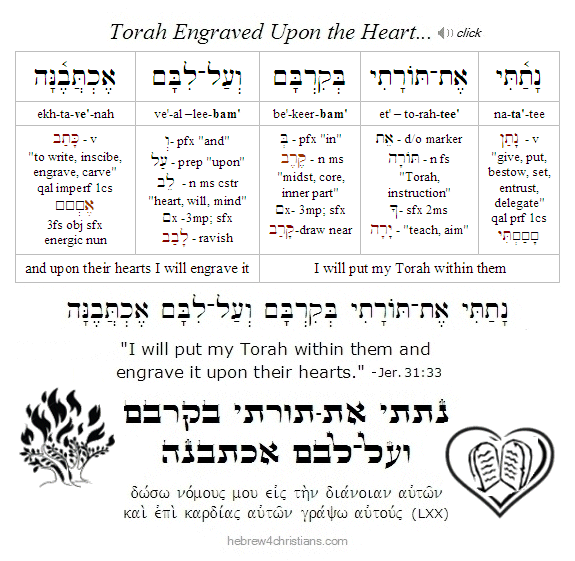 |
The Fifth Commandment:
Respecting your History...
This week we are reviewing the Ten Commandments at Sinai...
02.06.26 (Shevat 19, 5786) The first four of the Ten Commandments (עשרת הדברות) focus on our relationship with God, and it is only through obedience to these commandments that we are able to really understand our own identity - as well as the identity of others in our family, our community, and our world. The Fifth Commandment, to honor your parents, bridges the commandments directed heavenward (bein adam la'makom) with those directed toward one's fellow man (bein adam le'chavero).
Honoring our parents teaches us the first principles of honoring God and others; it is the fulcrum by which we learn empathy and "derekh eretz" (דרך ארץ), that is, the basic respect that underlies courtesy and good manners. The importance of this commandment cannot be overstated, since the word translated "honor" (i.e., kabed: כבד) derives from a root word meaning "weighty" (in terms of impressiveness or importance) and is often used to refer to the glory of God. The meaning of kabed in this context derives from the preceding verses (i.e., the first four commandments) which center on honoring God Himself. When we likewise honor our father and mother, the LORD says, "I reckon it as though I dwelled with them and they honored Me" (Kiddushin 31a).
Hebrew Lesson
Exodus 20:12a reading (click for audio):
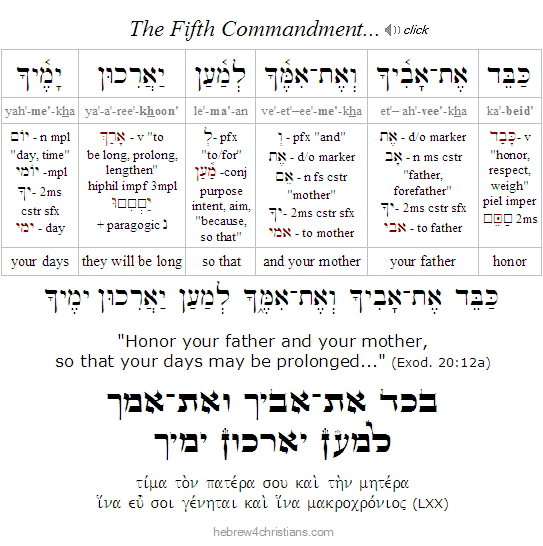 |
Affirmation: "O Lord, grant me your heart and passion for the good of all people..."
The Fourth Commandment:
Remember the Sacred...
02.06.26 (Shevat 19, 5786) The Fourth Commandment is to "remember" (i.e., zakhor: זכוֹר) the Sabbath day for holiness (Exod. 20:8). We are to set aside, that is, regard as sacred, the seventh day as an acknowledgment that God is both our Creator (Exod. 20:11) and our Savior (Deut. 5:15). By "remembering" the Sabbath we understand other days of the week in relation to it, the "first day" until the Sabbath, the "second day" until the Sabbath, and so on until we reach the Sabbath itself which marks an appointed time of sanctity and rest (i.e., menuchah: מנוחה). Some of the Jewish mystics came to regard the Sabbath not so much as a "day" in the usual sense but rather a spiritual "atmosphere" to be welcomed and greeted as beloved (לכה דודי). The fourth commandment also includes the restriction from doing profane activities (i.e., melachah: מלאכה): "you shall not do any labor" because Shabbat is time set apart for holy pursuits, for family connections, and for healing rest. God blessed the seventh day and sanctified it so that there would special provision from heaven to honor this time (Exod. 16:22). So important is the Sabbath day that God emphatically repeated the commandment just before he gave the tablets of the law to Moses (Exod. 31:13-18).
The Sabbath is a delight – not a burden; a time for celebrating your personal rest in our Messiah Yeshua (Isa. 58:13; Heb. 4:9). Indeed, all those who honor the Sabbath - including the "foreigners" of Israel - will be given a name that is "better than sons and daughters" that will never be cut off (Isa. 56:3-8). Moreover, Sabbath will be honored in the Millennial Kingdom to come: "From new moon to new moon, and from Sabbath to Sabbath, all flesh shall come to worship before me, declares the LORD" (Isa. 66:23). Indeed the blessing of the Sabbath will be honored in the heavenly Jerusalem itself! (Rev. 22:2).
Hebrew Lesson
Exodus 20:8 on the Sabbath day (commentary):
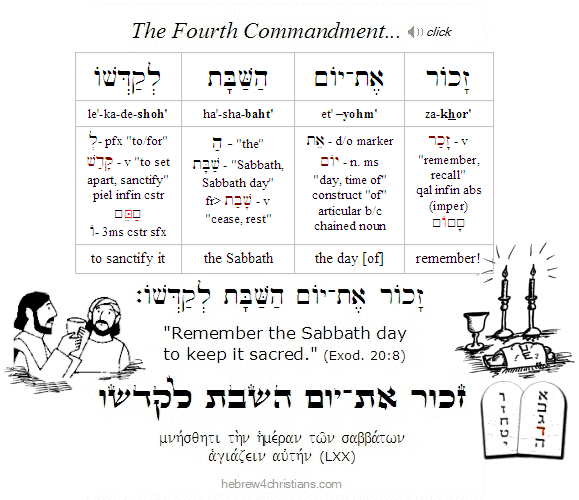 |
A Prayer:
O Lord, my Heavenly Father, I am all of need, all of brokenness, all of emptiness, all of weakness before You. I call out from the depths; O Lord, hear my prayer... For you alone are my Healer; you alone are the Source of all my hope. Whom have I in heaven but Thee? Without you I am as nothing, but with you I can leap as a hart over a wall; I can run and not be weary, I can walk and not faint...
You are the fountain of life; in your light I see light; in your consolations I find strength. Break forth your streams in my desert places; set my feet upon the highway of your holiness; direct my heart toward Zion with songs of praise upon my lips, with songs and everlasting joy. Let sorrow and sighing flee away in the compass of your peace, O Lord.
Thank you for being my salvation, O Lord God, and for attending to my heart's cry for you. Thank you for being all I need for everything you call me to be. Help me to rest by trusting in the gift of your life, your love, your passion. O Lord, I surrender to your love for me; thank you for your care... Amen.
Affirmation: "O Lord, help me to seek the beauty of your holiness always..."
The Third Commandment:
Respect the Gift of Life...
Our Torah this week includes the account of the giving of the Ten Commandments at Sinai...
02.06.26 (Shevat 19, 5786) The Third Commandment is "You shall not take the Name of the LORD your God in vain" (Exod. 20:7). This commandment implies that it is forbidden to invoke God's name for unholy or profane purposes, for example in jest or as a curse, though it further forbids using the truth of God as a means of harming or degrading other people. "Lifting up" God's name for selfish purposes is a violation of this commandment, and the commandment continues by gravely warning that "the LORD will not hold him guiltless who takes his name in vain." The sages have said that all the words of Torah together form the name of God, and if a single word or letter is missing from a Torah scroll it becomes unfit for use. This teaches that honoring God's word is therefore connected with honoring his Name, and conversely, dishonoring God's name expresses contempt for his word.
Hebrew Lesson
Exodus 20:7a Hebrew reading:
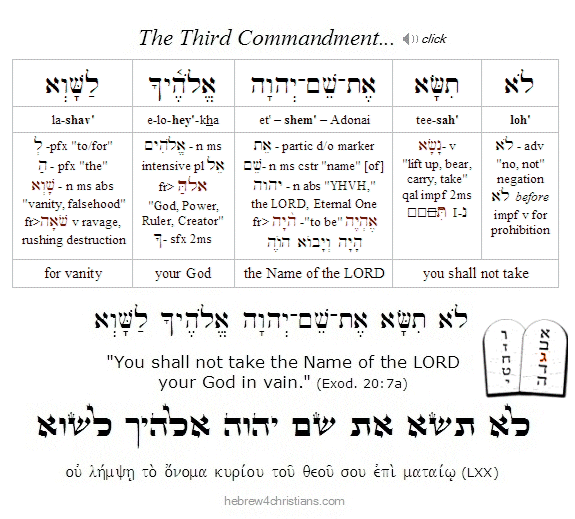 |
Affirmation: "Lord, you are worthy of all my praise; let your Name be magnified in my life."
Why I don't Write More Books?

02.06.26 (Shevat 19, 5786) Many people have suggested that I should write books to "capture" my writings and to make them more accessible to others, and while I love books and have written a few over the years, what I share here constitutes a long "book" of sorts, being written and revised for over 24 years now, that constitutes a medly of my mediations, Torah studies, theological and philosophical articles, devotional writings, weekly Torah summaries and podcasts, graphical Hebrew lessons with PDF files and accompanying audio, photos of my family observing the holidays of the Jewish year, and much more.
I love books and my house is stuffed with many of them, but as Writing books is also expensive and time consuming, and I am just one person here. It's my opinion that sharing my writings and thoughts in this format is better than writing a physical book anyway, because what I am share is alive, moving, and it expresses my journey with you on a regular basis. I hope this makes sense. There are a number of "PDF" files I have made over the years that you can download for free and print if you want a hardcopy.
Shalom to you, and thank you for being a friend to Hebrew for Christians. - John
The Second Commandment:
Focus on the Highest...
02.05.26 (Shevat 18, 5786) The Second Commandment, "You shall have no other gods before Me" (Exod. 20:3), implies individual accountability for your soul before the Creator of all reality. Pagan religions often believe in a supreme being but regard such as unknowable and distant and therefore they commonly appeal to divine "subordinates" (e.g., angels, other beings with godlike powers, etc.) to intervene on their behalf.
The second commandment teaches that there are no intermediate or subordinate beings to which we may appeal, since there is only one God who holds all power and authority in heaven and earth and we are each accountable directly to him. When we pray, then, we are not to venerate angels or saints or to appeal to God on behalf of intermediaries. We come boldly before the Throne of Grace to make our appeals personally before the Living God (Heb. 4:16). The second commandment implies monotheism with the implication that appealing to other gods (or god-like powers) is actually worship of demonic entities (see Deut. 32:17; 1 Cor. 10:20). We are to know that "the LORD is our God, the LORD alone," as the opening of the Shema proclaims: שׁמע ישׂראל יהוה אלהינו יהוה אחד (Deut. 6:4).
Hebrew Lesson
Exodus 20:3 Hebrew reading (click for audio):
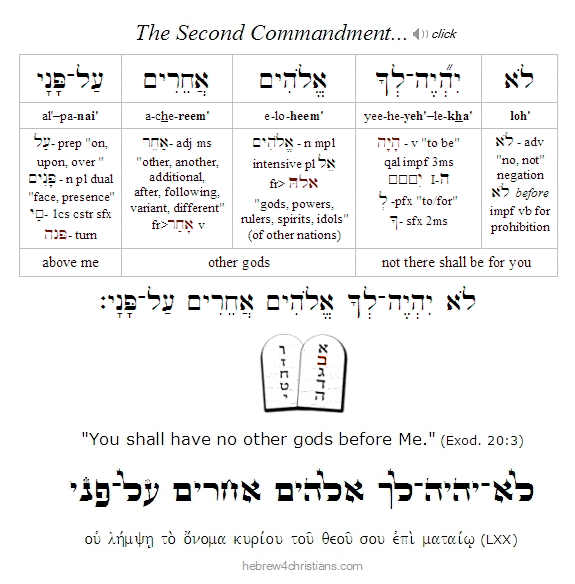 |
Affirmation: "O Lord, you are my greatest blessing and good; the treasure of my life."
The First Commandment:
Receive God's love for you...
The following is related to Parashat Yitro and the giving of the Ten Commandments at Sinai...
02.05.26 (Shevat 18, 5786) Historically, Christian tradition has regarded the First Commandment (of the Ten Commandments) to be: "You shall have no other gods before me" (Exod. 20:3), though Jewish tradition regards the opening words, "I am the LORD your God (אנכי יהוה אלהיך) who brought you out of the land of Egypt, out of the house of slavery" (Exod. 20:2) to be the First Commandment -- and the foundation upon which all the other commandments are based.
Though the statement "I am the LORD your God..." is not an imperative, it nevertheless assumes that you will accept the truth of God's revelation, and therefore it might also be understood as the duty or commandment to accept the truth. "I am the LORD your God who brought you out..." refers to the saving acts of God performed on your behalf, and therefore the proper response is one of heartfelt gratitude.
After all, without faith in the truth that the LORD is your Redeemer who loves and chooses you, the subsequent commandments would be devoid of context and significance. Indeed all the subsequent commandments are grounded in the truth of God that is received by faith (Hab. 2:4), and therefore the first commandment is to have emunah, or faith in God. Moses ben Nachman interprets the First Commandment to know that God exists and to believe in him, which implies studying and exploring the greatness of the Creator and Savior.
Finally, note that connection between the First Commandment to accept the truth of God's reality and the Shema: שְׁמַע יִשְׂרָאֵ֑ל יְהוָה אֱלֹהֵינוּ יְהוָה אֶחָד - "Hear O Israel, the LORD is our God, the LORD alone!" (Deut. 6:4). Like the First Commandment, the Shema is a declaration that the LORD is your God alone, and everything follows from that realization.
Hebrew Lesson
Exodus 20:2 Hebrew reading (click for audio):
Affirmation: "You alone are my LORD and my God..."
<< Return
|