|
Jewish Holiday Calendar
For December 2025 site updates, please scroll past this entry....
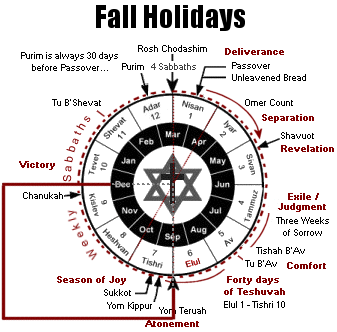
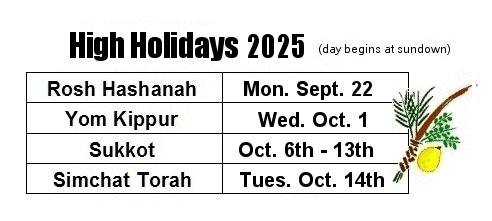
The Jewish civil year begins in the fall, though the Biblical year begins in spring (Exod. 12:2). Preparations for the fall holidays begin with a thirty day period of teshuvah (repentance) during the (late summer) month of Elul. The following ten days begin with the Feast of Trumpets (i.e., Rosh Hashanah, on Tishri 1) and end with the Day of Atonement (i.e., Yom Kippur, on Tishri 10). These first ten days of the new year are called the "Ten Days of Awe" (i.e., aseret ye'mei teshuvah: עֲשֶׁרֶת יְמֵי תְּשׁוּבָה), or simply the Jewish "High Holidays." Just five days after the solemn time of Yom Kippur begins the joyous week-long festival of Sukkot ("Tabernacles"), which is immediately followed by the celebration of Simchat Torah. The holiday of Chanukah occurs in late fall and carries over to the winter season:
The Fall Holidays:
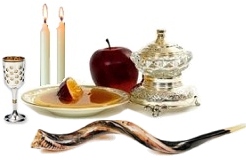
The fall festivals prophetically indicate the Day of the LORD, the second coming of Yeshua, the great national turning of the Jewish people, and the establishment of the reign of the Messiah upon the earth during the Millennial Kingdom in the world to come.
Note that in accordance with tradition, holiday dates begin at sundown. Moreover, some holidays may be postponed one day if they happen to fall on the weekly Sabbath:
1. Month of Tishri (Mon. Sept. 22nd [eve] - Tues. Oct. 21st [day]) - Fall holidays begin
2. Month of Cheshvan (Tues. Oct. 21st [eve] - Thurs. Nov. 20th [day])
- Four Sabbaths: Noach, Lekh-Lekha, Vayera, Chayei Sarah
- Yom Ha'Aliyah - Honoring Israel's immigrants (Mon. Nov. 5th; Cheshvan 7)
- Sigd - 50th day after Yom Kippur; Ethiopian Jewish holiday (Tues. Nov. 26th)
3. Month of Kislev (Thurs. Nov. 20th [eve] - Fri. Dec. 21st [day])
- Four Sabbaths: Toldot, Vayetzei, Vayishlach, Vayeshev
- Winter Solstice: Fri. Dec. 21st Kislev 23)
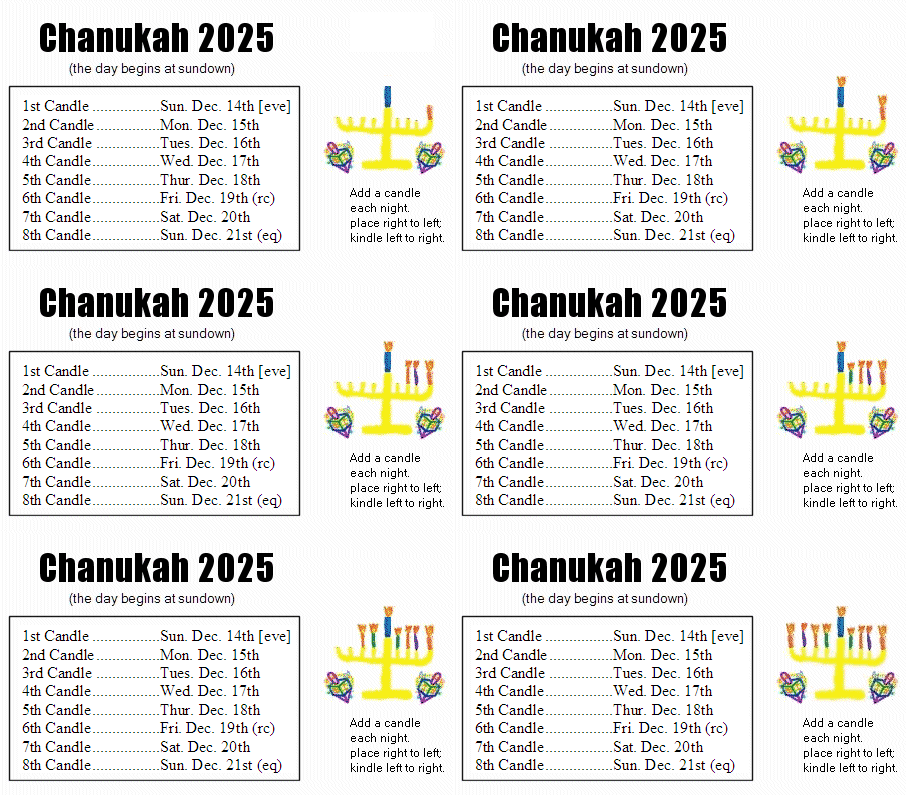
- Dates for Chanukah 2025 (5786):
- 1st Chanukah candle - Sun. Dec. 14th [i.e., Kislev 25]
- 2nd Chanukah candle - Mon. Dec. 15th [i.e., Kislev 26]
- 3rd Chanukah candle: Teus. Dec. 16th [i.e., Kislev 27]
- 4th Chanukah candle: Wed. Dec. 17th [i.e., Kislev 28]
- 5th Chanukah candle: Thurs. Dec. 18th [i.e., Kislev 29]
- 6th Chanukah candle: Fri. Dec. 19th [i.e., Kislev 30] (Chodesh Tevet)
4. Month of Tevet (Fri., Dec. 19th [eve] - Sun. Jan. 18th [day])
- Four Sabbaths: Miketz, Vayigash, Vayechi, Shemot
- Dates for Chanukah (continued):
- 7th Chanukah candle: Sat. Dec. 20th [i.e., Tevet 1]
- 8th Chanukah candle: Sun. Dec. 21st [Tevet 2] Zot Chanukah
- Last day of Chanukah: Mon. Dec. 22 until sundown
- Winter Solstice: Sun. Dec. 21st (Tevet 2)
- Christmas - Mon. Dec. 25th (Tevet 5, 5786)
- Asarah B'Tevet - Tues. Dec. 30th (dawn), fast for Jerusalem
- Secular New Year: Mon. Jan. 1st, 2026 (Tevet 12, 5786)
 |
Note: For more about the dates of these holidays see the Calendar pages....
December 2025 Updates
Note: If any page content appears to be missing, please refresh the page...
The Amazing Life of Jacob...
"Perseverance is more than endurance. It is endurance combined with absolute assurance and certainty that what we are looking for is going to happen." - Oswald Chambers
12.31.25 (Tevet 11, 5786) The great patriarch Jacob experienced many losses in his life. He was born in strife and raised with a twin brother who vexed his soul. His father was blind to the character of Esau and despite the prophecy given to his wife Rebekah that the "elder shall serve the younger," Isaac regarded Esau to be the family heir. Jacob's mother, on the other hand, steadfastly believed God's promise and esteemed Jacob as the chosen son. When Jacob later conspired with his mother to trick Isaac into conferring to him the blessing of the firstborn, his brother Esau sought to kill him and Jacob was forced to flee to his uncle's place in Mesopotamia. Along the way there he had a dream of the ladder from heaven where God confirmed that Jacob was indeed the chosen heir of the family. God promised to watch over him during his journey and to later bring him back to the promised land.
After this great vision of the ladder from heaven, Jacob crossed over from the promised land and came into the servitude of his mother's unscrupulous brother Laban. Jacob was allowed to stay as one Laban's servants, but he asked his uncle if he could marry his daughter Rachel in return for the promise to work for him for seven years. Laban agreed but disguised his older daughter Leah to take the place of Rachel at the wedding ceremony (perhaps to remind Jacob of his own scheme to disguise himself as Esau before his father). After Jacob protested his uncle's duplicity Laban allowed him to marry Rachel (in addition to Leah) but only if he promised to serve him for an additional seven years. Jacob agreed to these terms.
During the course of his years of servitude, Jacob had eleven sons (and one daughter) from Leah (and her surrogate Zilpah) and from Rachel (and her surrogate Bilhah). Rachel had been barren for years but when she finally conceived and bore a son she named him "Joseph," Jacob decided the time had come to go back to his homeland. When he told his uncle his plans to return home, Laban persuaded him to stay with him as his chief shepherd. Jacob reluctantly agreed and worked for six more years and became quite wealthy, but when Rachel became pregnant a second time, he had a vision from the Lord saying the time had come to go back home. Instead of trying negotiate any further with his uncle, Jacob decided to escape and flee with his family and return to Canaan.
When Jacob finally arrived back to his homeland, 22 years had passed. During this time his mother had died but his father Isaac was still alive and living in Hebron. When some of Jacob's scouts came and told him that his estranged brother Esau was coming to meet him with an army of men, Jacob immediately divided his family into groups and separated them to protect them. Then he crossed the river Jabbok alone and passionately wrestled with the Angel of the Lord until daybreak, where he received God's blessing and the new name "Israel," the one who grapples with God.
After encountering the mysterious Angel and being renamed Israel, Jacob met his brother and was peacefully reconciled to him. He then went to the City of Shechem where there his daughter Dinah was assaulted by a local prince. Upon learning of this outrage, Jacob's sons Simeon and Levi privately took revenge upon the Shechemites by killing all the males of the city. This greatly upset Jacob and God then instructed him to go to Bethel, to the place where God first spoke to him in a dream and Jacob had made a vow, and there to offer sacrifices to him. Jacob did so and the Lord met with him and blessed him saying, "I am God Almighty: be fruitful and multiply. A nation and a company of nations shall come from you, and kings shall come from your own body. The land that I gave to Abraham and Isaac I will give to you, and I will give the land to your offspring after you" (Gen. 35:11-12).
After Jacob left Bethel, he journeyed toward Bethlehem where Rachel went into hard labor and died while giving birth to her second son Benjamin. There Jacob set up a pillar over her tomb. Joseph was likely seven or eight years old when his brother was born. This must have been especially difficult for Jacob, especially after his great encounter with God at Bethel...
About ten years later, as Jacob lived with his family in the land of Canaan, we learn that Joseph was designated to be his "right hand man" because he was the firstborn son of his beloved wife Rachel. As I've mentioned elsewhere Jacob and Joseph had a lot in common, and he gave his son an ornamental tunic to honor his place in the family. At about the same time Joseph began having repeated dreams about becoming the family ruler - grandiose dreams which aroused his brother's sore envy.
One day when the brothers moved Jacob's flocks to an area near Shechem, Jacob dispatched Joseph to oversee how they were doing and to report back to him. When the brothers saw him, however, their animosity overtook them and they immediately decided to kill him. As Joseph approached they striped him of his ornamental tunic and threw him into an empty well. Later they sold Joseph to some Ishamelite slave traders and then concocted a story to cover up their crime. The brothers went home and told Jacob how they had found Joseph's tunic covered in blood in the desert and they were afraid that he had been killed by a wild animal. When Jacob heard the news he was left in grief and shock...
Note that Joseph was in Egypt for 13 years (counting his time serving Potiphar and his time in prison) before he was promoted by Pharaoh for interpreting his dreams. Joseph then served Pharaoh during the "seven years of plenty" that were followed by two years of famine that affected the land of Canaan, and it was at this time, when Joseph was 32 years old, that Jacob sent his brothers to Egypt to get food that had been collected and stored there. After a lot of drama and testing of his brothers, Joseph finally revealed himself to them and explained that the famine would last five more years. He then asked his brothers to go back to Canaan and to bring his father Jacob to live in the land of Egypt. When Jacob later heard the news that his long lost son Joseph was still alive it was like a dream, but he "hoped against hope" and decided to go to the land of Goshen to be reunited with his son. "It is enough; Joseph my son is yet alive: I will go and see him before I die" (Gen. 45:28).
So Jacob left for Egypt and along the way there stopped at Beersheba to offer sacrifices. The Lord then reassured him that Joseph was indeed very much alive: "I am God, the God of your father. Do not be afraid to go down to Egypt, for I will make you into a great nation there. I will go down with you to Egypt, and I will also surely bring you up again; and Joseph will put his hand to close your eyes" (Gen. 46:1-4).
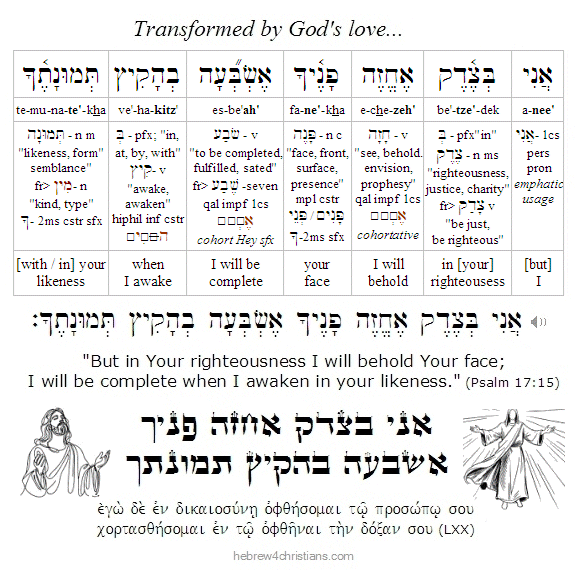
For 22 years Jacob had lived in grief for his beloved son, and when he finally saw him again, Joseph was 39 years old and Jacob was 130 (Gen. 41:6; 47:9). Their reunion was a dream come true. Jacob's first words to his son after all those years were: "Now I am ready to die; I have seen your face again (רְאוֹתִי אֶת־פָּנֶיךָ) and know you are still alive" (Gen. 46:30).
When Joseph presented his father before Pharaoh, Jacob blessed him, and the king then asked him how old he was. Jacob replied: "The days of the years of my sojourning are 130 years. Few and evil have been the days of the years of my life, and they have not attained to the days of the years of the life of my fathers in the days of their sojourning" (Gen. 47:9).
Jacob then settled in the land of Goshen and lived another 17 years before he died at the age of 147 (Gen. 47:28). The sages note that Jacob lived with Joseph for 17 years before he was taken away, and he lived another 17 years after being restored to his son before he died. The last 17 years of Jacob's life were his "golden years," years of his senescence, and the season for him to prepare for his death. During this time Joseph cared for his father, helped him live in comfort, and later made arrangements for his death.
The Torah is silent about these last 17 years of Jacob's life but jumps from the climactic account of their reunion to the time when Jacob asked Joseph to solemnly promise to bury him in the Cave of Machpelah in the land of Canaan. Sometime after this, Joseph was told that Jacob was sick and he went to visit him with his two sons Manasseh and Ephraim. There they saw Jacob upon his deathbed, planning how to bless his sons before he died. When he saw Joseph's sons, Jacob adopted them as his own, recalling God's promise to make of him into a great nation. Before he blessed them Jacob poignantly said to Joseph: "I never thought I would see your face again (רְאֹה פָנֶיךָ לֹא פִלָּלְתִּי), yet now God has let me see your children as well!" (Gen. 48:11).
You are undoubtedly familiar with how Jacob proceeded to bless Joseph's two sons, how he crossed his arms and placed his right hand on the head of the younger son Ephraim and his left hand upon the older son Manasseh. This was by design, as it was a confession of Jacob that God is the one who truly imparts the blessing. "May the Angel who redeemed me from all harm bless the young men, and may they be called by my name and the name of my fathers, Abraham and Isaac, and may they multiply abundantly like fish in the midst of the land." When Joseph sought to correct his father and tried to reverse his hands, Jacob said: יָדַעְתִּי בְנִי יָדַעְתִּי, "I know, my son, I know..." "So he blessed them that day, saying, "By you will Israel bless, saying, 'May God make you like Ephraim and Manasseh.'" So he put Ephraim before Manasseh (Gen. 48:20).
Jacob then told Joseph that he would die but prophesied that God would be with him and eventually bring the family back to the promised land. He then bequeathed the land of Shechem to him as a surety that the prophecy would prove true (Gen. 48:22, Josh. 24:32).
Finally the great patriarch called all of his sons together to bless them and to tell them about what would happen in the end of days (Gen. 49:1). In this connection the sages note that though Jacob would indeed bless his sons, he was prevented by God to reveal the vision of the "End of Days" (אַחֲרִית הַיָּמִים) to them at this time. I will not repeat the poetic blessings Jacob gave to each son except to mention that Judah was identified to be the heir of the Savior to come and that Joseph's descendants would be blessed unto the ends of the earth.
Notwithstanding all the sorrows and struggles of his life, Jacob was God's chosen vessel as the great patriarch of Israel. Jacob's life had a happy ending because of the eternal hope given to him by the promises of God. לִישׁוּעָתְךָ קִוִּיתִי יְהוָה - "For Your salvation I wait, O LORD" (Gen. 49:18). His dying wish was to be buried in the promised land to be "gathered to his fathers" in anticipation of his resurrection from the dead and the restoration of all things.
Despite everything that happened to Jacob, God's plan prevailed and the blessing of Joseph was established. Nevertheless the children of Israel would undergo four centuries of slavery in preparation for their redemption from Egypt and the great revelation of the altar at Sinai.
God's providence is called "hashgachah" (הַשׁגָּחָח), a word taken from Psalm 33:14 that says, "From the place of His habitation he looks carefully (i.e., hisgiach: הִשְׁגִּיחַ) upon all the earth's inhabitants." Rabbi Chanima interpreted this to mean that God's hand is in every detail of our lives. He wrote: "No one bruises his finger on earth unless this was decreed from on high." The Torah commentator Rambam qualified this idea by saying that "hashgachah pratit," or God's personal supervision, is only granted to those who are pious and who earnestly seek God's presence (i.e., the godless are less noticed by God). On the other hand Yeshua our Savior taught that God knows everything about us, everything we say and do, and he even counts the number of the hairs on our heads - implying that God's knowledge of us is beyond our own understanding. Like Jacob we cry out, "For Your salvation I wait, O LORD" as we trust in his guidance and control over all the details and circumstances of our lives...
In this connection I wonder whether we would really want it to be any other way? God "cannot not" know everything and not be God, of course. In other words His omniscience (i.e., yediat hakol: יְדִיעַת הַכֹּל) is a "necessary" attribute of who God truly is. And when it comes time for you to die, do you believe that God will be there for you or not? At that time you will be utterly helpless and passive, completely at the mercy of the One whom you trust will somehow "collect" your soul and bring you before his presence. You are ultimately powerless over what will become of you and you therefore must trust in God's grace, love, and power to perfect your destiny as his beloved child.
Some people chafe at the idea of God's "close providence" over all things and resist the thought that they are powerless over their lives.They don't mind that God will work "all things together for good" for them in the end, but they want to be in control of their own way through this life in the meantime... Others, however, find great and unshakable comfort that Almighty God upholds their lives, and that every heartbeat and every breath they take is a gift from above as personally directed by His will.
Socrates said that philosophy is the "practice for death," for death is the gateway to the life beyond: "The one aim of those who practice philosophy in the proper manner is to practice for dying and death" (Phaedo). Our Torah portion is called "Vayechi" which means "and Jacob lived," yet it begins with his preparations before he died. Jacob understood that physical death was not the end but rather just the beginning. Like his grandfather Abraham, he believed in the unseen reality of God's presence in everything. And when he died the Torah says - וַיֵּאָסֶף אֶל־עַמָּיו - "he was gathered unto his people" - a statement that provides a vivid picture of his blessed homecoming, the fulfillment of the promised land, and his entry into the everlasting habitations of God. Let the name of the Lord be praised. Amen.
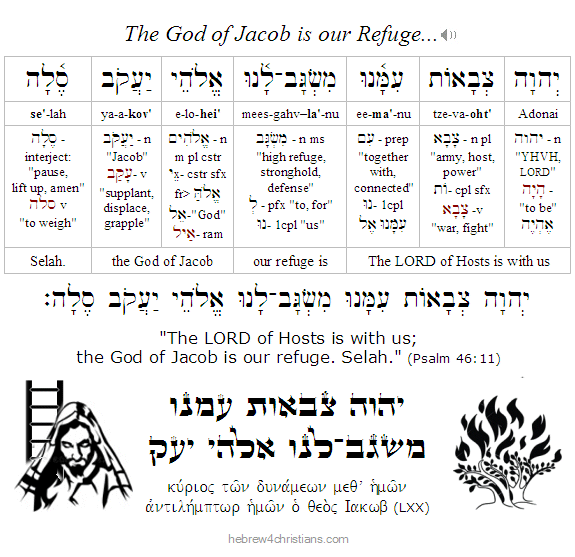
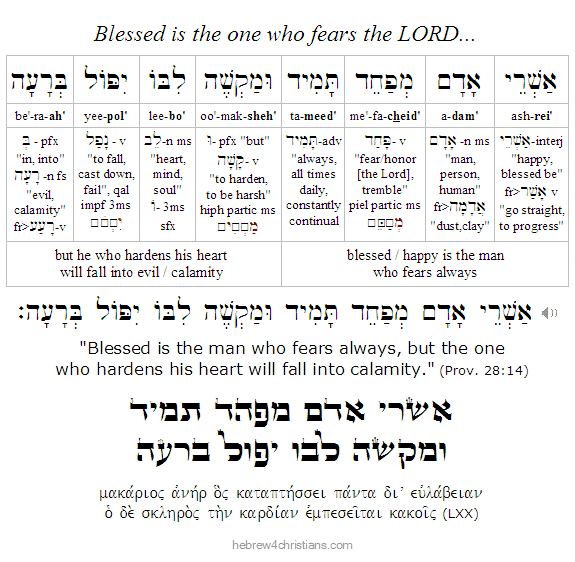
Hebrew Lesson
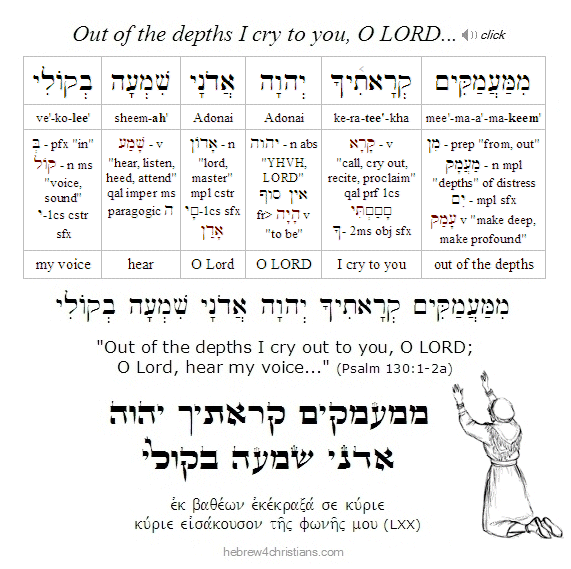
Psalm 46:11 Hebrew reading:
The Heart's Truth...
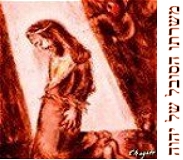
12.30.25 (Tevet 10, 5786) According to Jewish tradition, it was Joseph's firstborn son Manasseh who was "the steward" who planted the silver goblet in Benjamin's sack and had him arrested as a thief (see Gen. 44:1-13). But did Manasseh knowingly participate in Joseph's orchestrated charade? Did he understand that his uncles had come to Egypt or did he regard them simply as "Canaanite strangers"? Was he was simply "obeying orders" from his father as "Joseph's steward," or was he willingly conspiring against his uncles as Joseph's son? Regardless of his exact motivation, however, Jewish tradition maintains that Manasseh forfeited part of his inheritance for causing his uncles to rend their garments. As a divine consequence, the descendants of Manasseh were decreed to be the first of Israel carried into captivity by the Assyrians (c. 740 BC).
The moral of this story is that duplicitous words and actions -- even if they are intended to promote a greater good -- are unjustified and can even cause us to lose a portion of the blessing intended for our lives. The end never justifies the means. God is not a pragmatist, and there are no "noble lies" for sake of the Kingdom of Heaven.
But what are we to make of Joseph's words and actions? Wasn't his charade and his scheme to entrap his brothers based on a similar sort of deception? What's the difference between Manasseh's deception and his father Joseph's? Why does Jewish tradition forgive Joseph for his duplicity but blame his son? Moreover, why didn't Joseph send a message to his father after he became a man of power in Egypt? For that matter, why didn't he show compassion for his obviously needy family during the time of famine? Why did he exacerbate their suffering by arresting Simeon, thereby greatly increasing the heartache of Jacob (Gen. 42:24)? If Manasseh was punished for causing his uncle's garments to be rent, should not Joseph have been punished for the suffering he caused his entire family?
Various answers to these questions have been offered by the sages. Maimonides claimed that Joseph acted the way he did to see if his brothers had genuinely regretted their actions. Other sages have said that Joseph might have thought his father was somehow involved in the conspiracy to sell him. After all, Jacob had publicly reprimanded his son for his dreams (Gen. 37:10) and was the one who initially sent his son on the mission to spy on his brothers (Gen. 37:14) -- which eventually led to his sale to the Ishmaelites (Gen. 37:28). Moreover, wasn't Joseph's firstborn son called Manasseh (מְנַשֶּׁה), meaning "forgetting" in reference to "all my father's house" (Gen. 41:51)? Still others disagree and say that Joseph "forgot" his father's house because had he disclosed the truth, Jacob would have cursed his sons, and Joseph did not want this to occur. Joseph's withholding of his identity was therefore to be understood as an act of mercy toward his brothers. Still others say that Joseph's neglect of his father was the consequence of his father's neglect of his father Isaac while he was captive to Laban (i.e., the "sins of the fathers" are passed on to their children). And so on...
Perhaps the difference lies in the inward heart motivation. Joseph was endued with prophetic wisdom that was evidenced early in his life. His family listened as he recounted his God-given dreams. They must have understood the stakes of being the firstborn son (bechor) of Israel and therefore the stakes for the fledgling nation... Moreover, the battle between Joseph and his brothers was Joseph's -- not Manasseh's -- and therefore Manasseh was wrong to "take on" the offense of his father. Joseph's deception was therefore strategic, intended to defeat the initial deception of his father Jacob by his brothers... Furthermore, the silver goblet surreptitiously put into Benjamin's sack and the phony charges might have come from another motive: perhaps he could not tolerate the pain of further separation from his only full-blooded brother (and son of his mother Rachel). Perhaps Joseph didn't want to risk never seeing Benjamin again, so his deception was based on love itself. Maimonides wrote that "Joseph was afraid that the brothers hated Benjamin, or were jealous of their father's love for him as they had been jealous of Joseph. He was afraid that Benjamin had realized that they had harmed Joseph and this had led to acrimony between them. Therefore Joseph did not want Benjamin to go with them lest they harm him, until he had verified their love for him" (Ramban, 42:9). Still, there is the nagging question, if Joseph had such compassion for his brother, why didn't he send word to his father after he began his ascent in Egypt?
There are various other cases of seemingly justified cases of deception in the Bible, of course. Both Abraham and Isaac deceived Avimelech yet were prospered by God (Gen. 20:14-15; Gen. 26:11-16); Jacob deceived his father Isaac yet inherited the divine blessing (Gen. 27:19,33); Leah and Rachel deceived Jacob yet became the matriarchs of Israel (Gen. 29:25); Joseph deceived his brothers yet was elevated as a savior of the family (Gen. 39-45); the Jewish midwives lied to Pharaoh concerning the birth of Jewish babies yet were rewarded by God (Exod. 1:17-20); Rahab lied to the king about the whereabouts of Joshua's spies yet became part of the lineage of Messiah (Josh. 2); Jael pretended to offer Sisera protection but hammered a tent peg into his head while he was asleep (Judges 4); Nathan the prophet "deceived" David into confessing his sin with Bathsheeba (2 Sam. 12); Mordecai and Haddasah hid the fact that they were Jews, etc. I am sure you can think of other examples.
There are a lot of questions regarding all of this, though wisdom explicitly instructs us to refrain from the practice of deception in our lives. The Scriptures clearly teach that deception is morally blameworthy: "Shall I acquit the man with wicked scales and with a bag of deceitful weights?" (Micah 6:11). The Holy Spirit, moreover, is called the Spirit of Truth (John 14:17, 16:13), and it is "impossible for God to lie" (Num. 23:19, Heb. 6:18, Titus 1:2). The Apostle Paul wrote: "Therefore, having put away falsehood, let each one of you speak the truth with his neighbor, for we are members one of another" (Eph. 4:25), and "do not lie to one another, seeing that you have put off the old self with its practices" (Col. 3:9). Throughout the ethical teaching of the Scriptures, the tzaddik, the righteous man, is always described as yashar - full of integrity and moral righteousness. "Midvar sheker tirchak" (מִדְּבַר־שֶׁקֶר תִּרְחָק), "keep far from a falsehood" (Exod. 23:7). This is the prescription for a good life, that is, for being at peace with yourself. In the heavenly Jerusalem to come, truth will reign completely, and "outside are the dogs and sorcerers and the sexually immoral and murderers and idolaters, and everyone who loves and practices falsehood" (Rev. 22:14).
Nonetheless, if deception is sometimes sovereignly "allowed" for the sake of the Kingdom of Heaven, the converse also appears to be true. Truth is sometimes expressed for the sake of the kingdom of Hell...
Sometimes true words and actions performed in an unloving or spiteful manner are morally blameworthy. Dietrich Bonhoeffer (1906–1945) tells the story about how a teacher once humiliated one of her students by standing him up in front of the class to ask whether his father -- notoriously known as the town drunk -- had been out drinking the night before. The little boy knew the accusation was true but bravely announced "No." When the teacher mockingly asked him again, pressing him for "the truth," the boy was adamant: "NO!" Bonhoeffer's comment was that this little boy spoke more truth by his lie than if he had merely reported the "facts" to the class -- and thereby betrayed the dignity of his father... The truth is not some objective state of affairs that can be reported dispassionately. Without love as its context, such "truth" becomes a lie. Satan keeps his own books.
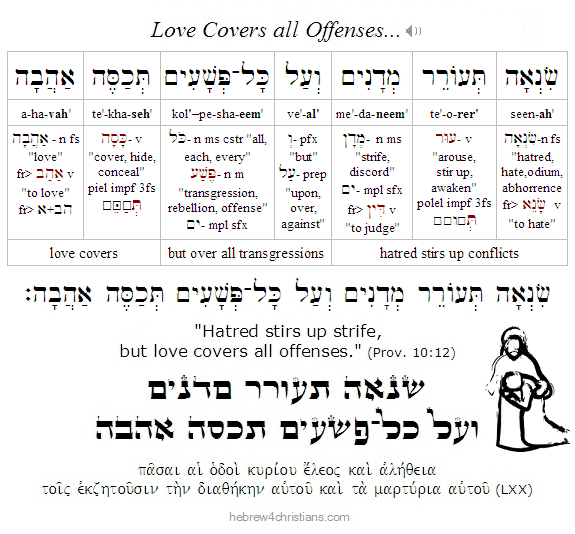
It is said that Joseph never told Jacob the truth about his betrayal by his brothers, not even when Jacob was on his deathbed. His love forbade him to engage in lashon hara (evil speech) or to bring further pain to his father. Love overlooks a multitude of transgressions. May God help us all "speak the truth in love" -- or else help us to keep silent.
Hebrew Lesson
Proverbs 10:12 reading (click):
 |
About the Secular New Year...
"The highest goal of spiritual living is not to amass a wealth of information, but to face sacred moments. Spiritual life begins to decay when we fail to sense the grandeur of what is eternal in time." - Abraham Heschel
12.30.25 (Tevet 10, 5786) In most countries of the contemporary world, "New Year's Day" is usually celebrated as a "revelry" on "January" 1st, though this date comes from the decree of the consuls of ancient (and pagan) Rome -- certainly not from anything taught in the Torah and the Hebrew Scriptures. However, because it falls eight days after December 25th, some old church tradtions under the heel of Rome marked this date as the "Festival of Christ's Circumcision and offered religious services to make resolutions and to offer up additional prayers. Some of these churches conducted "midnight" communion services so that the sacraments would be taken just before the start of the "new year." Now while all this might be encouraging and helpful on some level, it needs to be stressed that the civil New Year the world celebrates is not a Biblical holiday at all, and in fact is contrary to the Biblical Calendar that was revealed in the Torah and Scriptures.
As I have repeatedly taught over the years, according to Torah there are two mirroring "New Years" observed during the year. The first occurs two weeks before Passover (Nisan 1) and the second occurs ten days before Yom Kippur (Tishri 1). The first is called Rosh Chodashim (see Exod. 12:2), which commemorates the month of the redemption of the Jewish people (i.e., the month Yeshua was sacrificed for our sins), whereas the second is called Yom Teru'ah that is associated with the "Feast of Ingathering" at the "end of the year" (Exod. 23:16, 34:22). Later Yom Terua'h became known as Rosh Hashanah ("the head of the year") which began a ten-day "trial" of humanity climaxing on the Day of Atonement (Yom Kippur).
The two "new years" of the Jewish calendar mirror each other and reveal the two advents of Messiah, first as the great Lamb of God as the Suffering Servant who dies for the sins of his people, and second as the great King of Glory, when Yeshua returns at the "Day of the LORD" and establishes his reign in Zion (Jersualem) after the time of the Great Tribulation.
"Time is deeper and stranger than anything else in our lives, it takes everything with it, nothing is bigger than time, nothing survives its power" (Jacob Needleman). Of course God alone is the Author of Being and Time; He is the One who sustains all things by the word of his power: "For by him all things were created, in heaven and on earth, visible and invisible, whether thrones or dominions or rulers or authorities-- all things were created through him and for him. And he is before all things, and in him all things hold together" (Col. 1:16-17).
It's been said that the liturgy of the Jew is the calendar, and therefore we understand the two new years as two "axes" upon which turn the theme and tone of the calendar year. Regarding the secular "new year" and its relationship to the Torah, see the H4C article:
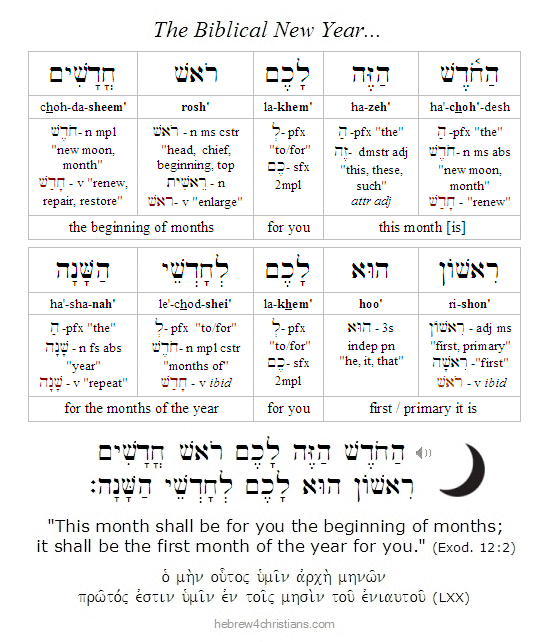
Hebrew Lesson
Exodus 12:2 reading (click):
Footnote: Please note that I am not suggesting that we should become "pedantic" or fussy about all this, for though we are not "of the world" we are still "in" the world (John 17:14-17), and therefore we will normally use the customary names for days, months, years, etc. That said, it is good to understand the Torah's calendar (and how it correlates to the secular calendar) since it reveals astounding prophetic truth about our Lord and gives us wisdom regarding the seasons of God's providential design...
The Courage to Believe...
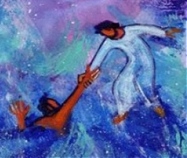
"Christ leads me through no darker rooms than He went through before." - Richard Baxter
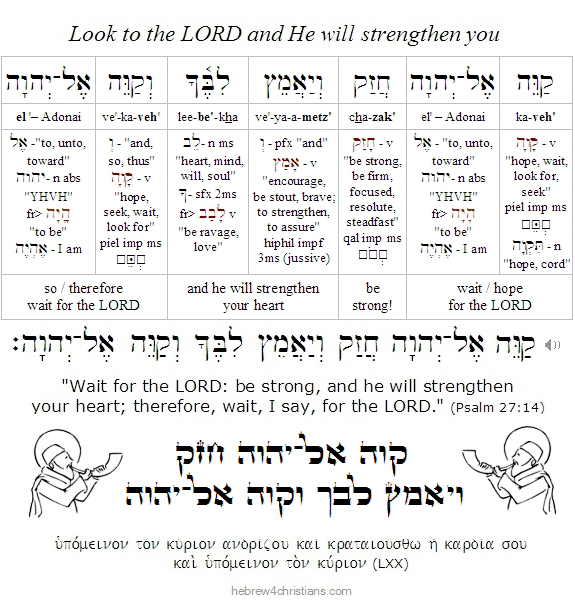
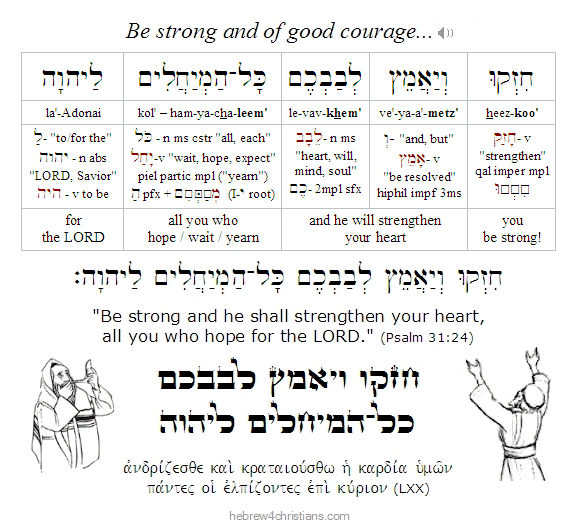
12.30.25 (Tevet 10, 5786) When you feel like you are losing hope, King David offers encouragement and wisdom, if you are willing to receive it: "Be strong and he shall strengthen your heart, all you who hope for the LORD" (Psalm 31:24).
To the doubting heart David simply says "be strong." The Hebrew word is just one word, "chizku" (חִזְקוּ), an imperative that means "take heart!" or "be brave!" or "be resolute!"
But how can we be commanded to be strong or brave when courage is just what we need in our time of fear? Is this some sort of wishful thinking? What might David mean?
The Hebrew root for the command to "be strong" (i.e., chazak: חזק) means to "harden" or to steel yourself inwardly - to make firm your conviction, and to resolutely decide to have hope despite your fear. Interestingly this same verb is used to describe when Pharaoh's heart was hardened as he refused to let Israel go.... With the same tenacity are we to refuse to let go of our hope, even to the very end.
King David then offers a promise based on his own experience. Once you have earnestly decided to hold fast to your hope, the Lord will "ratify" your decision by strengthening your heart. The logic goes something like this. If you decide to keep faith in God, then God will intervene and strengthen your resolve. The Hebrew verb used for "strengthen" (יַאֲמֵץ) is "hiphil," meaning it is causative: God's Spirit will cause your heart to be strengthened, to be strong, and to be full of courage.
As you make up your mind, the LORD will give you the heart and the will to go forward... Align your will with God's will ("thy will be done") and in your hope you will be empowered to do the miracle. "According to your faith be it done unto you."
When Ruth decided to cleave to her mother-in-law Naomi instead of going back to her former life, the Scripture says she was courageous: "And when Naomi saw that she was determined to go with her, she said no more" (Ruth 1:18). The Hebrew phrase "she was determined" uses the same language David used when he said God would strengthen the heart of faith. Ruth had inwardly reflected on the question whether to leave or to stay, but she made up her mind to remain with Naomi no matter what the cost. "For where you go I will go, and where you lodge I will lodge. Your people shall be my people, and your God my God."
The Hebrew word for courage (i.e., ometz: אוֹמֵץ) comes from the same Hebrew root (אמץ) used by David to say that God will give strength to your heart. It was the remarkable courage of Ruth - a Moabitess - that enabled her to become a member of Israel, the grandmother of King David and indeed of Yeshua himself!
Ruth's passion, as it was David's, was to press on in hope and cleave to God's promise. And this is God's appeal to us, too, for David adds that the relationship of the trusting heart and the power of God is available for all who sincerely look to him. The Hebrew word for "wait" (i.e., yachal: יָחַל) is a "piel" (intensive) form that expresses passionate and earnest desire or expectation -- a longing of the soul for God's presence.
Amen. When we decide to believe the promise, God will supply us with the strength and courage that reveals the blessing of Yeshua.
Hebrew Lesson
Psalm 31:24 reading (click):
 |
Curses turned to Blessings...
"God will not send trial without the intention of blessing; therefore, where the trial is great, we may be sure that the blessing intended is great also." - Philip Bennett Power
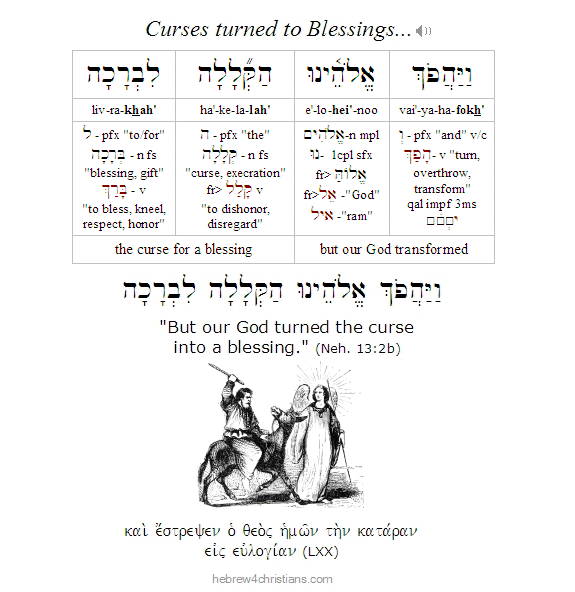
12.29.25 (Tevet 9, 5786) Among other things, our Torah reading this week (i.e., Vayechi) teaches that God can (and truly does) turn curses into blessings (see Neh. 13:2). There are many instances given in Scripture. For example, Joseph was blessed despite the ill-will of his brothers: "You devised evil against me, but God devised it for good" (Gen. 50:20). Note that the same verb for "devised" (i.e., chashav: חשׁב) is used to describe both the evil intent of the brothers and the good intent of the Lord (Jer. 29:11). This teaches us that God overrules the malice of men to effect his own good purposes, and therefore we can rightfully affirm gam zu l'tovah (גם זו לטובה), "this too is for good" (Rom. 8:28). Underlying the surface appearance of life (chayei sha'ah) is a deeper reality (chayei olam) that is ultimately real, abiding, and designed for God's redemptive love to be fully expressed.
Resist the temptation, therefore, to judge by mere appearances. Forbid your troubles (or the troubles of this world) to darken the eye of your faith. Do not unjustly judge God's purposes or try to understand His ways (Psalm 145:3; Isa. 40:13; Isa. 40:28). As the story of Balaam shows, God makes even the wrath of man praise Him (see Psalm 76:10). "Then God opened Balaam's eyes, and he saw the Angel of the LORD (מלאך יהוה) standing in the way, with his drawn sword in his hand. And he bowed down..." (Num. 22:31). Indeed, the cross of Yeshua is the ultimate expression of how God undoes the evil within the heart of man (Col. 1:20-21). Every knee will bow to the LORD our God and Savior (Isa. 45:22-23; Phil. 2:10-11).
We find comfort that the schemes of the wicked are ultimately subject to the sovereign purposes of the LORD our God. "Ein od milvado" (אין עוד מלבדו) - there is no power that can be exercised apart from God's consent and overarching will... Indeed all authority on heaven and earth belongs to Yeshua, the "the Ruler of the Kings of the earth" (עֶלְיוֹן לְמַלְכֵי־אָרֶץ). As it is written, "All the nations you have made shall come and worship before you, O Lord, and shall glorify your name" (Psalm 86:9). Amen. Beauty for ashes; hashevenu, Adonai...
 |
Wisdom for a New Year...
"Man is like to vanity: his days are as a shadow that passeth away." - Psalm 144:4
12.29.25 (Tevet 9, 5786) It is tragic that so many people go about their lives as if God doesn't exist (or worse, make "gods" to rationalize their own lusts). Instead of soberly acknowledging their days are numbered in this world, they subconsciously assume they will live forever, and they steadfastly ignore any idea of judgment to come. Yeshua warned us, however, that "nothing is hidden except to be made manifest; nor is anything secret except to come to light" (Mark 4:22). We should tremble before such words. Each of us will give account for what we have done with the time given us (Heb. 9:27; 2 Cor. 5:10; Matt. 12:36).
Moses therefore prayed to God: "Teach us to number our days, that we may apply our hearts unto wisdom" (Psalm 90:12). Each soul is given a finite amount of time in this world, and therefore Moses asked God to teach us how to live in light of our ultimate destiny... For this we need wisdom, which primarily consists of knowledge of the holy (דַעַת קְדשִׁים) and the experience of the awe of the LORD (יִרְאַת יְהוָה, Prov. 9:10). Note then the connection between learning to "number our days" and apprehending the sacredness of life. As we learn to esteem our days, so we discover wisdom for our sojourn to eternity. Reflecting on the brevity of life awakens us to consciously reflect upon the course of our lives and to distill the ultimate concerns of our hearts.
Consider, then, the "measure of your days..." Your life in this world will end far sooner than you expect, and then what will become of you? I am not here thinking of the end of "the" world, but rather the end of your world - when you will die and face the light of eternity. Today, this moment, you are on the way, going someplace; your "latter days" are already come upon you... If you are not prepared today, how will you be better prepared tomorrow? Today is the day of salvation, the hour that matters most. Learn to die to the world now, to let go of what holds you captive, so that you are free to meet that which forever shall come. Don't put off genuine teshuvah: turn while there is still time. As Jim Elliot once said: "He is no fool who gives what he cannot keep, to gain what he cannot lose." And may God give us mercy to say from the heart: "For me to live is Messiah, and to die is gain" (Phil. 1:21).
Yet how many of us take all this to heart? How many of us "number our days" that we might attain wisdom? Do we appreciate the brief amount of time we are given in this life? When we were young we believed we will live forever. King David prayed, "make me know my end and what is the measure of my days; let me know how fleeting I am!" (Psalm 39:4).
The sages say on the day of death, one considers one's life as if it had been a single day... Life goes by so quickly, and we never know when our personal "Rosh Hashanah" will come. "No one knows the day or hour..." That's why it is so vital to be healed and to turn to God while there is still time. So let us turn to him today and bacharta ba'chayim – "choose life!" "For this commandment (of turning to God in faith) is not hidden from you, and it is not far away. It is not in heaven... nor across the sea.... Rather, the matter is very near you – in your mouth and your heart – to do it" (Deut. 30:11-14; Rom. 10:8-13).
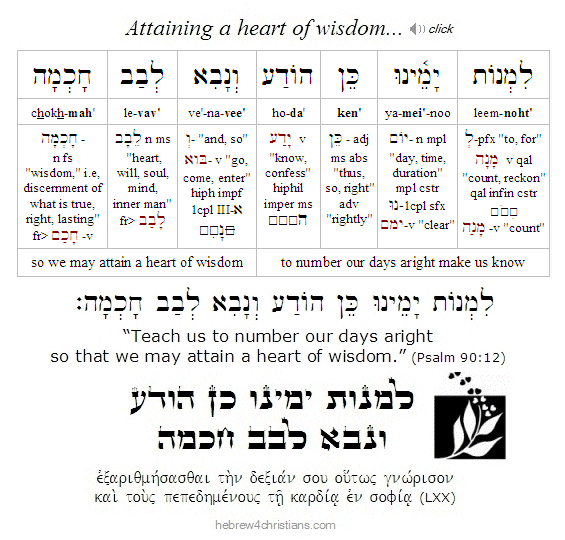
Hebrew Lesson:
Psalm 90:12 Hebrew reading (click):
A hope not deferred...
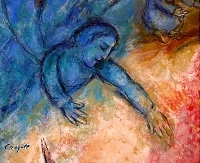
12.29.25 (Tevet 9, 5786) From our Torah portion this week (i.e., Vayechi) we recall the testimony of our father Jacob: "The days of the years of my sojourning are 130 years. Few and evil have been the days of the years of my life.." (Gen. 47:9).
The great patriarch Jacob experienced repeated hardship and affliction in his life. Some of his hardships undoubtedly came from his own carnal striving, but even after he wrestled with the Angel, he grieved and made mistakes... Nevertheless, all of Israel was ordained by God's providential design. In hindsight Jacob came to regard his earthly life as a time of "sojourning" (מָגוּר) and testing that he endured on route to his true homeland, namely "the place" (הַמָּקוֹם) of the Foundations of God's Presence (see Heb. 11:10).
As Jacob later exclaimed from his deathbed: "For your salvation I have hoped, O LORD" (לִישׁוּעָתְךָ קִוִּיתִי יְהוָה; Gen. 49:18). And to you, dear friend, does the Spirit beckon to remain steadfast in trust. "Surely there is a future and our hope shall not be cut off" (Prov. 23:18). Amen, let us keep our hearts fixed on the truth of the promise. The hour draws near...
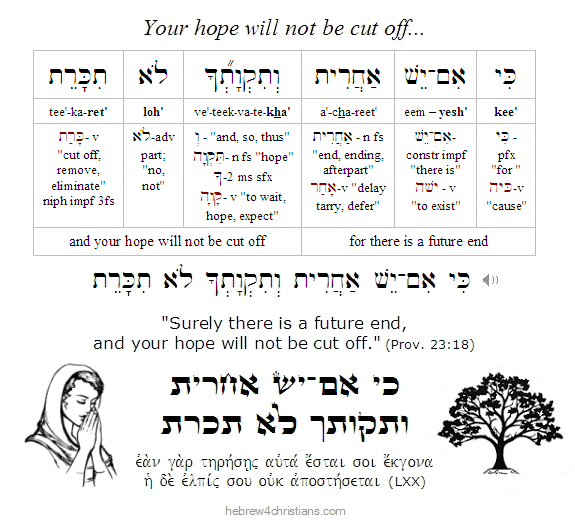
Hebrew Lesson
Prov. 23:18 Hebrew reading:
Vayechi - "And He Lived..."

Our Torah reading for this week is the last of the Book of Genesis and includes Jacob's great prophecy of the coming Messiah...
12.28.25 (Tevet 8, 5786) Our Torah reading for this week, parashat Vayechi (i.e., Gen. 47:28-50:26), recounts recounts how the great patriarch Jacob adopted Joseph's two sons (Ephraim and Manasseh) as his own children. When Jacob blessed the boys, however, he intentionally reversed the birth order by putting the younger before the older, signifying that the old struggle he had faced as a child was over, and he now understood things differently. The family had apparently learned that blessing from God is for the good of all, and that there is no real blessing apart from genuine humility that esteems the welfare of others.
Following this, Jacob summoned his sons together to hear his final words of blessing before he died. Of particular importance was Jacob's vision of the coming Messiah, the future King of Israel. It may have been supposed that Reuben, Jacob's firstborn son, would receive the honor of being heir to Messiah, but he was rejected because of his ill-conceived scheme to be regarded as the head of Israel after the death of Rachel, when Reuben "consorted" with Rachel's handmaid Bilhah. This must have been terribly painful to Jacob who was still in mourning over the death of his beloved wife. The betrayal of Bilhah would also have been a crushing blow. So, Reuben was not to be the heir of the promised one. Nor would Simeon, his second son, nor Levi, his third, for they had a history of violence and anger that appalled Jacob over the years - first exhibited when they murdered the Shechemites after their sister had been seduced and violated by a Canaanites prince there (Gen. 34).
When Jacob turned to regard his son Judah, however, he saw the promise of God. Judah, you will recall, had willingly offered up his life to save his brother Benjamin in accordance with his father's will. Because he was willing to die to fulfill his word to his father, Judah was to be praised and his brothers would bow before him. Judah is courageous a lion, willing to die for the sake of honor. Because of this, Judah was chosen be heir to the Messiah himself, the coming one who would exercise dominion over the nations: "The scepter shall not depart from Judah, not the ruler's staff from beneath his feet, until "Shiloh comes" (i.e., he to whom it belongs, namely the Messiah), and "to him shall be the obedience of the nations" (Gen. 49:10). Note that the second part of this prophecy refers to Messiah's coming as "ben David," the great "Lion of the tribe of Judah," who would wash his garments in the blood of God's enemies and subject the nations to the kingship of God (Gen. 49:11-12; Isa. 63:3). After this great declaration of the coming of Messiah, prophecies and blessings were then given over Jacob's other son's, and then Jacob carefully instructed his sons to bury him only in the promised land, and not in the land of Egypt (Gen. 49:10-12; 49:29-32).
Upon Jacob's death, Joseph and his brothers, with various dignitaries of Egypt, formed a funeral procession and returned to Canaan to bury him in the Cave of Machpelah in Hebron. After the funeral, they returned to Egypt, but Joseph's brothers feared that he would now repay them for their former betrayal and threw themselves on his mercy. Joseph reassured them that they had no reason to fear him and reminded them that God had overruled their earlier intent by intending him to be a blessing to the whole world (Gen. 50:20).
The portion ends with the account of the death of Joseph, who made the chiefs of Israel promise to take his bones with them when the LORD would bring them back to the land of Canaan (foreseeing the great Exodus to come). Joseph's faith in the Jewish people's return to the Promised Land is summarized by his statement: "God will surely remember you" (Gen. 50:24). He died at age 110, was embalmed and placed in a coffin in Egypt, full of faith that he would be raised from the dead in the land promised to Abraham, Isaac, and Jacob. Later he was buried in the area of Shechem, the first area of land purchased from the Hittites by Abraham (Gen. 23) that was given to Joseph as an inheritance (Gen. 48:22; Josh 34:22).
Hebrew Lesson:
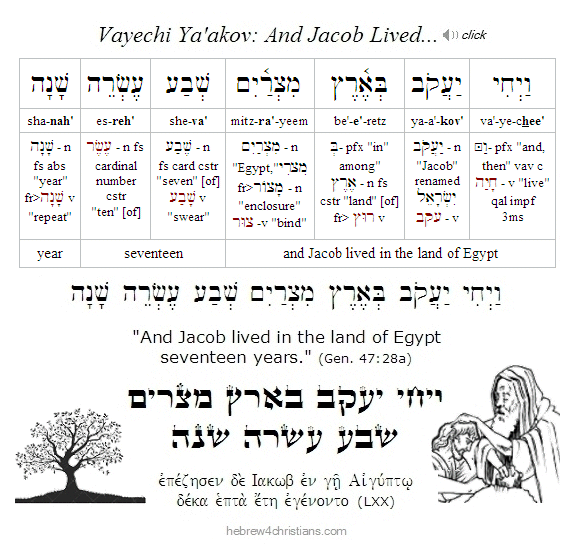
Genesis 47:28a Hebrew reading lesson (click):
Vayechi Outline:
- First Aliyah (Gen. 47:28-48:9)
Jacob foretells his death.
Jacob lived his last seventeen years in Egypt. Near the end of his life he called Joseph and asked him to promise that he would bury him in the Cave of Machpelah in the promised land. Later Joseph visited Jacob again and brought his two sons, Manasseh and Ephraim, to be blessed by his father. Jacob elevated their status to be Jacob's own sons.
- Second Aliyah (Gen. 48:10-16)
Jacob blesses Ephraim and Manasseh.
Joseph presented his two sons to be blessed by Jacob, but his father crossed his hands and placed his right hand on Ephraim's head and then blessed them. "May the Angel who redeemed me from all harm bless the young men, and may they be called by my name and the name of my fathers, Abraham and Isaac, and may they multiply abundantly like fish in the midst of the land."
- Third Aliyah (Gen. 48:17-22)
Ephraim is given the greater blessing.
Joseph was upset that Jacob reversed the conventional order of blessing his sons and attempted to reverse his father's hands. Jacob replied to him: "I know, my son, I know," saying that the younger would be the greater and that his children would fill the nations." Jacob then added that all Israel will bless each other by saying: "May the LORD make you like Ephraim and Manasseh," putting Ephraim first.
- Fourth Aliyah (Gen. 49:1-18)
Jacob fortells the end of days.
Jacob summoned all his sons and gave each one a mysterious blessing. For example Reuben was reprimanded for trying to divide the family; Simeon and Levi were rebuked for killing the Shechemites; Judah was blessed with monarchy; while Zubulon, Issachar, and Dan were given special blessings.
- Fifth Aliyah (Gen. 49:19-26)
Joseph is honored by Jacob.
Jacob's sons Gad, Asher, and Naftali were then blessed, though the emphasis fell upon Joseph, Jacob's firstborn son of Rachel, who was honored for his beauty, his suffering, and his righteousness. A lavish litany of blessings were given to Joseph.
- Sixth Aliyah (Gen. 49:27-50:20)
The death of Jacob.
Last of all Benjamin, Jacob's youngest son, was blessed. Jacob then repeated his request to be buried in the Cave of Machpelah in Hebron, and he passed away at the age of 147. A great funeral procession of all the elders of Egypt and Jacob's family went to see Jacob buried. After returning to Egypt, Joseph's brothers were afraid that he would finally get his revenge upon them for their earlier betrayal, but Joseph was gracious and expressed complete forgiveness.
- Seventh Aliyah (Gen. 50:21-26)
The death of Joseph.
Before dying at the age of 110, Joseph prophesied to his brothers that the LORD would take them out of Egypt and bring them back to the Promised Land. Joseph then asked his brothers to swear that when God would lead them out, they would take his remains and bury him in the land of Canaan.
Yasher Koach and Chazak! (said upon completing a book of the Torah)
 |
The Book of Genesis...
12.28.25 (Tevet 8, 5786) This week we will finish reading the Book of Genesis for the current Jewish year... This incalculably essential book begins with an account of the creation of the universe by the LORD and the creation of man in His image and likeness.
Genesis not only explains the origin of life itself but also the origin of death that came about through Adam's transgression, a condition of "spiritual death" that was passed on to Adam and Eve's descendants and that affects the very fabric of creation.
The book then reveals the corruption of the first ten generations of humanity that eventually led to divine judgment by means of the worldwide flood (mabbul). From Noah's line, however, would come Abraham who was called by God to become the patriarch through whom the promised Deliverer would come.
The remainder of the book focuses on the lives of the three great patriarchs (Abraham, Isaac, and Jacob), and ends with the story of Joseph, Jacob's firstborn son of Rachel, who eventually brought the entire family of Jacob to Egypt to escape famine. This of course set the stage for the great Exodus from Egypt under the leadership of Moses...
The book of Genesis ends with Joseph dying and being put into a coffin in Egypt, awaiting the redemption of God and the inheritance of the promise (Gen. 50:26).
Note that the word translated "coffin" is the Hebrew word "aron" (אֲרוֹן), a word used elsewhere in the Torah to refer exclusively to the Ark of the Covenant (the ark that Noah built and the ark that Moses was placed in are both called "teivah"). Throughout their desert wanderings, then, after the Sinai revelation, the Israelites carried two special arks - one holding the bones of Joseph and the other holding the tablets of the Ten Commandments.
Hebrew Lesson
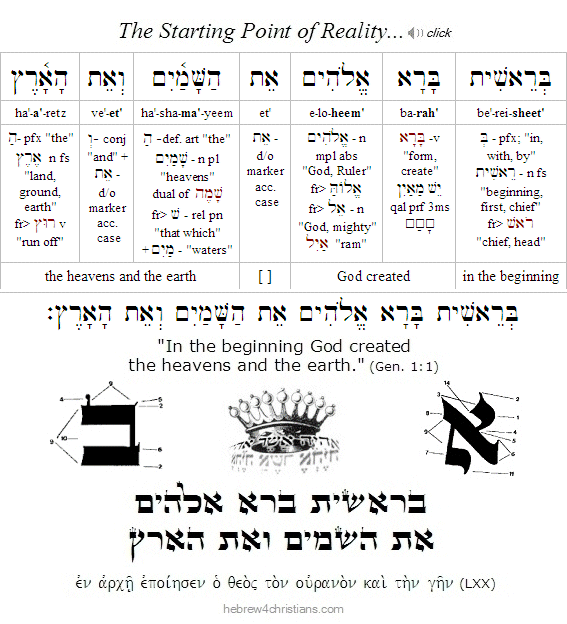
Genesis 1:1 Hebrew reading (click):
The focus of Christmas:
He was born to Die for us...
12.25.25 (Tevet 5, 5786) Though the promised birth of Yeshua may have occurred during the holiday of Sukkot (Tabernacles) with the incarnation occurring during Chanukah (the Festival of Lights), other people of good faith observe the traditional date of December 25th, for reasons that I have explained in some detail elsewhere. Regardless of your particular conviction regarding the date of Yeshua's birth, however, the most important thing to remember is that He was born to die (Heb. 10:5-7). The story of his birth is only significant in relation to His sacrificial death (Mark 8:27-33).
This is of "first importance" (1 Cor.15:3-4). The "manger" scene leads directly to the Cross at Moriah. Indeed, in Jewish tradition the day of one's death is more important than the day of one's birth, since death summarizes the meaning and significance of a person's life in this world. Birth represents potential, whereas death represents inheritance... Therefore the Jewish custom is to commemorate the anniversary of a person's death (i.e., yahrzeit: יארצייט) rather than the date of birth (though the date of birth is also important, especially with regard to matters of circumcision, naming, etc.). Nevertheless, the custom of honoring the day of death of someone is derived from the Scriptures: "A good name is better than precious oil, and the day of death (is better) than the day of birth" (see Eccl. 7:1).
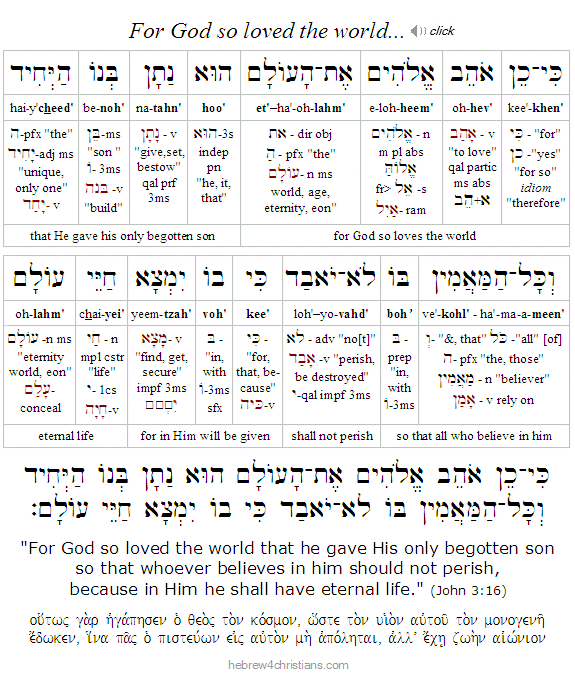
The day of Yeshua's death (on Erev Pesach) represents the essential message of the Gospel story itself: "God so loved the world that He gave His only begotten Son, that whoever believes in Him should not perish but have eternal life" (John 3:16). This is of "first importance": Yeshua was born to die for our sins, to make us right with God, and was raised from the dead to vindicate the righteousness of God (1 Cor. 15:3-5). "For our sake God made Him to be sin who knew no sin, so that in him we might become the righteousness of God" (2 Cor. 5:21). The birth of the Messiah (or rather His incarnation) was the "first step" toward His sacrifice for our deliverance (Heb. 2:9-18). As Rabbi Paul said, "I decided to know nothing among you except Yeshua the Messiah - and him crucified" (1 Cor. 2:2).
 |
Yeshua came to earth and emptied himself (κένωσις) of His regal glory and power in order to be our High Priest of the New Covenant. The life he lived in complete surrender to the Father was meant to demonstrate that He alone is the efficacious Healer and High Priest (Mediator) of us all: "But [He] made himself nothing (εκενωσεν), taking the form of a slave, being born in the likeness of men; and being found in human form, he brought himself low by becoming obedient to the point of death, even death on a cross" (Phil 2:7-8). "There is therefore now no condemnation for those who are in Yeshua the Messiah. For the law of the Spirit of life has set you free in Yeshua the Messiah from the law of sin and death. For God has done what the law, weakened by the flesh, could not do. By sending his own Son in the likeness of sinful flesh and for sin, he condemned sin in the flesh, in order that the righteous requirement of the law might be fulfilled in us, who walk not according to the flesh but according to the Spirit" (Rom. 8:1-4).
Though Christmas is customarily the time that many people observe the birth of the Messiah and Savior, it is surely appropriate to celebrate Yeshua's glory as our risen King and Lord every day of our lives.... Therefore I sincerely wish each and every one of you a wonderful Christmas (and Chanukah) season. May we all take time to reflect upon the profound gift of the One who was so great that He emptied Himself (κένωσις) of all His regal glory and power to be clothed in human flesh in order to die as our sin offering before the Father.
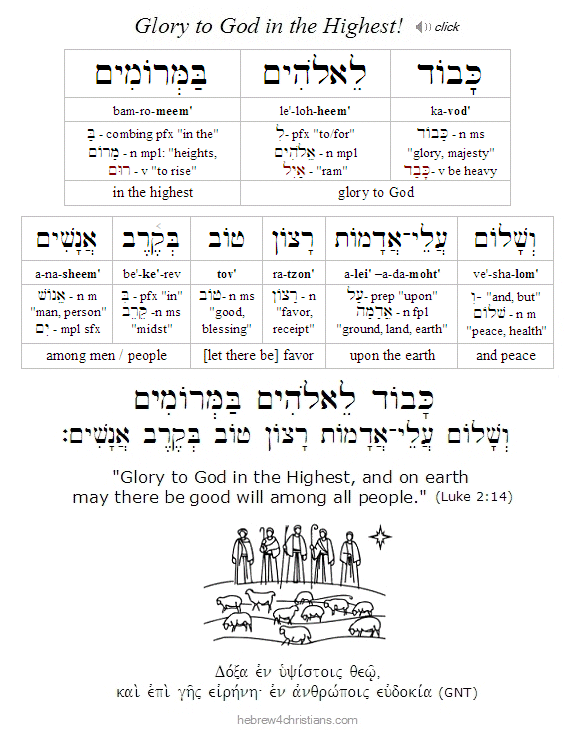 |
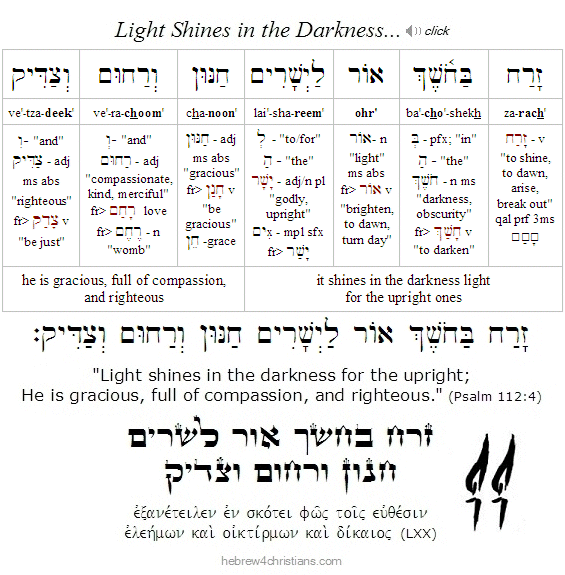
By putting our trust in Yeshua, Light of the World (האור העולם), we partake in His chayei olam - eternal life - sharing in His invincible love. He is faithful and true, our Prince of Peace and Beloved Savior. Yehi Shem Adonai mevorakh: "Blessed be the Name of the Lord."
Addendum:
Let me add that it's one thing to speculate on the anniversary of the birth date of Messiah, and quite another to submit to His rule in your heart at this present hour... We must be careful. "The natural person does not accept the things of the Spirit of God, for they are foolishness to him, nor is he able to know them because they are spiritually discerned" (1 Cor. 2:14).
Note that the "natural person" mentioned here is not carnal or bodily-focused (σαρκικός), but is "soul-focused" (ψυχικὸς), emphasizing the life of the intellect and rationality. The "soulish" person may find the idea of God or matters of religion "interesting," but not as a matter of life and death.
The Spirit of God must first awaken a person to reveal their need for a healing so radical that everything will be transformed, and a new "spiritual person" (πνευματικός) will be quickened to receive the truth of God. The Scripture says we are to ask in order to receive, but we do not know enough to truly ask until we accept the reality about our condition. When we ask according to God's will, however, God sets in motion the miracle and the answer to our heart's cry.
Regarding these matters, I quote Augustine of Hippo:
In necessariis unitas (in essentials unity),
In dubiis libertas (in doubtful things liberty),
In omnibus autem caritas (but in all things love).
Mystery and Humility...

The following is related to themes of the Christmas season...
12.24.25 (Tevet 4, 5786) Though it is important to guard our sincere convictions and to be passionate about what we believe, we must nevertheless be careful to walk in humility before the mystery of life... After all, much is inscrutable to us, much is beyond our understanding, and therefore, if we are honest, we should be reverent before the "sacred secrecy" of everything.
Fanaticism and intolerance (whether secular or religious) is motivated by willful ignorance of the marvelous complexities that pervade existence. The fanatic invariably seeks to reduce life to a simple formula, recipe, and a generalization. The humble person, on the other hand, freely confesses that they "walk by faith, not by sight" -- by hearing the Word of God and heeding what the Spirit of God is saying to the heart...
For now we "see through a glass darkly," which literally means "in a riddle" (ἐν αἰνίγματι). A riddle is an analogy given through some resemblance to the truth, though quite often the correspondences are puzzling and obscure. Hence, "seeing through a glass darkly" means perceiving obscurely or imperfectly, looking "through" something else instead of directly apprehending reality.
We see only a reflection of reality, and our knowledge in this life is indirect and imperfect. This is contrasted with the "face to face" (פָּנִים אֶל־פָּנִים) vision and clarity given in the world to come, when our knowledge will be clear and distinct, and the truth of God will be fully manifest and no longer hidden.
Being "face to face" with reality means being free of the riddles, the analogies, the semblances, etc., which at best adumbrate our way.. Such reflection should make us humble whenever we share our faith. "Now we know in part, but then shall we know in whole" (1 Cor. 13:12). Let therefore repeat that an honest theology must find a place for mystery, for "seeing through a glass darkly," and for the apprehension of awe and wonder.
"A genuine faith must recognize the fact that it is through a dark glass we see; though by faith we do penetrate sufficiently to the heart of the mystery so as not to be overwhelmed by it. A genuine faith resolves the mystery of life by the mystery of God. It recognizes that no aspect of life or existence explains itself, even after all known causes and consequences have been traced. All known existence points beyond itself. To realize that it points beyond itself to God is to assert that the mystery of life does not dissolve life into meaninglessness...." (Reinhold Niebuhr)
Since the LORD God is called the Infinite One (אֵין סוֹף) whose understanding is without limit (Psalm 147:5), we must use analogies, metaphors, symbols, allusions, parables, poetry, and other linguistic devices (as well art and music) to convey spiritual truth and meaning. We compare (συγκρίνω) spiritual things with spiritual (1 Cor. 2:13).
Some of the classical "mystics" have said the way to God is through the transcendence of words altogether, though most of them use imagery and poetry to speak about "ineffable" reality. Others, like Soren Kierkegaard, use "indirect communication" to evoke the decision to believe, to find hope, and to walk by faith. The truth can be found, not by means of humanistic learning, but by special revelation and encounter with the Truth of God.
Such revelation is sometimes called argumentum spiritus sancti, or the "argument from the Holy Spirit." Soren Kierkegaard wrote in his journals: "In 1 John 5:9 we read: 'If we receive the testimony of men' (this is all the historical proofs and considerations) 'the testimony of God is greater' -- that is, the inward testimony is greater. And then in verse 10: 'He who believes in the son of God has the testimony in himself.' Therefore genuine faith is more than a creed or "doctrine"; it is existence itself, a matter of spirit, wherein new life is expressed in relationship to God through Yeshua the Savior. Regarding the rational enterprise of theology proper, Kierkegaard wrote: "A dogmatic system ought not to be erected on the basis: to comprehend faith, but on the basis: to comprehend that faith cannot be comprehended" (Journals and Papers).
Our lives are surrounded by miracles, mysteries, and wonders... We cannot "live, move, and have our being" apart from the surpassing glory that pervades reality, and particularly that which makes our hearts come alive.
"Bring me a fruit from that tree." "Here it is, venerable sir." "Cut it open." "It is cut open, venerable sir." "What do you see in it?" "Very small seeds, venerable sir." "Cut one of them open." "It is cut open, venerable sir." "And what do you see in it?" "Nothing, venerable sir." Then he said, "That hidden thing which you cannot see, O gentle youth, from that hidden thing has this mighty tree grown" (Upanishad)
 |
Regarding the "indirect method" of communication, we note that Yeshua himself regularly used parables and stories to communicate deeper truths about ultimate reality. For instance, he likened the human heart to "soil" into which the Heavenly Farmer plants seed; he wanted his followers to know God as "heavenly Father," the idealization of family love, and so on. Often he was surprised at how dull his own disciples were regarding his use of spiritual analogies (Matt. 15:16, 16:9-11; Mark 8:17; John 6:22-66).
Yeshua often taught in parables because they simultaneously conceal and reveal the truth. A parable obscures the truth to those who don't really want it; just as it reveals the truth to those who do (Luke 8:9-10). Since Yeshua's whole life was a parable of sorts - a "disguise" that led to the victory of our deliverance (Phil. 2:7) - it is not surprising that he regularly used "figures of speech" to provoke people to examine their own heart attitude and faith... In this connection note that Yeshua never explained the "mysteries of the kingdom of God" directly to the crowds, nor did He ever pander to the crowd's clamor or interests. His message is always meant for the individual soul who was willing to follow Him -- to the one who had "ears to hear." Yeshua will forever be the Face of God to us, our Mediator and Savior, blessed be He (2 Cor. 3:18).
Just as there are literaly hundreds of Names and Titles of God given in Scripture, so there are many analogies to help us understand His heart. For instance, God is likened to a farmer, a shepherd, a caring neighbor, a tenant, a king, an impartial judge, a pottery maker, an investor, an employer, a jilted husband, a passionate lover, and so on.
However, the analogy Yeshua used the most was that the LORD God is our Heavenly Father, and that we are His beloved children. As it is written in the Psalms, "Like a father pities his children, so the LORD pities those who fear Him" (Psalm 103:13). And the most intimate Name of God is simply Abba (אבּא), a term of endearment that a child uses for his father. For those who believe, the eyes of the LORD are like those of a loving father who rejoices in the presence of his child.
Hebrew Lesson:
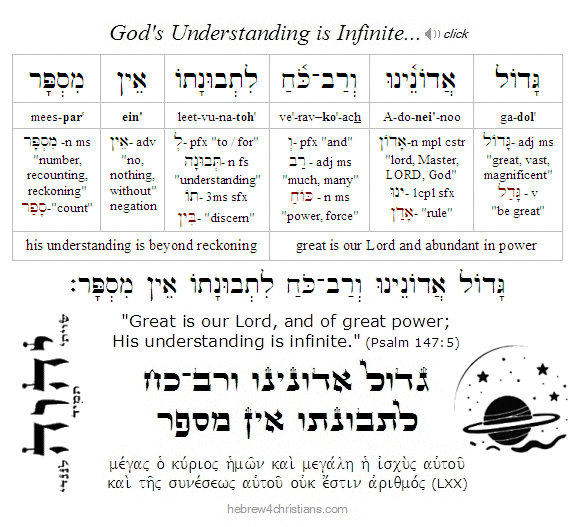
Psalm 147:5 Hebrew reading:
The Wisdom of this World...
12.24.25 (Tevet 4, 5786) The "wisdom of this world" (σοφια του κοσμου τουτου) is the prevailing cultural spirit that suppresses the reality of God's Presence and truth. It is the realm of the savvy, the worldly-wise, the shrewd, the intellectual, the prudent, and even the "doctrinally pure," as we will see. Yeshua once said that "the sons of this world are more shrewd (φρονιμως) in dealing with their own generation than the sons of light" (Luke 16:8).
In 1 Corinthians 3, the Apostle Paul admonished Christians to get beyond their "party loyalties" and doctrinal strife in order to understand that Messiah is the Foundation, the "Archimedean Point," of all true wisdom about life. Authentic wisdom is humble in its apprehension of the mysteries of God (μυστηριων θεου). It does not boast in men's ideas or lean upon the calculations of carnal human reason. Indeed, the way of the Spirit is often at odds with the intuitions of reason itself, since it is based not on an ideology or doctrinal "system" but upon the Living Presence of the Teacher. Therefore Paul said, "Let no one deceive himself. If anyone among you thinks that he is wise in this age, let him become a fool that he may become wise" (1 Cor. 3:18).
Of course Paul didn't mean that Christians were to board some "Ship of Fools" and live as spiritual absurdists in this life. He knew that there were many Scriptures that commanded the pursuit of wisdom, truth, understanding, and so on. Paul was teaching in a rabbinical style and used hyperbole to make his point. In light of the truth of the Presence of God Himself, adherence to creedal formulas or allegiance to a particular human teacher makes "wisdom" ultimately foolish and futile. The need to be "right" is often based on ignorant motivations that cloak an inward condition of pride, vanity, and unbelief. As Heschel once wrote: "In a controversy, the instant we feel anger, we have already ceased striving for truth and have begun striving for ourselves."
It is written in our Scriptures, "For the wisdom of this world is folly with God. For it is written, "He catches the wise in their craftiness" (1 Cor. 3:19). Note that in this verse the Hebrew word translated "folly"is kesilut (כְּסִילוּת), perhaps better understood as stupidity (i.e., the state of being in a a state of delusion or "stupor"). The "wisdom of this world" is ultimately based on fear that leads to the desire to control others. Sometimes, as in the case of warfare, it leads to acts of violence and murder. Human reason designs and schemes in order to obtain its self-serving ends, whereas heavenly wisdom understands that there is no further "end" in sight than that of the LORD Himself and His Presence....
Every sect or group tends to define and enforce its own sense of "wisdom" (ideology, creed, liturgy, worldview, etc.), though the LORD calls us to resist this spirit in order to function as a true witness of His Presence (1 John 2:15-17). Living this way will invariably result in a "collision" with our surrounding culture as we testify that God is here now.
It is axiomatic, then, that the ideology and coercion of the crowd, the various forms of "worldly wisdom" (including religious wisdom) that seduces us to forget God's Presence, invariably leads to spiritual blindness and foolishness. Since the group is unable to apprehend this fact, a "debased" mindset ("group-think") evolves that leads to depravity and the lust to control and enslave others: "Since they did not see fit to acknowledge God, God gave them up to a debased (αδοκιμος) mind to do what ought not to be done" (Rom. 1:28).
It is written in the Torah: "Now therefore, if you will indeed obey my voice and keep my covenant, you shall be my treasured possession" (Exod. 19:5). The Hebrew grammar here is intense. The phrase often translated as "if you will indeed obey" uses an emphatic construction, "if hearing you will hear" (אִם־שָׁמוֹעַ תִּשְׁמְעוּ), which suggests a sincere willingness to listen for the voice of the LORD. That is why the LORD speaks kol demamah dakkah (בְּקוֹל דְּמָמָה דַקָּה), that is, in a quiet whisper, because a quiet and listening heart is required to hear what the Spirit is saying. Actively listening to the whisper of God enables you to walk as his beloved child, segulah (סְגֻלָּה), a treasured person.
Our battle today, as it always has been, is to combat the world and its so-called "wisdom" (i.e., propaganda, lies, and disinformation) that implicitly (and sometimes explicitly) denies and suppresses God's Presence (1 Tim. 6:12; Eph. 6:10-18). This is essentially a spiritual war, since the battlefield is the thickened hearts and dulled minds of those who are in varying states of blindness to the truth (2 Cor. 4:4; 10:4-5). Of course we must begin with ourselves and examine our own inward condition (2 Cor. 13:5). Are we genuinely walking in faith? Do we experience every moment of our lives as a gift from God? Do we directly encounter the Teacher within our hearts, or are we merely impostors, pretenders, or professors?
If we ask the LORD God for wisdom, He has promised to give it to us (James 1:5). After obtaining wisdom and discernment, we must engage our culture and speak the truth in love. Tzedek tzedek tirdof: "Justice, justice shall you pursue" (Deut. 16:20). To be passive or to resign oneself is to abandon our post. Ask the LORD for the courage to live and speak your convictions. He is faithful and will preserve all those who call upon Him in the truth.
Hebrew Lesson
Proverbs 8:3 reading (click for audio):
The Star Still Leads...
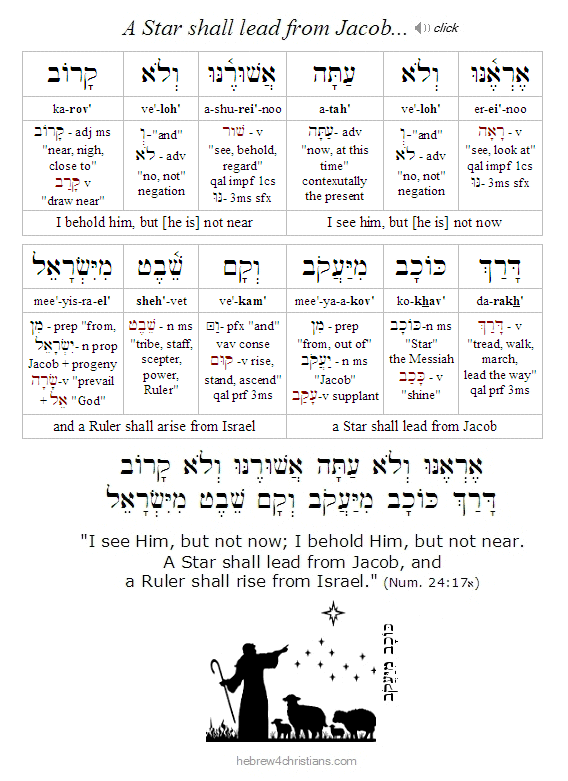
12.24.25 (Tevet 4, 5786) During the holiday season we may recall Balaam's enigmatic prophecy: "There shall come a star out of Jacob..." Amazingly, this ancient Aramean seer – who may have been the forebear of the "magi of the east" (Matt. 2:1-2) – foresaw the coming of the Messiah: "I see him, but not now; I behold him, but not near: a star shall come out of Jacob (כּוֹכָב מִיַּעֲקב), and a ruler shall arise out of Israel" (Num. 24:17).
Balaam's prophecy described the coming of the Messiah and his reign in two distinct aspects: "A star from Jacob shall lead the way (i.e., דָּרַךְ)," this refers to Messiah's first coming as the way of life (John 14:6), "and a scepter shall ascend (וְקָם שֵׁבֶט) from Israel," this refers to Messiah's second coming to establish the kingdom after the final redemption.
The story of Balaam took place "out of view" of the Israelites, which teaches us that the LORD our God is always at work - even among our enemies - for our blessing and confessing our ultimate good... No weapon formed against God's people shall prosper, and every tongue that speaks in judgment shall be made to stammer out praise.
"He who vindicates us is near; who will contend with us?" Indeed, "who shall bring any charge against God's elect? It is God who justifies. Who is to condemn? Yeshua the Messiah is the one who died -- more than that, who was raised -- who is at the right hand of God, who indeed is interceding for us" (Rom. 8:33-34). Those of faith understand that history - including the "End of Days" - as the expression of God's sovereign and providential hand. The Savior always works "all things together for the good" of those who are trusting in Him. The Star of Messiah still shines and reveals the way of life to those willing to believe...
Hebrew Lesson
Numbers 24:17 reading (click):
obscure -- to test our hearts....
Yom Kippur and Christmas...
12.24.25 (Tevet 4, 5786) If the priest Zechariah was performing the Yom Kippur avodah when he was visited by the angel Gabriel (as seems to be the case given the context, see Luke 1:8-23), and if his wife Elizabeth conceived about that time (see Luke 1:24, that is, sometime in the middle of the month of Tishri), and her cousin Mary was then told of the incarnation six months later, during Passover season (Luke 1:26, 36), then the birth of Yeshua could have been sometime during the middle of the month of Tevet, which is indeed close to the traditional December 25th date observed by the majority of Christians...
After all, as you read the the prophetic announcement of the birth of John given in Luke, it certainly seems that Zechariah was performing the Yom Kippur ritual at the Temple, offering incense before the parochet before he entered the sacred chamber of the Holy of Holies. Indeed, one implication of this interpretation is that the Lamb of God (שׂה הָאֱלהִים) was conceived during Passover, which seems appropriate as the time of the Incarnation...
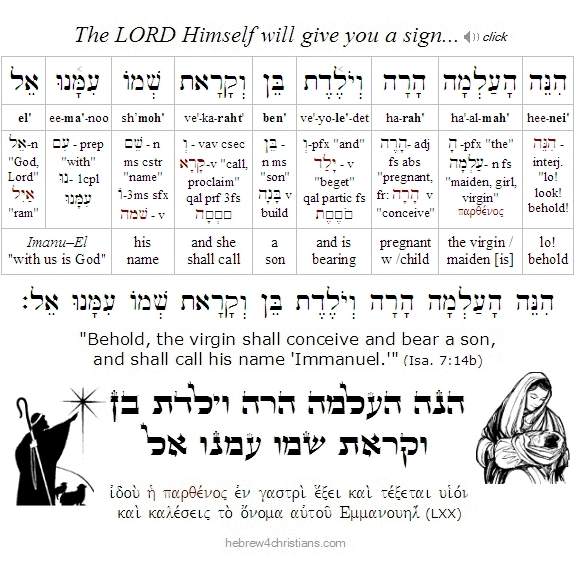
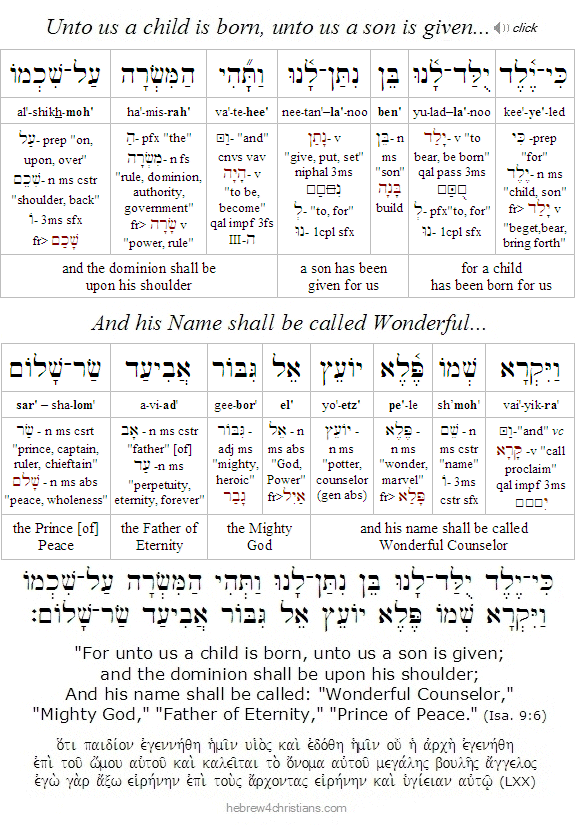
ὁ λόγος σὰρξ ἐγένετο καὶ ἐσκήνωσεν ἐν ἡμῖν -- "The Word became flesh and dwelt among us" (John 1:14) -- which of course is the essence of the gospel message. As it is written concerning the birth of Messiah: "For unto us a child is born, unto us a son is given: and the dominion shall be upon his shoulder; and his name shall be called 'Wonderful Counselor,' 'the mighty God,' 'the everlasting Father,' 'Prince of Peace'" (Isa. 9:6).
Hebrew Lesson:
Isaiah 7:14b Hebrew reading lesson (click):
Of course the exact date of Yeshua's birth is existentially irrelevant, apart from the fact that he indeed was born into this world as our Savior, and indeed, the New Testament stresses the significance of his death more than his birth (1 Cor. 2:2; 1 Cor. 15:3-4). Nevertheless, we use the "good eye" to regard our Christian friends who honor this time to remember the birth of Yeshua, even if we have convictions that may lead us to think Messiah was born during Sukkot. For some hopefully peaceful discussion about the birth date of the Messiah Yeshua, see the article, "Christmas: Was Jesus really born on December 25th?"
Note: The point of this entry was to explore the traditional date as a possibility, not to be dogmatic and intolerant. You certainly do not have to agree with the traditional date, of course, though if you disagree, then you should at least address the pertinent question of what Zechariah was doing in his service when the prophecy of the birth of John was made. Follow your own convictions and walk in peace toward all people (Heb. 12:14). Shalom.
The Disguised Egyptian...
The following is related to our Torah reading for this week, parashat Vayigash...
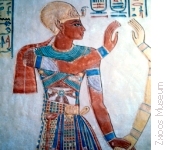
12.23.25 (Tevet 3, 5786) Before he revealed his identity to his brothers, Joseph (arrayed as an unknown Egyptian satrap) ensnared his brothers by hiding a silver divination goblet in Benjamin's sack and then sending his steward (his disguised son Manesseh) to arrest Benjamin for stealing the goblet. All this was designed by Joseph to test his brothers. Would they abandon Benjamin, just as they had abandoned him to die in an empty well years earlier? After the arrest, the brothers returned to face the charges, and Judah nobly stepped forward and begged to take Benjamin's place for the "crime." When Joseph understood that Judah was willing to sacrifice his own life for his brother -- and when he saw the anxious looks of his other brothers -- he realized that they had learned their lesson.
Joseph then sent all the Egyptians out of the room, to spare his brothers embarrassment. According to Midrash, he then turned to his brothers and said, "You told me that your brother Joseph died. Are you sure?" "Yes, we are; he's dead," the brothers assured him. Joseph then became angry and said, "How can you lie? You sold him as a slave! I bought him and can call him right now." Joseph then called out, "Joseph, son of Jacob, come here right now to speak to your brothers..."
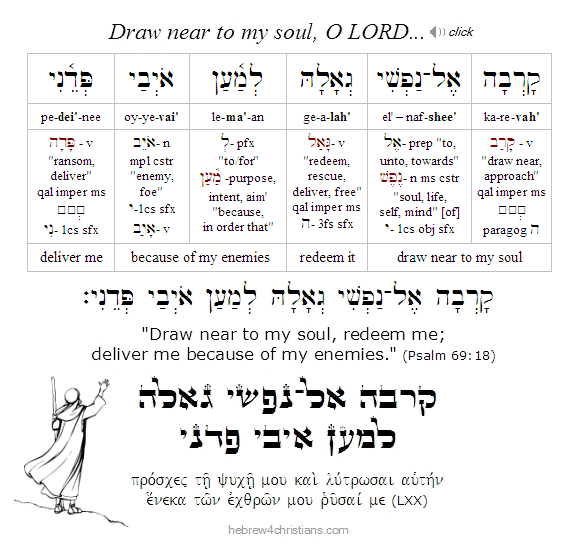
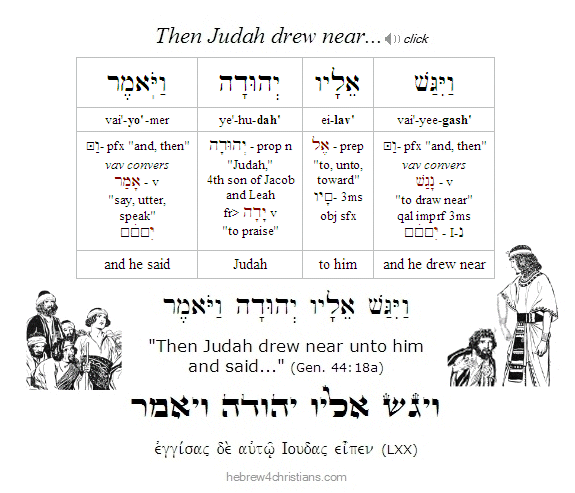
Terrified, the brothers turned to see if Joseph was coming. When Joseph saw that his brothers were prepared to meet their brother and ask for his forgiveness, he then spoke to them in Hebrew, "Who are you looking for? I am Joseph. Is my father still alive?" (Notice that Joseph revealed himself to his brothers using Hebrew speech as the token of his identity.) When Joseph saw his brothers draw back in fear at his shocking disclosure, he reassured them by saying, g'shu na elai - "Please come near to me; come and see..."
When Joseph's father Jacob later learned that his long-lost son was indeed alive, vatechi ruach ya'akov avihem - "the spirit of their father Jacob was revived." Though for over 22 years Jacob was bereaved, all along his beloved son was only a few days journey away from him. According to Jewish tradition, Joseph never told Jacob about his betrayal by his brothers, not even when Jacob was on his deathbed. His love forbade him to engage in lashon hara (evil speech) or to bring further pain to his father.
The revelation of Joseph and his reconciliation with his brothers is a prophetic picture of acharit ha-yamim (the "End of Days") when the Jewish people, in Great Tribulation, will come to Yeshua as Israel's deliverer. Presently, the veil is still over the eyes of the Jewish people and they collectively regard Yeshua as an "Egyptian" of sorts.
On a pe'shat level (i.e., literal sense), when Joseph revealed his identity: ani Yosef ha'od avi chai ("I am Joseph; is my father alive?"), he was asking his brothers if his father Jacob was still physically alive. This is puzzling, since in earlier encounters the brothers attested that Jacob was very much alive... On a sod level (i.e., in a mysterious sense), since Joseph is a picture of Yeshua (Mashiach ben Yosef), the question can be phrased, "I am Yeshua - is My father alive?," that is, do you now understand the righteousness of God the Father in raising me from the dead and promoting me to His right hand? Yeshua therefore evokes the confession of faith from the beloved Jewish people: "I am your brother Yeshua: do you now understand that My Father is alive?"
Time is short, chaverim... We are approaching the End of Days and time of "Great Tribulation." In a soon-coming hour Yeshua will speak comforting words to His long-lost brothers (in Hebrew, to be sure!) and restore their place of blessing upon the earth. May He come speedily, and in our days. Maran ata, Yeshua!
Hebrew Lesson
Psalm 69:18 reading (click):
The Word Made Flesh...
The holiday of Christmas provides an opportunity for us to one again focus on the truth of incarnational theology, to celebrate the revelation of God in Yeshua, and to proclaim the miracle that God "emptied Himself" by being clothed in human flesh as the great Lamb of God....
12.22.25 (Tevet 2, 5786) At Mount Sinai we heard the voice of God (קוֹל אֱלהִים) speaking from the midst of the Fire (Deut. 4:33), an event that foreshadowed the great advent of the King and Lawgiver Himself, when the Eternal Word (דְבַר־יְהוָה) became flesh and dwelt with us (Phil. 2:6-7; John 1:1,14). Any theology that regards God as entirely transcendent (i.e., God is beyond any analogy with the finite) will have a problem with divine immanence (i.e., God is inherent and involved within the finite), since the highness, holiness, and perfection of God will make Him seem distant, outside of us, far away, and unknown...
Incarnational theology, on the other hand, manifests the magnificent humility and nearness of God to disclose the divine empathy. Indeed, the LORD became Emanu'el (עִמָּנוּ אֵל), "God with us," to share our mortal condition, to know our pain, to experience the wounds of sin, and to be abandoned, alienated, forsaken. It is God's own bittul hayesh (בִּטּוּל הַיֵּשׁ) - his "self-nullification" for the sake of love and truth. The "Eternal made flesh" bridges the gap between the realm of Ein Sof (אין סוף), the "infinitely transcendent" One, and the finite world of people lost within their sinful frailty. Of course we believe Adonai Echad (יְהוָה אֶחָד) - that the "LORD is One" - both in the sense of being exalted over all things but also in the sense of being compassionately involved in all things (Rom. 11:36). We therefore celebrate the giving of the Torah both at Sinai and especially at Bethlehem with the birth of Messiah. We celebrate that God is indeed the King and Ruler over all, but we further affirm that God's authority and rule extends to all possible worlds - including the realm of our finitude and need...
As I've mentioned elsewhere, the climax of Sinai was the revelation of the Sanctuary. The two tablets of the law, summarizing the Ten Commandments, were stored inside the famous Ark of the Covenant (אֲרוֹן בְּרִית־יְהוָה), a sacred "three-in-one" box placed in the innermost chamber of the Tabernacle called the Holy of Holies (קדֶשׁ הַקֳּדָשִׁים). As such, the Ark served as kisei ha-kavod (כִּסֵּא הַכָּבוֹד), the Throne of Glory itself. Upon the cover (or crown) of the Ark (i.e., the kapporet) were fashioned two cherubim (i.e., angel-like figures) that faced one another (Exod. 25:17-18). According to the Talmud (Succah 5b), each cherub had the face of a child - one boy and one girl - and their wings spread heavenward as their eyes gazed upon the cover (Exod. 25:20). It was here that God's Voice would be heard during the Yom Kippur service, when sacrificial blood was sprinkled upon the crown to symbolize the atonement of sin secured through Messiah, the Word that became flesh for us... In the very heart of the Sanctuary, then, we see the Word of God and the sacrficial blood.
The LORD God Almighty was clothed with human skin: our flesh, our bones... The miracle of the incarnation is the "Absolute Paradox," as Soren Kierkegaard once said, wherein the infinite and the finite meet in the inscrutable mystery of the Divine Presence. Here God "touches a leper," eats with sinners and prostitutes, sheds human tears, and suffers heartache like all other men... The gloriously great God, the very Creator of the cosmos, has "emptied Himself" to come in the form of a lowly servant (δοῦλος) - disguised to the eyes of the proud and hardhearted, but is revealed as High Priest to those who are genuinely broken and in profound need. The LORD God is God over "all possible worlds," and that includes both the celestial realms of the heavens but also the world of the fallen, the ashamed, the alienated, and the lost... God's infinite condescension reveals and augments the majesty of His infinite transcendence. There is no world - nor ever shall there be such - where the LORD God Almighty does not reign and have preeminence.
Do not suppose for a moment that the Torah of Moses does not teach "incarnational" theology. Since God created human beings in his image and likeness, the "anthropomorphic language" of Scripture is meaningful. The LORD reveals himself in human terms - using human language, expressing human emotions, and so on, as it says: Moses spoke to God panim el panim - "face to face" (Deut. 34:10). The Torah always has to take on human form - the Word made flesh - for the sake of human beings who live in flesh and blood reality...
The greatest expression of God's word is found in the Presence of Yeshua. This is the Word of God that "tabernacles" with us, full of grace and truth (John 1:14). Yeshua is the "Living Torah" who empties himself to enter our world to rescue us from death. Our Scriptures state that "in these last days God has spoken to us by his Son, whom He appointed the Heir of all things, through whom also He created the worlds" (Heb 1:2). Note that the Greek construction for the phrase translated, "by his son" is ἐλάλησεν ἡμῖν ἐν υἱῷ, which literally means "he spoke to us in Son" -- that is, in the language or voice of the the Son of God Himself... God speaks the language "of Son" from the midst of the fire revealed at Zion. "Therefore, since we are receiving a kingdom that cannot be shaken, let us be thankful, and so worship God acceptably with reverence and awe (μετὰ αἰδοῦς καὶ εὐλαβείας) - for our God is Esh Okhelah - a Consuming Fire" (Heb. 12:28-29).
Hebrew Lesson
Isaiah 9:6 Hebrew reading:
Addendum: Consider further the metaphorical and anthropomorphic language of the Scriptures: God "sees," God "hears," the "hand of the LORD" saves, etc. Without an implied incarnational theology, there would be no language that we could comprehend about God who is the Infinite One that transcends all things... God gets angry; God feels sorrow; God is jealous; God is a lover, etc. all these metaphors bring the language of heaven into the world of humanity... The Spirit that imparts revelation does so inside a human brain and is translated into human apprehension. Yeshua is the Substance of the shadowy talk of analogical language; he embodies God-life before us.... Yeshua is the Word of God made flesh -- able to touch us, know us, share in our suffering, heal us of our sin-sickness, etc.
H4C Podcast:
Parashat Vayigash:
The Intercession of Judah...
12.21.25 (Tevet 1, 5786) Shavuah tov, Chodesh tov, and happy Zot Chanuakah, chaverim! In our Torah portion for this week (i.e., Vayigash: Gen. 44:18-47:27) we read about Joseph's climactic revelation of his true identity to his long lost brothers.
Recall that Benjamin had been falsely accused of stealing the Viceroy's chalice and was arrested and brought before Joseph for immediate judgment. His brother Judah then "drew near" (vayigash) and offered to bear the penalty for his brother, pleading with Joseph to spare his aged father the loss of yet another son.
Joseph was so moved by Judah's act of mesirat nefesh (self-sacrifice) that he decided the time had finally come for him to reveal his identity to his brothers. After clearing the room, he began speaking in fluent Hebrew and said, אֲנִי יוֹסֵף הַעוֹד אָבִי חָי / ani Yosef, ha'od avi chai / "I am Joseph; is my father alive?" When the brothers drew back in shock, Joseph said, "Draw near to me, please" (from the same verb nagash) and explained how God providentially brought him to Egypt to save the family's life....
Hebrew Lesson:
Genesis 44:18a reading (Vayigash):
The revelation of Joseph and his reconciliation with his brothers is a prophetic picture of acharit hayamim (the "end of days") when the Jewish people will come to understand that Yeshua is indeed the One seated at the right hand of the majesty on high as Israel's "disguised" Deliverer. At that time Yeshua will speak comforting words to His long lost brothers and restore their place of blessing upon the earth.
Indeed, the entire story of Joseph is incredibly rich in prophetic insight regarding our Lord and Savior. Vayigash (וַיִּגַּשׁ) means "and he drew near," referring first to Judah's intercession for the sins of his brothers, and then to Joseph's reciprocal desire for the brothers to draw near to him (Gen. 44:18, 45:4). Joseph initiated the reconciliation by saying, גְּשׁוּ־נָא אֵלַי / ge'shu na elai - "Please draw near to me," and indeed there is a play on the verb nagash (נָגַשׁ), "draw near," throughout this story.
Yeshua is depicted both in Judah's intercession (as the greater Son of Judah who interceded on behalf of the sins of Israel) and in Joseph's role as the exalted Savior of the Jewish people in time of tribulation. When Joseph disclosed himself and asked, "Is my father alive," we hear Yeshua evoking the confession of faith from the Jewish people: "I am Yeshua: do you now understand that My Father is alive?" Upon His coming revelation, all Israel will confess that indeed God the Father is "alive" and has vindicated the glory of His Son.
Priests of His Light...
12.19.25 (Kislev 27, 5786) Chanukah reminds us of some important truths, but it especially calls us to make renew our faith and to draw near to God. May we therefore rededicate the "Temple" of our lives to serve the Lord and walk in His light wholeheartedly (1 Cor. 3:16). Indeed, we are called to be a "kingdom of priests," a set-apart people, and a light to the nations (Exod. 19:6; Isa. 42:6; 1 Pet. 2:9). Note that the very first responsibility given to the priests of Israel was to care for the ner tamid (נר התמיד), the light of the Menorah (Exod. 27:20-21), to signify our consciousness of the Divine Presence (Psalm 18:28; 36:9).
The challenge we all face is to remain "in the light as God is in the light" and not to be seduced by the world's godless "hermeneutics" or ways of interpretation (Isa. 2:5; 1 John 1:7, 2:17). God's eternal light radiates through all things (Isa. 6:3; Psalm 139:11-12), just as the great "yehi ohr" (יְהִי אוֹר) - "let there be light" - is the first word spoken to creation (Gen. 1:3). To be a priest means being so filled with the truth of God that you radiate peace; your inner light shines and you glorify your Father in heaven (Matt. 5:16). That is how we draw others to the truth, by first receiving the beauty of the LORD (Psalm 27:4).
Of course being a "witness to the light," that is, being a "priest," does not mean you are a "perfect person" who walks about with a blissed-out attitude despite the various trials and tests we all face in this life. No, we all still sin, and we therefore need to confess the truth of our condition to abide in the light (1 John 1:9; James 5:16). Like everything else in Scripture, here we encounter paradox, as Yeshua taught: "Blessed are the impoverished in spirit (πτωχοὶ τῷ πνεύματι), for theirs is the kingdom of heaven; blessed are the ones who mourn (οἱ πενθοῦντες), for they shall be comforted; blessed are the meek (οἱ πραεῖς), for they shall inherit the earth" (Matt. 5:3-5). Yea, "God chose what is foolish in the world to shame the wise; God chose what is weak in the world to shame the strong, God chose what is low and despised in the world, even things that are not, to bring to nothing things that are, so that no human being might boast in the presence of God" (1 Cor. 1:27-29).
The Hebrew word for priest (i.e., kohen: כּהֵן) may come from the word ken (כֵּן) meaning "yes" and the word kivun (כִּווּן) meaning to "direct" or "lead," implying that a priest helps direct a person toward affirming the Reality and greatness of God. The role of a priest is to draw us to God, then, but how is that possible if the mediator cannot genuinely understand our sorrows and struggles? What draws others to God is his love, but how can we come to believe in that love were it not for the priesthood of the leper, the priesthood of the outcast, the priesthood of the reject? Even so Yeshua was afflicted with our infirmities and therefore sympathizes with our brokenness and frailty (see Heb. 4:16).
As a priest of brokenness, you are called to be a wounded healer, and you can testify of God's saving grace and love for you despite your sorrow, anger, weaknesses, and failures... Accepting God's compassion for you - just as you are - allows you to show grace and kindness to others who are also hurting, and therefore you can serve as a priest of God.
Be encouraged, friends... "For the commandment is a lamp and Torah is light, and the reproofs of discipline are the way of life" (Prov. 6:23). Here we may understand the "reproofs of discipline" as the (ongoing) process of consciously turning away from darkness (of fear, anger, etc.) to the behold the divine light. We have to start here, after all... The way of life is teshuvah (repentance, turning to God), which is a painful process to the lower nature, but is necessary to walk in the light. Confession brings light into our hearts (James 5:16; 1 John 1:5-9), and the end of our struggle is healing and life.
Happy Chanukah, friends, and let us walk in the Light of the LORD!
Hebrew Lesson
Proverbs 6:23 reading with commentary (click):
Chanukah and Vigilance...
12.19.25 (Kislev 27, 5786) The message of Chanukah is to resist being "assimilated" into this dark world and its benighted culture. As it says, "Do not be conformed to this world, but be transformed (i.e., transfigured by the light) through the renewal (ἀνακαίνωσις) of your mind, that by testing you may discern what is the will of God" (Rom. 12:2).
Notice that the Greek word translated "conformed" is a passive verb (συσχηματίζω, derived from σύν, "with," + σχῆμα, "matrix") which means that we must consciously resist being lulled into accepting this world's various ideologies (matrix) that are crafted to ignore Divine the Presence and Truth.
In the realm of the spiritual, there is simply no place of neutrality, and if we are not going forward, then it's likely we are going backward... Therefore we are repeatedly commanded to test the spirits and to examine truth claims. We ask God for wisdom and use the discernment that comes from the Holy Spirit.
Hebrew Lesson:
Psalm 143:10a Hebrew Reading (click):
We must exercise diligence to ensure we are not taken captive by the world and its seductive deceptions. Both Passover and Chanukah celebrate spiritual freedom, and indeed the very first word given at Sinai was "I AM the LORD thy God who brought you out (הוֹצֵאתִיךָ)... of the house of slavery" (Exod. 20:2).
God's first concern is to be known as your Deliverer, the God of your freedom. Therefore the Spirit of God says, "Thou shalt be free" (2 Cor. 3:17; Gal. 5:1). Set your focus, then, on the Divine Presence and refuse to live in fear of mere men and their political schemes. God has an appointment scheduled with the princes of this world, though we trust our Good Shepherd who keeps us from the wrath to come...
God's Hidden Prince...
12.19.25 (Kislev 27, 5786) Parashat Miketz (מקץ) is always read during the Chanukah season, and the sages find a link between this Torah portion and the festival itself. First they note that the portion has 2,015 words, and second, that the word "ner" (נר), meaning "lamp," is 250. Finally, since Chanukah runs for eight days, they multiply 8 x 250 and the result is 2,015. Every "jot and tittle" or mere coincidence?
Miketz means "at the end (קץ) of" and Chanukah is often regarded as the last holiday of the year (Purim, which occurs exactly 30 days before Passover is thought to be a herald of the spring holiday season). Since Chanukah celebrates the victory of faith in God over the oppression of worldly power and "wisdom," it prophetically marks the "end" of history with God's victory over the darkness and the establishment of his Temple upon the earth.
Since the end of something can also mark the beginning of something new, Chanukah is also associated with the rise of Joseph who prefigured the Messiah who would save his people from death. In the beginning of his life Joseph was regarded with jealousy and suspicion by his family, but in the end Jacob understood that his dreams foresaw and envisioned God's salvation for Israel, and by extension for the whole world. Likewise in the end of the drama of Joseph, we realize that he devised the plan to bring his family together in blessing. They looked upon "the one they had pierced" and wailed, but they finally understood that everything transpired according God's providential plan (Gen. 45:5).
Another shiur ("lesson") from "Miketz" teaches that what is considered great in this world may be overturned by what is small, something as ethereal as dream, a fragile thing as airy as the wind, and yet it portends great power. In that time of history Pharaoh was regarded as the "son of Ra" in the world, the consummate expression of the "Man-God," but it was lowly Joseph, the God-Man, who was given real power to save the world. Pharaoh's dreams foretold the riddle that "the first shall be last and the last shall be first." The ugly and lean cows consume the fat cows; the thin and withered ears of grain swallow up the full ears.
Joseph, young and enslaved by the worldly system, was given great insight, self-control, and wisdom, and these qualities proved to be more powerful than all the might and glories of ancient Egypt. Think of the unlikely progression. Abraham was called from among the nations and walked to a far away land that was promised to him by a hidden Voice; in the eyes of the world he was a dreamer and a nobody. Abraham's promised son Isaac was brought to the altar to be sacrificed on a mountain top, an act of worship that transcended all human understanding yet it meant nothing to worldly power. Isaac's son Jacob became a fugitive who fled the land of promise to become a lowly hired hand for his lecherous uncle Laban. After he escaped from his slavery and returned home, he wrestled with God in the dark silence and somehow prevailed, but in worldly terms he was a man of no consequence. However from Jacob would come Joseph, "the beautiful dreamer" who was destined to ascend from the depths to become the savior of the Jewish people and the indeed the world. The story of Joseph's life proclaims the great truth, "Not by might, nor by power, but my my Spirit, says the LORD of hosts" (Zech. 4:6). Amen.
Hebrew lesson
Zechariah 4:6 reading (click for audio):
The Binding of Simeon...
12.19.25 (Kislev 27, 5786) In our Torah portion this week (Miketz) we read that when Joseph's brothers first had come to Egypt for grain, Joseph "disguised himself" (וַיִּתְנַכֵּר) and spoke to them harshly. "Joseph knew his brothers, but they did not recognize him, and he remembered the dreams he had of them. Then he gazed upon the brothers and said: "You are spies; you have come to see the nakedness of the land!" (Gen. 42:8-9).
The brothers immediately denied they were spies and explained to Joseph that they were simple men "from a family of twelve brothers, sons of one man in the land of Canaan, and that the youngest brother was back home with their father, but one of their brothers had died" (Gen. 42:13). Upon hearing this, Joseph decided to set his trap. The murky statement that one of them "had died" (i.e., ha'echad eineinu: הָאֶחָד אֵינֶנּוּ, "the one is not us") may have indicated to him that his brothers had not taken responsibly for what they had done to him as a young man, and therefore he sought to test their character...
"This is how I will test your story. I swear by the life of Pharaoh that you will never leave Egypt unless your youngest brother comes here! One of you must go and get your brother, while the rest of you remain in prison. In this way your words may be tested to see if you are telling the truth. If not, then, as surely as Pharaoh lives, you are spies!
So Joseph put them all in prison for three days. On the third day Joseph said to them, 'I am a God-fearing man. If you do as I say, you will live. If you really are honest men, choose one of your brothers to remain in prison. The rest of you may go home with grain for your starving families. But you must bring your youngest brother back to me. This will prove that you are telling the truth, and you will not die. To this they agreed" (Gen. 42:15-20).
At this point in the reading we learn some things that were not mentioned earlier in the Torah when the brothers had conspired together and threw Joseph into the pit (see Gen. 37:18-28). We also learn here that Joseph had been using an "interpreter" to speak to the brothers to make his disguise even more convincing. After giving them the choice of which brother was to be sacrificed, Joseph stood before the brothers waiting for their response.
"And they spoke to one another (in Hebrew, thinking that Joseph could not understand what they were saying): "Clearly we are guilty because of what we did to Joseph long ago. We saw his suffering when he pleaded with us for his life, but we wouldn't listen. That's why this trouble is come upon us!" "Didn't I tell you not to sin against the boy?" Reuben asked. "But you wouldn't listen. And now we have to answer for his blood!"
But they didn't know that Joseph understood them, for he had been speaking to them through an interpreter (מֵלִיץ). So he turned away from them and began to weep. After he regained his composure, he asked them again who would be taken as a ransom. Then he took Simeon (שִׁמְעוֹן, "the LORD heard") from among them and bound him right before their eyes" (Gen. 42:21-23).
The brothers finally began facing the truth about what they had done. "We are guilty regarding our brother" (אֲשֵׁמִים אֲנַחְנוּ עַל־אָחִינוּ); "we saw his suffering" (רָאִינוּ צָרַת נַפְשׁוֹ); "he pleaded with us and we did not listen" (הִתְחַנְנוֹ אֵלֵינוּ וְלֹא שָׁמָעְנוּ) and "that's why this distress has come upon us." When Rueben reminded the brothers they also "didn't listen" to him when he sought to save Joseph, the sin of "lo shmoa et la'emet" (לא שׁמוע את לאמת), not listening to the truth was explicitly confessed. The binding of Simeon was a parable of sorts: "the LORD who hears" was taken captive into silence. The brothers finally realized that their cruel unwillingness to listen to the pleas of their brother was a worse sin than selling him into slavery, and that their lack of compassion was the root cause of their sin...
Hebrew lesson
Proverbs 28:14 reading (click for audio):
Made Alive in the Spirit...
"For God, who said, 'Let light shine out of darkness,' has shone in our hearts to give the light of the knowledge of the glory of God in the face of Yeshua the Messiah. But we have this treasure in jars of clay, to show that the surpassing power belongs to God and not to us. We are troubled on every side, yet not distressed; we are perplexed, but not in despair, persecuted, but not forsaken; cast down, but not destroyed; always carrying in the body the death of Yeshua, so that the life of Yeshua may also be manifested in our bodies" (2 Cor. 4:6-10).
12.18.25 (Kislev 26, 5786) What does it mean when we say that we have "spiritual life" in Messiah? The Apostle Paul wrote: "I have been crucified with Messiah; it is no longer I who live, but Messiah who lives in me. And the life I now live in the flesh I live by faith in the Son of God, who loved me and gave himself for me" (Gal. 2:20). In another place Paul said that we are a "new creation" through our connection with Yeshua: "If anyone is in Messiah, he is a new creation; the old has passed away, behold, the new has come" (2 Cor. 5:17).
Spiritual life is both a fact yet also a potentiality within us. First it is a fact about us, a miracle imparted to us, yet we are as passive as a dead man to receive this blessing. No one can make this happen within them; no one has the power to generate divine life within their own heart. God does not "help those who help themselves" but those who cannot help themselves. The miracle comes as a gift from above, "regeneration" from death to life, and it is beyond the realm of any human agency to produce (John 1:12-13). Indeed Yeshua taught that no one can come to him for life unless they were called by God to receive that life (John 6:44). It is not a matter of religious observance or rituals; it is not the result of human wisdom and esoteric knowledge. God has chosen us to know Him before the foundation of the world, that is, before the very world was created (Eph. 1:4-12). If you are truly regenerated by God, then your spiritual life - the birth of your new spirit - is a fact about what God alone has done to create you as his beloved child.
Second, our spiritual life is a potentiality that is realized as we exercise faith in God our Redeemer and walk in the truth of who he says we are. This follows from the fact that even though we are regenerated and spiritual beings, we are nevertheless mortal and subject to the universal futility of the created order, and this further implies that we have an "old" or former nature that still appeals to our former sensuous life. This is why we are instructed to "put off" the old nature with its lusts and to "put on" the new nature created in God's image (Eph. 4:22-24). The divine seed implanted within us struggles to fully come alive as God's child: "This I say then, walk by the Spirit, and you will not carry out the desire of the flesh. For the desires of the flesh are against the Spirit, and the desires of the Spirit are against the flesh, for these are opposed to each other, to keep you from doing the things you want to do. But if you are led by the Spirit, you are not under the law" (Gal. 5:17-18).
You find life by the agency of the Holy Spirit that creates within you godly affections and desires that transcend the moral demands of the law given by Moses. This is ultimately a matter of faith in God's transformation of your heart, not of your decision to abandon carnal pleasures and other selfish impulses. You have been crucified; you have died; your old life is buried, and now you are alive from the dead. When you "walk by the Spirit" you submit to being carried by God's grace rather than trying to wrest control for your live based on your own efforts. The law of God is still "holy and just and good" but there is a paradigm shift that occurs at regeneration by which we "die to the law" and consequently relate to the law differently (Rom. 7:1-6). We respect God's moral authority and affirm the verdict of the law, but we rest in peace regarding the law because of the salvation of Messiah.
The life of the spirit within us is not a matter of other-worldly speculation but something to be lived and experienced, and that means it is known in the midst of the fallen world of this realm. The "life I now live in the flesh," is subject to the same mortal processes of decay and dissolution as does the "natural" man (i.e., the person governed by ψυχή, or the animal life of the σάρξ), though the difference is that the "spiritual" man has a new nature derived from God rather than the old nature received from Adam. This new nature unites us to Yeshua as the father and Savior of redeemed humanity: "As in Adam all die, so in Messiah all will be made alive" (1 Cor. 15:22). The life of the spirit does not uproot us from this transient realm but testifies of the reality and presence of the eternal while we live in the present vanity (Rom. 8:20-25).
"Hear my prayer, O LORD, and give ear unto my cry. Keep not silent at my tears, for I am a stranger with you, and a sojourner as were all my fathers" (Psalm 39:12).
We overcome despair of the fallen world by seeking God and living by faith before his presence, and the test of our faith is to live this way even if we are to live and die as mere men. This is testified by the very incarnation of Yeshua himself, for he emptied himself by becoming a mortal man to unite mortal men with the deeper reality of God's everlasting life, and his victory over death was evidenced by his passion to yield his life to God even through the sting of death itself.
So how do we live in light of this great salvation? How do we have "spiritual life" in Messiah? We find life by faith, "b'khol levavkha," with all of our being. We accept the reality of who God is and we accept where we are embedded in this world. In all of circumstances we look to God who promises us the depths of eternal life and his undying love.
It is important to make peace with where we are and what we are doing, since this peace comes from having trusting God and surrendering to what he says is truth. This is where our faith is confessed and declared. Walking in the Spirit means living our lives right now, in this time and place, and with all the surrounding circumstances of our lives, before the presence of God. If we are not assured of God's presence, if we fail to remember that God is "YHVH," we cannot have confidence and peace in "the life that I now live in the flesh" (Gal. 2:20).
Therefore living the spiritual life means that we continually renew our minds by remembering the truth of who God says that we are. As is written: "LORD, who shall abide in thy tabernacle? who shall dwell in thy holy hill? He that walketh uprightly, and worketh righteousness, and speaketh the truth in his heart" (Psalm 15:1-2). We must "speak the truth in our hearts" to be kept awake in holy expectation for the revelation that is to come. As we meditate on the word of God, its promises are enlivened within us (Psalm 119:150). All of this leads us to earnest prayer, that is, turning our whole being before the LORD. When we bless God we join in the very songs of the angels. Prayer and worship connect us to the immediacy of God's presence...
Renewing your mind forces you to break free from the deadening matrix of habit, routine, sloth, and the constancy of low expectations. It is an inner struggle to "make a place" within your heart to seek and encounter God. Making time to pray is to fight the good fight of faith.
Prayer is therefore essential, and it is our opportunity to bring our whole heart to God for healing and blessing. But prayer is only meaningful if it is honest and true. The Lord knows all our hidden faults, and "there is no creature hidden from His sight, but all things are naked and open to the eyes of Him to whom we must give account." However we have a Savior who knows all our struggles and intercedes on our behalf. "Let us therefore come boldly unto the throne of grace, that we may obtain mercy, and find grace to help in time of need" (Heb. 4:13-16).
Turning to God is only viable when we truly hope and believe that a personal relationship with God is both possible and indeed necessary for us. Just as we need God to know that we need God, so we need God to be able to pray to God. "Open thou my lips, and my mouth will show forth thy praise" (Psalm 51:15). If you pray but feel like you are not connecting to God, pray anyway and commit your yearning to God who knows all things. God is merciful and gracious and accepts us whenever we sincerely reach out for his hand (Psalm 16:8).
Faith in God is a matter of inner conviction that the Lord knows you and wants you to know that you are known as his beloved child. He has "beset you before and behind" and lays his hand upon you. Yea, even the number of the hairs of your head are all counted. You encounter his presence in your simplicity, in your frailties, and in the depths of your heart. The Lord sees you as you are and he blesses you in your hope. He is there for you always...
Hebrew lesson
Psalm 17:15 reading (click for audio):
Joseph and Messiah...
12.18.25 (Kislev 26, 5786) Shalom chaverim. More chapters of the Torah are devoted to the life of Joseph than to the account of creation, the story of Adam and Eve, the flood of Noah, the call of Abram to the promised land, the miraculous birth and (near) sacrifice of Isaac, the transformation of Jacob into Israel, and so on....
Perhaps Joseph is given such prominence because his life depicted both the Suffering Servant (Yeshua's first advent) and the One who reigns at the right hand of the power on high and who delivers Israel (Yeshua's second advent). Indeed, the life of Joseph provides a "prophetic outline" of Yeshua the Lord, the One who is both rightly called "Mashiach ben Yosef" (מָשִׁיחַ בֶּן־יוֹסֵף), "the Messiah son of Joseph," as well as "Mashiach ben David" (מָשִׁיחַ בֶּן־דָוִד), "the Messiah the Son of David." Sadly, most people are happy to contemplate the "Son of David" who will overthrow the enemies of God but do not want to see the cost and the sacrifice of God revealed in the suffering servant of the "Son of Joseph."
Hebrew Lesson
Isaiah 53:3 Hebrew reading (click):
For more on this subject, including 60 ways in which Joseph prefigured the advent of Yeshua the Messiah, see "Mashiach ben Yosef."
Essence of Chanukah...

The eight-day Festival of Chanukah runs from Sun. Dec 14th - Mon. Dec. 22nd this year...
12.17.25 (Kislev 25, 5786) The essence of Chanukah is simply to receive the light, to bear witness of the radiance of God's victory. We celebrate the work of God, his salvation, and the triumph of his love. Therefore its message is "wake up, open your eyes, and believe" the good news: darkness and despair will not prevail; your mourning will find comfort, your grief its solace. Your heart's deepest longing shines brightly, even now, if you will but believe... With God's help, fight the darkness of fear...
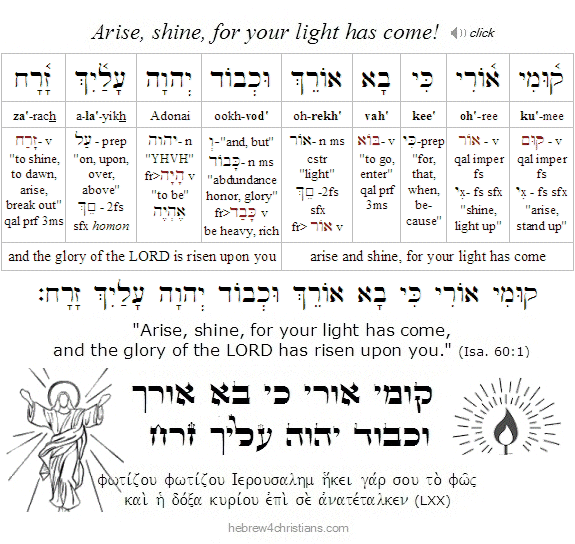 |
The LORD said to Moses from the midst of the shining flame: 'Take off your sandals from your feet, for the place on which you stand is holy' (Exod. 3:5). The Chofetz Chaim comments: We all need to rise higher... Never say, I will be able to lift myself up at another time or different place. By faith see that this place, right now, is holy ground, and awaits your response. May God open the "eyes of your heart" to help you see (Eph. 1:18-19).
Waking Up to the Light...
The following is related to the holiday of Chanukah...
12.17.25 (Kislev 25, 5786) Some people seem to sleepwalk through their days, without ever waking up... They miss life's wonder; they close their eyes to the Divine Presence; they shun asking the "big questions" because this disturbs their prejudices; indeed, they would rather be entertained, mesmerized, and rendered unconscious. Many people prefer to be put under a hypnotic spell than to be brought back to reality; they actually want their illusions and virtual lives! The first step of deliverance is to confess that we are asleep, and that we prefer sleep to opening our eyes to the truth. As it is written, "it is light that makes everything visible; therefore it says, "Awake, O sleeper, and arise from the dead, and the Messiah will shine on you" (Eph. 5:14). Arise and shine, for your light has come!
Recall that the holy menorah (מְנוֹרָה) was formed from one piece of pure beaten gold weighing 3,000 shekels of silver (nearly 100 pounds). It was a highly decorative work that had seven branches (with seven lamps), nine flower blooms, eleven fruits, and twenty two cups. According to the Talmud, the menorah measured eighteen tefachim (i.e., "palms") in height (from the base to the start of the lamps), or roughly 5.25 feet. It is called the "lamp of God" (נֵר אֱלהִים) in the Scriptures (1 Sam. 3:3).
This amazing "lamp of God" was made by hammering a single piece of solid gold into shape (Exod. 25:36). Note that the word translated "hammered" or "beaten" (מִקְשָׁה) comes from the word for "difficult" in Hebrew (קָשֶׁה). According to midrash, the method for constructing the menorah was difficult for Moses to comprehend, so the LORD first showed him one in the fire and told him: "This is how you will make it." Moses was unable to do so, however, so the LORD told him to take a block of gold and have Betzalel (the carpenter from Judah) throw it into the fire. After a flash of dazzling light, a glorious menorah came out formed by God Himself. This is a picture of Yeshua being immersed into fires of affliction to give us light.
The lamps of the menorah were lit daily, "from evening until morning," starting from the central lamp (the shamash) and then moving right to left (Exod. 27:21). According to the Talmud (Shabbat 22b), while all the lamps received the same amount of olive oil, the "westernmost" lamp (according to Rashi, the center lamp, due to its orientation) miraculously never ran out of oil, even though it was kindled first in the sequence. In other words, when Aaron would rekindle the lamps every evening, he found the shamash still burning, so he simply refilled it with oil and trimmed its wick.
This miracle is also said to have occurred during the Temple period, though it abruptly ended about 40 years before the destruction of the Second Temple (c. 30 AD), after the death of Yeshua the Messiah, the true Servant and "the Branch of the LORD." As it is attested in the Talmud: "Our Rabbis taught: During the last forty years before the destruction of the Temple the lot ['For the Lord'] did not come up in the right hand; nor did the crimson-colored strap become white; nor did the westernmost light shine" (Yoma 39a).
The light from the menorah is a spiritual light. It was not seen from the outside of the Tabernacle, but only while inside the holy chamber, before the holy place of sacrificial atonement. It enabled service to God to be performed, though it was not a light to be used for profane purposes. Notice that the six lamps faced the central lamp -- a picture of Yeshua, the Light of the World whose arms and legs were "hammered" for our sins.... He is the suffering servant (shamash) who lightens everyone in the world. He is the center, the supporting trunk for the other branches (John 15:5).
The light itself came from the burning of pure olive oil - a symbol of anointing and the Holy Spirit (רוּחַ הַקּדֶשׁ). It was kindled by the hand of a man of peace and humility. Likewise, when we are given light to behold the sacrifice of Yeshua for our atonement (כַּפָּרָה), we are filled with the divine light (John 8:12; 1 John 1:7, Eph. 5:8). When we come to the cross, we can behold the truth of God's unfailing love that draws us to be united with Him.
Hebrew Lesson
Proverbs 6:23 reading (click):
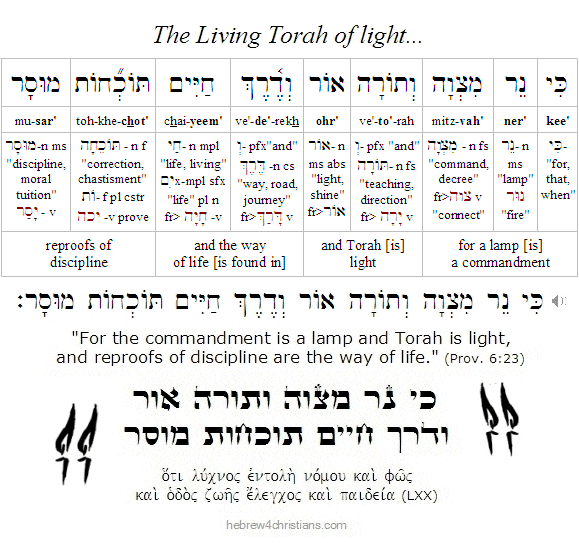 |
It is not easy to wake up, to rouse ourselves, to find focus, concentration, "kavanah," - and yet spiritually speaking it is essential. Hence Yeshua repeatedly asked his disciples: "Do you now believe?" May God have mercy upon us and help us rise to behold His glorious light!
Happy Chanukah!
Joseph and his brothers...
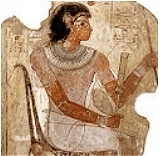
The following provides some refection about the story of Joseph and his brothers...
12.16.25 (Kislev 24, 5786) Though he had twelve sons, the Torah says that "Jacob loved Joseph more than all his other sons" (יִשְׂרָאֵל אָהַב אֶת־יוֹסֵף מִכָּל־בָּנָיו), since he was the son of his old age, and the firstborn son (bechor) of his beloved wife Rachel (Gen. 37:3). Indeed, Jacob and Joseph shared a lot in common: Both had infertile mothers who had difficulty in childbirth (Rebekah and Rachel); both of their mothers bore two sons (Rebekah: Esau/Jacob; Rachel: Joseph/Benjamin); both were hated by their brothers, and perhaps most significantly, both had lost their mothers (Joseph was present when his mother died, whereas Jacob never saw his mother again after he fled from his brother Esau).
Perhaps their shared struggles explains why Jacob favored his Joseph and made for him the special "ketonet passim" (כְּתנֶת פַּסִּים), a full-sleeved robe or ornamental tunic that set him apart from his other sons, and perhaps this also explains why Joseph had boasted about his "dreams of preeminence" over his brothers... Indeed, the story of Joseph is, among other things, a story about his dreams. As a young man, his dreams centered on himself, which led to his betrayal and fall; but after being humbled in prison, he focused on the dreams of others, which led to his exaltation...
There is a lot of mystery surrounding the life of Joseph ben Yisrael. Like his father who fled from the hatred of his brother Esau, Joseph became a victim of his brothers' malice. After being betrayed and sold into slavery as a teenager, Joseph later seemed to abandon his family identity, perhaps like his estranged uncle Esau. Unlike his father Jacob, however, Joseph had no "Bethel" experience along the way. Indeed, upon his release from prison he was thoroughly "Egyptianized." Joseph wore Egyptian clothes, spoke fluent Egyptian, married an Egyptian wife, assumed an Egyptian name, and named his firstborn son "Manasseh" (מְנַשֶּׁה), a word that comes from the verb nasah (נָשָׁה), meaning "to forget." It seems that Joseph wanted to forget his past life. After all, despite his later ascendancy in Egypt -- when he had the means to reconnect with his long-lost family (including his father and brother Reuben who were deceived into thinking he was dead) -- he did nothing to contact them. (For more on this, see "The Heart's Truth.")
The truth (i.e., aletheia: ἀ+λήθεια) cannot be forever forgotten, however. When his brothers finally reappeared in his life seeking help, it had been 22 long years since they had last seen him (incidentally, the very same amount of time Jacob had been away from his family as well). Joseph was now forced to deal with his past life. But he played the part of a "stranger" and withheld his true identity... As part of his charade, Joseph bound and imprisoned Simeon (who, according to tradition was the brother who originally threw Joseph into the pit). It was then that the brothers remembered what they had done to Joseph when they betrayed him as a child. Here the Torah adds a detail not originally given in the story of Joseph's betrayal, namely, that the brothers had ignored Joseph's desperate cries for help (Gen. 42:21-24). Perhaps the shock of seeing their helpless brother Simeon bound before them reminded the brothers of the terrible pain they had once caused Joseph...
Most of you familiar with the drama will recall how Joseph then demanded that his brother Benjamin be brought from Canaan in order to "corroborate" the brothers' story. Benjamin - the last link to Jacob's deceased wife Rachel and to his lost beloved son Joseph - had surely assumed Joseph's place as Jacob's favorite son, and Jacob was quite unwilling to part from him for any reason. The famine, however, forced the issue and Judah swore to his father to take personal and eternal responsibility for the welfare of his beloved son... Jacob finally relented in a state of fearful resignation.
So the brothers, this time with Benjamin, trekked back to Egypt. Although the sages argue about the exact chronology, it is clear that Benjamin was not a child when Joseph was thrown into the pit at age 17. When he finally saw his brother again, Joseph was so overcome with emotion that he left the room to weep.
A midrash tells of the conversation between Joseph and Benjamin that brought tears to Joseph's eyes. Joseph sternly asked Benjamin, "Have you a full brother, one who has the same mother as you?" "I had a brother," answered Benjamin, "but I do not know where he is." "Do you have sons?" asked Joseph. "I have ten." "What are there names?" "I named them all after my brother and the troubles that befell him. One is called "Bela" because my brother was nivlah - swallowed up - and disappeared. Another is called "Bechor" because he was the bechor (firstborn) of his mother. A third is called "Achi" because he was achi, my brother, and a fourth is called "Chuppim" because he did not see my chuppah (i.e., wedding day)." So Benjamin explained the names of his ten sons and Joseph was full of love for his brother and sadness for the time they had not shared together.
Another midrash tells the story about how Joseph carefully seated his brothers from youngest to oldest (Gen. 43:33). He wanted to have Benjamin sit next to him but was unsure how to arrange the seating without arousing suspicion. Picking up his goblet and pretending that it had magic powers, Joseph called out the brothers names: "Reuben, Simeon, Levi, Judah," and so on from oldest to youngest. When he came to Benjamin, he said, "He has no mother and neither do I. He had a brother who was separated from him at birth, and so did I -- let him sit next to me!" The fivefold portion given to Benjamin was meant to test the brothers to see how they would react to a brother being shown preferential treatment.
When Joseph later "framed" Benjamin for stealing the "divination goblet," he was masterfully recreating a situation similar to the one in which he was sold by his brothers. Had the brothers done teshuvah and truly changed? Or would his brothers abandon Benjamin as they had abandoned him in his hour of need? In order for there to be genuine reconciliation, Joseph needed to see if his brothers had really undergone teshuvah. When Judah stepped forward to take the place of his brother, he willingly accepted the guilt of them all. When Judah said, "What can we say, my lord; God has found out our sin" (Gen. 44:16), he was not confessing to the theft of the divination cup, but rather to the brothers' crime of throwing Joseph into the pit and selling him as a slave...
The Hebrew word "Miketz"(מִקֵּץ) means "at the end of" and points to prophetic future (i.e., the "end of days" or acharit ha-yamim). Just as Joseph was a "dreamer" who was betrayed by his brothers but was promoted to a place of glory by the hidden hand of God, so Yeshua was betrayed by his people yet was exalted over all the nations (מֶלֶךְ הַגּוֹיִם). And just as Joseph later disguised himself as a "stranger" and an "Egyptian" to his brothers but was finally revealed to be their savior, so will the Jewish people come to see that Yeshua is the true Savior of Israel. Then will the hope of Israel be fulfilled, as is written in the New Testament: "And so all Israel shall be saved: as it is written, 'There shall come out of Zion the Deliverer who shall turn away ungodliness from Jacob'" (Rom. 11:30, citing Isa. 59:20).
Amen. Let that day come!
Hebrew Lesson
Isaiah 59:20 reading (click):
Keep the Flame Burning...
"Faith is the strength by which a shattered world shall emerge into the light." - Helen Keller
12.15.25 (Kislev 24, 5786) Chag Chanukah Sameach! Keep the flame within your heart burning, friend... A sage once told a person struggling with his faith: "It is written that all creation was brought into being because of people like you. God saw there would be people who would cling to our holy faith, suffering greatly because confusion and doubt would plague them. God perceived that such would overcome these doubts and troubles of heart and remain strong in their belief. It was because of this that God brought forth all creation." Indeed, it was because of this that Yeshua our LORD suffered and died for you... Amen.
Therefore never yield to despair, since that leads to further darkness and fear. Press on and keep fighting the "good fight" of faith (1 Tim. 6:12). Remember that you infinitely matter to heaven; your life has great value; you are significant and you are truly loved by our Heavenly Father. There is a "future and a hope" for you; there is "a white stone, and on that stone will be written a new name that no one can understand except the one who receives it" (Rev. 2:17). May "the trial of your faith, being much more precious than of gold that perishes, though it be tested with fire, be found to result in praise and glory and honor at the revelation to come" (1 Pet. 1:7).
"I am sure of this, that he who began a good work in you will bring it to completion (ἐπιτελέω) at the Day of Yeshua the Messiah" (Phil 1:6). The LORD is able to guard you (φυλάξαι) from stumbling and to present you blameless before the presence of His glory with great joy (Jude 1:24). "The LORD upholds all who are falling and raises up all who are bowed down" (Psalm 145:14). "He will sustain you to the end, guiltless in the Day of our Yeshua the Messiah" (1 Cor. 1:8). He who calls you is forever faithful; He will surely do it (1 Thess. 5:24). Yea, "the Lord is faithful (נֶאֱמָן הוּא): He will establish you and guard you against the evil one" (2 Thess. 3:3). The Spirit says, "Fear not, for I AM with you always."
Hebrew Lesson:
Isaiah 41:10 Hebrew reading (click):
Parashat Miketz - מקץ
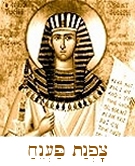
The eight days of Chanukah run from Sunday Dec. 45th (i.e., Kislev 25) at evening until Monday December 22nd this year. The weekly Torah reading is not suspended for Chanukah, though there are some additional Torah readings for each of the days of the holiday...
12.14.25 (Kislev 23, 5786) In our Torah portion for Chanukah week, parashat Miketz (i.e., Gen. 41:1-44:17), we will read how imprisoned Joseph successfully interpreted Pharaoh's dreams and suddenly rose to power in Egypt. Because of a famine in the land of Canaan, however, his brothers (who had earlier betrayed him) came to Egypt in search of food. A disguised Joseph then tested his brothers to see whether they were the same people who had callously sold him into slavery, or whether they had undergone teshuvah (repentance).
The eventual revelation of Joseph and his reconciliation with his brothers is a prophetic picture of acharit ha-yamim (the "End of Days") when Israel, in Great Tribulation, will come to accept Yeshua as Israel's true deliverer. Presently, the veil is still over the eyes of the Jewish people and they collectively regard Yeshua as an "Egyptian" of sorts. In this connection, I list some of the ways that Joseph is a "type" or foreshadowing of the coming Yeshua as the Suffering Servant (see "Mashiach ben Yosef").
Hebrew Lesson
Genesis 41:1a reading (click):
The Truth about Chanukah...
The eight-day Festival of Chanukah begins at sundown on Sunday, Dec. 14th this year...
12.13.25 (Kislev 22, 5786) Celebrating Chanukah is an easy and enjoyable custom that does not require a lot of cost or effort. All you will need is a Chanukah menorah, a box of 44 Chanukah candles, and a blessings sheet (available free from Hebrew for Christians). Optionally you can get a "dreidel" to spin for amusement and put up some Chanukah decorations. Traditionally we eat some simple foods that are cooked in oil, such as potato latkes, kugel, jelly donuts, etc. Overall the mood of the holiday is joyful - a time to remember how God performs miracles for his people as he did for Israel when the holy Temple was recaptured and restored from the Syrian oppressors during the second century B.C.
For each of the days of Chanukah we light candles, kindling one for the first day, two for the second, and so on until we reach the climactic eighth day, when all shine together. Some of the sages say the word "Messiah" (i.e., mashiach: מָשִׁיחַ) may be regarded as an acronym for the phrase "we light throughout the eight days of Chanukah," i.e., מַדְלִיקִין שְׁמוֹנָה יְמֵי חֲנוּכָּה: madlikin (מ) shemonah (שׁ) yemei (י) Chanukah (ח). Indeed, the central lamp of the Chanukah menorah is called the shamash (שַׁמָש), the "Servant" that bears the original flame that kindles all the others. The salvations, wonders, and solace that God performed for us "in those days, at this time" therefore prefigure the greater deliverance we have in Yeshua, the Suffering Servant and Light of the World...
Despite Jewish tradition about the subject, however, there are several misconceptions about Chanukah that should be mentioned. First, Chanukah is not "Jewish Christmas," though many Jewish families later adopted the practice of giving gifts to friends and family members at this time because of the influence of Christmas. Second, Chanukah does not celebrate the victory over the Greeks by the Maccabees but rather their victory of the Syrians under "Epiphanes" who sought to force the Jewish people to abandon their faith and to assimilate the thinking of the prevailing Greek culture under Alexander the Great. Third, the "miracle of Chanukah" was not that one jar of oil was miraculously enabled to illuminate the recaptured Temple for eight days and nights but rather that a small ragtag army of devout Jewish patriots were able to overthrow the oppression of the Syrians and to restore proper worship at the Temple. Finally it's likely that the victory of the Macabees was first celebrated as a "belated" Sukkot holiday because they had missed observing Sukkot during the war with the Syrians. Later this "belated Sukkot" was renamed as "Chanukah" to commeorate the victory.
In the New Testament (John 10:22-39) we read that Yeshua went to the Temple during the "Festival of Rededication" (i.e., chag ha'chanukah: חַג הַחֲנֻכָּה) and there was accosted by Jewish zealots who wanted to know if he was the Messiah to come who would overthrow God's enemies and establish the Zion upon the earth. When Yeshua said that he was indeed the Messiah but explained that his divine mission was not to overthrow worldly political enemies but to deliver Israel from their sins, the zealots became enraged and sought to stone him to death for claiming to be God. Yeshua then asked whether it was blasphemy for someone to be a sanctified agent of God's will, and he then quoted Psalm 82:6 which reads: "אֱלֹהִים אַתֶּ֑ם וּבְנֵי עֶלְיוֹן כֻּלְּכֶם" which can be translated as God saying to Israel: "You are divine beings, and you are the sons of the Most High" and then continues to say "but surely like men you shall die" (אָכֵן כְּאָדָם תְּמוּתוּן). Note that Yeshua here argued that God is revealed to the world through the agency of people who are chosen to do his will, even though they are mortal human beings. So the only interesting question regarding the claim of Yeshua comes down to whether he truly was an agent of God's will or not, for it would be blasphemy to say "I and the Father are one" when that was not true, but if it was indeed true, then it must be respected as the word of God. Therefore to establish his claim that his testimony was true, Yeshua pointed to his many miracles as evidence that he was God's representation in the world, and that "the Father is in me, and I am in Him." His argument was the form if p>q; p, therefore q: "if I do miracles in the Name of YHVH (p) then I am from YHVH (q); I do miracles in the Name of YHVH (p); therefore I am from YHVH (q)."
As followers of Yeshua the Messiah, there are valid reasons to remember Chanukah. First it is important to remember that had God not given the victory to the Maccabees, then the Temple would have been razed and Jewish identity would have been lost. Worse yet, Jewish assimilation into Greek culture might have jeopardized the coming of the Messiah Himself. Yeshua's disagreement with the zealots therefore concerned the spiritual meaning of the Temple (and how God could finally establish it upon the earth), but we should not regard this disagreement to imply that he negated the validity of Jewish historical experience - much less the words of the ancient prophets themselves. Indeed one day God would establish Zion upon the earth, but that would come about by the power of God, not by man (Acts 1:7). Just as Daniel prophesied about how the Messiah Himself would be "cut off" for the transgression of God's people (Dan. 9:24-27), so he foresaw the ultimate doom of the Antichrist by the hand of the Messiah Himself (Dan. 8:23-25). Yeshua likewise taught that the "little horn" (i.e., Antiochus) prefigured the greater "Abomination that makes Desolation" to come (Matt. 24:15-22, Mark 13:14; cp. Dan. 9:27, 11:31;12:11). Yeshua was of course speaking centuries after Antiochus set up an altar to Zeus and offered a pig in the Temple, and therefore it is clear that He was prophesying of a future "abomination that makes desolation" that would occur later in Jewish history. The Apostle Paul likewise stated "that day will not come, unless the rebellion comes first, and the man of lawlessness is revealed, the son of destruction, who opposes and exalts himself against every so-called god or object of worship, so that he takes his seat in the temple of God, proclaiming himself to be God, who opposes and exalts himself against every so-called god or object of worship, so that he takes his seat in the temple of God, proclaiming himself to be God" (2 Thess. 2:3-4).
Secondly, as I've stated in my Christmas article, it is likely that Yeshua was born during the festival of Sukkot (in the middle of the seventh month), when God chose to "tabernacle" with us (Immanuel), and this implies that Yeshua would have been conceived nine months earlier, during the season of Chanukah. (Put the other way around, if Yeshua were conceived in late Kislev (Nov/Dec), he would have been born 40 weeks later during Sukkot.) Chanukah then would commemorate the miracle of the Incarnation -- when God the Son chose to divest Himself of his regal glory to begin his redemptive advent into this dark world -- an event which undoubtedly is the among the most significant in all of sacred history.... It was by means of his advent, after all, that the Messiah would ultimately restore the Temple by means of His sacrificial life and death. In other words, since Yeshua was born during Sukkot, and conceived during Chanukah, celebrating this season bears witness that Yeshua is the true light of the world. The conception of the Messiah marked the beginning of the redemption of Israel - and indeed the redemption of all the families of the earth...
For more on this subject, please see the links below. Chag Chanukah Sameach chaverim!
Hebrew Lesson
Psalm 112:4 reading (click):
Seeing beyond the Seen...

"Faith is the assurance that the best and holiest dream is true after all." - Frederick Buechner
12.12.25 (Kislev 22, 5786) Yeshua told us: "Blessed are those who have not seen and yet have believed" (John 20:29). Despite the struggle of this life - our sorrows, pains, and even death itself - we believe in God's love and promise for us, even if we do not presently see the fulfillment of our hope, just as Abraham believed the promise that he would be the father of an innumerable multitude long before he saw any sign of its fulfillment.
Abraham "believed the impossible" and "hoped against hope" (παρ᾽ ἐλπίδα ἐπ᾽ ἐλπίδι), meaning that hope kindled within him even though there was nothing to see in the realm of the natural -- he believed in an unseen good; he trusted in the One who gives life to the dead and who "calls into existence the things that do not exist" (Rom. 4:17).
The Scripture comments: "He did not weaken in faith when he considered his own body, which was as good as dead (since he was about a hundred years old), or when he considered the deadness of Sarah's womb. He did not stumble over the promise of God through unbelief but was strong in faith, and gave glory to God, fully persuaded that God was able to do what he had promised, and that is why his faith was counted to him as righteousness" (Rom. 4:19-22).
Likewise we are called to believe in an unseen good, an unimaginably wonderful destiny for our lives, as it says, "Things no eye has seen, nor ear heard, nor mind imagined, are the things God has prepared for those who love him" (1 Cor. 2:9). Faith does not use natural reason or the evidence of the senses to see the unseen, but it "believes to see" through "eyes of the heart" to know the hope of God's calling and to attain the blessing (Eph. 1:18).
Faith in God's love comes from a different source and has a different means of apprehension than human wisdom, so that no matter how things might appear in this fallen world, the LORD God may be known and trusted to work all things for our ultimate good. "Blessed are those who have not seen and yet have believed." Amen.
Hebrew Lesson
Psalm 27:14 Hebrew Reading:
Humility of the Messiah...
During this time of year we observe both Chanukah and Christmas, though these are two very different holidays. Chanukah celebrates the rededication of the Temple after the Maccabees prevailed against Syrian oppression of the Jewish people, whereas Christmas celebrates the coming of the promised Savior of the world in the birth of Yeshua...
12.12.25 (Kislev 22, 5786) Though the world system profanes the message of the birth of Messiah for the sake of avarice and greed, let us take a moment to reflect on its ongoing spiritual significance, namely, that God emptied Himself (κένωσις) of His regal glory and power to become your Savior and High Priest, able to fully sympathize with our weakness, frailty, shame, and chronic sinfulness (Heb. 4:15-16; Phil 2:7-8). Almighty God, the Presence of Love, the Heart of Reality, clothed himself in human flesh and bone to become Immanu'el (עִמָּנוּ אֵל) - "God with us" - so that we could be touched by Him, healed by Him, and redeemed by Him... In light of this, it is only fitting we should join the refrain of heavenly host: "Glory to God in the highest, and upon earth peace, good will among all people!" (Luke 2:14). Amen! Yeshua is the Eternal Sign and Wonder of the LORD God Almighty...
Hebrew Lesson
Luke 2:14 reading (click):
|
Consider the absolute humility of God as He chose to enter into this world as "baby Jesus." Meditate on the glory and sheer paradox of God's love! "Baby Jesus" is the perfect disguise to hide the truth from the proud eyes of the flesh, though the humble of heart can see... "For since in the wisdom of God the world by its wisdom did not know God, God was pleased to save those who believe by the foolishness of preaching" (1 Cor. 1:21). For "who comprehends the mind of the LORD, or gives him instruction as his counselor?" Through his great plan to redeem people from the dominion of Satan and his agents in this evil world, God emptied Himself to become clothed in the frailty human flesh, born in a manger as the great Lamb of God, and born to die as the ransom for all who will believe. Ah, what would we do without the gift of God, friends? What hope would we have? Regardless of the exact date of his birth of His birth, let's thank God that our Moshia (Savior) was willing to be born into this dark world to offer Himself as our sacrificial Redeemer! "For from him and through him and to him are all things. To him be glory forever. Amen" (Rom. 11:36).
But what are you to do, then, if you sincerely want to follow the Torah's calendar in light of entrenched Christian customs? Well, we certainly may commemorate the birth of Messiah during the holiday of Sukkot (or Shavuot, etc.), though we must be careful to show charity and use the "good eye" toward those who may adhere to the traditional date for "Christmas." Likewise we commemorate the death and resurrection of Messiah during Passover and Firstfruits, respectively, though we do not begrudge those of good faith who honor these great events of salvation during what they call the "Pascha" or even the "Easter" season. Often we are tested in exactly this way, chaverim! We must not miss the "weightier matters" of extending grace to others, as Yeshua clearly taught (Matt. 23:23). As it is written, "Let every man be fully persuaded in his own mind" (Rom. 14:5; Col. 2:16).
Friends, we must test the spirits -- and that particularly includes our own! How do we treat the "stranger" among us? How do we regard the "weaker brother?" Do we demand that our doctrine be esteemed, or do we allow room for others to seek the Lord and his wisdom? Ask yourself: Does this person (or group) honor Yeshua as God the Son, the Redeemer of Humanity who died for our sins and rose from the dead? If so, then keep your heart warm and soft toward him or her, even if he or she has yet to discover the Jewish roots of their faith. "Strive for peace with everyone" (Heb. 12:14). "Let those of us who are mature think this way, and if in anything you think otherwise, God will reveal that also to you" (Phil. 3:15). Though we desire unity with one another (John 17:11), we cannot reasonably insist on doctrinal uniformity, especially in light of the frailty of our shared human condition... The truth of God is known in humility and love.
Hebrew Lesson
Psalm 8:2a reading (click):
Israel's Rejected Prince...
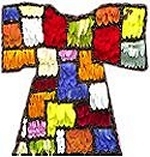
12.12.25 (Kislev 22, 5786) From the beginning of this week's Torah portion (Vayeshev) until the end of Sefer Bereshit (the Book of Genesis), the focus shifts from the patriarch Jacob to his twelve sons, but particularly to his beloved son Joseph (יוֹסֵף). Recall that Joseph's jealous brothers had stripped him of his "coat of many colors" and then mercilessly threw him into a pit -- a providential event that would eventually lead to the deliverance of the Jewish people by the hand of a "disguised savior." Indeed, story of Joseph's ordeal is a story of divine hashgachah (providential supervision) that foretells the drama of Yeshua our Messiah, both as the Suffering Servant and as a national deliverer of Israel.
The Torah reading begins, "Jacob settled (vayeshev Ya'akov) in the land of his father's sojourning, in the land of Canaan" (Gen. 37:1), but then immediately turns to the story of Joseph, who was seventeen years old at the time: "And these were the generations of Jacob: Joseph being seventeen years old..." (Gen. 37:2). Why does the toldot (genealogy) of Jacob begin with Joseph rather than Reuben (the firstborn son of Leah) here? Was the Torah suggesting that Joseph was regarded by Jacob as his (chosen) "firstborn" son?
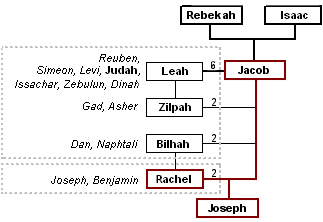 |
Jacob and Joseph undoubtedly shared a lot in common, and this surely caused Jacob to prefer his firstborn son (of Rachel) over his other sons. For instance, both men had infertile mothers who had difficulty in childbirth; both mothers bore two sons; and both were hated by their brothers. In addition, the Torah states that Jacob loved Joseph more than all his other sons since he was the son of his old age, and was the firstborn son (bechor) of his beloved wife Rachel. Indeed, Jacob made him an ornamented tunic (ketonet passim) to indicate his special status in the family.
At any rate, the Talmud (Sanhedrin 106a) notes that whenever the word vayeshev (וַיֵּשֶׁב) is mentioned in Torah, it introduces a painful episode. Immediately following the statement that "Jacob settled (vayeshev Ya'akov) in the land of his father's sojourning," the Torah states that Joseph brought an "evil report" about his brothers to his father, and this ultimately led to the selling of Joseph into slavery and to further heartache for Israel. The Jewish sage Rashi notes that whenever someone called by God wants to "settle down" and live at ease, God orchestrates events to keep him free from complacency. This certainly happened in the case of Jacob, where sibling rivalry and baseless hatred (called sinat chinam: שִׂנְאַת חִנָּם) so disrupted the peace of the family that his children were eventually led into exile and slavery.
But there is redemption and healing, even in the midst of betrayal and loss... We note that Joseph was sent by his father from the "depths of Hebron" (מֵעֵמֶק חֶבְרוֹן) to seek the welfare of his brothers (Gen. 37:14). Hebron (חֶבְרוֹן) is one of the very first places Abraham lived after he entered the Promised Land (Gen. 13:18). The word itself comes from a root (ח.ב.ר) that means "union," or "friendship," suggesting that from the depth of family union would come struggle but eventual deliverance. The "depths of Hebron" therefore suggests that Joseph's assignment was ultimately redemptive in nature - to restore love to the family by means of God's providential salvation...
Hebrew Lesson
Psalm 130:1-2 reading (click):
ישוע מקור האור
The Source of Light...
12.11.25 (Kislev 21, 5786) Did you know that Yeshua observed the Chanukah festival? We read from the New Testament: "Now it was the Feast of Dedication (i.e., chag Chanukah) in Jerusalem, and it was winter, and Yeshua walked in the Temple, in Solomon's porch. Then the Judeans surrounded Him and said to Him, "How long do You keep us in doubt? If You are the Messiah, tell us plainly...." And Yeshua answered them: "I have told you, but you do not believe. The works that I do in My Father's name, they bear witness of Me. But you do not believe, because you are not of My sheep, as I said to you. My sheep hear My voice, and I know them, and they follow Me. And I give them eternal life, and they shall never perish; neither shall anyone snatch them out of My hand. My Father, who has given them to Me, is greater than all; and no one is able to snatch them out of My Father's hand. "I and My Father are one" (John 10:22-30).
Ironically enough, Chanukah is not mentioned in the "Old Testament" Scriptures (i.e., the Tanakh) but it is explicitly mentioned in the New Testament!
Faith in God's promised Savior enables us to behold the light of God as revealed in the face of Yeshua (2 Cor. 4:6). "For God, who commanded the light to shine out of darkness, has shined within our hearts to impart the light of the knowledge of the glory of God in the Face of the Messiah" (בְּפָנָיו שֶׁל הַמָּשִׁיחַ). All who believe in Him are made partakers of the new covenant of God, and the Scriptures say to them: "But you are a chosen generation, a royal priesthood, a holy nation, His own special people, that you may proclaim the praises of Him who called you out of darkness into His marvelous light" (1 Pet. 2:9).
"God is Light; in Him there is no darkness at all" (1 John 1:5). Yeshua said: "I am come a light into the world, that whoever believes in me should not abide in darkness" (John 12:46). The ultimate message of Chanukah is eschatological and full of hope. This world is passing away and the Kingdom of Heaven will one day be established upon the earth. We live in light of this blessed hope of the culmination of God's redemption (Titus 2:11-13). Meanwhile all of the world's rulers are "on notice" from God Almighty: their days are numbered and they will surely face the judgment of the LORD God of Israel (see Psalm 2). We must stand against evil by refusing to conform to the world around us (Eph. 6:11-18).
Now is the time. As it is written: "Let your light so shine before others that they may see your good works and give glory to your Father who is in heaven" (Matt. 5:16). Followers of Yeshua are made part of His Dwelling - extensions of His Presence in this dark and benighted world - and during this Chanukah season may we earnestly remember the call to rededicate our lives to Him! שהאור שלך יאיר - May your light shine!
Hebrew Lesson:
Psalm 36:9 Hebrew reading (click):
The Irrespressible Light...
12.11.25 (Kislev 21, 5786) In the Gospel of John it is recorded that Yeshua said, "I am the way, the truth, and the life" (John 14:6). Note that the Greek word translated "truth" in this verse is aletheia (ἀλήθεια), a compound word formed from an alpha prefix (α-) meaning "not," and lethei (λήθη), meaning "forgetfulness." (In Greek mythology, the "waters of Lethe" induced a state of oblivion or forgetfulness.) Truth is therefore a kind of "remembering" something forgotten, or a recollecting of what is essentially real.
Etymologically the word aletheia further suggests that truth is "unforgettable" (i.e., not lethei), that is, it has its own inherent and irresistible "witness" to reality. In that sense light is a metaphor for truth: "The light shines in the darkness, and the darkness has not overcome it" (John 1:5). People may lie to themselves, but ultimately truth has the final word.
Greek scholars note that the word lethei itself is derived from the verb lanthano (λανθάνω), which means "to be hidden," so the general idea is that a-letheia (i.e., truth) is non-concealment, non-hiddenness, or put positively is revelation or disclosure. Thus the word of Yeshua - His message, logos (λόγος), revelation, and presence - is both "unforgettable" and irrepressible. Yeshua is the Unforgettable One that has been manifest as the express Word of God (דְּבַר הָאֱלהִים). Yeshua is the Light of the world (אוֹר הָעוֹלָם) and the one who gives us the "light of life" (John 8:12). Though God's message can be suppressed by evil and darkened thinking, the truth is regarded as self-evident and full of intuitive validation (see Rom. 1:18-21).
The Hebrew word for truth (i.e., emet: אֱמֶת) comes from a verb (aman) that means to "support" or "make firm." There are a number of derived nouns that connote the sense of reliability or assurance (e.g., pillars of support). For example, the noun emunah (i.e, אֱמוּנָה, "faithfulness" or "trustworthiness") comes from this root, as does the word for the "faithful ones" (אֱמוּנִים) who are "established" in God's way (Psalm 12:1).
A "play on words" regarding truth occurs in the prophet Isaiah: אִם לא תַאֲמִינוּ כִּי לא תֵאָמֵנוּ / im lo ta'aminu, ki lo tei'amenu: "If you are not firm in faith, you will not be firm at all" (Isa. 7:9). Without trust in the LORD, there is no stability... Truth is something trustworthy, reliable, firm, or sure. In colloquial English, for example, this idea is conveyed when we say, "He's a true friend...", indicating that the loyalty and love of the person is certain.
The familiar word "amen" likewise comes from this root. Speaking the truth (dibbur emet) is foundational to moral life: "Speak the truth (דַּבְּרוּ אֱמֶת) to one another; render true and perfect justice in your gates" (Zech. 8:16; Psalm 15:2). Yeshua repeatedly said, "Amen, Amen I say to you...." throughout his ministry to stress the reliability and certainty of God's truth (Matt. 5:18, 26, etc.). Indeed, Yeshua is called "the Amen, the faithful and true witness" (Rev. 3:14).
The relationship between the Hebrew and the Greek ideas seems to be that the revelation of God - the aletheia - is reliable and strong. The source for all truth in the universe is found in the Person and character of the God of Israel, blessed be He... The self-disclosure of the LORD is both unforgettable - both in the factual and moral sense - as well as entirely trustworthy. Aletheia implies that truth is something that should never be forgotten, and therefore we are regularly admonished not to "forget" the LORD (Deut. 8:11, Psalm 103:2), to "remember" his covenants, to "keep" his ways, to "guard" His precepts, and so on.
The Scriptures attest that Yeshua is the true Light (אוֹר אֱמֶת) that comes from eternity to give light for all mankind He is "the true light, the One who shines to all mankind, has come into the world" (John 1:9).
During this Chanukah Season -- and always -- may the LORD God of Israel help us walk in the unforgettable and irrepressible radiance of His glory. May God help us shine with good works that glorify God's Name (Matt. 5:16). "For God, who said, 'Let light shine out of darkness' (יְהִי אוֹר וַיְהִי־אוֹר), has shone in our hearts to give the light of the knowledge of the Glory of God in the face of Yeshua the Messiah" (2 Cor. 4:6).
Hebrew Lesson
Isaiah 9:2 Hebrew Reading (click):
Focus for the Soul...
12.10.25 (Kislev 20, 5786) It is written in our Psalms: "I lift up my eyes to the hills, from where comes my help? My help is from the Lord, the Maker of heaven and earth" (Psalm 121:1-2). The sages recommend this verse to be better read as: "Will I lift up my eyes to the hills to find help? No, for my help is from the Lord..." The focus should not be upon the physical "high places" of the earth but upon the Ground of all being itself. We are to look to Lord, "oseh shamayim va'aretz," "the Maker of heaven and earth."
Some people look for "high places," ideals, "mountain top" experiences to bring heaven down to earth, and therefore they have little use for rawness of gospel truth. In their striving to attain virtue, they are offended at the cross because it bespeaks our need, brokenness, and the sigh of human frailty. Divine Wisdom, however, is distilled through real experience, which inevitably reveals our poverty of spirit and our powerlessness to heal ourselves. The fear of the Lord is the beginning of such wisdom, since this fear is the realization of our inability to transcend our own "fallenness," that is, to be delivered from our perverse inclination to destroy ourselves. The fear of the Lord reveals our alienation from what is truly good and what we truly need, regardless of whatever we imagine to be ideal.
Moses was a case in point. Trained and educated in the wisdom and ideals of ancient Egypt, as a young man he became a "failed messiah" when he sought to ascend to the truth in his own virtue and strength, and consequently was he sent into exile for 40 years to learn his own nothingness. When the Lord called out to him from the paradoxical bush that he was chosen to lead Israel from Egyptian bondage, Moses replied "Who am I?" And that marked the moment of Moses' revelation. The lesson of Moses in Midian is that encountering God comes from emptying the "self" of its illusions. Salvation, if it is possible at all, is the sovereign work of God; the "flesh" has nothing to do with it.
Poor human nature sighs over what might have been but has been lost to fecklessness and sinful frailty. Time reveals the abandonment of all carnal hope, even of ethical and religious ideals, and to look only to the Lord the maker of heaven and earth, for help. And that is the message of the cross again, which scandalizes romantic conceits of pride by revealing them useless before the heavenly verdict. The cross reveals our need for salvation from ourselves, from the albatross of sin slung heavily about our necks.
Yeshua did not come to present a higher ideal than was given in the law of Moses, for if we despair to keep the law of God and understand our powerlessness, how would teaching an even higher ideal help? He did not come as a teacher but as our deliverer, and for that he was born to die. He emptied himself and made himself nothing to so that he would offer his life upon the altar of the cross, and by his death we are healed.
He speaks to those who hunger and thirst for salvation: "Come to me you who labor and are heavy laden, and I will give you rest. Take my yoke upon you and learn from me, for I am humble and lowly of heart, and you shall find rest for your soul. For my yoke is easy, and my burden is light" (Matt. 11:28-30). The answer is found in him - in his work for us - wherein he dies in our stead and remakes us through the power of the Holy Spirit. By means of his death we are freely given his blessing of life, everlasting holiness, and deliverance from sin. This is the "good news" of the gospel - encouragement for those whose hearts have fainted, who have despaired over lost ideals and who desperately know they have failed in life.
The message of Yeshua is to come to him to find your help in the Lord. He will take you up, remake you, and restore your wasted years, made safe in the arms of the one who alone is your help, the Maker of heaven and earth.
The old hymn sings true:
"Just as I am, without one plea,
But that Thy blood was shed for me,
And that Thou bidst me come to Thee -
O Lamb of God, I come, I come."
Whatever your present condition, God loves you with the passion that led Yeshua to the cross. The Lord is present for you now, if you will believe, not some time later, after you've attempted to remedy yourself or after you have somehow "endured to the end." Chaverim, we never get beyond this place of need wherein we come to know God as the only sure help for our lives, which is to say that we never get beyond our need for the cross...
Hebrew Lesson
Psalm 121:1-2 reading (click):
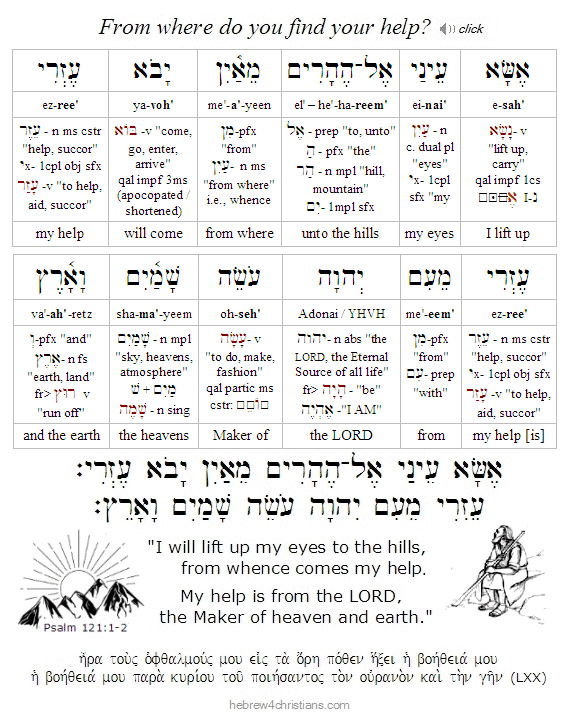 |
The Nearness of God...
"When I thought of nothing but to end my days in these troubles (which did not at all diminish the trust I had in God, and which served only to increase my faith), I found myself changed all at once, and my soul, which till that time, was in trouble, felt profound inward peace, as if she were in her center and place of rest." - Brother Lawrence
12.09.25 (Kislev 19, 5786) When he came to accept life on God's terms rather than his own, Brother Lawrence found peace within his soul. This epiphany, or moment of revelation, changed everything, because accepting life on God's terms meant that God was involved in every detail of his life, and therefore God was present and near at all times...
We cannot change ourselves, at least not our deepest self. True transformation comes from God, and change will take place by itself, that is, by God's inner work within you. The process of spiritual growth is ultimately mysterious and divine: "The Kingdom of God is like someone who spreads seed on the ground. He goes to sleep and gets up, night and day, and the seed sprouts and grows, though he does not know how. By itself (αὐτομάτη, "automatically") the soil produces a crop, first the stalk, then the head, then the full grain in the head. And when the grain is ripe, he comes in with his sickle because the harvest has come" (Mark 4:26-29).
God is doing the work of salvation within you, and all we can do is to learn to accept ourselves as we presently are - despite any disappointments we have faced along the way. As the apostle Paul wrote: χάριτι δὲ θεοῦ εἰμι ὅ εἰμι - "by the grace of God I am what I am." The great "I am" of the LORD is the Source of your life, from the beginning to the end. And it is because of the grace of God that Yeshua tasted death for everyone (Heb. 2:9).
When we come to faith and undergo "regeneration," or spiritual rebirth, the seed of His life is planted within us and the divine life begins to grow. Just as you did nothing to bring yourself into this world, so you can do nothing to bring yourself into God's kingdom. Regeneration (and sanctification) is a miracle that comes "of the Spirit" (John 3:5, 8).
We are witnesses of God's miracle within us, and our only need is to trust in his plan for our lives, regardless of our present circumstances (Isa. 26:12; Jer. 29:11; Prov. 3:5-6). God's plan includes the promise of heaven, but it also includes our inner struggles, our troubles, and our need. His plan includes a personal heart connection with you so that you come to know his love for you.
"Trust in him at all times, O people; pour out your heart before him; God is a refuge for us. Selah" (Psalm 62:8). Pouring your heart out to God in an honest, spontaneous, and intensely personal way is called "hitbodedut" (הִתְבּוֹדְּדוּת) in Hebrew. We "pour out" (שׁפך) whatever is within us, both the bad and the good. We confess our temptations and failures, our need for his deliverance, our yearning for life, our sorrows, our joys, our fears and our hope. We show God what's inside us, our intimate secrets, our "kishkes," and hold nothing back...
After we "talk our hearts out" before the Lord, in our emptiness we can begin to truly listen, as it says, "In returning and rest you shall be saved; in quietness and in trust shall be your strength" (Isa. 30:15). Only after we sigh deeply and surrender are we receptive to the voice of the Spirit's whisper. אַשְׁרֵי כָּל־חוֹכֵי לוֹ - "Blessed are all those who wait for Him" (Isa. 30:18). We wait, we abide, we persevere -- even when God seems to "take his time" or does not immediately intervene in ways we might apprehend. We do not lose heart, for we find strength when we trust in God's love... The Light of the world still shines: Yeshua, be my inner word, my heart, and my groaning for life today, and forevermore: Amen.
I've mentioned before that there are two relationships you will always have in your life: one with yourself, and the other with God. The "self" is really an inner dialog within the heart and ultimately it is a conversation with God. You cannot know who you are apart from God, though tragically people can suppress God's presence and live a life of madness.... Sanity comes by the miracle of rebirth. Knowing God's presence transforms the heart forever.
Open your heart and look to the Lord. Hide nothing and trust in mercy that changes you. "Come unto me," Yeshua says. Come as you are. If you hear the inward call, he will give you the means and courage to come; he will impart grace to trust him that redeems you by his love. As you open your heart in trust, the Lord becomes your Refuge, and you will know Him in all your ways.
"I can't change myself... O Lord, you surely know that. Or I won't change, because I don't know how or I can't find the willingness. You know this too. I am all emptiness; apart from you I am nothing. My heart pants; it's hard to breathe; I am a troubled vapor. I ache in my powerlessness and in my hope. There is no good within me; I come to you, just as I am, and I am set free from myself, because you alone are the substance and heart of my life. Though I don't understand whatever happens, and often I feel anxious and afraid, I find true peace in you. You call me Beloved. Accepted. Redeemed. Healed. I find my life in your presence, O LORD. Hold me fast and keep me close to your heart always. Amen."
Hebrew Lesson
Psalm 62:8 Hebrew reading (click):
The Reason for Chanukah...
12.09.25 (Kislev 19, 5786) The holiday of Chanukah provides a reminder that we must remain committed to the truth in a godless, and therefore insane, world. After all, since ultimate reality is the "handiwork" (i.e., conscious design) of a single, all-powerful, all-knowing, all-loving, morally perfect, purposive, personal, and spiritual Agency that has been revealed in the Jewish Scriptures, those who deny this Reality are living in a state of delusion (that is, a protracted "hallucination" that indicates radical departure from what is real). In a sense, the history of humanity - especially as it has been expressed philosophically and politically -- has been nothing less than the conscious collusion to redefine reality as something that it isn't. "The kings of the earth station themselves, and the dignitaries (רוֹזְנִים) take counsel together against (lit. "over") the LORD and His Mashiach" (Psalm 2:1-3). Spiritual warfare is therefore the fight for sanity and truth in a world that prefers madness and self-deception.
Despite being an anti-Semite, the early Church father Tertullian (160-220 AD) once asked a very good question: "What does Athens have to do with Jerusalem?" He was right for asking the question, though ironically, as a Greek-minded "replacement theologian," he was wrong for categorically libeling the Jewish people (see Adversus Iudaeos, c. 200 AD). Historically speaking, religious Jews have always loved the Torah and resisted the pull toward assimilation... Indeed, what other nation has survived over the millennia as have the Jewish people? Sadly, it is a continuing sin of many of today's "church leaders" to disregard the miraculous existence of Israel - including the modern State of Israel - by refusing to give the LORD God of Israel glory for His faithfulness.... Look, if God isn't faithful to the promises made to ethnic Israel, what makes these people think He won't change His mind regarding the Church? But I digress here...
Historically, Chanukah remembers the Maccabee's resistance to the coerced Hellenization (i.e., the spread of pagan Greek culture) of the Jewish people, though more generally it represents the ongoing struggle against assimilation to the prevailing "world system." In modern day America, for instance, the pressure to assimilate takes the form of "political correctness" and the acceptance of official propaganda that multicultural pluralism/cultural relativism is the truth. For those of us who follow Yeshua, Chanukah is the bold proclamation that the Light of the World has come, despite the face that "people loved darkness rather than light because their deeds were evil" (see John 3:19).
The story of Chanukah goes back to ancient Greece and the pagan worldviews of Hesoid and Homer, Plato and Aristotle. Alexander the Great (r. 336-323 BC), the tutelage of Aristotle, became a militant King of Macedon who swept across Syria, Egypt, and Babylonia to defeat the mighty Persian Empire. Alexander's rapid military conquests extended Greek culture and influence throughout the civilized world. When he later died (323 BC), Alexander's kingdom was divided into four parts and the land of Israel became a province of Syria under the rule of the Seleucid dynasty.
In 175 BC, a new king, Antiochus IV (also called "Epihpanes") ascended the throne in Syria. Under the "auspices" of his regime, Jerusalem began to look more and more like a Greek city as Hellenistic culture was officially promoted. Antiochus allowed Hellenistic Jews to have prominent roles in the Holy Temple - so much so that even a non-priest (named Menelaus) was given the role of being the Temple's Kohen Gadol (High Priest). This enraged many Jews, however, who then called for Egyptian rule instead of Syrian (the Egyptians were more tolerant of local customs and did not force Hellenization). Later, when Antiochus returned from an unsuccessful military campaign against Egypt, he decided to quell the Jewish call for Egyptian rule and murdered some 40,000 people in Jerusalem. Soon after this, he decreed that Jews must abandon their faith in the Torah and to cease offering sacrifices in the Temple. The Holy Temple itself was desecrated and images of the god of Zeus (the "sky god") were placed on the altar and in the sanctuary. Pagan altars were soon erected throughout Judea and pigs were regularly sacrificed upon them. The study of Torah was outlawed (as well as the observance of Shabbat, holidays, and ritual circumcision), and the penalty for disobedience to these decrees was death.
Many Jews fled and hid in the wilderness and caves and many died kiddush HaShem - as martyrs (see Heb. 11:36-39). Eventually Jewish resistance to this imposed Hellenization meant literal war. In 164 BC, in Modin, a small town about 17 miles from Jerusalem, Mattityahu (Matthias), a Hasmonean priest, and his five sons took refuge. When Antiochus' soldiers arrived at Modim to erect an altar to Zeus and force the sacrifice of a pig, Mattityahu and his sons rose up and killed the Syrians. They then fled to the Judean wilderness and were joined by other freedom fighters. After some organizing, they soon engaged in successful guerrilla warfare against their Syrian/Greek oppressors.
Mattityahu died about a year later and his son Judah became the leader of the resistance. Judah came to be known as the "Maccabee" -- a title that either was an acronym of the phrase, mi komocha ba'elim Adonai, "Who is like You among the gods, LORD?" (Exod. 15:11) or else was derived from the Hebrew word for "hammer" (makevet), indicating his ferocity in battle. According to legend (Shabbat 21b), on the 25th of Kislev, three years to the day after the Syrian/Greeks had defiled the Holy Temple by making it a shrine to Zeus, the Maccabees vanquished their oppressors and recaptured the Temple. When the faithful Jewish priests searched for the holy olive oil to light the menorah, however, they found only one jar that was not defiled (i.e., only one still had the seal of the High Priest). The oil in this jar was sufficient to burn for only one day, and it would take eight days until a new supply could be produced. According to tradition, the one-day supply of oil miraculously burned in the menorah for eight days, and later, this eight day period was commemorated as Chunukah, "Dedication," also known as the Festival of Lights.
Interestingly, Chanukah is mentioned only a couple times in the Talmud (i.e., Shabbat 20a, 21b), perhaps because the Maccabean dynasty (the forefathers of the Sadducees) eventually became entirely corrupt, and the Talmud (which grew out of Pharisaic tradition) did not want to draw much attention to them. Therefore the Talmud's statements (recorded centuries after the Maccabean rebellion) focus on the miracle of the oil rather than on the merits of the Maccabean resistance. This approach has been adopted in normative (rabbinical) Judaism, and today Chanukah primarily centers on the miracle of the lights (i.e., the lighting of the candles) rather than the militant overthrow of religious persecutors.
Chanukah is alluded to in the Torah itself. First, the 25th word of the Torah is or, "light," as in "Let there be light" (Gen. 1:3), and some of the sages say that this suggests Kislev 25. Second, immediately after the festivals (moedim) of the Jewish year are enumerated in Leviticus 23, the commandment to "bring clear oil from hand-crushed olives to keep the menorah burning constantly" is given (see Lev. 24:1-2), and this again is said to foresee the time of Chanukah.
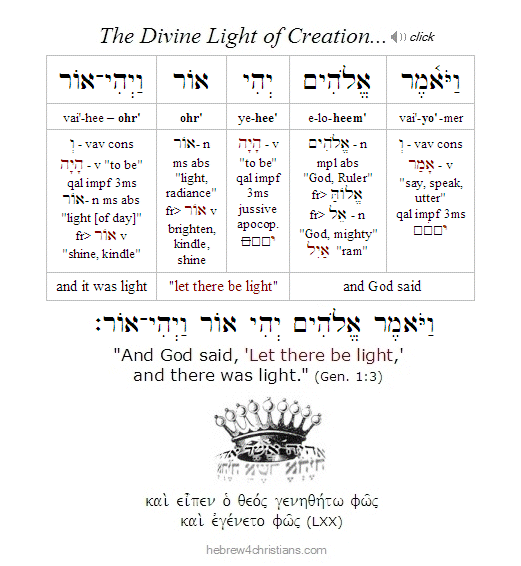 |
Some Bible scholars say that the prophet Daniel foresaw the events of Chanukah centuries beforehand in a vision of a "male goat running from the west" with a conspicuous horn between its eyes (Alexander the Great) that was broken into four (Dan. 8:1-12). Out of the four horns arose a "little horn" (Antiochus) who greatly magnified itself, cast down some of the stars (righteous souls), took away the sacrifices, and cast down the sanctuary in Jerusalem. Years after the Maccabean revolt, Yeshua celebrated Chanukah in the same Temple that had been cleansed and rededicated only a few generations earlier (John 10:22). It was here that many asked if He were the coming Messiah -- harkening back to the liberation of the earlier Maccabees. During a season of remembering miracles (nissim), Yeshua pointed out that the works that He did attested to His claim to be the long-awaited Mashiach of the Jewish people (John 10:37-38).
Finally, in an eschatological sense "Epihpanes" foreshadows the coming time of the "Messiah of Evil" (anti-christ) who will one day attempt to "assimilate" all of humanity into a "New World Order" (Dan. 9:27, 2 Thess. 2:3; Rev. 13:7-9, etc.). At first he will appear to be a "world savior" who will broker peace for Israel and the Mideast, but after awhile, like his archetype Epiphanes, he will savagely betray the Jewish people and set up a "desolating sacrilege" in the Holy Place of the Temple (Matt. 24:15). His satanic rise will occur during acharit hayamim - the "End of Days" - otherwise called the period of the Great Tribulation (Matt. 24). The Final Victory of God will be established when Yeshua returns to destroy this Messiah of Evil at His Second Coming. The Holy Temple will then be rebuilt and dedicated by the hand of the true Messiah of Israel...
Practically speaking, the word chanukah (חֲנוּכָּה) means "dedication," a word that shares the same root (חָנַךְ) as the Hebrew the word chinukh (חִנּוּךְ), meaning "education." Just as the Maccabees fought and died for the sake of Torah truth, so we must wage war within ourselves and break through the stronghold of apathy and indifference that the present world system engenders. We must take time to educate ourselves by studying the Torah and New Testament, for by so doing we will be rededicated to the service of the truth and enabled to resist assimilation into the corrupt world. Love not the world, neither the things that are in the world... (1 John 2:15). The "cleansing of the Temple" is a matter of the heart, chaverim. The enemy is apathy and the unbelief it induces. We are called to "fight the good fight of faith" and not to conform to this present age with its seductions and compromises (1 Tim. 6:12, Rom. 12:2).
Therefore let me wish you a joyful time of celebrating the true and everlasting victory of the Light of the World, our LORD Yeshua. His light "shines in the darkness, and the darkness will never overcome it" (John 1:5): Amen.
Hebrew Lesson
John 1:5 reading (click for audio):
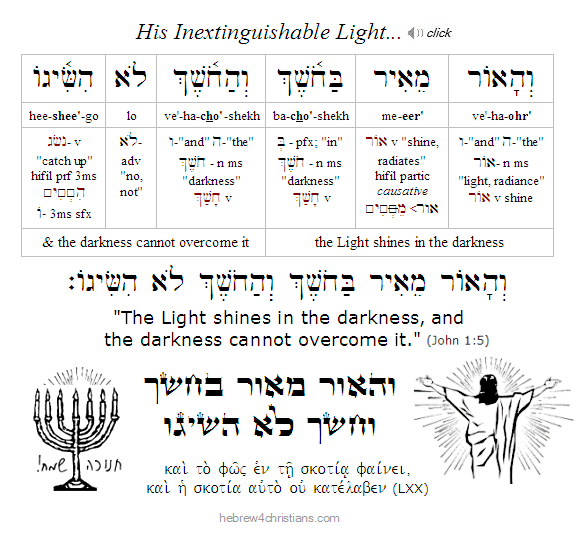 |
The Depths of Hebron...
12.08.25 (Kislev 18, 5786) As young man, Joseph was adorned with a "coat of many colors" and lived in his father's house as the favored son. Joseph was an innocent dreamer who was given visions of greatness by God Himself. Despite being despised and rejected by his brothers, however, his father commissioned him "from the depths of Hebron" (מֵעֵמֶק חֶבְרוֹן) to look into their welfare (Gen. 37:14). Notice that the word Hebron (חֶבְרוֹן) comes from a root (חָבַר) that means "union" or "fellowship," suggesting that Jacob sent out his beloved son "from the depth their fellowship" to search for his missing children....
Joseph willingly accepted his father's mission and set out for Shechem, where he wandered about in search of his brothers. There he met "a certain man" (thought to have been the Angel) who asked him, "What do you seek?" Joseph answered, "I am seeking my brothers" (37:15-17). The sages say that Joseph was seeking the brotherhood (חֲבֵרוּת) of his brothers, for without it life was not worth living. The angel then told him the brothers had "journeyed away" (נָסְעוּ מִזֶּה) and left for "Dothan" (דּתָן), which the midrash says was "code" for a sense of religious self-righteousness (i.e., דָּת). In other words, when the brothers had earlier said, "Let us go to Dothan," they began seeking how they might justify killing Joseph. Rashi states that the angel was in effect warning Joseph of their true intent. Joseph, however, was undeterred by the hatred of his brothers and pressed on with his search...
Joseph willingly left the holiness and purity of Jacob's home for the sake of his brothers, yet it was this very commitment that led to his betrayal and his descent into the depravity and suffering of Egypt. In obedience to his father, he risked everything for the sake of restoring his brothers' love. Prophetically, the "certain man" who first questioned Joseph gave him the "key" to his survival in Egypt. By constantly asking "What do you seek?" Joseph's heart would remain focused in its search. Despite his suffering along the way, Joseph kept faith that his dream of a greater good would one day be fulfilled...
Similarly, Yeshua existed in celestial glory with His Father yet willingly chose to divest himself of his splendor to reach out to his brothers. His incarnation was an infinite descent from the "depth of Hebron" (i.e., communion with the Father) into the realm of "no reputation" (i.e., kenosis, "emptying") in search of his brothers' love (Phil. 2:6-7; Luke 19:10). This search led him to "Dothan," where he faced the self-righteousness of the religious authorities and their wrath. But notice that it was Yeshua's love which ultimately led him to the cross, for it was there that he willingly suffered and died for the sake of his brothers' sins. Yeshua "set his face like a flint" (Isa. 50:5-7); he never gave up the quest for his brothers' love, even before he was vindicated and exalted to the Father's right hand. "For while we were yet sinners, the Messiah gave up his life for us" (Rom. 5:8).
The goal of the cross was to restore us to the "depth of Hebron," the place of communion and love with the Father. God gave up His only begotten Son so that we could be reunited to Him in love. "Behold, what manner of love the Father has bestowed upon us, that we should be called the sons of God" (1 John 3:1).
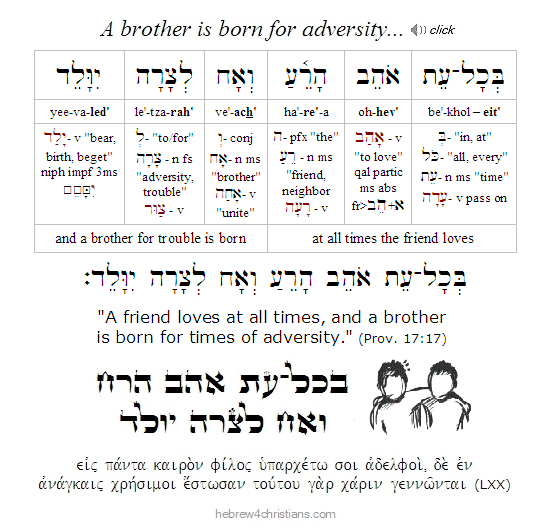 |
<< Return
|