 |
|
|
|
The Jewish Holidays |
|
|
||||||||||||||||||||||||||||||||||||||||||||
|
|
|
|
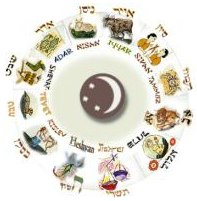
The feasts and holidays of the LORD are part of the larger mosaic of Jewish time that expresses the corporate life cycle of Jews all over the world.
|
|
|
|
|
The Jewish Day |
|
|
|
|
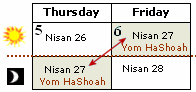
Since the Torah's day (יום התורה) begins at sundown, you must remember that a given holiday actually begins on the night before the day listed in a Jewish calendar. For example, Yom HaShoah (Holocaust Memorial Day) occurs on Nisan 27, which actually begins after sundown, Nisan 26: |
|
|
|
|
|
|
In the example above, Yom HaShoah (ום השואה) is observed both on Thursday the 5th (after sundown) and Friday the 6th (during daylight hours). |
|
|
|
|
|
|
|
The Torah's week (שבוע התורה) begins on Sunday and ends on Saturday (Shabbat). The Jewish sages have argued that Shabbat is the most important of the mo'edim, since it is explicitly commanded to be observed in the Aseret HaDiberot (Ten Commandments). |
|
|

|
|
|
|
|
|
|
The Torah's month (חודש התורה) is based on the lunar cycle, and Rosh ha'Chodesh ("the Head of the Month") symbolizes the renewal of the new moon (month), when the moon appears as a sliver in the sky. Rosh Chodesh is marked by special liturgy. |
|
|
||||||||||||||||||||||||

|
|
|
|
|

|
|
|
 |
|
|
|
|
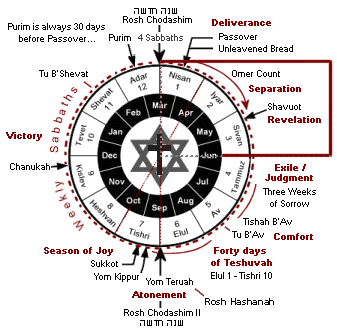
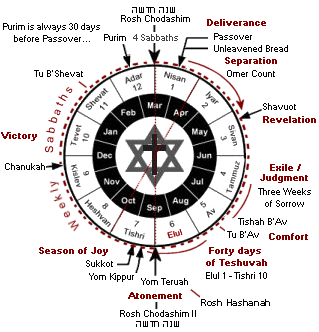
The spring holidays (חגי האביב) reveal the first coming of Yeshua (as Mashiach ben Yosef) and provide a portrait of the death, burial, and resurrection of the Messiah: Yeshua was crucified on erev Pesach (during the time of the sacrifice of the Passover lambs), buried during Chag Hamotzi (the festival of Unleavened Bread), and was resurrected from the dead on Yom Habikkurim (the Day of Firstfruits). Fifty days after Passover, on the climactic holiday of Shavuot (i.e., the feast of Pentecost), the Ruach HaKodesh (Holy Spirit) fell on the believers in fulfillment of the promise given by our Lord. Note both that the giving of the Holy Spirit occurred precisely according to the calendar countdown given in the Torah (Lev. 23:15-16) and that it occurred after the cross of Yeshua -- just as our Messiah foretold (Acts 1:6-8, Acts 2:1-4). This proves that the feasts of the LORD (מוֹעדי יהוה) were not abolished after the crucifixion of the Lord. The meaning of the gospel is prefigured and told in the holidays given in the Torah. See Luke 24:27, 24:44; John 5:46; Acts 26:22, etc.
|
|
|
|
 |
|
|
|
|
|
|
|
|
|
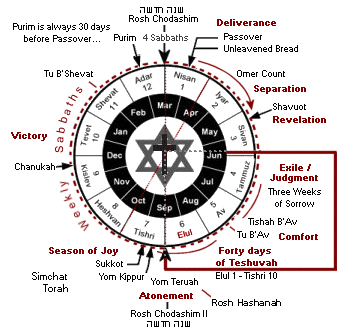
The summer holidays (חגי הקיץ) conclude with the 30 days of the month of Elul, a yearly season of teshuvah (repentance) that anticipates Rosh Hashanah and the fall holidays. The days of Elul are combined with the first ten days of the month of Tishri to create the Forty Days of Teshuvah (ארבעים יום תשובה) that culminate with the holy day of Yom Kippur. |
|
|
|
 |
|
|
|
|
The summer holidays help us prepare for the second coming of the Messiah:
|
|
|
|
|
|
|
|
|
|
||||||||||||||||||||||
|
|
|
|
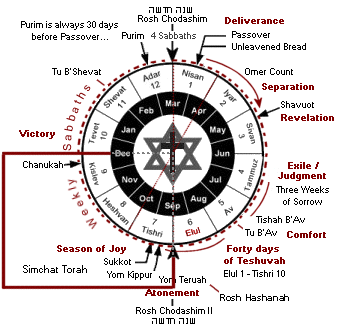
The fall holidays (חגי הסתיו) prophetically indicate the great Day of the LORD (יוֹם־יְהוָה), the second coming of Yeshua, the great national turning of the Jewish people, and the establishment of the reign of the Messiah over the earth during the Millennial Kingdom.
|
|
|
|
|
|
|
Note that two other dates are significant during this season:
|
||||
|
||||
|
|
|
|
|
||||||||||||||||||||||
|
|
|
|
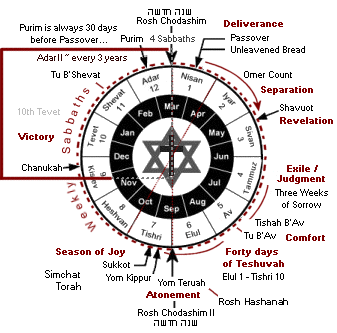
The winter holidays help us anticipate the final victory to come...
|
|
|
|
|
|
|
||||
|
|

|
|
|
|
|
|
|
|
|
|
|
In addition to Yom Kippur, the Talmud (Tractate Rosh Hashana 18b) discusses four fast days (ימי צום) based on Zechariah 8:19 that commemorate the destruction of the First and Second Temples and the exile of the Jewish People from their homeland. In addition, two other fast days are mentioned in the Rabbinical literature, yielding a total of six prescribed fasts (seven if Yom Kippur is included). |
|
|
|
|
|
|
|
 |
||||||
|
|
||||||