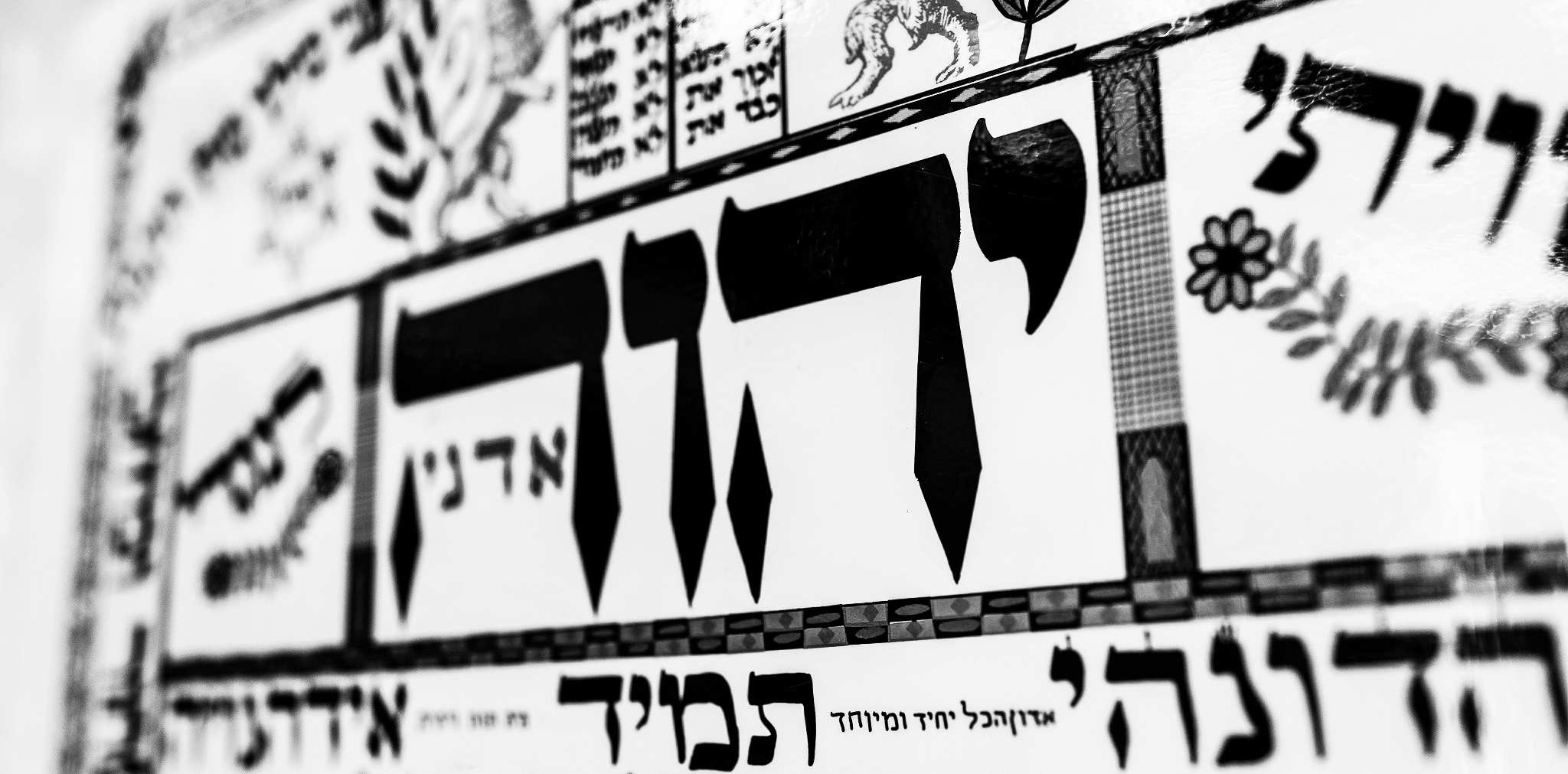
 Our father Abraham is called ha-ivri (הָעִבְרִי) – “the Hebrew,” a term that means “one who has crossed over” (עָבַר) from another place (Gen. 14:13). The famous medieval Torah commentator Rashi literally identified this “other place” as Ur Kasdim (אוּר כַּשְׂדִים), located east of the Euphrates River, though the midrash (Genesis Rabbah) spiritually identified it as the realm of idolatry: “The whole world stood on one side, but Abram crossed over to the other.” Abram separated himself from a world steeped in idolatry and polytheism by worshipping One God who is the sole Creator of all things…. Understood in this way, being “Hebrew” means being regarded as an “other,” a “stranger,” or an “outsider” to idolatrous worldly culture. Therefore all those who “cross over” from the realm of death to life because of Yeshua are rightly called “Hebrews” (John 5:24).
The term “Jew,” on the other hand, refers to one who praises the LORD (יְהוּדָה). The word (יְהוּדִי) comes from a root (יָדָה) which means to “confess” or to “praise” God (Gen. 29:35). The Apostle Paul alluded to this by saying that one whose heart has been circumcised by the Spirit is “one who is praised by God — not by men” (Rom. 2:29). Being a Jew therefore means you are “chosen” to receive blessings and grace to live in holiness for the glory of God and for the healing of the world. The performance of various mitzvot are for the greater purpose of tikkun olam, the “repair of the world,” in order to reveal God’s goodness and love (Eph. 2:8-10). Doing so makes someone a Jew, since his praise comes not from man, but from the LORD. God is the source and the power of what makes a true tzaddik (righteous person). After all, Israel was meant to be a “light to the nations” (Isa. 42:6; 60:3), and God had always planned for all the families of the earth to come to know Him and give Him glory through his chosen servant Abraham (see Gen. 12:3; 22:18). “Jewishness” is therefore not an end in itself but rather a means to bring healing to the nations… Indeed, the entire redemptive story of the Scriptures centers on the cosmic conflict to deliver humanity from the “curse” by means of the “Seed of the woman” who would come. The gospel is Jewish because it concerns God’s great redemptive plan for the whole world (John 3:16; 4:22).

 “If a person vows a vow (i.e., neder: נֶדֶר) to the LORD, or swears an oath (i.e., shevuah: שְׁבוּעָה) to bind himself by a pledge, he shall not break his word. He shall do according to all that proceeds out of his mouth” (Num. 30:2). The Hebrew expression “break his word” literally means “profane his word” (יַחֵל דְּבָרוֹ), that is, to defile the soul by causing it to be inwardly divided, irresolute, and cowardly. After all, breaking your word means violating the integrity of who you are, showing that what you say and what you do are not unified, and this leads to feelings of shame. Your words confess your reality and bring it to life… If you cannot keep your word, your word becomes profane, empty, lost — you become a “stranger to yourself,” unsure of what you intend. “Let your “yes” be yes and your “no” be no; learn to say what you mean and mean what you say (Matt. 5:37).
 The Hebrew word “spirit” (i.e., ruach: רוּחַ) points to wonder, to something extraordinary and beyond our expectation, that is, to the mysterious Divine Presence that pervades all things yet rises above all things. Yeshua likened the ruach with the inscrutable motions of the wind. He said, “The wind blows where it wishes, and you hear its sound, but you do not know where it comes from or where it goes. So it is with everyone who is born of the Spirit” (John 3:8). We see the effects of the wind, but not the wind itself, which illustrates that the wind surrounds us yet is ultimately beyond our grasp and control. To be “born of the Spirit” is therefore a mysterious intervention from heaven (John 1:13), just as being “led by the Spirit” implies seeing differently, that is, apprehending the Divine Presence in the mysterious motions of life.
 From our Torah portion this week (i.e.,
 “Speak to the children of Israel, and say unto them, ‘When ye are passed over into the land of promise… drive away all the inhabitants of the land before you; destroy all their carved images, all their molten images, and demolish their high places’” (Num. 33:51-52). The Hebrew word for idolatry is “avodah zarah” (עֲבוֹדָה זַרָה), which literally means strange or “foreign” worship… The worship of anything other than the true God, whether it is pleasure, money, fame, control, security, self-improvement, health, religion, etc., is regarded as foreign, since it alienates us from the truth of reality. We were created to be in relationship with God but we lose sight of this truth whenever elevate what is finite to the status of the infinite. Indeed idolatry is the substitution of not-god (לא־אֵל) for the sacred, absolutizing the present and worshiping the temporal. Since our greatest good is found in the eternal verities of the divine communion, the Lord cannot give us an absolute good apart from Him, since there literally is no such thing. “No one can serve two masters,” Yeshua said, and “a divided house cannot stand.” For our own good, then, God necessarily is the Ultimate Concern of our life, and he wants to spare us the pain, disappointment, and trauma of being double-minded, disintegrated, and full of inner conflict. Spiritual warfare therefore means taking every thought captive before the bar of God’s truth, rooting out and destroying all our inner idols so that we can be delivered from the anguish of uncertainty and ambivalence.
 “Yea, though I walk through the valley of the shadow of death, I will fear no evil…” (Psalm 23:4). O God of Light, Light of the world, surely You know my need for light as I look to You, especially when darkness tries to extinguish my hope. Despite my inability to see you now, help me to know that you are with me; let “thy rod and thy staff comfort me” and lead me closer to you. Lord, when I am afraid, quicken the faith you have put within my heart. Be Thou my Shepherd in my darkness, O Lord my God…
 The theology of our Messiah insists that truth matters, and that knowing the truth about God is absolutely essential for life itself. Nothing is more important; nothing is more vital. As Yeshua solemnly affirmed: “This is eternal life (חַיֵּי עוֹלָם), that they may know you, the only true God (אֶל־אֱמֶת), and Yeshua the Messiah (יֵשׁוּעַ הַמָּשִׁיחַ) whom you have sent (John 17:3). Note that the Hebrew word for knowledge is da’at (דַּעַת), a word that implies intimate cognitive differentiation and the apprehension of spiritual reality. Your life is a venture of faith, an irrepeatable, infinitely costly venture.
 The message of the cross of Messiah is that your deepest need for love, peace, and happiness is not to be found in this world, nor in the religious philosophies of this world, but instead is found by being healed from the sickness of spiritual death. That’s the gospel message, after all, which presents an offense to the “flesh,” that is, to natural human pride and humanistic aspiration. Indeed many religious people seem to think that something more is needed than the miracle of Messiah, and they therefore both underestimate the severity of our lost condition while flattering the ego with the conceit that it can contribute something to prospect of genuine eternal life… The Apostle Paul admonished: “If with the Messiah you died to the axioms of this world, why, as though you still belonged to the world, do you submit to its presuppositions (i.e., δόγματα)?” (Col. 2:20). Religious “legalism” (i.e., adherence to formula or ritual rather than living in personal faith) is a worldly practice that leads to a false sense of security in the mantras, ceremonies, “virtue signaling,” theological jargon, and various “mummeries” of religion. Worse still may such worldly religion lead to a “holier-than-thou” sense of spiritual superiority or elitism. Yeshua denounced the religionists of his day by focusing on what mattered most of all — healing the outcasts, touching the lepers, seeking the lost, and being a “friend of tax collectors and sinners” (Matt. 11:19). Focusing on outer forms of religion — even Torah based religion — elevates the law to an end in itself rather than as a means to the greater end of love and healing. We have to be careful not to make an idol out of religious practices, for all the commandments are meant to serve the end of receiving God’s love and sharing that blessing with others. Any “Torah observance” that leads you to “thank God that you are not like other people” (Luke 18:11) is therefore not genuine Torah observance at all, for the heart of the Torah is love, just as love is the Torah of the Gospel (John 15:12).
 The “doctrine of Balaam” (ἡ διδαχή Βαλαάμ) is the wicked strategy of enticing others to sin by encouraging them to “eat food offered to idols” and to engage in sexual immorality (Rev. 2:14). This was how Balaam was able finally to curse the Israelites at Baal Peor, after all (see Num. 25:1-10; 31:16). In short, Balaam’s doctrine was one of “syncretism,” advocating a mindless “tolerance” that arrogantly claimed that all religions are equally true, and therefore all are equally false… Such “tolerance” is a charade for moral and spiritual nihilism that creates weakened people easily controlled by political fascism. In ancient Rome, official “tolerance” led to the brutal intolerance of the “Imperial Cult” where the power of the State (represented by the Emperor) was worshiped. In our age, the doctrine of Balaam first entices people to “eat food offered to idols,” that is, to partake in the irrational dogma of “absolute tolerance” and unthinking universalism. After opening the heart to accept such idolatry, sexual immorality is the natural expression, a consequence of self-deception. We must remain vigilant: God sets us free from the slavery of surrounding culture to become a witness of the truth. Assimilating with this world and its political ideals and cultural idols is a form of spiritual adultery. Do not fool yourself: Whoever makes himself a friend of the world is an enemy of God (James 4:4).
 In this week’s Torah portion (i.e.,