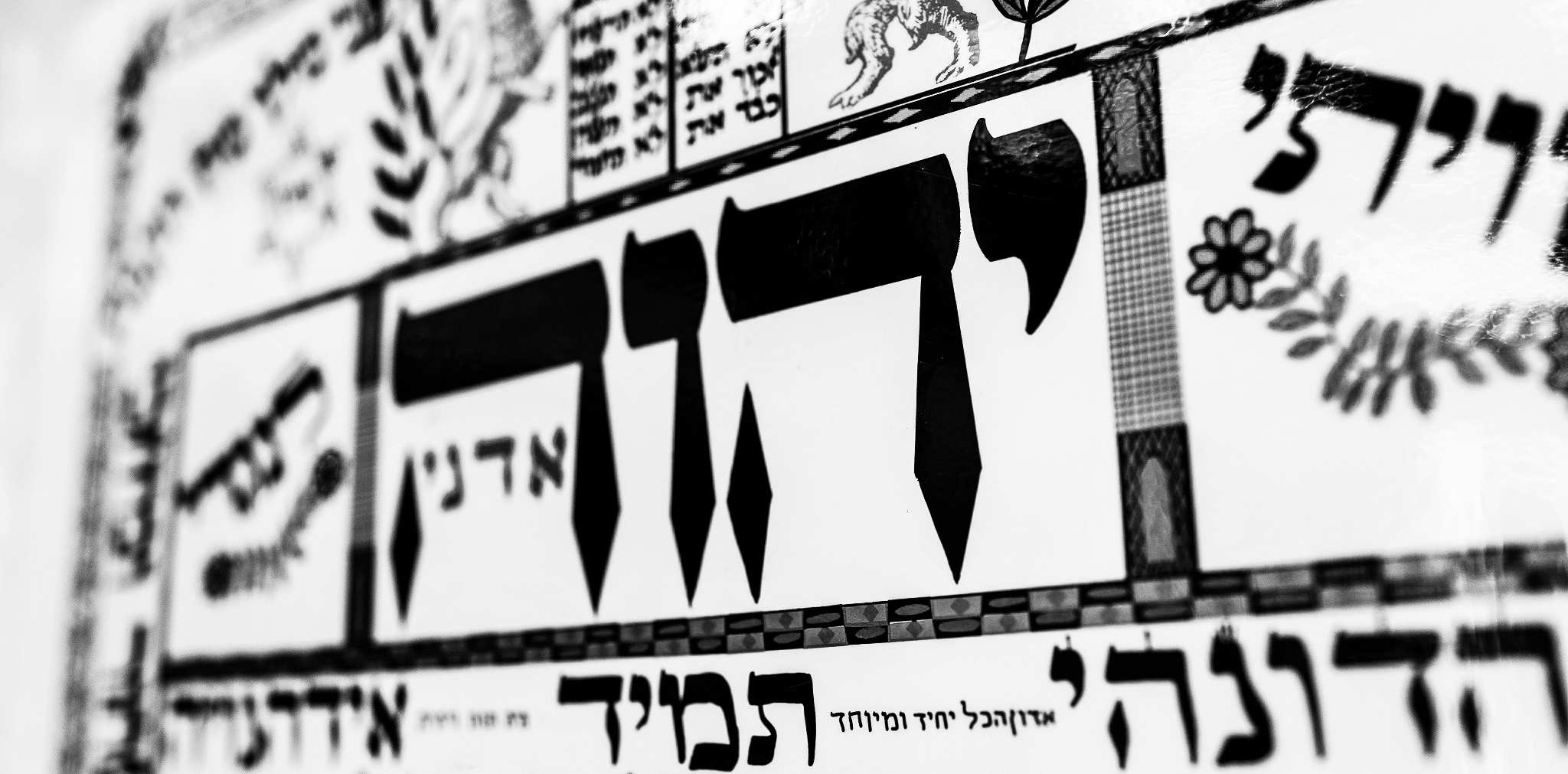
 The first verse of the Book of Leviticus is usually translated: “And the LORD called to Moses and spoke to him,” where the subject of the verb vayikra (וַיִּקְרָא), “and he called,” has an implied antecedent, which if expressed would read: “And the LORD called to Moses and the LORD spoke to him…”

The Hebrew text of the Torah scroll is written with a small Aleph (א) at the end of the verb vayikra, however, indicating something of textual and grammatical interest. Note that the Hebrew letter Aleph is constructed from two Yods (each that represent a yad, or “hand”) joined by a diagonal Vav (that represents a man). One Yod (י) reaches upward while the other reaches downward, and both extend from the “fallen” Vav (ו), picturing Yeshua, the humble One who was “wounded for our transgressions, and bruised for our iniquities” as our Mediator between heaven and earth (Isa. 53:5; 1 Tim. 2:5). The implied subject, then, of vayikra can be seen to be the “small Aleph,” the Humble One who calls out from the Tent of Meeting…

Aleph is the first letter of the first word of the first commandment of God: anokhi (אָנכִי): “I AM” (Exod. 20:2), which also designates the Name ehyeh (אֶהְיֶה) first revealed to Moses (Exod. 3:14). The numerical value of Aleph is one, indicating its preeminence, and it is a silent letter, alluding to the ineffable mystery of God’s sovereign will (the related word aluph (אַלּוּף) means “Master” or “Champion”). In the Hebrew script used for writing Torah scrolls (ketav Ashurit), Aleph is constructed from two Yods (that represent “hands”) joined by a diagonal Vav (that represents man). One Yod (י) reaches upward while the other reaches downward, and both extend from the “fallen” Vav (ו), picturing a “wounded Man” or Mediator (1 Tim. 2:5). In the Hebrew numbering system (i.e., gematria), Yod = 10 and Vav = 6, so adding up the three parts of Aleph yields 26, the same value as the Name of the LORD: YHVH (יהוה). The very first letter of the Hebrew Alphabet, then, pictures the three-in-one LORD who mediates all of life for our salvation. And just as there are three parts to Aleph, but Aleph is One (echad: אֶחָד), so there are three Persons to the Godhead, yet God is absolutely One. Indeed, the gematria of the word Aleph (אָלֶף) is 111 (Aleph=1, Lamed=30, and Pey=80). As Yeshua said, every “jot and tittle” of Scripture is significant…
“And he called” is written anonymously, but once you understand that this is the Word of the LORD speaking, you will turn back to the Creator and then YHVH will speak to you from within the Tent of Meeting…
 “Whoever battles with monsters had better see to it that it does not turn him into a monster” (Nietzsche). A God-fearing man once complained to a sage that he was tormented by evil desire and had become despondent over it. The sage listened intently and then said, “Guard yourself from such despondency above all else, for it is worse than sin. When the yetzer [evil impulse] awakens desire in us, it is not concerned with plunging us into sin, but with plunging us into despair by way of our sinning.”
 The
The 
 It is written in the book of Hebrews that faith (understood in context to refer to the superior ministry of Yeshua that brings eternal redemption and that supersedes the earthly ministrations of the Levites) is the “underlying substance” (i.e., ὑπόστασις, or “being”) of our hope that “demonstrates” (ἔλεγχος) the realm of the unseen in the decisions and actions of those who truly believe. Faith is also a subjective conviction of the heart that apprehends the “unseen,” though that passion is a response to the hidden reality of God, and it is the work or practice of faith that makes the unseen seen. Another way to say this is that the believing heart “substantiates” the promise of God – apprehending the future and making it present within the heart (2 Cor. 4:18). “We walk by faith, not by sight.”
 So much depends on how you look at things… Take the Tabernacle, or “Mishkan,” for instance. Compared to the glories of the Egyptian pyramids, the Sphinx, the enormous temples at Thebes and other places, the Mishkan must have seemed unimpressive and a bit underwheming. The Holy Place structure, for instance, measured just 20 x 20 cubits in size – a modest area covered in animal skins and curtains. Inside the tent structure (ohel) was placed the Menorah, the Shulchan (table), and the relatively small Golden Altar used to burn incense. The tent was further divided by a curtain (parochet) that cordoned off the Holy of Holies, a 10 x 10 cubit square section that contained the most sacred ritual object of all, namely, the Ark of the Covenant. All in all the Mishkan seemed to be a rather humble dwelling shrine when compared to the opulent structures of Egypt.
 Just as we ask God for daily bread (לֶחֶם חֻקֵּנוּ), so we ask him for our daily deliverance: “Lead us not into temptation, but deliver us from evil” (Matt 6:13). Note that the term translated “evil” in many translations (“deliver us from evil”) is a substantive rather than an adjective: τοῦ πονηροῦ, the evil one… “Give us this day our daily deliverance from the evil one….” Our daily bread and our daily deliverance are connected with our decision to “choose life” (בַּחַרְתָּ בַּחַיִּים) — and to always choose life — even in moments we find difficult, distressing, and even when we might wish that we were no longer living… Choosing life means refusing to escape reality by evading the significance of our choices; it means finding the will to regard life as worthy; it implies that we will eat our bread in trust that the Lord is at work even in the darkest of hours (Passover occurred at midnight)… Choosing life means refusing to eat the fruit of death and to seek Yeshua, the Tree of Life. We live one day at a time; we only have today. We are given daily bread for this hour of our need. Today is the day of your deliverance – if you are willing to walk in it. Therefore, the Spirit of the Living God cries out, “Choose life and live!”
 My life has been filled with sorrow, loss, and pain, and therefore I’ve always felt great earnestness about why I exist and what might be the reason for my life. Perhaps because pain and trouble have haunted my days, the matter of salvation for me has always been deeply existential. I did not hunger for healing to find solace over the various disappointments that commonly attend our lives; for me the question was a matter of life and death. I felt like was suffocating and dying inside every day. “Find God or die.”
 The ancient Greek philosophers sought for “salvation” (Σωτηρία), which they generally understood as freedom from the fear of death… Therefore Socrates sought to dispel mythical superstition by regarding philosophy as the “practice for death,” by which he meant that reflecting upon this “shadowy world” would instill a profound hunger for the eternal (and ideal) world, and he therefore advised that, since we all must die, we ought to prepare ourselves now for eternity, by focusing the mind on what is most essential, real, and beautiful.
 If you can’t detect God’s hand in your circumstances, then trust His heart… The heart of faith affirms: gam zu l’tovah (גַּם זוּ לְטוֹבָה): “this too is for good,” particularly when the present hour may be shrouded in darkness… Whenever I am confused about life (which is often enough), I try to remember what God said to Moses after the tragic sin of the Golden Calf: “I will make all my goodness pass before you and will proclaim before you my Name, ‘The LORD’ (יהוה). And I will be gracious to whom I will be gracious, and will show mercy on whom I will show mercy” (Exod. 33:19). God’s character does not change: the LORD is the same “yesterday, today, and forever.” The meaning of the Name, however, cannot be known apart from understanding the need of the heart…
 An honest person is invariably a humble person, since honesty compels the soul to confess the truth that it is profoundly ignorant, incapable of understanding even the simplest matters of life, and entirely powerless to heal itself… People may argue over words, concepts, and abstractions, inflating their opinions above even the Reality they purport to define, but the humble soul acknowledges that he doesn’t really know much about anything… And if “all the efforts of the human mind cannot exhaust the essence of a single fly,” then how is it that people get puffed up and proud regarding their supposed knowledge of life itself? It is far better to approach life in deep reverence, wonder, love, and childlike trust than to profess your dogma based on pride and illusions…