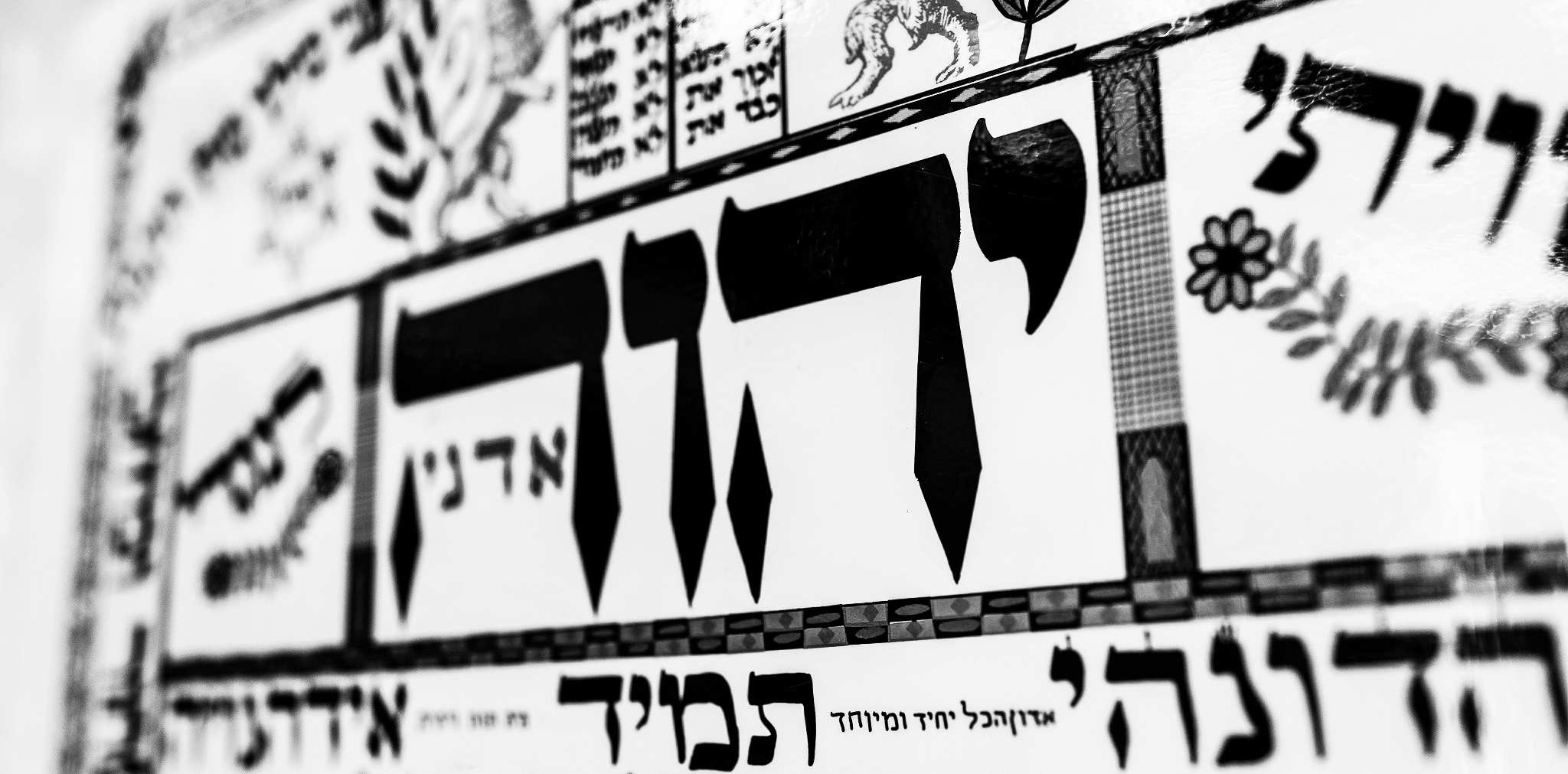
 I had mentioned that on Yom Kippur the High Priest would enter the Holy of Holies and there present the sacrificial blood upon the cover of Ark of the Covenant to make atonement for Israel.
During this solemn ritual the priest would invoke the sacred name of the LORD (i.e., יהוה) while saying his prayers for the people. Since this was the only time the High Priest could enter the Holy of Holies and utter “shem ha’gadol,” the great Name of God, Yom Kippur also came to known as the “Day of the Name” (יום השם).
Perhaps because the Yom Kippur ritual is so mysterious and exciting, the question naturally arises as to how the priest would pronounce the sacred name YHVH (יהוה). Is YHVH pronounced “Yahveh”? or “Yahweh”? or perhaps “Yehovah”? (the morpheme YAH is clearly attested). Consulting the original manuscripts does not settle the issue because they were written without vowels, and the scribes who later added the vowel points (i.e., nekudot) changed the pointing for YHVH to avoid saying it in vain. Christians sometimes feel a bit frustrated or anxious when they consider this, especially because various religious cults claim to have discovered the phonetics of God’s “real” name and use it a sort of “shibboleth” or password for acceptance into their societies…
To seriously attempt to answer the question about God’s name, however, requires thinking a bit about the philosophy of language, and in particular understanding that a name (of any kind) is a symbol intended to point to a reality. Every name (spoken, written, or otherwise represented) is a sign that is intended to signify something. Names “point” to things, and every name (or term) encapsulates a cluster of ideas that summarize, describe, and define what that thing is as opposed to other things (genus and difference). The Name for God, then, would point to or signify the Reality the name stands for, though in the case of God who is the Supreme Being, no one name can fully express the Reality signified since God is Infinite and beyond our full comprehension. That is why Yeshua has a name that no one knows but himself (see Rev. 19:12). Indeed the name YHVH (יהוה) is derived from the Hebrew verb hayah (היה), meaning “to be,” which implies that the Reality signified transcends spatio-temporal categories and therefore is “ein sof” (אין סוף), beyond all reckoning and therefore ineffably mysterious (2 Chron. 6:18; Psalm 40:5; 145:3; Job 9:10, Rom. 11:33, etc.).
 In this world of constant flux, change, and invariable dissolution, is it realistic to expect perfection? Are not our expectations often romanticized notions of how we think things ought be rather than what they really are? Don’t they often collide with the messy and unpredictable matters of life? The desire for elusive “perfection” leads to disillusionment and sorrow. Instead of gratefully accepting what we have, we ask “what if” or wonder about other possibilities that might bring us closer to our supposititious ideal.
 “Hear, O heavens, and give ear, O earth: for the LORD hath spoken, I have nourished and brought up children, and they have rebelled against me…. Ah, sinful nation, a people laden with iniquity, offspring of evildoers, children who deal corruptly! They have forsaken the LORD, they have despised the Holy One of Israel, they are utterly estranged. Why will you still be struck down? Why will you continue to rebel? The whole head is sick, and the whole heart faint. From the sole of the foot even to the head, there is no soundness in it, but bruises and sores and raw wounds… Your country lies desolate; your cities are burned with fire; in your very presence foreigners devour your land; it is desolate, as overthrown by foreigners….” (Isa. 1:2-7).
 It is written in our Scriptures: “My child, if you receive my words and treasure up my commandments with you, making your ear attentive to wisdom and inclining your heart to understanding; yes, if you cry out for insight and raise your voice for understanding, if you seek it like silver and search for it as for hidden treasures, then you will understand the fear of the LORD (יראת יהוה) and find the knowledge of God (דעת אלהים). For the LORD gives wisdom; from his mouth come knowledge and understanding; he stores up sound wisdom for the upright; he is a shield to those who walk wholeheartedly before Him” (Prov. 2:1-7).
 Think counterculturally. Do not let your mind be conformed (lit., “squeezed into the mold”) of this world, but be transformed (μεταμορφόω, i.e., metamorphosized like a caterpillar is changed into a butterfly) by the renewal of your mind (Rom. 12:2). The Greek word translated “renewal” is ἀνακαίνωσις, from ἀνά, meaning “up, into the midst,” and καινός, meaning “newness.” The idea here is that we are inwardly transfigured as we take hold of the truth of the new covenant and make it central to our lives. For this we must “put on the mind of Messiah” and repudiate the world’s values and vain philosophies (1 Cor. 2:16). “When the devil is called the god of this world, it is not because he made it, but because people serve him with worldliness.” The “god of this world” blinds the eyes of those who do not believe so they cannot see the truth of the gospel of Messiah (2 Cor. 4:4). The philosophy of this world is always based on lies, propaganda, fear, lust, pride, anger, appeals to vanity, and so on. We must use discernment and test the world’s assumptions against the truth of the Scriptures.
 In the Torah portion for
  From our Torah (
 The Scriptures teach that every word we speak and every choice we make are infallibly recorded in “heavenly scrolls,” and one day these scrolls will be opened as a testimony about what we did with our lives (Dan. 7:10; Matt. 12:36-37; 1 Cor. 3:13, 4:5). “And I saw the dead, both the great and the small, standing before the throne, and books were opened. Then another book (סֵפֶר אַחֵר) was opened, which is called the Book of Life (סֵפֶר הַחַיִּים). And the dead were judged by what was written in the books, according to what they had done” (Rev. 20:12).
 Yeshua said the kingdom of heaven could be likened to a king who gave a wedding feast for his beloved son. Those who were invited made one excuse after another why they could not attend, so the disappointed king then instructed his servants to “go out quickly to the streets and lanes of the city, and bring in the poor and crippled and blind and lame… and compel everyone you find to come in, so my house may be filled.” God loves people and implores them to personally join in the celebration of his love, to partake of the marriage feast of Lamb (Rev. 19:7). But note that this means that we are to bring all the lame, broken, and fearful parts of ourselves to the banqueting table of God’s love… The courage to “come to the table” only comes from a sense of being welcomed and accepted, that is, by trusting that you are truly made safe by God’s love….
 If you are having a tough day today, or if you feel oppressed, lonely, or heavy of heart, let me encourage you to praise God anyway… Offering thanks to the LORD is a powerful weapon for announcing God’s triumph over the darkness of the present hour (2 Cor. 10:4). Indeed, the Lord is “enthroned” by the praises (תְּהִלּוֹת) of His people (Psalm 22:3). Therefore give voice to your hope and confidently affirm: “Behold, God is my salvation (i.e., my yeshua, my “Jesus”); I will trust, and will not be afraid; for the LORD God is my strength and my song, and he has become my salvation” (Isa. 12:2).