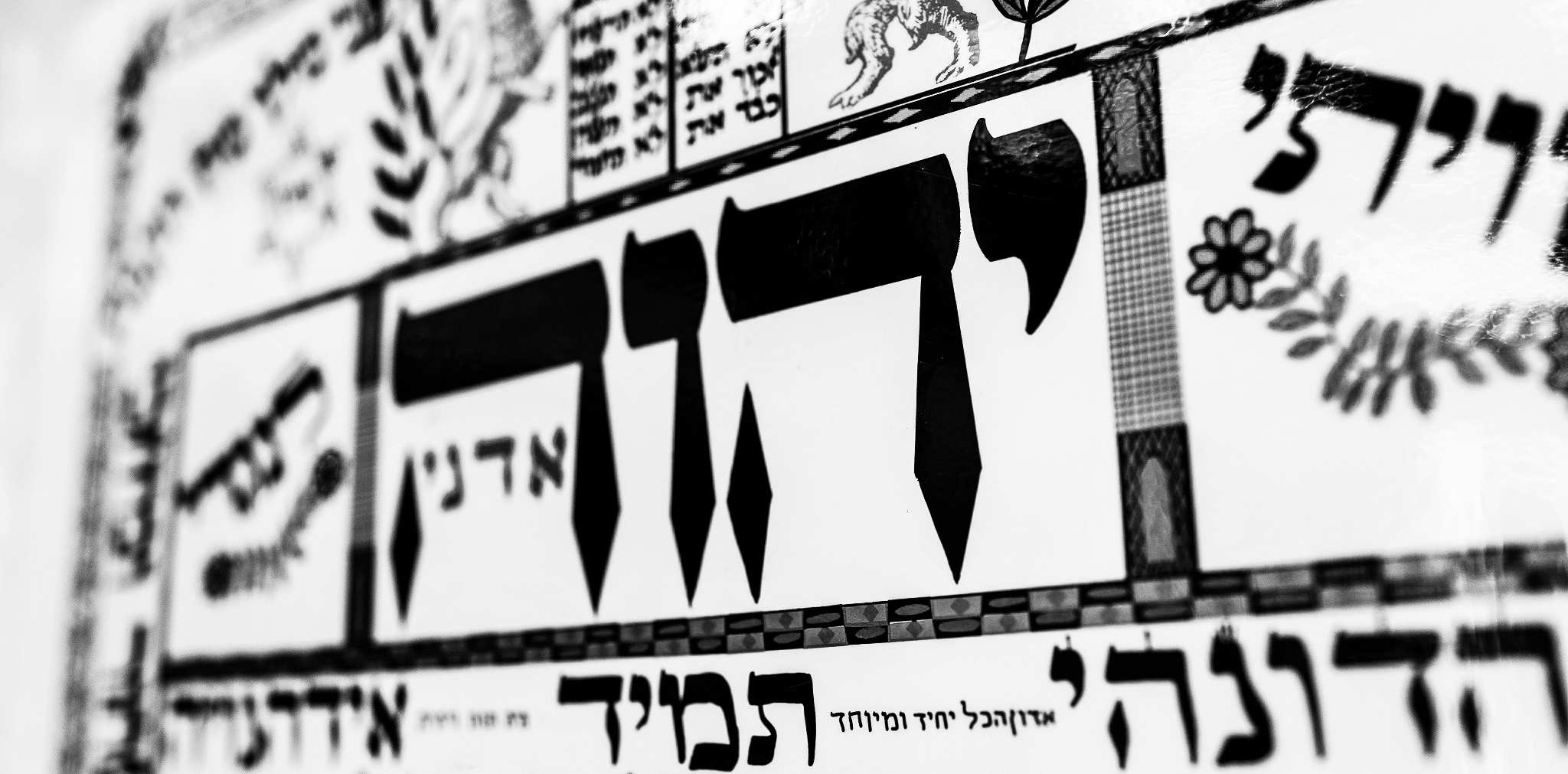
 This week’s Torah portion (the first of the Book of Exodus) is called Shemot (שְׁמוֹת, “names”) because it begins with a list of the “names” of the descendants of Jacob who came to dwell in the land of Goshen: וְאֵלֶּה שְׁמוֹת בְּנֵי יִשְׂרָאֵל הַבָּאִים מִצְרָיְמָה / “These are the names of the sons of Israel who came to Egypt” (Exod. 1:1). Now while it’s true that the Torah here lists the various names of the sons of Jacob, this portion of Torah more importantly refers the Names (plural) of the LORD God of Israel Himself.
To see this, let’s consider the central story of this portion of Torah, namely, the commissioning of Moses at the Burning Bush (see Exod. 3:1-20). Note that the Torah states that it was the Angel of the LORD (i.e., Malakh Adonai: מַלְאַךְ יהוה) who appeared to Moses בְּלַבַּת־אֵשׁ מִתּוֹךְ הַסְּנֶה / “in a flame of fire out of the midst of a bush” (Exod. 3:1-2). But then the Torah goes on to say that the LORD (יהוה) saw Moses drawing near to the bush while God (i.e., Elohim: אֱלהִים) called out to him. God (i.e., Elohim) then commanded Moses to remove his sandals and identified Himself as the “God of Abraham (i.e., Elohei Avraham: אֱלהֵי אַבְרָהָם), the God of Isaac (i.e., Elohei Yitzchak: אֱלהֵי יִצְחָק), and the God of Jacob (i.e., velohei Ya’akov: אֱלהֵי יעֲקב).” In this short and dramatic account we have several Names of God presented – the Angel of the LORD, the LORD, God (Elohim), and the “God of Abraham, the God of Isaac, and the God of Jacob” – all of which refer to the One true God!
 Many people go through the day oblivious to the miracle of existence… If you carefully consider even the most common of things, however, such as a piece of bread, for instance, you will soon realize that it represents a series of causes leading back to transcendental power, and finally, to the Creator and Sustainer of all things. A piece of bread comes from flour, which is milled from seed grown in topsoil through an amazing synthesis of light, air, minerals, and water. However, photosynthesis is a secondary effect of more fundamental forces such as the energy of the sun, the elements of earth, water, and atmosphere, the pull of gravity, and the marvelous inner “form” or intelligence of the seed itself… The “germination” of a seed is really quite miraculous, replicating the body and energy of a plant in miniature form (“this acorn I hold in my hand contains a thousand oak trees”). My point here is simple. Life is full of mysteries, though we can suppress consciousness of its wonders by means of ingratitude for our existence. God is never silent, however, since “The heavens declare the glory of God; the sky above proclaims the work of his hands; Day to day pours out speech; night to night reveals His knowledge” (Psalm 19:1-2).
 The Lord had compassion for his people as they were suffering in Egypt. The LORD told Moses, “I have surely seen the affliction of my people who are in Egypt and have heard their cry… I know their sorrows” (Exod. 3:7). The grammar here is intense: “seeing I have seen” (רָאה רָאִיתִי). Understand, then, that God surely sees your struggles, friend. Second, know that God heeds the outcry (צְעָקָה) of your heart, and indeed, he interprets your groaning as if it were for the sake of serving him. Your heart’s cry is transformed by grace to be the cry for God himself, for relationship with Him: “The cry of the people has come to me,” he again told Moses (Exod 3:9), which means all the sufferings, the wrongs, the hopes, the fears, the groans, the despair, the prayers, were present before him, as if he counted every word and sigh. Third, realize that God knows your sorrows; he gathers all your tears into his bottle (Psalm 56:8). The word translated “sorrows” (מַכְאב) is the same used to describe the “Man of sorrows” (אישׁ מַכְאבוֹת), Yeshua our Suffering Servant, who gave up his life to deliver you from darkness, sorrow, and fear (Isa. 53:3-5).
 Yeshua often used various agricultural images in his parables. For example, he explained that people are known by the “fruits” of their lives (Matt. 7:16-20). He likened the spread of his message in terms of “sowing and reaping” (Matt. 13:3-23) and compared the Kingdom of Heaven to the secret working of a mustard seed (Matt. 13:31-32). Yeshua regarded the world as a “field” for planting with different “types of soil” (Matt. 13:38-43), and warned of the “great harvest” of souls at the end of the age (Luke 10:2; Matt. 13:30). He pointed to signs from a fig tree to indicate the nearness of the prophesied End of Days (Matt. 24:32-33). Yeshua also used the metaphor of a “vine and its branches” to explain how his followers are to be connected to Him (John 15:1-6).
 Spiritual fruit does not immediately crop up but requires time and its own season (Psalm 1:3). The process of spiritual growth is mysterious and comes from heaven’s creative power, as Yeshua said: “The Kingdom of God (מַלְכוּת הָאֱלהִים) is like someone who spreads seed on the ground. He goes to sleep and gets up, night and day, and the seed sprouts and grows, though he does not know how. By itself (αὐτομάτη, i.e., “automatically”) the soil produces a crop, first the stalk, then the head, then the full grain in the head. And when the grain is ripe, he comes in with his sickle because the harvest has come” (Mark 4:26-29). The wonder of faith understands the “ordinary” process of the growth of a seed as genuinely miraculous… With God all things are possible – and that includes the miracle of our newness of life. It is the fruit of the Spirit, after all, and that means that its source and end is found in God’s love…
 “Pray that you may never have to endure all that you can learn to bear.” Yes, though we must also believe that God “will not let us be tested beyond what we are able to bear, but with the test will also provide the way of escape (τὴν ἔκβασιν) so that we may be able to endure it” (1 Cor. 10:13). Indeed, in light of suffering what we really need is perseverance, or what the New Testament calls hupomone (ὑπομονή), a word that means “remaining [μένω] under [ὑπο]” the Divine Presence while being tested (the English word “suffer” comes from the Latin word sufferre, from sub- (under) + ferre, to carry, and therefore denotes “bearing under” difficulty). When we suffer, especially when we find no answer to our agony, we need to find the will to believe, the strength to stay constant, and the rise of hope that gives utterance to simple prayers that focus the heart upon the Lord’s Presence: “God have mercy…” “Help me, O God…” “I need Thee, O Lord…” When we receive grace to faithfully suffer, we hear the Spirit whispering back to us: “Be not afraid…” “Live in me…” “Walk in the light…” “I am with you always…” “You are loved…”
 The Hebrew word for “world” or “age” is olam (עוֹלָם), which is derived from a root verb (עָלַם) that means “to conceal” or “to hide.” God “hides” His face from us so that we will seek Him, and that means we must press through ambiguity to earnestly take hold of divine truth. Centuries before the time of the philosopher Plato, King David proclaimed that there was a “divided line” between the realm of the temporal world and realm of the hidden and eternal world. The temporal world is finite, subject to change, yet pointed beyond itself to an eternal world, which was the source of real significance, meaning, and life itself (2 Cor. 4:18). Therefore King David said, בַּקְּשׁוּ פָנָיו תָּמִיד/ bakeshu fanav tamid: “Seek His face at all times” (Psalm 105:4). Note that the numerical value for the word “fanav” (i.e., “His face”) is the same as that for the word “olam.” When we truly seek God’s face (i.e., His Presence) we are able to discern the underlying purpose for our lives.
 The defining characteristic of our age may be summed up by the word “stupidity,” which may be defined as the impaired spiritual, moral, and mental condition of acculturated people (even seemingly intelligent ones) that has rendered them incapable of honestly evaluating truth claims and thinking logically (Rom. 1:28). Such “stupidity” has been inculcated by pop culture, scripted by mass media; propagated by the “dumbing down” of our educational system, and disseminated by godless political correctness propaganda for several generations now… Today we live in a morally insane and lawless culture that is incapable of self-governance — a culture that has become entirely reprobate before the eyes of heaven.

 “Love not the world, neither the things that are in the world. If any man love the world, the love of the Father is not in him” (1 John 2:15). The way of faith always represents collision with the world (κόσμος) and its philosophy of the “good life.” Happy are those who “hunger and thirst” for righteousness, who refrain from this world and make themselves poor because of inner heartache. For them no amount of the world’s pleasures can obscure the difference between what is and what ought to be… This world is at best a corridor to the world to come, a “valley of decision” about what we ultimately choose to believe and to love…The heart of faith looks forward to “the city that has foundations, whose designer and builder is God” (Heb. 11:10).