|
Jewish Holiday Calendar
For March 2026 site updates, please scroll past this entry....
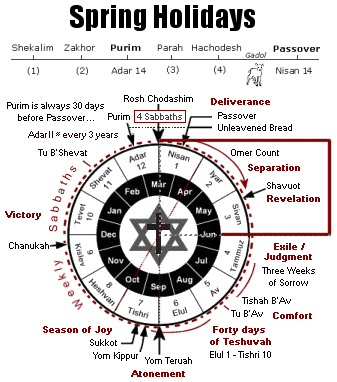
The Torah divides the calendar into two symmetrical halves: the Spring and the Fall, indicating the two advents of Messiah. The Biblical year officially begins during the month of the Passover from Egypt (called Rosh Chodashim, see Exod. 12:2), and the spring holidays of Passover, Unleavened Bread, and Firstfruits both recall our deliverance from Egypt and also our greater deliverance given by means of the death, burial, and resurrection of the Messiah, the great Passover Lamb of God. The holiday of Shavuot (i.e., "Pentecost") both commemorates the revelation of the Torah at Sinai as well as the revelation of the Ruach HaKodesh (Holy Spirit) at Zion, in fulfillment of the promise given by our Lord....
The intermediate months of summer end with the advent of the sixth month of the calendar, the month of Elul, which recalls the time Moses interceded on behalf of Israel after the sin of the Golden Calf. To commemorate this time of our history, we likewise focus on teshuvah (repentance) in anticipation of Rosh Hashanah and especially in anticipation of Yom Kippur, the great "Day of Atonement." In Jewish tradition the 30 days of Elul are combined with the first ten days of the seventh month (called the "Days of Awe") to set apart "Forty Days of Teshuvah" leading up to the Day of Forgiveness for Israel. Immediately following Yom Kippur, the mood changes as we begin preparing for a joyous week-long celebration called Sukkot (i.e., "Tabernacles") that concludes with the holiday of Simchat Torah.
 |
The Spring Holidays:
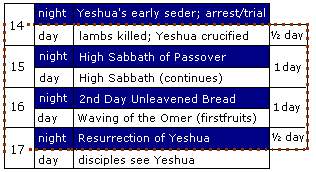
The spring holidays (חגי האביב) portray the death, burial, and resurrection of the Messiah: Yeshua was crucified on erev Pesach (during the time of the sacrifice of the Passover lambs), buried during Chag Hamotzi (the festival of Unleavened Bread), and was resurrected from the dead on Yom Habikkurim (the Day of Firstfruits). Fifty days after Passover, on the climactic holiday of Shavuot (i.e., the feast of Pentecost), the Ruach HaKodesh (Holy Spirit) fell on the believers in fulfillment of the promise given by our Lord. Note that the giving of the Holy Spirit occurred precisely according to the calendar countdown given in the Torah (Lev. 23:15-16), and that it occurred after the resurrection of Yeshua -- just as our Messiah foretold (John 16:7; Acts 1:6-8, 2:1-4). This proves that the feasts of the LORD (מוֹעדי יהוה) were not abolished after the crucifixion. The meaning of the gospel is prefigured in the holidays given in Torah. See Luke 24:27, 24:44; John 5:46; Acts 26:22, etc.
![Spring Holiday Timeline (H4C]](../../../../About_HFC/Site_News/Archive-2026/roshchodeshim-line.gif) |
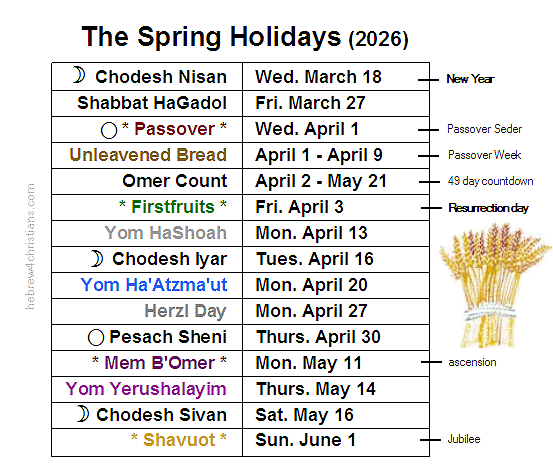
Kindly note that in accordance with both Torah and Jewish tradition, the following holiday dates begin at sundown before the date they are listed (ויהי־ערב ויהי־בקר; Gen. 1:5):
- Month of Adar (Mon. Feb. 19th [eve]) - Wed. March 18th [day])
Dates for Passover Week 2026:
Free Seder Guide
- Month of Nisan (Wed. March 18th [eve]) - Thurs. April 16th [day])
- Month of Iyyar (Thurs. April 16th [eve] - Sat. May 16th [day])
- Month of Sivan (Sat. May 16th [eve] - Sun. June 14th [day])
 |
Note: For more information, see the Calendar Pages....
March 2026 Updates
Note: If any page content appears to be missing, please refresh the page...
Teshuvah and God's Love...
"The Holy One, blessed be God, said to Israel: 'My children, present to me a single opening of repentance, small like the eye of a needle, and I will open for you entrances through which wagons and carriages can pass.'" –Shir Hashirim Rabbah 5:3.
03.31.26 (Nisan 13, 5786) If you ever feel disappointed because of recurring personal struggles and failures, do not add to your troubles by despising yourself, but instead allow your character defects to lead you to humility and surrender before God. Bear in mind that you are unable to please God apart from his intervention and help (John 6:63), so avoid self-reproach, since teshuvah (i.e., repentance) is not about learning to deal with your pains, after all, but trusting the Lord to do the miracle of healing within you. It is liberating to fully apprehend that it is God who justifies you and not you yourself....
You "have been crucified with the Messiah" (Gal. 2:20) - the verb used in this phrase is a "perfect passive" form in the original language (i.e., συνεσταύρωμα), meaning that it indicates completed action done on your behalf. Your job is not to devise your own sanctification but to receive the blessing by faith, trusting in God's righteousness given on your behalf. The focus is not on you, and when you get out of the way and surrender, the grace and love of God will do the impossible within you (Matt. 19:26).
In a way, teshuvah is a kind of death, that is, identifying with the judgment of Messiah given on your behalf, just as teshuvah is life as you take hold of your new identity in him. Practically speaking you turn away (i.e., "die to") your anger, disappointments, bitterness, and sorrows by turning to the Lord for his acceptance and grace. God will bring freedom and newness of life from what binds your heart. As C.S. Lewis once advised: "Remember that He is the artist and you are only the picture. You can't see it. So quietly submit to being painted, that is, keep fulfilling all the obvious duties of your station... asking forgiveness for each failure and then leaving it alone. You are in the right way. Walk -- don't keep on looking at it" (Collected Letters). How you do teshuvah depends a great deal on where you are standing: if you are before the cross of Messiah, then you stand on the side of divine grace; otherwise you will remain in a place of exile, questioning God's love for you. Choose to believe and you will see his heart for you...
Hebrew Lesson
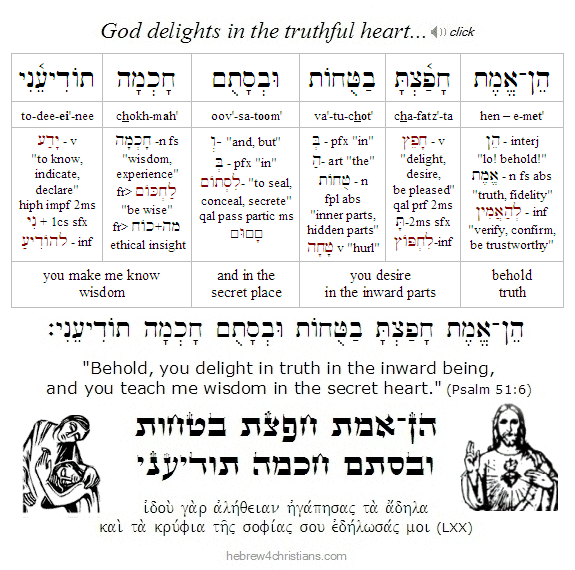
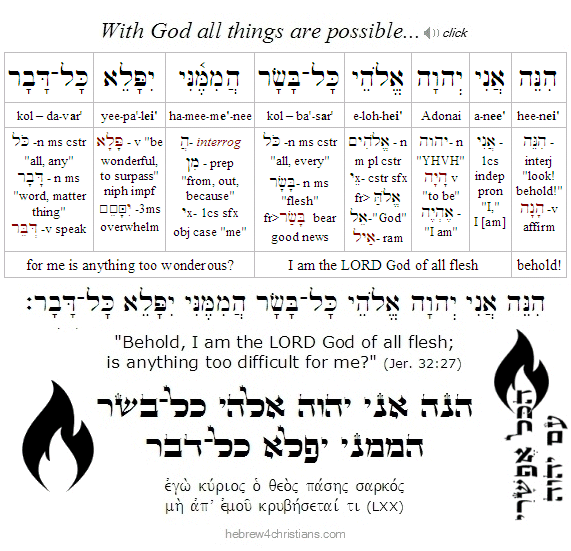
Jeremiah 32:27 reading (click for audio):
 |
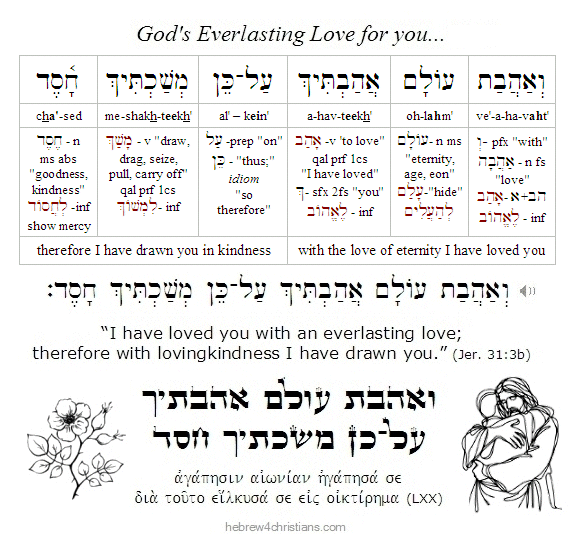
The "severity" of the gospel demands that you regard yourself as beloved, worth saving, and that you are God's friend... "There is no greater love than this: that someone lay down his life for his friends" (John 15:13). God quite literally demands that you regard yourself as benefitted by the sacrifice of his beloved son Yeshua in your place; he demands that you understand how dear you are to his heart. God sees something of such great value in you that he was willing to suffer and die to redeem it from loss... Just as the kingdom of God is a "pearl of great price," so you are a pearl of great price to God. What grieves and angers God is the refusal to believe that you are someone of infinite importance to him... Only God can rightfully make such a demand because He knows that loving other things more than Him leads to "disordered love," darkness, and eventual madness. We were created and given the breath of life for God's love, but substituting finite things for our infinite need will never bring lasting healing to our souls...
Those who are "in the flesh" cannot please God (Rom. 8:8). We must turn away from regarding ourselves as mere "flesh" and understand that we are essentially spiritual beings created and redeemed by God (2 Cor. 5:16). We must give up the distinctions in the "world of basar" - the carnal world that is known through sensuous apprehension - and accept ourselves as "new creations" in the Messiah. It is "not the children of the flesh who are the children of God, but the children of the promise are counted as offspring" (Rom. 9:6-8).
The mere conviction of sin is not the same thing as repentance. We have to step beyond a troubled conscience and have our sin crucified by God's love and grace. Grace is therefore essential to genuine repentance, since moral reformation is never enough. "When Christ calls a man, he bids him come and die." We must be humbled so that we can receive. God gives us bitter experience of our inadequacy to call us to return to him. Only God can kill the power of sin within our hearts. Conviction of sin is not the end, but rather newness of life.
There is a place for godly sorrow, of course, and for genuine regret over our sins. As we understand God's desire and love for us, we begin to realize that the essence of sin is the refusal of God's heart for us. The underlying issue with sin concerns the question of God's love. Simply abstaining from certain actions does not address the deepest need of the heart. It is not turning away from sin that matters as much as turning toward God. The death of sin is meant to lead us to the life of love...
God is both infinitely loving and infinitely just, and both of these "attributes" are inseparably a part of who he is. God is One. Nonetheless, the cross of Yeshua proves that "love is stronger than death, passion fiercer than the grave; its flashes are flashes of fire, a raging flame, the very flame of the Lord" (Song. 8:6). It is at the cross that "love and truth have met, righteousness and peace have kissed" (Psalm 85:10). This implies that we must drop our defenses – even those supposed objections and pretenses voiced by our shame – and "accept that we are accepted." It is God's great love for you that leads you to repent and to turn to him. Allow yourself to be embraced by his "everlasting arms."
Genuine repentance will entirely change you. It is an act of profound respect over what God has done on your behalf. You say, but I am a miserable wretch! Indeed that is so, but the consciousness of your wretched state is the heart's cry for love... God goes "outside the camp" to meet with you. He enters the leper colony to join you there, in your wretchedness, and even takes upon your fatal disease. He sees you in your desperate estate and joins you there. God enters into the dust of your death and says, "Live!"
Repentance means changing your thinking, turning around to face the truth, and returning to embrace God's love. It does not identify the whole person with sin, but rather regards all people as redeemable, worthy, and valuable to God. Conviction of sin is not the end, but rather the means to newness of life. God saved us so that we could be in a love relationship with Him. We must "choose life," and that means choosing to welcome God's love into your heart. The only sin that can keep you from God's everlasting love is the denial that his love is personally for you. You must forsake seeing yourself "in the flesh" and take hold of God's spirit, his passion, and his grace for your soul. You are worthy to be loved because God is worthy to make you so.
Repent and believe the good news. God is love, and that love is for you. Amen, and may the Holy Spirit seal these words upon our hearts....
Our Reason for Being...
03.31.26 (Nisan 13, 5786) From our Torah portion just before Passover (i.e., parashat Tzav) we read: "This is the thing that the LORD commanded you to do, so that the glory of the LORD may appear to you: Draw near to the altar and offer your sin offering and your burnt offering and make atonement for yourself" (Lev. 9:6-7).
In this connection, have you considered why you were born into this world? What is your purpose, destiny, and end? The Torah states that you were personally created by Almighty God, who breathed out the breath of life (נִשְׁמַת חַיִּים) into you, and then redeemed your life so you could know the glory of God and spiritual reality. As it is written: "Worthy are you, our Lord and God, to receive glory and honor and power, for you created all things, and by your desire they existed and were created" (Rev. 4:11).
God creates all things for his glory and purposes, which indeed is the first blessing recited over the bride and groom in a traditional Jewish wedding: בָּרוּךְ אַתָּה יְהוָה אֱלהֵינוּ מֶלֶךְ הָעוֹלם שֶׁהַכּל בָּרָא לִכְבוֹדו / "Blessed are you Lord our God king of the universe, who has created all things for his glory." The purpose of life is to know and love God, to walk in His light and truth, and to glorify his compassion and grace forever...
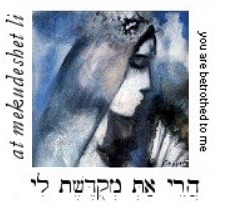
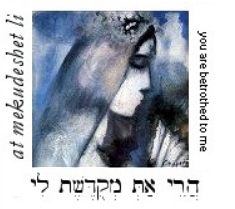
At a traditional Jewish wedding the groom places the ring on his bride's finger and says: Harei, at mekudeshet li: "Behold, you are betrothed to me." Love and holiness are interconnected, since the beloved is set apart as sacred and treasured. May God help us see the wonder of His love for our lives: "Do not be conformed to the passions of your former ignorance, but as he who called you is holy, you also be holy in all your conduct, since it is written, "You shall be holy, for I am holy" (1 Pet. 1:14-16). Amen, the essence of holiness is God's love...
 |
Great Passover Mystery...
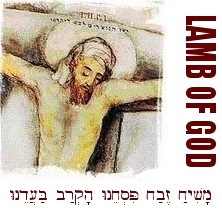
"But God forbid that I should boast except in the cross of our Lord Yeshua the Messiah, by whom the world has been crucified to me, and I to the world." - Gal. 6:14
03.30.26 (Nisan 12, 5786) If you sometimes feel a bit unsettled or confused about the relationship between the law of God and the message of gospel, you are not alone, for even the Apostle Peter, who was a close disciple of Yeshua for over three years, was confused about the issue. In fact, Peter's confusion eventually led the Apostle Paul to publicly rebuke him for separating himself from Gentiles when certain religious Jews came to visit him in Antioch (Gal. 2:11-18). It's hard to believe what happened, since Peter should have known better after he was given a direct vision from God showing that Gentile believers were to be regarded as co-heirs of eternal life (see Acts 10). Nevertheless, Peter seemed to be afraid of "Judaizers" who insisted that Gentiles must observe the law of Moses in order to be saved, and it was that point in particular that raised the holy ire of the Apostle Paul...
What gave Paul the authority to rebuke Peter? Didn't Peter do a lot of miracles and boldly preached that salvation had come to Israel in Yeshua (e.g., Acts 2:14-40)? Yes indeed, though despite his special place among the first disciples, the conversion of Paul was an exceptional thing, and it is important to understand that after his conversion, God himself taught Paul the deeper implications of the ministry of Yeshua, particularly as it was related to the Torah (see Gal. 1:11-20). Whereas the four gospels faithfully bear witness of the life and ministry of Yeshua, God specifically called Paul to explicate the meaning of the gospel.
Recall that before his conversion Paul was a Torah student under Rabbi Gamaliel (גמליאל), a leading member of the Sanhedrin during years concurrent with Yeshua as he was preaching in Judea (Acts 22:3). Rabbi Gamaliel, who was the grandson of renowned rabbi Hillel the Elder (רבי הלל הזקן), is quoted in the book of Acts, where he sagaciously advised the Sanhedrin Council to show leniency toward the followers of Yeshua, saying "let them alone, for if this plan or this undertaking is of man, it will fail; but if it is from God, you will not be able to overthrow them, lest you find yourselves fighting against God" (see Acts 5:34-40).
I once read an article that wondered whether Paul might have known of the teachings of Yeshua before his conversion and whether he might even have heard him preach on various occasions. Indeed, Paul may have witnessed the Lord's crucifixion itself! I think this is an entirely reasonable possibility, especially since Paul was an earnest Torah student who lived in Jerusalem during the time when Yeshua was preaching there. Surely "Rabbi Sha'ul," as he might have been called, would have been zealously interested in Yeshua's discussions and confrontations with the scribes and Pharisees, and he likely would have been provoked by Yeshua's rejection of the priesthood of the Temple as well. And surely Paul would have been intensely concerned about Yeshua's claim to be the Messiah of Israel!
The New Testament records that Paul had witnessed the testimony Stephen and approved of his execution (see Acts 6:8-8:2). Shortly afterward we read that he was consumed with the madness of religious rage and volunteered to lead a posse to arrest followers of Yeshua who had fled to Syria and to bring them back to Jerusalem to face charges of blasphemy. It was during this Jewish "crusade," you will recall, that Paul was suddenly blinded by the light from heaven as he heard Yeshua (speaking in Hebrew) saying, "Saul, Saul, why do you persecute me?" Saul then answered, "Who are you, Lord?" and the voice replied, "I am Yeshua whom you are persecuting" (Acts 9:1-20; Acts 26:10-18).
Paul immediately understood the implications. He didn't need any further explanation. Perhaps in a flash he remembered Stephen's amazing testimony as he died for his faith, or perhaps he recalled the vision of Yeshua dying on the cross... We are not sure what went through his mind, but it is clear that he unquestioningly accepted the Voice that spoke to him as being none other than that of Yeshua himself, raised from the dead.
This might explain why Paul regarded the crucifixion of Yeshua to be the most significant thing God has ever done, surpassing all the glories and wonders of the Exodus from Egypt and the giving of the law at Mount Sinai (1 Cor. 2:2; Gal. 6:14). The significance of the cross and the resurrection of Yeshua suddenly opened Paul's eyes to the better and more profound redemption accomplished by God that set him free from slavery to religion...
Do you see why Paul had reason to oppose Peter's hypocrisy? When he wrote about the original controversy, Paul said: "When Peter had come to Antioch, I withstood him to his face, because he was in error. When he first arrived there, he ate with the Gentile Christians, who were not circumcised. But afterward, when some friends of James came, Peter wouldn't eat with the Gentiles anymore because he was afraid of those people who insisted on the necessity of circumcision. As a result, other Jewish believers followed Peter's hypocrisy, and even Barnabas was led astray by their hypocrisy (Gal. 2:11-13). This is an example of the principle that "a little leaven leavens the whole lump," meaning that a little compromise in the truth can lead to widespread apostasy if it goes unchallenged.
It is almost shocking that Peter acted this way. It seems as if Peter forgot what Yeshua had taught, despite being a very close disciple of Yeshua for several years and someone who had personally seen the resurrected Lord after his crucifixion. It is baffling that the very man whose confession was the was the "rock" and pillar of the early church was unclear about the ministry of the Lord and the implications of the gospel, and therefore God sovereignly called Paul to explain and clarify the meaning of the crucifixion...
Peter's hypocrisy aside, the crux of the matter had to do with the believer's relationship to the "law," understood as the collection of commandments given to Israel at Sinai through the mediation of Moses, and ratified as a special covenant with the Jewish people (Exod. 24:7-8). In later Jewish tradition, the idea of "law" extended beyond the written commandments to include matters of custom and self-serving interpretations... In essence, the controversy raised the question whether Christians were obliged to observe the law given at Sinai or whether the new covenant in Yeshua had radically changed our relationship with God.
Paul argued that while the moral law of God is constant, the new covenant is truly new, not a "renewed" version of the Sinai covenant with its conditional blessings for obedience and curses for disobedience. The moral law of God itself is holy, just, and good, but Yeshua came to set us free from the need for the law itself by transforming the hearts of people to make them into God's beloved children (Jer. 31:31-34; Ezek. 36:26-27; Gal. 4:1-7). Likewise the laws for sacrifice were temporary and provisional until Yeshua came to offer up his life as the High Priest and mediator of the new covenant of God (Heb. 10:4).
The danger of "mixing" the covenants was so great that Paul wrote the Book of Galatians as a sustained argument against the possibility. Far beyond rejecting the idea that followers of Yeshua were required to keep the law of Moses to be saved, Paul argued that they no longer were related to the former covenant at Sinai at all, and he went so far as to say that he "died to the law so that he could live to God" (Gal. 2:19, also Rom. 7). That is a very bold statement, particularly coming from Paul, who once boasted that he was far ahead of his fellow Jews in his zeal for the traditions of his ancestors (Gal. 1:14). Earlier he had testified to Agrippa, "I am a Jew, born in Tarsus in Cilicia but brought up in this city (i.e., Jerusalem), educated with strictness under Gamaliel according to the law of our ancestors, and was zealous for God" (Acts 22:2). Yet despite all his Jewish pride and zeal, Paul compared his education and heritage as "dung" compared with the excellencies of knowing Christ.
In another letter Paul wrote: "For we are the circumcision, who worship by the Spirit of God and glory in Christ Jesus and put no confidence in the flesh -- though I myself have reason for confidence in the flesh also. If anyone else thinks he has reason for confidence in the flesh, I have more: circumcised on the eighth day, of the people of Israel, of the tribe of Benjamin, a Hebrew of Hebrews; as to the law, a Pharisee; as to zeal, a persecutor of the church; as to righteousness under the law, blameless. But whatever gain I had, I counted as loss for the sake of Christ. Indeed, I count everything as loss because of the surpassing worth of knowing Christ Jesus my Lord. For his sake I have suffered the loss of all things and count them as dung, in order that I may gain Christ and be found in him, not having a righteousness of my own that comes from the law, but that which comes through faith in Christ, the righteousness from God that depends on faith" (Phil. 3:3-9).
Paul did not say all this to boast of his Jewish heritage and background, but on the contrary he said this to point to Yeshua as the all-sufficient way for anyone - Jew or Gentile - to be made right with God. And that is why Paul sought to persuade Peter, who perhaps was still wondering if he should observe Jewish custom and law, saying: "You and I are Jews by birth, not 'sinners' like the Gentiles, yet we know that no one is justified by the works of the law but by the faithfulness of Jesus Christ. And we have come to believe in Christ Jesus, so that we may be justified by the faithfulness of Christ and not by the works of the law, because by the works of the law no one will be justified" (Gal. 2:15-16).
I've said it before, I'll say it again: Yeshua is not the "second coming" of Moses... There is something truly new with the "new covenant" with God in Messiah, not something merely reworked or "renewed." Paul put it this way: "I have been crucified with Christ, nevertheless I live, yet not I, but Christ lives in me, and the life I now live in the flesh I live by the faith of the Son of God, who loved me and gave himself for me. I do not frustrate the grace of God: for if righteousness come by the law, then Christ died in vain" (Gal. 2:20-21).
Most of us familiar with Christian theology are familiar with this passage, but at that time it was a shocking and even scandalous message for those who were born and raised to be followers of Moses. The Apostle Paul, the trained Torah sage, was keenly aware of the stakes and what a radical change was implied by the ministry of Yeshua. Therefore he went so far as to liken the Sinai covenant to a kind of slavery when compared to the new covenant of freedom (see Gal. 4:21-31). Trying to mingle the covenants of Sinai and Zion leads to confusion and to adulterous destruction (Gal. 1:6-9; 2:4-5; 2:21; 3:3,10, etc.). Only the "death benefits" of Messiah makes you an heir to the Kingdom of God (Gal. 4:4-7).
Paul's teaching - and the overall message of the New Testament - is that Yeshua is the "end" or the "goal" of the law for all who believe, the substance of all that the law required. If you are hoping to get right with God, trying to keep the law is a dead end. Yeshua repeatedly taught that we are slaves to sin that need to delivered by God's power, and that this power comes from trusting in the righteousness of God found in him.
Yeshua pointed to God's power to save from sin when he told his disciples, "For I tell you that this Scripture must be fulfilled in me: 'And he was numbered with the transgressors.' For what is written about me has its fulfillment" (Luke 22:37). Here the Lord refers to the cross he would bear on our behalf and the great suffering servant servant prophecy of Isaiah: "Out of the anguish of his soul he shall see and be satisfied; by his knowledge shall the righteous one, my Servant, make many to be accounted righteous, and he shall bear their iniquities" (Isa 53:11).
Some people falsely claim that Paul "invented" the doctrine of "justification by faith." Nonsense. It was alluded to in the Torah (Gen. 15:6), but Yeshua plainly taught that we are justified by faith in him and not by means of keeping the law. Recall the parable of the two men who went to the temple to pray (Luke 18:9-14). One was an "observant" Jew who did his best to keep the law, and who celebrated that he was "not like other men," and the other was a woebegone sinner who could only sigh, "God, be merciful to me, a sinner!" Yeshua says it was the honest and broken sinner who returned to his house justified, but not the other.... Indeed, even a carefully observant Jew who has done "all that God commanded" is still an "unworthy servant" that stands in need of salvation (Luke 17:10).
It's a great irony only God could orchestrate that the greatest rabbi of the Second Temple period, a man with the zeal of Pinchas, one who who fervently sought to persecute any who dared impugn the sanctity of Torah, was converted by God's sovereign intervention to become the great teacher of the significance of the gospel of Yeshua! No one was more qualified to understand the radical difference between justification through keeping the law and justification imparted by faith in the power of God than was Paul...
Among other things Paul wrote that "when the fullness of time had come, God sent forth his Son, born of woman, born under the law, to redeem those who were under the law, so that we might receive adoption as his children. And because we are his children, God has sent the Spirit of his Son into our hearts, prompting us to call out, 'Abba, Father'" (Gal. 4:4-5). He further said that "what the law could not do in that it was weak through the flesh, God did by sending His own Son in the likeness of sinful flesh, on account of sin: He condemned sin in the flesh, that the righteous requirement of the law might be fulfilled in us who do not walk according to the flesh but according to the Spirit" (Rom. 8:3-4). He pointed to Yeshua as the manifestation of the Savior and true redemption of God: "For He made Him who knew no sin to be sin for us, that we might become the righteousness of God in Him" (2 Cor. 5:21). Every knee shall bow and every tongue shall confess that Yeshua alone is Lord (Phil 2:9-11).
At issue here is nothing less than the truth of how we are made right with God. The "Judaizers" were a group of Jews who believed that traditional adherence to the law was necessary for salvation, even for Gentiles proselytes who came to believe in Yeshua. "But some men came down from Judea and were teaching the brothers, 'Unless you are circumcised according to the custom of Moses, you cannot be saved' (Acts 15:1-5). Paul vigorously opposed this teaching because he understood the implications of what was being implied by the Judaizers. The controversy came to a head at the Jerusalem Council (Acts 15) where James presided and the matter was settled in agreement with Paul that "no one is justified by observing the law but by faith in Yeshua the Messiah. So we, too, have put our faith in Yeshua that we may be justified by faith in him and not by observing the law, because by observing the law no one will be justified" (Gal. 2:16). Paul succinctly made his summary point by saying "I do not frustrate the grace of God: for if righteousness come by the law, then Christ died in vain" (Gal. 2:21). There is great comfort to be found here, friend, for if God justifies you, you no longer need to be afraid of his acceptance of you (see Rom. 8).
Justification by faith is indeed the true teaching of Yeshua. Listen to some of his words on the subject: "Truly, truly, I say to you, whoever hears my word and believes him who sent me has eternal life. He does not come into judgment, but has passed over from death to life" (John 5:24). "Truly, truly, I say to you, whoever believes has eternal life" (John 6:47). As Moses lifted up the serpent in the desert, so everyone who looks to Yeshua will be saved. "This is the will of my Father, that everyone who looks on the Son and believes in him should have eternal life, and I will raise him up on the last day" (John 3:14-15; 6:40). More could be said about this, but these verses alone should suffice to demonstrate that Paul's understanding of the gospel was grounded in what Yeshua himself had taught. Faith in Yeshua saves the soul...
Now I want to shift my attention to something that is utterly profound and that summarizes the existential meaning of the gospel for the person who receives its truth, and that has to do with what really happened during the crucifixion and resurrection of our Lord...
The cross of Messiah means more than being saved from the judgment of hell... Of course that is part of its significance, and we are infinitely grateful for Yeshua's sacrifice on the cross for our healing and atonement, but we need to think this out some more by asking if our forgiveness of sin is the substance of the gospel, or is there something more? Is forgiveness the end of the matter or it is the means to something far more vital and significant?
Some people think "Jesus died for my sins and now I am just waiting for the glories of heaven to come some day," but is that all there is to the salvation of God - a future happiness, a "ticket to ride" into the kingdom to come, and so on? Might it not be better to say, "Jesus died for my sins, in my place, so that I might now live in his righteousness for his sake? Are we not redeemed for the purpose of bearing the life of Yeshua within us, to become living extensions of his presence here on the earth? (John 17:14-23).
In this connection I want to again quote Paul's radical summary regarding the cross: "For I through the law died to the law that I might live to God. I have been crucified with Christ, nevertheless I live, yet not I but Christ lives in me, and the life I now live in the flesh I live by faith in the Son of God who loved me and gave himself for me" (Gal. 2:19-20). Note here the number of personal pronouns used in this passage. The pronoun "I" appears seven times, and the pronoun "me" is used three times. How can we unravel this?
The statement "I through the law (διὰ νόμου) died to law (νόμῳ ἀπέθανον) that I might live to God" summarizes and encapsulates the doctrine of "justification by faith." The law serves as a mirror that shows our need for salvation, whereas the cross of Messiah (and our relationship to it) allows us access to the Holy of Holies by the blood of Yeshua, "by a new and living way which He consecrated for us, through the veil, that is, His flesh" (Heb. 10:19-20). Yeshua was "under the law" and lived a life of complete righteousness, thereby becoming our perfect intercessor as he offered up his life in exchange for our own. There is a "new altar" that transcends what was given in the Levitical sacrificial system (Heb. 13:10).
"I have been crucified with Christ" (χριστῷ συνεσταύρωμαι) is the affirmation that my sinful life has been "incorporated" into Yeshua's own, just as he was sacrificed in my place and for my behalf. The "I" here refers to the old sin nature inherited through Adam's original transgression. God made Yeshua who knew no sin to be sin for us, that we become the righteousness of God in Him" (2 Cor. 5:12).
Then there's the next part: "nevertheless I live" (ζῶ δέ). Like Barabbas who was released from his death sentence, so am I released, though in the case of the crucifixion, the release takes place after the death of Yeshua, as his resurrected life is imparted within me. "I" am made new. I live, but not I (οὐκέτι ἐγώ), that is, not as I was before, but "Christ lives in me" (ζῇ δὲ ἐν ἐμοὶ χριστός), that is, I am who I am in relationship to God. This is Paul's way of saying he was "born again": the old nature derived from Adam has been crucified and a new nature has been given through his union with Yeshua. This is the power given to live according to the righteousness of God.
Just as you are to trust and to accept that Yeshua was crucified for you, on your behalf, incorporating you into his heart, taking your place in judgment, exchanging his life for your own, so you are to trust and to accept that you have been crucified with him, and that your old life was taken away and replaced with a new, indestructible nature of his resurrection life. A blessed union is created where his "for me" is answered by your "with him." Χριστῷ συνεσταύρωμαι– "I already have been crucified in Messiah." The two go together: trusting in the finished work of Messiah for you is trusting in his finished work within you, and that means living a new kind of life as a beloved child of God...
Paul's devotional conclusion logically follows: "The life that I now live in the flesh I live by faith in the Son of God who loved me and gave himself for me." This again is the new "I" or life created by God that trusts in his redemption given in Yeshua. Instead of connecting with God on the basis of the law of Moses and its ordinances, I am set free to live in heartfelt relationship with the Son of God who loves me and gave himself for me... I now have access to the throne of God's grace and rejoice in the glory of God given in our Savior the Messiah.
Yeshua did not come to "reform" or improve the old human nature, but to put an end to it, to kill it, crucify it, and bury it in the depths. It is just as much a matter of faith to receive the death of Yeshua as it is to receive his life. Receiving his death means identifying with his cross and leaving the old life in the tomb; receiving his life means knowing yourself made new by the power of his resurrection. "Therefore, if anyone is in Christ, he is a new creation; old things have passed away; behold, all things have become new" (2 Cor. 5:18).
The end of the matter is "Christ lives in me" (ζῇ δὲ ἐν ἐμοὶ χριστός). The redeemed life is known by the new nature, the divine seed implanted within your soul at your rebirth and derived from your union in Yeshua's resurrection. It is by the eternal life given by Yeshua that we are able to "live to God" (ἵνα θεῷ ζήσω). The indwelling of Yeshua refers to his everllasting connection with your regenerated heart as a child of God. The divine seed of his life is the power of God within the trusting heart, making it grow in grace. God attests to his faithful love by putting the spirit of his Son into our hearts, crying, "Abba! Father!"
"I decided to know nothing among you except Yeshua the Messiah and him crucified" (1 Cor. 2:2). This is what mattered most to Paul in his relationship with God. The cross of Messiah means far more than being released from the verdict of death that our sin warrants and evokes, but instead is about the miracle of an exchanged life, the miracle of rebirth and divine life. We need God as our healer and our priest more than our lawgiver. We were redeemed from our bondage to sin and death for the purpose of being part of Yeshua's life and heart, part of his family, members of the gloprious "Kingdom of God." Amen. "I have been crucified with Christ," whatever I was in my former life is now gone; I am quickened and made alive as a new person, raised from the dead, and created by God's grace to be as his beloved child forever. All this comes from the merciful kindness of Yeshua, who loved me and gave himself for me. Blessed be his name forever and ever!
Let us celebrate the great Passover miracle of God within our hearts!
Hebrew Lesson
Rev. 5:12 Hebrew reading (click):
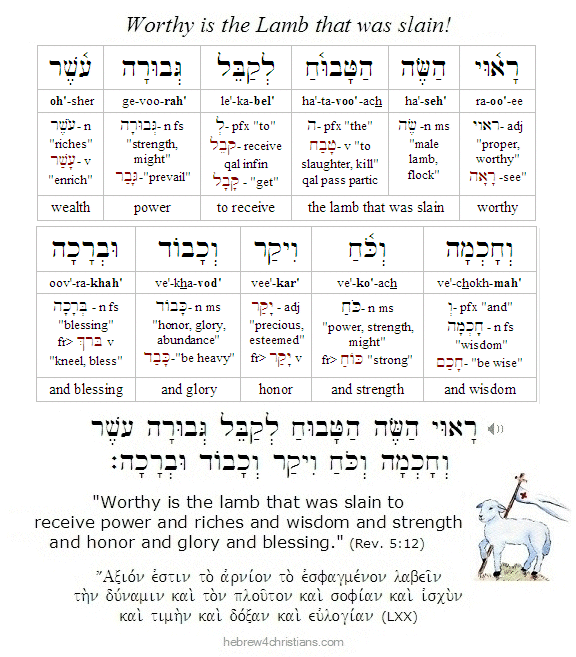 |
Taking Passover Personally...
The great holiday of Passover begins Wednesday April 1st at sundown...
03.30.26 (Nisan 12, 5786) The message of Passover applies to each of us: "In each and every generation an individual should look upon him or herself as if he or she (personally) had left Egypt." Indeed the very First Commandment is to accept the reality of your personal deliverance by the LORD: "I am the LORD your God, who brought you (singular) out of the land of Egypt, out of the house of slavery" (Exod. 20:2).
Note that the Hebrew word "Egypt" is mitzraim (מצרים), a word that means "prison, enclosure, or straights," from the verb tzur (צוּר) meaning "to bind or confine" (the Yiddish word tsuris, "trouble," comes from the same root). On the other hand, the Hebrew word for salvation is yeshuah (ישועה), from a root that means to "make wide," to "release from constraint," to deliver or set free.
It is noteworthy that God began the Ten Commandments by identifying Himself as our Redeemer and Deliverer rather than as our Creator, because the very purpose of creation is to be set free by means of God's redemptive love given through Yeshua, the "Lamb slain from the foundation of the world" (Rev. 13:8; 1 Pet. 1:18-20; Eph. 1:4; 2 Tim. 1:9). Amen. The book of Genesis is the context to the story of the Exodus. Happy Passover, friends...
Hebrew Lesson
Exodus 20:2 reading (click):
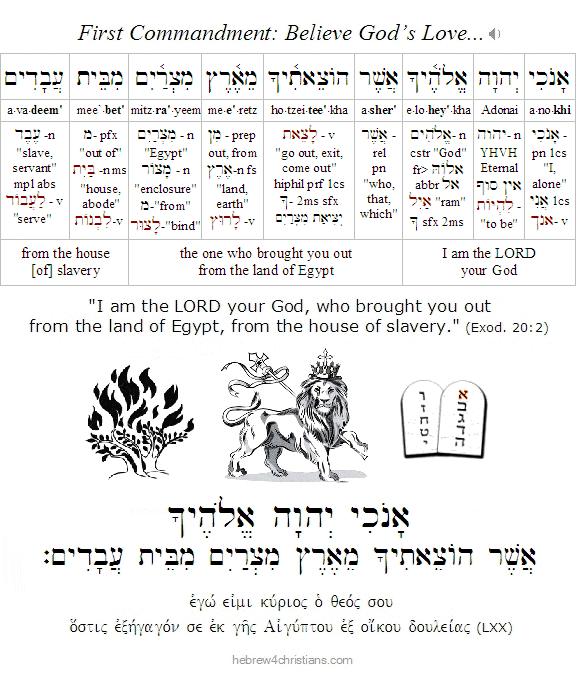 |
Passover Torah Readings...
03.29.26 (Nisan 11, 5786) The weekly Torah Reading cycle is suspended for the holiday week of Unleavened Bread (also called "Passover Week"), with each day of the week (from Nisan 15 through Nisan 22) assigned additional readings from the Torah and Haftarah. For a list of readings see the "Weekly Torah Readings" page on the Hebrew for Christians web site.
Unlike Western Christian tradition that followed the dictates of Emperor Constantine who oversaw the Council of Nicaea (325 A.D.) and decreed that "Easter" should be observed on the first Sunday following the first full moon after the spring equinox (March 21), the early Messianic believers in Yeshua followed the Jewish calendar by observing Passover on Nisan 14 as clearly prescribed in the Torah (see Exod. 12:18; Lev. 23:5; Num. 9:4-5; Num. 28:16; Josh. 5:10), with the resurrection occurring three days later, on Nisan 17 (Yom Bikkurim).
Hebrew Lesson
Leviticus 23:5 reading (click for audio):
Our Broken Matzah...
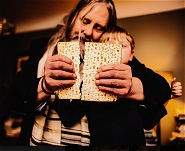
The holiday of Passover begins Wed. April 1st at sundown this year...
03.27.26 (Nisan 9, 5786) During the Passover Seder, three matzahs are placed on the table, said to represent Abraham, Isaac and Jacob, respectively. During the "Yachatz" step of the seder, the middle matzah (representing Isaac) will be broken to recall how Isaac was sacrificed in obedience to his father, foreshadowing the sacrifice of Yeshua by God the Father. Indeed, the Talmud states, "We break the middle matzah in tribute to Yitzchak (Isaac), who accepted the sins of the people upon himself" (Shabbos 89b). The smaller half of this broken matzah will be eaten later during the Motzi Matzah step, while the larger half will be eaten during the "Afikomen" step, near the end of the night...
In Hebrew, the middle of something is it's heart - the heart of the heavens, the heart of the earth, the heart of the sea, the heart of a person... Since the offering of Isaac by Abraham foretold of the greater offering of Yeshua by God Himself, when we break the middle matzah, then, we recall the broken heart of God over the pain Yeshua endured by taking our sins upon Him at the cross...."For our sake he made him to be sin who knew no sin, so that in him we might become the righteousness of God" (2 Cor. 5:21).
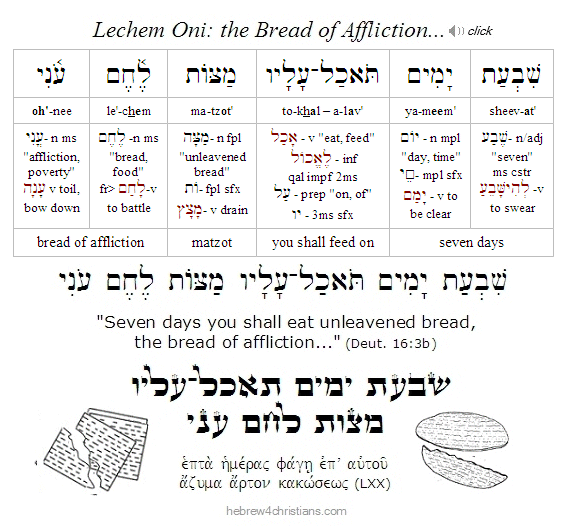
During his Passover seder with his disciples, Yeshua "took matzah, and after blessing it broke it and gave it to the disciples, and said, "Take, eat; this is my body" (Matt. 26:26). Since Yeshua did this while they were eating dinner, the matzah he broke would have been the Afikomen, thereby making the connection between the hidden bread (lechem ha-nistar) that would be broken given for our deliverance. The matzah we eat during Passover is called lechem oni (לֶחֶם ענִי) - "the bread of [His] suffering" - and eating the Bread of Life that was "broken for us" remembers ish makhovot, the man of sorrows, the suffering of our LORD...
Hebrew Lesson
Deut. 16:3b Hebrew reading:
 |
Assured by Love's Promise...
"Listen to your life. See it for the fathomless mystery it is. In the boredom and pain of it, no less than in the excitement and gladness: touch, taste, smell your way to the holy and hidden heart of it, because in the last analysis all moments are key moments, and life itself is grace." - Buechner
03.27.26 (Nisan 9, 5786) Right now, as you are seeing this, take a moment to reaffirm that the Lord Yeshua is your deliverer and that you trust in Him for eternal life. He promises the trusting heart: "I tell you the solemn truth, the one who hears my message and believes in the One who sent me has (i.e., present active indicative) eternal life and will not be condemned, but has passed over (literally, "crossed over") from death to life" (John 5:24).
Note that the verb translated "has passed over" is "perfect active" that expresses completed action: "this one has already crossed over from death to life." In other words, the gift of eternal life is an accomplished reality (though it is only experienced as we truly receive the love and grace of God from the heart of faith). The "basis" of life is now radically new and of a different order. As the apostle Paul later summarized: "For it is by grace you have been saved (i.e., a perfect passive participle that denotes completed action done on your behalf with effects that continue to the present) through faith, and this is not from yourselves, it is the gift of God, not a result of works, so that no one may boast" (Eph. 2:9-10). I'm so glad it's not the strength of my grip that keeps me holding on to God, but the strength of His...
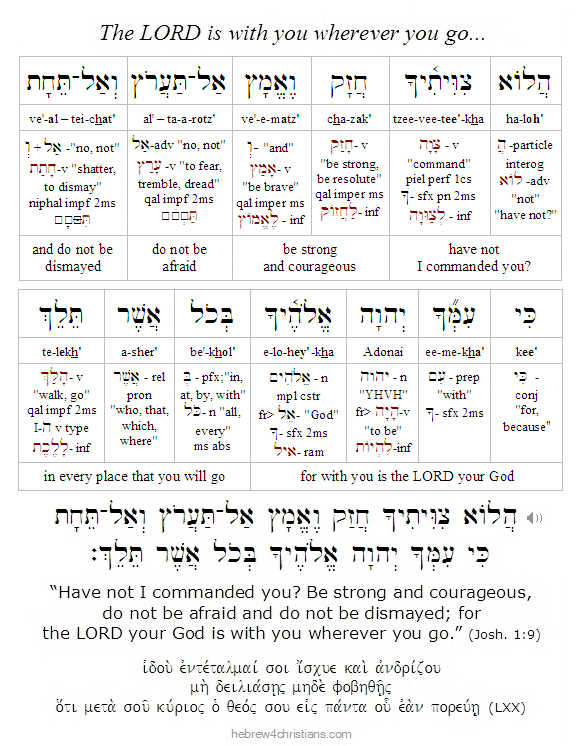
So "be strong and of good courage" – chazak ve'ematz! The Lord our God promises "never to leave you nor forsake you" and to be with you wherever you go (see Josh. 1:5,9; Heb. 13:5, Psalm 139; Matt. 28:20). That is the miracle of faith bestowed from above: The revelation that God himself attends to your life and personally cares for you. In the Greek New Testament, the wording of Hebrews 13:5 is highly emphatic: Οὐ μή σε ἀνῶ, οὐδ᾽ οὐ μή σε ἐγκαταλείπω: "Not ever will I give up on you; no, not ever will I leave you behind." Alevai! May you hear the voice of the Good Shepherd calling you, and may He forever keep you under His watchful care. Amen.
Hebrew Lesson
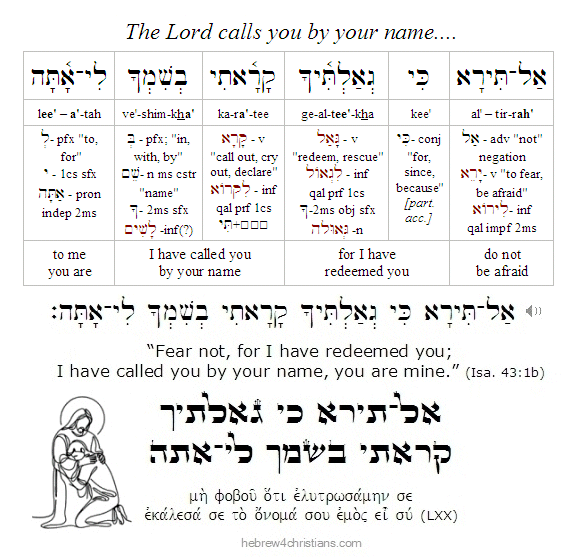
Isa. 43:1 Hebrew reading (click):
Truth's Weightier Matters...
03.26.26 (Nisan 8, 5786) The Torah is filled with various imperatives of one kind or another. The term mitzvah (מצוה) is a general term used to refer to any commandment given by God. The various mitzvot can be further divided into the subcategories of "chukkim" and "mishpatim" (Deut. 4:5). Generally speaking, mishpatim (מִשְׁפָּטִים) are rules or "judgments" given for a clearly specified reason. These sorts of rules, such as the prohibition to steal, promote well-being in a society and therefore make sense to us. Chukkim (חֻקִּים), on the other hand, are statutes given without a specifically stated reason (i.e., fiats or divine decrees). These sorts of decrees, such as the prohibition of mixing seeds or fabrics (kilayim), may appear irrational to human reason....
A verse from Torah portion Acharei Mot states that God expects His people to "follow my rules (mishpatim) and keep my decrees (chukkim) and la-lechet bahem (לָלֶכֶת בָּהֶם), 'to walk in them.' I am the LORD your God" (Lev. 18:4). This idea of "walking in" the commandments is called halakhah (הֲלָכָה), which derives from the verb halakh (הָלַךְ), meaning "to walk." Notice, however, the immediately following verse: "You shall keep my statutes and my rules, which the man who shall do them shall live by them (וָחַי בָּהֶם): I am the LORD" (18:5). The sages interpret this verse to mean that the Torah's commandments are intended to lead to life, and therefore they deduced that there were certain cases where the commandments may be broken to avoid the loss of life. For instance, if some rasha (evil person) were to force you to eat non-kosher or to be killed, the sages state that you should go ahead and eat the unclean meat... The duty to honor life - pikuach nefesh - is more important than following the "letter of the law" in such extreme cases.
The same can be said about violating the laws regarding the Sabbath: it is morally praiseworthy to violate the Sabbath day in order to save someone's life... Likewise, Queen Esther requested the Jews to fast precisely during the holiday of Passover because of the urgency of the situation... There are, however, certain exceptions that are regarded as "absolute" obligations. The prohibitions against murder, incest, and idolatry are always to be observed, even to the point of death itself. In these cases, in other words, it is better to die kiddush haShem (as a martyr) rather than to violate one of these commandments.
During the Holocaust, Jews at the concentration camps who wanted to observe the Passover Seder faced a dilemma regarding the "letter of the law." The Torah clearly states that no chametz was to be eaten during the days of Passover, but the only food given to the prisoners contained leaven. The prisoners were forced to either use chametz as their "matzah" (and water as their "wine") or else to fast for the holiday, thereby endangering their lives.... The rabbis quoted the verse from our Torah portion - "you shall live by my commandments" to imply "and not die by them" to not only permit the use of chametz but also provided a blessing for precisely doing so....
I share this with you to help keep things in perspective. As important as Passover rituals are (e.g., getting rid of chametz, etc.), they are never to trump the more important duties to honor life, to express gratitude, to walk in love, etc. Ahavat HaShem - the love of God - is ultimately what Passover (and the Cross) is all about, not religious rituals.... Yeshua didn't say that any particular ritual or religion was "the way, the truth, and the life," but that He was "the way, the truth, and the life," and that no one comes to God apart from Him (John 14:6).
Someone might object that I am "adding" Jewish tradition to the words of the Scriptures by agreeing that "living by God's commandments" implies the (negative) duty not to die because of them, but I would argue that Yeshua Himself would agree with Jewish tradition in this case. In other words, I believe Yeshua would agree that it is a valid inference that "living by the commandments" is intended to promote life, and that sometimes the "letter of the law" may indeed be broken for the sake of saving or preserving life. Indeed Yeshua ran afoul of those Pharisees who regularly insisted that Jews should obey the "letter of the law" at the expense of the needs of others. Hence we see Yeshua going out of his way to heal people on the Sabbath day (Luke 13:14; John 5:7-12); we see him touching the "untouchable" lepers (Matt. 8:2-3; Mark 1:40-31); we see him "consorting" with tax collectors and "sinners" (Mark 2:16; Luke 7:36-50), and so on. In fact, some of Yeshua's most scathing words of condemnation were delivered to those religionists who set aside "tithes" at the expense of the needs of others (Mark 7:9-13; Matt. 23:23; Luke 11:42).
It's important to remember that Yeshua didn't live in a cultural vacuum when he ministered among the Jews of the late Second Temple period... It may be safely said that Yeshua generally interpreted the moral meaning of the Torah similarly to Bet Hillel (and sometimes to Bet Shammai). He reaffirmed the central duty of the Torah (the Shema) and the duty to love others (for more on this subject, see the article, "Torah sheba'al Peh"). However it vital to remember that Yeshua did not come to teach us moral truth as much as He came to die as the Lamb of God... All of the moral law of the Torah is clearly restated in the New Testament. It is the sacrificial death of Yeshua that makes all the difference between the torah of the older covenant with the torah of the new.
So let's "keep the feast," chaverim, in the best way we can, but let's not forget what is really important during this season of Passover. Yeshua is the sacrificial Lamb of God who takes away all our sin and makes us clean before the Father... When God sees the blood of His Son, he "passes over" the visitation of his wrath (Exod. 12:13; John 1:29; 3:36). Any message or "ritual" of Passover that overlooks this central fact is therefore radically misguided.
Follow the path of peace, chaverim... I wish you a joyous and grace-filled Passover season in the love of Yeshua, our true Lamb of God! May he give us purity of heart, sincerity and truth, set free from the "leaven" of anxiety, pride, and despair... Amen.
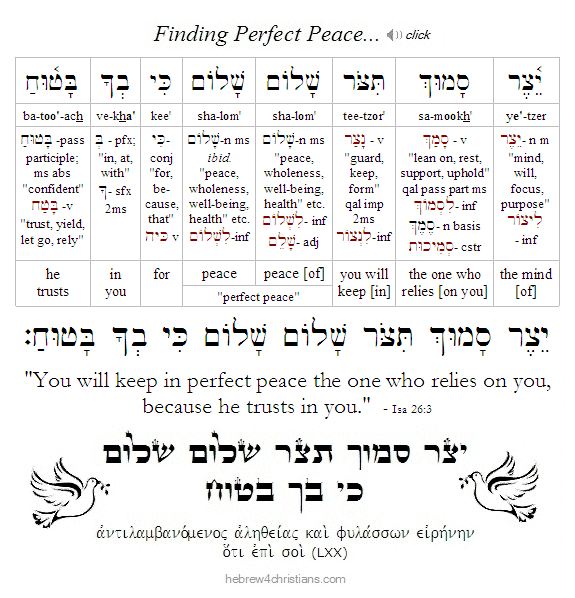
Hebrew Lesson
Isaiah 26:3 Hebrew reading (click):
 |
Believing to See...

Do not seek to understand in order to believe, but believe in order to understand...
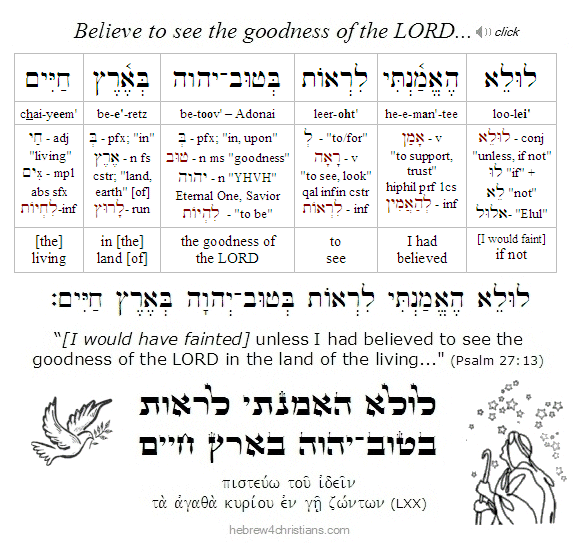
03.26.26 (Nisan 8, 5786) Faith believes in the invisible light and accepts the truth of love that overcomes all darkness, hate, and fear. "I believe..." "I believe to see...." "I believe to see the goodness of the LORD..." "I believe to see the goodness of the LORD in the land of the living" (Psalm 27:13). I believe; I look upward; my chest aches and I long for relief; I look forward; my heart hopes even in these passing shadows, even in the midst of my fears, my afflictions, my struggles. My heart chooses to see the unseen good, the good limned by God's promise, the substance of his kindness, his blessing whispered over my fears...
The heart of faith testifies that there is "unfinished business," that there is more than meets the eye, that evil will not have the last word, and that our tears will one day forever be wiped away. Despite the ambiguity, faith "hopes against hope" that the LORD God will intervene and bring everlasting healing to us all. As it says, "Let him who walks in darkness and has no light trust in the Name of the LORD (יִבְטַח בְּשֵׁם יְהוָה) and rely on his God."
Bittachon (trust) is a word for this world, which says, "Though he slay me, I will trust in him..." Those who call upon the LORD can trust not only in concealed good behind ambiguous appearances ("all things work together for good") but also in a future, real, substantive good that will one day be clearly manifest for us all. Meanwhile, may the LORD our God keep us from such depth of sorrow that leads to sickness, darkness and despair. Amen.
Hebrew Lesson
Psalm 27:13 Hebrew (click):
Living by Faith...
03.25.26 (Nisan 7, 5786) Each of us has been created by God for a sacred purpose. There is a deep reason why you were born. This explains why we sometimes feel lost and alone in this life. Our discontent, the fracture we sense both within and around us, our sorrows, suffering, and inevitable losses, all of it together, presents a "message" to our souls, a "basso profundo" groan of the heart, a visceral yearning for healing, for eternal life, for heaven... God has created us for himself, yet we find no lasting peace apart from him (Eccl. 3:11). Or as Augustine of Hippo famously put it: "Thou hast made us for thyself, O Lord, and our heart is restless until it finds its rest in thee" (Confessions). Therefore our Lord cries out to those who are hurting, troubled, and afraid: "Come to me, all who labor and are heavy laden, and I will give you rest. Take my yoke upon you, and learn from me, for I am gentle and lowly in heart, and you will find rest for your souls" (Matt. 11:28-29).
We are told "lekh-lekha," to "come to yourself" and reconnect to your spiritual essence, your identity, and your heart (Luke 15:17). We have to start the journey there, because ultimate reality is intensely personal, being grounded in the "Who-ness" of God. It is within the consciousness of our own "I am," our deepest identity as a personal, thinking, and feeling being, that we are able to relate to the person and heart of the great "I AM" of the LORD.
Abram is the exemplar of faith for us; indeed he is called the "father of faith" (Isa. 51:1-2; Rom. 4:16; Gal. 3:29). Abram courageously searched for God in his emptiness, and God graciously answered the cry of his heart. He left everything behind as he journeyed into the realm of promise - regarding himself as someone chosen to know God's blessing and grace. Abram was able to walk by faith because he stopped listening to the voices of the ego - the worldly and unbelieving parts of himself - and therefore was able to hear God's truth.
According to the classical sages, Abram was tested ten separate times in the course of his life. In the first test, Abraham was asked to "go to a land that I will show you" only to find it a place of famine and trouble. In the very of the tests, Abraham was asked to "go to the land of Moriah, to the place that I will show you," and there to offer up his promised son Isaac as a burnt offering... In each case the temptation was to give up hope in God's promise, since at the time of each test Abram did not know the outcome as a foregone conclusion. Nevertheless Abram walked in faith, in fear and trembling, yet his trepidation was contextualized by the deeper strength he found in God's love and presence. Abraham had to close his eyes to this world and walk in the darkness of faith to see the divine light that transcends this realm; he had to "believe to see" that God's promise was sure.
So the journey is one of faith and the inner transformation that comes from trusting in God (בִּטָּחוֹן). "Go from your country and your kindred and your father's house to the land that I will show you" is the call of teshuvah - turning away from enslaving habits that deaden our consciousness - and to come alive by believing that which transcends own understanding. The Greek word for repentance, "metanoia" (μετάνοια) describes the process well, since it means going beyond ("meta") the habitual categories of the mind ("nous") to believe and apprehend the miracle of God. Faith discerns the unseen good that is at work behind the realm of appearances. God is the "Father of Lights" who supervises the ebb and flow of creation. He is always working to direct all things according to his purposes and will. This is the "land that I will show you," that is, the realm of blessing and eternal life.
Hebrew Lesson
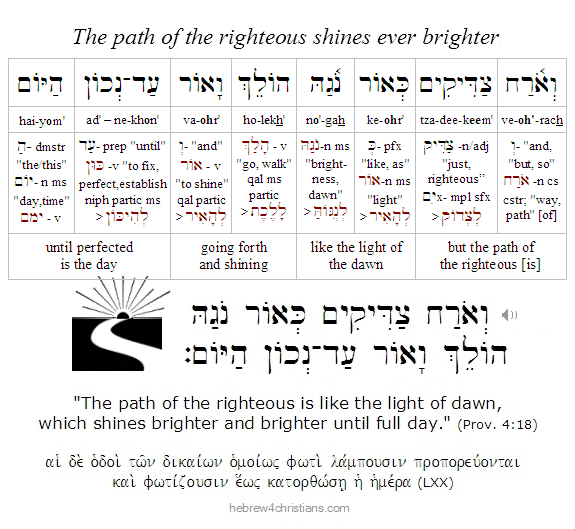
Proverbs 4:18 reading (click):
Retelling the Story...
"In every generation, each of us is obligated to see himself or herself as though he or she personally came forth from Egypt."- Traditional Hagadah
03.25.26 (Nisan 7, 5786) Concerning the observance of the Passover Seder the Torah states, "When your child asks you in time to come, 'What is the meaning of the testimonies and the statutes and the rules that the LORD our God has commanded you?' then you shall say, 'We were slaves (עבדים היינו) to Pharaoh in Egypt, but the LORD brought us out of Egypt with a mighty hand. And the LORD showed signs and wonders, great and grievous, against Egypt and against Pharaoh and all his household, before our eyes" (Deut. 6:20-23). We are instructed to "remember what the LORD your God did to Pharaoh and to all Egypt, the great trials that your eyes saw, the signs, the wonders, the mighty hand, and the outstretched arm, by which the LORD your God brought you out" (Deut. 7:19). As it is written in the Shema, "You shall teach them diligently to your children," we ask, what do we teach? And we answer: Kulo! Everything – the whole story of our deliverance (הסיפור המלא).
The early sages taught that Hebrew word "Pesach" (פסח) can be read as peh (פֶּה), "mouth," and sach (סַח), "speaks," indicating that Passover is a confession of the truth of God's redemption, testifying to the truth of the LORD's faithful love. On Pesach we thank God for the revelation and the wonder of the great Lamb of God that was slain... Indeed, in light of the truth of the Scriptures - both in the Torah, the writings, the prophets, and the New Covenant Scriptures - how is it possible to honor the LORD God of Israel and to celebrate his redemption apart from the Messiah who came to earth to die as the great Lamb of God? Yeshua is the heart and central meaning of the Passover, and there is simply NO true Passover Seder apart from the blood of the Lamb (Heb. 2:3; Heb 10:28-29).
Hebrew Lesson
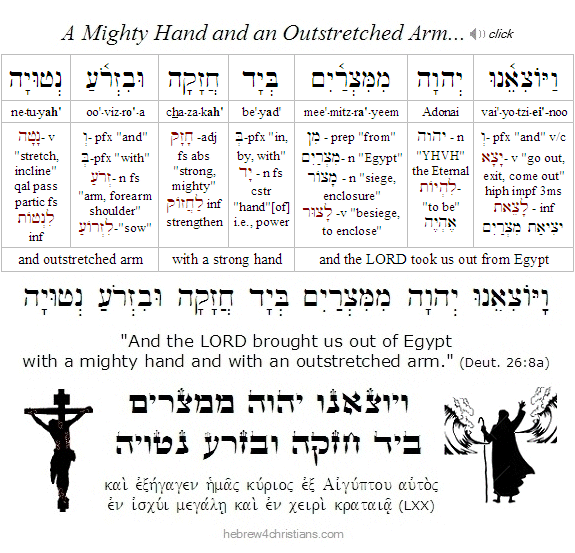
Deuteronomy 26:8a reading (click):
Related Topics:
The Meaning of Passover...
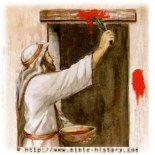
03.24.26 (Nisan 6, 5786) In Parashat Bo we read about the institution of Passover and the final terrible plague that was to befall the Egyptians on the Passover night. When we think of this time, we may imagine God "passing over" those houses that had the blood of the lamb smeared on their doorposts, though it might better be said that God passed into the homes of those who trusted him, while he withdrew His Presence from those that did not...
To see this note that two different words are used that can be translated as "pass over." First, God said, "I will pass over (i.e., avar: עֲבַר) the land of Egypt that night, and I will strike all the firstborn in the land of Egypt, both man and beast; and on all the gods of Egypt I will execute judgments; I am the LORD" (Exod. 12:12). But directly after saying this, God promised to "pass over" (i.e., pasach: פָּסַח) the homes of those who trusted in him to impart his protection from the plague of death: "The blood shall be a sign for you, on the houses where you are. And when I see the blood, I will pass over to you (lit. עֲלֵכֶם, 'upon you'), and no plague will befall you to destroy you, when I strike the land of Egypt" (Exod. 12:13). In other words, when God would see the blood of the Passover lamb, he would pass over to enter the house and "cover" its occupants from the judgment of death.
The blood of the Passover lamb sheltered people from the plague of death by atoning for their sin by means of a substitutionary sacrifice. The Torah states that "the life (i.e., nefesh: נֶפֶשׁ, or 'soul') of the flesh is in the blood" (Lev. 17:11), and therefore death represents the separation of the soul from the body. The life blood of a sacrificial lamb was therefore offered in exchange for the death and destruction of others. Eating the lamb "roasted by fire" meant identifying with the death offered in exchange for your own; eating matzah, or unleavened bread, signified being delivered in haste, apart from the "rise of the flesh" or human design; and eating maror, or bitter herbs, recalled the bitterness of former bondage.
The first time the word "blood" occurs in the Scriptures concerns the death of Abel, the son of Adam and Eve who was murdered by his brother Cain. After Abel's blood was shed, the LORD confronted Cain and said, "What have you done? The voice of your brother's blood is crying to me from the ground" (Gen. 4:10). Since blood is the carrier of life, it bears the energy and vitality of life: it has its own spiritual "voice." Likewise, the blood of Yeshua, the true Lamb of God who died upon the cross, speaks on our behalf, and reverses the power of death by creating a barrier that death can no longer cross, since the death of the sacrificial victim "exchanges" the merit and power of life. Unlike the blood of Abel that "cries out" for justice, the blood of Yeshua cries out for mercy (Heb. 12:24). Putting our trust in the provision of God's sacrifice causes His wrath (or righteous judgment) to pass over while simultaneously extending love to the sinner.... This is the essential message of the gospel itself, that we have atonement through the sacrificial death, burial, and resurrection of Yeshua our Savior, the great Lamb of God. As Yeshua said, "I tell you the solemn truth, the one who hears my message and believes the One who sent me has eternal life (חַיֵּי עוֹלָם) and will not be condemned, but has passed over (i.e., μετά + βαίνω, lit., "crossed over" [עָבַר]) from death to life" (John 5:24). Just as God's judgment passes over from life to death on my behalf; so His love passes over from death to life on my behalf...
Notice that the Hebrew verb "pasach" can also mean "to limp," suggesting the heel of Messiah that was "bruised" in the battle for our redemption (Gen. 3:15). It is the cross of Yeshua that enables the mercy of God to "overcome" his justice, or that allows "steadfast love and truth to meet; righteousness and peace to kiss" (Psalm 85:10). His attribute of Justice passes over us as His attribute of Compassion passes into us... The sacrifice of Messiah allows God to be both just and the justifier of those who trust in God's remedy and exchange for our sin (Rom. 3:26).
The idea of substitutionary atonement is surely mysterious and complicated, but ultimately the message is simple: God loves you and has made a way for you to be eternally accepted -- despite your sin... That's the "good news" of the cross. That's what Yeshua meant when he said, "Just as Moses lifted up the serpent in the wilderness, so must the Son of Man be lifted up, that whoever believes in him may have eternal life. For God so loved the world, that he gave his only Son, that whoever believes in him should not perish but have eternal life (חַיֵּי עוֹלָם). For God did not send his Son into the world to condemn the world, but in order that the world might be saved through him" (John 3:14-17). Humanity as a whole has been "bitten by the snake" and needs to be delivered from its deadly venom. Just as the image made in the likeness of the destroying snake was lifted up for Israel's healing, so the One made in the likeness of sinful flesh was to be lifted up as the Healer of the world (Rom. 8:3). All we need to do is look and believe. Yeshua died for you so you can live. He stands at the door and knocks, offering to "pass over" to give you his life (Rev. 3:20).
Hebrew Lesson
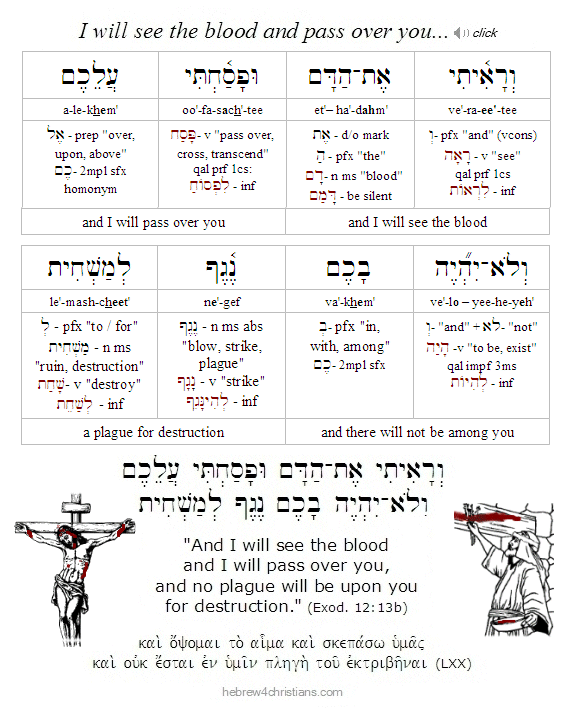
Exodus 12:13 reading:
Passover Soul Searching...
The following is related to the theme of repentance before the holiday of Passover...
03.24.26 (Nisan 6, 5786) The search for "chametz" (חפש חמץ) before Passover may be likened to the soul searching we do before the High Holidays in the fall, when we take an inventory of our spiritual condition (חשבון נפש) and do teshuvah. For the entire week of Passover we are not to have any leavened products in our homes, nor are we to consume any leavened products outside our home. We are to be "leaven-free" (Exod. 12:19).
This might seem a bit strange, but the Torah associates chametz (חָמֵץ), or "leaven" that which decays and "sours" (חָמוּץ), and it is therefore generally considered to be a corrupting influence or hidden source of uncleanness that manipulates purer elements (Lev. 2:11. Like the influence of a lump of leaven in a batch of dough, "spiritual" leaven functions or symbolizes the evil impulse within us that corrupts ("puffs up") and sours our soul (Matt. 16:6). As such chametz is considered a metaphor of sin which we are commanded to put away from us, and the removal of chametz is a metaphor of our sanctification (1 Cor. 5:6).
The Torah instructs us to mindfully search and remove sources of inner impurity so that we might experience the truth that we are a "new lump" - that is, a new substance that is purged from the rotting influences of our sinful past... We are to have no tolerance for our sinful former lifestyle and godless attitudes. And since Yeshua has been sacrificed as our Passover Lamb, you are indeed a new creation (בּריה חדשׁה) made "unleavened" (pure) by the power of the Holy Spirit (2 Cor. 5:17). Therefore you are likewise commanded put away the "old nature" (יצר הרע) and purge from your life the old influences that inwardly canker you and make you sick (Eph. 4:22; Col. 3:9). Walk without hypocrisy in the truth of the love of God for your soul.
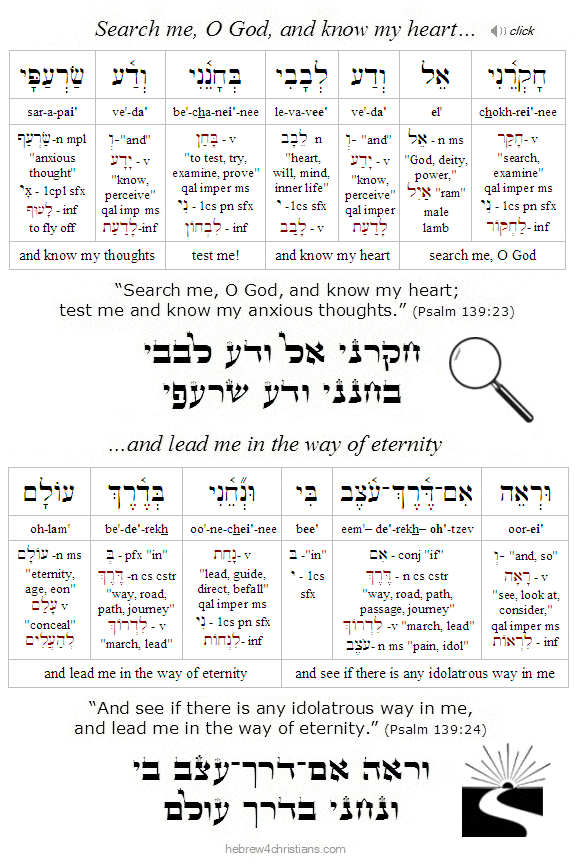
חָקְרֵנִי אֵל וְדַע לְבָבִי
בְּחָנֵנִי וְדַע שַׂרְעַפָּי
וּרְאֵה אִם־דֶּרֶךְ־עֹצֶב בִּי
וּנְחֵנִי בְּדֶרֶךְ עוֹלָם

"Search me, O God, and know my heart!
Test me and know my anxious thoughts!
And see if there be any idolatrous way in me,
and lead me in the way of eternity."
(Psalm 139:23-24)

Affirming God's Light...
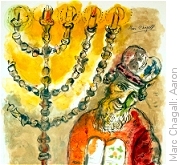
"O house of Jacob, come and let us walk in the light of the LORD" - Isaiah 2:5
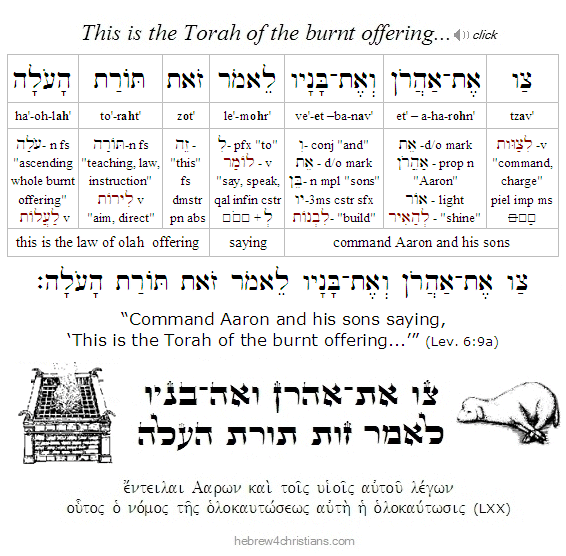
03.24.26 (Nisan 6, 5786) From our Torah for this week (i.e., Tzav) we read: "The fire on the altar shall be kept burning on it; it shall not be extinguished" (Lev. 6:12). The sages say do not read "burning on it" but rather "burning in him" (בּוֹ), referring to the heart of the worshiper And where the text says "it (i.e., the fire) shall not be extinguished" (לא תכבה), read instead "extinguish (תִכְבֶּה) the negative (לא)" by trusting in God's promise for our good, despite any temporary setbacks or apparent failures...
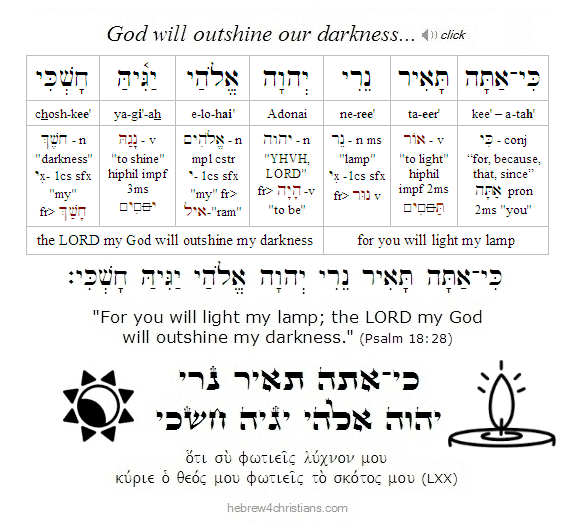
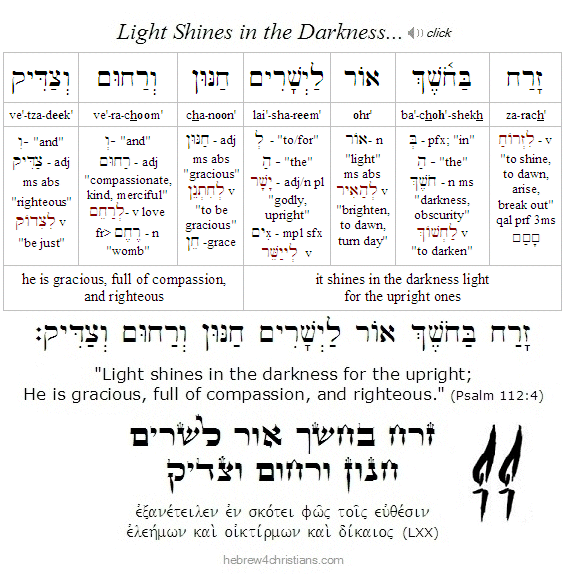
The Holy Spirit imparts the fire of faith that fills our hearts with hope, affirming with "tongues of fire" words of life and light that vanquish darkness. As it is written: "Light dawns in the darkness for the upright; He is gracious, full of compassion, and righteous" (Psalm 112:4).
זָרַח בַּחשֶׁךְ אוֹר לַיְשָׁרִים
חַנּוּן וְרַחוּם וְצַדִּיק
"Light dawns in the darkness for the upright;
He is gracious, full of compassion, and righteous."
(Psalm 112:4)

Spiritually speaking, the first step is to find hope... The Divine Light is seen by means of the eye of faith (עין האמונה), and therefore we find strength by trusting in God's Presence, even though we cannot presently see Him (2 Cor. 4:18; 5:7). "Trust in the LORD with all your heart, and do not lean on your own understanding. Know Him in all your ways, and He will straighten your paths. Be not wise in your own eyes; fear the LORD, and turn away from evil" (Prov. 3:5-7). Wait on the LORD and He will strengthen your heart....
We must keep courage, remain steady as we fight the good fight of faith. As it is written, "The LORD is my light and my salvation; whom shall I fear? The LORD is the stronghold of my life; of whom shall I be afraid? When evil men attack me to devour my flesh, when my adversaries and enemies attack me, they totter and fall. Even if an army is deployed against me, I do not fear; even if war is rises against me, I remain full of trust" (Psalm 27:1-3).
The Midrash says, "The Holy One Himself, as it were, made light for the upright. Thus it says, "The LORD is my light and my salvation" (Psalm 27:1) and "When I sit in darkness, the LORD will be a light to me" (Micah 7:8). While I sit in darkness in this world, during these latter days before the promised return of Yeshua, when troubles may afflict me and lawlessness may abound – then God's light will shine brighter still, for the LORD is gracious to all who put their hope in Him, and this favor and love will be manifest for me.
Keep the flame within your heart burning, friend... A sage once told a person struggling with his faith: "It is written that all creation was brought into being because of people like you. God saw there would be people who would cling to our holy faith, suffering greatly because confusion and doubt would plague them. God perceived that such would overcome these doubts and troubles of heart and remain strong in their belief. It was because of this that God brought forth all creation." Indeed, it was because of this that Yeshua our LORD suffered and died for you... Amen. Therefore never yield to despair, since that leads to further darkness and fear. Press on and keep fighting the "good fight" of faith (1 Tim. 6:12).
Let us then reaffirm our confidence: The darkness of this world forever is swept back before the overmastering radiance and power of Yeshua, the King of Glory, the Root and Descendant of David, and the Bright Morning Star (Rev. 22:16). Those who believe in Him are given the "light of life" that overcomes the darkness of this world (John 8:12).
 |
Passover is all about Yeshua...
"Now I want to remind you, even though you have been fully informed of these facts once for all, that Yeshua, having saved the people out of the land of Egypt, later destroyed those who did not believe" - Jude 1:5
03.23.26 (Nisan 5, 5786) Some apparently well-meaning Christians think that followers of Yeshua have no business doing a Passover seder as instructed in the Torah because, in light of the new covenant, all that is now needed is to remember Jesus' crucifixion for our sins and to celebrate his resurrection by partaking in the sacraments. This viewpoint assumes that, despite the instructions in the Torah, the yearly Passover service, or seder, is not intended for Christians, since it focuses on the Exodus from Egypt and the Jewish people, and the message of the gospel is universal, for every "tongue and tribe." Moreover Christians are no longer "under the law" and therefore are not obligated to keep the various ordinances of the "Old Testament," especially with regard its ceremonial laws.
There are some real difficulties when we disregard the Torah's instructions to observe the Passover, however, particularly because Yeshua himself identified his entire ministry as the "Lamb of God" who redeems us from the curse of the law, and he used the message of the Passover to teach his followers this truth. Bear in mind that the idea of the Passover was not enacted at Sinai as part of the Sinai covenant, but *predates the giving of the law.* In other words, the faithful of Israel obeyed God's instruction to take refuge under the blood of the sacrificed lamb to escape the plague of death delivered upon Egypt, but this was done before Moses ascended Sinai to receive and ratify the covenant of the law.
Indeed the theme and message of Passover is timeless for understanding the Bible. The message was delivered in the Garden of Eden when God sacrificed a lamb to cover the shame of Adam and Eve (Gen. 3:21); it was prefigured in the lamb that was sacrificed by Abraham in place of Isaac during the Akedah; it was portrayed in the blood of lamb sacrificed in Egypt whose blood was daubed upon the doorposts; it was memorialized every day and night at the Tabernacle (and later at the Temple) as "continual korban," the offering of which was central to the sacrificial ministrations for Israel; it was foretold by the Hebrew prophets (Isa. 9:6; Isa. 53; Psalm 22:16; Prov. 30:4; Zech. 12:10. etc.), and it was fully manifested in the incarnation, mission, and sacrifice of God's beloved Son himself, the promised heir to come who allowed himself to be "caught in the thicket" for our sins, and who was bound upon the altar of the cross to shed his blood for our redemption. This was the central meaning of the "greater exodus" that Yeshua discussed with Moses and Elijah on the mount of transfiguration before his crucifixion (see Luke 9:29-31). Amen, Yeshua as our sacrificial Lamb is heart of the gospel message itself (John 1:29; 1 Pet. 1:19; Isa. 53:3-12); it's the "scarlet thread" he showed his followers (Luke 24:27); it's the Metaphor God chose to make his sacrificial love known to us.
Hebrew Lesson
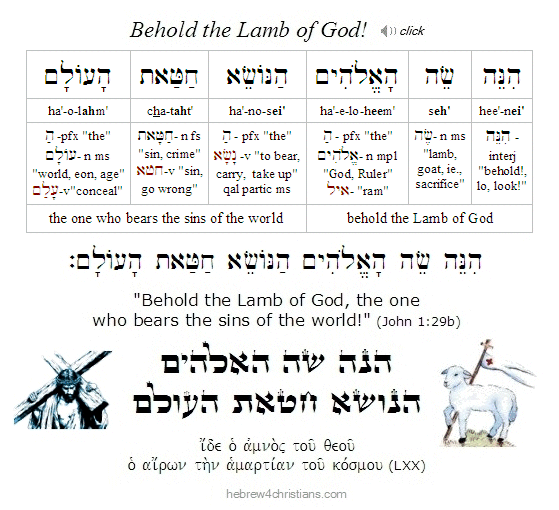
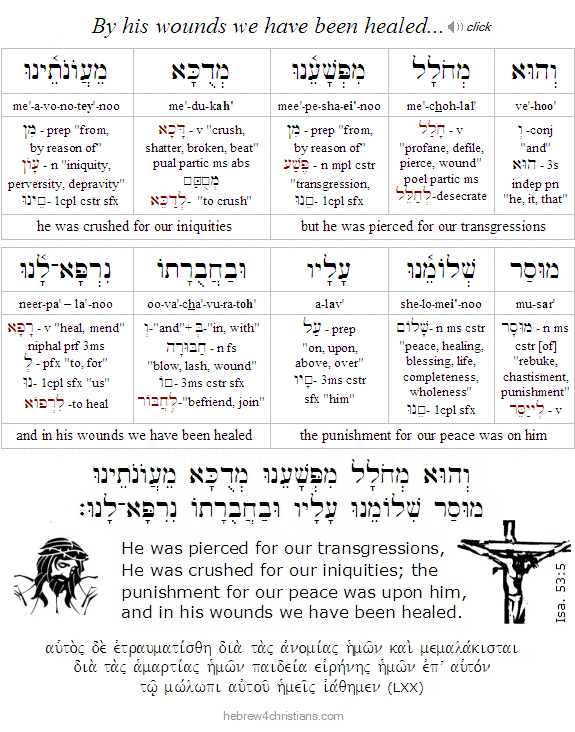
Isaiah 53:5 reading (click for audio):
The message of "Christ our Passover Lamb" (המשיח פסח שלנו) will extend forever and unto eternity itself, when the Lamb of God is fully glorified and enthroned, as it says: "For the Lamb on the throne will be their Shepherd. He will lead them to springs of life-giving water. And God will wipe every tear from their eyes" (Rev. 7:17). "And the city has no need of sun or moon, for the glory of God illuminates the city, and the Lamb is its light" (Rev. 21:23).
The meaning and substance of Passover, then, is essential to the life of the Christian, and to dismiss its significance is to risk missing the point of God's redemption and salvation itself. The Apostle Paul used "Passover language" to describe our new life in Messiah by admonishing us to: "purge out the old leaven, that you may be a new lump, since you truly are unleavened. For our Passover lamb is the Messiah sacrificed for us (שֵׂה הַפֶּסַח שֶׁלָּנוּ הַמָּשִׁיחַ). Therefore let us keep the feast, not with old leaven, nor with the leaven of malice and wickedness, but with the unleavened bread of sincerity and truth" (1 Cor. 5:7-8).
The LORD did not waste his breath by revealing the Torah to Israel, nor did he speak out of two sides of his mouth when he instructed them to keep the Passover holiday every year (Num. 9:2,14; Lev. 23:5; Deut. 16:1). Remember - Jesus was the Voice of God speaking to Israel at Sinai; Jesus was Moses' Teacher regarding the seven holidays of the Torah! He said "Do not think that I came to destroy the Law or the Prophets. I did not come to destroy but to fulfill. For assuredly, I say to you, till heaven and earth pass away, one jot or one tittle will by no means pass from the law till all is fulfilled. Whoever therefore breaks one of the least of these commandments, and teaches men so, shall be called least in the kingdom of heaven; but whoever does and teaches them, he shall be called great in the kingdom of heaven" (Matt. 5:17-19). Heaven and earth has not yet passed away, and therefore the Torah has its voice and place in the life of follower of Yeshua. Faith does not mean we are devoid of law of God, even if the verdict of the law reveals our sin. As the Apostle Paul said, "Do we then make void the law through faith? Certainly not! On the contrary, we establish the law" (Rom. 3:31). We are justified by trusting in the righteousness of God, but that does not mean we disregard God's law so that "grace may abound" (Rom. 6:1-2)
So you see that the question of whether Christians should seriously engage the Passover turns on how they read the Scriptures, and in particular, how they esteem the words of the Torah. If they tend to read the Bible out of context, by focusing on the New Testament without taking time to carefully consider the context given in the Hebrew Scriptures, they may underestimate the significance of the Passover seder and will think of it in theologically abstract terms, as an analogy or metaphor foretelling what Yeshua has done, and that it is now best remembered during "communion" rituals, rather than as an invitation to participate in the annual retelling of the great story of redemption that is the heritage of the people of God. But Yeshua himself observed the Passover with his disciples, and indeed his last Passover before his crucifixion represented his most intimate heart to us. We miss a lot if we minimize the significance of the Passover or regard it as somehow incidental to our life as believers in the great Lamb of God.
"For Christ our Passover is sacrificed for us; therefore let us keep the feast" (1 Cor. 5:7-8).
Postscript:
I want to add that though we are not under the terms of the Sinai covenant, we are nevertheless beholden to the Torah and its message, particularly regarding its witness to the deeper truth of Yeshua the Messiah. We have a new covenant "not based on the covenant made with the fathers" at Sinai, but that does not mean we disregard the Torah of the fathers, and especially the Torah of the patriarchs who foresaw the deliverance to come. Remember, Passover extends before and after the making of the covenant at Sinai, and (as mentioned above) the Passover itself was given before the law was given at Sinai...
That said, Passover has its application in relation to the law, since by means of Yeshua's sacrifice we are set free from the verdict of sin (and death) given through the law. "I through the law died to the law," and yet it is by the law we discover our need for the gospel.
|
For such a time as this...
03.23.26 (Nisan 5, 5786) An old midrash says that at the time of the great Exodus, only a remnant of Israel was actually saved while all the others died in the makkah (plague) of darkness, having fallen so low that they could not believe in the redemption or even want to be redeemed (Rom. 9:27-28)... How dreadful; how tragic! God forbid that we should give up our hope now, chaverim, especially because of the great salvation Yeshua secured for us at the cross (Heb. 2:3-4; Heb. 6:4-6). בכל דור ודור -- be'chol dor vador -- "in each and every generation" an individual should look upon him or herself as if he or she (personally) had been rescued from the "Egypt" of this world...
And yet divine history is somewhat "cyclical" in its expression. The closer we go back to the beginning, the more we see how the future was "seeded" and gets replayed in every generation. Both the Tree of Life (עֵץ הַחַיִּים) and the Tree of the Knowledge of Good and Evil (עֵץ הַדַּעַת טוֹב וָרָע) were present in the original paradise (Gen. 2:9). When Eve listened to the lies of the nachash (serpent) and regarded the forbidden tree as "desirable to make one wise," she immediately began her descent into exile. At the very dawn of human history, then, we see that "truth" (אֱמֶת) apart from God (א) leads to death (מֵת).
Adam and Eve's disobedience led to God's gracious promise regarding the coming "Seed" who would restore all things by being victorious in the war for truth (Gen. 3:15). Of course, this promised Seed was Yeshua, our Suffering Servant and "Second Adam," who, through His sacrifice upon the cross, "reversed the curse" and reconciled humanity with God.
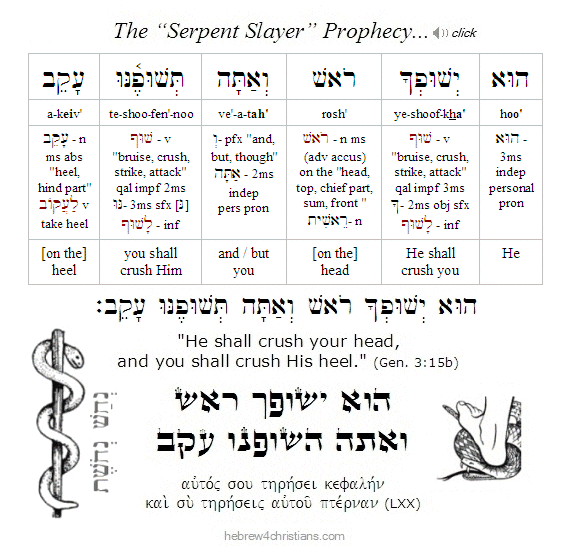 |
Note, however, that this "proto-gospel" message also implied perpetual warfare between the heirs of the Messiah (called the "children of light") and the heirs of Satan (called the "children of darkness"). The ongoing enmity between these "two seeds," then, was ultimately something God willed (1 Thess. 5:5; Col. 1:13; 1 John 3:10). The children of light are called to be am kadosh - a holy people - separate from the evil engendered by the fallen world and its forces, just as the very first creative expression of God was the separation of light from darkness (Gen. 1:3-4). The children of light "hate evil and love the good," and conversely, the children of darkness "hate the good and love evil" (Psalm 34:21, Prov. 8:13, Amos 5:15). The Exodus story, then, is not so much a matter of ancient history as it is a present revelation of God's righteous liberating power over the powers of darkness.
God delivered Israel with a "strong hand" (בְיָד חֲזָקָה) and led them directly to Mount Sinai to re-encounter the Tree of the Knowledge of good and evil, just as the Cross of Yeshua is the Tree of Life in the midst of the Garden of God. Life is about spiritual warfare, and the power encounter between God and Pharaoh is a paradigm for the ages. Therefore Yeshua refered to his own sacrificial death as the great Lamb of God to be the final exodus (Luke 9:31).
Throughout history we see the repeated attempt to resuscitate or revive ancient "Ra worship" (which derives from Satan in the garden). Every culture has its emissaries of evil -- its "pharaohs," its political dynasties, its caste systems, and its presumed sense of status quo. In the ancient world, most political figures were literally deified; in the Middle Ages, they were thought to rule through "divine right"; but in today's secular world, there is no justification given for their control other than through deception and the naked "will to power." In nearly every case, however, it can be stated that politicians and leaders of this world represent what is most sick about the human condition. Politicians and princlings are given "their hour" in this earth, and they are undoubtedly groomed by the "god of this world" who was a murderer and a liar "from the beginning" (John 8:44). The dust and ashes of countless past civilizations and regimes attest to this truth...
Today we are living in a world that is "globalist" by design. Politicians are often unwitting lackeys for the darker powers seeking to consolidate power to enslave the whole earth. The so-called global economy and its system of usury is the mechanism that will give rise of yet another "Pharaoh" who likewise will be judged by the LORD God Almighty at the End of Days.
Many people live in a state of fear because they believe the lies and propaganda of "the lords of the darkness of this world" / τοὺς κοσμοκράτορας τοῦ σκότους τούτου (Eph. 6:12). Satan's power always has been through the use of deception. If he can get you to believe a lie, he will begin to control you through fear. This is how the devil has always gained the kingdoms of this world -- through deception and violence... As followers of Yeshua, we must always keep in mind that reality centers on the LORD God of Israel and never in the "rhetorical violence" and metaphysical fantasies of political or media figures.
The LORD God of Israel truly cares about people's liberation from deception and oppression. The story of the Exodus is His everlasting rebuke to all the world's dictators and should cause every politician to soberly assess their fate... The time is coming when His judgment will fall upon all the "kings of the earth who take counsel against the LORD and against His Anointed One" (Psalm 2:2). Halevai, ad ana Adonai?
Presently we are living with the tension of the "already-not-yet" aspect of the original prophecy that "he (the Messiah) will crush the head (of the serpent)." Satan still appears to have the upper hand, at least in the temporal realm. Final victory is not yet here, even if it is assured through the promises of God (Rom. 16:20). And while the time appointed by God for the Messianic redemption of Israel and the "End of Days" is a heavenly kept secret (Mark 13:32), there are certain signs called chevlei mashiach (חֶבְלֵי מָשִׁיחַ) - the "birth pangs" of the Messiah - that indicate that the time is imminent when this world (κόσμος) will be judged.
Most of these birth pangs indicate peril and danger, including "distress of nations in perplexity because of the roaring of the sea and the waves," and "men's hearts failing them for fear, with foreboding of what is coming on the earth" (Luke 21:25-6). In addition, the moral depravity of mankind will be unmasked, showing us clearly that "men shall be lovers of their own selves, covetous, boasters, proud, blasphemers, disobedient to parents, unthankful, unholy, without natural affection, trucebreakers, false accusers, incontinent, fierce, despisers of those that are good, traitors, heady, highminded, lovers of pleasures more than lovers of God; having a form of godliness, but denying the power thereof" (2 Tim. 3:2-3). The increase in "globalism" and the unholy urge to unify the world into a new type of "Babylon" will give the Messiah of Evil his coming political platform in the days ahead. So-called "political correctness," that is, social coercion based on godless consensus, is the perverse ethos of our time.
We must hold to the truth that "all things work together for good to them that love God" (Rom. 8:28), and we must also take hold of the command given to Joshua: "Be strong and of good courage!" Just as Joshua was promised that the LORD would be with him as he went in to possess the land, so we must remember that the LORD has promised never to leave us nor forsake us (Heb. 13:5; Matt. 28:20) - even in the midst of tribulation, or distress, or persecution, or famine, or nakedness, or danger, or sword (Rom. 8:35).
We do not need to live in fear, because melo khol ha'aretz kevodo: מְלא כָל־הָאָרֶץ כְּבוֹדו, "the whole earth is filled with God's glory (Isa. 6:3). Amen: "In God have I put my trust: I will not be afraid: What man can do unto me?" (Psalm 56:1). Passover is all about the victory of God over the powers of darkness for the sake of our deliverance (i.e., yeshuah: יְשׁוּעָה). The echo of Moses' cry, "Let my people go!" is still resounding in the heavenly realms. So be encouraged, chaverim, even in the face of evil. Do not be afraid and do not be dismayed, "for the LORD your God is with you wherever you go." Amen!
Hebrew Lesson
Joshua 1:9 reading (click for audio):
The Sabbath before Passover...
03.22.26 (Nisan 4, 5786) The Sabbath that immediately precedes the holiday of Passover is called the "Great Sabbath" (i.e., Shabbat HaGadol: שבת הגדול), in honor of the time when the Israelites set aside the lamb for the Passover Sacrifice (i.e., korban Pesach: קרבן פסח).
During the time of the Temple it was customary to obtain the Korban Pesach (i.e., Passover lamb) four days before Passover so that worshipers could make sure that their lambs had no blemishes which would preclude them from being offered as sacrifices. This was done to fulfill the instructions given in Exodus 12 that the lamb for Passover be "without spot or blemish."
Interestingly, this period of time allowed time for each family to become personally attached to their lamb so that it would no longer simply be "a lamb" (Exod. 12:3) but rather their lamb" (Exod. 12:5). Indeed the Torah refers to "the" Lamb of God, as if there was only one: "You shall keep it [i.e., the Passover lamb] until the fourteenth day of this month, when the whole assembly of the congregation of Israel shall slaughter him (אתוֹ) at twilight (Exod. 12:6). Note that the direct object "him" (i.e., oto) can be read as Aleph-Tav (את) combined with the letter Vav (ו), signifying the Son of Man who is First and Last.
![Spring Holiday Timeline (H4C]](../../../../About_HFC/Site_News/Archive-2026/March/shabbathagaolline.gif) |
Shabbat HaGadol foreshadowed the offering of Yeshua as the "Lamb of God" who takes away the sins of the world. The New Testament notes that it was a few days before Passover when Yeshua made His triumphant entry into Jerusalem riding on a donkey, signifying His Messiahship, in fulfillment of the prophecy of Zechariah: "Rejoice greatly, O daughter of Zion! Shout aloud, O daughter of Jerusalem! Behold, your king is coming to you; righteous and having salvation is he, humble and mounted on a donkey, on a colt, the foal of a donkey" (Matt. 21:1–11; Zech. 9:9). During this time, when the pilgrims had come to select the lamb for the Passover sacrifice, they saw Yeshua and cried out: hoshiah na (הושׁיעה נא), meaning "please save!" or "save now!" (in English this phrase was translated from the Latin to form "Hosanna!"). The people spontaneously began singing Psalm 118:25-26 in anticipation of the fulfillment of the great Messianic hope.
Hebrew Lesson
Psalm 118:25-26 Reading (click for audio):
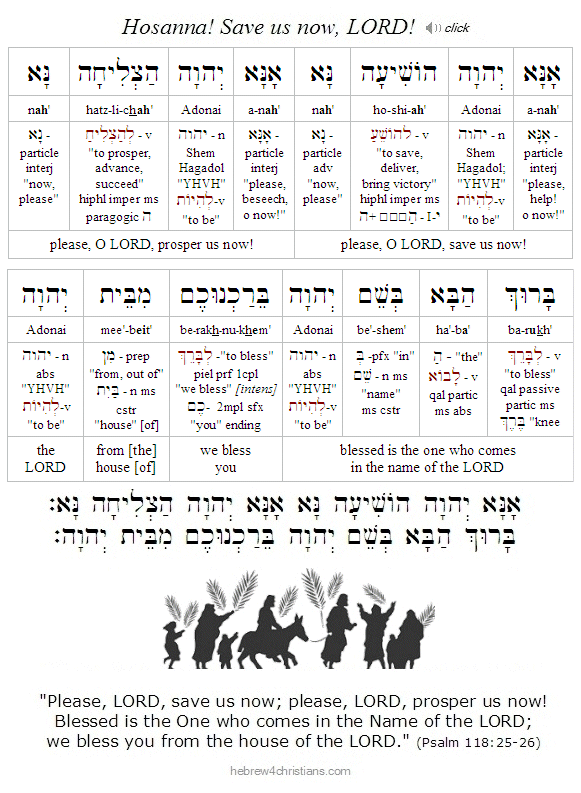 |
The Haftarah for Shabbat HaGadol (Malachi 3:4-24) foretells of Yom Adonai (יוֹם יהוה), the great Day of the LORD, and the return of Yeshua as Mashiach ben David. May that day come soon, chaverim. For more information, click here.
Ordained by the Lamb:
Parashat Tzav - פרשת צו
Every year we read Parashat Tzav before the holiday of Passover...
03.22.26 (Nisan 4, 5786) Our Torah reading for the Sabbath just before Passover (i.e., Shabbat HaGadol) is called "parashat Tzav," where we learn that the first priests of Israel were ordained for their service by the blood of the lamb. First Aaron and his sons were washed with water, arrayed in priestly garments, and anointed with holy oil. During this ordination ceremony, a sin offering and burnt offering were offered on their behalf, and then a special "ram of ordination" (i.e., eil ha-milu'im: איל המלאים, lit. "ram of abundance [מָלֵא]") was slaughtered. Some of this ram's blood was applied to the right ear, right thumb, and big toe of the Aaron and his sons (a picture of Yeshua as our suffering High Priest), and the rest of the blood was dashed upon the sides of the altar. After its slaughter, Moses took some unleavened bread and put it in the hands of the priests to perform tenufah (a wave offering) before the altar (a picture of the resurrection).
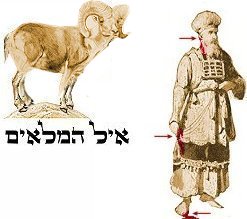 |
As followers of Yeshua, we too have been anointed with the blood from the "Ordained Lamb" -- Yeshua as our Kohen Gadol of the better covenant (Heb. 8:6). And we too have been anointed with the sacred shemen (oil) that symbolizes the presence and aroma of the LORD in our lives. As followers of Yeshua we are therefore truly "...a chosen race, a royal priesthood, a holy nation, a people for his own possession, that you may proclaim the excellencies of him who called you out of darkness into his marvelous light" (1 Peter 2:9). As Yeshua said: "You did not choose me, but I chose you and appointed you that you should go and bear fruit and that your fruit should abide, so that whatever you ask the Father in my name, he may give it to you" (John 15:16). May the God of Israel be pleased to help you serve Him in the truth...
Help me, O LORD...

"One life on this earth is all that we get, whether it is enough or not enough, and the obvious conclusion would seem to be that at the very least we are fools if we do not live it as fully and bravely and beautifully as we can." - Buechner
03.20.26 (Nisan 2, 5786) King David prayed to God, "Make haste to help me, O Lord my salvation!" (Psalm 38:22). David expresses our common condition in this world as we stand in desperate need for God's help and deliverance from what assails our very soul. "My iniquities are gone over mine head, as a heavy burden they are too heavy for me" (Psalm 38:4). The sages have said that the only prayer really we have is "help, Lord," and I use this one on a daily basis, that is, whenever I am once again confronted with the truth of my condition....
The Hebrew word translated "make haste" comes from the root word "chush" (חוּשׁ) which means to hurry, to act quickly, or to come quickly. The Psalms often open the lips our our need: "O make haste to help me!" (i.e., chushah l'ezrati: חוּשָׁה לְעֶזְרָתִי).
I recall an old Yiddishkeit prayer that says, "O LORD, I know that you will help us; but will you help us before you will help us?"
|
An old Jewish prayer says, "O LORD, I know that you will help us;
but will you help us before you will help us?"
|
Although God sometimes tarries, he assuredly does so for our ultimate good. He declares, "I am the LORD; in its time I will hasten it" (Isa. 60:22). But still the anxious heart sighs, "Is it time, LORD? Will you now restore the kingdom to Israel?" But as Yeshua has said, "It is not for you to know times or seasons that the Father has fixed by his own authority" (Acts 1:6-7). We are therefore left waiting for God's ultimate answer: His glorious coming to fulfill our salvation.
Living in the "already-not-yet" state of redemption is a soul-building venture that helps us to acquire the precious middah (quality) of patience: "In your patience possess ye your souls" (Luke 21:19).
In Modern Hebrew the word teshuvah, often translated "repentance," also means "an answer." It is the mind's turning to a shelah, a question, attending to it with honesty in the pursuit of truth. Often the trials in our lives function as God's question to us, and we are asked to answer with the teshuvah of settled faith.
 |
The last words recorded of Yeshua in the Bible are: "Surely I come quickly" (Rev. 22:20) which is immediately followed by the last prayer of the Scriptures, an "antiphon" expressing our hope in him: "Even so, come, Lord Yeshua!"
Suffering produces endurance (Rom. 5:3), but God has promised "to keep you from falling and to present you faultless before the presence of his glory with exceeding joy" (Jude 1:24). "Lord I believe, help my unbelief." May He come speedily, and in our day. Amen.
Hebrew Lesson
Psalm 38:22 reading (click for audio):
A Persevering Hope...

03.20.26 (Nisan 2, 5786) There's an old story of the ancient philosopher Thales of Miletus who fell into a well while he was contemplating the heavenly bodies. All his grand intellectual aspirations resulted in a pratfall of humility. Kierkegaard likewise tells the tale of notable professor who, in the pontification of grand ideas of the cosmos, was oblivious to a drop of sweat that dangled precariously from his nose. And there have been times in my life when I have meticulously studied Scripture and was so engrossed in theological matters that I somehow forgot that God was really present! In such moments, if I were suddenly interrupted, I would likely fall into a moment of peevishness and irritation. It would be comical if it weren't so sad and disappointing, and yet there is a message in the pain that should not be missed....
What do we do with our inconsistencies, those "lapses" of faith that expose what we are actually believing at the time? These are gaps or incongruities between what we might say is true and what our behavior otherwise reveals. For instance, we may say that we trust God with our lives, and aver that we believe that the Almighty works all things "together for our good," but inwardly we are filled with impatience, anxiety, and even dread. We are vaguely conscious of our dissimulation at times; we feel the tension that something is not right about us; we sense that we are not who we want to think we are. We may even suspect that we are inwardly divided, unstable, and afraid of what is hidden within our deepest hearts. But we tolerate our pretenses. We may ask ourselves "what would Jesus do?" and then find reasons to excuse ourselves; we may affirm: "When I am weak, then I am strong," and then "think twice" in fear over circumstances that we do not understand...
So how do we deal with this contradiction between what we are and what we ought to be? How do we reconcile what "is" with what "ought" to be? In other words, how do we "practice what we preach?" We all experience the "gap" between the real and the ideal not only in the social and political world around us, but also - and more profoundly - as duplicity within our own hearts. Alas, how can we no longer be "two-souled' or double minded? How can we be set free from the influence of the "shadow self"?
These are not questions about theology or doctrine, but about emotional and spiritual maturity, that is, they are matters of personal character. When Yeshua said that the truth would set you free, he didn't mean that you would find freedom by studying theology as much as by undergoing transformation of the heart. He was talking about reality - namely the reality of God's righteousness healing your sick life... Theology is important, of course, but primarily as a means to the greater end of knowing God "bekhol levavkah," with all your heart, "bekhol nafshekha," with all your soul, and "bekhol me'odekha," with all your might. The essential reason for learning about God is be in heartfelt relationship with him, after all, and that will lead to transformation of the way we live - that is, how we think, talk, and make decisions. Spiritual truth is "existential." How we live life reveals what we truly believe. But all of it comes from the miracle of God's truth that declares and makes us who we really are...
When we are born from above, we are given a new nature, and the "seed" of eternal life is implanted within the soul. Heart transformation, experientially speaking, comes through time, as a matter of undergoing "reproof" and "correction." This is sometimes called the process of "sanctification," which means walking uprightly in the way of holiness. The Lord is likened to a potter and we are as clay in his hand (Isa. 64:8). Life on the "potter's wheel" can be messy, unsettling, and sometimes excruciatingly hard, but it is God's sovereign work to form your life according to his design and purposes. From our perspective it seems so tedious and difficult, but from God's perspective it is "already done," it is the finished work of Christ that he sees.
God gives us the Scriptures to help us know his heart, as it is written: "All Scripture is inspired by God and profitable for doctrine, for reproof, for correction, and for training in righteousness" (2 Tim. 3:16). Here we note that the Hebrew word for "reproof" is tochechah (תּוֹכֵחָה), from a root (יכח) that means to test or judge the quality of something. God's reproof reveals the gap between our behavior and his standard of moral and spiritual truth, and when we are reproved by God, we understand how we fall short of his will. The Hebrew word for "correction" is mussar (מוּסָר), from a root (יָסַר) that means to chasten or punish, though always with the aim of developing godly character. God will sometimes allow us to undergo affliction, for instance, to teach us patience or humility. "Training in righteousness" means being instructed, as a child, in what is upright, true, and honorable. The life of faith is "education for eternity" where we "catch up" with the reality of God's power within us.
Narrowing the gap between what we say that we believe and how we actually live is therefore an ongoing process for us in this life. The world, the flesh, and the devil are forces that weigh us down to keep us profane and fallen, but God provides his Spirit and he instructs us to walk in the victory of faith. If we ignore or rationalize the gap, however, that is, if we allow the inner conflict and dissonance to become deeply rooted within our souls, we run the risk of becoming either self-deceived or embittered over the struggle. Bitterness is especially dangerous because it can result in abandoning the life of faith altogether (Heb. 12:15). We can fight against these temptations by affirming that what is "really real" about who you are is what God says and does on your behalf in Yeshua. We look to Him, not to ourselves...
The test of faith is a matter of the heart more than the head. Things such as fear, pride, or ungodly desire can overrule our profession of faith, and we "forget" our calling before the Lord. The battle is found within the heart. Courage and moral allegiance is more powerful than intellectual conviction regarding matters of temptation.
The inner conflicts are real. The battle is for our souls. Many of us have truly felt or experienced the glories of God's love, and we want to believe and to walk in the light of that love... So we try various things to know God or recapture our hope. We study, read, think hard, pray, attend services, and so on. But as we try again to be spiritual or religious or self-assured, we may become bound, weary, and feel like a failure... We suspect that we have failed God, failed ourselves, and failed others. We go dark, ashamed, and anxious, but we try yet again, and again, until we are distraught and in agony of heart.
Yet this cycle or undulation is part of the test of faith, this agony of trying and failing, encountering our shadowy duplicity of heart, descrying yet again what we really are on the inside, and crying out for deliverance from our faithlessness, our hypocrisy, our fecklessness, and our despair... Paradoxically, because we cannot help ourselves, we continue trying, lamenting, confessing, and persevering - despite ourselves - and in the lament of the struggle to be who God says we are, we begin to surrender to a deeper heart or way of being - broken, humbled, brought face to face with our powerlessness and need - and it is then that we discover the healing hand of God is at work... God alone saves us, not we ourselves.
"You do not know what spirit you are of..." (Luke 9:55). Yeshua's words imply that each of us has the responsibility to know ourselves (γνῶθι σεαυτόν), and to learn to endure (and overcome) the natural motives and focus of our hearts. We collide with the truth of our spiritual condition in the midst of our daily frustrations, as we experience conflict, opposition, and the inner groan that arises from pressures and disappointments. Spiritual growth means learning to transcend our negative reactions, to stop cursing our conflicts, and to awaken to the blessings that surround and pervade our way. It requires a miracle. It demands faith.
If we are able to find the courage, our failures and brokenness may be used by God to purify the intentions of the heart by helping us to be more honest with ourselves. We begin to realize that we are more vulnerable than at first we thought; that our faith is not as strong as we imagined, and that our motives are often mixed and unconscious. Illusions are striped away; idols crumble; deeper levels of selfishness are uncovered; and the gap between our words and our deeds is exposed yet again... It is one thing, after all, to intellectually think about faith or to idealize spirituality, but it is quite another to walk out faith in darkness. Yet it is only there, in the rawness of heart, that we discover what we really believe and how our faith makes traction with reality... And there we will discover, if we persevere, the truth that Paul affirmed: "I have been crucified with the Messiah. It is no longer I who live, but Messiah who lives in me. And the life I now live in the flesh I live by the faith in God the Son, who loved me and gave himself for me. I do not nullify the grace of God, for if righteousness (i.e., salvation) were through the law, then Yeshua died for no purpose" (Gal. 2:20-21).
There is a "hidden blessing" (ברכת סוד) that comes from our troubles. When we learn to accept that we are accepted despite ourselves, we find God's Presence and can breathe in his peace and love, despite the sorrows and grief of our lives. When we come to the light, and do not deny the truth about our condition, we can honestly confess the Lord is our healing (Heb. 4:16). When we seek the good - and even bless the struggle - we express our trust that God is using our trials to help us grow and to bring beauty from our ashes (2 Cor. 7:10). "O Lord, I need you for everything, every last thing. Please meet my great need for You, for without you I am nothing." Amen, "turn us back to you, O LORD, so shall we be turned..." (Lam. 5:21).
Contrary to the assumption that the life of faith should always be triumphant, we all will experience various setbacks, pratfalls, troubles and various challenges in our lives. This does not mean that God does not care for us however, because on the contrary, this is by his design; a plan supervised by God's love and blessing, and the afflictions we therefore encounter are part of his work for our good (Rom. 8:28; Heb. 12:6). We "descend in order to ascend"; we go down to go up (לרדת כדי לעלות). It seems counterintuitive to the flesh, but the heart of faith gives thanks for all things - the good as well as the evil (see Job 2:10). We affirm: "This too is for the good," yea, even in the midst of our struggle, no, even more -- precisely in the midst of our struggle -- for this, too, is for our good. Faith is the resolution to trust in the reality of God's goodness even during hard times when we feel abandoned or lost (see Isa. 50:10). The Lord uses the "troubles of love" (יִסּוּרֵי אַהֲבָה) for our good - to wake us up and cling to him all the more, since this is what is most essential, after all...
God forbid we should give up now, friends. Faith "sees the unseen" and believes that the day of our ultimate healing draws near. You are in good hands as the Lord forms your soul for the glory of his purposes... Stay strong and keep your hope alive. !מחיל אל חיל
Hebrew Lesson:
Psalm 18:28 reading (click):
Honesty and Deliverance...
03.20.26 (Nisan 2, 5786) "Those who are well have no need of a physician, but those who are sick. I have not come to call the righteous but sinners to repentance" (Luke 5:31-32). Every one of us has a "dark side" or a "shadow self" that has destructive and selfish urges. We try to conceal this truth from others (and even ourselves) but such denial doesn't change the reality within our hearts (Matt. 5:19; Jer. 17:9; Eccl. 9:3). Indeed, when we pretend to be something we are not we are more likely to be overwhelmed by dark forces hidden within us. Paradoxically we most vulnerable when we think we are well, that is, when we deny our sickness our heart and minimize our need for deliverance.
The way of healing is to "own" or confess the truth of our inner condition and to acknowledge the dark passions that sometimes overmaster our best intentions. We must give ourselves permission to allow the hurt, angry, and fearful voices to be heard and sanctioned within us - and then to bring these dark and hidden aspects of our selves before God for healing. The failure to do so will split the soul and cause the hidden aspects of the self to seek "revenge" upon the "parent self" that censors their message. The struggle within our hearts is real and we should attend to it seriously. Denying evil by pretending that we are okay, or by blaming others, blinds us to the truth of our ongoing need for deliverance. May God help each of us to be honest with ourselves and to confess our great need before our Heavenly Father.
Why do we have such difficulty being genuinely honest with ourselves? Despite the fact that we may profess that we are "sinners saved by grace," we often make excuses for our failures, rationalizing that we are not "that bad," and therefore we postpone genuine teshuvah (repentance) and trifle with our spiritual lives. We do this because we feel an almost irresistible desire or "need" to justify ourselves, to "save face" by pretending that we are not "incurably sick," or by attempting to find something about us that makes feel valuable and worthy. As H.L. Mencken once wittingly noted, "the 'truth' that survives is simply the lie that is pleasantest to believe."
The LORD wants us to be truthful in the "inward being" (Psalm 51:6), though that truth will cost us something, namely whatever worldly gains we might find through self-deception... Opening our hearts to divine examination eventually means colliding with the world of men and their conspiracies, since the godly man no longer abides their presence (Psalm 1:1-2). The Apostle Paul said there was an exclusive disjunction between seeking the approval of men and of the approval of God: "Do I seek to please men? for if I yet pleased men, I should not be the servant of the Messiah (Gal. 1:10). Likewise we are told not to deceive ourselves (lit., "reason around" the truth, from παραλογίζομαι, from παρά, "around, beside" and λογίζομαι, "to reason") by merely hearing the truth of Scripture and not living it (James 1:22). God is not interested in "lip service" any more than he desires heartless sacrifice (Isa. 29:13; Hos. 6:6; Matt. 15:9). "Let your love be genuine (ἀνυπόκριτος, without a "mask" put on), abhor what is evil; cling to what is good (Rom. 12:9). God abhors those who pretend to know Him but who are really spiritual impostors (Matt. 7:21-23; 25:11-12; Luke 6:46).
Tragically (and paradoxically) many people can talk themselves into believing something without really believing it, and that is perhaps the most dangerous thing of all (Matt. 7:22-23). On the other hand, some people can talk themselves into believing (or accepting) something that they know is untrue (or morally wrong), and that self-deception leads to inner fragmentation, chaos, and dissolution of character. A "double-minded man is unstable in all his ways" (James 1:8). As I have said before, the word translated "double-minded" is dipsuchos (δίψυχος), a word formed from δίς, "twice" and ψυχή, "soul." The word describes the spiritual condition of having "two souls" that both want different things at once -- a state of inner contradiction and ambivalence.
Hebrew Lesson
Psalm 51:6 reading (click):
Thank the LORD our God that there is real healing for our inner dividedness, ambivalence, and double-mindedness, but that healing demands rigorous honesty. As Kierkegaard rightly observed: "No person is saved except by grace; but there is one sin that makes grace impossible, and that is dishonesty; and there is one thing God must forever and unconditionally require, and that is honesty." Therefore we are instructed to confess our faults one to another, and pray for one another, that we may be healed (James 5:16). May the LORD our God help each of us to be wholehearted in our devotion to Him.
Finally, friend, a closing thought. Let us not despair by thinking that we will never change. We must simply "enter into" the presence of God in Yeshua. That is what "self-denial" really means: Turn to God and know his heart. When we do, we receive a heart to know him in return... "Believe to see" the goodness of the LORD in your midst. Amen.
Preparing for Passover...
The holiday of Passover begins in less than two weeks, on Wed. April 1st this year...
03.19.26 (Nisan 1, 5786) To celebrate the holiday of Passover, we first must remember why it is so important for us. We must understand how the great exodus of Israel from Egypt (יציאת מצרים) constitutes the central parable (or story) of the Torah, and indeed of the entire Bible. The bondage of the Israelites to Pharaoh represents humanity's slavery to sin; deliverance from cruel bondage is effected by trusting in the blood of the sacrificial lamb of God; the exodus from death to life symbolically comes through baptism into the Sea of Reeds; the journey to truth represents the pilgrimage to Sinai, and so on.
We must further remember that the redemption in Egypt led directly to the revelation given at Sinai. When God personally manifested his glory to Israel, he did not begin by saying he was our Creator, but rather our Redeemer: "I am the LORD your God (אָנכִי יְהוָה אֱלהֶיךָ), who brought you out of the land of Egypt, out of the house of slavery" (Exod. 20:2). God began with these words because the purpose of the creation itself is to demonstrate God's redemptive love and to be known as our Savior and Redeemer, just as Yeshua is the "Lamb slain from the foundation of the world" (Rev. 13:8; 1 Pet. 1:18-20; Eph. 1:4; 2 Tim. 1:9).
"All things were created by Him (i.e., Yeshua), and for Him" and in Him all things consist (συνεστηκεν, lit. "stick together") (Col. 1:16-17). Creation therefore begins and ends with the love of God as manifested in the Person of Yeshua our Redeemer, the great Lamb of God and our Savior... He is the Center of Creation - the Aleph and Tav - the Beginning and the End (Isa. 44:6; Rev. 1:8). All the world was created for the Messiah: "For from him and through him and to him are all things. To him be glory forever. Amen" (Rom. 11:36).
Understanding the Calendar...
Although it may be a bit confusing to understand the overlap and sequence, the Torah instructs us to prepare for Passover by first noting the first "new moon" of the Spring (aviv), which is called the first day of the month of Nisan on the Jewish calendar. This is called "Rosh Chodashim," meaning the "head of the months," and it therefore serves as the start of the new year as well (Exod. 12:2). From the outset of the new moon until the full moon of the same month marks 14 days, which at sundown marks the appointed time or holiday of Passover. Technically speaking Passover runs only one day, from the evening of the 14th until the 15th, but since it begins concurrently with the first of the seven days of unleavened bread (Exod. 12:15-20), Passover is often regarded as week-long holiday.
Now to make matters a bit more complicated, the Torah instructs us to count 49 days – "seven weeks of days" – from the day following Passover until Shavuot (i.e., Weeks or "Pentecost"). This period of time is called Sefirat HaOmer (סְפִירַת הָעוֹמֶר), or the "counting the sheaves" (Lev. 23:15-16; Deut. 16:9-10). Of particular interest to us is the second day of the count, on Nisan 17, called Yom HaBikkurim (יוֹם הַבִּכּוּרִים), "the Day of Firstfruits," which marks not only the "first of the harvest" but the resurrection of Yeshua from the dead - the "firstfruits" of redeemed humanity secured by his sacrifice for us as the Lamb of God.
The festival of Shavuot ("Weeks, "Pentecost"") marks the culmination or "jubilee" of the Passover redemption, and it is therefore called Atzeret Pesach (עצרת פסח), or "the Gathering rally of Passover." According to the traditional sages the new moon of Nisan (חודש ניסן) marks the start of sacred time, the Passover remembers the sacrifice of the Passover Lamb, the first day of Unleavened Bread remembers the Exodus from Egypt, the seventh day of Unleavened Bread remembers the crossing of the Red Sea, the counting of the Omer recalls the days before the giving of the Torah at Sinai, and Shavuot (Pentecost) remembers the giving of the Torah exactly seven weeks (שבעה שבועות) after the Exodus (on Sivan 6 in the Torah's calendar). Followers of Yeshua understand Pentecost to the appointed time for the advent of the Holy Spirit as was promised by our Savior (see Acts 1:3-2:4; John 15:26, John 16:7).
![Spring Holiday Timeline (H4C]](../../../../About_HFC/Site_News/Archive-2026/March/roshchodeshim-line.gif) |
In a sense Shavuot stands in contrast to Passover that requires unleavened bread (matzah), since two loaves of bread made from the first fruits of the wheat harvest were baked with chametz (yeast) before being "waved before the LORD" (Lev. 23:15-21 which pictures the "one new man" (Jew and Gentile) gathered before the altar (Eph. 2:14).
Getting Ready for Passover...
Some Christian traditions observe a 40 day period of repentance and preparation leading up to "resurrection day" (which they reckon to always fall on a Sunday based on an exegetical error). This tradition may have been derived from the 40 days of teshuvah observed by the Jewish people during the time of the High holidays in the fall, and some theological correspondences can be made between Passover and Yom Kippur regarding atonement. That said, there is no indication given in Scriptures that we should fast or otherwise undergo dietary restrictions in preparation of the holiday of Passover, though of course we are instructed to remove all "chametz" from our homes and to abstain from eating any during the days of unleavened bread. We need to use the "good eye" with those who may differ with us regarding the observance of the holidays, and we must be sure to keep focused on what is most essential regarding all of this heart of the Lord...
From the Jewish perspective, we get ready for the Passover today by planning for a "Seder," or commemorative meal, that remembers the great Exodus from Egypt and that retells how the Lord faithfully saved Israel with a "mighty hand and an outstretched arm."
The traditional Passover Seder that has been developed over the centuries has more or less been distilled into a formulaic text recited during the commemorative meal by a designated seder leader (or leaders). This text is called the Haggadah (הַגָּדָה, "telling") and it was designed to guide the order of the Passover service... Everybody gets involved in the seder and often discussions can be lively and intense. And while there is no "official" Passover seder, most haggadot (seder guides) will set forth the traditional sequence of 15 "steps" (or activities) that we will do to commemorate our deliverance from our bondage in Egypt...
So one of the first steps to prepare for Passover is to select a Haggadah that you will use for the family service and familiarize yourself with its content. You then can make a checklist of needed items for the meal. If we make some time to do this, we will feel more comfortable as we go through the Passover service with our family and friends.
To help you get started, you can download the (free) Hebrew for Christians Passover Seder and print a copy for yourself and for each participant at your Seder. The seder is guide is called "Worthy is the Lamb," and it will guide you through all the 15 steps of the traditional seder with constant reference to the ministry of Yeshua as the Lamb of God.
 |
"Worthy is the Lamb"
H4C Passover Seder Guide (pdf)
Removing the Chametz...
The Torah tells us to remove any trace of leaven or "chametz" from our houses before the Passover begins (Exod. 13:7; Duet. 16:8). Because of this we clean our homes of all possible chametz (products or residue which might contain leavening such as bread, crumbs etc.) before the holiday begins. The cleaning culminates in the Erev Pesach ceremony of Bedikat Chametz, when the last vestiges of leaven are removed from the house. For the entire week of Chag HaMatzot we are not to have any leavened products in our homes, nor are we to consume any leavened products outside our home. We are to be "leaven-free.
The process for removing chametz from your house is a fairly involved, and frankly very few people have the time and energy to perform a thorough cleaning in the traditionally prescribed manner. Nonetheless, the traditional steps include:
- Cleaning all possible locations where chametz might have been eaten or might be found in the house. This means searching for crumbs under the cushions of your sofa or stuffed chairs, in the pockets of your coats and pants, on closet floors, and so on. After a room is entirely cleaned and declared chametz-free, it is called "Pesachdik" and no further eating in that room is allowed until after Passover.
- Emptying and scrubbing down the entire refrigerator to remove all traces of chametz. This includes washing out the freezer as well.
- "Kashering" your stove and oven. This involves a thorough scrubbing of the entire oven, stove top, and racks and then turning the stove (and stove tops) on for over one hour at the highest temperature. A microwave oven can be kashered by boiling a bowl of water inside it for more than 20 minutes.
- Putting away all dishes, silverware, pots, utensils, etc. that are normally used during the year. Only dishes, silverware, pots, utensils, etc. that are "dedicated" for Passover may be used during Passover Week.
- "Kashering" your dining room and kitchen tables by pouring boiling water over them and then thoroughly scrubbing them down with soap and water. After kashering, the tables are covered until Passover.
- Scouring the sink, counters, and all other appliances with boiling water.
- Scrubbing down the floors, windows, and all other parts of the house.
The Hebrew word chametz (חָמֵץ) derives from the same root as the word "sour" (חָמוּץ), and is generally considered to be any corrupting influence, a hidden uncleanness that manipulates purer elements. Like the influence of a lump of leaven in a batch of dough, "spiritual" leaven functions as an evil impulse within us that corrupts and sours our soul. As such chametz is considered a metaphor of sin which we are commanded to put away from us. The removal of chametz is a metaphor of our sanctification. Part of observing Passover, then, means being careful not to eat anything with chametz (yeast) during the entire seven days of the Feast of Unleavened Bread (i.e., from Nisan 15 through Nisan 22).
Note that the search for hidden chametz is not unlike the soul searching we do before the fall High Holidays, when we perform chesbon hanefesh (חֶשְׁבּוֹן הַנֶּפֶשׁ) by taking inventory of our spiritual condition before the LORD. In other words, we are commanded to search and remove sources of inner impurity so that we might experience the truth that we area "new lump" - that is, a new substance that is untainted by the sour and rotting influences of our past lives. Since Yeshua has been sacrificed as your Passover Lamb, you are indeed a new creation (בְּרִיָּה חֲדָשָׁה) and are made "unleavened" by the power of the Holy Spirit (2 Cor. 5:17). Therefore we are likewise commanded put away the "old nature" - the yetzer ha'ra - and purge from your life the old influences that inwardly canker you and make you sick. Walk without hypocrisy in the truth of the love of God for your soul.
Keeping the Feast...
Observing Passover is crucial for God's people. In the Torah we read: "And the LORD spoke to Moses in the desert of Sinai, in the first month (בַּחֹדֶשׁ הָרִאשׁוֹן) of the second year after they had come out of the land of Egypt, saying, 'Let the people of Israel keep the Passover at its appointed time. On the fourteenth day of this month, at twilight, you shall keep it at its appointed time; according to all its statutes and all its rules you shall keep it' (Num. 9:1-3).
Ultimately all true Torah points to Yeshua, who is the divinely appointed Redeemer and the beginning and goal of all of creation... "When the fullness of time (τὸ πλήρωμα τοῦ χρόνου) had come, God sent forth his Son, born of woman, born under the Torah, to redeem those who were under the Torah, so that we might receive adoption as sons" (Gal. 4:4-5). As the psalmist later declared: "He made the moon for the appointed times" (Psalm 104:19). And since Yeshua came to perfectly fulfill the meaning of these appointed times, it is clear that he observed this calendar as well (Gal. 4:4-5).
Therefore, friends, let us keep the feast of Passover according to the appointed time of the LORD, namely, on the 14th day of the month of Nisan, the first month of the Biblical calendar, at twilight, as a time to be remembered and guarded for all generations (Exod. 12:42). As the Apostle Paul wrote: "Cleanse out the old leaven that you may be a new lump, as you really are unleavened for Messiah our Passover Lamb has been sacrificed for" (1 Cor. 5:7-8). Amen! Worthy is the Lamb who was slain!
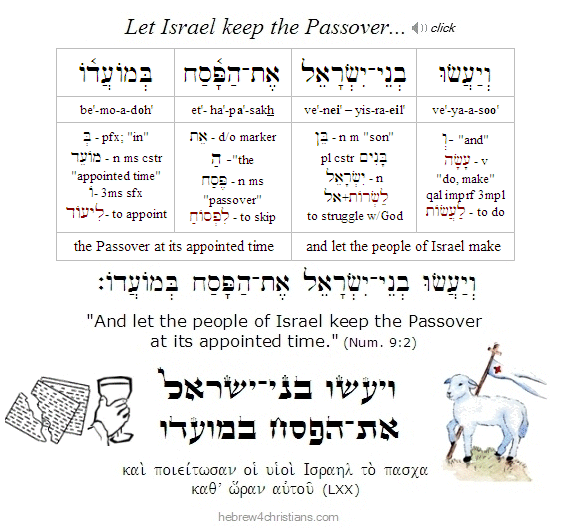 |
Beginning Again...
Shanah Tovah b'Yeshua, chaverim. At this time may we renew our hearts before the LORD.
03.19.26 (Nisan 1, 5786) When considering the matter of "teshuvah" (i.e., returning to God), it is vital to understand that God does not love you based on your obedience, though his love for you will lead you to obedience... It is only after accepting that you are accepted despite yourself – despite your inherent inability to please God, despite your incurably sick heart, despite your disobedience, sin, and so on – it is only then that earnest, Spirit-enabled obedience may arise spontaneously within your heart (Rom. 2:4).
In this sense "obedience" is like falling in love with someone. It is your love that moves you to act and to express your heart, and were you prevented from doing so, you would undoubtedly grieve over your loss... Therefore the "law of the Spirit of Life in Messiah" is first of all empowered by God's grace and love. We walk by faith, hope, and love – these three. And this explains why the first step of teshuvah is to love God: Ve'ahavta et Adonai (Deut. 6:5). The work of faith is to believe in the miracle that God's love is "for-you-love..." (John 6:29).
If you find yourself operating from a sense of God's conditional acceptance, you will undoubtedly need to repeat the same sins over and over until your heart is finally convinced of its incurably wretched state. You must first be utterly sick of yourself to believe in the miracle of God's deliverance. You have to be "sick of your sickness" and be willing to give it up. Only then will the message of find opportunity to speak...
It needs to be added, however, that genuine repentance implies an understanding that sin is dreaded because it separates us from God's love. Some seem to think Yeshua died on the cross for their sins so that could live their lives without regard for sin, but that is of course a perversion of the truth. Yeshua did not suffer, bleed out, and agonize upon the cross for our sins so that we'd be given license to disregard the God's great cost to remedy our hearts...
Indeed, by treating sin lightly we disparage the sacrificial work of Yeshua given on our behalf – we "crucify the Son of God afresh" and thereby deny God's wrath for sin as well as his severe mercy given to those who trust in him (Heb. 6:4-9).
There is no Torah apart from the cross, just as there is no cross apart from the Torah... Most of all, the cross of Yeshua reveals that God is willing to sacrifice everything for your blessing...
Hebrew Lesson
Psalm 145:8 reading (click):
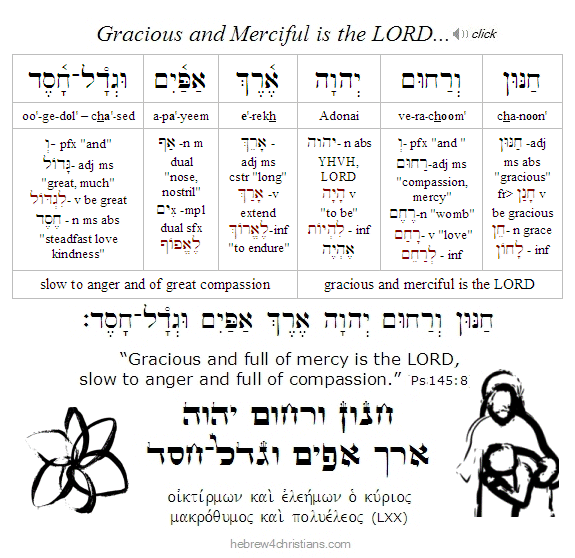 |
"Blessed is the man who walks not in the counsel of the wicked, nor stands in the way of sinners, nor sits in the seat of scoffers, but his delight is in the Torah of the LORD, and in His Torah he meditates day and night" (Psalm 1:1-2). Again, it is a severe mercy, a weighty grace, that is bestowed to us, friends...
The Month of Deliverance...
03.19.26 (Nisan 1, 5786) Are you discouraged by this evil world, chaverim? Do you sometimes utter the plaintive prayer: "O Lord, I know that you will help us; but will you help us before you will help us?" When things are dark and seemingly hopeless, it is tempting to yield to passivity and even to despair, but it is precisely then that our faith must rise up and become all the more emboldened. Faith in God's love is the victory (i.e., netzach: נֶצַח) that overcomes the world and its illusions (1 John 5:4). We must remember that the LORD is our Deliverer and Kinsman Redeemer (הַגּוֹאֵל), a "very present help" in our troubles.
The great Passover (חג הפסח הגדול במצרים) is all about the victory of God over the powers of darkness for the sake of our deliverance (יְשׁוּעָה). "Let my people go!" Indeed, the month of Nisan is called Chodesh ha-yeshuah (חדֶשׁ הַיְשׁוּעָה), the "month of the salvation," both in terms of remembering the physical deliverance from the political powers of Egypt, but more profoundly in terms of our spiritual deliverance given at Zion/Moriah through the Messiah. Chodesh ha-yeshuah can also be read as chadash ha-yeshuah, "the new (חָדָשׁ) salvation," suggesting the new covenant power we are given in the Messiah. We wrestle not against flesh and blood, chaverim, but against hidden powers of darkness that seek to enslave us as Pharaoh did of old (Eph. 6:12). But thanks be to God who gives us the victory (netzach, salvation) through our Lord Yeshua the Messiah (1 Cor. 15:57).
Passover is really a month-long celebration. Over and over it is referred to as the "month of spring" (חדֶשׁ הָאָבִיב), the "month of redemption," the month of Nisan, and so on. The word Nisan (נִיסָן) itself might come from either the word nitzan (נִצָּן), meaning "bud" (Song 2:12), or the word nissim (נִסִּים) meaning "miracles," both of which suggest physical and spiritual resurrection in our lives. Others think the word comes from the verb nus (נוּס), meaning "to flee," both in relation to Israel's flight from Egypt and Egypt's flight from Israel (i.e., when the pursuing Egyptian cavalry fled (נָסִים) before the sea closed upon them (Exod. 14:25, 27). We also see this usage in the verse: "The wicked flee (נָסוּ) when no one pursues, but the righteous are bold as a lion" (Prov. 28:1). The devil's power is found in the lie. If he can make you afraid, you will not think clearly. Establishing your faith in the truth will embolden you to deal with the lies and distortions that are intended to enslave you in fear. As Yeshua said, the truth will set you free (John 8:32).
Yeshua is called the "Lion of the tribe of Judah" (הָאַרְיֵה מִשֵּׁבֶט יְהוּדָה) and the "Root of David" (שׁרֶשׁ דָּוִד). Notice that the name Judah (יְהוּדָה) includes the Name YHVH (יהוה) with the insertion of the letter Dalet (ד), suggesting that this shevet (tribe) would be the "door" or "gate" into the presence of God. Yeshua the Messiah was from the tribe of Judah who described Himself as ha-sha'ar (הַשַּׁעַר) "the gate" (John 10:9). Putting our faith in Yeshua gives us bold access to the throne of God's grace so that we can find help (deliverance) in time of our need (Heb. 4:16).
In light of the conditions of this present evil world, we cry out for the Messiah to return now! We want His deliverance, just as He delivered the Jews from ancient Egypt with great signs and wonders. Most politicians, by definition, exhibit the Pharaoh-like lust to control and exploit people. They are called "the lords of the darkness of this world" / τοὺς κοσμοκράτορας τοῦ σκότους τούτου (Eph. 6:12). This is the nature of the corruption of those who crave power over others... Today, so many people live in fear because they believe the propaganda of the "princes of this age." We must always keep in mind that reality centers on the LORD God of Israel, not in appearances and the rhetoric of political or media figures. Melo khol ha'aretz kevodo: מְלא כָל־הָאָרֶץ כְּבוֹדו, "the whole earth is filled with His glory (Isa. 6:3). And the LORD God of Israel cares about people's liberation from deception and tyranny. The story of the Exodus is His everlasting rebuke to all the world's dictators and should cause every politician to soberly assess their fate... The time is coming when His judgment will fall upon all the "kings of the earth who take counsel against the LORD and against His Mashiach" (Psalm 2:2).
The world runs on a different "clock" and operates under its own set of philosophical assumptions. The "wisdom of this world" (σοφία τοῦ κόσμου τούτου) is the prevailing cultural spirit that suppresses the reality of God's Presence and truth. Such "wisdom" is regarded as foolishness before God, and God has promised to "seize the so-called wise in their own craftiness" (1 Cor. 3:19). The life of faith, on the other hand, sees what is invisible. Faith (emunah) apprehends "the substance (ὑπόστασις) of things hoped for, the assurance (ἔλεγχος, conviction, "correction," "argument," i.e., tokhachat: תוֹכַחַת) of things not seen" (Heb 11:1). Faith "looks not to the things that are seen but to the things that are unseen. For the things that are seen are transient, but the things that are unseen are eternal" (2 Cor. 4:18).
Ultimately Passover is about experiencing the deliverance of God from our fears, despite the appearance of rampant wickedness in this world. During this season - and always - may He help us walk by faith (בָּאֱמוּנָה), not by sight (2 Cor. 5:7). May He give you comfort and reassure you of His strong arm of deliverance at this time... Remember the great promise: "God is our refuge and strength, a very present help in trouble. Therefore we will not fear though the earth gives way and the mountains be moved into the heart of the sea." Amen.
Hebrew Lesson
Psalm 46:1-2 reading (click):
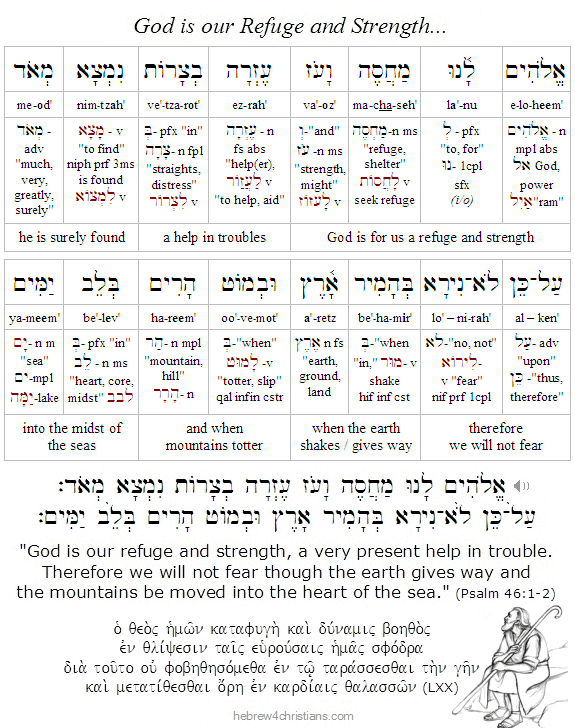 |
The Time is Now...

03.19.26 (Nisan 1, 5786) At the advent of a new Biblical year, it is traditional to confess our sins and turn to the Lord with a renewed passion. Therefore the sages admonish: "Repent one day before you die" (Mishna Avot 2:15b). But who knows the day of one's death in advance? Therefore live each day as if it were to be your last, and may God help you make the wholehearted decision to "seek the LORD while He may be found; call out to Him while He is near" (Isa. 55:6). Amen. But many people live in a state of hesitation and uncertainty... The Spirit asks: "How long will you go limping between two different opinions?" (1 Kings 18:21).
This question is meant for us to hear today. We are being called to make up our minds and turn (shuv) to the LORD. After all, what is more important to you than your relationship with God? Is there anything more important than this? As C.S. Lewis once said, "Christianity, if false, is of no importance and, if true, is of infinite importance. The one thing it cannot be is moderately important" (God in the Dock). "For he is our God, and we are the people of his pasture and the sheep of his hand today -- if you hear his voice" (Psalm 95:7). Today, if you hear his voice, do not harden your heart (Heb. 3:15). "Take care, brothers, lest there be in any of you an evil, unbelieving heart, leading you to fall away from the living God, but encourage one another every day, as long as it is called "today," so that none of you may be hardened by the deceitfulness of sin" (Heb. 3:12-13). Wake up! The time is now...
Hebrew Lesson
Psalm 39:4 Hebrew reading (click):
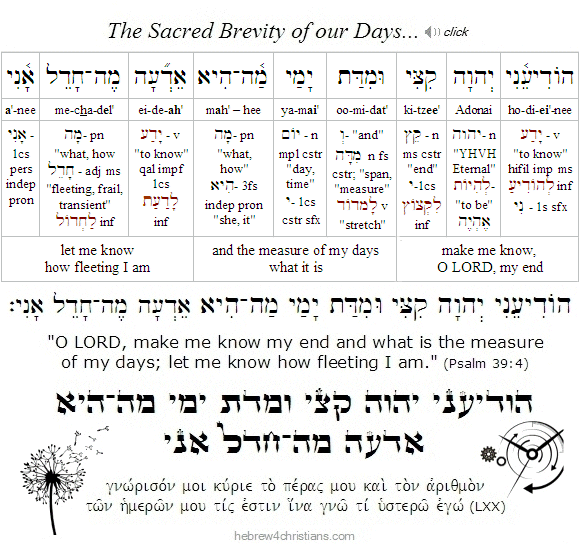 |
To a Happy New Year!
03.19.26 (Nisan 1, 5786) As I mentioned earlier this week, the new moon of Nisan is the most significant of the Jewish calendar since it initiates the first month of the Biblical Calendar - and therefore represents the Biblical "New Year's Day." Of all the various Rosh Chodesh celebrations, then, Rosh Chodesh Nisan is foundational, since it presents the starting point for the cycle of the yearly festivals (mo'edim) that reveal prophetic truths about the LORD God of Israel and His beloved Son, Yeshua the Messiah, blessed be He.
Rosh Chodesh Nisan Sameach and Happy New Year chaverim!
The Central Truth of Torah...
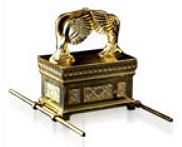
03.18.26 (Adar 29, 5786) The Book of Leviticus (ספר ויקרא) is to the Torah what the Book of Hebrews is to the New Testament. Leviticus is both the physical and spiritual center of the Five Books of Moses and comprises its ritual expression. The sages count 246 of the 613 commandments of the Torah in this book (over 40%), and many of the Talmud's discussions regarding ritual purity and holiness are based on it.
The story of the Exodus reveals that the nation of Israel was "born" by means of the blood of the Passover lamb. But the Passover was a means to the revelation given at Sinai, and the revelation at Sinai found its ritual expression in a system that required the constant shedding of the blood of sacrificial animals (i.e., the Tabernacle). "For the life of a creature is in the blood, and I have given it to you to make atonement for yourselves on the altar (of the Mishkan); it is the blood that makes atonement for one's life" (Lev. 17:11).
Sometimes it seems as if there are two different sacrificial themes given in the Torah (and the New Testament, as well). First we have Passover -- and the redemption given through the blood of the Passover lamb -- and then we have Yom Kippur, with atonement given through the blood of the goat. Passover represents the blood of redemption (i.e., freedom from slavery, deliverance, salvation, etc.) and Yom Kippur represents the blood of atonement (i.e., freedom from guilt, cleansing from sin, etc.).
Note that the original Passover sacrifice (קרבן פסח) was not given to the Levitical priesthood as a sin offering, since it preceded Sinai and the giving of the various laws concerning the Mishkan/Temple sacrificial rites. In the same way, Yeshua's sacrifice was directed from Heaven itself by means of the prophetic office of Malki-Tzedek (מַלְכִּי־צֶדֶק) - a higher order of priesthood (Gen. 14:18; Psalm 110:4; Heb. 7). Yeshua both offered Himself up as the "Lamb of God" that causes the wrath of God to (eternally) pass over those who personally trust in Him, and He also offered himself as the "Goat of God" whose blood was sprinkled in the Holy of Holies to cleanse us from sin and give us (everlasting) atonement. (Other metaphors are also given in Scripture, for example, Yeshua offered Himself as a Snake lifted up (John 3:14-15; cp. Num. 21:4-9), as a Red Cow (parah adumah), and so on).
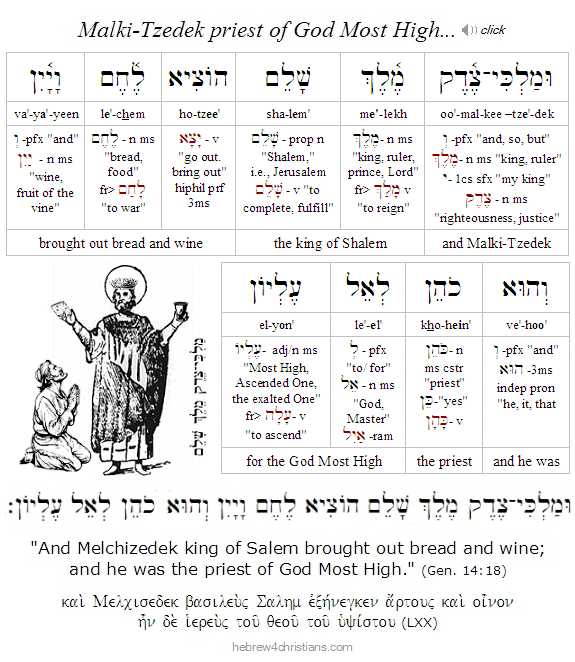 |
For Yom Kippur, of course, two goats were required: one goat was for blood sacrifice in the Holy of Holies (the Goat of the LORD) and the other was used as a "scapegoat" for the sins of the community (the goat of Azazel / the devil). The Gospels seem to emphasize the connection between Yeshua as the "Lamb of God who takes away the sins of the world" with Passover/Exodus more than the connection between Yeshua as the "Goat of the LORD" whose blood was sprinkled upon the Mercy Seat with Yom Kippur - though the author of the Book of Hebrews explicitly makes this connection (Heb. 9:11-12; 24-ff).
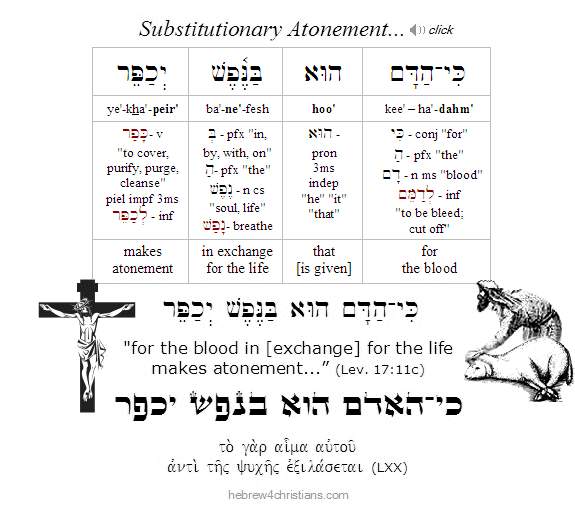 |
Yeshua as the "Lamb of God" pictures personal redemption from slavery to Satan and freedom from the wrath of God. This is the greater Passover/Exodus connection. By means of Yeshua's shed blood and broken body, the wrath of God passes over us and we are set free to serve God.... Yeshua as the "Goat of God" pictures both personal cleansing (i.e., "propitiation" or "expiation" for our sins: the Greek word (ἱλαστήριον) is used in the LXX for the kapporet (Mercy Seat) in the Holy of Holies which was sprinkled with the blood of the sacrifice on Yom Kippur) as well as national teshuvah and cleansing for ethnic Israel at the end of the Great Tribulation period. At that time Yeshua will function as Israel's true High Priest whose sacrifice is applied for Israel's Atonement. This is the Yom Kippur connection.
Since the destruction of the Second Temple in AD 70, Judaism has struggled to make sense of the Book of Leviticus' significance. After all, the Rabbis of the Mishnah and Talmud redefined Jewish worship to bypass the Torah's commandments for blood atonement rituals by substituting Torah study, daily prayer, and acts of loving kindness. Thus the Pirke Avot says, "The world stands on three things: Torah, service, and acts of loving kindness (1:2)," and Yochanan ben Zakkai (a primary contributor to the Mishnah who established Judaism without the Temple) appealed to Hosea 6:6 to substitute prayer for sacrifice.
Later, the medieval scholar Moses Maimonides (the "Rambam") suggested that animal sacrifices were a temporary dispensation given by the LORD to counter the idolatrous impulses of ancient Israel. The theory goes that in ancient times, people worshipped animals and made sacrifices to idols, so the LORD came up with the idea of the Tabernacle to "constrain" such impulses. Animals could only be sacrificed (though not worshipped) at the designated place (i.e., the Tabernacle) under the supervision of the LORD's priests, though ultimately this practice would be phased out as Israel became more "enlightened."
The Jewish commentator Isaac Abrabanel (1437-1508) supported Maimonides' claim and wrote: "It's analogous to the case of a prince who turned villainous and acquired the habit of eating disgusting food. Said the king: Let him eat the disgusting food at my table and he'll come to break the habit. Likewise, the Israelites were steeped in idol worship, including sacrifices. Said God: Let them bring those sacrifices to me at the Tent of Meeting, and from this they'll come to break the habit."
Of course Modern Judaism followed the lead of Yochanan ben Zakkai and the later medievalists by saying that avodah (Temple service) has been replaced by prayer.... "Atonement" has become a system consisting of performing "good deeds" of Torah study, prayer, fasting and acts of lovingkindness (gemilut chasidim). However, given that 246 of the 613 commandments of the Torah concern details of the sacrificial system, this conclusion seems warranted only if we assume that Oral Torah (and Jewish tradition) can directly contradict (i.e., "preempt") the written commandments given by Moses himself...
Jewish tradition is not without its witness, however. In the Talmud it is recorded that "during the last forty years before the destruction of the Temple the lot ['for the Lord'] did not come up in the right hand; nor did the crimson-colored strap become white; nor did the westernmost light shine; and the doors of the Hekhal would open by themselves" (Yoma 39b). Forty years before the destruction of the Second Temple would be around 30 AD -- the time of the sacrificial death of Yeshua for the sins of Israel and the world. The requirement for the blood of atonement forever stands, just as every word of the Torah is true...
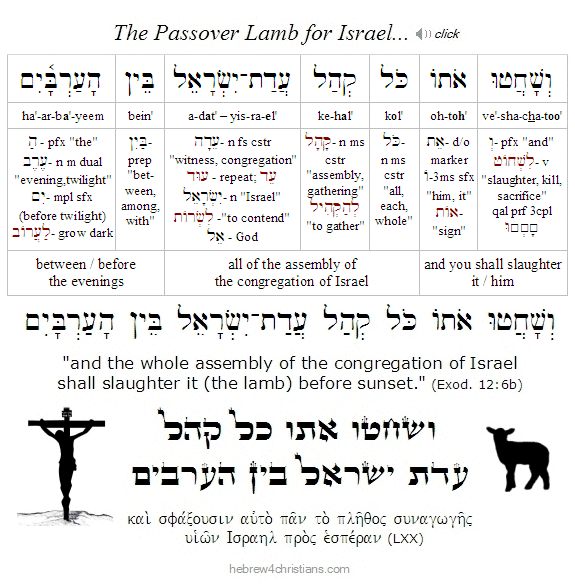 |
Audio Podcast:
Gospel of godly Sorrows...
"Let the preacher use words which do not only try to give answers to the questions that we ask or ought to ask but which help us to hear the questions that we do not have words for asking..." - Frederick Buechner
03.17.26 (Adar 28, 5786) Have you ever felt desperately alone, cut off, and far from hope? Have you ever been bereft of comfort, and forsaken — as if you were wandering "among the tombs," cutting yourself just to feel something or to express the anguish that's inside? Have you ever thought that no one can come near you because the leprous shame of your heart puts you at a distance? Are you without help and unable to share your sorrows? Do you have a "private tongue" that admits of no interpretation?
This was the tragic case of the demon-possessed man mentioned in the Gospels. Interestingly this man is said to have come "from the land of the Gerasenes" (אֶל אֶרֶץ הַגַּדְרִיִּים), a phrase that could be interpreted as "from the land of the strangers," which may provide a hint of why he was so troubled within his heart. At any rate, the story reveals the terminal problem of sin and spiritual death, as this man was helplessly bound to his torment and unable to escape, and as such he provides an example of the human condition itself. Of course most people are able suppress their inner darkness to some extent, though it is tragically common to hear of otherwise "sane" people doing insane things. The prisons of the world cannot contain the rampant disorder of the sick human heart. The madness of murder, genocide, slavery, systemic racism, and war-driven atrocities are practices that go back to the earliest times of human history. The demon-possessed man is therefore a type of "every man," the dark shadow of a self lost within himself...
We may sometimes envy people who seem to be of cheery disposition or favored circumstance; and we might even wonder why we are often distraught or riddled with pain, yet the sickness of heart apart from God's presence lurks within us all, secretly haunting even the happiest of joys, for without a genuine relationship with God, the self is left to itself in a prison of its own making... That is the real madness of hell. And even in worldly circumstance, in the midst of the utmost of godless amenity, arises the uneasy sense that something is radically wrong, that the baubles and excitements of the world are nothing but fool's gold, and that your soul is wearing away in vanity.
People are in despair because they are spiritually sick and out of alignment with reality. They may appear to be successful or pleased with themselves, but the hidden spiritual void within inevitably makes them anxious and full of despair. They may try to assuage their own inner pain by engrossing themselves even further into worldly life, through social conformity, faith in their own prosperity, or through various addictions, but the end is still the same, and they feel alone inside, a tragic self lost within itself...
Now you might wonder what profit there is to reflect on such dark matters, and yet the truth of the gospel is contextualized in the silence of our secret fears, our sorrows, our anxieties, and in the utmost depth of our wish to be set free from our painful condition. The gospel provides the answer to our dread sickness, yet the only way we come to understand our need for its healing is to know the tragic depravity of our lives...
Yeshua warned that the truth of God is given in parables, so that people "seeing do not see, and hearing do not hear, nor do they understand" (Matt. 13:13). But why so hide the truth? Nay, but it is God's ratification of their own will: "For the hearts of these people are hardened (i.e., dull and callous toward divine truth), their ears are hard of hearing, and their eyes they have closed, lest they should see with their eyes and hear with their ears, and understand with their hearts and turn, so that I should heal them" (Matt. 13:15). Here Yeshua points out the "dark truth" that people prefer their vanity and the arrogance of their own opinions to the revelation of God. Ironically enough, people don't want to hear the "bad news" that they are inwardly enslaved to themselves, lost to their pride, and in need of God's intervention and would actually rather die in their defiance like Pharaoh of old.
Surely God knows the depths of our blindness and the tragedy of His absence. "Come unto me all you who labor and are heavy laden," he cried out in sympathy for our lost condition. Yeshua knew that it is the awareness of God's absence that moves the heart to seek for Him, and it is from the midst of the whirlwind that we hear His voice...
The truth of the gospel - the whole truth - includes everything about what is real, and that includes the darkness and tragedy of our lives... We all enjoy hearing words of assurance and experiencing moments of "enlightenment," but faith must persevere when we are weak or sick, when our self-confidence falters and our self-respect is lost. For it is then, in the awful shade of our wretchedness that we experience God's absence and are driven before the eye of the storm, seeking God's truth for us. "The rain descends, the floods come, the winds blow and beat upon the house" - everyone is under the gale. We are all, in a sense, tragic figures, vulnerable to the "storm of life" and our own inner storms, but if we pretend (i.e., refuse to see) that we not in desperate need for deliverance, God remains distant from us. Seeing we will not see; hearing we will not hear...
"Come unto me all you who labor and are heavy laden..." That is the first word of invitation spoken to the torment of exhausted fears and disappointments. God speaks to the person conscious of their own mortality and powerlessness, to the fearful heart, to the angry soul, to those abandoned and enslaved in loneliness and heartache.
Indeed we are told to "rejoice in the Lord always," but praise arises in the midst of our struggles, for this rejoicing is not something put on like a cosmetic, nor is it a cliche of empty praise tempered by the day's fortuity, but it instead is a response to what is ultimately true. "Come unto me all you who labor and are heavy laden — and I will give you rest." The praise arises from the peace we are given as we abandon ourselves to God's care. The apostle Paul who told us to "rejoice in the Lord always" did so under the whip of much persecution...
The truth of the gospel must touch reality, and that includes the tragedy of our lives as lost, sinful, and bedraggled souls. It includes the confession that we sometimes cry out before the storm and receive no answer, that we still feel bound to our sickness of heart and find no healing, and that the groan of our desperation itself is our only real prayer for God's presence…
The temptation is to resort to religious platitudes or to censure the lament of our hearts so that we hear only what we want to hear, but it is possible to be "religious" and self-deceived, and to be "holy" but unconnected to what is real... We may go to church three times a week and yet be "seeing" yet not see, to be "hearing" yet not hear.
The revelation of our great need is axiomatic to the message of the gospel, and it goes deeper than merely reading the Ten Commandments and understanding that you are a lawbreaker at heart. The law reveals our need for healing but is powerless to help us. The deeper problem is uncovered as we consider why we are lawbreakers, why we seek the darkness, and why we prefer our sickness to the promise of healing.
What ultimately changes the heart is God's intervention, that is, his salvation, though we have to be careful not to make this into a cliche... "It is the Spirit that gives life; the flesh is of no avail" (John 6:63). This salvation is not simply freedom from the penalty of sin but freedom from its power. Often, however, we are slow to realize this, and God allows us to revisit the various "waste places" of our own lusts until we have become sick of ourselves -- sick "to the bones." We have to be willing "to give up our sickness," and usually that means that we must experience repeated failures until we have "learned from the heart" that the LORD - and the LORD alone - is our Healer and Deliverer. Heartache and despair can lead to "godly grief (λύπη) that leads to genuine repentance in our lives (2 Cor. 7:10).
"Salvation is of the Lord," and the brokenness of our spirit is God's gift to us... "Thus saith the LORD, The heaven is my throne, and the earth is my footstool: where is the house that ye build unto me? and where is the place of my rest? For all those things hath mine hand made, and all those things have been, saith the LORD: but to this man will I look, even to him that is poor and of a contrite spirit, and trembleth at my word" (Isa. 66:1-2). As Yeshua said: "Blessed are the poor in spirit (οἱ πτωχοὶ τῷ πνεύματι)." This phrase pictures someone crouching as a helpless beggar, totally dependent on God for help. If you are struggling, ask God to help you surrender your "heart sickness" to Him.... It's His work, not your own, that saves you... God alone truly changes the heart. Repentance is a miracle from heaven given to you, personally...
"If you confess with your mouth that Yeshua is Lord and believe in your heart that God has raised Him from the dead, you will be saved" (Rom. 10:9). But his confession implies you know the truth of your condition, namely that you are weary, heavy laden, and full of grief over your life. It deflates your human pride, yet it is the sober truth. But how can you "receive" the miracle of regeneration when you still hold hope in your own sufficiency? How can you know God's compassion when your inmost heart still rationalizes and even loves its pain? There is a perverse aspect of human nature that revels in its dissipation, relishes its resentments, and excuses its helpless lusts. We must confess with our mouths that Yeshua is Lord, that he bears our place into shameful hell yet is raised from the dead to impart to us true life. "For with the heart one believes unto righteousness" (Rom. 10:10).
To speak the whole truth of the gospel means being willing to speak out or confess the darkness, for only then is the reality of the light made visible to us. "In the beginning God created the heavens and the earth. And the earth was without form and void (תֹהוּ וָבֹהוּ); and darkness (חֹשֶׁךְ) was upon the face of the deep." This is how the Bible begins; these are its opening words. God created the heavens and the earth in a primordial state of "tohu va'vohu v'choshek," confusion and emptiness and darkness. Yet the very next verse says that "the Spirit of God (רוּחַ אֱלֹהִים) moved upon the face of the waters." This was before anything of substance yet existed. God's Presence hovered over the depths of the waters, and God then said, "Let there be light" (יְהִי אוֹר): and there was light (Gen. 1:1-3). But note the order here. God begins with the darkness and speaks forth his creative and healing light. Likewise God's begins with our darkness and recreates us to reflect his image in the truth.
I've written elsewhere that the Hebrew verb chalah (חָלָה) means to be "sick," from a root that means emptiness (חלל) and profanity (חֹל). To be sick can symbolically be understood as profane (ח) thinking (ל) regarding the Spirit of God (ה), which suggests that illness and disease result from obstruction of the divine light. Using the same sort of methodology we see that the Hebrew word for healing (רפא) can suggest that when the mind (ר) directs the mouth (פ) to praise God (א), the soul will experience shalom (שׁלום).
The Torah is called "light" in Prov. 6:23 (תּוֹרָה אוֹר), and the Word of God brings light to the heart as it says, "Your word is a light to my path" (Psalm 119:105) that "enlightens my eyes" (Psalm 19:8) and "imparts understanding" (Psalm 119:130). YHVH is called our light and our salvation (Psalm 27:1), just as Yeshua is the creative force of reality (John 1:1-3) who embodies the divine light to the world (John 8:12). Light is God's means of connecting with us through the heart, and divine healing comes from connecting with God through revelation - the "sun of righteousness (שֶׁמֶשׁ צְדָקָה) that shines with healing in his wings" (Mal. 3:20). Yeshua is the heart and healing center of existence who came to deliver people from darkness. May God open our eyes to see his light now...
Hebrew Lesson
Psalm 25:17 reading (click for audio):
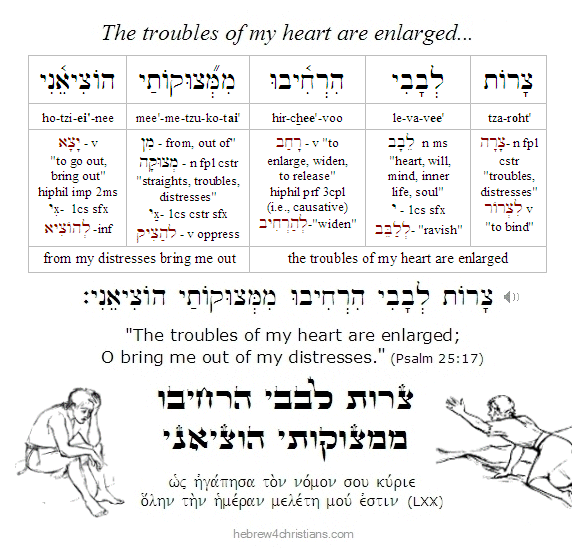 |
Faith in the End of Days...
03.17.26 (Adar 28, 5786) As we draw closer to the appointed "End of Days," it is crucial that we gird ourselves by recalling the truth of God and by refusing to embrace the world and its despair... Yeshua foretold of these perilous times and warned us to be ready. The current war with Iran in the Middle East may be a foreshock of judgment upon the world system that continues to scorn the truth of God -- a message portending the greater judgment to come upon a godless world order that refuses the message of redemption.
According to the general framework of prophetic history, we are currently living in the "days of the Messiah," just before the time of great worldwide tribulation that will lead to the prophesied acharit hayamim (אַחֲרִית הַיָּמִים), or the "End of Days." This is the age in which the spirit of the Messiah is available to all. These are "days of God's favor" that are ending soon. According to traditional Jewish sources (Pesachim 54b; Midrash Tehilim 9:2), no one knows the exact time when the Messiah will appear -- though there are some hints. The condition of the world during the end of days will be grossly evil (2 Pet. 3:3; 2 Thess. 2:3-4, 2 Tim. 3:1-5).
The world system will undergo various forms of tribulation, collectively called chevlei Mashiach (חֶבְלֵי הַמָּשִׁיחַ) - the "birth pangs of the Messiah" (Sanhedrin 98a; Ketubot, Bereshit Rabbah 42:4, Matt. 24:8). Some sages say the birth pangs will last 70 years, with the last 7 years as the most intense period -- the "Time of Jacob's Trouble" / עֵת־צָרָה הִיא לְיַעֲקב (Jer. 30:7). Just before the arrival of Yeshua as Mashiach ben David, a period of tribulation and distress for Israel will occur. After this "great tribulation" period, however, Yeshua will usher in Yom YHVH, the "Day of the LORD," and the sabbatical millennium, the 1000 year reign of King Messiah will commence (Rev. 20:4).
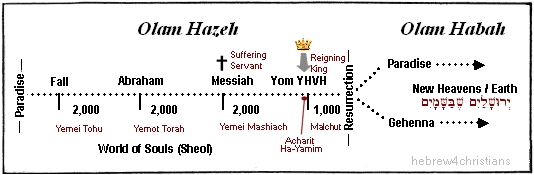 |
During this time of imminent judgment, we must keep our eyes heavenward, trusting in the LORD God Almighty (כֹּל יָכוֹל), invoking Yeshua who is the only Savior (המושיע היחיד). Just as the patriarch Noah foresaw the great cataclysm to come, so we understand that the world above our heads and under our feet is likewise destined to destruction, as we also await the promised world to come. As it is written in our Scriptures: "Lift up your eyes to the heavens, and look at the earth beneath; for the heavens vanish like smoke, the earth will wear out like a garment, and they who dwell in it will die in like manner; but my salvation will be forever (ישׁוּעתי לעולם תהיה), and my righteousness will never be dismayed" (Isa. 51:6). Amen. "The grass withers, the flower fades, but the Word of our God will stand forever" (Isa. 40:8).
Faith discerns the invisible... Our father Abraham was promised descendants as numerous as the stars in the sky or sand on the seashore, despite the fact that he was an old man and his wife had long past the age of bearing children. Abraham believed in the One who gives life to the dead and calls into existence the things that do not exist: "He staggered not at the promise of God through unbelief but was strong in faith, giving glory to God; and being fully persuaded that, what He had promised, He was able also to perform: And therefore it was imputed to him for righteousness" (Rom. 4:19-22). Faith in God trusts in an unseen good, apprehends a future and a hope, and refuses to allow this world to have the last word of what is ultimately real. Therefore, like Abraham, we are "strangers and exiles on the earth, looking forward to the city that has foundations, whose designer and builder is God" (2 Cor. 4:18; Rom. 1:20; Heb. 11:10,13).
Hebrew Lesson
Isaiah 40:8 Hebrew reading (click):
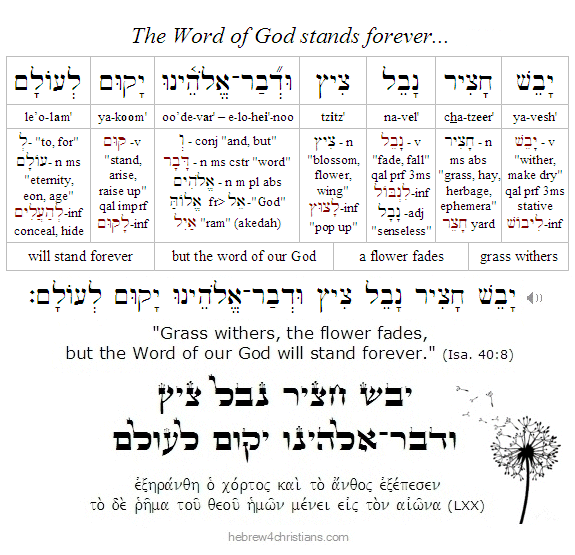 |
Sacrifice and Holiness...
03.16.26 (Adar 27, 5786) The book of Vayikra (i.e., Leviticus) presents two "overarching" themes. The first concerns the system of sacrifices (i.e., korbanot: קָרְבָּנוֹת) that were to be arranged in the Mishkan (and later, at the Temple). These include the daily sacrifice of the lamb (קָרְבַּן תָּמִיד), sacrifices for guilt and sin, thanksgiving offerings, and so on. The culmination of the sacrificial system, however, was expressed by the elaborate Yom Kippur service that was performed to obtain "kapparah" (כַּפָּרָה), or atonement for the people.
The second overarching theme of the book of Vayikra concerns matters of personal holiness (i.e., kedushah: קְּדוּשָׁה), including laws regarding what is "clean" (i.e., tahor: טָהוֹר) and "unclean" (i.e., tamei: טָמֵא) in matters of diet, sexual relations, personal health, and so on. In addition, holiness is connected with social relationships, such as the duty to honor parents, to give tzedakah (charity) to the needy, and to refrain from doing harm to others. Indeed, the Ten Commandments are restated in Vayikra beginning with the words, "You shall be holy, for I the LORD your God am holy" (Lev. 19:1-2). Note, incidentally, that the order of the commandments appears differently in the Book of Leviticus (chapter 19) than what is written in Exodus chapter 20, and is also different from the ten commandments listed in Deuteronomy chapter 5. This teaches that though there are different ways to express God's commandments, we have the responsibility to distill the deeper truth of God's will...
These two major themes - sacrifice and holiness - are connected, though perhaps not in the way you might immediately think. Many people suppose the sacrifices were given as a ritual means of obtaining pardon for sin, but this is an oversimplification. The Hebrew prophets did not add or subtract from the laws given at Sinai, though they sometimes criticized the people for offering sacrifices without the desire to obey God's law. The sacrifices themselves were not the problem, but they were ineffectual apart from genuine teshuvah (see 1 Sam. 15:22-31; Hos. 6:6; Matt. 12:7; Prov. 21:3; Isa. 1:11. Micah 6:6, Jer. 7:22).
The point is that offering sacrifice apart from a heart of obedience is meaningless mummery and ostentation, since the moral law of God was given first to the people and only afterward were the sacrifices described to Moses in the vision of the altar at Sinai. But it is obedience to God that imparts virtue to sacrifice, as the cross of Yeshua exemplifies.
The idea of sacrifice predates the giving of the law given at Sinai, of course, and goes back to the primordial Garden of Eden itself where God offered up the lamb for Adam and Eve's transgression (Gen. 3:21). This set the pattern, and later Adam brought sacrifice, as did Cain, Abel, Noah, Shem, Abraham, Isaac, Jacob, and Moses.
We can learn from the account of Cain and Abel about righteous sacrifice. First note that Abel presented to God a sacrificed lamb - recalling the original sacrifice of God and the promise of the redemption to come given to Adam and Eve (Gen. 3:14-15) - whereas Cain offered fruits "of the earth." Their respective sacrifices present a study in contrasts, as God "turned to Abel and his offering" but he did not regard Cain's offering. In a sense Abel (הֶבֶל), whose name comes from "vanity" or "vapor" (הָבַל), "re-presented" God's offering of the lamb that covered the sin of his parents, having faith in the promise of the Redeemer who was to come, whereas Cain (קַיִן) whose name means "to get" or to "take" (קָנָה), simply returned the gift of the fruits of the garden. Now there is of course nothing wrong with offering "first fruits" to God as minchah (מִנְחָה), or a gift, but God was looking for Cain to have faith in his promise. When God saw that Cain felt dejected, He rhetorically asked: "If you do well, will you not be accepted?" which indicates that being accepted is a matter of earnest faith in God, for that is what "doing well" truly means in the eyes of heaven. The Lord's words to Cain teach us that the basis for offering sacrifice to God is to express faith in his healing love and salvation...
This principle is essential to all true Torah: Those who trust in God's promises find divine blessing, as the LORD said to aged Abraham when he gazed upon the canopy of stars and believed the "impossible" promise that he would become the father of a multitude of people. Yet Abraham trusted God for the miracle: "And he (Abraham) believed in the LORD; and he (the LORD) counted it to him for righteousness" (Gen. 15:6). Abraham believed in God's righteousness -- his blessing, power, and lovingkindness -- that would fulfill the vision, certainly not in his own merit or strength.... This is the very first commandment, after all, namely to believe in the Lord as your Savior, Healer, Blessing, Life, Destiny, and so on. "I AM the LORD your God" (אָנֹכִי יְהוָה אֱלֹהֶיךָ) is the first word of faith (Exod. 20:2).
We have to be careful about what we think makes us right with God. Do you trust in yourself or in God for healing righteousness? Abel saw the vanity of human effort to attain righteousness, whereas Cain sought to acquire it through his own effort. The Holy Temple was destroyed because false religion offered sacrifices as a way to excuse their sin and consequently to disregard the call to turn to God and live a life of holiness. Walking by faith means understanding the sanctity of life itself, to accept that we are called by God to be set apart to know Him in all our ways (Prov. 3:5-6). Offering a sacrifice as "payment" for sin misses the point. True holiness means being "separated" from the profane to know and love God, but too often religion can serve as a false god that promotes sin by promising forgiveness apart from the need to walk in the obedience of faith. Therefore God said through the prophet Hosea: "I desire goodness and not sacrifice" (Hos. 6:6). "Sacrifice" from a faithless person is an abomination to God (Isa. 1:11; Amos 5:21; Prov. 15:8).
The two great themes of sacrifice and holiness are therefore connected by faith in God's promises, and there can be no true sacrifice apart from heartfelt faith. Indeed, this is the ultimate purpose of the sacrifices - to honor God's heart and redeeming love given in Yeshua, the great Lamb of God (John 1:29; 1 Cor. 5:7). The blood of "bulls and goats" could never take away sin, but the sacrifice of God given of his own love for us does, and that is the message of the cross (Heb. 10:4-10).
The sacrificial system with the daily offering of the lamb (קָרְבַּן תָּמִיד) foreshadowed the Substance of the promise fulfilled in Yeshua. It is not our sacrifice that is the focus, but God's sacrifice of Christ given on our behalf, and our only response to this exceedingly precious blessing is to offer up heartfelt thanks for God's kindness and mercy. "It is the kindness of God that leads you to repentance" (Rom. 2:4). As it written, "Through Him (i.e., the sacrifice of Yeshua) let us then continually offer up the sacrifice of praise to God, that is, the fruit of lips that confess the truth of his Name" (Heb. 13:15). Amen.
Hebrew Lesson
Psalm 4:5 reading (click):
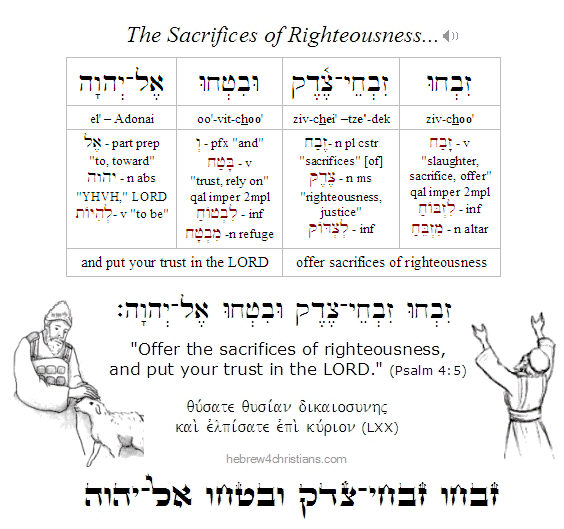 |
Torah of Sacrifices...
03.16.26 (Adar 27, 5786) Our Torah reading for this week (i.e., Vayikra) begins with the Lord calling out (קָרָא) to Moses to explain the "laws of korbanot" (תורה של קרבנות), or the way the people could pleasingly draw near to him. Note that the root of the word korbanot, often translated as "offerings" or "sacrifices," is karov (קרוב) which means to come close, to enter into, or to approach. The korbanot, or sacrifices, were meant to bring us closer to God, and the central sacrifice at the altar was that of a defect-free male lamb offered daily, called korban tamid (קָרְבַּן תָּמִיד), or the "perpetual sacrifice." Unlike other sacrifices that may be offered at the altar, the korban tamid was continually offered by God Himself in commemoration of the great Passover redemption wherein the blood of the lamb was offered on behalf of Israel. Like the cross of Messiah our Passover (משיח פסח שלנו), God provides the Lamb and by this grace He enables access to the divine presence for blessing and eternal life...
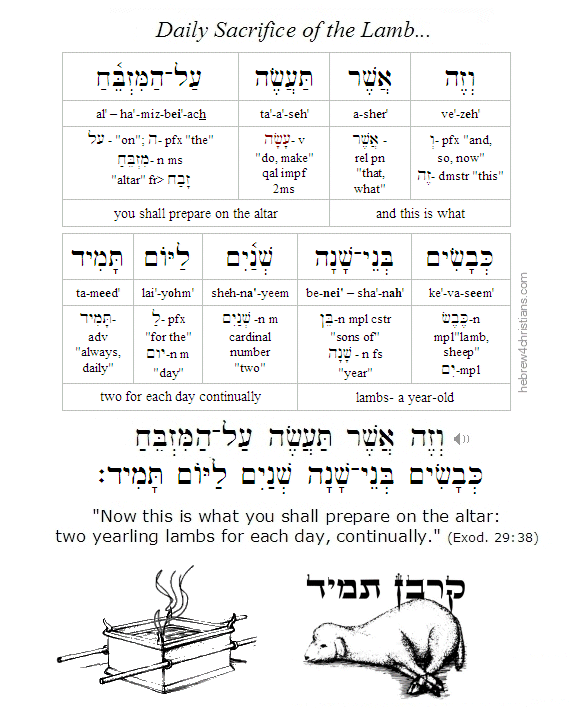 |
Other sacrifices, such as the "chatat" (חטאת) or sin offering, required the offerer to place his hands on the head of the animal, leaning on it will all his might, as he confesses his wrongdoing and expresses his desire to return to God. This procedure is called "semichah" (סמיכה) and the confession is called "vidui" (וִדוּי). Immediately following this the animal is led away to be ritually slaughtered (i.e., shechittah: שחיטה) and the blood was caught in a basin and then dashed upon the altar by the designated kohen (כּוֹהֵן), or priest.
Various other korbanot are mentioned in our reading, including the "olah" (עולה), or "ascending" offering wherein the kosher animal is entirely burned on the altar; the "shelamim" or "peace" offering (קרבן שלמים) given for celebratory events or to give thanks (תודה); the "asham" or guilt offering (קרבן אשאם) which is a type of sin offering that is more serious and involves restitution for wrongdoing. Note that for each of these offerings, if an offerer is too poor to offer an animal for sacrifice, the "minchah" (קרבן מנחה), or prepared flour offering, or the "ohf" (קרבן עוף), a bird (i.e., pigeon or dove) sacrifice was acceptable.
Note that the original Passover sacrifice (קרבן פסח) was not given to the Levitical priesthood as a sin offering, since it preceded Sinai and the giving of the various laws concerning the Mishkan/Temple sacrificial rites. In the same way, Yeshua's sacrifice was directed from Heaven itself by means of the prophetic office of Malki-Tzedek (מַלְכִּי־צֶדֶק) - a higher order of priesthood (Gen. 14:18; Psalm 110:4; Heb. 7). Yeshua both offered Himself up as the "Lamb of God" that causes the wrath of God to (eternally) pass over those who personally trust in Him, and He also offered himself as the "Goat of God" whose blood was sprinkled in the Holy of Holies to cleanse us from sin and give us (everlasting) atonement. (Other metaphors are also given in Scripture, for example, Yeshua offered Himself as a Snake lifted up (John 3:14-15; cp. Num. 21:4-9), as a Red Cow (parah adumah), and so on).
For Yom Kippur (יום הכיפורים), or the "Day of Atonement," two goats were required: one goat was for blood sacrifice in the Holy of Holies (the Goat of the LORD) and the other was used as a "scapegoat" for the sins of the community (the goat of Azazel). The Gospels emphasize the connection between Yeshua as the "Lamb of God who takes away the sins of the world" with Passover/Exodus more than the connection between Yeshua as the "Goat of the LORD" whose blood was sprinkled upon the Mercy Seat with Yom Kippur - though the author of the Book of Hebrews explicitly makes this connection (Heb. 9:11-12; 24-ff).
It may seem like the details of the various sacrifices are tedious and even boring to read, but the deeper truth of what they represent is nothing short of amazing. Yeshua as the "Lamb of God" pictures personal redemption from slavery to Satan and freedom from the wrath of God. This is the greater Passover/Exodus connection. By means of Yeshua's shed blood and broken body, the wrath of God passes over us and we are set free to serve Him.... Yeshua as the "Goat of God" pictures both personal cleansing (i.e., "propitiation" or "expiation" for our sins: the Greek word (ἱλαστήριον) is used in the LXX for the kapporet (Mercy Seat) in the Holy of Holies which was sprinkled with the blood of the sacrifice on Yom Kippur) as well as national teshuvah and cleansing for ethnic Israel at the end of the Great Tribulation period. At that time Yeshua will function as Israel's true High Priest whose sacrifice is applied for Israel's Atonement. This is the Yom Kippur connection.
Hebrew Lesson
Psalm 9:10 Hebrew reading (click):
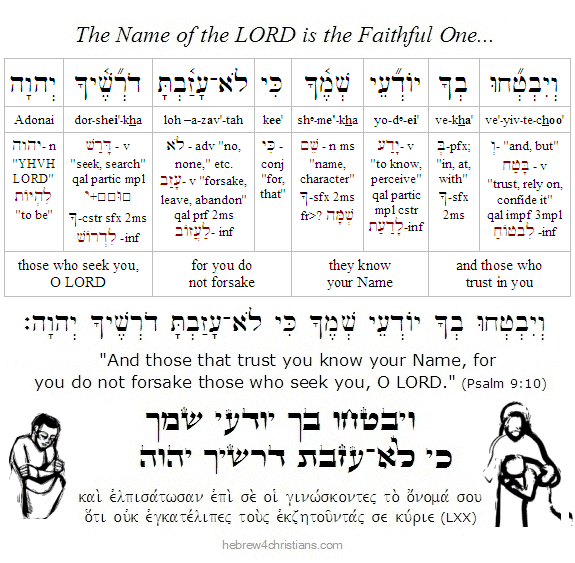 |
The Gospel of Leviticus...
The following is related our Torah reading for this week, parashat Vayikra...
03.15.26 (Adar 26, 5786) From a "macro" or high-level view, we can understand the book of Leviticus to provide a spiritual map that points the way to connect with God. It was written to speak to our need and desire to enter into the holy space of the divine reconciliation...
Recall that the book of Genesis explains our origin, the fall of our souls into sin and our subsequent alienation from God. It also foretold of the coming Redeemer who would heal us from our fallen estate and establish the kingdom of God upon the earth.
The book of Exodus further reveals the LORD as our Deliverer who saves us from bondage to olam hashkerim (עוֹלָם הַשְׁקְרִים), the false world, and who then graciously leads us to freedom by awakening our souls to divine truth.
The Exodus from Egypt (יציאת מצרים) serves as a parable of the salvation experience (Rom. 15:4; 1 Cor. 10:11). First, faith in God's promise is expressed by sheltering under the blood of the lamb of God as a "passover" sacrifice (as it was with Abel's offering), and through it we are delivered from the plague and curse of death. We are then graciously led by the Spirit of God through the waters into newness of life when we begin our journey to our true homeland. We begin to understand the covenant promise to be God's people. The revelation at Sinai pulls back the curtain of the phenomenal world to disclose the underlying and overarching spiritual reality. Hearing the divine voice imprints us with God-consciousness. We are awed and overwhelmed with the divine presence and desire to enshrine it within our hearts forever.
The building of the Mishkan (Tabernacle) "reifies" the vision to create a habitation of the divine Presence. It embodies our gratitude to God. As Solomon later said as he dedicated the Temple in Jerusalem, however: "Will God indeed dwell on the earth? Behold, heaven and the heaven of heavens cannot contain You. How much less this Temple which I have built! Yet regard the prayer of Your servant and his supplication, O Lord my God, and listen to the cry and the prayer which Your servant is praying before You today" (1 Kings 8:27-28). Nevertheless, the desire to know God to be present calls for a sacred place to be made within the heart...
And this is what the book of Leviticus, or Vayikra, is really about: hearing the call of God to draw near to Him. Therefore the Mishkan was structured with inner chambers or "gateways" that led ever closer to the throne of God himself. We come to the first gate by faith: the Curtain of the outer courtyard is opened and we enter. We see the outer altar where the Lamb of God was continually offered, reminding us of the original sacrifice and promise given at Eden. We wash ourselves at the basin and enter the Holy Place where we behold the divine light of the Menorah. We eat of the "bread of Presence" (לֶחֶם פָּנִים) and offer prayer at the golden Altar of Incense. At the appointed time, we reverently open the veil to enter the Holy of Holies, appealing to the blood offered on our behalf to make atonement for breaking God's heart. In a cloud of smoke we descry the blood sprinkled seven times over the broken tablets stored in the sacred Ark. We confess the Name of the LORD and sense His blessing and acceptance...
The great and overarching lesson of Vayikra is that God delivers us so that we can know his heart. And this is the message of the Cross of Messiah as well -- the great Altar of God, the Tabernacle "made without hands," where Yeshua entered the Holy of Holies to willingly offer up his blood in intercession for our brokenness (Heb. 9:11-12). Yeshua entered the dark cloud of darkness to bring you into God's light.... Amen, and may His Name forever be praised.
Hebrew Lesson
Psalm 26:8 reading (click):
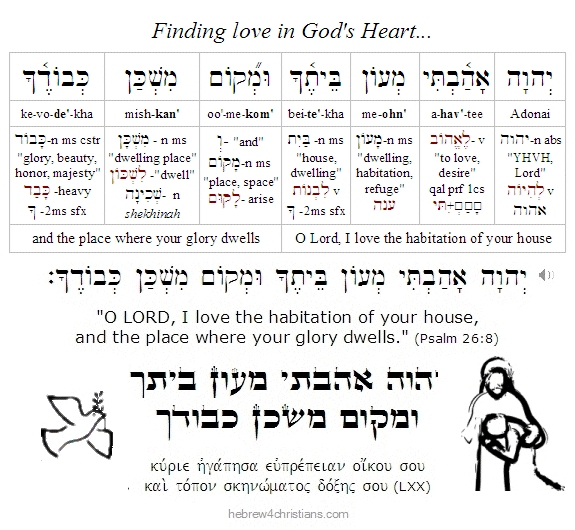 |
The LORD Calls Out - ויקרא
This week we begin a new book of Torah, sefer Vayikra (i.e., the book of Leviticus)...
03.15.26 (Adar 26, 5786) The first Torah portion for the new Biblical New year is parashat Vayikra ("and he called"), the very first section from the Book of Leviticus (ספר ויקרא). In Jewish tradition, Leviticus is sometimes called the "Book of Sacrifices" (i.e., sefer ha'zevachim: ספר הזבחים) since it deals largely with the various sacrificial offerings brought to the altar at the Mishkan (i.e., Tabernacle). Indeed, over 40 percent of all the Torah's commandments are found in this central book of the Scriptures, highlighting that blood atonement is essential to the Torah. Moreover, since the revelation of the Tabernacle was the climax of the revelation given at Sinai, the Book of Leviticus reveals its ritual significance, as it is written: "For the life of the flesh is in the blood, and I have given it for you on the altar to make atonement for your souls, for it is the blood that makes atonement (kapparah) by the life" (Lev. 17:11).
Unlike narrative portions of other books of the Torah, the Book of Leviticus begins with the LORD himself "calling out" (i.e., vayikra) to Moses to explain that the way to draw near to Him is by means of atoning sacrifice. It is noteworthy that throughout the book, only the sacred name of the LORD (יהוה) is used in connection with sacrificial offerings, and never the name Elohim (אלוהים). This suggests that sacrificial offerings were given to draw us near to experience God's mercy and compassion rather than to simply appease His anger.... In other words, the Name of the LORD represents salvation (i.e., yeshuah: ישועה) and healing for the sinner, not God's judgment (John 3:17). Indeed, the word korban (קרבן), often translated as "sacrifice" or "offering," comes from a root word karov (קרב) that means to "draw close" or "to come near" (James 4:8). The sinner who approached the LORD trusting in the efficacy of the sacrificial blood shed on his or her behalf would find healing and life...
In this connection we note that the ancient Greek translation of the Torah (called the Septuagint) translated the Hebrew word kapporet (i.e., כפרת, "mercy seat") as hilasterion (ἱλαστήριον), sometimes translated "propitiation." The New Testament picks up this usage in Romans 3:25: "God put forward Yeshua as a propitiation (ἱλαστήριον) through faith in His blood." In other words, the shedding of Yeshua's blood - represented by His Passion upon the cross - was "presented" upon the Heavenly Kapporet, before the very Throne of God Himself for our atoning sacrifice (i.e., kapparah: כפרה) before God.
Our Daily Deliverance...
03.13.26 (Adar 24, 5786) Just as we ask God for daily bread (לֶחֶם חֻקֵּנוּ), so we ask him for our daily deliverance: "Lead us not into temptation, but deliver us from evil" (Matt 6:13). Note that the term translated "evil" in many translations ("deliver us from evil") is a substantive rather than an adjective: τοῦ πονηροῦ, the evil one... "Give us this day our daily deliverance from the evil one...."
Our daily bread and our daily deliverance are connected with our decision to "choose life" (בַּחַרְתָּ בַּחַיִּים) -- and to always choose life -- even in moments we find difficult, distressing, and even when we might wish that we were no longer living...
Choosing life means refusing to escape reality by evading the significance of our choices; it means finding the will to regard life as worthy; it implies that we will eat our bread in trust that the Lord is at work even in the darkest of hours (Passover occurred at midnight)...
Choosing life means refusing to eat the fruit of death and to seek Yeshua, the Tree of Life. We live one day at a time; we only have today. We are given daily bread for this hour of our need. Today is the day of your deliverance - if you are willing to walk in it. Therefore, the Spirit of the Living God cries out, "Choose life and live!"
"Do not be grieved [even over yourself], for the joy of the LORD (חֶדְוַת יְהוָה) is your strength" (Neh. 8:10). Affirming the love, faithfulness, compassion, and salvation of God is a powerful way to defeat the enemy of our souls, who regularly entices us to despair.
King David regularly asked God to help him in his spiritual struggles. "Though I walk in the midst of trouble (בְּקֶרֶב צָרָה), you preserve my life; you stretch out your hand against the wrath of my enemies, and your right hand delivers me" (Psalm 138:7). "For the enemy has pursued my soul; he has crushed my life to the ground; he has made me sit in darkness like those long dead. Therefore my spirit faints within me; my heart within me is appalled" (Psalm 143:2-3).
Despite whatever struggles we may face, "the LORD is near to the brokenhearted and saves the crushed in spirit (Psalm 34:18). Indeed, the Lord God is far greater than your heart's sin and will one day entirely deliver you of sin's effect and influence. Amen.
Shabbat shalom chaverim...
Hebrew Lesson
Psalm 34:19 reading (click):
The Love of Truth...
03.13.26 (Adar 24, 5786) Christian (and Jewish) theology insists that spiritual truth matters, and knowing the truth about God is absolutely essential for life itself. Nothing is more important. Nothing is more vital. As the Savior of the world attested: "This is eternal life (חַיֵּי עוֹלָם), that they may know you, the only true God (אֶל־אֱמֶת), and Yeshua the Messiah (יֵשׁוּעַ הַמָּשִׁיחַ) whom you have sent (John 17:3).
The truth sets us free; it is the unbreakable seal that bears witness of reality. In the Gospel of John it is recorded that Yeshua said, "I am the way, the truth, and the life" (i.e., ᾽Εγώ εἰμι ἡ ὁδὸς καὶ ἡ ἀλήθεια καὶ ἡ ζωή). The Greek word translated "truth" in this verse is aletheia (ἀλήθεια), a compound word formed from an alpha prefix (α-) meaning "not," and lethei (λήθη), meaning "forgetfulness." (In Greek mythology, the "waters of Lethe" induced a state of oblivion or forgetfulness.) Truth is therefore a kind of "remembering" something forgotten, or a recollecting of what is essentially real.
Etymologically, the,. the word "aletheia" suggests that truth is "unforgettable" (i.e., not lethei), that is, it has its own inherent and irresistible "witness" to reality. In that sense light is a metaphor for truth: "The light shines in the darkness, and the darkness has not overcome it" (John 1:5). There can be no truth apart from moral reality. People may lie to themselves, but ultimately truth has the final word.
Note that the word lethei itself is derived from the verb lanthano (λανθάνω), which means "to be hidden," so the general idea is that a-letheia (i.e., truth) is non-concealment, non-hiddenness, or (put positively) revelation or disclosure. Thus the word of Yeshua - His message, logos (λόγος), revelation, and presence - is both "unforgettable" and irrepressible.
Yeshua is the Unforgettable One that has been manifest as the express Word of God (דְּבַר הָאֱלהִים). Yeshua is the Light of the world (אוֹר הָעוֹלָם) and the one who gives us the "light of life" (John 8:12). Though God's message can be suppressed by evil and darkened thinking, the truth is self-evident and intuitively certain (see Rom. 1:18-21).
We have a moral imperative, given by God Himself, to receive the truth and to live according to the nature of spiritual reality. Those who reject or suppress the truth, however, are responsible for their actions, as it is written, "No one who practices deceit shall dwell in my house; no one who utters lies shall continue before my eyes" (Psalm 101:7).
Hebrew Lesson
Psalm 25:5a reading (click):
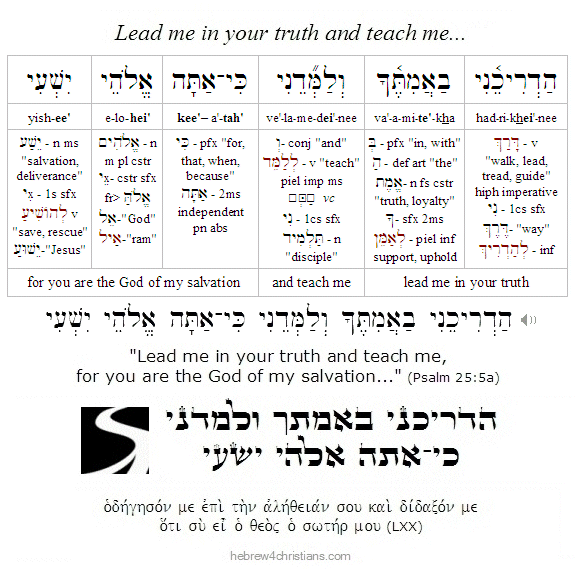 |
The Hidden Treasure...
03.13.26 (Adar 24, 5786) "The kingdom of heaven is like treasure hidden in a field, which a man found and covered up. Then in his joy he goes and sells all that he has and buys that field. Again, the kingdom of heaven is like a merchant in search of fine pearls, who, on finding one pearl of great value, went and sold all that he had and bought it" (Matt. 13:44-46). Here Yeshua teaches us that a relationship with God is the true source of joy and value in life, and that all other passions and desires are like "fools gold" when compared with its overwhelming worth... In this connection Soren Kierkegaard wrote: "If anyone thinks he is a Christian and yet is indifferent toward being that, then he really is not one at all. Indeed, what would we think of a person who gave assurances that he was in love and also that it was a matter of indifference to him?" (Works of Love).
The Shema, the "first and greatest commandment," is to love God "bekhol levavkha" (בְּכָל־לְבָבְךָ) with all our hearts, yet how is that love possible apart from the revelation of the passion of love itself? "We love because God first loves us" (1 John 4:19), and therefore teshuvah ("repentance") is a matter of being in love, celebrating God's heart for us, awakening to its wonder, and being thrilled and overjoyed at its reality. Is this not the essence of the matter? "Shimon ben Yonah, atah ohev oti?" – "Simon son of Jonah, do you love me?" (John 21:17). But how can we love the Lord apart from trusting his heart for us? "Come unto Me," Yeshua says, "live in Me and I will live in you." O Lord God our Savior, deliver us from apathy and indifference! Soften our hearts and awaken us to our great desire and need for you! For those of us who are so sick at heart that they are afraid to trust that love, even divine love, will not fail, help us despite ourselves. Hashivenu, Adonai: turn us, O LORD, and we shall be turned; heal us, and we shall be healed. O Source of all grace and truth and love, let know the breadth and length and height and depth of your great love!
For what do you hope? What are your dreams? Your deepest desires? Where is your treasure? Yeshua cautioned those who sought their happiness in this world: "Do not store up for yourselves treasures upon earth... be rich toward God" (Matt. 6:19-20; Luke 12:21). When we treasure God, our focus is directed toward the eternal reality, and our interest in this world fades. We trust God to meet our daily needs and surrender our future to His care. The only worry we face concerns our own deficiencies in our obligations to the Savior. Our duty is to love God in the truth - bekhol levavkha - with all our heart, having no thought of ourselves. Indeed, self-denial means to quit thinking about yourself (from α-, "not," + ῥέω, "to speak") by accepting what God has done for you. "It is not my business to think about myself. My business is to think about God. It is for God to think about me" (Simone Weil). Amen, where your treasure is, there will be your heart also.
Hebrew Lesson
Jer. 24:7a reading (click):
Confession and Reality...
"To confess your sins to God is not to tell God anything He doesn't already know. Until you confess them, however, they are the abyss between you. When you confess them, they become the bridge." - Frederick Beuchner
03.12.26 (Adar 23, 5786) Sin is not the result of not knowing what is right, but rather of being unwilling to understand it as such, and therefore is the refusal to do what is right. It is not the result of ignorance but rebellion. Sin doesn't say "I can't" but rather "I won't," and therefore it is a matter of the will, the heart, the secret desires of the soul... Just as grace is inaccessible for someone who refuses to be honest with himself, so is forgiveness. If a person refuses to confess the truth about his condition, salvation itself is impossible, since God literally cannot save the soul that denies its need for Him. Therefore the Scripture does not vainly declare: "Whoever conceals his transgressions will not prosper, but the one who confesses and forsakes them will find mercy" (Prov. 28:13).
Hebrew Lesson
Psalm 29:11 reading (click):
A person who "conceals" or "covers" his sin denies it, either by outright disavowal or by explaining it away by offering self-deceptive excuses. This person simply cannot prosper – in the spiritual sense of the word – because he is not living in reality... Indeed, his conscience is burdened with a "secret ban," an inner voice of condemnation that must be suppressed and squelched. As Alan Redath commented: "Willful sin that has not been confessed and forgiven that makes us feel that God has forsaken us, for that sin causes Him to hide His face from us." It is only when the person who comes to the light, who acknowledges the truth of his sin and who is anxious to be free of its effects, who will be shown mercy (i.e., rachamim (רַחֲמִים), which comes from the word rechem (רֶחֶם), "womb").
In this evil world, it may sometimes seem that crime "pays," but certainly not before the Divine Presence, and in the world to come, every word and deed will be fully accounted before the bar of God's justice and truth. But even in this world, the sinner is secretly haunted by his conscience; he is driven to madness, hidden despair, and lives in dread and anxiety over the truth he conceals... It has been said that the problem with "getting away with it" is that you indeed "get away with it," meaning that your sin will follow you as doggedly as your own shadow in this world... Ultimately sin is a form of cowardice, since it hides in fear from the light of truth. Unconfessed sin leads to anxiety, paranoia, and weakness of the soul...
"What is accomplished through lies can assume the mask of truth; what is accomplished through violence can go in the guise of justice, and for a while the hoax may be successful. But soon people realize that lies are lies at bottom, that violence is violence - and that both lies and violence will suffer the destiny history has in store for all that is false." (Martin Buber)
I mentioned recently that one of the reasons God revealed the Ten Commandments was because it was His way of saying, "I know who you really are, I see you..." This is why the people drew back in terror, because they realized that God saw the inner condition of their heart, exposed it, and shined the light of moral truth upon it. Nonetheless it is a great and ongoing credit to the Jewish people that they were willing to receive the revelation at Sinai, since it demonstrates that they were genuinely willing to be honest with themselves. Despite their many subsequent failures, they still revered the truth of God's Torah and meticulously preserved the revelation for future generations (Rom. 3:1-2).
Understanding the Bible...
I am sometimes asked about the "best" Bible translation. Here's my answer to the question.
03.12.26 (Adar 23, 5786) What are we to make of all the different Bible translations that are available today? How are we to make sense of the many interpretations? In addition to the various "mainstream" versions available (i.e, KJV, ASV, JPS, RSV, NIV, NASB, ESV, NKJ, NLT, TNK, etc.), you can also purchase any number of "Study Bibles" to suit your preferences. For example, you can now read the Sportsman's Study Bible, the "Manga Bible," the "Emergent Bible," the "Bride's Bible," the "Revolve Fashion Bible," the "Duct Tape Bible," the "True Images Bible" (teaches young women about sex and self-esteem), and so on and on and on....
 |
Now while it is true that language gradually changes over time, and that the task of good translation is to communicate the "source" language/culture to a "target" language/culture, it should be clear that in order to do this accurately, the source language/culture (in this case, ancient Hebrew/Jewish culture) must be carefully understood before attempting to communicate its thought to a target culture. Sadly, this has not happened, at least in most translations of the Hebrew Scriptures into English (and into other languages).
For example, the word "church" does not appear in the earliest English translations of the Old Testament. The Greek translation of the OT (called the Septuagint or LXX) uses the word ekklesia (from ek- + kaleo, "to call") for two different Hebrew words that both refer to a "congregation" or "assembly": kahal (קהל) and 'edah (עדה). It appears to be a sizable fault of various English translations of the Christian Bible that the word "church" was coined to translate the word ekklesia in the New Testament, since this suggests an anti-Jewish bias by implying that there is a radical discontinuity between "Israel" and the followers of Yeshua (i.e., the "church"). In other words, if the same Greek word (ekklesia) is used in both the LXX and the NT, then why was a new word invented for its usage in the English translation of the New Testament? Why not rather translate the word as it was used in the LXX, or better still, as it was used in the original Hebrew Scriptures? For more information about this, please my article "Israel and the Church."

Culturally speaking, however, there might be a more insidious reason why we are seeing an explosion of Bible versions and study guides tailored to various subcultural concerns....
Since there is always the temptation for the "Church" to mimic the ways of the world and follow the spirit of the age, perhaps some of the reason we see this multiplicity of Bible translations (and stylized repackaging of the Bible) is the relatively recent rise of the philosophy of "deconstructionism," an anti-authorial literary approach that maintains that the original intent of an author is essentially unknowable (or at least irrelevant). According to this epistemologically cynical theory, a "text" derives its meaning from the reader and not from the intention of the original author. Deconstructionism is perhaps the brainchild of the enormously influential philosopher Ludwig Wittgenstein and his description of a plurality of "language games" that mark an individual's particular "form of life." In a sense, Wittgenstein abandoned the hope of finding "objective meaning" for language and resorted to a polysemous relativism that was limited to natural and particular "organic" usage. Some people argue that Wittgenstein made room for "mysticism" in language, but it is better to regard his thinking, even his "later" thinking, as ultimately relativistic and even nihilistic.
Wittgenstein's philosophy of language implies that the hopelessly classical pursuit to find "the meaning" of a text must be abandoned for observation about how people choose to use it, especially as a means of action, persuasion, power, and especially of politics. "Truth" has become "perspectival," which is just a another way of saying that it is relative to the vision (i.e., reiyah: רְאִיָּה) or opinion of the interpreter (i.e., "reader"). Every story has a "spin," or an "angle" that is somehow self-serving to the storyteller. There is no transcendental, objective, and universally binding truth; no "metanarrative" that tells the story about "God, the world, and everything." Everyone is left alone to develop his or her own linguistic expression of life and values.... Hence we now have "The Manga Bible," the "Queer Bible," the "Atheist Bible," etc., and hence we live in a world of existential alienation and virtual incommunicability with those outside our ghettoized "hermeneutical circle."
Even among orthodox Christians and those who profess to hold to a "high view" of Scripture we see these tendencies (hence it's become rather trendy for "emergent church" types to pooh-pooh the idea of certainty in their understanding of the Scriptures).
In light of this situation of "epistolary agnosticism" (to coin a new phrase), I thought it would be good to remind myself of something Soren Kierkegaard wrote in his work, "For Self-Examination and Judge for Yourself." Kierkegaard used the analogy of a lover's letter written in a foreign language to make the distinction between the often tedious process of translation and the art of reading from the heart... For the lover -- the one for whom the words are addressed -- all the "scholarly preliminaries" of translation are regarded as nothing more than a necessary evil to reach the goal -- that of reading and understanding the question of the lover's message.
Kierkegaard's point is that we can often cop out of our commitment to follow the LORD by pleading that we do not know how to interpret some portions of the Scriptures. Indeed, even Bible scholars are not immune from this risk. The task of busily comparing translations, consulting various commentaries, performing exegetical tasks etc., can lead to an excuse to essentially disregard the message. Ironically enough, Bible scholars can actually study the Scriptures in order to defend themselves from what the Scriptures are clearly saying! If you want to read more, please take a look at the article, "Alone with God's Word."
Indirectly, of course, the foregoing provides yet another reason why it is important to study Biblical Hebrew, especially in light of the Jewish culture that informs the pages of Scripture. Hebrew words, phrases, grammar - when joined with an understanding of the cultural context in which they are embedded - helps us identify tendentious readings of various translators (i.e., interpreters) and commentators. Understanding the Jewish roots of your faith and the Hebraic mindset helps you attune yourself with the source message of Scripture more fully. As our Beloved has said, "The truth (yes, there really is such a thing) shall set you free" (John 8:32).
An additional note:
It needs to be remembered that language usage indeed changes over time. The source language (i.e., the original MSS) is a somewhat static thing (subject to ongoing textual criticism) of which we must make serious effort to understand in light of the culture and context of the original authors. Context is the key. This is where a Jewish perspective of the Scriptures is essential, for without this a lot of assumptions may be "read into" the original text and foreign ideas are used to convey what the translators think is an equivalent meaning for a target language/culture. That is why I always aim to understand how the original authors would have understood their own usage before looking at how someone else decided to render their findings in English.
The ideal thing is to study both Hebrew and Greek. Work hard to obtain a rudimentary reading level (i.e., the ability to read the simpler constructions of the text while using original language dictionaries and grammatical tools). Then you can check the translation of a passage of interest and are no longer at the mercy of translators. You can do some of your own investigative work and exegesis. Find a time-tested translation of the original languages (such as the KJV or ESV) and learn how to access the Greek and Hebrew exegetical commentaries to help you interpret the original intent of the text.
Therefore make an effort to study the Scriptures in Hebrew and Greek (but especially in Hebrew, since the Hebrew text underlies the authority of the Greek text). Consider the various translations as guides to help you understand the original writings. We can trust in God's providential guidance and care of his word, as the Dead Sea Scrolls and other ancient manuscripts prove the meticulous preservation of the texts of Scripture over the centuries. "The words of the LORD are pure words: as silver tried in a furnace of earth" (Psalm 12:6). Above all pray and ask the Holy Spirit - who is the ultimate Author of the Word of God - to give you wisdom and insight as you seek God's truth. Yeshua himself has promised that we will know the truth of God by means of his revelation (John 17:17). Shalom chaverim.
Hebrew Lesson
Psalm 119:160 reading:
Refuge in all Generations...
03.12.26 (Adar 23, 5786) We must not let let worry blind us to God's ongoing care; we must not live like those who have no faith. We have a place in our Father's heart; we have a share in his house above. Exalt the Lord as your Dwelling Place "in all generations"; behold his unchanging glory despite the fleeting shadows of this world.
We must first look to the Eternal to rightly see the finite; we must look upward before we look downward. As we contemplate God's Eternality and power, we realize the wonder and sanctity of our short time here. The Eternal is our refuge, our "dwelling place," in all generations, and that means in the present generation as well, on the other side of fleeting appearances of this world. When we pray to God as Avinu She-bashamayim, "Our Father in Heaven," we are calling to the One who (ש) is in the midst of the waters (מים) of Life.
The psalmist says (Psalm 118:17): "I shall not die but live." In order to live you must give yourself to death, but when you have done so, you discover that you are not to die, but live. "Giving yourself to death" means surrendering to God's will, accepting the yoke of heaven, and trusting in His governing "flow" over all of creation. This is the deeper meaning of "baptism" as we are immersed into God's care for us. Yeshua gives us abundant life.
The bloom of every flower is by eternal purpose, and not one common sparrow is forgotten by your Heavenly Father (Luke 12:6). God's irresistible providence comprehends and orders all things, from the realm of the subatomic to the cosmic motions of the heavenly bodies. The Lord is the Center of reality: "All things were created by Him, and for Him, and in Him all things hold together" (Col. 1:16-17).
In light of this, Blaise Pascal asked, "What is left for us but to unite our will to that of God himself, to will in him, with him, and for him the thing that he has eternally willed in us and for us." In other words, what else can we do but learn to trust, accept, and to say "yes" to life – even if we may feel like strangers in exile during our sojourn here...
All our days are ordained; recorded in God's scroll. Therefore may God "teach us to number our days to get a heart of wisdom" (Psalm 90:12). So don't lose heart, friend; He who cares for you is a Good Shepherd, and you shall dwell in the house of the LORD forever.
Hebrew Lesson
Psalm 90:1 reading (click):
Note: We don't rejoice because things may go well for us, since our worldly circumstances may change at any time, but rather we rejoice because our names are written in heaven. "For none of us lives to himself, and no one dies to himself. For whether we live, we live unto the Lord; and whether we die, we die unto the Lord: whether we live therefore, or die, we are the Lord's" (Rom. 14:7-8). Amen.
Why Study Torah?
This following is related to our Torah reading this week, parashat Vayakhel-Pekudei...
03.12.26 (Adar 23, 5786) Where it is written, "All Scripture is breathed out by God and profitable for teaching, for reproof, for correction, and for training in righteousness, that the godly one may be complete, equipped for every good work" (2 Tim. 3:16-17), it is to be noted that "the Scriptures" referred to here are the Jewish Scriptures (i.e., the Torah, the Prophets, and the Writings), since they are the foundation, the context, and the overarching matrix for the later New Covenant revelation... These were the Scriptures Yeshua used to contextualize and explain his ministry to his followers: "And beginning with Moses and all the Prophets, he interpreted to them in all the Scriptures the things concerning himself" (Luke 24:27). Indeed when Paul wrote these words to Timothy the "New Testament" Scriptures had not yet been compiled by the leaders of the first-generation followers of Messiah.
How important is the Torah, friends? It is essential as the foundation for all that follows, including the very meaning of the gospel message! In other words, the Torah has a logical, linguistic, semantic, and theological priority regarding our understanding of the New Testament, and the failure to read in context invariably leads to faulty interpretations and doctrinal errors of various kinds. "To the Jew first, and [then] to the Greek" (Rom. 1:16) is a principle not only of how the gospel message would transcend ethnic Israel to be offered to all the nations, but also about how we should approach the subject of Biblical hermeneutics. God "breathed out" (θεόπνευστος) his revelation in order, and the message itself must be understood in light of that order (Gal. 4:4-5). Moreover, since all of the New Testament finds its semantic roots in the Torah of Moses and the other Hebrew Scriptures, it is important to study Biblical Hebrew first before studying the Greek New Testament, since the Greek words were translated from the ideas originally given in the Hebrew texts of the Torah.
All of the Torah is amazingly wonderful; it is an inestimably great blessing! After all, what would we know of the creation of the universe and of humanity apart from its pages? What would we know of the reason for sin, sickness and death -- and therefore our need for salvation itself apart from the account of the fall of man as described in Book of Genesis? Or what we know of God's moral truth apart from the revelation of the law at Sinai? Or how could we understand the need for sacrificial blood atonement apart from the sacrificial laws given in Leviticus? Or how would we understand the struggle of the journey of faith apart from the Book of Numbers? Or how would we appreciate the essential duty to love God with all our hearts -- the great Shema -- and the corresponding duty to love others as we love ourselves apart from the Book of Deuteronomy?
So the Torah provides the framework by which we read the Gospels, and apart from this framework we miss much of the original intent and meaning of the Bible... Again, that was Yeshua's approach to the Scriptures, after all. He repeatedly explained to his followers that would have to suffer and die, according to the Scriptures (see Luke 9:22, 9:44; Matt. 16:21; Mark 8:31). He told the disciples on the road of Emmaus: "All things had to be fulfilled, which were written in the law of Moses, and in the prophets, and in the psalms, concerning me (Luke 24:44). Indeed Yeshua chided the rabbis of his day saying: "You search the Scriptures because you think that in them you have eternal life; but it is they that bear witness about me" (John 5:39), and he also said, "If you would have believed Moses, you would believe in me, because he wrote about me" (John 5:46).
So love the Torah, friends; learn its message and study its passages carefully. That's good New Testament theology, after all: "For everything that was written in former times was written for our instruction, so that through endurance and through encouragement of the Scriptures we may have hope" (Rom. 15:4). The Holy Spirit still speaks to the heart of those who love Yeshua, the everlasting King of the Jews: "Oh how I love your Torah (תּוֹרָה); it is my meditation all the day" (Psalm 119:97). Amen.
Hebrew Lesson
Psalm 119:79 commentary (15 min):
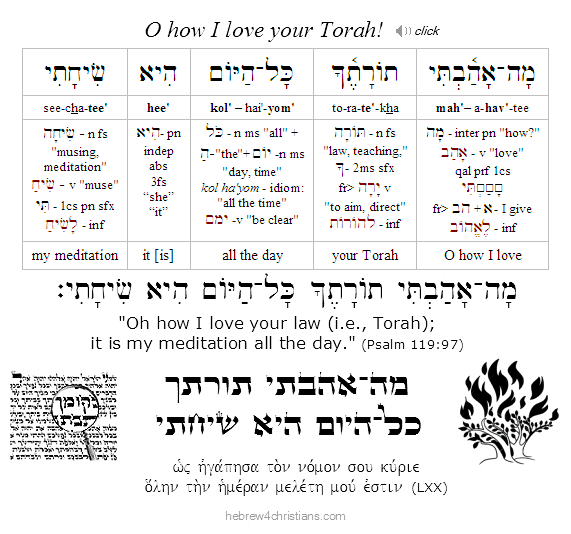 |
Upheld by His Mercies...
03.11.26 (Adar 22, 5786) Julian of Norwich gave her account of living by faith. On the one hand she said she experienced times of revelation and sweet delight in her soul, "filled with everlasting certitude, firmly sustained, without any painful dread," but at other times she was seemingly left to herself in depression, "weary of life and irked with myself, so that I kept the patience to go on living only with difficultly" (Revelations of Divine Love). In times of joy she exulted with the Apostle Paul, saying "Nothing can separate me from the love of Christ!" while in times of dejection she cried out, "Lord, save me, for I perish!"
In hindsight she later understood that the Lord allowed her to sometimes feel his comfort and at other times to be left to herself to teach her that it is his will that she would understand that he keeps her equally safe, both in woe as in well-being... "If there is anywhere on earth a lover of God who is always kept safe from falling, I know nothing of it, for it was not shown to me. But this was shown - that in falling and rising again we are always kept in that same precious love. Between God and the soul there is no between."
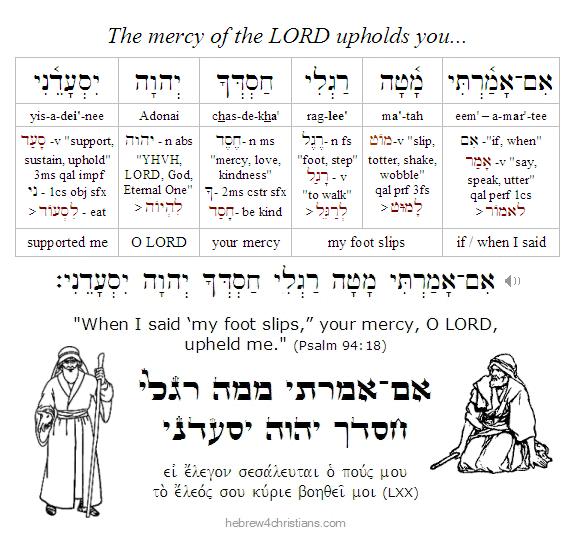 |
When you are unsure of your way, when you walk in uncertainty, you are unsteady in your resolve and are tempted to regard your life as being without any solid foundation. When you become alive to the truth that the LORD is your "Rock," the very ground upon which you live, move, and have your being, then your steps are made sure, as it says, "The steps of a man are established by the LORD, when he delights in his way; though he fall, he shall not be cast down: for the LORD holds his hand" (Psalm 37:23-24). Amen.
Preparing for His Presence...
The concluding portion of the Book of Exodus, parashat Pekudei (פְקוּדֵי), leaves us with the challenge to "account" for our lives in relationship to the sanctuary of the Lord.
03.10.26 (Adar 21, 5786) Recall that the materials for the construction of the sanctuary were given by free-will offerings of the heart, and therefore we must begin there - as we present ourselves a "living sacrifice" (i.e., korban chai: יקָרְבָּן חַ) to engage the work of God.
Now some days we may not feel a sense of willingness regarding our commission, but when we find grace to believe that we were personally redeemed by God's "mighty hand and outstretched arm" (יָד חֲזָקָה וּבִזְרוֹעַ נְטוּיָה) for the purpose of knowing and serving him, our hearts find will find their resolve. Indeed this is the very point for our lives, the "chief end" and reason for our existence, namely, to glorify God and to love him forever. We first find faith to make a dwelling place within our hearts (i.e., mikdash ha'lev: מִקְדָּשׁ הַלֵב), freely offering our desire to serve the Lord be'khol li'beinu (בְּכֹל לִיבֵּנוּ), with all our hearts...
In this connection we note that even though the people had brought their contributions before the Lord, the actual assembly of the sanctuary (i.e., mishkan: מִשְׁכָּן) occurred three months later, on Nisan 1, the beginning of the month of salvation (חוֹדֶשׁ הַיְשׁוּעָה). This teaches us that we must trust in God's perfect timing and providential plan for our days. It is our job to "show up" and be ready, but it is the work of God's Spirit that makes all the difference (John 6:63; Isa. 26:12). The wise, however, take oil in their vessels to ready their lamps (Matt. 25:4).
Moses was instructed to wait until "Rosh Chodashim" (ראשׁ חֳדָשִׁים), that is, the first day of the month of salvation (i.e., yeshuah: יְשׁוּעָה), because the dwelling place of God centers on his redemptive love given in Messiah (Rev. 5:6). Yeshua is the full expression of the "Lamb of God" motif offered in Scripture - first in the original garden of Eden (Gen. 3:15,21), then again in the sacrifice of Isaac at Moriah (Gen. 22:13), then yet again in Egypt at the time of the Passover redemption (Exod. 12:21-23), and finally in the climactic and decisive sacrifice of Yeshua upon the cross at Golgotha (הַגֻּלְגֹּלֶת), where our sins were forever "rolled away" (Isa. 53; John 1:29; Mark. 15:12; 1 Pet. 1:19, Rev. 5:9, etc.). This is also the time of Yeshua's resurrection from the dead, the advent of God's ultimate redemption and recreation of humanity (1 Cor. 15:20; Acts 26:23). Amen. The dwelling place of God was to be embodied from his own saving work given on our behalf, so that we could dwell within his heart forever.
The place of God is known through the miracle of faith. Like a mustard seed that is sown, the outer shell must first be broken to release the hidden power of divine life, and afterwards it becomes a holy habitation. Note again that such growth occurs over time as the result of God's timing and grace (Mark 4:26-19). We may sometimes feel like we are not where we should be spiritually, but times of waiting and the Torah of endurance are necessary for the revelation to come. We must have faith that God's power is at work beneath the veneer of our passing days. The soil that covers the seed is being prepared to break through to the light....
The Book of Exodus (סֵפֶר שְׁמוֹת) ends prophetically with the Shekhinah Glory of the LORD filling the newly built sanctuary: "For the cloud of the LORD was on the Tabernacle by day, and fire was in it by night, in the sight of all the house of Israel throughout all their journeys." This is a vision of the coming day, chaverim, when we will be with our Lord forever. Amen.
Hebrew Lesson
Isaiah 26:12 Hebrew reading:
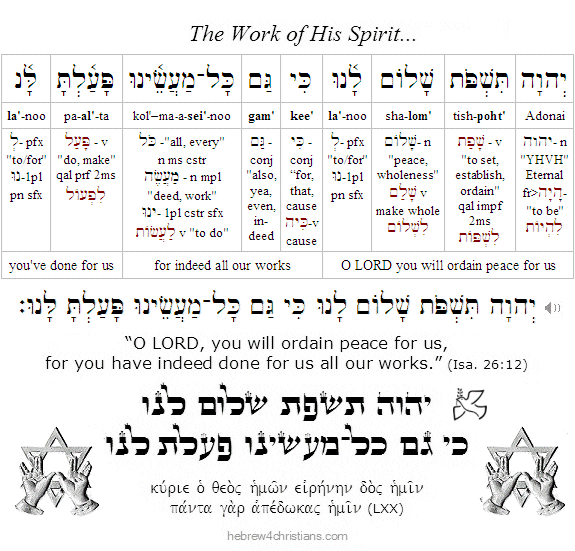 |
The Beginning and End...
03.10.26 (Adar 21, 5786) The final portion of the Book of Exodus (i.e., Pekudei) provides details about the construction of the Tabernacle (מִשְׁכָּן) and its furnishings as well as the special clothing of the priests. At the end of the portion we read, וַיְכַל משֶׁה אֶת־הַמְּלָאכָה / "Moses finished all the work" (Exod. 40:33), a phrase that has the same gematria (numeric value) as bereshit (בְּרֵאשִׁית, "in the beginning"), the very first word of the Torah (Gen. 1:1). This suggests that the very creation of the universe was for the sake of the building of the Altar of God, and by extension, for the sake of the sacrificial love of God to be demonstrated to all of creation.
The Talmud states, "All the world was created for the Messiah" (Sanhedrin 98b) and indeed, Yeshua is called "the Lamb slain from the foundation of the world" in the New Testament (Rev. 13:8; 1 Pet. 1:18-20; Eph. 1:4; 2 Tim. 1:9). "All things were created by Him (i.e., Yeshua), and for Him" and in Him all things consist (συνεστηκεν, lit. "stick together") (Col. 1:16-17). Creation therefore begins and ends with the redemptive love of God as manifested in the Person of Yeshua our Mashiach, the great Lamb of God... He is the Center of Creation - the Aleph and Tav - the Beginning and the End (Isa. 44:6; Rev. 1:17).
Some of the Jewish sages said that "the seal of God is truth," since the final letters of the three words that conclude the account of creation -- bara Elohim la'asot ("God created to do" [Gen. 2:3]) -- spell the word for truth (i.e., emet: אֱמֶת):
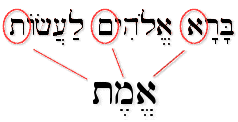 |
The idea that God created the world "to do" implies that He had finished all His work of creation (and redemption) after the sixth day (Heb. 4:3), which is yet another way of saying that Yeshua is the Lamb slain from the foundation of the world. Salvation is not an afterthought or "plan B" of God's purpose for creation. "Before Abraham was, I AM." Our LORD Yeshua always is the Way, and the Truth, and the Life for us (John 14:6).
Hebrew Lesson
Rev. 1:8 Hebrew reading:
Remembering the Future...
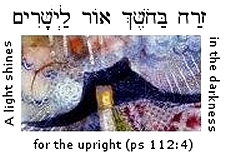
03.10.26 (Adar 21, 5786) When we experience troubles and sorrows in our lives, we must "remember the future," for our salvation and destiny is bound up in the truth of hope (Rom. 8:24; Heb. 11:1). We must call to mind the great promises of God and believe that there is indeed a blessed time of healing and deliverance awaiting us, even if we must abide in the shadow of its substance for a bit longer: "For behold, the Day is coming (הַיּוֹם בָּא), burning like an oven, when all the arrogant and all evildoers will be stubble. The Day that is coming shall set them ablaze, says the LORD of hosts, so that it will leave them neither root nor branch. But for you who fear my Name, the Sun of Righteousness (שֶׁמֶשׁ צְדָקָה) shall rise with healing in its wings. You shall go out skipping like calves released from the stall. And you shall tread down the wicked, for they will be ashes under the soles of your feet, on the day when I act, says the LORD of hosts" (Mal. 4:1-3).
The "Sun of Righteousness," Shemesh Tzaddik (שֶׁמֶשׁ צְדָקָה), is Yeshua the son of David, the ascended life-giving Healer of God. Of Him it is said, "The LORD God is a sun and a shield" (Psalm 84:11) and "the LORD shall be to thee an everlasting Light (אוֹר עוֹלָם), and thy God thy glory; thy sun shall no more go down, for the Lord shall be thine everlasting light" (Isa. 60:19-20). The Divine Light will shine on those who receive God's righteousness, that is, on those who put their trust in the One who said, 'I am the Light of the world' (John 8:12).
Yeshua is melech ha-kavod (מֶלֶךְ הַכָּבוֹד), "the King of Glory" -- and no one can stand before the blinding power of His countenance (Psalm 27:4; Rev. 1:8-19). His is the "Fountain of Light" for all of creation, the Source and End of all life: "For by Him all things were created, in heaven and on earth, visible and invisible, whether thrones or dominions or rulers or authorities -- all things were created through Him and for Him. And he is before all things, and in him all things hold together... that in everything He might be preeminent" (Col. 1:16-18). Yeshua will come "with healing in his wings" -- that is, in healing radiance, with rays and beams, which metaphorically describe His influence over the hearts of men... Note that the word for "wings" used in this passage (i.e., kanaf: כָּנָף) pictures the image of a heavenly tallit (טַלִּית), or the heavenly firmament (רָקִיעַ) of the LORD's sheltering Presence.
So "remember your future," chaverim, the day draws near! Let us not grow weary. Let us renew our hearts and confess the truth of God's blessing in our hearts. "Now it is being decided whether, in the day of your supreme sorrow or temptation, you shall miserably fail or gloriously conquer. Character cannot be made except by a steady, long-continued process" (Phillips Brooks). Amen. Let us continue to trust in the One who has promised never to leave nor forsake us, the One who gives us the strength to persevere amidst the trials of life, who gives us the victory over the powers of hell and death for the sake of His great Name.
Hebrew Lesson
Isaiah 60:20b Hebrew reading:
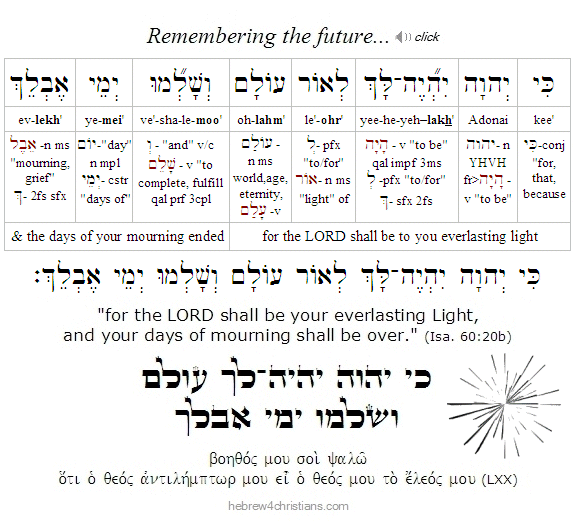 |
Sanctity and the Sabbath...
The Sabbath is a "sign" (אוֹת) of faith in the heart of a Jew... (Exod. 31:17).
03.10.26 (Adar 21, 5786) Our Torah portion this week (i.e., Vayakhel) begins this way: "And Moses assembled (וַיַּקְהֵל מֹשֶׁה) all the congregation of the people of Israel and said to them, "These are the things that the LORD has commanded you to do. Six days work shall be done, but on the seventh day you shall have a Sabbath of solemn rest (שַׁבַּת שַׁבָּתוֹן), holy to the LORD..." (Exod. 35:1-2). The prohibition to abstain from profane activities on the Sabbath day was intended to set apart God's people as his own treasured possession (Deut. 5:14-15). The sages further note here that this commandment refers not only to the commandment to keep the Sabbath day, but also refers to our duty to work as well...
Indeed the idea of the holiness of the Sabbath day finds its structure and meaning as an oasis within the context of doing work (melachah), setting itself apart from the profane, to both signify the sacredness of the realm of "being" over "doing," but also to consecrate our "doing" as a matter of service before God.
Practically speaking this means that we will be yashar (honest, upright) about how we use of time, and particularly so about how we work at our jobs or do what is expected of us. We are to "redeem the time" by honoring the Lord with the sacred gift of our lives. O Lord, teach us to number our days aright so that we attain a heart of wisdom" (Psalm 90:12). Amen.
Hebrew Lesson
Psalm 90:12 reading (click):
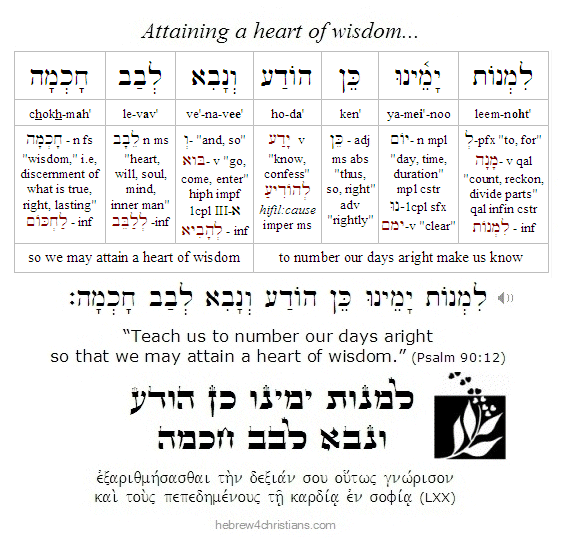 |
Anticipating Passover:
Shabbat HaChodesh...
After Purim, Passover quickly appears on the horizon... This year the seder begins April 1st.
03.09.26 (Adar 20, 5786) The world runs on a "clock" that operates under assumptions that are different than those revealed in the Scriptures.... The "wisdom of this world" (σοφία τοῦ κόσμου τούτου) is the prevailing cultural spirit that suppresses the reality of God's Presence and truth. Such "wisdom" is regarded as foolishness before God, and God has promised to "seize the so-called wise in their own craftiness" (1 Cor. 3:19). The life of faith, on the other hand, sees what is invisible. Faith (emunah) apprehends "the substance (ὑπόστασις) of things hoped for, the assurance (ἔλεγχος, conviction, "correction," "argument," i.e., hokhachah: הוכחה) of things not seen" (Heb 11:1). As the Scripture says, the heart of faith "looks not to the things seen but to the things unseen; for the things that are seen are transient, but the things that are unseen are eternal" (2 Cor. 4:18).
The Sabbath that immediately precedes (and sometimes falls on) the Biblical New Year is called Shabbat HaChodesh (שבת החודש), the "Sabbath of the Month" (of Nisan). This Sabbath is significant because it marks the start of the month of Redemption (i.e., the first month called Nisan) which God called "the beginning of months" (i.e., Rosh Chodashim). We honor this event by reading an additional passage from the Torah concerning the sanctification of the new moon (Exod. 12:1-20), and we spiritually prepare for this month by studying about Passover and the related spring holidays of Unleavened Bread, Firstfruits, and Shavuot:
|
The commandment to sanctify the first new moon of the year (i.e., Rosh Chodashim) reveals that it is our responsibility to sanctify (i.e., observe) Biblical time in general. In other words, when we observe "the beginning of months," we are acknowledging that time itself is rooted in the Biblical calendar with its divinely inspired cycle of festivals (i.e., the moedim). Note that this year the Biblical New Year begins on Wed. March 18th at sundown, and therefore Passover begins exactly two week weeks later, Wed. April 1st at sundown:
|
Originally Rosh Chodashim was simply called the "first month" because it marked the month of the Exodus and the other months were named in relation to it, similar to the days of the week in the Hebrew calendar (i.e., the first day, the second day...). Later it was called Chodesh Ha-Aviv (חודש חביב) - "the springtime month" (because the calendar is reset in the spring) and later still it was known as Nisan (ניסן) to commemorate God's faithfulness to Israel after the Babylonian Exile (Neh. 2:1; Esther 3:7).
The word "Nisan" (נִיסָן) might come from either the word nitzan (ניצן), meaning "bud" (Song 2:12), or the word nissim (ניסים) meaning "miracles," both of which suggest physical and spiritual resurrection in our lives. Others think the word comes from the verb nus (נוּס), meaning "to flee," both in relation to Israel's flight from Egypt and Egypt's flight from Israel (i.e., when the pursuing Egyptian cavalry fled (נָסִים) before the sea closed upon them (Exod. 14:25, 27). We also see this usage in the verse: "The wicked flee (נָסוּ) when no one pursues, but the righteous are bold as a lion" (Prov. 28:1). The devil's power is found in the lie. If he can make you afraid, you will not think clearly. Establishing your faith in the truth will embolden you to deal with the lies and distortions that are intended to enslave you in fear. As Yeshua said, the truth will set you free (John 8:32).
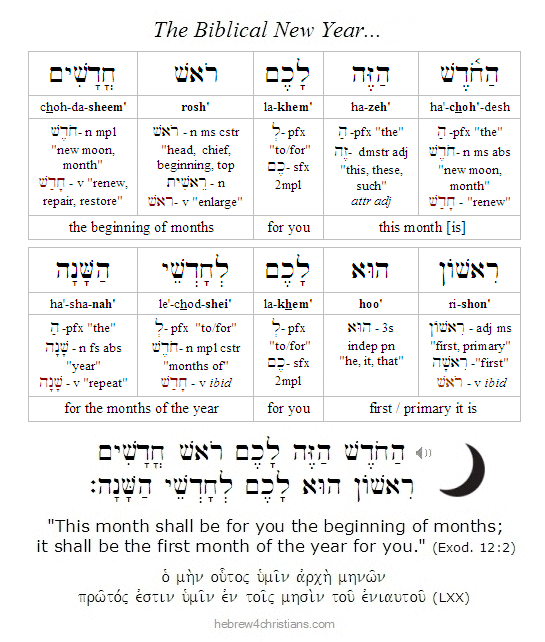 |
The new moon of Nisan is the most significant of the "new moons" of the Jewish calendar since it initiates the very first month of the Biblical Calendar - and therefore represents the Biblical "New Year's Day." Of all the various Rosh Chodesh celebrations, then, Rosh Chodesh Nisan is foundational, since it presents the starting point for the cycle of the yearly festivals (mo'edim) that reveal prophetic truths about the LORD God of Israel and His beloved Son, Yeshua the Messiah, blessed be He.
יְהִי רָצוֹן מִלְּפָנֶיךָ יהוה אֱלהֵינוּ
וֵאלהֵי אֲבוֹתֵינוּ
שֶׁתְּחַדֵּשׁ עָלֵינוּ שָׁנָה טוֹבָה וּמְתוּקָה
בַּאֲדנֵינוּ יֵשׁוּעַ הַמָּשִׁיחַ אמן
ye·hee · ra·tzon · meel'·fa·ne'·kha · Adonai · e·lo·hei'·noo
vei·lo·hei · a·vo·tei'·noo · she·te·cha·desh · a·lei'·noo · cho·desh tov
ba'a·do·nei'·noo · Ye·shu'·a · ha'·ma·shi'·ach · A·men

"May it be your will, LORD our God
and God of our fathers,
that you renew for us a good and sweet year
in our Lord Yeshua the Messiah." [Amen]

Download Study Card
<< Return
|