|
Apparently there are some so-called "Messianic" ministries out there that claim there are two different ways to "walk faith" in the Messiah, depending on whether you identify yourself as a Jew or not. According to these people, Jewish believers in Yeshua should be "Torah observant," while non-Jewish believers (i.e., "Gentiles") are merely "invited" to become (what they term) "Torah submissive." As one of these organizations recently put it: "Gentile believers do not share identical obligation to Torah as Jewish believers, but they are invited to participate in all of the commandments along with Israel and should be encouraged to do so" (First Fruits of Zion, Divine Invitation). According to this "two class" system, Jewish believers are obligated to be "Torah observant," whereas their non-Jewish counterparts are not... The two groups "do not share" the same obligation before the Lord.
Let me say plainly that "Messianic" ministries that advocate such invidious doctrines are in grave error -- and are undoubtedly legalistic cults. Forget the lip service these ministries may give to the idea of "salvation by grace through faith." When you get past the "surface language" you will begin to discern appeals to a form of "works righteousness," a meritocracy, a system that claims that salvation itself is ultimately conditional upon something you do, some merit of your own, some observance, some action, some prescribed ritual... Listen closely to the connotations of language. You will soon enough detect that those who teach such divisive things are either ignorant of the meaning of the Torah (and therefore of the meaning of the gospel) or else are deceivers intent on "bewitching" vulnerable souls with superficial knowledge. Their message is often joined with a seductive appeal to human pride as well: "This is what the text really means..." "Now you can know the secrets - unlike those common 'Gentile Christians' who don't really understand..." etc. Please read what I've got to say and see if you might not agree.
At the outset it must be conceded that no one has ever been genuinely "Torah observant" since the destruction of the Second Temple in 70 AD. More than 40% of the Torah's commandments concern various laws of the priesthood and the sacrifices (korbanot), but apart from a divinely appointed altar (i.e., the Temple), it is literally impossible to fulfill these commandments. Since this is undeniably the case, any advocate of "Torah observance" must immediately qualify their claim by appealing to the logic (and authority) of the Mishnah/Talmud (i.e., Oral Law), which equates prayer, good deeds, and charity with the Torah's sacrificial system (see Berachot 26b). In other words, the idea of "Torah observance" today distills to the question of the authority of the various customs and traditions of post-Temple Judaism. The Oral law of Judaism -- and therefore the authority of the sages -- is given priority over the written law of Moses. (The same point might be made, incidentally, regarding various social laws found in Torah. For example, we are not living in a theocratic kingdom, we do not observe agricultural laws for ancient Israel, we do not release slaves at the year of Jubilee, and so on.)
But let me go further here. I've written extensively about the question of "Torah observance" in numerous articles elsewhere on this site. "Torah triflers" (i.e., those who advocate legalism but have yet to seriously think through its implications) are often unaware of the deeper function of Sinai and its provisions. Two things should immediately be said regarding this: 1) Olam ("everlasting") doesn't necessarily mean unchanging (at least in the Greek sense of the term), especially since Moses, David, and Ezra all changed the Torah, and most of the later Jewish sages acknowledged that Torah would be changed in yemot ha-Mashiach (the days of the Messiah); and 2) the New Covenant is an entirely new covenant -- not a renewed version of the sefer ha-brit sprinkled with the blood of bulls at Mt. Sinai. Paul goes back to the Abrahamic covenant -- not to the "blessings and curses" issued from the mountains of Gerizim and Eval as the foundation underlying the deeper covenantal message of God's chesed. Of course you are "free" to attempt to justify yourself using the terms given at Sinai, but then you are constrained by the conditions of that agreement (Deut. 27:26), and you are thereby implicitly denigrating the need for a radically New Covenant. Be forewarned: Persisting in such a project ultimately outrages the Spirit of Grace (רוּחַ הֶחָסֶד) that broods over the Cross of Mashiach (Heb. 10:29). We are furthermore cautioned that hardening our hearts on this matters can lead to eternal loss (Heb. 6:4-8). God is not mocked. He did not sacrifice His Son for the sake of creating disciples of Moses and the rabbis... We are called to follow the Messiah and submit to His authority alone (Matt. 23:8). Anything else is chillul HaShem and a betrayal of the Messiah!
It is written: "Now the righteousness of God (צִדְקַת אֱלהִים) apart from the law is manifested, being witnessed by the law and the prophets" (Rom. 3:21). Those who attempt to mix the covenants are called adulterers (Rom. 7:4-ff.).... The goal or aim of the Torah was the New Covenant -- not the other way around (Gal. 3:17-19). The law is called a "schoolmaster" meant to lead to the Messiah and His Kingdom rule (Gal. 3:23-26). The glory of the Torah of Moses was destined to fade away (2 Cor. 3:3-11), just as its ritual center (i.e., the Tabernacle/Temple) was a shadow to be replaced by the greater priesthood of Malki-Tzedek (Heb. 10:1; 13:10). "Now we are released from the law, having died to that which held us captive, so that we serve in the new way of the Spirit and not in the old way of the written code (Rom. 7:6). "For what the law could not do, in that it was weak through the flesh, God sending his own Son in the likeness of sinful flesh, and for sin, condemned sin in the flesh: That the righteousness of the law might be fulfilled in us, who walk not after the flesh, but after the Spirit" (Rom. 8:3-4).
Let's look at this from a metaphorical perspective, or by means of a Scriptural parable. מַעֲשֵׂה אֲבוֹת סִימָן לַבָּנִים / ma'aseh avot siman labanim: "The deeds of the fathers are signs for the children." When Abraham was tested with the Akedah (i.e., the sacrifice of his son Isaac), the temptation was to elevate blind obedience above the dictates of compassion and conscience. His temptation, so to speak, was whether to listen to the voice of God (אֱלהִים) or to the voice of the LORD (מַלְאַךְ יְהוָה).
Why didn't Abraham argue with God (אֱלהִים) by remembering Him as the LORD (יְהוָה), the Compassionate Source of life? Earlier he had argued with God regarding the destruction of Sodom. So why didn't he argue to save his own son? Might this have been Abraham's test, namely, that God wanted Abraham to argue and to challenge the command to perform child sacrifice? According to this view, Abraham failed the test, since he blindly obeyed God without protest (this is similar to those who want to obey the letter of the Torah without taking time to discern the overarching significance of its message). It is noteworthy that after the Akedah, God and Abraham never spoke directly to one another again...
Abraham went ahead to offer homage to Elohim, the God of Justice, upon Moriah... The temptation, from this perspective, was not to be swayed by the "merely human" compassion of a father for his son... For three days Abraham steeled himself from all appeals of human tenderness and compassion. At the decisive moment, however, the LORD (יְהוָה) intervened -- and Abraham ultimately heeded the Voice of Love/Grace rather than the voice of Justice/Law.... This was the deeper Voice of the LORD; and this was also Abraham's ultimate deliverance.

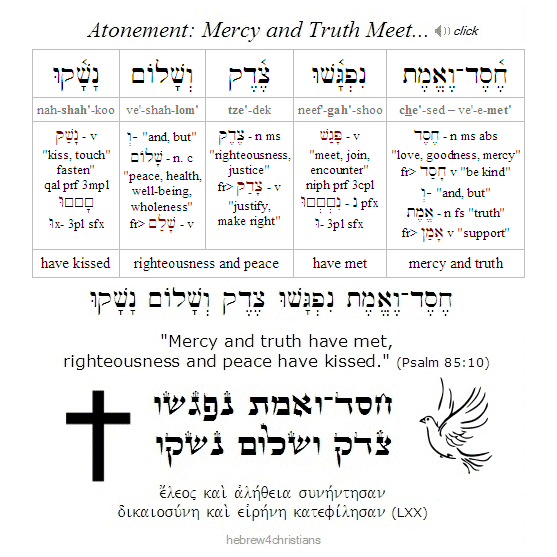
There is a fantastic midrash about the white ram that Abraham sacrificed in place of his son (see the Midrash of the White Ram). After its death, the ram's soul returned to heaven, but it wanted to do more in the world of people, so God sent him back to earth. God then gave the ram horns so long that they reached all the way to heaven. In this way, the ram could be in both worlds at once: with its feet on earth and its horns in heaven. Similarly, God sent His Son as the Ram of God to satisfy His requirements for justice (as Elohim) and to demonstrate His unbounded chesed/love (as the LORD). Yeshua now spans heaven and earth as our substitutionary atonement, intercessor, and heavenly advocate. In Him "steadfast love (chesed) and truth (emet) meet; justice (tzedek) and peace (shalom) kiss" (Psalm 85:10). His merit alone is our Bridge to the Father: יְשׁוּעָתָה לַיהוָה - Salvation is from the LORD.
Hebrew Lesson:
Psalm 85:10 Hebrew Reading:
 |
It is vital, chaverim, to understand that we are saved by hope in the love and grace of God -- not through adherence to an external lawcode (or by appealing to God as Elohim rather than as YHVH/Yeshua). God looks within the heart. The justified live by trusting in God's gracious love and forgiveness-- not on the basis of meritocracy or conformity to a religious code (Hab. 2:4; Titus 3:5-6). Ultimately there is an infinite difference between being a slave and being a child.
Messianic groups that advocate adherence to the terms of the Sinai covenant or otherwise promote "Torah observance" spawn insidious confusion that subtly undermines the message of the Gospel itself. Ironically enough, most of these so-called "Torah observant" ministries often do not truly understand what the word "Torah" actually means. They seem to rather uncritically accept rabbinical thinking and definitions, but they really don't go back far enough. They do both too little and too much in their theology.
It is vital to remember there is a distinction between "Torah" (תּוֹרָה) and "Covenant" (בְּרִית). As the author of the Book of Hebrews lucidly states: "When there is a change in the priesthood (i.e., as mediators of the covenant), there is necessarily a change in the Torah as well" (Heb. 7:12). The Levitical priesthood mediates the truth of the Covenant of Sinai; the priesthood of Yeshua (after the order of Malki-Tzedek) mediates the truth of the New Covenant. Torah is a general word that means "instruction" and is always a function of the underlying covenant of which it is part: it is our response to the covenantal actions of the LORD God of Israel.
Focusing on the Torah's requirements for ethnic Jews (as opposed to non-Jews) promotes a religious "class system" that Yeshua never once promoted. It focuses on what separates us -- the mechitzah or "dividing fence of partition" -- rather than on the "one new man" ideal that brings us all together (Eph. 2:14). If you want to be great in the Kingdom of Heaven, you efface yourself and become a slave to all (Mark 9:35; 10:44). Moreover, since circumcision is the ritual "sign" par excellence of what it means to be an "ethnic Jew," it may be regarded as a test case in this matter. As the great Torah sage Rav Sha'ul (i.e., the Apostle Paul) wrote:
For freedom Messiah has set us free; stand firm therefore, and do not submit again to a yoke of slavery (ζυγῷ δουλείας). Mark my words- I, Sha'ul, tell you that if you undergo brit milah (בְּרִית מִילָה) Messiah will be of no advantage to you at all! Again, I warn you: any man who undergoes brit milah is obligated to observe the entire Torah! You who are trying to be declared righteous by God through legalism have severed yourselves from the Messiah! You have fallen away from God's grace! For it is by the power of the Spirit, who works in us because we trust and are faithful, that we confidently expect our hope of attaining righteousness to be fulfilled. When we are united with Messiah Yeshua, neither being circumcised nor being uncircumcised matters; what matters is trust expressing itself through love. (Gal. 5:1-6)
The great Apostle went on to say, "I wish the people who are bothering you (regarding the matter of legalism) would go the whole way and castrate themselves" (Gal. 5:12). Paul used such strong language because the heart of the gospel message was at stake. As the author of the Book of Hebrews put it, "We have an altar from which those who serve the tent (i.e., the Temple) have no right to eat" (Heb. 13:10). Salvation is a gift from God given to those who are trusting in Yeshua for deliverance, just as sanctification is likewise a gift. There is no middle ground on this issue. You either accept God's justification on your behalf, or you will resort to efforts at self-justification.
Note: Yeshua is the "end of the Torah for righteousness to all who believe" (Rom. 10:4); He is Torah righteousness for those who trust in Him and who put no confidence in the flesh (Phil. 3:3-9). If you're struggling with the question of whether you should become "Torah observant" (or "Torah submissive"), it might be helpful to revisit some of the contrasts between the "old" and "new" covenants described in the New Testament. To help you see some of this, I've created a new table called "Compare the Covenants." Hopefully you will better appreciate the life-transforming differences between the Torah of the New Covenant (given at Zion) with the Torah of the older Covenant (given at Sinai).
|