|
|
 |
|
|
|
|
Weekly Torah Reading
|
|
|
|
Parashat Vayera ("and He appeared")
|
|
|
Click on the links to display the Scriptures:
|
|
|
|
|
|
|
|
Torah Reading Overview
|
|
|
|
Last week's parashah (Lekh Lekha) recounted how Abram left everything behind in response to the promise of divine inheritance given by the LORD. As a result of his obedience, the LORD told Abram that he would become the father of a multitude of people, as numerous "as the stars in heaven." Even in his old age, Abraham believed the promise and the LORD counted him righteous for his faith. Thirteen years later the LORD renamed him "Abraham" and made a unilateral covenant to give him the land of Canaan as an everlasting possession. The LORD further commanded Abraham and his descendants to be circumcised as a sign of the covenant.
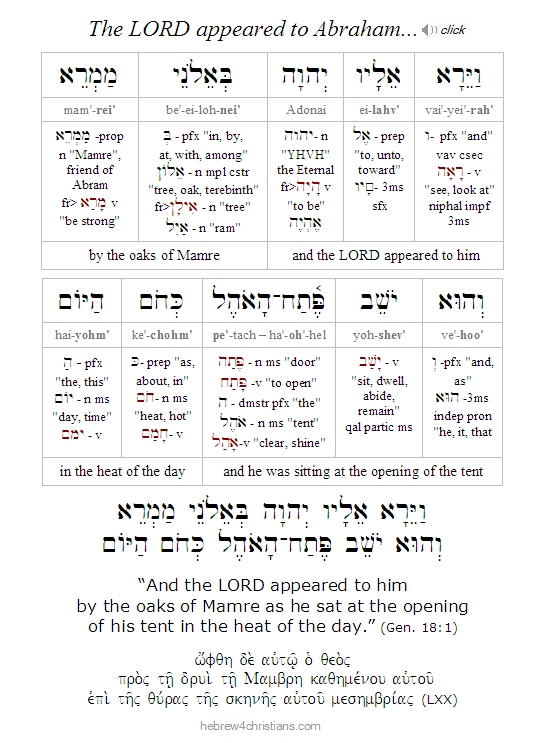
The parashah begins:
|
|
|
|
|
|
And the LORD appeared to him by the oaks of Mamre, as he sat
at the opening of his tent in the heat of the day. (Gen. 18:1)
|
|
|
|
According to the Jewish sages, it was just three days after performing his circumcision, the time of the most intense pain as a result of the procedure, that the LORD appeared to Abraham by the "oaks at Mamre." Nonetheless, despite his discomfort, in a display of Hachnasat Orchim (hospitality), he rushed off to prepare a meal for the three mysterious guests who appeared in the desert heat.
While the three men were eating, one of them announced that in exactly one year, He would return to them and Sarah would then birth to a son. Sarah, who had been listening from the tent door, heard this and laughed within herself at the suggestion. To this the LORD (disguised as one of the three guests) replied "Why did Sarah laugh and say, 'Shall I indeed bear a child, now that I am old?' Is anything too wonderful for the LORD? At the appointed time I will return to you about this time next year, and Sarah shall have a son."
The three guests then set out from there for Sodom, and Abraham accompanied them to see them off. Then the LORD said, "Shall I hide from Abraham what I am about to do, seeing that he shall surely become a great and mighty nation, and all the nations of the earth shall be blessed in him?" The LORD then explained that He was going to see if the outcry against the wicked cities of Sodom and Gomorrah was true, and if so, was going to pronounce judgment upon it.
Abraham then drew near to question the LORD about his intent: "Will you indeed sweep away the righteous with the wicked?" he asked. "Shall not the Judge of all the earth do what is just?" In a profound sequence of hypothetical questions and answers, Abraham asked the LORD whether He would destroy the entire city if 50 righteous dwelt there. No, answered the LORD, not if there were 50 in the city. Well, how about 45? No again, answered the LORD. Abraham began showing some chutzpah. What about 40? 30? 20?... 10? The LORD then stated that if even ten righteous men were found there, He would spare the city from His wrath, and then went His way.
When two of the three disguised angels arrived at Sodom, Abraham's nephew, Lot, extended his hospitality and sought to protect them from the evils of nightlife in the wicked city. He took the angels into his home, prepared a meal for them, but soon a mob surrounded his house and demanded that he release the two strangers to them for sexual abuse. Lot tried to reason with them, and even offered his two daughters in their place, but the mob grew ugly and finally rushed him. The two angels intervened, however, by pulling him inside the house and striking the mob with blindness. They then revealed that they were sent by the LORD to destroy the city, and urged Lot to warn his immediate family of the imminent doom. Lot tried to warn his daughter's fiancees, but they thought he was jesting. Sadly, no one else listened to Lot's warning, either.
As the morning dawned, the angels urged Lot to flee the city with his wife and two daughters, but he lingered. Finally, they (mercifully) took his family and led them outside of the city to safety. Lot was given permission to flee to the small city of Zoar, and just as he entered, the LORD began raining sulfurous fire down upon the evil cities of Sodom and Gomorrah. Tragically, Lot's wife "looked back" and was turned into a pillar of salt.
Lot then decided to flee to the hills with his daughters. While taking shelter in a cave, his two daughters (believing that they and their father were the only ones left alive after the apocalypse) got their father drunk, had sexual relations with him, and became pregnant. The two sons born from this incident would become the father the nations of Moab (מוֹאָב, lit., "from the father," i.e., מ+אָב) and Ammon (בֶּן־עַמִּי, lit. "son of my people," i.e., בֶּן+עַמִּי), respectively. In subsequent Jewish hiistory, King David's great grandmother Ruth was a descendant of Moab, and King Solomon's wife Naamah (who bore his successor Rehoboam) was a descendant of Ammon....
After this, Abraham moved south to Gerar. Apparently Abraham had an ongoing agreement with Sarah to pretend to be brother and sister during their travels, in order to avoid clan violence upon settling in a godless area. Sure enough, a Philistine king named "Avimelech" took Sarah to be part of his harem, but in a dream, the LORD warned him that he was a dead man if he failed to return her back to Abraham, her husband. Avimelech did so, and castigated Abraham for his duplicity. However, Abraham was then given his choice of the land in the area.
The LORD then visited Sarah as He had said and she miraculously conceived a son, whom Abraham called Yitzchak (Isaac). Abraham was 100 years old, and Sarah 90, when Isaac was born. According to the commandment of brit milah, Abraham circumcised Isaac on the eighth day.
Now when Isaac was weaned, Abraham threw a party, but Sarah noticed Hagar's son Ishmael mocking, so she said to Abraham, "Cast out this slave woman with her son, for the son of this slave woman shall not be heir with my son Isaac." At first Abraham was displeased, but the LORD told him to do as Sarah had asked, because it was through Isaac that his offspring would be named, and the LORD would bless Ishmael and make him the patriarch of a great nation.
So Abraham sent Hagar and his son Ishmael away to wander in the desert. When the water Abraham gave them ran out, Hagar covered her son in the brush and then went off to wail for his death. But God heard the voice of their crying, and an angel of God showed her a water supply to save the boy's life. "And God was with the boy, and he grew up. He lived in the wilderness and became an expert with the bow."
Abraham then dwelt "many days" among the Philistines, and Avimelech made a treaty with him at Be'er Sheva, where Abraham gave him seven sheep as a sign of their truce.
And then comes Abraham's greatest test of all....
|
|
|
|
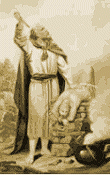
This supreme test of faith is called the Akedah ("binding"), or sometimes Akedat Yitzchak ("the binding of Isaac"), and the story of this test is recounted daily by Orthodox Jews during morning synagogue services and also during Rosh Hashanah. In a very real sense, the Akedah represents the "Gospel according to Moses."
As Messianic believers, we understand the binding of Isaac to foreshadow the ultimate sacrifice the heavenly Father would give on our behalf in Yeshua. Unlike Abraham, God the Father actually offered His only begotten Son (בֵּן יָחִיד) upon Moriah in order to make salvation available to all who believe (John 3:16-18; 1 John 4:9). As Abraham himself believed: אֱלהִים יִרְאֶה־לּוֹ הַשֶּׂה / Elohim yireh-loh haseh ("God Himself will provide a lamb").
אֱלהִים יִרְאֶה־לּוֹ הַשֶּׂה לְעלָה בְּנִי
e·lo·heem · yeer·eh-loh · ha·seh · le·oh·lah · be·nee

"God will provide for himself the lamb for the burnt offering, my son."
(Gen. 22:8)
 |
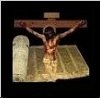
Consider how the Akedah provides a prophetic picture of Yeshua as the "Lamb of God" (Seh haElohim) who takes away the sins of the world (John 1:29). Both Isaac and Yeshua were born miraculously; both were "only begotten sons"; both were to be sacrificed by their fathers at Mount Moriah; both experienced a "passion"; both were to be resurrected on the third day (Gen. 22:5, Heb. 11:17-19); both willingly took up the means of his execution; and both demonstrate that one life can be sacrificed for another – the ram for Isaac, and Yeshua for all of mankind. Indeed, Isaac is a clear picture of the Greater Seed of Abraham to come, the One who would remove the curse and save us from death.
The very first occurrence of the word love in the Scriptures (i.e., ahavah: אַהֲבָה) refers to Abraham's love for his "only" son who was to be sacrificed as a burnt offering on Moriah (the very place of the crucifixion of Yeshua), a clear reference to the gospel message (Gen. 22:2; John 3:16). Some scholars have noted that the word ahavah comes from a two-letter root (הב) with Aleph (א) as a modifier. The root means "to give" and the Aleph indicates agency: "I" give (i.e., the Father gives). Love is essentially an act of sacrificial giving... The quintessential passage of Scripture regarding love (αγαπη) in the life of a Christian is found 1 Corinthians 13: "Love seeks not its own..."
Whereas the Akedat Yitzchak foreshadowed God's provision for the coming Temple, the Akedat Yeshua (i.e., the crucifixion of Yeshua at Moriah) was the altar where the justice and chesed (love) of the Father fully met. For more on this incredibly rich subject, please see the articles, "The Passion of Isaac" and "The Sacrificed Seed."
On account of Abraham's obedience and trust in the LORD, the Angel of the LORD then said, "By myself I have sworn, declares the LORD, because you have done this and have not withheld your son, your only son, I will surely bless you, and I will surely multiply your offspring as the stars of heaven and as the sand that is on the seashore. And your offspring shall possess the gate of his enemies, and in your Seed (singular) shall all the nations of the earth be blessed, because you have obeyed my voice."
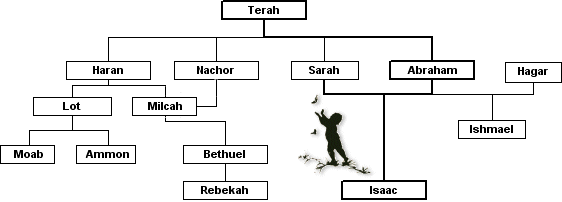
The parashah concludes with Abraham settling in Beer Sheva and receiving news of the birth of a daughter, Rebekah, to his nephew Bethuel:
 |
|
|
|
|
|
|
Haftarah Reading Overview
|
|
|
|
The Haftarah for Parashat Vayera concerns two nisim (miracles) performed by the prophet Elisha, the disciple of Eliyahu haNavi (Elijah the Prophet).
In the first miracle, an impoverished widow had no means to pay a debt owed by her late husband, and a creditor was threatening to take her two sons as slaves in lieu of her payment of the debt. She appealed to the prophet Elisha, who told her to borrow empty vessels from all her neighbors, to close the doors of her home, and to pour oil into them from the one remaining cruse of oil that she had. She had faith in the prophet, and the oil miraculously flowed from the original cruse until all the borrowed vessels were full. Elisha instructed her to sell enough of the oil to pay the debt, and to live off the supply of remaining oil.
In the second miracle, Elisha happened to pass through Shunam in Israel where he befriended a prominent woman and her husband. Eventually, the woman asked her husband to add a guest room to their home to accommodate the prophet during his travels through the area. In appreciation, Elisha asked her if there were anything he could do for her, but she declined the offer. However, Elisha's servant noticed that the couple was childless, and Elisha then prophesied that in a year she would have a son.
The following year, a son was indeed born. But as a young child, he suddenly fell ill and died on his mother's knees. The Shunamite woman put the lifeless body of the boy on the bed of the prophet, and immediately set out to find Elisha at Mt. Carmel.
After realizing what had happened, Elisha sent his servant before him with his staff, instructing him to use it to revive the boy. However, he was unable to revive the child.
When Elisha finally arrived, he went to his room and found the child. He then lay on top of him, mouth-to-mouth, eye-to-eye, hand-to-hand, and, as it were, reintroduced the boy's soul into him, using himself as a conduit. The boy sneezed seven times, and opened his eyes. The mother opened the door, bowed at Elisha's feet, and took her son.
As one who came after Eliyahu haNavi, Elisha is a type of Mashiach Yeshua, who brings abundance to those who have faith in Him and who has power to raise people from the dead (techiyat hametim). The miracle of the oil is similar to the miracle of the loaves of bread, and the raising of the Shunamite woman's child is similar to the raising of Jairus' daughter (Luke 8:41-55).
|
|
|
|
Brit Chadashah Overview
|
|
|
|
The readings from the New Testament concern the Greater Seed of Abraham, Yeshua the Mashiach, the Savior of the world.
In the first reading from Luke, we see how Miriam (Mary) was also promised a miraculous child, in fact, the very Seed of Abraham promised to come into the world. When she inquired how this would be possible, since she was a virgin, the angel responded that with God nothing would be impossible. Just as it seemed impossible for Sarah to give birth to Isaac, so she would give birth to Yeshua - by the power of the LORD - since there is nothing too wonderful for the LORD (see Gen 18:4).
The second reading from Luke is about the post resurrection appearance of the LORD Yeshua to His disciples, and how he "opened their minds" to understand how He fulfilled everything written in the Torah and the Nevi'im and the Ketuvim (i.e., the Tanakh) concerning His suffering, death, and resurrection on the third day (Luke 24:26-27;45). As He was ascending to heaven, He blessed His disciples and told them to await the coming of the Ruach HaKodesh (Holy Spirit) to be given on the festival of Shavu'ot (Pentecost).
The reading from the Epistle of 2 Peter mentions the fate of the ungodly, who will be swept away in judgment as were the inhabitants of Sodom and Gomorrah. However, like righteous Lot, the Lord knows how to rescue the godly from trials, but to reserve the unrighteous under punishment until the day of judgment.
|
|
|
|
Blessing:
|
|
|
|
|
|
Related Discussion:
|
|
|
|
|
|
|
Hebrew Audio Files:
|
|
|
|
|
Click the following links to hear the desired chapters read from this week's Torah:
|
|