|
|
 |
|
|
|
|
Weekly Torah Reading
|
|
|
|
Parashat Terumah ("Contribution")
|
|
|
Click on the links to display the Scriptures:
|
|
|
|
|
|
|
|
Torah Reading Overview
|
|
|
|
Last week's Torah portion (Mishpatim) explained how the Israelites became am kadosh (a holy people) by entering into covenant with the LORD at Mount Sinai. The terms of the covenant were written down in Sefer HaBrit ("the Book of the Covenant"), which contained a variety of laws to govern the people in the Promised Land. When the people agreed to obey the terms of the covenant, Moses took sacrificial blood and threw it on them saying, "Behold the blood of the covenant that the LORD has made with you in accordance with all these words." Moses then re-ascended the mount to receive luchot ha'even (the tablets of stone) inscribed with the Ten Commandments, and to learn additional Torah from the LORD.
Parashat Terumah opens with the LORD saying to Moses:
|
|
|
|
|
|
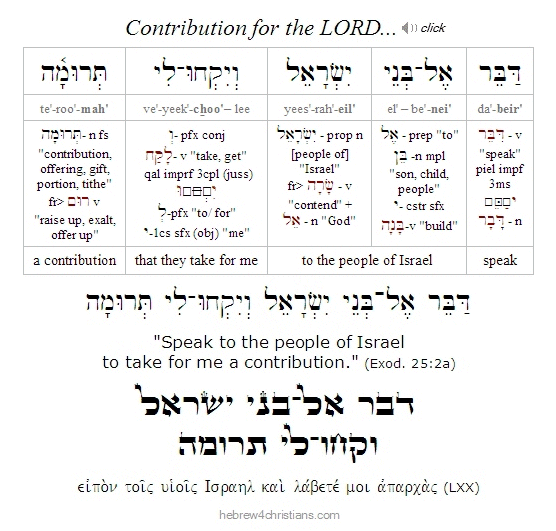
The LORD said to Moses, "Speak to the people of Israel, that they take for me a contribution. From every man whose heart moves him you shall receive the contribution for me. (Exodus 25:1-2)
|
|
|
|
Terumah means "contribution," "portion," "gift," or "freewill offering." In this week's parashah, the LORD asks for help "from every man whose heart moves him" to provide materials for the Mishkan kodesh (holy Tabernacle), a structure that would symbolize His Presence among the Israelites during their sojourn to the land of Canaan. (The word mishkan (מִשְׁכָּן) comes from a root (שָׁכַן) meaning "to dwell" and from which the word shekhinah (שְׁכִינָה) is derived.) This holy tent was intended to be "God's dwelling place among the people" where sacrifices were offered and God would communicate with the people through Moses and the Kohen Gadol (High Priest). Detailed instructions for constructing the Mishkan according to the pattern given to Moses are provided in this portion (the Mishkan later became the model for the Bet Hamikdash (Temple) in Jerusalem, and even for synagogue architecture in later days).
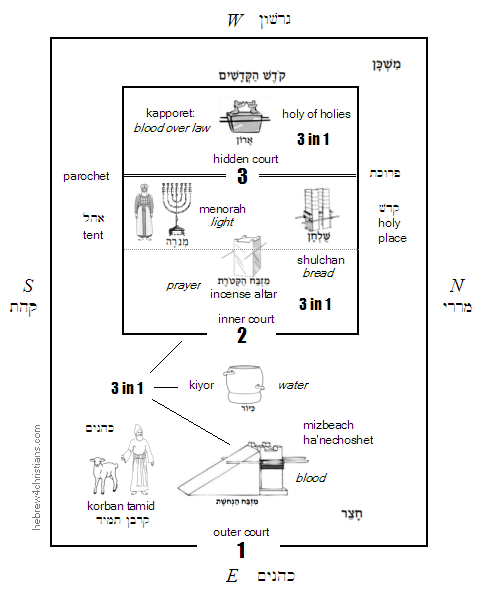
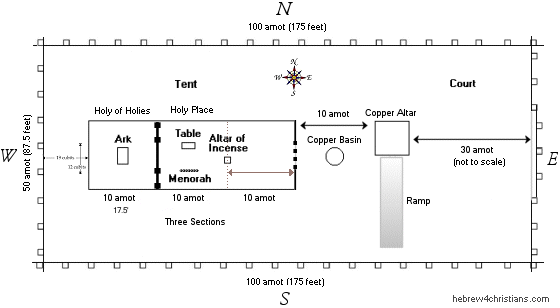
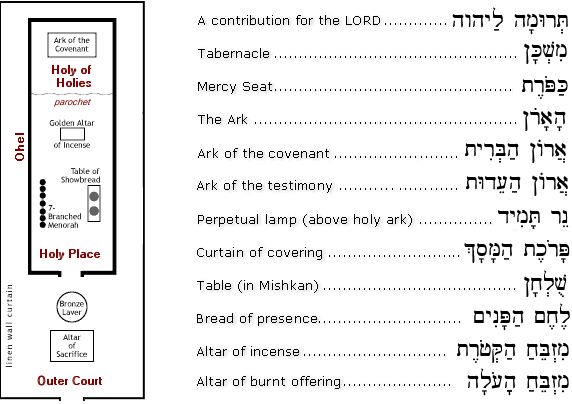
The Mishkan consisted of three main parts: The Outer Court called the chatzer (containing the altar for blood sacrifices and the bronze laver used by the priests), and a tent-like structure called the ohel that was divided into two separate chambers: (1) haKodesh or the Holy Place, an outer chamber into which only priests who performed sacred duties had access (which contained the shulchan (table of showbread), the menorah (lampstand) and mizbeach HaKatoret (the altar of incense)); and (2) kodesh ha'kodeshim, or the Holy of Holies, the innermost chamber which only the Kohen Gadol (High Priest) entered on Yom Kippur, and which contained the aron ha'brit (the Ark of the Covenant that held the two tablets containing the Ten Commandments).
 |
|
|
|
|
 |
|
|
|
The rest of the parashah is sometimes called tzuvui haMishkan, the commandment to build the Mishkan according to the pattern that Moses was given upon Mount Sinai (it proceeds from the inner to the outer - from the Holy of Holies to the Outer Court). Each component of the Mishkan, down to the smallest detail, is filled with symbolic significance about how to approach the LORD under the terms of brit yashanah (the Older Covenant of Moses with the Levitical priesthood as its ritualistic expression).
Where did the Israelites get the materials required to build the mishkan? After all, the following materials were required: gold, silver, copper, wool dyed purple and wool dyed blue, linen, goats' hair, "seal" (tachash) skins, shittim (acacia) wood, olive oil, spices, and various precious gems. This stuff normally isn't seen lying around the desert....
Various midrashim state that the gold and jewels came from despoiling the Egyptians (though some especially rare jewels were found in the desert with the manna that fell); the acacia trees came from Jacob, who foresaw the need 300 years earlier; and the required extra long beam (i.e., the middle beam for the mishkan) came from a tree that Abraham himself had planted which the angels had chopped down and carried to the desert for the Israelites.
According to the Midrash Rabbah, the mishkan is the likened to the creation of the universe:
Regarding the work of the first day of creation, it says, "He who stretches out the heavens like a curtain" (Psalms 104:2). Regarding the making of the Mishkan it says, "And you shall make curtains of goat's hair for a tent over the Tabernacle" (Exodus 26:7).
Regarding the work of the second day of creation, it says, "Let there be a firmament... and let it divide between the waters and the waters" (Genesis 1:6). Regarding the making of the Mishkan it says, "And the veil shall divide for you between the Holy and the Holy of Holies" (Exodus 26:33).
Regarding the work of the third day of creation, it says, "Let the waters under the heavens be gathered together" (Genesis 1:9). Regarding the making of the Mishkan it says, "And you shall make a copper basin, and the base thereof of copper, for washing" (Exodus 30: 18).
Regarding the work of the fourth day of creation, it says, "Let there be luminaries in the heavens" (Genesis 1:14). Regarding the making of the Mishkan it says, "And you shall make a Menorah of pure gold" (Exodus 25:31).
Regarding the work of the fifth day of creation, it says, "Let fowl fly above the earth" (Gen. 1:20). Regarding the making of the Mishkan it says, "The cherubim shall spread out their wings upward" (Exodus 25:20).
On the sixth day man was created [to inhabit and cultivate the earth]. Regarding the Mishkan, G-d says to Moses, "Bring near Aaron your brother [to perform the service in the Sanctuary]" (Exodus. 28:1).
Of the seventh day we have it written, "And the heaven and the earth were completed... And G-d completed His work... and G-d blessed... and G-d sanctified... " (Genesis 2:1-3). Regarding the making of the Mishkan it says: "Thus was completed all the work of the Tabernacle... And Moses blessed them... And it came to pass on the day that Moses completed the Tabernacle... and sanctified it" (Exodus 39:32-43; Numbers 7:1).
The purpose of the Mishkan was to provide a symbolic means for an Israelite under the covenant of Moses to come before the Presence of the LORD. Note that under these terms, the approach to the Holy One was predicated on the recognition of His moral law (as expressed in Sefer HaBrit, and in particular, the Ten Commandments), but access for the sinner was graciously given through sacrificial blood rituals as mediated by the designated Levitical priest. Atonement ("at-one-ment") was only made possible by means of adherence to the prescribed patterns and rituals (which were later transferred to the Bet HaMikdash located on Moriah). Since the blood rituals form the basis for the enactment of the covenant, it should not be surprising that the Heavenly Reality would be found in the sacrificial blood of Yeshua the Mashiach as Kohen Gadol of Brit Chadashah (for additional information, see my article on Yom Kippur as well as Moriah).
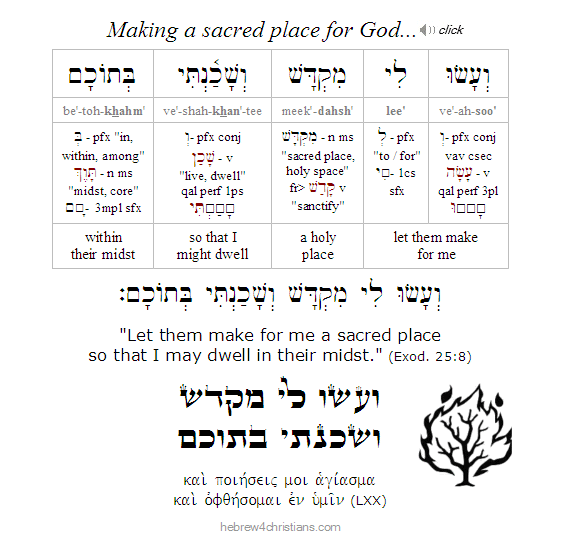
Hebrew Lesson:
Exodus 25:8 Hebrew reading:
|
|
|
|
Haftarah Reading Overview
|
|
|
|
In the Torah reading, the Israelites began constructing the Mishkan, the "portable Temple" that would move from place to place with the people in the desert. In the Haftarah, King Solomon directed the Jewish people to begin constructing the Holy Temple which was designed to be a "resting place" for the Divine Presence in Jerusalem.
The idea of the Temple came from King David, who transformed the concept of the Mishkan into a vision of a "House for the LORD." David was prevented from building the Holy Temple, however, because he was a man of war, and the task was therefore given to his son Solomon, who began its construction in the 480th year after the Exodus from Egypt, during the fourth year of his reign. It was modeled after the Mishkan, though proportionately it was twice the size and a porch-like feature was added, along with a three-story extension extending all around the building. The entire structure was constructed without the aid of iron tools, since iron is often used in warfare, and the Temple was created to establish life and peace for people. God promised Solomon the Temple would remain standing only if the Jewish people would remain faithful to Him. In 586 BC, the Temple was destroyed by Nebuchadnezzar. It had stood for 410 years.
As the Midrash says, "The land of Israel is situated in the center of the world, and Jerusalem in the center of the land of Israel, and the Temple in the center of Jerusalem, and the Holy of Holies in the center of the Temple, and the foundation-stone on which the world was grounded, is situated in front of the ark"(Midrash Tillin Terumah, Kedoshim). In this connection it may be added that the phrase, sha'alu shalom Yirushalayim, "pray for the peace of Jerusalem" (from Psalm 122:6) actually suggests the Messiah Yeshua. The word sha'alu actually means "ask" (as in ask a sheilah, a question). Shalom is a Name of Yeshua, since He indeed is Sar Shalom (the Prince of Peace). The word Jerusalem means "teaching of peace" (the "Jeru" at the beginning comes from the same root as Torah, which means teaching), so the phrase could be construed as "ask about the Prince of Peace and His Teaching." At any rate, we know that Yeshua is indeed the King of Jerusalem (Matt. 5:35) who will soon return to reign over all the earth.
|
|
|
|
Brit Chadashah Overview
|
|
|
|
The Torah appeals, in the Name of the Lord, that we should be charitable people, reflecting his heart of kindness. Indeed giving to others imparts the blessing of God: "Take for Me an offering" (וְיִקְחוּ־לִי תְּרוּמָה), the Scripture states, rather than "Give for Me an offering," since we receive more than we give through acts of charity (Exod. 25:1-2). The early sages explained that when we give tzedakah (charity), it may seem like we giving something from our own substance for the sake of another, but in truth we are actually taking, since we are spiritually receiving back much more than we give (both in this life and especially in the world to come). The reward we get in return for our giving is always far greater than whatever we originally gave (Mal. 3:10), and this implies that giving is really a kind of "taking..." This agrees with Yeshua's teaching: "Give, and it will be given to you. Good measure, pressed down, shaken together, running over, will be put into your lap. For with the measure you use it will be measured back to you" (Luke 6:38). Likewise he said, "Truly, I say to you, as you did it to one of the least of these my brothers, you did it to me" (Matt. 25:40). "Whoever is generous to the poor lends to the LORD, and he will repay him for his deed" (Prov. 19:17). The sages consider the act of giving to others as one of the greatest of the commandments, since it is the essence of God to give to His creation, and it is through analogous giving that we are enabled to see the Divine Presence, as it is written in the Scripture, "I will see your face in tzedakah" (Psalm 17:15).
The Brit Chadashah readings pertain to the blessings of giving tzedakah even while under the terms of the New Covenant. It is written that "God loves a compassionate (ἵλεως) giver" (2 Cor. 9:7). Followers of the Messiah Yeshua are to be marked by goodness (טוֹבָה) expressed in generosity (נְדִיבוּת). The fruit of the Spirit (פְּרִי הָרוּחַ) listed in Galatians 5:22-23 fulfills the requirements of the Law, but they constitute the supernatural outgrowth of the grace and love of God in the heart of one who trusts in Yeshua as Messiah (see John 15:1-8). Our lives are sanctified in the manner in which they were initially justified: wholly by faith in the love and grace of God.
One of the middot ha-lev (qualities of heart) of the righteous soul is to be giving to others. This is simply part of the ethos of the Jewish soul. Rabbi Asi says, "Charity equals in importance to all other mitzvot combined." And Rabbi Yehudah likewise says, "Ten hard things have been created in the world. The rock is hard, but iron shatters it. Iron is hard, but fire softens it. Fire is powerful, but water extinguishes it. Water is heavy, but clouds carry it. Clouds are thick, but wind scatters them. Wind is strong, but a body resists it. The body is strong, but fear crushes it. Fear is powerful, but wine banishes it. Wine is strong, but sleep works it off. Death is stronger than all, yet tzedakah (charity) delivers from death, as is written, צְדָקָה תַּצִּיל מִמָּוֶת - "Charity delivers from death" (Prov. 10:2).
Blessing:
|
|
|
|
 |
|