|
January 2026 Updates (continued)
Note: If any page content appears to be missing, please refresh the page...
God Knows your Name...
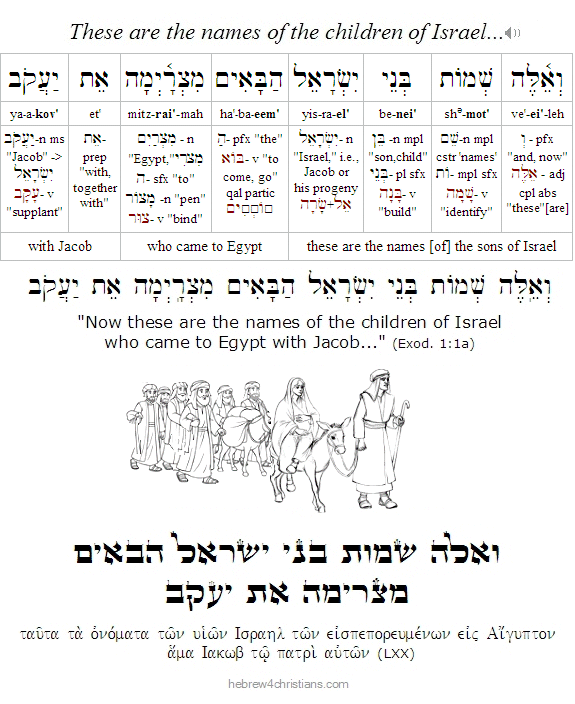
01.05.26 (Tevet 16, 5786) The book of Exodus opens with the words "ve'eleh shemot" (וְאֵלֶּה שְׁמוֹת), "and these are the names" (of the children of Israel). The LORD calls each person by name to make the journey... The Creator of all things (הבורא של הכל) calls each star by its own name (Gen. 22:17, Psalm 147:4) and yet He also knows each lily of the field and sparrow that flutters its wings (Matt. 6:28-30, 10:29). And as Yeshua said, even the hairs on your head are all numbered (Matt. 10:30).
The term hashgachah pratit (הַשְׁגָּחָה פְּרָטִית) refers to God's personal supervision of our lives (hashgachah means "supervision," and pratit means "individual" or "particular"). Since God is the Master of the Universe, His supervision and providence reaches to the smallest of details of creation - from subatomic particles to the great motions of the cosmos. Of particular interest, however, are those whom He created be'tzelem Elohim: in His image and likeness. The LORD is called אלהֵי הָרוּחת לְכָל־בָּשָׂר / Elohei ha-ruchot lekhol-basar: "The God of the spirits of all flesh" (Num. 16:22), and that means that every spirit ultimately answers to Him.
We find great comfort when we understand that God has complete authority over categorically everything in the universe -- including our ultimate welfare (John 10:27-28). When we pray to the LORD God of Israel, we intuitively understand that He is completely sovereign and Lord over all things... All power, glory, authority, and dominion is His alone, and all that is in the heaven and in the earth is His (1 Chron. 29:11-12). We do not worry that He is incapable of handling our troubles or that He is unable to help us. No, we acknowledge that the God most High (אֵל עֶלְיוֹן) sustains all things by the Word of His power (Col. 1:17). He is "the blessed and only Sovereign, the King of kings (מֶלֶךְ הַמְּלָכִים) and the Lord of lords" (1 Tim. 6:15). Whenever we think clearly in light of the revelation of Scripture, we apprehend the truth about God's sovereign glory and power...
Hebrew Lesson:
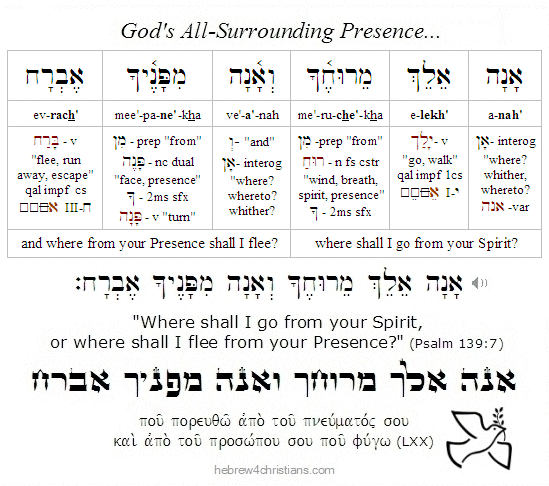
Psalm 139:7 Hebrew reading (click):
It may seem incomprehensible that the LORD God who created the heavens and the earth can simultaneously attend to the vast sweep of the universe while also keeping personal watch over each of us... C.S. Lewis noted that since God is not limited by time, He has "infinite attention" to spare for each one of us, and indeed, the Lord regards each person with such focused attention that it is as if they were the only person in existence. And this personal knowledge is implied in Yeshua's redeeming sacrifice upon the cross, for you must trust that Yeshua died for you personally, intimately, for your every secret sin, as if you were the only person who ever lived in the world...
It's astounding to think that God knows categorically everything and every detail of every thing in every possible state of existence at all times -- and yet He is not an "abstract Mind" but the personal and conscious source of life itself, the Center of Existence, the hidden heart of reality itself. Blessed is His Name. He is the personal healer and redeemer of each one of us, and He regards each of us with infinite love and concern. He is present in every moment of your life; he knows the secrets of your heart, and he knows your name...
Parashat Shemot - פרשת שמות
01.04.26 (Tevet 15, 5786) Our Torah reading for this week is the very first of the Book of Exodus, called "parashat Shemot" (i.e., Exod. 1:1-6:1). This portion begins directly where the Book of Genesis left off, namely by listing the various "names" (shemot) of the descendants of Jacob who came to Egypt to live in the land of Goshen.
Over time Jacob's family flourished and multiplied so greatly that the new king of Egypt – who did not "remember" Joseph - regarded them as a political threat and decided to enslave them. When the king's oppression did not curb their growth, however, he cruelly commanded the Hebrew midwives to kill all newborn Jewish boys. When the midwives bravely refused to obey, however, the Pharaoh commanded that all newborn boys were to be drowned in the Nile river (the Hebrew word for Egypt, Mitzrayim (מִצְרַיִם), can be rearranged to form the phrase tzar mayim (צַר מַיִם), meaning "torture through water," which was the plan of the nefarious Pharaoh).
During this time of terrible and appalling oppression, a family from the tribe of Levi bore a son and hid him for three months. When the baby could no longer be concealed, however, his mother Yocheved (יוֹכֶבֶד) set him afloat in the Nile River inside a basket, praying that he might somehow escape death. Miriam (מִרְיָם), the baby's sister, watched what would happen, and soon the basket was discovered by the daughter of Pharaoh, who decided to save the baby and adopt him as her own son. Miriam then cleverly offered to have her mother become the baby's wet-nurse for the princess. After the child was duly weaned, he was brought to Pharaoh's palace to live as the princess' son. The Egyptian princess named him "Moses" (משֶׁה), meaning "drawn out" (מָשָׁה) of the water.
Later, when Moses was a full-grown man, he "went out to his people and looked on their burdens." When he saw an Egyptian beating an Israelite slave, he killed the Egyptian and hid his body in the sand. The following day he tried to reconcile two Israelites who were fighting, but the one in the wrong prophetically objected: "And who made you a prince and judge over us? Do you want to kill me as you killed the Egyptian yesterday?" Upon hearing this Moses decided to flee from Egypt to Midian. There he rescued Zipporah (צִפּרָה), the daughter of Jethro (יִתְרוֹ), a Midianite priest. Soon afterward, Moses decided to work for Jethro and married Zipporah. They had a son named Gershom (גֵּרְשׁם, "a stranger there").
After nearly 40 years living in Midian as a shepherd, God called out to Moses from the midst of a burning bush (סְנֶה בּוֹעֵר) to commission him to lead the Israelites out of Egypt back to the land He promised to the descendants of Abraham, Isaac, and Jacob. When Moses protested that he was inadequate for this task, God gave him three "signs" to authenticate his message. God also appointed his brother Aaron to be his spokesperson.
Moses and Aaron then went to the Pharaoh and demanded that the Israelites be permitted to leave Egypt to worship the LORD in the wilderness. Shelach et ammi! "Let my people go!" The Pharaoh, however, dismissed Moses and his God, and increased the workload of the slaves by forcing them to make bricks without straw. This set the stage for the great "showdown" between the LORD and the worldly power of Satan, as embodied in the Pharaoh...
May we all have great joy and strength as we begin reading a new book of Torah for this new (secular) year. Chazak ve'amatz, mechayil el-chayil chaverim...
Sefer Shemot - ספר שמות
01.04.26 (Tevet 15, 5786) Over the next several weeks (until the middle of March, 2026) we will be reading and studying the Book of Exodus (סֵפֶר שְׁמוֹת) and considering its message in light of the revelation of Yeshua our Messiah. Some of the greatest narratives of all the Scriptures are found in this amazing book, including the Israelites' enslavement and subsequent deliverance with the ten plagues by the hand of the LORD. After the great Passover, Moses led the people out of the land Egypt, crossing the Sea of Reeds, and arriving at Sinai to receive the Torah exactly 49 days later. While Moses was on the mountain, however, the people worshipped a Golden Calf, and a long period of repentance occurred until the covenant was reestablished. The remainder of the book describes the amazing vision and construction of the Mishkan (Tabernacle) -- the great Altar upon which a defect-free lamb (קָרְבָּן תָּמִיד) was offered every day and every night...
In English the word "Exodus" ("going out") comes from the title of the ancient Greek translation of the phrase Sefer Yetziat Mitzraim ("the book of the going out from Egypt"). Hence the Greek word ἔξοδος became "Exodus" in Latin which later was adopted into English. In the Hebrew Bible this book is called Shemot (i.e., שְׁמוֹת, "names"), following the custom of naming a book according to its first significant word.
Regarding what it means to "name" something, in the philosophy of language there is a distinction between the "sign"€� and the "signified."� The "sign" refers to a word (or description) that references the "signified," that is, to the reality itself. It is one thing to study theology or to parse the original languages, but it is quite another to step into the river of faith and swim. There is no other way to know the Name of God but by the heart's struggle and passion.
In this connection let me quote from Jewish philosopher Martin Buber (1878-1965): "The generations have laid the burden of their anxious lives upon this word and weighed it to the ground; it lies in the dust and bears their whole burden. Human beings with their religious factions have torn the word to pieces; they have killed for it and died for it, and it bears their finger marks and their blood. Where might I find a word like it to describe the highest! ... But when all madness and delusion fall to dust, when they stand over against Him in the loneliest darkness and no longer say, "He, He," but rather sigh "Thou," shout "Thou," all of them the one word, and when they then add "God," is it not the real God whom they all implore, the One Living God, the God of the human race? Is it not He who hears them?"
The spiritual challenge we have when reading the Book of Exodus is how to encounter the great story as a message or parable for our own pilgrimage in this world. May God help us as see its patterns of meaning that will lead us closer to his heart. Amen.
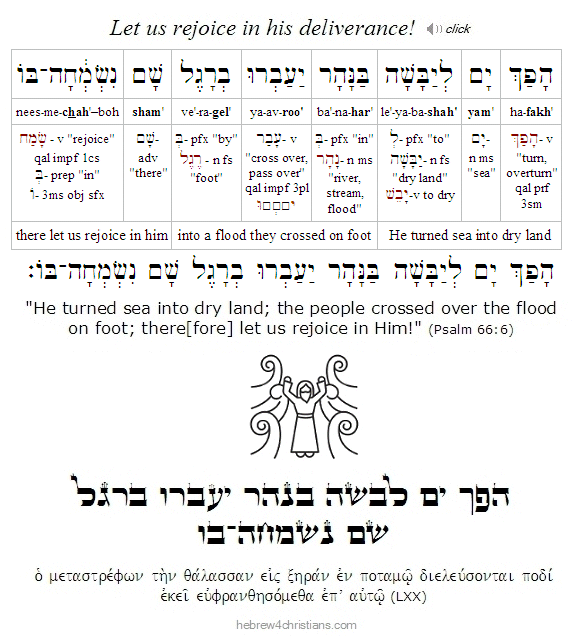
Hebrew Lesson
Psalm 66:6 reading (click):
The Good Eye of Faith...
01.04.26 (Tevet 15, 5786) Among other things, the story of Joseph reveals how God's hidden hand moves for good in our lives. Despite the terrible betrayal of the pit, the unjust suffering of the prison house, and the sorrow of losing his family, there was light, exaltation, and joy to come forth. God knows how to take our emptiness to yield "storehouses in Egypt..." As Joseph later told his brothers, "you meant evil against me, but God meant it for good" (Gen. 50:20). Resist the temptation to judge by mere appearances. Forbid your sorrow to blind the eyes of faith. Do not unjustly judge God's purposes or try to understand His ways; accept that He works all things together (συνεργέω) for good -- making even the very wrath of man to praise Him...
Faith "sees what is invisible" (2 Cor. 4:18) and understands (i.e., accepts) that the "present form of this world is passing away" for purposes that are good (1 Cor. 7:31). It affirms that underlying the surface appearance of life (chayei sha'ah) is a deeper reality (chayei olam) that is ultimately real, abiding, and ultimately designed for God's redemptive love to be fully expressed. In this world we must "see through" a mirror (i.e., indirectly) to begin to see the dawn of our eternal home; but one day we will behold God panim el panim (פָּנִים אֶל־פָּנִים), "face to face" (1 Cor. 13:12). In the meantime, faith beholds the invisible light, the truth of God's love that overcomes all the powers of darkness, hate, and fear.... "I believe. I believe in the sun even when it is not shining; I believe in love even when feeling it not; and I believe in God, even when God is silent" (from an anonymous poem found on the wall of a cellar in Cologne, Germany, where some Jews hid from the Nazis).
"Faith in divine providence is the faith that nothing can prevent us from fulfilling the meaning of our existence. Providence does not mean a divine plan by which everything is predetermined, as in an efficient machine. Rather, providence means that there is a creative and saving possibility implied in every situation, which cannot be destroyed by any event. Providence means that the demonic and destructive forces within ourselves and our world can never have an unbreakable grasp upon us, and that the bind which connects us with the fulfilling love can never be disrupted." - Paul Tillich
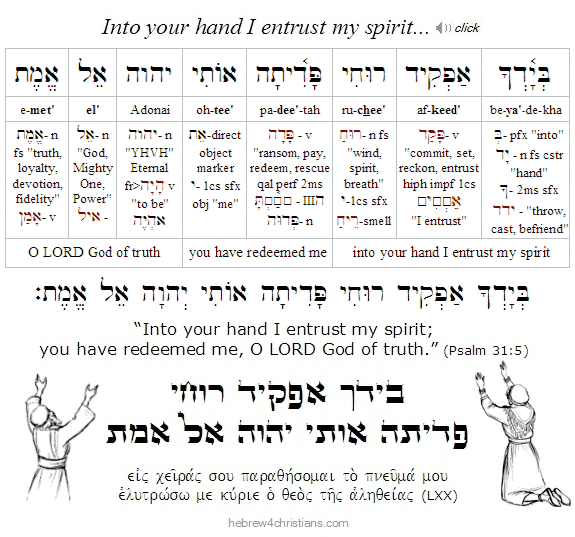
Hebrew Lesson
Psalm 31:5 Hebrew reading:
For more on this important topic, see "Joseph and the Good Eye."
Are Christians "Spiritual Jews"?
"You are a chosen generation, a royal priesthood, a holy nation, God's own special people, that you may proclaim the praises of Him who called you out of darkness into His marvelous light. For once you were called "not my people" (לֹא־עַמִּי) but now you called are the people of God; once you were called "without mercy" (לֹא רֻחָמָה), but now you have obtained mercy" (1 Pet. 2:9-10).
01.03.26 (Tevet 13, 5786) Some followers of Yeshua wrestle with a sense of inferiority or insecurity because they were not privileged to have been born into an ethnically Jewish family... In light of the love of God, this is most unfortunate, especially since it was the Lord's intent from the beginning to redeem all the families of the earth. And while it is a privilege to be born Jewish, we need to be careful not to worship "Jewishness" per se but to carefully understand what being a Jew means from God's perspective.
Yeshua did not mince words as he appealed to the "lost sheep of the house of Israel." He taught that a person could very well be a direct descendant of King David himself, raised in a scrupulously religious home, and yet be an "alien" soul before God. When he told Nicodemus: "You must be born again" he was speaking to a distinguished rabbi and leader of the Jewish people. If Yeshua told a kosher Jew that he needed to repent and to be born from above to enter into the kingdom of God, how much more would a non-Jew have this great need? Sometimes the first shall be last, and the last shall be first, and at other times the last shall be first and the first shall be last, but in either case all people made in the image of God need to be redeemed by the life of Christ. Both Jews and non-Jews (in the ethnic sense) need to be transformed by God's power and adopted as God's children...
The word Jew comes from the root yadah (יָדָה) which means to "thank." Jacob's wife Leah used a play on words regarding her birth of her fourth son when she said she would "thank the LORD" (אוֹדֶה אֶת־יהוה), and therefore named her son "Judah" (יְהוּדָה, Gen. 29:35). Later the word "Jew" (יְהוּדִי) began to be used after the destruction of the First Temple (see 2 Kings 25:25) and was later used in the Aramaic books of Ezra/Nehemiah).
Paul alluded to the connection between gratitude and being Jewish when he wrote: "For no one is a Jew who is merely one outwardly, nor is circumcision outward and physical, but a Jew is one inwardly, and circumcision is a matter of the heart, by the Spirit, not by the letter. His praise is not from man but from God" (Rom. 2:28-29). Being a Jew in the spiritual sense is a matter of the heart, and therefore it may be said that all those who confess the LORD God of Israel in the truth are "spiritual Jews" (the root word yadah also means to confess). If you are "blood-related" to God by the Messiah through faith, you are "grafted in" to the covenants, promises, and blessings originally given to ethnic Israel, and are therefore a genuine member of "God's household" in full standing (see Eph. 2:12-22).
Regarding this idea of Jewish identity Paul wrote: "So then you are no longer strangers and aliens, but you are fellow citizens with the saints (tzaddikim) and members of the household of God (i.e., b'nei Elohim)" [Eph. 2:19]. Non-Jews who accept the salvation offered by Yeshua are fellow heirs, members of the same body, and are full partakers of the blessing of the Messiah through the gospel (Eph. 3:6). As was repeatedly promised in the Torah, the blessing of Abraham is imparted to all the families of the earth because of Yeshua (Gal. 3:14).
Moses taught that being "chosen" meant living in holiness for the glory of God and for the welfare of the world. Therefore a true Jew (יהודי אמיתי) takes the role of being a both a mediator (i.e., "priest") and an ambassador for the LORD God. The performance of various mitzvot were for the greater purpose of tikkun olam (תיקון עולם), or the "repair of the world." Israel was always meant to be a "light to the nations" (אור לגויים), just as followers of Yeshua, the King of the Jews, are commissioned to reveal God's light of salvation (Matt. 5:16).
God's greater plan was for all families of the earth to come to know Him and give Him glory, as Abraham was called: Av hamon goyim (אַב הֲמוֹן גּוֹיִם), the father of a multitude of nations (Gen. 17:4; Rom. 4:16). "Jewishness" is therefore not an end in itself but rather a means to bring healing truth to the nations... Indeed, the entire redemptive story of the Scriptures is about the cosmic conflict to deliver humanity from the "curse" of death by means of the "Seed of the woman" who would come. Abraham was chosen to be the condiut of the Messiah, and through his progeny the Promised Seed would come. And that is why Yeshua is called the "Second Adam," because he came to recitify the original sin of Adam ha'rishon, or "the first Adam." Yeshua became the "Son of Man" who saves all of humanity - all the families of the earth - through his redemption. As the Apostle Paul affirmed, any talk of genetics, bloodlines, lineage, and so on are a means to this greater redemptive end (Phil. 3:2-9).
It goes even deeper... A chosen person is not one the basis of their genetics or family lineage, but solely from the personal call and election of God. "For not all who are descended from Israel belong to Israel, and not all are children of Abraham because they are his offspring, but "through Isaac shall your offspring be named" (Rom. 9:6-7). This means that it is not the children of the flesh who are the children of God, but the children of the promise are counted as offspring" (Rom. 9:8). The idea of "chosenness" therefore is independent of considerations of "flesh" but is directly related to our response to God's promises.... This was true of "Israel at large" in relation to its faithful subset called she'arit Yisrael (i.e., the faithful remnant), just as it is true of those who trust the promise of life in Yeshua the Messiah.
God is no "respecter of persons" (Acts 10:34, Rom. 2:11). He is able to make the unclean clean (Acts 10:28) and to regard those who were once called "Not My People" as "My People" (Hosea 2:23, Matt. 3:9). Therefore a true Jew is one who is circumcised inwardly, someone who has undergone spiritual brit millah - "covenant of the word" (Deut 10:16, 30:6; Rom. 2:28-29, 1 Cor. 7:19, Gal. 5:6; 6:15; Phil. 3:3, Col. 2:11, etc.). Indeed, Paul insisted that any merit he might have obtained either through his pedigree or his adherence to the moral law code was to accounted as "less than nothing" (i.e., σκύβαλα) in comparison to the righteousness graciously given to him through his relationship with Yeshua (Phil. 3:3-8).
Hebrew Lesson
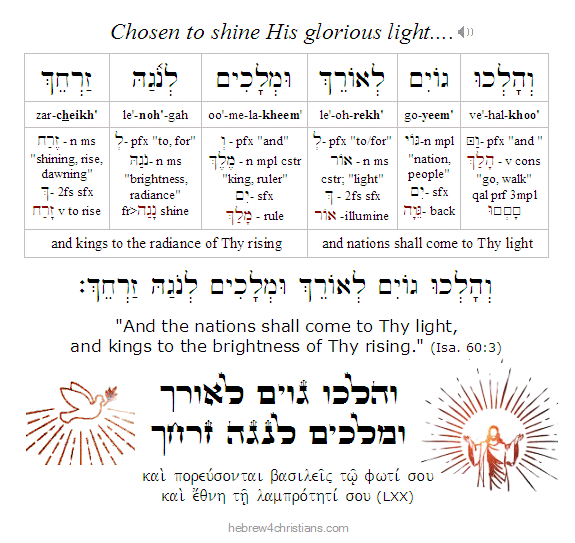
Isaiah 60:3 Hebrew reading (click):
 |
A Prayer...
"O Lord, it matters not what I've been or my lineage in the natural, but who I am now, in the present moment, as I reach out to you, trusting that whatever I am is made possible only through the handiwork of your love for me, even in my uttermost estate, my depths, and my unknown, for by your Spirit am I reborn, made alive, given a name, and brought near to you heart as you child...
I am what I am only through who you are, and I am one for whom you died and whom you have called to live in the power and mercy of your Spirit. Please, O Lord, let my life bless your name; let it bear true witness of the miracle of your saving love. Blessed is the Lord who brings me out of the darkness of shame into the radiance of His beauty and grace. Amen."
The Great Shiloh Prophecy...
Our Torah reading for this week is Parashat Vayechi, the last portion from the Book of Genesis, which includes Jacob's blessing of his sons...
01.02.26 (Tevet 13, 5786) When the time came for Jacob (i.e., Israel) to die, he called all his sons together. According to midrash, Jacob wanted to tell them about the "End of Days" (i.e., acharit ha'yamim: אַחֲרִית הַיָּמִים) when the Messiah would come, but he was prevented by the Holy Spirit. According to the Jewish sages, God prevented Jacob because He does not want anyone to know the "day or the hour" when the great King of Israel would appear...
Why not? Why wouldn't God want to tell his children the hour of the promised Messiah's appearance? According to Jewish tradition, if people knew how long they would have to wait, they might despair of life altogether, or, if they knew the exact time, they might "repent" just for that reason, and not because it came from the heart... On the other hand, Jacob's prophecy regarding the coming of the Messiah as a future ruler from the tribe of Judah alluded to the timing of the Messiah's appearance.
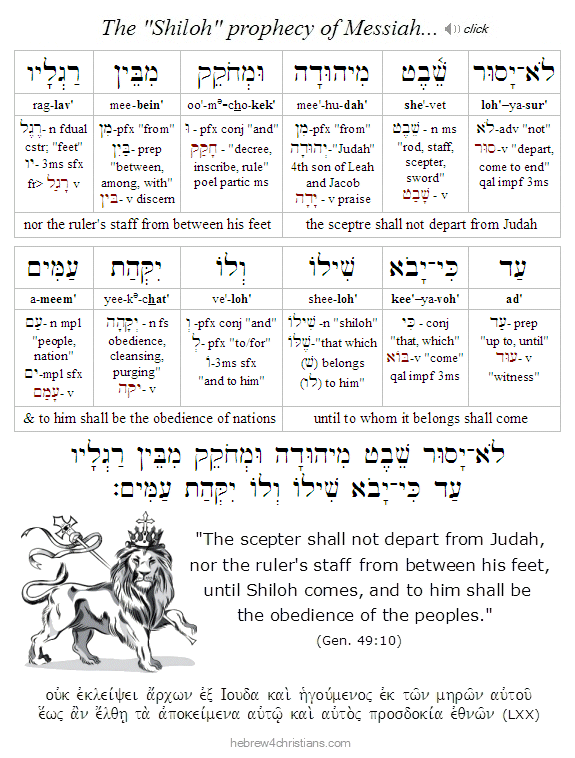
To review, Jacob prophesied that "the scepter will not depart from Judah, nor the ruler's staff from between his feet, until 'Shiloh' (שִׁילוֹ, i.e., "the one to whom it belongs") comes..." (Gen. 49:10). If the regency of Judah was established by the Sanhedrin, then the "scepter" (rod of authority) would have departed from Judah in AD 6-7 after the Romans installed a procurator as the authority in Judea. This "shiloh" prophecy, then, would have failed. However, since Messiah the son of David had indeed come and was in their midst as Yeshua mi-netzeret (Jesus of Nazareth) during this window of time, the Shiloh prophecy did not fail....
Like most prophecies in Scripture, the Shiloh prophecy has a "dual aspect" or "double fulfillment." The "King of the Jews" (a synonym for the Messiah, called "Christ" by Christendom) had indeed come "before the scepter departed from Judah," but he went unrecognized since he came to fulfill the role of the Suffering Servant (Mashiach ben Yosef). The second part of the prophecy, "and to him shall be the obedience of the nations," is yet to be fulfilled. It will become a visible reality only after his Second Coming, at the end of olam ha-zeh (this present age), when Jesus comes to judge the nations (the "sheep and the goats") and establish the Kingdom of God from David's throne in Jerusalem.
Note that Jacob's prophecy that "the scepter will not depart from Judah... until Shiloh comes" includes all the letters of the Hebrew alphabet except for the letter Zayin (ז), which is the Hebrew word (זַיִן) for a weapon, suggesting that when the Messiah would (fiirst) come, it would not be by means of arms or weapons (as a miltary leader), but rather by the Holy Spirit (ruach ha-kodesh). The time for the sword still awaits as Yeshua will one day return to overthrow Satan's kingdom and to establish Zion as the praise of the earth...
There is an old story of the Magid of Brisk who each year would bring proof from the Torah that the Messiah would come that year. Once a certain Torah student asked him, "Rabbi, every year you bring proof from the Torah that the Messiah must come this year, and yet he does not come. Why bother doing this every year, if you see that Heaven ignores you?" The Magid replied, "The law states that if a son sees his father doing something improper, he is not permitted to humiliate him but must say to him, 'Father, the Torah states thus and so.' Therefore we must tell God, who is our Father, that by keeping us in long exile, he is, in a sense, causing injustice to us, and we must point out, "thus and so it is written in the Torah," in hope that this year he might redeem us." This same principle, of course, applies to those of us who are living in exile and who eagerly await the second coming of the Messiah Yeshua. We should continue asking God to send Him speedily, and in our day, chaverim...
Regarding the Messiah's Second Coming, we therefore find ourselves in the same position of expectation as Israel's sons who heard the original prophecy. Though Jesus told us about the "signs" of the time (and the "fig tree has brought forth its leaves," see Matt. 24:32-33), we do not know the exact "day or the hour" and therefore must be ready for his return at any time (Matt. 24:36-25:13). The Spirit and the Bride say, "Come." Maran ata, Yeshua!
Hebrew Lesson
Genesis 49:10 reading (click):
Lord, teach us to pray...
01.02.26 (Tevet 13, 5786) There is only one place in the New Testament where the disciples asked Yeshua to teach them something, and that was when they said, "Lord, teach us to pray" (Luke 11:1). Yeshua then responded by giving them a pattern of prayer that's been called "the Lord's Prayer," though it's better to think of it as a model for prayer instead of a formulaic petition to recite. After all, the disciples asked "Teach us to pray," not "teach us a prayer," as if a special prayer could serve as a sort of incantation to propitiate God.
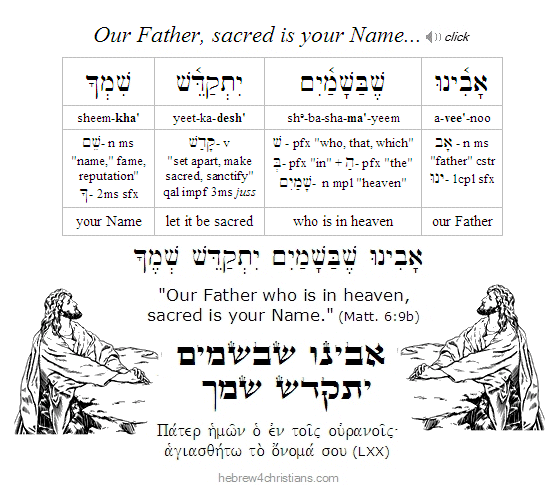
Yeshua points us to the Father. He did not use religious or formulaic expressions such as "Barukh attah Adonai," "Ribbono shel Olam," or "Elohei Avoteinu," nor did he endorse praying "rotely" three times a day as decreed by the elders of the Great Assembly. No, Yeshua taught us to come to God using the simple word "Father." This is the language of familiar intimacy that expresses the trust a young child has for his earthly father.
So Yeshua teaches us to pray in heartfelt confidence that God is our caring heavenly Father, and this implies that we understand and regard ourselves as his beloved children. We have access to God's heart in a direct and meaningful way.
So Yeshua teaches us to pray in heartfelt confidence that God is our caring heavenly Father, and this implies that we understand and regard ourselves as his beloved children. We have access to God's heart in a direct and meaningful way.
As God's beloved children we are to honor and our heavenly Father and to esteem his will and vision for our destiny. "Holy is Thy name"; "Thy will be done"; "Thy kingdom come" - all these matters come before requests for our "daily bread" -- and even before matters of our need for forgiveness of sin. Of course God cares for our daily needs, our forgiveness, our deliverance from evil, and so on, but Yeshua concentrates our focus on the Father and our identity as his children first of all. Da lifnei mi attah omed: "Know before whom you stand."
Regarding personal petitions, it is wise to understand that your Heavenly Father gives what you need, not what you may want at the time. "Ask and it shall be given you" means "keep on asking" (Luke 11:9). If a recurring request seems to go unanswered, remember that initial barriers are not necessarily refusals but are meant to yield what is best for you (Rom. 8:28). We can be confident, however, that God hears us when we pray and that he gives "good gifts" to those who ask Him (Matt. 7:11) -- in particular, gifts of the Holy Spirit (Luke 11:13).
God gives wisdom to those who ask for it (James 1:5) and imparts the "spirit of wisdom and revelation to know him better" (Eph. 1:17). If we ask in accordance with his will, we have confidence that he will act on our behalf (1 John 5:14-15). These are "spiritual blessings in heavenly places" representing the deepest need of our hearts.
We are instructed to "present ourselves to God as those who are alive from the dead" (Rom. 6:13), indicating that we are to come confident of his acceptance because of what Yeshua has done on our behalf. We are "crucified with Christ" (Gal. 2:20) and share in his resurrection life.
In the Torah the "daily sacrifice," or korban tamid (קָרְבַּן תָּמִיד), was offered to the LORD every morning and evening upon the altar, which corresponds to being a "living sacrifice" (i.e., korban chai: קָרְבָּן חַי) to the LORD (Rom. 12:1-2).
We are to "pray without ceasing," which means living what we believe in all that we do. We take up our cross daily (Luke 9:23). We come "boldly" before the throne of grace. We are made "alive from the dead" to access God's presence and heart for us at all times. We have been made new creations, members of God's household, esteemed, eternally beloved....
The word translated "pray" (euchomai) means to "wish" (εὐχὴ) for oneself (or for another) the good. True prayer is not something we do, but what Holy Spirit does within us; it is an inner groan that arises from being transformed by the power of God. When we know ourselves as his redeemed child, we come before our Father and wish to do his will.
Hebrew Lesson
Matthew 6:9b reading (click):
 |
Note about prayer as a "wish"
Regarding the connection between prayer and "wishing," let me clarify by saying that like any other word, its meaning is derived from context and must be discerned by its use or application. The Hebrew word for praying is lehitpalel (לְהִתְפַּלֵל), a verb form that is "reflexive" and connected with self-examination and supplication (פָּלַל), whereas the Greek word in the New Testament, "euxomai" (εύχομαι ), is a "deponent" verb that likewise has the idea of pleading, wishing, asking for something before God...
I understand that some people don't like the idea of wishing to refer to prayer, but ask yourself, is not a "wish" a desire for something that seems hard to get or to even be unattainable? Is it not the expression of hope? We wish for all the evil to be gone from us; we wish to be our Lord in heaven; we wish that our friend was not sick or dying, we wish we had a better job, etc. Surely part of the reason for praying comes from these sorts of desires of the heart, or "wishes." Of course some wishes can be childish while others can be downright evil (I wish that guy was dead!), but the word itself is "neutral" and depends on the spirit behind the desire. I hope this makes some sense.
 |
Blessed Poverty of Heart...
Happy New year, friends. May this coming year be one of blessing and healing for your life....
01.01.26 (Tevet 12, 5786) It is written in our Scriptures, "Carry one another's burdens, and in this way you will fulfill the law of Christ. For if anyone thinks he is something when he is nothing, he deceives himself" (Gal. 6:2-3). These are words reminding us to show compassion and help to others, but they are also words that warn us not to regard ourselves too highly (i.e., to think we are "something"), for the more we understand the truth of own sinful heart and need for God's help (that we are "nothing"), the more we will be willing to help others who likewise struggle with the burden of "dealing with themselves." Paradoxically it is the awareness of our sinfulness that impels our need for God's healing, but fooling ourselves by denying our wickedness blinds us to the truth of Yeshua.
This reminds me of a joke I once heard. During Yom Kippur services, the rabbi raises his arms up to the heavens and cries out, "Oh God, before you I am nothing!" Seeing this, the cantor beats his chest and shouts out, "Oh God, before you I am nothing!"
Inspired by their piety, a humble farmer standing in the back of the congregation stands and proclaims, "Oh God, before you I am nothing!"
The rabbi turns to the cantor and says, "Hmph, look who thinks he's nothing."
Friends, we have to be vigilant lest our carnal insecurities get the best of us. We all have an "inner Pharisee" that entices us to think that we are somehow "better" than other people. It is always good to remember that there is only one God, and you are not Him! Amen.
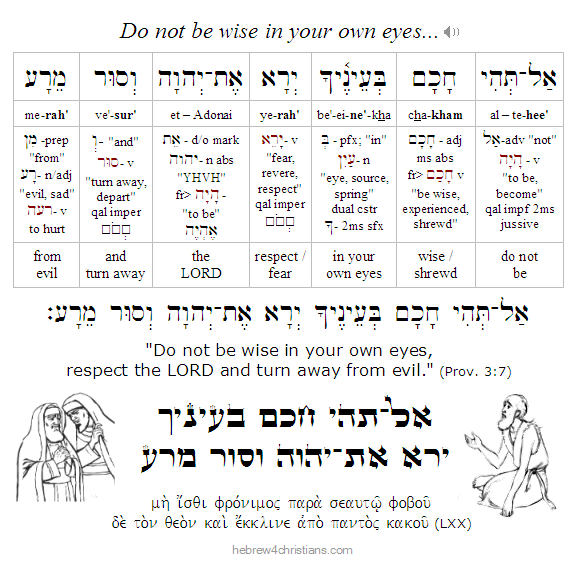
Hebrew lesson
Proverbs 3:7 reading (click for audio):
A New Year Blessing...
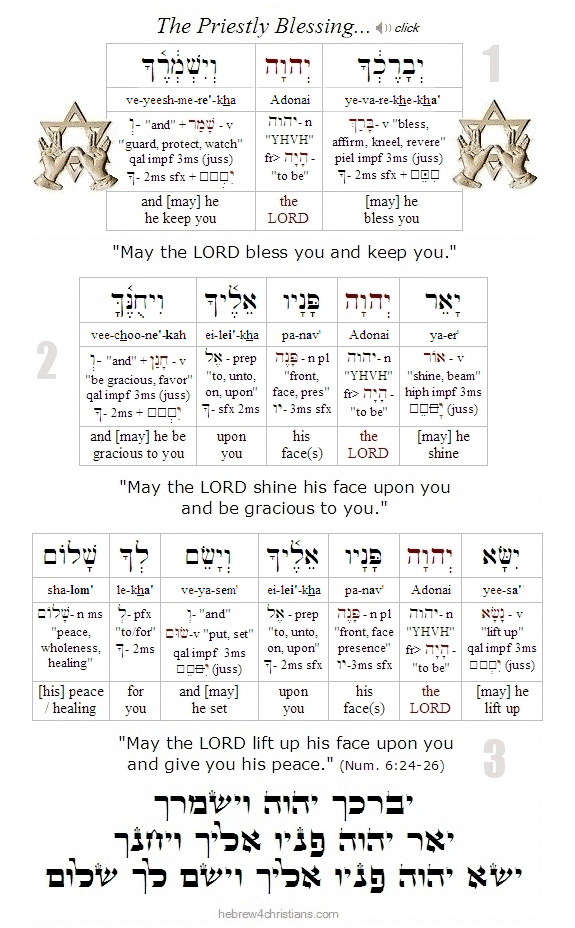
01.01.26 (Tevet 12, 5786) At the outset of the new year, let us recall the ancient priestly blessing, the great expression of hope and grace that transforms us into "name bearers" of God. The blessing of the LORD guards us from illusion, directing our hearts to focus on what matters most; His radiance changes us, revealing the miracle of grace. As God "lifts up his face," he discloses his Presence within all things, and imparts to us his healing peace.
God's Name is "put upon" us so that we become vessels that carry redemptive love and healing to the world. We are endowed with divine energy to be made fruitful; we are empowered to serve God in the truth. The consciousness of our blessedness touches every moment, and we begin to see all of life as sanctified, sacred, full of wonder and meaning.
יְבָרֶכְךָ יְהוָה וְיִשְׁמְרֶךָ
יָאֵר יְהוָה פָּנָיו אֵלֶיךָ וִיחֻנֶּךָּ
יִשָּׂא יְהוָה פָּנָיו אֵלֶיךָ וְיָשֵׂם לְךָ שָׁלוֹם
ye·vah·re'·khe·kha' · Adonai · ve·yeesh'·me·re'·kha
yah·eir · Adonai · pah·nav · e·ley'·kha · vee·khoon·ne'·kah
yee·sah · Adonai · pah·nav · e·ley'·kha · ve·yah·seim · le·kha · shah·lohm

"May the LORD bless you and keep you;
May the LORD shine his face upon you and be gracious to you;
May the LORD lift up his face upon you and give you his peace."
(Num. 6:24-26)
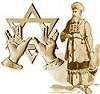
Hebrew Study Card
Note that the text of this great "priestly blessing" (i.e., birkat kohanim) begins with three words, is comprised of three parts, invokes the divine Name three times, and is therefore quite appropriately called "the three-in-one blessing."
Note that each of the three phrases begins with the letter Yod (י), suggesting the threefold hand of YHVH (יהוה) that touches you: the Father blesses you (יְבָרֶכְךָ); the Word of God shines upon you (יָאֵר), and the Spirit of God lifts you up and carries you in the way of life (יִשָּׂא). .
The threefold blessing is One, of course, just as Adonai echad: יְהוָה אֶחָד, the LORD is One (Deut. 6:4), and the essence of the blessing is to partake of healing and wholeness as expressed in the Hebrew word shalom (שָׁלוֹם). Amen. Without oseh shalom, without peace made within our hearts, all other blessings are only apparent and without substance...
Hebrew Lesson
Numbers 6:24-26 reading (click):
<< Return
|
|