|
Jewish Holiday Calendar
For April 2026 site updates, please scroll past this entry....
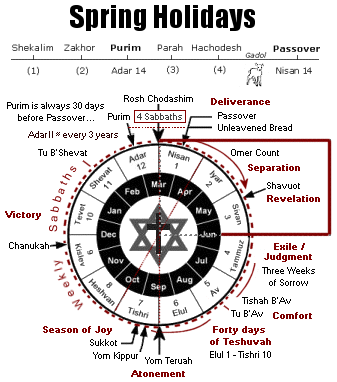
The Torah divides the calendar into two symmetrical halves: the Spring and the Fall, indicating the two advents of Messiah. The Biblical year officially begins during the month of the Passover from Egypt (called Rosh Chodashim, see Exod. 12:2), and the spring holidays of Passover, Unleavened Bread, and Firstfruits both recall our deliverance from Egypt and also our greater deliverance given by means of the death, burial, and resurrection of the Messiah, the great Passover Lamb of God. The holiday of Shavuot (i.e., "Pentecost") both commemorates the revelation of the Torah at Sinai as well as the revelation of the Ruach HaKodesh (Holy Spirit) at Zion, in fulfillment of the promise given by our Lord....
The intermediate months of summer end with the advent of the sixth month of the calendar, the month of Elul, which recalls the time Moses interceded on behalf of Israel after the sin of the Golden Calf. To commemorate this time of our history, we likewise focus on teshuvah (repentance) in anticipation of Rosh Hashanah and especially in anticipation of Yom Kippur, the great "Day of Atonement." In Jewish tradition the 30 days of Elul are combined with the first ten days of the seventh month (called the "Days of Awe") to set apart "Forty Days of Teshuvah" leading up to the Day of Forgiveness for Israel. Immediately following Yom Kippur, the mood changes as we begin preparing for a joyous week-long celebration called Sukkot (i.e., "Tabernacles") that concludes with the holiday of Simchat Torah.
 |
The Spring Holidays:
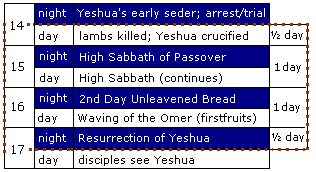
The spring holidays (חגי האביב) portray the death, burial, and resurrection of the Messiah: Yeshua was crucified on erev Pesach (during the time of the sacrifice of the Passover lambs), buried during Chag Hamotzi (the festival of Unleavened Bread), and was resurrected from the dead on Yom Habikkurim (the Day of Firstfruits). Fifty days after Passover, on the climactic holiday of Shavuot (i.e., the feast of Pentecost), the Ruach HaKodesh (Holy Spirit) fell on the believers in fulfillment of the promise given by our Lord. Note that the giving of the Holy Spirit occurred precisely according to the calendar countdown given in the Torah (Lev. 23:15-16), and that it occurred after the resurrection of Yeshua -- just as our Messiah foretold (John 16:7; Acts 1:6-8, 2:1-4). This proves that the feasts of the LORD (מוֹעדי יהוה) were not abolished after the crucifixion. The meaning of the gospel is prefigured in the holidays given in Torah. See Luke 24:27, 24:44; John 5:46; Acts 26:22, etc.
![Spring Holiday Timeline (H4C]](../../../../About_HFC/Site_News/Archive-2026/roshchodeshim-line.gif) |
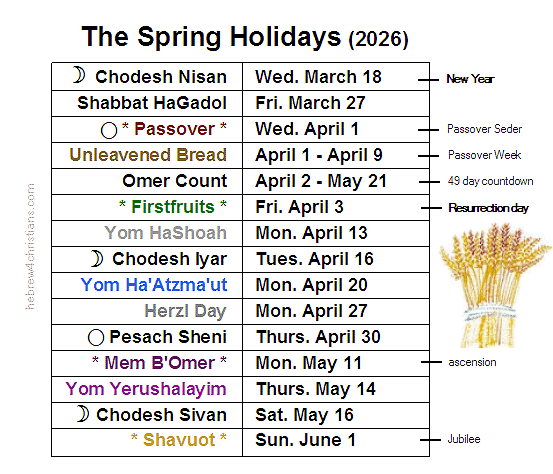
Kindly note that in accordance with both Torah and Jewish tradition, the following holiday dates begin at sundown before the date they are listed (ויהי־ערב ויהי־בקר; Gen. 1:5):
- Month of Adar (Mon. Feb. 19th [eve]) - Wed. March 18th [day])
Dates for Passover Week 2026:
Free Seder Guide
- Month of Nisan (Wed. March 18th [eve]) - Thurs. April 16th [day])
- Month of Iyyar (Thurs. April 16th [eve] - Sat. May 16th [day])
- Month of Sivan (Sat. May 16th [eve] - Sun. June 14th [day])
 |
Note: For more information, see the Calendar Pages....
April 2025 Updates
Note: If any page content appears to be missing, please refresh the page...
Expelling the Darkness...

"For our struggle is against spiritual forces of evil..." Eph. 6:12
04.30.26 (Iyyar 13, 5786) Human life is a battleground of forces, and each person is engaged in a spiritual war for the deliverance of their soul. Often we are not willing to enter the battle until we have been sufficiently wounded by our own sins: many of us have to become "sick of being sick" until we are ready to seriously engage the underlying issues...
The battle is not optional and there is no place of neutrality or indifference. We must learn to deal with our own inner struggle against evil. Before we can help others to be free, however, we must be free ourselves, and that means learning how to expel the darkness hidden within our own hearts and to walk in God's light.
Deliverance means being set free from that which "possesses" us, and that includes the demonic strongholds of fear, anger, envy, lust, and so on. Unchecked impulses can lead the soul to dark thoughts, self-alienation, shame -- a tenuous existence of subjugation and pain.
The way of deliverance is to "name the demon," that is, to challenge the ground it claims and to exercise divine authority over our hearts. Above all this means being honest about our struggle and taking a decisive stand against our own oppression... Fighting the "good fight of faith" means caring enough to be healed...
We can only face the demonic if we are willing to be honest with ourselves, for without genuine honesty we cannot see our condition. "A little leaven leavens the whole lump" (Gal. 5:9). We must be willing to confess that there is much within us that remains unhealed, and that we are often unmindful of what really motivates our behavior. Even those things we might suppose as good - our religion or our self-control, for example - can possess us in ways that bring harm to ourselves and others....
When Yeshua expelled the demonic, the afflicted soul was given inner peace and put into their "right mind" (Mark 5:15). In other words, deliverance from madness is linked to God's healing influence in our lives: "For God has not given us a spirit of fear, but of power, and of love, and of a sound (safe) mind" (2 Tim. 1:7).
Note that the word translated "sound" (or "safe") comes from the verb sodzo (σῴζω), meaning to be healed from destructive inner conflict. A delivered person has "inner balance" and is not easily overthrown by his conscious (or unconscious) passions. Such a person is grounded in reality: he knows who he is, what he needs, and is realistic about what he can and can't do. His soul is not divided but rather unified, centered, and focused. He is consciously present and accepts life without resistance.
Yeshua gives us "authority" over the demonic to heal (Luke 9:1). The Greek word translated authority is "eksousia" (ἐξουσία), a compound formed from the preposition ek- (ἐκ), meaning "out of," and the noun ousia (ουσία), meaning "being" or substance, thereby suggesting power over physical and spiritual reality.
Another way to understand eksousia, however, is to see it as the ability to see beyond the realm of the transient to abide within the realm of the Eternal. The Father represents the unseen, the infinite, the supreme providential and transcendental aspects of the One true God, just as the Son represents the seen, the finite, the suffering and immanent aspects of God... They are One (similarly the Holy Spirit is the Spirit of God, and therefore is One with God). Yeshua was entirely submitted to the will of the Father, which means he was able to let go and trust in the all-encompassing Divine Presence. His life was grounded in his relationship with the Eternal: "He that has seen me has seen the Father" (John 14:9). Since Yeshua lived in complete unity or "oneness" with God, he was completely centered and fully conscious of his identity as God's Son. His authority (eksousia) came from being properly aligned or related to God the Father, that is, ultimate reality, which enabled him to be a vessel or conduit for the expression of God in the world.
The Scriptures state: "Yield yourselves to God; take a stand against the devil and he will flee from you" (James 4:7). We first ground ourselves in what is real - surrendering and accepting the given moment - and then we decisively refuse to be taken captive by our imagination, fear, lust, etc. When we turn to the light the darkness will be expelled (John 1:5).
Let's choose life and therefore live (Deut. 30:19); let's take our stand against the powers of hell; let's repudiate our fears and "spiritually slay" whatever seeks to drive and control us. May we call upon the name of the LORD and abide in the peace and power of his salvation. Amen.
Hebrew Lesson
Joel 2:32a Hebrew reading (click):
 |
Seek the LORD and His Strength...
"There was an exhausted woodcutter who kept wasting time and energy chopping wood with a blunt ax because he did not have the time, he said, to stop and sharpen the blade." - de Mello
04.30.26 (Iyyar 13, 5786) "Faith is the foundation (i.e., ὑπόστασις: the "substance," reality, underlying essence, etc.) of hope, the conviction of the unseen... Without faith it is impossible to please God, for whoever would draw near must believe that God exists and rewards (μισθαποδότης) those who seek him" (Heb. 11:1,6).
Note that God is pleased when we seek his presence, that is, when we when we look past the ephemera and ambiguity of the phenomenal world for the truth about spiritual reality (2 Cor. 4:18). For our part, faith resolves to confession (ὁμολογέω), that is, aligning our perspective and focus to agree with the revelation and message of divine truth and verbally declaring our conviction. We must say that we believe, and affirm it with all our heart (Rom. 10:9). As it says, "I will make Your faithfulness known with my mouth" (Psalm 89:1).
When you encounter tribulation, or experience some crisis of your faith, reaffirm aloud: "I believe in God's promise..." Physically expressing your faith is itself an act of faith, and this encourages your soul to trust in God's healing reward even in the present struggle or darkness. God is faithful and meets you more than halfway... "Seek the LORD and His strength; ask for His Presence at all times" (Psalm 105:4).
Hebrew Lesson
Psalm 105:4 reading with comments (click):
 |
Kiddush HaShem:
Sanctifying God's Name...
"He is no fool who gives what he cannot keep to gain what he cannot lose." - Jim Elliot
04.29.26 (Iyyar 12, 5786) From our Torah this week (Emor) we read: "You shall not profane my holy Name, that I may be made sacred among the people of Israel" (Lev. 22:32), which the early sages said provides the basis for "kiddush HaShem" (קידוש השם), or the duty to always honor God, even if that might mean enduring martyrdom for your faith.
Jewish halakhah (law) furthermore says we are to think of kiddush haShem whenever we recite the Shema, that our inmost intent should be self-sacrifice (mesirat nefesh), or the willingness to give up our lives to God in complete surrender. After all, if we are not willing to give up our lives for God, how can we be willing to genuinely live for him? The purpose or goal of our very existence is to know and love God, to be sanctified in truth, but if we value our carnal lives on earth as more important, we exist in a state of contradiction. Therefore people obsessed with their own physical safety, health, pleasure, happiness, well-being, etc., do not know the true meaning of life...
Our lives on this earth were not meant to be an end in themselves, but rather a means to the greater end of knowing and loving the Eternal God. Indeed, God's love is better than any sort of life this present world can afford. As Jim Elliot once said, "He is no fool who gives what he cannot keep to gain what he cannot lose."
 |
Sanctifying God's Name means that we regard our relationship to God to be an end in itself - our ultimate concern - and there is nothing higher that may challenge our duty before heaven. "Seek first the kingdom of God and his righteousness" (Matt. 6:33). Our mortal life in this fleeting world is a means to the end of reaching our eternal destiny (Psalm 16:11), and esteeming the means above the end is therefore idolatry (Rom. 1:25). This is called chillul HaShem (חילול השם), or profaning the Name of God...
Our faith in the LORD may lead us into collision with the world and its spurious power structures, however "we ought to obey God rather than men" (Acts 5:29). Taking a stand for Torah truth will make you an outsider to the "crowd" and its endless idols and vanities. Indeed a person of genuine moral conviction may be labeled an "enemy of the state," may be persecuted as a "terrorist," and may even suffer martyrdom.
Shadrach, Meshach, and Abednego rightfully defied the king's decree to bow down before the "golden image," and they confessed that they were willing to die rather than betray the truth of the LORD of Israel (see Dan 3). This is a prime example of kiddush HaShem, honoring the truth of God even at the risk of losing our lives. For many Jews, reciting the Shema is a solemn declaration that we esteem the truth of God above all things, that God alone is our ultimate good, and that we must be willing to surrender our lives rather than to deny the greatness and glory of His Name. Many tzaddikim have died with the Shema on their lips...
Kiddush HaShem may be understand both literally and metaphorically. Literally understood, kiddush HaShem (i.e., martyrdom) is a possibility, one of the severest tests that may be given to the soul, and the temptation is to shrink back from the threat of death by denying the faith... Metaphorically understood, kiddush HaShem is a necessity, an essential act of the will that decides to "take up the cross" and follow Yeshua, and the temptation is to minimize the truth, to compromise the faith, and thereby to slowly fade away...
In this connection Yeshua asks, "What will it profit a person if he gains the whole world and forfeits his soul?" (Mark 8:36). Indeed, finding your life, value, and "place" here is to exile yourself from the promise of heaven. As Yeshua said, "Whoever finds his life will lose it, and whoever loses his life for my sake will find it" (Matt. 10:39). What is required, in other words, is categorically everything, with nothing left over. As Dietrich Bonhoeffer reminds us: "Salvation is free, but discipleship will cost you your life."
We see an example of both chillul HaShem and kiddush HaShem in the life of the Apostle Peter. On the one hand, though he had boldly professed that he would be willing to die for Yeshua, he later denied that he even knew his Savior and friend (Luke 22:33-34). After doing teshuvah (i.e., repentance) however, Peter became wholehearted and fearless, and Christian tradition says he eventually died as a martyr under the tyranny of wicked Emperor Nero...
Likewise, in our effort to relate to people of different faith, we may be tempted to soften the demands of the gospel or to minimize the deity of Messiah. Sadly I've seen this happen a lot among Gentiles who get so enamored with the Jewish roots of the Christian faith that they begin to question, then outright deny the central Torah of our Messiah (the deeper law of mercy). Indeed we must not confuse the covenants of God, for this leads to double-mindedness and is regarded as "spiritual adultery" (see Rom. 7:1-4). It is chillul HaShem - the desecration of the Name of God - to turn away from the meaning and message of the cross of Messiah (Gal. 6:14; 1 Cor. 2:2). The price of being loyal to Messiah is mesirut nefesh (מְסִירוּת נֶפֶשׁ) -- surrendering your life by "taking up the cross." The cross is a scandal to religion and all other attempts to whitewash the truth about the human condition (Gal. 5:11).
In the Kaddish we read: "yitgadal ve'yitkadash shemei rabba," meaning "may God's great Name be magnified and sanctified." Amen, and may we honor and sanctify the presence of the LORD by turning to Him with all our heart, soul, and strength, knowing Him in all our ways. He is faithful and will help us sanctify His Name...
Hebrew Lesson
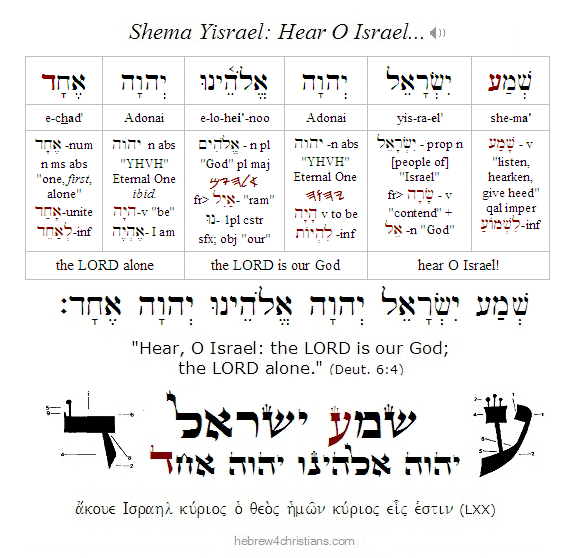
Deut. 6:4 reading with comments (5 min audio):
The Appointed Times of God...

"The catechism of the Jew is his calendar." - Rabbi Samson Raphael Hirsch (1808-1888)
04.29.26 (Iyyar 12, 5786) Our Torah portion this week (Emor) lists the eight main mo'edim (מוֹעֲדִים) -- the "appointed times" and "holy days" of the LORD given in the Jewish Scriptures. These special times are also referred to as mikra'ei kodesh (מִקְרָאֵי קדֶשׁ), "times in which holiness is proclaimed" (Lev. 23:2). Note that this is the first time that the Torah reveals a comprehensive description of the festivals of the year, including the following special times:
- The Sabbath (יום השבת) - The weekly observance of Shabbat that commemorates God as the Creator and Redeemer of the world (Exod. 20:11; Deut 5:15). According to the sages, Shabbat is the most important of the appointed times, even more important than Yom Kippur and the Ten Days of Awe (see Exod. 31:13). There are 54 weekly Sabbaths in a "leap year" and 50 for regular years... In addition to the Sabbath are monthly Sabbaths (שבתות חודשיות) called Rosh Chodeshim.
- Pesach (חג פסח), also called Passover. This appointed time commemorates the redemption from death that comes from the sacrificial blood of the Lamb of God...
- Unleavened Bread (חג המצות) - This holiday denotes the sanctification of the people of God, the "crossing over" into the realm of Promise (Exod. 14:22). Note that the Counting of the Omer (ספירת העומר) is also first mentioned in this section of Torah (Lev. 23:9-16).
- Firstfruits (ום בכורים), also called "Reishit Katzir". This marked the first wave offering (תנופת העומר) of the new harvest which symbolized the time of the resurrection of Messiah and the victory of Life over the powers of hell and death (Lev. 23:9-12).
- Shavuot (חג השבועות), also called "Pentecost." This marks the climax of the Passover Season, the giving of Torah at Sinai, and the giving of the Holy Spirit at Zion (Exod. 34:22). It marks the advent of the New Covenant for all nations, tribes, and tongues.
- Yom Teru'ah (יום תרועה), also called "Rosh Hashanah" (Num. 29:1). This marks the start of the final "week of years" of the End of Days and time of worldwide judgment, otherwise called the "Great Tribulation."
- Yom Kippur (יום כיפור) also called the Day of Atonement (Lev. 16:29). This holiday prophetically denotes the national repentance, cleansing, and restoration of the Jewish people at the end of the Tribulation Period.
- Sukkot (חג סוכות) also called "Tabernacles" (Lev. 23:39-43). Note that this is the first time the commandments to dwell in a Sukkah and to wave the arba minim (four species) are mentioned in the Torah). This denotes the Millennial Kingdom and Sukkah of God established as Zion. (The two more recent holidays of Chanukah and Purim are alluded to in this portion as well: see the parashah summary for more information.)
Notice that there is a restatement of the commandment to leave food for the poor and the stranger (pe'ah, leket, etc.) that appears in the midst of the list of the various holidays (see Lev. 23:22), which the sages said was intended to remind us to help those in need, especially during these times (i.e., giving tzedakah). Hence we see that giving of tzedakah is a regular part of the Jewish holidays (e.g., giving ma'ot chittim [מַעוֹת חִטִּים] "money for wheat" during Passover, matanot la'evyonim [מַתָּנוֹת לָאֶבְיוֹנִים] for Purim, and so on). The sages ask, "Why did the Torah place the mitzvah of helping the poor while speaking about the holidays and their particular sacrifices? To teach us the greatness of charity: 'God credits whoever gives charity to the poor as if they built the Holy Temple and presented offerings therein to God.' Giving a gift to the poor is giving a gift to God Himself!"
Since there are at least 50 weekly Sabbaths in a Jewish year in addition to the seven prescribed holidays (not to mention Rosh Chodesh and the other holidays such as Purim, Chanukah, Israel Independence Day, etc.), it is no wonder that the Scriptures declare: "A person with a cheerful heart has a continual celebration" (Prov. 15:15). The moedim are times to give thanks to the LORD for all He has done.... Rejoice in the Lord always!
 |
Notice further that the calendar is divided into two equal parts of exactly six lunar months each, both of which center on redemptive rituals and end with harvests. The first half of the divine calendar begins on Rosh Chodashim (i.e., Nisan 1; Exod. 12:2), which is followed by the instructions to select the Passover lamb on Nisan 10 (Exod. 12:3), slaughter it in the late afternoon of 14th (Exod. 12:6-7) and eat it on the 15th (Exod. 12:8). The Passover itself initiated the seven day period of unleavened bread (from Nisan 15-22), wherein no leaven was to be consumed (Exod. 12:15-20). On an agricultural level, Passover represents spring, the season of the firstfruit harvests (i.e., chag ha-katzir: חַג הַקָּצִיר), and so on.
On the "other side of the calendar," Yom Teruah (or Rosh Hashanah) marks the start of the second half of the year (Exod. 23:16, Lev. 23:24), which is followed by the Yom Kippur sacrifice ten days later, on Tishri 10 (Lev. 23:27), followed by the weeklong festival of Sukkot ("Tabernacles") that occurs from Tishri 15-22 (Lev. 23:34-36). On an agricultural level, Sukkot represents the reaping of the fall harvest (i.e., chag ha'asif: חַג הָאָסִף) at the "end of the year" (Exod. 23:16). In other words, in some respects the fall holidays "mirror" the spring holidays on the divine calendar, and indeed, both sides of the calendar represent different aspects of God's redemptive plan for the world. As I've written about elsewhere, the spring holidays represent the first advent of Yeshua (i.e., Yeshua as Suffering Servant, Lamb of God, Messiah ben Yosef), whereas the fall holidays represent His second advent (Yeshua as Conquering Lord, Messiah ben David).
In an attempt to include Chanukah and Purim as apart of the divine calendar revealed in the Torah, the Jewish sages note that immediately after the LORD revealed these holidays, he instructed Moses to keep the menorah in the Holy Place of the Mishkan burning continually (ner tamid) and to provide weekly "showbread," or twelve loaves of bread on the shulchan inside the Holy Place. The sages say that the instructions regarding the oil of the menorah alludes to Chanukah, whereas the lechem ha-panim ("showbread") alludes to hester panim - or "hiding of face" and the nes nistar (hidden miracle) of the Esther story.
Hebrew Lesson
Lev. 23:4 reading (click):
The Cycles of Time...
Instead of thinking of time as a linear sequence of events (i.e., the measurement of linear, progressive motion), Jewish thinking tends to regard it in terms of a spiral or "helix," with a forward progression delimited by an overarching (and divine) pattern that recurs cyclically throughout the weeks, months, and years of life.
This can be seen in the Hebrew language itself. Some of the sages note that the Hebrew word for "year" - shanah (שָׁנָה) - shares the same root as both the word "repeat" (שָׁנָה) and the word "change" (שִׁנָּה). In other words, the idea of the "Jewish year" implies ongoing "repetition" - mishnah (מִשְׁנָה) - or an enduring "review" of the key prophetic events of redemptive history as they relived in our present experiences...
The idea that the events of the fathers were "parables" for us is expressed in the maxim: מַעֲשֵׂה אֲבוֹת סִימָן לַבָּנִים / ma'aseh avot siman labanim: "The deeds of the fathers are signs for the children." The Jewish year repeats itself thematically, but it also changes from year to year as we progress closer to the coming Day of Redemption...
We see this very tension (i.e., constancy-change), for example, in the "dual aspect" of the ministry of Yeshua our Messiah. In His first advent Yeshua came as our "Suffering Servant" and thereby fulfilled the latent meaning of the spring holidays, and in His second advent He will fulfill the latent meaning of the fall holidays and elevation of Zion. Nonetheless, we still commemorate both the "type and its fulfillment" every year during Passover by extending the ritual of the Seder to express the reality of Yeshua as the world's "Lamb of God," just as we commemorate the fall holidays in expectation of His rule and reign as our King....
None of this is meant to suggest, by the way, that there isn't an "end point" in the process - a glorious Day in which we will be with God and enjoy His Presence forever... The idea of the "cycles" of time, or "timeless patterns in time," suggests, however, that the "seed" for our eternal life with God has already been sown - and was foreknown even from the Garden of Eden, despite the fact that we presently groan while awaiting the glory of heaven.
Hebrew Lesson
Psalm 25:10 reading (click):
Vision of Jewish Destiny...

The Haftarah portion for this week (Ezek. 44:15-31) comes from the last section of the book of Ezekiel (chapters 40-48) that foretells the glory of the future Temple that will be built after the Final Redemption, during the 1,000 year Kingdom of Zion.
04.29.26 (Iyyar 12, 5786) Ezekiel (i.e., Yechezkel: יְחֶזְקֵאל) was a Jewish priest and Hebrew prophet who lived through the devastating time of the destruction of the First Temple (586 BC) and the subsequent exile of the Jewish people to Babylon. The prophet was actually exiled some eleven years before the Temple was destroyed and joined the other exiles who were taken when King Jehoiachin of Judah was removed by Nebuchadnezzar. While he was in exile at the River Kebar, Ezekiel had the astounding vision of the "Chariot of the LORD" (merkavah YHVH: מרכבה יהוה) with four wheels guided by the cherubim, upon which the LORD sat upon a sapphire throne (see Ezek. 1). This vision marked the beginning of Ezekiel's prophetic ministry to the exiles, which consisted primarily of a series of visions regarding the imminent destruction of the Temple, along with prophecies regarding the downfall of surrounding nations, the vision of the "dry bones" coming back to life (i.e., the resurrection of future Israel), the great prophecy of the war of Gog and Magog, and the climactic vision of the future Temple during the Messianic era...
Jewish tradition has tended to regard the Book of Ezekiel (סֵפֶר יְחֶזְקֵאל) as difficult to understand (and even objectionable) for a variety of reasons. First, the sages were troubled by apparent contradictions between Ezekiel's vision of the Temple Service and the laws given in the Torah. For example, various Temple rituals and rules described in the book appear to have been changed from the laws given earlier in the Book of Leviticus. Second, the sages thought Ezekiel took a "backward step" by reemphasizing the role of the Temple. Didn't Micah the prophet write: "With what should I come before the Lord? With burnt offerings and year-old calves? He has told you, O man, what is good; and what does the LORD require of you but to do justice, and to love kindness, and to walk humbly with your God?" (Micah 6:6, 8). Third, other sages objected to mystical visions found in the book (especially the vision of the Chariot), and warned that encouraging mysticism would lead the people astray. Despite these objections, however, the Book of Ezekiel was eventually accepted into the canon of the Jewish Scriptures, and today portions are publicly read (for the weekly Haftarah) no less than ten times a year. Part of the credit for the inclusion of the book is said to go to a first-century sage named Hananiah ben Hezekiah (c. 70 AD), who was reputed to have used "three hundred measures of oil" (to keep his lamps lit) as he tirelessly studied the prophecy and harmonized it with the laws Torah: "Were it not for him, the Book of Ezekiel would have been hidden" (Sabbath 13b). Today Jewish tradition makes "peace" with Ezekiel by understanding that the need for ritual is a part of Jewish life, just as is the study of the Torah, the practice of tzedakah, and so on. Among Orthodox Jews, however, the Book of Ezekiel foretells the time when the Messiah will come to the Jewish people and establish the Kingdom of Zion as the center of the earth.
Most modern commentators divide the Book of Ezekiel into four main divisions: (1) chapters 1-24 provide prophetic warnings before the destruction of the Temple; (2) chapters 25-32, provide prophecies during Jerusalem's fall, including prophecies of judgment upon the surrounding nations; (3) chapters 33-39, prophecies after Jerusalem's destruction, including promises of future restoration and blessing for Israel; and (4) chapters 40-48, the great vision of the coming Temple and its glory in the world to come (i.e., the Millennial Kingdom).
The Haftarah portion for this week (Ezek. 44:15-31) comes from the last section of the book (chapters 40-48) that foretells the glory of the future Temple that will be built after the Final Redemption, during the 1,000 year Kingdom of Zion. This Temple, it should be noted, will be built by the Messiah Yeshua after His second coming and is better understood as the "Fourth Temple," since the "Third Temple" will be destroyed at the end of the Great Tribulation period... The Book of Ezekiel refers to the Fourth Temple as "Adonai Shammah" (יְהוָה שָׁמָּה) meaning "the LORD is there" (Ezek. 48:35).
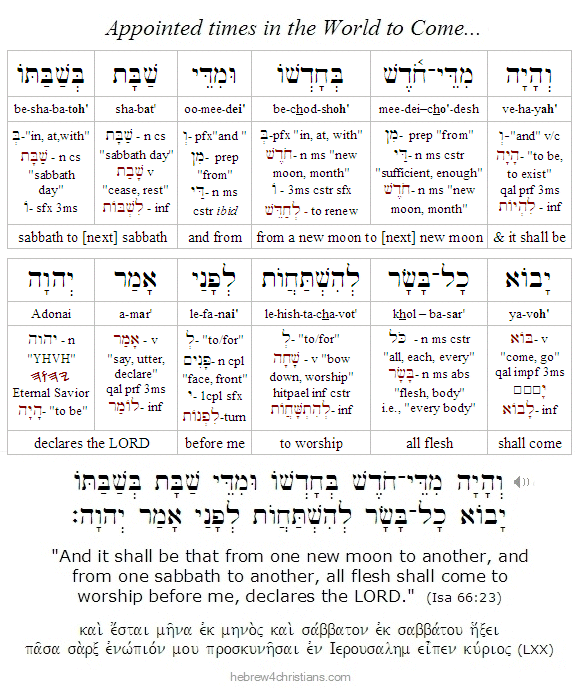
The connection between our Torah portion (Emor) and the haftarah clearly centers on the role of the priests and the continuation of the Jewish holy days in the world to come. The opening phrase of the parashah (Lev. 21:1), "Say to the priests" is therefore linked with the service described by the priests in the coming Millennial Temple. Like the instructions given in the Torah portion, Ezekiel declares that the priests "shall teach my people the difference between the holy and the profane, and show them how to distinguish between the unclean and the clean." In a dispute, they shall act as judges, and they shall judge it according to my judgments. They shall keep my laws and my statutes in all my appointed feasts, and they shall keep my Sabbaths holy" (Ezek. 44:23-24, cp. Lev. 10:10-11). Note that besides teaching the people the difference between the holy and the profane, the priests will judge the people and teach them about Shabbat, Rosh Chodesh, and the other festivals (especially Passover and Sukkot: Ezek. 45:17-25).
Interestingly, the priests of the Millennial Temple will only be those who are direct descendants of Zadok (צָדוֹק), who was the first High Priest in the Temple of Solomon (1 Kings 2:35). Zadok demonstrated loyalty to King David during the insurrection of Absalom (2 Sam. 15) and later anointed King Solomon to be the king of Israel after the failed attempt of Adonijah to seize the throne (1 Kings 1:32-ff). Zadok was also said to be a direct descendant of Pinchas (Phinehas), the grandson of Aaron, who had been promised a "covenant of priesthood for all time" (see Num. 25:13). Therefore the LORD says, "The Levitical priests, the sons of Zadok (בְּנֵי צָדוֹק), who kept the charge of my sanctuary when the people of Israel went astray from me, shall come near to me to minister to me. And they shall stand before me to offer me the fat and the blood, declares the Lord GOD" (Ezek. 44:15). In other words, other descendants of the Levites would be forbidden from the sacred service in the Holy Place of the future Temple. Spiritually speaking the "sons of Zadok" may refer to Christians who are called "sons of righteousness" (i.e., bnei tzedek: בני צדק) because they were faithful followers of Yeshua and by Him are made righteous by the blood of the Lamb of God.
The Jewish commentators, notably Radak, wrote that the spiritual level of the Zadokite priests will rise to be equal to that of the High Priest as described in the Torah portion of Emor. For instance, all the priests would wear the linen garments the High Priest wore during Yom Kippur (Ezek. 44:17-19), and the more stringent rules for holiness demanded of the High Priest are now applied to all the Zadokite priests. In other words, all the priests would be held to the higher standards of holiness formerly required for the High Priest alone. The priests will eat the meal offerings, sin offerings, guilt offerings, first fruits, and terumah (special contributions) brought by the people to the new Temple.
Some people are troubled by the idea of a Jewish priesthood operating in the world to come, and especially with the idea that the various sacrifices described in Ezekiel will be offered after the cross of Yeshua. Indeed, Ezekiel describes sacrificial offerings (given by the regent of King David) for the Sabbath day (46:1-5), the New Moon (46:6-8), the appointed feasts (46:9-12), as well as the daily (tamid) sacrifices (46:13-15). Because all this seems inconsistent with the message of the gospel, many Christian interpreters attempt to "allegorize" the Book of Ezekiel and apply its message as a vision of the triumphant church in heaven (this is characteristic of many who hold to some for of "ammillennialism," as well as to most "covenant" theologians). It should be noted, however, that what is being described in Ezekiel pertains to a coming "dispensation" or age that follows the "church age." The language of Ezekiel's description of the Temple is too precise to warrant such allegorization, nor do the detailed descriptions of the sacrifices, the appointed times, the description of the "city of the LORD" and the inheritance of the tribes hint at any kind of metaphor. It is better, then, to understand the future Temple to be the way a redeemed Israel will commemorate (or memorialize) the sacrifice of Yeshua as Israel's true High Priest and King. After all, if the sacrifices offered in the Levitical system before the cross looked forward to the sacrifice of Yeshua, it is logical that the sacrifices in the Kingdom of Zion will commemorate His sacrifice as Israel's Lamb of God...
When we consistently read the Scriptures using the "historical-grammatical" method, the Book of Ezekiel strongly contradicts the viewpoint of "replacement theology," and indeed the Jewish sages understand the book to be the ritual expression of the words of the other Hebrew prophets such as Isaiah, Jeremiah, Zechariah, and so on. So you see why the study of the Hebrew language (i.e., the "language of the Kingdom") and the study of the Jewish holidays is so important to us, chaverim. God's purposes remain the same, and the Torah is part of our heritage as followers of Yeshua, the Jewish Messiah and our Savior.... Those who ignore (or "interpret away") the literal reading of the Book of Ezekiel will likely be scandalized with the clear message of the Book of Esther as well.
The name Ezekiel means "God [אֵל] will strengthen [יֶחֱזַק]" and his message is one of hope and strength (chazak) for the Jewish people... As the apostle Paul foresaw, one day all Israel will be saved and the promises of the Hebrew prophets will be completely fulfilled (Rom. 11:26). God is faithful, chaverim, and He will do as He promised for the Jewish people.... May that day come soon!
Hebrew Lesson
Isaiah 66:23 reading (with comments):
 |
Perfection and Holiness...

"Consider that fact that, being nothing in ourselves, we cannot, without divine assistance, accomplish the smallest good or advance the smallest step toward Heaven." - Lorenzo Scupoli
04.28.26 (Iyyar 11, 5786) Our Torah portion this week (i.e., parashat Emor) begins by listing special requirements for Israel's priests to be eligible to serve, and then goes on to list the yearly cycle of Sabbaths and the seasonal festivals.
First of all the priests (kohanim) were required to be "perfect," without any physical defect or uncleanness that might render them unfit for service. Everything about the priests – their clothing, their hair style, their skin condition, and especially their adherence to the meticulous steps required to offer the daily sacrifice (לֶחֶם אֱלהָיו) - was to be "defect free," and any deviation might even incur the penalty of death itself (see Lev. 10:2; Num. 4:15, 2 Sam. 6:6-7). On the other hand, what sometimes disqualified a priest for service were things beyond his control, for instance, a variety of physical disabilities such as blindness, having a limp or disfigured limb, and so on (see Lev. 21:16-21).
Thinking about these various requirements raises some provocative questions concerning the meaning of "perfection" in our lives, and particularly how we, as a deeply flawed people, can possibly be "perfect." The question is radical and affects how we are to understand practical holiness or the idea of "sanctification": Are we to seek to be perfect people, and if so, how do we understand what this means? Is our spirituality bound up with perfectionism, with flawless performance, and with always being and doing what is right?
In the Sermon on the Mount Yeshua warned that our righteousness should exceed that of the religious leaders of his day (Matt. 5:20), and he went on to say: "be perfect, as your heavenly Father is perfect" (Matt. 5:48). Here we note that the Greek word translated "perfect" (τέλειος) may mean "mature" or "fully developed" more than morally flawless, though regarding moral and spiritual practice this distinction is not clear cut, especially if by "mature" we mean godly in character, as the context of Yeshua's statement clearly implies (see Matt. 5:1-48). The Hebrew word translated as "perfect" (תָּמִים) can also mean "complete," but it can connote being "wholehearted," "sound," or even healed (שָׁלֵם). So the question arises, does the word "perfect" mean "flawless" or "healed" -- or perhaps both?
Of course we affirm that God alone is truly perfect (Deut. 32:4; Psalm 18:30), completely good (Matt. 19:17), flawlessly righteous (Psalm 145:17), entirely holy (Isa. 6:3; Rev. 15:4), and peerlessly unique (Exod. 15:11; Jer. 10:6-7), but how can we relate to God's overmastering perfection in the midst of our daily flaws and chronic imperfections? How dare we approach "to offer the bread of God" (Lev. 21:17)?
Followers of the LORD are called to be a nation of priests, a "select people," set apart to serve God in holiness (Exod. 19:5-6; 1 Pet. 2:9; Lev. 11:45), but it is clear we are blemished, imperfect, blind, halt, needy, and unclean... This is common to the human condition: all of us, Jew or non-Jew alike, are broken, flawed, and in the midst of the inevitable flow of life that leads to death and decay (Rom. 3:23). We are sick with sin and unable to heal ourselves, and therefore we need a radical transformation - "deliverance from ourselves" – that must come through divine intervention and the miracle of spiritual rebirth (John 3:3,7).
Nevertheless in this world the paradox still remains: we are finite yet long for the undying, the infinite; we are in flux yet anchored in hope; we are a "new creation" yet still saddled with the old nature; we are made holy yet we live in the midst of the profane; we are purified yet still need cleansing; we are healed yet are still wounded; we are redeemed of God yet still need to turn to God in teshuvah; we die daily yet have eternal life. Our hearts are to be a divine sanctuary, yet we are powerless to make God appear in our midst...
Perfection haunts us; we often confuse the ideal and the real. Our romantic visions fail us; our poetic utterances are as an unknown tongue; all of us are strangers, wanderers, in lonely exile. And the question then becomes – how do we embrace the "already-not-yet," the process, the fleeting days with their poignant and achingly mundane moments – within the context of real hope, a vision that heals and brings us real comfort? How do we make peace with our imperfections, our present darkness, and our hunger for deliverance? How do we envision healing in the midst of our brokenness?
Ironically those defects that disqualify us as priests can be transformed into compassion for others, and this enables us to reach out to God in the midst of our flawed existence... After all, the deepest role of the priest is to draw others near to God, but this requires empathy and awareness of the needs of others. Therefore God clothed himself with our frailty, our infirmities, and the brokenness of our sin in order to redeem us in Yeshua. As it is written, we have a high priest who is able to sympathize (συμπαθέω) with our weaknesses (Heb. 4:15).
The priest of the New Covenant is a mediator through poverty of spirit and mourning (Matt. 5:3-8). Just as Joshua the high priest was graciously given robes of righteousness in exchange for his filthy garments (Zech 3), so we are given an imputed righteousness that comes through trusting in "the One who justifies the ungodly" (Rom. 4:5). "For our sake God made Him (i.e., Yeshua) to be sin who knew no sin, so that in him we might become the righteousness of God" (2 Cor. 5:21). This is a righteousness that is "apart from the law, though the law and prophets testified of it; namely, the righteousness of God given through the faithfulness of Yeshua the Messiah" (Rom. 3:21-22). Our groaning for the complete deliverance is a gift given by the Spirit of God crying out within our hearts (Rom. 8:22-23).
"In honesty you have to admit to a wise man that prayer is not for the wise, not for the prudent, not for the sophisticated. Instead it is for those who recognize that in face of their deepest needs, all their wisdom is quite helpless. It is for those who are willing to persist in doing something that is both childish and crucial" (Frederick Beuchner).
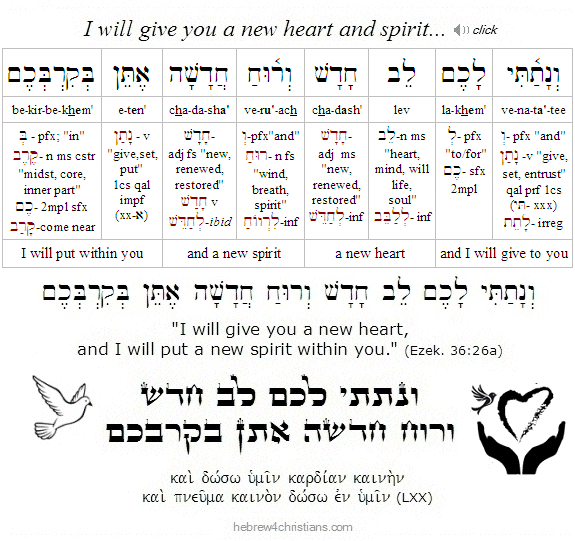
C.S. Lewis once remarked, "God doesn't love you because you are good, but He will make you good because He loves you." This goodness is the miraculous inner working of an imparted godliness, the divine gift of a new heart and spirit (Ezek. 36:26). Awaken to your eternal perfection in the world to come: "You shall be perfect even as your heavenly Father is perfect" can be read as a prophecy rather than as a command.
Therefore do not give up, friends; do not succumb to despair. Stop torturing yourself and focus on God's kindness and mercy for your life. We must endure ourselves and believe in the promised healing to come. As the Apostle Paul said to us: "Do not lose heart. Though our outer self is wasting away, our inner self is being renewed day by day. For this light momentary affliction is preparing for us an eternal weight of glory beyond all comparison, as we look not to the things that are seen but to the things that are unseen. For the things that are seen are transient, but the things that are unseen are eternal" (2 Cor. 4:16-18). And may God help us walk in perfect faith in His unfailing love (Phil. 3:14). Amen and amen.
Hebrew Lesson
Ezekiel 36:26a reading (click):
Healed in God's Love...
04.27.26 (Iyyar 10, 5786) How do you think God regards you? Does he see your sin first? If you think he disapproves of you, it's likely you will attempt to earn his approval by doing certain things (and not doing others), which puts you "under the law," that is, the never-ending cycle of self-justification. But you will never feel safe as long as you regard God's acceptance of you as conditional, since you will only be as secure as your own best efforts, a project that will exhaust you in the end.
We must know ourself as someone truly loved by God, just as the "prodigal son" came to know his father's unconditional love and acceptance despite his many misdeeds (Luke 15:11-32). The incarnation of Yeshua means that God "runs to meet and embrace you," regardless of whatever happened in your life that made you run away from home. And whatever else it may be, sin is the separation from God's love, but Yeshua made the decision to die for your sins before you were born. Your sin cannot overrule God's surpassing and personal love for your soul, since God gave up his very life for you to find life.
The Hebrew word for "life" is chayim (חַיִּים), a plural noun that contains two consecutive letter yods (יי) that picture two "hands held together" (the Hebrew word yad [יָד] means "hand"), or the union of our spirit with God's Spirit. The word itself reveals that there is no life apart from union with God, who extends his hand to you and says, "Live in me" (John 15:4).
We live in God's love by faith, receiving our daily bread as his flesh and our drink as his blood (John 6:53). Yeshua is the Source of all life, and we find nourishment, strength, and fullness of joy in his life. The Lord is our light and our salvation, the Mediator of divine life (Psalm 27:1; John 1:4). As it is written, "Whoever has the Son has the life; but whoever does not have the Son of God does not have the life" (1 John 5:12).
The Lord is also called "the God of breath" (Gen. 2:7; Num. 16:22). The Hebrew word for breath is ruach (רוּחַ), a word that means both "spirit" and "wind." God is as close as your breath and surrounds you like the unseen yet encompassing air. Since God's name YHVH (יהוה) means "Presence" (Exod. 3:13-14), "Life" (Deut. 30:20), and "Love" (Exod. 34:6-7), he is the Beloved, the "I-am-with-you-always" lover of your soul. So fear not; you are never really alone. Yeshua breathes out to you and says, "Receive the Holy Spirit" (John 20:22).
Hebrew Lesson
Isaiah 41:10a reading (click for audio):
 |
Ways of Holiness:
Parashat Emor - פּרשׁת אמר

04.26.26 (Iyyar 9, 5786) Our Torah portion for this week (parashat Emor) lists the eight main holidays revealed in the Jewish Scriptures. In the Torah, these "holidays" are called "appointed times" (i.e., mo'edim: מוֹעֲדִים), a word which comes from the Hebrew root meaning witness (עֵד). Other words formed from this root include edah (עֵדָה), a congregation, edut (עֵדוּת), a testimony, and so on. The related verb ya'ad (יָעַד) means to meet, assemble, or even to betroth. The significance of the holy days, then, is for the covenant people of the LORD to bear witness to God's love and faithfulness.
"Speak to the people of Israel and say to them, 'These are the appointed times of the LORD (מוֹעֲדֵי יְהוָה) that you shall proclaim as holy convocations (מִקְרָאֵי קדֶשׁ); they are My appointed times'" (Lev. 23:2). Note that these hallowed times - the very first of which is the weekly Sabbath - are "of the LORD," and that means they should be regarded as appointments given by God Himself to help draw us closer to Him, to reveal His prophetic truth, and to remind ourselves of His great plan for our lives. God did not give us the Torah in vain, friends, neither does He speak out of two sides of his his mouth... Yeshua was the Voice of the LORD speaking the words of Torah to Israel at Sinai, and therefore every "jot and tittle" (קוֹצוֹ שֶׁל יוֹד) is indeed relevant to our lives as his followers (Matt. 5:18-19).
Hebrew Lesson
Leviticus 23:2 reading (click for audio):
 |
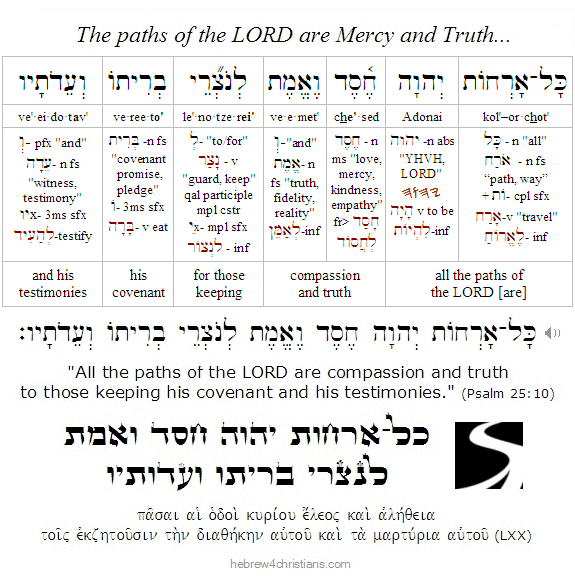
Metaphorically the "paths of the Lord" (i.e., orechot Adonai: ארחות יהוה) are likened to "ruts" or grooves created by the wheels of a caravan (i.e., orechah: ארְחָה) passing repeatedly over the same ground. These paths signify the Divine Presence journeying with God's children in this world. In temporal terms, we are able to discern the path by means of the divine calendar. God's love and faithfulness attend to His covenant (brit) and to the commemorations of the yearly "appointed times" that testify of God's faithful love. Keeping God's testimonies, then, means that we will be careful to observe the holidays in order to witness to God's truth...
Hebrew Lesson
Psalm 25:10 reading (click):
Hebrew Lesson
Opening words of parashat Emor:
Root of the Righteous...
04.24.26 (Iyyar 7, 5786) It is written, "No one is established by wickedness, but the root of the righteous will never be moved" (Prov. 12:3). A person's heart is revealed by his core convictions and desires. Wealth and the pleasures of this world do no good for the eternal soul. Although the wicked of this world may appear to prosper, it is only temporary and will not last (Psalm 37:1-2); on the other hand, though the righteous may appear to fall, it is only temporary, and they will rise again, since the Root of the Righteous (שׁרֶשׁ צַדִּיקִים) is God's own power: "The steps of a man are established by the LORD, when he delights in his way; though he fall, he shall not be cast down, for the Lord holds his hand" (Psalm 37:23-24).
Hebrew Lesson
Proverbs 12:3 reading (click for audio):
The sages note that the word translated "established" (in Prov. 12:3) comes from a word (כֵּן) meaning a "base" or a "stand" – that is, something external that supports something, but the word "root" (שׁרֶשׁ) refers to the inner essence of the plant. The Malbim said that man is like an inverted tree with its roots on top, drawing life from heaven that provides him with spiritual sustenance. The wicked cut themselves off from the root and base their lives on the material and transitory foundation of this world. Yeshua likened the immovability of the righteous as those who build their house on the rock: when the tempest comes, the house will not fall, because it is founded upon the rock. Those who build their house on the sands of this world are foolish: when the tempest comes, the house will collapse and its fall will be great (Matt. 7:24-27). In the midst of life's storms and trials, the righteous (הצדיקים) have an inner support that keeps them from being destroyed, and that is the Rock of our Salvation (צוּר יִשְׁעֵנוּ), Yeshua our Lord!
The Scriptures state twice: שׁרֶשׁ לְמָטָּה וְעָשָׂה פְרִי לְמָעְלָה / "Take root downward and bear fruit upward" (2 Kings 19:30; Isa. 37:31). As Yeshua said, "unless a grain of wheat falls to the ground and dies, it abides alone; but if it dies, it produces a harvest (John 12:24). The inner life goes into the earth - it dies and then is re-opened to yield fruit. We pray we might surrender ourselves to the Lord fully, being immersed in His passion, "bearing fruit in every good work (ἐν παντὶ ἔργῳ ἀγαθῷ καρποφοροῦντες) and growing in da'at HaShem (דַעַת אֱלהִים) - the knowledge of God" (Col. 1:10). The "fruit of the righteous is a Tree of Life" lit., etz chayim (עֵץ חַיִּים), "the Tree of lives" (Prov. 11:30). It is the fruit of Yeshua, the Righteous One, who bears fruits of healing for the lives of those who turn to Him in trust...
"I can do all things through the Messiah who strengthens me," not "some things," or a "few things," but ALL things (Phil. 4:13). Yeshua is the Tree of Life, the Source of all our strength. "May you to be strengthened with power through his Spirit in your inner being" (Eph. 3:16). Let's remember to pray for one another and ask the LORD to help make each of us fruitful to the glory of our Heavenly Father (John 15:8). Amen...
 |
Temptation of Despair...
04.24.26 (Iyyar 7, 5786) There is a cunning temptation to become offended over yourself, to allow disappointment and self-contempt to whisper within your heart: "If anyone really knew me, they wouldn't love me at all." Entertaining such a thought leads the soul to darkness, isolation, and to accept the "bad faith" that you are defective, irredeemable and ultimately destined to rejection.
In light of the truth of the gospel, however, being offended over yourself is really a form of unbelief, since it impugns the love of God that saves you from despair. To escape from the curse of self-rejection we must renounce our bad faith and find courage to believe that we are beloved God, accepted and received into his heart because of his goodness and mercy.
Despite our many failures and sins, despite our frailties and habitual stumbling, we must hear again words of God's love that declare that we are his beloved. God knows all about you. He knows all of your secret sins; he understands your struggles and your fears, yet he steadfastly loves you anyway (Rom. 5:8). His love and acceptance are a pure gift given to you, and all that he asks is that you believe - and emotionally receive - that he is for you, now, in this hour. This is the "good faith" that trusts that you are redeemed, healed, and welcomed by your Father in heaven.
The Word of the Lord says that you are precious and honored in God's sight, and that in all your affliction he himself is afflicted (Isa. 43:4; 63:9). May it please God to deliver us from self-loathing and know ourselves as his precious children.
Hebrew Lesson
Psalm 143:8 reading (click):
 |
Forsake me not, O LORD...

04.24.26 (Iyyar 7, 5786) Though it is true that God will never leave nor forsake us, he nevertheless allows trouble in our lives so that we will learn to call upon him and know his heart in our struggles (1 Pet. 1:5-9; Hos. 6:1-3; Job 5:18; Jer. 3:22). For how else will we understand the truth of our great need for him, and how else his great provision? "Blessed are the poor in spirit," describes the poignant awareness of our inner poverty, our bankruptcy of heart, the destitution of our condition (Matt. 5:3).
We cry inwardly, "Forsake me not, O LORD: O my God, be not far from me" (Psalm 38:21) because we realize our need for deliverance from ourselves; we understand that we cannot take even a step in his way apart from his upholding. As Kierkegaard said: "We know that if God should put to the test our faithfulness to him, we know well that at the moment of testing, he himself must hold on to us, that is, we know that at bottom we are unfaithful, and that every instant it is he who at bottom holds us." Amen, as the Spirit intercedes: סְעָדֵנִי וְאִוָּשֵׁעָה - "Hold me up, and I shall be made safe, and I will have respect unto thy statutes continually" (Psalm 119:117).
"Do not forsake me, O LORD," is the mantra in our darkness, the antiphon of God's promised Presence, despite the devouring gloom; it is the cry of the heart that knows that only God can get us through the next moment and its temptation to despair. "Do not forsake me, O LORD, lest I be swallowed up by my pain, my fear, my sadness, my anguish of heart; do not forsake me, for I am nothing but the anguish of the moment, the sorrow of loneliness, the fear of my own heart as I tremble before you in my desperation; O do not forsake me...."
O LORD, You came to heal the sick; you spoke life to those who are without strength or remedy; you came to seek the lost, to find those who are without a place or sense of belonging in this world. O Lord, you know that without you I can do nothing; you know that I am weak, poor, and needy; my path is perilous and I have no hope apart from you. Be not far from me; do not leave me to my own devices nor the counsel of my own soul. Save me, O God, for the glory of your Name; be magnified in your heart of love and faithfulness. Amen.
Hebrew Lesson
Psalm 38:21 reading (click):
 |
The Way of Truth...

04.23.26 (Iyyar 6, 5786) It is written in Torah portion Kedoshim: "You shall not put a stumbling block before the blind (לִפְנֵי עִוֵּר לא תִתֵּן מִכְשׁל); you shall fear God; I am the LORD" (Lev. 19:14). Just as no one can deny the validity of logic by means of argument, so no one can intelligibly deny that truth is necessary... Indeed, every person intuitively believes that truth exists, since otherwise he or she would not ask any questions or make any statements.
We intuitively presuppose the value and reality of truth whenever we communicate, and we understand that there is an implied social contract to be honest and not to deceive others. Deceitful language puts a "stumbling block before the blind" when it is used to withhold important information from others. For example, politicians who make evasive statements or who offer mutually exclusive promises to different groups of people are being dishonest and are cloaking their true intentions. The same may be said about people who sell products or services using various misleading claims.
The lie is a type of violence. Martin Buber once said, "What is accomplished through lies can assume the mask of truth; what is accomplished through violence can go in the guise of justice, and for a while the hoax may be successful. But soon people realize that lies are lies at bottom, that violence is violence - and that both lies and violence will suffer the destiny history has in store for all that is false."
Those who willfully misdirect others violate the ninth commandment not to bear false witness (Exod. 20:16; 23:1). Such deception is called "genevat da'at" (גְּנֵבַת דַעַת), or "stealing of the mind," since it defrauds another person's thinking. Misleading people is a violation, then, of both the commandment not to steal and the commandment not to bear false witness.
The Torah warns us never to exploit other people's vulnerability or to take advantage of their good will and trust. Those who use false words and deceitful language to blind the eyes of the gullible will assuredly face judgment, as it is written: "No creature is hidden from God, but everything is naked and exposed to the eyes of him to whom we must render an account" (Heb. 4:13). Lying to others is desecration, profanity, and ultimately a form of violence. Those who cause others to stumble will tragically discover that truth will be a stumbling block to them. May God help us to fear Him and to be yashar – upright in our communication with others. Therefore may each of us proclaim: "I have chosen the way of truth; I have set your judgments before me" (Psalm 119:30; also 2 Tim. 2:19).
דֶּרֶךְ־אֱמוּנָה בָחָרְתִּי
מִשְׁפָּטֶיךָ שִׁוִּיתִי
"I have chosen the way of truth;
I have set your judgments before me." (Psalm 119:30)

The First Step of Faith...

"He [God] lets me weep before him in silent solitude, pour forth again and again my pain, with the blessed consolation of knowing that he is concerned for me — and in the meanwhile he gives that life of pain a significance which almost overwhelms me." - Kierkegaard
04.22.26 (Iyyar 5, 5786) There is an indispensable element of our spiritual life that is all-determinative, that affects everything else, and that is the decision of whether we will choose to "show up," whether we will engage it's hope; and whether we will open our eyes and yield ourselves to the light... And this is an ongoing decision.
Therefore we read: "If you walk in my statutes (אִם־בְּחֻקּתַי תֵּלֵכוּ) and observe my commandments and do them..." (Lev. 26:3). The sages note that unlike the holy angels, we must "walk out" the faith of our days, and therefore we are always moving either forward or backward. In this world, God's sun shines on the just and unjust alike (Matt. 5:45). Every human being lives by faith of some kind, and it is therefore impossible to opt out of the decision to "choose this day whom we shall serve" (Josh. 24:15). Indifference or apathy is as much a spiritual decision as is outright rebellion, and if we do nothing today to draw us near to the Lord, we will eventually regress and slip backward.
This is all very sobering. "No one knows the day or hour," and that's why it is so vital to turn to God and be healed while there is still time. So turn today and bacharta ba'chayim (בָּחַרְתָּ בַּחַיִּים) - "choose life!" "For this commandment (of turning to God) is not hidden from you, and it is not far away... No, the matter is "very near you" (כִּי־קָרוֹב אֵלֶיךָ הַדָּבָר מְאד) - in your mouth and your heart - to do it" (Deut. 30:11-14; Rom. 10:8-13).
Hebrew Lesson
Deut. 30:19b reading (click):
Renew your mind:
Escape from the Matrix...

"Be ready, for the Son of Man is coming at an hour you do not expect." (Matt. 22:44)
04.22.26 (Iyyar 5, 5786) "Seek first the kingdom of God and his righteousness" (Matt. 6:33). This is the right approach to life: Open your heart to heaven and seek God's presence before you do anything else (Prov. 3:5-6). This is particularly important at this time, friends. Do you want your mind to be confused, excited, depressed or angry? Do you want others to decide what is important and "real" for you? Then turn your attention to this world and its rumors and its tendentious news. The mass media thrives on trouble - whether real or imagined - and serves to manipulate people by making them afraid. The newsmakers of this world understand that fearful people make their most loyal consumers...
Consider the godless assumptions that underlie the news of the this world. Purported and alleged experts are lined up; the dialog is scripted; sound bites are repeated on a relentless schedule, images and videos are crafted, yet you will hear nary a word to call upon God for healing and deliverance. God is simply "not there"; he is not part of the narrative of the present crisis or trouble. And yet nothing could be further than the truth!
The LORD God must be the first principle of our thinking or else we will become deceived, regardless of the formal validity of our reasoning. There is a difference between "soundness" and "validity," and if we do not begin with truth, our thinking will be impaired, even if we accidentally make inferences that turn out to be empirically true. Therefore we must be vigilant and vigorously challenge ideas that attempt to seduce us away from the truth and divide our affections. We must learn to identify the false assumptions that deny the knowledge of God and take "every thought captive" to Messiah. We must be on guard for subtle, unspoken, and calculated appeals to compromise our faith (2 Cor. 10:5).
If we find ourselves in a state of recurring temptation, we must examine the underlying assumptions that are at work in our thinking. If we dig deeper, we are likely to discover that we are doubting that God cares for us, or we are fearful that God will not meet our needs. We must therefore counter such faithless assumptions with God's revealed truth, and that means regularly studying and reviewing the Scriptures to remind ourselves about what is real rather than what is illusory. We then can learn to look at life as it really is - a spiritual world, a "valley of decision," the corridor that irresistibly leads to the world to come. Each soul is on a journey to meet with God for judgment... Yet God does not leave us comfortless. He has promised to never leave nor forsake those trusting in Him. The Lord is your Good Shepherd who walks with you during your sojourn through this temporal world (Psalm 23).
Hebrew Lesson
Psalm 23:4 reading (click for audio):
 |
A voice says, "Cry!" And I said, "What shall I cry?" All flesh is grass, and all its beauty is like the flower of the field" (Isa. 40:6). "All flesh is grass" (כָּל־הַבָּשָׂר חָצִיר) - we are here today but gone tomorrow. We have only so many chances to turn to the LORD and make up our minds that we will serve Him. ALl our days are numbered. The Torah uses a metaphor: "man is a tree of the field," i.e., הָאָדָם עֵץ הַשָּׂדֶה, Deut. 20:19). The righteous man is described as a "tree planted by the rivers of water that brings forth fruit in his season" (Psalm 1:3). If you stand in front of a tree to watch it grow, however, you will see nothing. But if you care for the tree, nurture it over time, and provide for its needs, eventually you will see its fruit appear. God gives us each a season to repent, but if that proves fruitless in our spiritual lives, eventually we will be "cut down" (Luke 13:6-9).
The Scriptures warn that a "double-minded man is unstable in all his ways" (James 1:8). The word translated "double-minded" is dipsuchos (δίψυχος), a word formed from δίς, "twice" and ψυχή, "soul." The word describes the spiritual condition of having "two souls" that both want different things at once. It is therefore a state of inner contradiction, of having two separate minds holding contradictory thoughts. "How long will you go limping between two opinions?" Notice that the word translated "limping" is posechim (פּסְחִים), from the same root as Passover (i.e., pasach: פָּסַח): How long will you pass from one thing to another? How long will you play "hot potato" with your commitments?
Being doubleminded makes us "unstable in all our ways." Such a "cross-eyed" approach leads to disorientation and confusion. The Greek word used to describe being "unstable" (ἀκατάστατος) is the same word used to translate being "storm-tossed and not comforted" in last week's Haftarah portion (LXX: Isa. 54:11). The image of a ship being tossed in the sea pictures a state of distress and peril. Interestingly, the description of being "not comforted" is lo nuchamah (לא נֻחָמָה), which comes from the very word translated as "repent" or "regret" (nacham). When we are double-minded, we are "storm tossed" and unable to experience the comfort that comes from genuine repentance. We are like "a wave of the sea that is driven and tossed by the wind" (James 1:6).
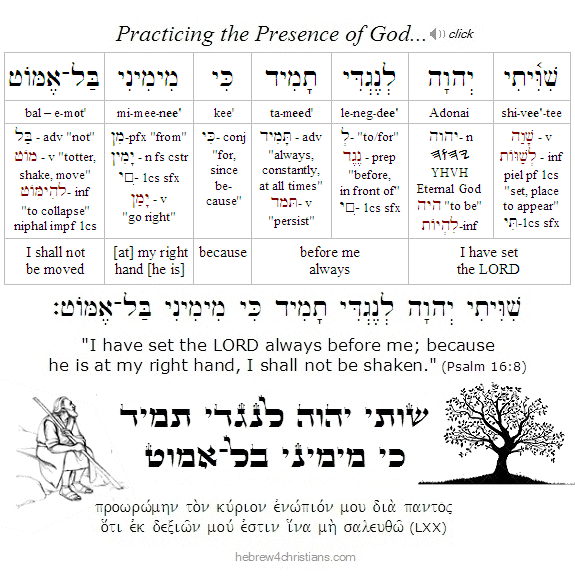
On the other hand, singleness of vision concentrates the will and produces wholeheartedness, conviction, stability, inner peace (shalom) and genuine character. As Soren Kierkegaard said, "purity of the heart is to will one thing." "I have set the LORD always before me; because He is at my right hand, I shall not be moved" (Psalm 16:8).
Hebrew Lesson
Psalm 16:8 reading (click for audio):
 |
The Apostle Paul taught that we are not to be "conformed" (συσχηματίζω) to the pattern of this fallen world but rather be "transformed" (μεταμορφόω) by renewing our minds, so that by testing we may discern what is the will of God (Rom. 12:2). Note that the word translated "conformed" in this verse means to accept the world's scheme (σχῆμα) of understanding things, that is, to passively go along with the world's "matrix" of lies, wishful thinking, propaganda, etc. The word translated as "transformed," on the other hand, means to be metamorphosed or radically changed into a different kind of nature with a different source of being itself. Such transformation comes from having our minds "renewed" -- the word used in this verse (i.e., ἀνακαινόω) means being "made new on the inside," and therefore renewal is the gift of teshuvah (turning to God).
"Our view of the world is truly shaped by what we decide to hear" (William ames). Understand, then, that the foundation of all transformation of inner character and outward conduct comes from the miracle of having a renewed mind. I use the word "miracle" quite intentionally, since by itself "right thinking" is powerless to help the sinner truly change his ways, and therefore something more - radically new life and healing power from heaven, is what is necessary.The gospel is the power of God for salvation (Rom. 1:16). Indeed "the beginning of transformation of character is the renovation in the very centre of the being, and the communication of a new impulse and power to the inward self" (Alexander Maclaren). Amen, may the LORD God work out our salvation and give us the grace to walk our days in the light of his countenance.
|
Loving the Stranger...
"No one ever told me that grief felt so like fear." - C.S. Lewis
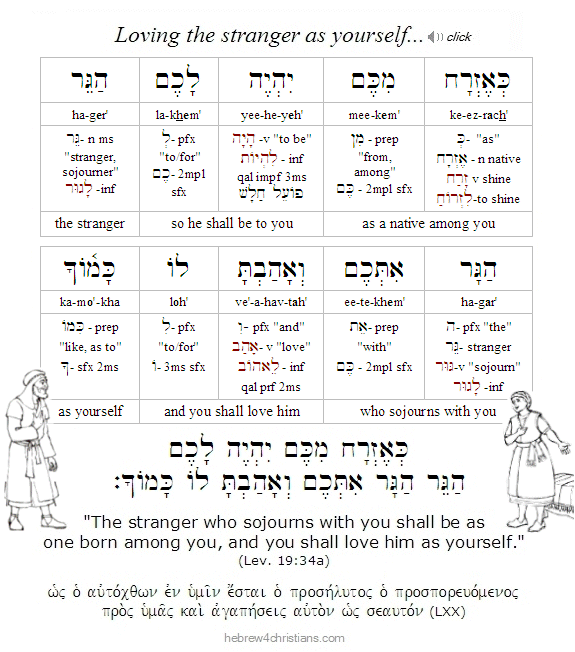
04.22.26 (Iyyar 5, 5786) From our Torah portion this week (Acharei-Kedoshim) we read: "The stranger who dwells among you shall be to you as one born among you, and you shall love him as yourself; for you were strangers in the land of Egypt: I am the LORD your God" (Lev. 19:34). But how is it possible to love someone who is a "stranger" apart from empathy for someone who is lost? The unspoken assumption here is that since we know how it feels to be an outcast, oppressed and without a sense of belonging or home, so we ought sympathize with others who feel that way too.
When we acknowledge the suffering of others we also acknowledge our own. We let go of the weapons of blame and retribution when we give voice to the "stranger" within ourselves, when we realize that others share in our suffering: "Do not oppress a sojourner, for you know the soul of a stranger (וְאַתֶּם יְדַעְתֶּם אֶת־נֶפֶשׁ הַגֵּר), for you were strangers..." (Exod. 23:9). The Hebrew verb used here (i.e., yada, to know), implies intimacy, personal and direct understanding. You "know the soul" of the stranger by reliving their place, and by using the "good eye" to see how they share common our pain, joy, hope, and so on.
Being sensitive to the heartache of others helps us find our own healing: We are brought out of our "inner Egypt" into freedom and wholeness. Remembering what it was like to be a stranger helps us extend compassion to ourselves, and that brings healing to our hearts.
The mitzvah to love the stranger applies not only to someone whom we regard as an "outsider," but even more radically to the "stranger within ourselves," that is, to those aspects of ourselves we censor, deny, or reject...
Like the prodigal son, we have to "come to ourselves" to return home (Luke 15:17), believing that we are somehow redeemable, though we will be unable to know how much we are loved until we venture complete disclosure. That is the great risk of trusting in God's love for your soul: You must accept that you are accepted despite your own unacceptability... Those parts of ourselves that we "hide" need to be brought to the light, atoned for, healed, and reconciled. If we don't love and accept ourselves, then how can we hope to love and accept others?
Hebrew Lesson
Lev. 19:34 reading (click):
God's "Super Sign" of Israel...

"The very existence of Israel is as near to a miracle as we will find in the sober pages of empirical history." - Rabbi Jonathan Sacks
04.21.26 (Iyyar 4, 5786) Israel's Independence Day is called Yom Ha'atzma'ut (יום העצמאות), the "day of independence." In Hebrew, the word independence (atzma'ut) comes from atzmi - "my bones" (i.e., etzem: עֶצֶם), so the name itself alludes to God's glorious promise to revive the "dry bones" (עֲצָמוֹת) of Israel by bringing the Jewish people back from their long exile during the End of Days (Ezek. 37:1-6). "Son of man, can these bones live?"
Hebrew Lesson
Ezekiel 37:3a Hebrew reading (click):
 |
But why should Christians care about ethnic Israel? After all, many Christian denominations advocate some version of "Replacement Theology" and regard the promises God made to the Jewish people as belonging exclusively to their church... The existence of the modern State of Israel therefore evokes little thanks to God from these groups, and some of their ranks even regard Israel's revived presence on the world stage as an embarrassment to their typically "liberal" theology. Hence we see the (remarkably bad) phenomena of so-called "Christian" church denominations that express anti-Israel sentiment, even asking their followers to divest investments in Israel on behalf of the "Palestinians," etc.
The title "Christ" refers to the anointed King of Israel, the Mashiach (מָשִׁיחַ)... To say "Jesus Christ" is therefore to affirm that Yeshua is none other than the Messiah, the rightful King of Israel (מֶלֶךְ יִשְׂרָאֵל). Followers of Jesus, the One born "King of the Jews" (Matt. 2:2), should therefore care deeply about Israel because the existence of Jewish people - and of the nation of Israel in particular - demonstrates that the LORD (יהוה) is completely faithful to the covenant promises He made to our patriarchs (e.g., Gen. 15:9-21). Indeed, the Scriptures teach that the Name of God is forever designated as אלהי אברהם אלהי יצחק ואלהי יעקב - "the God of Abraham, the God of Isaac, and the God of Jacob" (Exod. 3:15), just as it is also the "LORD God of Israel" (יְהוָה אֱלהֵי יִשְׂרָאֵל). The perpetuity of the Jewish people - despite so much satanic hatred over the millennia - is an awesome testimony of God's loyal love (Jer. 31:35-37). עַם יִשְׂרָאֵל חַי / am Yisrael chai: "The people of Israel live!" Israel is a sign of the "sure mercies of David" (חַסְדֵי דָוִד הַנֶּאֱמָנִים) that are revealed in Yeshua, the Jewish Messiah (Isa. 55:1-6). Moreover, the New Covenant itself, as foretold by the prophet Jeremiah, explicitly promises the perpetuity of the Jewish people throughout the ages:
Behold, the days are coming, declares the LORD (יהוה), when I will make a new covenant (בְּרִית חֲדָשָׁה) with the house of Israel and the house of Judah, not like the covenant that I made with their fathers on the day when I took them by the hand to bring them out of the land of Egypt, my covenant that they broke, though I was their husband, declares the LORD. But this is the covenant that I will make with the house of Israel after those days, declares the LORD: I will put my Torah (תּוֹרָה) within them, and I will write it on their hearts. And I will be their God, and they shall be my people. And no longer shall each one teach his neighbor and each his brother, saying, 'Know the LORD,' for they shall all know me, from the least of them to the greatest, declares the LORD. For I will forgive their iniquity, and I will remember their sin no more."
Thus says the LORD, who gives the sun for light by day and the fixed order of the moon and the stars for light by night, who stirs up the sea so that its waves roar - the LORD of hosts is his Name: "If this fixed order departs from before me, declares the LORD, then shall the offspring of Israel (זֶרַע יִשְׂרָאֵל) cease from being a nation before me forever." Thus says the LORD: "If the heavens above can be measured, and the foundations of the earth below can be explored, then I will cast off all the offspring of Israel for all that they have done, declares the LORD. (Jer. 31:31-37)
According to this theologically critical passage, if you saw the sun shine today or the stars in the night sky, you can be assured that God's promise to preserve the "offspring of Israel" -- (i.e., zera Yisrael: זֶרַע יִשְׂרָאֵל) -- is in effect. Indeed, in the world to come, heavenly Jerusalem will have the names of the twelve tribes of Israel engraved upon its gates (Rev. 21:12). Note well that this is the only occurrence in the entire Tanakh (i.e., "Old Testament") that the New Covenant (בְּרִית חֲדָשָׁה) is explicitly mentioned... It is a foundational passage of Scripture for those who claim to be followers of the Jewish Messiah.
The spiritual blessings Christians enjoy come from the root of God's covenants with Israel... Yeshua our Savior was born the King of the Jews, and he plainly said הַיְשׁוּעָה מֵאֵת הַיְּהוּדִים הִיא- "salvation is from the Jews" (Matt. 2:2; 27:11; John 4:22). The Apostle Paul clearly warned those who think the church has "replaced" Israel: "Remember it is not you who support the root, but the root that supports you" (Rom. 11:18). This doctrine is so foundational that it may be rightly said that how you think about Israel will affect every other area of your theology. Indeed, the nation of Israel is God's "super sign" that He is faithful to His covenant promises (Jer. 31:35-37). Celebrating Israel's existence acknowledges God's loyal love for us all! For more on this subject, see the article, "Is Christianity Anti-Jewish?"
In the holy Torah we read how God said to Moses, "Say this to the people of Israel, 'The LORD, the God of your fathers, the God of Abraham, the God of Isaac, and the God of Jacob (אלהי אברהם אלהי יצחק ואלהי יעקב), has sent me to you.' This is my name forever, and thus I am to be remembered throughout all generations'" (Exod. 3:15).
Hebrew Lesson
Exod. 3:15b Hebrew reading (click):
"Your Name, O LORD, endures forever, your renown, O LORD, throughout all ages" (Psalm 135:13). Therefore the prophet cries: "in the east give glory to the LORD; in the coastlands of the sea, give glory to the Name of the LORD, the God of Israel" (Isa. 24:15).
Hebrew Lesson
Psalm 135:15 Hebrew reading (click):
Extraordinary Encounters...

"The fullness of joy is to behold God in everything." - Julia of Norwich
04.21.26 (Iyyar 4, 5786) We "sanctify" our hearts whenever we consciously focus on what is sacred, awesome, wonderful, and glorious about Reality, and in particular, on the Living God, oseh shamayim va'aretz (עשֵׂה שָׁמַיִם וָאָרֶץ), the Maker of Heaven and Earth, and the great salvation we have in Yeshua. In our Torah portion this week (i.e., Acharei Mot) we read: "You shall not do as they do (לא תַעֲשׂוּ) in the land of Egypt, where you lived, and you shall not do as they do in the land of Canaan, to which I am bringing you. You shall not walk in their statutes" (Lev. 18:3). In other words, we are not to follow the crowd, to appeal to the status quo, or to mimic the customs of the world because we are a visionary people who walk by faith in the Torah of the LORD (Psalm 119:1-3).
Being in a vital relationship with God means separating from the ordinary and mundane, leaving our "original homeland" behind us and crossing over to the realm of blessing. Abraham had to leave the land of his father before he could receive the promise; the Israelites had to trek far into the desert before they received the vision at Sinai, and we have to leave our old lives behind to partake of newness of life. There is a radical break from the past -- we are transformed, reborn, and made into new creations by the miracle of God (2 Cor. 5:17). "Being holy" therefore means coming alive and looking away from that which deadens our hearts (Col. 3:1-4). Behold, the LORD God of Israel makes all things new!
The call to be holy is radical and completely contrary to the world and its messages of conditional approval. Worldly culture flatters itself by making a pretense of true originality and genuine love. It imagines itself to be "cool," unconventional, creative, sophisticated, artistic, and so on, but in truth it is trite, uninspired, and cloyingly tragic. To be truly original means encountering God in your daily experience, struggling through the day in faith, disregarding the clamor and demands of popular culture and its idolatry (i.e., fads, fashions, trends, etc.). God calls his people to come alive, to be new, and to experience abundant life; we are to treasure the unseen, the possible, and to keep faith in the healing good that will overwhelm all darkness. Now that's radical; that's original; that's powerful.
Note the connection between worldliness and idolatry, since idolatry essentially involves trying to find your identity, your worth, your satisfaction, and your ultimate fulfillment in the realm of the transitory and the finite (i.e., the world) rather than in God.... We are (rightly) warned against the vices of "worldliness" and are admonished to abstain from popular culture and its spurious values, but note well that worldliness extends well beyond all this, since it concerns understanding the identity and nature of the person as a whole. The fruit of worldliness is the result of being rooted in this world rather than in God's kingdom. The various desires of the human heart - even the desire for "normal things" like personal happiness in this world - may be regarded as "worldly" if they are devoid of submission to God and His rule. Conversely, even Christian workers may be "worldly" if they base their identity in what they do rather than who they are in the Messiah...
We are "in" but not "of" the world; we are embedded within our culture to be salt and light, and that means we stay true to our vision and relationship with the LORD our God... We don't have to reinvent the wheel, however, since we learn from one another and especially from the testimony of our holy Scriptures, but nevertheless we must personally venture out and encounter God within our own hearts, trusting in his love for our everlasting healing. B'chol dor va'dor: in each generation an individual should look upon himself or herself as having been personally delivered from Egypt. To be efficacious, the message of the Passover Lamb must be personally received by the heart of faith.
Renew the affirmation of faith and know who you are: "If then you have been raised with Messiah, seek the things that are above (τὰ ἄνω ζητεῖτε), where the Messiah is seated at the right hand of God; focus your thoughts on the things above - not on things here on earth - for you have died, and your life has been hidden with Messiah in God. Then when the Messiah, who is your life, appears, you too will appear with him in glory" (Col. 3:1-4). Amen.
Hebrew Lesson:
Leviticus 20:7 reading (click for 2 min audio):
Loving our Neighbor...
"If we are to love our neighbors, before doing anything else we must see our neighbors. With our imagination as well as our eyes, that is to say like artists, we must see not just their faces but the life behind and within their faces." - Frederick Buechner
04.21.26 (Iyyar 4, 5786) Our Torah portion this week (Acharei Mot) contains the infamous verse, "You shall love your neighbor as yourself; I am the LORD" (Lev. 19:18), which is generally given lip-service as the most important ethical law of the Torah. The Talmud recounts that when challenged by a pagan to impart the meaning of the Scriptures "while standing on one foot," Hillel said, "What is hateful to you, do not do to your neighbor: that is the whole Torah and the rest is commentary; go and learn it." Hillel summed up the Torah as "doing no harm" toward others (i.e., the "Silver Rule"), which agrees with the Apostle Paul's statement, "Love does no wrong to a neighbor; therefore love is the fulfillment (πλήρωμα) of the law" (Rom. 13:10). Of course Yeshua earlier taught His followers, "whatever you wish that others would do to you, do also to them, for this is the Law and the Prophets" (Matt. 7:12; 22:36-40).
Some of the mystics have said that when two people love one another, the Holy One reigns between them, as alluded to by the Hebrew word for "love" (i.e., ahavah: אהבה), the gematria of which is thirteen (1+5+2+5=13), but when shared with another it is multiplied: 13 x 2 = 26, which is the same value for the Sacred Name (יהוה), i.e., (10+5+6+5=26). In other words, when we love, esteem, and respect one another, the LORD's presence is multiplied and revealed among us (1 John 4:7-8). "Where two or three gather in my Name..."
Hebrew Lesson
Leviticus 19:18b reading (click):
 |
In this connection, it is interesting to note that the gematria for the Hebrew commandment, "You shall love your neighbor as yourself" (i.e., וְאָהַבְתָּ לְרֵעֲךָ כָּמוֹך) equals 820, which is the same value as the word yekidash'ti (וְקִדַּשְׁתִּי), "And I [the LORD] will sanctify" (Exod. 29:44). When God commands us to "love your neighbor as yourself," he graciously includes the addendum: "I am the LORD," which the sages say recalls the revelation of the Name YHVH (יהוה), and that therefore is understood to mean, "I will help you to do this," or (in this case) "I will sanctify you through your acts of lovingkindness."
Followers of Yeshua have the ongoing obligation to love and care for one another (see John 13:34, 15:12,17, Rom. 13:8; 1 Thess. 4:9; 1 Pet. 1:22, 1 John 3:11, etc.). After all, in this world the only tangible way we can express our love for God is by extending gemilut chasadim (loving acts) to others (James 2:15-17, 1 John 3:17, 4:20). Indeed, Yeshua taught that our obligation to love and care for others may sometimes even preempt our outward duty to love God Himself. For example, what good is it to "tithe mint and cumin" for God's sake and yet neglect the needs of those who are suffering? (see Matt. 23:23).
Tragically, the idea of "loving" or "serving" God can even be used as a pretext for rejecting those with whom we might disagree... What else explains religious hatred, hidebound denominational prejudices, and other forms of "sanctimonious malice" at work in the various world religions of today? Even in so-called Christian churches we see this sort of bigotry at work. As Yeshua forewarned: "the hour is coming when whoever kills you will think he is offering service to God" (John 16:2). Sadly this sometimes applies even to those who claim to love and worship the very Prince of Peace (שַׂר־שָׁלוֹם). The world's religious zealots are routinely trying to "do God a favor" by hating and even killing others... This is "Jihad-version" of religiosity is unquestionably a terrible sickness of spirit. In light of the sacrificial love and grace of God, is it not the utmost sacrilege to scorn and despise others made in God's image?
Love is the central idea of all true Torah. Though there are some slight language differences between the Exodus and Deuteronomy versions of the Ten Commandments, both begin with "I AM" (אָנכִי) and both end with "[for] your neighbor" (לְרֵעֶךָ). Joining these together says "I am your neighbor," indicating that the LORD Himself is your neighbor (see diagram below). When we love our neighbor as ourselves (אָהַבְתָּ לְרֵעֲךָ כָּמוֹךָ), we are in effect demonstrating our love for the LORD, while on the other hand, every social transgression is a transgression against God. As our Scriptures teach, "If anyone says, "I love God," but hates his brother is a liar," since "love fulfills the law" (1 John 4:20; Rom. 13:8). When we love our neighbor as ourselves we walk in the Torah of the LORD, which is perfect (Psalm 19:7).
A Living Faith...
04.20.26 (Iyyar 3, 5786) Shalom chaverim yikirim. We read in our Torah this week (Kedoshim): "You shall keep my decrees and my judgments, the pursuit of which man shall live: I am the LORD" (Lev. 18:5). The Kotzker Rebbe advised reading this verse as "You shall keep my decrees and judgments to bring life into them," meaning that we should bring all our heart, soul, and strength into the teaching of Torah. The commandments nourish the soul as food does the body. Just as we seek to season our food to make it flavorful, so we seek to observe the truth with conviction and joy.
"All things that are exposed are made manifest by the light, for whatever makes manifest is light. Therefore He says: "Awake, you who sleep, arise from the dead, and Messiah will give you light. Therefore be very careful how you live – not as unwise but as wise, but redeem the time, because the days are evil." (Eph. 5:13-16)
Amen. "May the beauty of the LORD our God be upon us: and establish the work of our hands upon us; yea, establish the work of our hands" (Psalm 90:17).
Hebrew Lesson
Psalm 90:17 reading (click):
Prophetic Significance of Israel...

"Therefore say: 'This is what the LORD God (אדני יהוה) says: I will regather you from the peoples and I will gather you from the lands where you have been dispersed, and I will give you back the land of Israel.'" - Ezekiel 11:17
04.20.26 (Iyyar 3, 5786) Shalom ohavei Yisrael. Can a case be made that we among the "terminal generation" before the return of Yeshua? The Torah predicted that the "End of Days" would occur sometime after the return of the Jewish people from their worldwide dispersion back to the land of Israel (see Deut. 30:1-3), and indeed the theme of exile and return is repeated in the prophets (see Jer. 23:3; 32:37-38; Ezek. 37:21, etc.). Therefore it is surely extraordinary that Israel was reborn as a nation in their ancient homeland on May 14, 1948 (Iyyar 5, 5708), after nearly 2,000 years of exile...
Moreover, the existence of the modern State of Israel is entirely consistent with New Testament prophecies regarding the advent of the Messiah, since Yeshua taught that the Jewish people would indeed be in the land of Israel at the time of his second coming, and that the city of Jerusalem would be surrounded by enemies of the Jewish state (see Matt. 24-25; Mark 13, Luke 21). Furthermore, if we understand a "generation" to mean 70-80 years in duration (as stated in Psalm 90:10), then when Yeshua said, "this generation (ἡ γενεὰ αὕτη) shall not pass until all these things take place" (Matt. 24:34), he was perhaps referring to the generation that would originate with the restoration of the modern State of Israel, which further implies that Daniel's 70th Week (i.e., the Great Tribulation) could begin very soon. And while it is true that "no one knows the day or hour" of the "great day of the LORD" (יוֹם־יְהוָה הַגָּדוֹל), Yeshua faulted the scribes and the Pharisees for failing to discern "the signs of the times" (Matt. 16:3) and for missing the "time of their visitation" (Luke 19:44), and therefore we are to actively look in anticipation his second coming...
Hebrew Lesson
Isa. 66:8 reading (click):
 |
Am Yisrael Chai! - the people of Israel live! Like many other prophetic statements found in the Jewish Scriptures, this verse from the prophet Isaiah is "dual aspect," since it was both partially fulfilled when the Jewish people reestablished the State of Israel, but it will be entirely fulfilled at the outset of the Millennial Kingdom after the return of Messiah (see Isa. 66:7-16; Rom. 11:26). Meanwhile we behold the restoration of the "Fig Tree," and understand that the great harvest draws near, friends... May God help each one of us be awake, ready, with hearts full of steadfast faith (1 John 3:2-3; Titus 2:11-14; Matt. 24:32).
Regardless of how you may regard the prophetic events that herald the "end of the age," however, know this: Today might be your last in this world - your very own "Rosh Hashanah" when you will appear before the Judge and Creator of your life... Therefore should we live each day as if it were our last and pray that God will help us to serve Him in the truth.
Finally let me (preemptively) add that while we may discern that the time is indeed "short" and that the hour "draws near," I do not believe in "date setting" or predicting the return of the LORD, since that is "chokhmah nisteret" (חכמה נסתרת), "sealed wisdom," known only to the Father (see Matt. 24:36, Acts 1:7; 1 Thess. 5:2, etc.). Nevertheless we can foresee by faith the great and promised day to come!
Tues. April 21st - Wed. April 22nd
Happy Birthday Israel!

Death and Atonement:
Parashat Acharei Mot...

The Atonement of the Savior is the foundation and essence of our eternal salvation...
04.19.26 (Iyyar 2, 5786) This week we have another "double portion" of Torah. Our first Torah portion for this week is called Acharei Mot (אחרי מות). This portion transitions from the preceding readings regarding ritual purity (tahora) to recall the tragic incident of Nadab and Abihu, the two sons of Aaron who were killed when they offered "strange fire" upon the Altar of Incense during the dedication of the Tabernacle (see Lev. 10:1-2). Because these priests came close to the Holy of Holies and offered incense in a forbidden manner, the LORD commanded Moses to instruct Aaron that he should enter the innermost chamber only in a carefully prescribed manner once a year - on the tenth day of the seventh month - during the sacred time called Yom Kippur (i.e., the "Day of Atonement"). Incidentally, this is the anniversary of the date when Moses descended from Sinai with the restored tablets of the covenant after Israel was forgiven of the sin of the golden calf...
On this most solemn day, Aaron was commanded to immerse himself in a mikveh (pool of fresh water) and to dress in all-white linen. He then was instructed to slaughter a bull as a personal sin offering. Aaron then brought some ketoret (incense) to burn within the Holy of Holies before returning to sprinkle the blood of the sin offering seven times before the Ark of the Covenant (i.e., the kapporet or "Mercy Seat"). Aaron repeated this procedure using the blood of one of two goats that was selected (by lot) to be slaughtered as a sin offering on behalf of the people. After this, Aaron took more of the sacrificial blood and purified the Altar of Incense and the other furnishings of the Tabernacle. Later, the fat of these sacrifices was burned on the Copper Altar in the courtyard, though the hide and the flesh were to be entirely burned outside the camp.
After purifying the Tabernacle, Aaron went to the gate of the courtyard and laid both hands upon the head of the other goat (designated "for Azazel," a name for the accusing angel) while confessing all of the sins and transgressions of the people. This "scapegoat" was not slaughtered, however, but was driven away into the wilderness, carrying "all their iniquities unto a land not inhabited." Finally, Aaron returned to the Tent, washed and changed his clothes, and offered two more burnt offerings – one for himself and one for the people – to complete the purification process.
This elaborate ritual was ordained to be a decree for Israel, and the day of Yom Kippur was to be observed every year as a time of "affliction and mourning" for all the people. The portion ends with further instructions about making sacrifices, including the prohibition against offering sacrifices apart from the rites of the Tabernacle. The consumption of blood is explicitly forbidden, since blood was reserved for sacrificial purposes upon the altar.
The Call to be Holy:
Parashat Kedoshim...

We are sanctified by faith in the mercy and grace of God given in the Atonement of Messiah...
04.19.26 (Iyyar 2, 5786) Our second Torah portion for this week, called Kedoshim (קדשׁים), provides a series of social and ethical commandments concerning the practical expression of holiness in daily life: "Speak to all the congregation of the people of Israel and say to them, You shall be holy (קדשׁים תהיו), for I the LORD your God am holy" (Lev. 19:2). Indeed this portion lists more mitzvot (commandments) regarding practical ethics (musar) than any other of the Torah, thereby directly connecting the holiness of the community with obedience to God's moral truth.
 |
After stating the requirement to be holy, the LORD begins to explain, "Each of you must respect (i.e., yirah: יִרְאָה) his mother and his father, and you must keep my Sabbaths. I am the LORD your God" (Lev. 19:3). The duty to revere (or honor) one's parents recalls the Fifth Commandment (Exod. 20:12), which is the starting point of learning to respect other people in our lives. Notice that the word for "my Sabbaths" (שַׁבְּתתַי) implies both the keeping of the weekly Sabbath as well as the "appointed times" of the LORD. As we will see, sanctifying time is a way we can express practical holiness in our lives...
Various practical commandments are given in this Torah portion through which a Jew is sanctified, or set apart to be kadosh - holy - and therefore fit for relationship with God. God is not only "wholly Other" (i.e., transcendent) but also pervades all of creation (i.e., "immanent"), and those who are called into His Presence must therefore be holy themselves. Such practical holiness results in sanctification obtained through the observance of commandments (mitzvot). These commandments include both mitzvot aseh (commandments to do something) and mitzvot lo ta'aseh (commandments to refrain from doing something). In addition, chukkim, or "statutes" are given that further separate the Jew from the customs and profanity of the surrounding nations.
Israel's Independence Day...
"The State of Israel is not just a place, but an idea, a dream, and a reality." - David Ben-Gurion, first Prime Minister of Israel
04.17.26 (Nisan 30, 5786) After the Jewish people had suffered for nearly 2,000 years of exile as clearly foretold by Moses (Lev. 26:38, 44; Deut. 28:64-64) and the Hebrew prophets (Isa. 43:5-6; Jer. 30:11; Joel 3:2; Ezek. 36:8-10; Hos. 9:1-10, etc.), Israel was miraculously reborn as a nation in their ancient homeland on May 14, 1948 (Iyyar 5, 5708). In honor of this historical event, Jews across the world traditionally celebrate Iyyar 5 as Israel's Independence Day, or Yom HaAtzma'ut shel Yisrael (ום העצמאות של ישראל).
The date for Yom Ha'atzmaut can vary from year to year. For instance, it may be moved a day earlier (i.e., to Iyyar 4th) so that it will not conflict with the weekly Sabbath. On our secular calendar this year Israel's (78th) Independence Day will be observed Tuesday, April 21st at sundown until the following sundown on Wednesday, April 22nd.
Note that the word atzma'i (עַצְמָאִי) means "independent" in Hebrew. The word atzma'ut (עַצְמָאוּת) means the state of independence, which comes from atzmi - "my bones" (עֶצֶם). Hence the "Day of Independence" is called Yom Ha'atzmaut in Hebrew. The name reminds us of God's promise to revive the "dry bones" (עֲצָמוֹת) of Israel by bringing the Jewish people back from their long exile (see Ezek. 37:4-5).
עַם יִשְׂרָאֵל חַי / am Yisrael chai: "The people of Israel live!" The nation of Israel is God's "super sign" that He is faithful to His covenant promises (Jer. 31:35-37). Celebrating Israel's independence acknowledges God's loyal love for us all.
 |
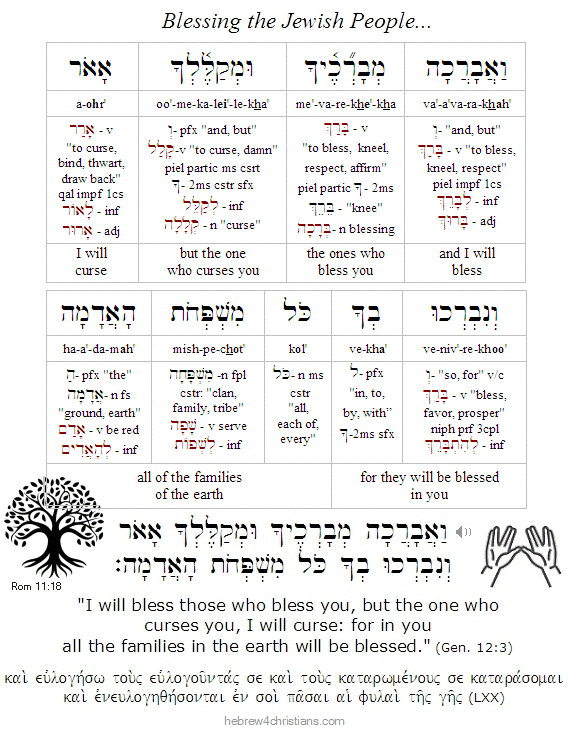 |
Tues. April 21st - Wed. April 22nd
Happy Birthday Israel!
Acceptance and Trust...

The following reflects on Yom HaShoah and our need for endurance...
04.17.26 (Nisan 30, 5786) What do we do with anguish of heart? The ancient Jewish custom of keriah (קְרִיעָה), the tearing of clothes (or cutting a black ribbon worn on one's clothes) to express grief, is to be performed while standing up. The sages say this is to teach that even in time of grave testing, when we protest over loss and recoil from what God brings our way - we are to be upright, we are to meet all sorrow while standing upright. We forswear all blame and accept life on God's terms, continuing to trust in times of darkness. Even in moments of inner heartache we affirm faith in God's promises for good.
We had nothing when we were born into this world, and all that we now have was given to us by hashgachah pratit - the providential plan of God. As the LORD graciously gave, so He has the prerogative to take away. Pain, suffering, and even death itself surely do not come by accident but are rather part of the inscrutable will of God, who works all things together for the good of creation. Gam zu l'tova – this too is "for the good," even if the good is not revealed in the moment.
Job refused to blame God for his troubles for he understood that whatever God does (or allows) must itself good, and there is no reason to doubt this, even if in the present there is tribulation – indeed, even unto the throes of death. "Every good gift and every perfect gift is from above, coming down from the Father of the heavenly lights, with whom there is no variation or shadow due to change" (James 1:17). As it is written, lo yimna-tov laholekhim be'tamim (לא יִמְנַע־טוֹב לַהלְכִים בְּתָמִים), "no good thing does he withhold from those who walk in completeness" (Psalm 84:11), and you are made complete (תָּמִים) because of the finished work of Messiah on your behalf. Do not be afraid of His providence: no good thing will the LORD withhold from you...
We cannot escape suffering in this life, but God gives us heart to face the struggle. Each day contains the opportunity to serve God even in the midst of trouble (Matt. 6:34). We cannot control much of what happens to us in this life, so our task is to sanctify time and trust that God will see to our true needs. Taking refuge in God means personally trusting in His goodness for your soul, despite circumstances that might tempt you to lose heart. al evosh, ki chasiti vakh - "Let me not be ashamed, for I put my trust in You" (Psalm 25:20).
Hebrew Lesson
Psalm 25:20 reading (click):
 |
The Light of Faith...

"In faith there is enough light for those who want to believe and enough shadows to blind those who don't." - Blaise Pascal
04.17.26 (Nisan 30, 5786) Instead of regarding the Bible as a "Book of Answers" for our questions, it is worthwhile to think of it as a "Book of Questions" for our answers. As we listen, God questions us so that we can know him by means of the dialog within our hearts.
As any good teacher knows, when a student earnestly wrestles with a question he learns more than if he were given a straightforward answer. As Soren Kierkegaard once said there are many who arrive at conclusions in much the way schoolboys do: "they cheat their teachers by copying the answer book without having worked the problem out themselves." We may be able to parrot creedal formulas or recite catechisms, yet in the end it is our own responsibility to make an authentic faith commitment.
The Lord allows to be without answers so that we will be free to seek, to struggle, and to "own" what we come to understand through our relationship with him... That way our learning will be real, substantive, and born from the urgency our own inner need.
Indeed, God's very first question to man is always, ayekah: "Where are you?" (Gen. 3:9), which appeals for us to acknowledge how we hide from the truth. "Where are you?" is the poignant call of the Seeking Father for his lost child, and the question only becomes "our own" when we are willing to look at how we've come to be at this place in our lives. God's question to our heart is meant to lead us out of hiding to respond to his loving call...
Hebrew Lesson
Psalm 119:130 reading (click for audio):
 |
Thomas Aquinas' most significant work was his Summa theologiae or 'Summary of Theology,' a massive book that attempted to systematize all of Christian theology. He worked on it from 1266 through 1273, but when he was nearly finished, he underwent an experience so intense that, as he himself explained, everything he had written "seemed like straw." He thereafter gave up writing about theology after he encountered the Reality itself.
Everything is inherently mysterious, since everything ultimately expresses the inscrutable will and decrees of God.... Ask yourself with earnestness of heart: Where do I come from? Who am I? Where am I going? For what reason was I created? The first step is to wonder, to ask the searching questions, and to seek God's wisdom... The LORD is faithful and will reveal truth to the heart that seeks..
It is too easy to be preoccupied with everyday concerns and to miss the marvel and sheer wonder of existence itself. If you will approach these questions with humility and reverence, you will be filled with wonder, your heart will be filled with greater fervor, and you will hunger more than ever for God's Presence.
|
Foreseeing Heaven...

"The sense that in this universe we are treated as strangers, the longing to be acknowledged, to meet with some response, to bridge some chasm that yawns between us and reality, is part of our inconsolable secret. For glory means acceptance by God, response, acknowledgment, and welcome into the heart of things. The door on which we have been knocking all our lives will open at last." (C.S. Lewis: Weight of Glory, 1942).
04.16.26 (Nisan 29, 5786) When Abraham sought a place to bury his wife Sarah, he said to the Hittites chieftains: "I am a stranger and sojourner among you..." (Gen. 23:4). The righteous invariably feel like strangers to this world, since they are only passing through, and their focus is on the invisible "city that has foundations, whose designer and builder is God" (Heb. 11:10). Likewise they are as sojourners, not at home in this world, because their faith sees through the vanity and deceit of the present world, and therefore they regard themselves as on a journey to the place of truth and holiness where God abides.
The profane person, on the other hand, regards their natural life in this world to be of utmost importance, and therefore they ensconce themselves in this world, "absolutizing" the moment and forfeiting the blessing of the eternal (Matt. 16:26). Abraham regarded himself as a "stranger and sojourner" (גֵּר־וְתוֹשָׁב) because the people of his world considered themselves as "owners" and "permanent residents" who sought their inheritance in the here and now. Abraham was a "resident" of someplace higher, however, and understood this world to be a corridor to the next. The sages comment on this paradox: God says to man, 'If you see yourself as a permanent resident in this world, then I will be a stranger to you; if, however, you see yourself as a stranger to this world, then I will be a Dwelling Place for you."
Hebrew Lesson
1 Chronicles 29:15 Hebrew reading:
 |
Like father Abraham we must learn to see beyond the temporal to behold the eternal; we must look past the shadows to see the substance. Faith calls us to see the unseen, to believe in the promised good that will come, and to keep hope alive... We have to turn our attention away from the rumors and visions of the present hour to see the supernal light which transcends the atmosphere of this world (2 Cor. 5:7). Faith separates us from the visible and temporal realm (i.e., chayei sha'ah: חיי שעה) before the invisible and eternal realm (i.e., chayei olam: חַיֵּי עוֹלָם); it hears (shema) the "yes" of the LORD in the midst of worldly dissipation and despair. Faith is the heartache, the groaning, and the yearning for undying love. "Whom have I in heaven but you? And there is nothing on earth that I desire besides you. My flesh and my heart may be consumed, but God is the strength of my heart and my portion forever" (Psalm 73:25-26). This world appears to the eye of faith a strange place, and here we are no more than sojourners as we look for our heavenly habitation whose builder and maker is God (Heb. 11:10; John 14:1-3). Our hearts yearn for the unseen good, healing beyond death to life, the realm of promise and blessing and unending grace.
So for what do you hope? What are your dreams? Your deepest desires? Where is your treasure? Yeshua cautioned those who sought their happiness in this world: "Do not store up for yourselves treasures upon earth... be rich toward God" (Matt. 6:19-20; Luke 12:21). When we treasure God, our focus is directed toward the eternal reality, and our interest in this world is minimal. We trust God to meet our daily needs and surrender our future to His care. The only worry we face concerns our own deficiencies in our obligations to the Savior. Our duty is to love God in the truth - bekhol levavkha - with all our heart, having no thought of ourselves. Indeed, self-denial means to quit thinking about yourself (from α-, "not," + ῥέω, "to speak") by accepting what God has done for you. "It is not my business to think about myself. My business is to think about God. It is for God to think about me" (Simone Weil).
"Now, if we are made for heaven, the desire for our proper place will be already in us, but not yet attached to the true object, and will even appear as the rival of that object. If a transtemporal, transfinite good is our real destiny, then any other good on which our desire fixes must be in some degree fallacious, must bear at best only a symbolical relation to what will truly satisfy" (C.S. Lewis: Weight of Glory, 1942).
Hebrew Lesson
Psalm 73:25 Hebrew reading:
Endurance and Hope...
"Those who hope in Christ can no longer put up with reality as it is, but begin to suffer under it, to contradict it. Peace with God means conflict with the world, for the goads of the promised future stab inexorably into the flesh of every unfulfilled present. If we had before our eyes only what we see, then we should cheerfully or reluctantly reconcile ourselves with things as they happen to be. That we do not reconcile ourselves, that there is no unpleasant harmony between us and reality, is due to our unquenchable hope." – Jurgen Moltmann
04.15.26 (Nisan 28, 5786) Though we are optimistic about the purpose and end of reality, and though we believe that God "works all things together for good" (Rom. 8:28), we are not therefore "monistic idealists," that is, those who say that "God is One" really means that evil is not real or that it is actually a "part of God." Reductionistic answers are always too simplistic, whether they come from science, theology, or cracker-barrel philosophy...
The Spirit of God says: "Woe to those who call evil good, and good evil; who put darkness for light, and light for darkness; who put bitter for sweet, and sweet for bitter! Woe to those who are wise in their own eyes, and prudent in their own sight!" (Isa. 5:20-21).
It is woeful to confound the moral truth of God with sophistical categories of human arrogance: "language games" intended to subvert and pervert all the great principles of truth, wisdom, and of righteousness... And it is woeful to "sanctify crimes with the names of virtues," to pillage the truth of language for illicit or perverse gain. And yet again it is woeful to abuse the mind by confounding the role of conscience, to disparage intuitions of moral reality, to impugn logical reasoning, and therefore to make a "pretend form" of knowledge.
The Holy Spirit states that the difference between good and evil, and of sin and righteousness, is as evident as the difference between the most obvious of contrary qualities discovered by the senses, such as the benefit of light over darkness and of seeing over being blind.... Throughout the Scriptures, "darkness" symbolizes ignorance, error, deception, and crime, whereas "light" connotes truth, knowledge, and heartfelt piety. Likewise bitterness is associated with evil and sin: "Your own wickedness will correct you, and your backslidings will rebuke you. Know therefore and see that it is evil and bitter (רַע וָמָר) that you have forsaken the LORD your God, and that the fear of Me is not in you (וְלֹא פַחְדָּתִי אֵלַיִךְ)," declares the Lord GOD of hosts" (Jer. 2:19; see also Jer. 4:18), just as sweetness is associated with goodness and righteousness: "How sweet are Your words to my taste! Sweeter than honey to my mouth" (Psalm 119:103); "Taste and see that the LORD is good; blessed is the person who trusts in Him" (Psalm 34:8). The commandments of God are more to be desired than gold, yea, than much fine gold: sweeter also than honey and the honeycomb; moreover by them is thy servant warned, and in keeping of them there is great reward" (Psalm 19:10-11).
Alas, the majority of people in every generation love darkness more than light, as our Lord attested: "This is the condemnation, that light has come into the world, but people love darkness rather than light, because their deeds are evil. For every one that does evil hates the light and does not come to the light, so that his deeds would be exposed. But the person who does truth comes to the light, that his deeds may be made manifest that they done by God's power" (John 3:19-21). In this connection Charles Elliot wrote: "Deliberate perversion is in all ages the ultimate outcome of the spirit that knows not God, and therefore neither fears nor loves Him, whether it shows itself in the license of profligacy, or the diplomacy of Machiavellian statesmen, or the speculations of the worshipers of mammon."
We are given "exceedingly great and precious promises," yet in this world we suffer and experience real pain, heartache, and troubles. Yeshua said "in this world you will have tribulation," though that is not the end of the story, of course, for there is the cheer of God's' victory, even if we must repeatedly ask God for grace to endure our troubles without murmuring or kvetching (John 16:33; Heb. 4:16). I realize that is often difficult, and some of you might be within the fiery furnace even now. You might be asking, "Where are you, Lord, in all of this? Why don't you bring me out of these troubles?" In such testing you need endurance (ὑπομονή) to hold on to hope, believing that God uses affliction to refine you for good. As Paul said, "We rejoice in our sufferings, knowing that suffering produces endurance, and endurance produces refined character, and refined character produces hope" (Rom. 5:3-4). Each of us is still upon the "Potter's wheel," and God's hand continues to shape us into vessels that one day will reveal his glory and honor. "The LORD will give strength to his people; the LORD will bless his people with peace" (Psalm 29:11).
Hebrew Lesson
Psalm 29:11 reading (click):
Let's keep holding on, friends, and never give up. Though these are indeed perilous times, the Lord our God is faithful and true. He will never leave nor forsake us, whatever may come. The Lord gives us acharit ve'tikvah (אַחֲרִית וְתִקְוָה), "a future and a hope" (Jer. 29:11).
Kaddish and Providence...

"Here is a fundamental difference between the man of faith and the man of unbelief. The unbeliever is 'of the world', judges everything by worldly standards, views life from the standpoint of time and sense, and weighs everything in the balances of his own carnal making. But the man of faith brings in God, looks at everything from His standpoint, estimates values by spiritual standards, and views life in the light of eternity. Doing this, he receives whatever comes as from the hand of God. Doing this, his heart is calm in the midst of the storm. Doing this, he rejoices in hope of the glory of God." - Arthur W. Pink
04.15.26 (Nisan 28, 5786) Since we are required to both affirm and to trust that "all things work together for good" (Rom. 8:28), we must bless God for perceived evil as well as for perceived good, since all circumstances of life come from the hand of the LORD our God (Job 2:10). Despite appearances that sometimes seem to the contrary, we believe that the all-powerful, supreme LORD has not abandoned the world but actively sustains and upholds it with benevolent intent (Heb. 1:3). "We walk by faith and not by sight" (2 Cor. 5:7). When bad things happen to the righteous, we trust in God's personal care for their ultimate good, despite their present troubles. As the prophet Job said: "Though he slay me, I will trust in Him" (Job 13:15). This is the heart behind the Kaddish, the mourner's prayer, that expresses acceptance of God's world, despite the pain, sorrow, loss, and so on.
I've mentioned before that the term hashgachah pratit (השׁגחה פרטית) refers to God's personal supervision of our lives (hashgachah means "supervision," and pratit means "individual" or "particular"). Since He is the Master of the Universe, God's supervision reaches to the smallest of details of creation - from subatomic particles to the great motions of the cosmos. God not only calls each star by its own name (Psalm 147:4), but knows each particular lily and sparrow (Matt. 6:28-30, 10:29). Each person created in the likeness of God is therefore under the direct, personal supervision of God Himself -- whether that soul is conscious of that fact or not. As Yeshua said, even the hairs on your head are all numbered (Matt. 10:30). Indeed, the God of Israel is called אלהי הרוּחת לכל־בּשׂר / Elohei ha-ruchot lekhol-basar: "The God of the spirits of all flesh" (Num. 16:22), and that means He is LORD even over those who vainly attempt to suppress His Presence and reality. "Can a man hide himself in secret places so that I cannot see him? declares the LORD. Do I not fill heaven and earth?" (Jer. 23:24).
The Talmud says that when Moses asked God, "Please show me your glory" (Exod. 33:18), he was asking for God's vindication in the light of the gnawing question: "Why do the righteous suffer while the wicked prosper?" Moses was not given an explicit answer, and some of the sages said he wrote the enigmatic Book of Job to demonstrate that the question can only be reduced to God's inscrutable will: "Where were you when I laid the earth's foundation?" (Job 38:4). In other words, the question can only be answered by the One who knows the beginning from the end, the Infinite One who sees the implications and concatenation of all things. As finite beings, we see only a fraction of the big picture, and therefore we must yield our trust to the Wisdom and Power of Almighty God (Deut. 32:4).
It is written, "Your eyes saw me when I was inside the womb; in your scroll everything was written, my days were ordained before they came into existence" (Psalm 139:16). In light of God's providential ordering of our lives, Blaise Pascal asked, "What is left for us but to unite our will to that of God himself, to will in him, with him, and for him the thing that he has eternally willed in us and for us." The Mishnah says it this way: "Do His will as if it was your will that He may do your will as if it was His will" (Avot 2:4). In other words, what else can we do but learn to trust, accept, and to say "yes" to life -- even if at times we may feel like orphans, lost in a fatherless world... All our days are recorded in God's scroll.
Hebrew Lesson:
Psalm 139:16b reading (click):
 |
There is a dark temptation to refuse to accept God's sovereign will, which includes objecting to his "tolerance" of evil (for a season) until his greater plan for the redemption is fully manifest... We need to be careful lest we become hardhearted, bitter, and despair over the purpose for life - like Ivan in The Brother's Karamazov (Dostoevsky) who, though he intellectually gave assent to God's providential plan, refused to accept it because of the unspeakable cruelty and senseless suffering he saw in the world. His disillusionment moved him to say to his sincerely devout brother: "It's not God that I don't accept, Alyosha, only I most respectfully return him the ticket." How tragic that the heart can turn away from God because the present moment seems incomprehensible and broken.... How many people have so despaired when, if they had but held on for awhile longer, they may have received solace and comfort... For me it helps to remain humble, to confess my ignorance of much, and to "remember the future" wherein glory and beauty will be soon be revealed (Psalm 31:19).
Hebrew Lesson
Psalm 31:19a reading (click):
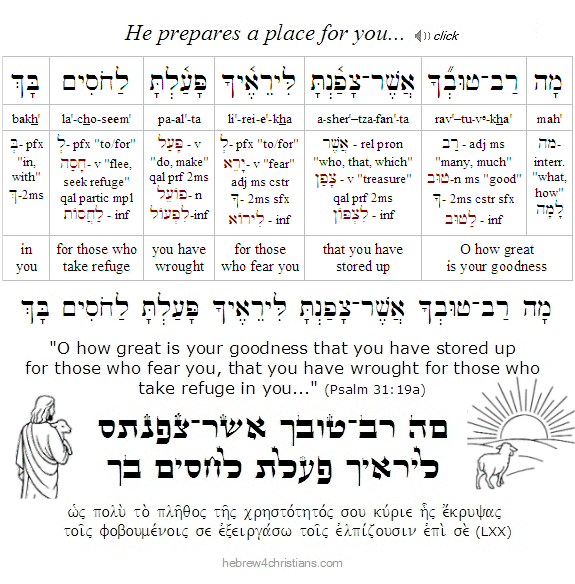 |
For more on this, see the meditation entitled "Paradox and Presence.
The Yoke of Messiah...
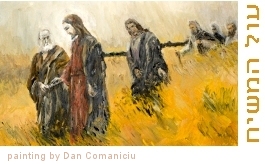
"And now brothers, I will ask you a terrible question, and God knows I ask it also of myself. Is the truth beyond all truths, beyond the stars, just this: that to live without him is the real death, that to die with him the only life?" - Buechner
04.14.26 (Nisan 27, 5786) What is the goal of our relationship with God? What is the point? Is it some form of escapism from the suffering we all experience? Is it as Karl Marx cynically said nothing but the "opiate" of the masses ("hopium") intended to insulate people from the dreadful truth of their mortal and ultimately hopeless condition? Or is it rather the most radical and fundamental need of the human heart, the very reason for our existence, and the ultimate truth for which we are willing to give up our lives and die?
Yeshua taught that the purpose of a relationship with God was to receive divine life by knowing the truth of God revealed in him. He said to his disciples: "This is eternal life (חַיֵּי עוֹלָם) that they may know you the only true God, and Yeshua the Messiah whom you have sent" (John 17:3). Knowing God in this way means understanding his heart and character, and learning to become "mature" (i.e., τέλειον, "complete, whole, finished") through your union with the Messiah (Col. 1:28; Eph. 4:13). Practically speaking we "put on" a new spiritual nature (our "new self") which is created after the likeness of God (כִּדְמוּת אֱלהִים) in true righteousness and holiness (Eph. 4:24). We know and believe who we are as God's beloved children (Rom. 8:29). This is a matter of faith, indeed, but it is also a matter of the will. We must line up our attitudes and emotions in light of the truth of reality...
Immature emotions are out of alignment with what is real, evidencing disordered affections based on illusions. "Putting away childish things" (1 Cor. 13:11) means surrendering or letting die (καταργέω) self-centered emotions and desires, letting go of self-pity or bitterness, and refusing to blame others. Spiritual maturity implies humility, denying yourself, a word that means to stop thinking about yourself (from α-, "not," +ῥέω, "to speak"), and living the truth by sharing God's redemptive vision and mission for others. We must be careful, however, not to drift away, since it is possible to "forget" the truth that once guided our way; and it is possible to become dull of hearing, shortsighted, and to stop growing in relationship with God (Heb. 2:1). Spiritual truth is not merely intellectual but existential: we must earnestly pursue (διώκω) our heavenly calling (Phil 3:14) and this requires the daily and ongoing decision to live before the LORD our God (Psalm 16:8). The invitation to "choose this day whom you will serve" (Josh. 24:15) implies that is your choice - and your responsibility - to draw near to God (James 4:8). We can do this by studying and memorizing Scripture, meditating, praying, and sharing our hope with others. Above all we must ask God for the gift of the Holy Spirit to "bear us up into maturity" (i.e., ἐπὶ τὴν τελειότητα φερώμεθα, Heb 6:1) so that we may learn from our Master who calls us to be joined to his yoke and learn from him (Matt. 11:29).
Hebrew Lesson
Psalm 116:7 reading (click for audio):
 |
Note: A "yoke" is a wooden crosspiece fastened over the necks of two animals that joins them together. Yokes are typically used to train one animal in the work of plowing or pulling a cart or as a way to team animals together for more efficient work. When Yeshua says "take my yoke (i.e., עוֹל / ζυγός) upon you and learn from me, for I am gentle and lowly in heart, and you will find rest for your souls" (Matt. 11:29), the metaphor implies that you will be joined or connected together with him to help cultivate the kingdom of God. Yeshua's yoke, however, is not like the yoke of various forms of "religion" that lead to slavery, but the source of a fruitful life that produces love, joy, and peace....
Cleansing of the Leper...

04.14.26 (Nisan 27, 5786) In our Torah reading this week we learn that while the priest needed to go "outside the camp" to examine a metzora (i.e., "leper"), the afflicted person still needed to come to the priest to meet him there (Lev. 14:2-3). In other words, the afflicted one was required to meet the priest "half-way." Hashivenu (הֲשִׁיבֵנוּ): "Return us to You, LORD, and we shall return" (Lam. 5:21). Like the prodigal son who returns home, God waits for us at the "edge" of the camp to meet us half-way...
The case of the metzora reveals that God sometimes disciplines his child with "exile" in order to awaken teshuvah within the heart. God imparted the spiritual disease of tzara'at to "remind" us of our sin and need for atonement, and the purification ritual was meant to illustrate our need for spiritual rebirth.... The gracious aim of affliction, then, is to "wake us from our slumbers" in order to reveal the way of life... As C.S. Lewis once said, "God whispers to us in our pleasures, speaks to us in our conscience, but shouts in our pains: It is His megaphone to rouse a deaf world."
A student once asked his rebbe: "Do we get punished for our sins in this world?" His succinct response was, "Only if we are made fortunate..."Indeed, correction from God is a blessing in disguise, since there is no worse state in this life than to be untouched by need, suffering and testing; there is nothing more dreadful than to be forgotten or overlooked by God (Rom. 1:28). God is teaching you through your failures; he is training you to persevere, to endure, and to become strong. As it is written, "If you are left without discipline (i.e., musar: מוּסָר), then you are illegitimate children and not sons" (Heb. 12:8). Being afflicted with "tzara'at" is a blessed state, since it reveals the nature of our lethal disease - and leads us back to the "edge of the camp" where God gives us healing....
As I have mentioned before, Jewish tradition links tzara'at with the sin of lashon hara, suggesting that the word metzora itself is a "play" on the Hebrew phrase, motzi ra: "one who brings forth [speaks] evil." Mavet v'chaim be'yad lashon (מָוֶת וְחַיִּים בְּיַד־לָשׁוֹן) - "Death and life and in the power of the tongue" (Prov. 18:21). Because we are made in the image and likeness of God, our words matter -- and they wield power. Indeed, the Hebrew word for "word" (דָּבָר) also means "thing." When we bless others, we are invoking grace and good will to be manifest in the world, but when we curse others, the opposite effect is intended... There is a connection here with the case of the metzora, whose fate rested upon a single word spoken by the priest: "unclean" (טָמֵא) or "clean" (טָהֵר). (For more on this subject, see "Teshuvah of the Tongue").
Yeshua soberly warned us, "I tell you, on the day of judgment people will give account (ἀποδίδωμι) for every careless word they speak (i.e., πᾶν ῥῆμα ἀργόν, all "empty" or "thoughtless" words), for by your words you will be justified, and by your words you will be condemned" (Matt. 12:36-37). Every word we utter reaches up to the highest places of heaven and echoes there. The sages say, "my words - not a soul knows." But the Holy One, blessed be He, says, "I am sending an angel who will stand near you and record every word you say about your neighbor." Every word we speak is recorded in the "heavenly scrolls" (Rev. 20:12). Therefore David admonishes us, "Who desires life (מִי־הָאִישׁ הֶחָפֵץ חַיִּים) and loves many days that bring forth good? Guard your tongue from evil and keep your lips from using deceptive speech. Turn away from evil and do good; seek peace and pursue it" (Psalm 34:13-14). Notice the connection between our words and our deeds here, which again suggests the connection between "words" and "things" (i.e., devarim: דְּבָרִים). It is very sobering to realize that our thoughts are essentially prayers being offered up to God... As David also said (Psalm 35:13): "May what I prayed for happen to me!" (literally, tefillati al-cheki tashuv - "may it return upon my own breast").
Because the metzora was put into exile because of his sinful thinking (i.e., words), so he came back to the "edge of the camp" only with words... This first step back was crucial, as the prophet later said, "Take with you words and return to the LORD. Say to Him, "Take away all our iniquity and receive us for good, so shall we render the sacrifice of our lips" (Hos. 14:2). When we sincerely return to the LORD, He will take care of the problem of our impurity, uncleanness, and sin. That's the message of the Cross of Yeshua, too. We can add nothing to His finished work but simply accept it as performed on our behalf through faith...
Hebrew Lesson
Hosea 14:2 reading (click for audio):
 |
The love of God is so great that He reached out and touched us - becoming a "leper" for us - and even chose to die "in exile" upon the cross to eternally purify us from our sins... In that sense, Yeshua surely meets us more than "half-way," since He "emptied Himself" (κενόω) of His heavenly glory and power in order to willingly bear our sickness, shame, and even death itself on our behalf... "But [He] made himself nothing (εκενωσεν), taking the form of a slave, being born in the likeness of men; and being found in human form, he brought himself low by becoming obedient to the point of death, even death on a cross" (Phil 2:7-8).
May His Name forever be praised!
Priests and Lepers...

04.13.26 (Nisan 26, 5786) In our Torah portion for this week (Tazria) we read: "When a person (i.e., adam: אָדָם) has on the skin of his body a swelling (שְׂאֵת) or a scab (סַפַּחַת) or a bright spot (בְּהֶרֶת)... he shall be brought to the priest" (Lev. 13:2). Here the sages note three common afflictions that befall the "children of Adam," namely, 1) swelling (i.e., שְׂאֵת), representing arrogance; 2) scabs (סַפַּחַת), representing worldly vanity (from a root (סָפַח) that means to "join together"); and 3) bright spots such as moles or macula (i.e., בַּהֶרֶת), from a root (בָּהָר) meaning to enlighten, representing carnal reasoning to regard the ways of God.
When we see only the affliction, we must go to the priest – to one who helps mediate the Divine Presence – to see how deep the affliction is and what its root might be... Symbolically, since we are all priests to one another (see Exod. 19:6; 1 Pet. 2:5,9; Rev. 1:6), we share our afflictions with one another, allowing ourselves to be seen, and to confess our need for healing. "Therefore, disclose (ἐξομολογέω, lit. 'confess out') your sins to one another and pray (εὔχομαι) for one another, that you may be healed..." (James 5:16).
Followers of Yeshua are intended by God to be healers (Luke 9:1). The most common word for healing in the New Testament is therapeuo (θεραπεύω), a word that means to serve, to care for, and to restore to health. Unlike some ministers who draw crowds to demonstrate the power of miraculous "faith healing," true spiritual healers take the time to listen to others, to hear their inward pain, and to extend compassion and grace to them. They help open the inner eyes of the heart by extending hope and a new vision about what is real... Indeed, lasting healing focuses less on being cured than on finding hope that will never die.
Hebrew Lesson:
Psalm 103:3 reading (click for audio):
 |
Monday April 13th at sundown
Holocaust Remembrance Day...

04.13.26 (Nisan 26, 5786) Yom HaShoah, or "Holocaust Remembrance Day," marks Israel's time of commemoration for the approximately six million Jews -- including over a million children -- who perished as a result of the actions carried out by Nazi Germany and its accomplices. It was inaugurated in 1953 and is annually observed on (or about) the 27th day of the month of Nisan, just a few days after Passover Week in the spring. In stark contrast to the celebration of freedom commemorated during Passover, Yom HaShoah commemorates a very difficult time when we revisit specters of systemic evil and again ask haunting questions about the power and presence of malevolence in our world. Often we are left speechless over the cruelty and depravity of human beings. It all seems so inexplicable, so needlessly horrible, so senseless, so vile... We may feel powerless, despondent, or full of indignation, but still we ask ourselves, how could this have happened? How was all of this possible?
Simply put, the Holocaust was the result of cowardice and self-deception... The systematic, institutionalized, and "politically correct" genocide of the Jewish people was made possible solely because so many others - including nominal "Christians" - forfeited their God-given responsibility to live as authentic individuals by passively surrendering their will to "the crowd." But giving up your identity to join a gang inevitably leads to fragmentation of the soul, potentially inviting in a "legion of demons..." Regardless of whether it's a gang of thugs running an inner city neighborhood, or the pressure to keep quiet over ethical misconduct at your place of work, or the desire to feel "approved" as a good citizen of the state, or even the pressure to conform to a particular religious group, in either case, "losing yourself" in the midst of the crowd is an evasion, a cop-out, and a desecration of the image of God within you. Indeed following the crowd is a form of slavery where you surrender your freedom for the sake of a supposed sense of security... You become self-deceived because you no longer "own" yourself but became the ward of "another." Becoming a member of a crowd makes you into a copy or similitude, a shadow rather than a person of substance.
We must never forget what happened to the Jewish people under Hitler; we must resolutely say "never again" (i.e., le'olam lo od: לעולם לא עוד) to such atrocities. The Holocaust was made possible because people timidly refused to stand apart from the group to serve as bold witnesses of the truth. And the great risk of our age is the revival of political fascism that attempts to again control, disarm, and violate people's freedom all for the supposed "greater good" of the "state." We must remember that silence in the face of evil is itself evil: "First they came for the communists, and I didn't speak out because I wasn't a communist. Then they came for the trade unionists, and I didn't speak out because I wasn't a trade unionist. Then they came for the Jews, and I didn't speak out because I wasn't a Jew. Then they came for me, and there was no one left to speak out for me" (Martin Niemöller).
This year Yom HaShoah, or "Holocaust Remembrance Day, begins Monday, April 13th (at sundown) and runs through Tuesday, April 14th until sundown.
Hebrew Lesson
Psalm 122:6 reading (click):
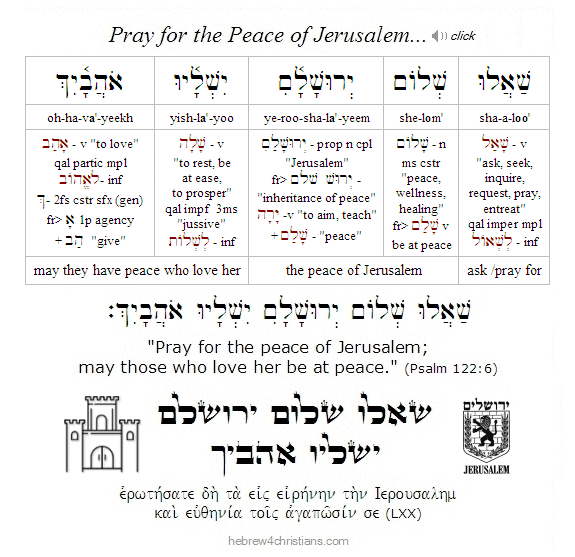 |
As atrocious and appalling as the European Holocaust was for the Jewish people, we would be remiss not to mention the current persecution of Israel and the Jewish people by Hamas ("Islamic Resistance Movement"), by Hezbollah, by the Islamic Republic of Iran, by the Palestinian Authority (the old PLO), and the various anti-Jewish groups and advocates around the world. Israel is truly surrounded by enemies...
And we should also remember the earlier genocide of Christians -- mostly Armenians but also Assyrians and Greeks -- that took place under the Islamic Ottoman Empire, throughout World War I, where the Turks systematically massacred approximately 1.5 million Armenians, 300,000 Assyrians, and 750,000 Greeks. Indeed April 24th is recognized (by some) as "Armenian Genocide Remembrance Day." In Yerevan, the capital of Armenia, hundreds of thousands of people walk to the Tsitsernakaberd Genocide Memorial to lay flowers at the eternal flame.
Finally, Christians are also under worldwide persecution and oppression as well. According to the Cato Report, today -- at this time in history -- Christians are the single most persecuted religious group in the world (and that does not include the persecution of Christians in many "democratic" countries such as the United States, Canada, the United Kingdom, and other countries of western and eastern Europe).
Yom HaShoah Podcast...

Yom HaShoah, or Holocaust Memorial Day, begins Monday April 13th at sundown and runs through the following day until sundown...
04.13.26 (Nisan 26, 5786) Shalom chaverim. I made an audio podcast for Yom HaShoah, or Holocaust Remembrance Day (see the link below). In it I discuss some of the philosophical influences that led to the atrocities of the attempted genocide of the Jewish people, including the rise of the wild-eyed idealism of G.W. Hegel and the invidious concept of the "dialectic" that was used to negate the value of the individual in preference to the collective.... Hegel directly influenced Karl Marx and his godless materialism and social revolutionary theories, and in general it may be said that German idealism led both to the nihilism of Friedrich Nietzsche and eventually to the barbarity of Adolf Hitler's national socialism. Though the subject matter is a bit philosophical, I nevertheless hope you will find it helpful.
Parashat Tazria-Metzora...
04.12.26 (Nisan 25, 5786) Shavuah tov, chaverim. In addition to Yom HaShoah observance this week we have a "double portion" of Torah, both parashat Tazria (Lev. 12:1-13:59) as well as parashat Metzora (Lev. 14:1-15:33), both of which focus on the concept of being "clean" (i.e., tahor: טָהוֹר) and purified from a state of "uncleanness" (i.e, tamei: טָמֵא).
The first reading, Tazria (תזריה) continues the discussion of the laws of "purity" and "impurity" that were introduced earlier with parashat Tzav. A woman who has just given birth is regarded as a niddah (a menstruent woman) and is considered "impure" (tamei) regarding the sanctuary for 40 days (if it is a boy) or 80 days (if it is a girl). On the eighth day of life a boy must be circumcised. After the mother's "period of ritual impurity" had ended, she was required to bring a yearling sheep as a burnt offering and a dove for a sin offering (if she is poor, two doves sufficed for both offerings).
The portion goes on to describe certain afflictions, collectively called tzara'at (צרעת) that cause the affected person (or thing) to be both ritually impure (i.e. tamei: טָמֵא) and in a state of uncleanness (i.e., tumah: טומאה). Note that tzara'at is not to be identified with "leprosy" (as some translations claim), since the symptoms of tzara'at included not just the afflicted person's skin, but sometimes his clothes, pottery vessels, and even his house.
When applied to people, tzara'at indicates a sort of a spiritual sickness (i.e., yisur: יסור) that could only be diagnosed by a kohen (priest). If white or pink patches appeared on a person's skin, the afflicted person was required to contact a kohen for an examination. If the priest detected 1) two hairs that had turned white within the spot, or 2) a piece of healthy skin in the middle of the spot, he was declared a "metzora" (מצורע) and was required to do undergo prescribed treatment; otherwise he was declared tahor (clean).
On the other hand, if the priest suspected tzara'at but was somewhat unsure, the supposed metzora was quarantined and required to perform teshuvah (repentance). If a second evaluation indicated that the spot(s) had grown larger in size, however, the person was declared tamei (unclean) and was subject to the restrictions for the metzora.
 |
Once someone was diagnosed as metzora, they were forced to leave the community and to live in a state of exile. He or she had to tear their clothes like a mourner, put a shroud over their face (descending to the upper lip) and remain alone. If anyone came near, the metzora was required to cry out: "Unclean! Stay away! Do not become impure because of me!" (no one was permitted to come within eight feet of the metzora). While so isolated, the person would have opportunity to perform teshuvah and seek spiritual "rebirth" (as described in the following Torah portion, parashat Metzora).
In our second portion this week (i.e., Metzora: מצורע), we learn about the laws for cleansing metzoraim. If the person suffering from tzara'at had apparently been healed, he or she would call for the priest to be officially reexamined. If the priest saw no sign of tumah (uncleanness), a second examination was scheduled a week later, and if the metzora was free from any sign of the disease, the process of tahara (purification) would begin.
The purification process was somewhat elaborate: After the second examination, the priest required that the metzora bring the following items for his cleansing:
- An earthenware bowl filled with spring water (mayim chayim)
- Two birds of the same type (whether turtledoves or pigeons)
- A stick of cedar wood
- A hyssop branch
- A scarlet thread
The priest then instructed that one of the birds would be slaughtered over the earthen bowl filled with fresh water, with its blood mixing with the water. The living bird, the piece of cedar, and the hyssop branch were then tied together using the scarlet thread, and the entire bundle was dipped into the earthen bowl. The blood and water mixture was then sprinkled seven times on the healed metzora, and the living bird was then set free.
Next, the afflicted person washed his or her clothes, shaved off all their hair (including the eyebrows), and bathed in a mikveh (ritual pool for cleansing). After that he or she could return to the camp - but not to his home for another seven days. On the eighth day the person would bathe again and offer several offerings (a chatat, an asham, an olah, and a minchah), but the blood from the asham (guilt) offering was mixed with oil and applied to his earlobe, thumb and foot, similar to the blood applied to the priests during their ordination. Oil from a meal offering was sprinkled seven times in the direction of the Sanctuary. Only after all this was the metzora pronounced tahor (clean) by the priest. The life of uncleanness would be over, and the healed person would be like a one who was brought back from the dead to new life.
This purification ritual corresponded with other rituals revealed in the Torah. The sprinkling of the hyssop by the priest recalled both the blood of the Passover lamb and the sprinkling of the ashes of the Red Heifer that cleanse from contact with death; the offering made of the two birds - one which was sacrificed and the other set free - recalled the scapegoat of the Yom Kippur ritual. The washing of garments, the shaving of all hair, and the immersion in a mikveh recalled the birth of the Jewish people at the Sea of Reeds. The blood of the guilt offering applied to the earlobe, thumb and foot, recalled the dedication of Aaron and his sons as the priests of Israel (Lev. 14:14). In other words, the individual purification process mirrored the purification of the community of Israel, and healing ultimately meant being reidentified as a redeemed child of God. In a very literal sense, then, we see how the metzora was "reborn" by water and by the blood (John 3:5; 19:34; Heb. 9:19).
Strength for the Weary...

04.10.26 (Nisan 23, 5786) In connection with our Torah portion for this week (i.e., Shemini) the sages ask, "Why does the Torah use a repetitious expression, "Sanctify yourselves and you shall be holy" (הִתְקַדִּשְׁתֶּם וִהְיִיתֶם קְדשִׁים) (Lev. 11:44)? Because when we make an effort - no matter how feeble at times - to draw near to the LORD, He will draw near to us....
There is a story (told in the midrash) that illustrates the idea: An old sage once saw a beautifully shaped rock which he very much wanted to bring as a gift to the Holy Temple in Jerusalem. However, the rock was too heavy for him to carry and he couldn't afford to pay porters to bring it to Jerusalem. The man prayed and asked God for help, and soon five angels (disguised as men) appeared to offer the man help. The sage told them that he would like them to carry the stone to Jerusalem, but he couldn't pay them. The five angels immediately offered to carry the rock on his behalf, but only if the man put his finger to the rock to "help" them carry it. The midrash states that although the angels didn't need man's help, the man was required to do what he could.... God then took care of the rest.
In this connection, the Dubner Maggid once told this parable: A tourist once checked into a hotel and asked the porter to bring his suitcase to the top floor, where he had rented a room. After an hour or so the porter knocked on his door and brought in the suitcase, sweating and breathing heavily. "What did you put into your suitcase, stones?", the porter asked, "it is extremely heavy!" The tourist looked at him in surprise: "My suitcase is heavy? Not at all! Mine is very light. You must have mistakenly brought up someone else's suitcase!"
Do you feel "weary" about serving the LORD? Then maybe you have "picked up" some other agenda along the way. The Lord says, "You have not worshiped Me .. that you should be weary of Me... (Isa. 43:22). In other words, serving the LORD leads to freedom and joy. Indeed, the NT Greek word for the word for "joy" (χαρά) is directly related to the word "grace" (χάρις). If you find yourself "weighed down" in your service of God, something may be wrong - and the burden you are carrying might be coming from a source other than God. Where the Spirit of the LORD is, there is liberty... God is not a "slave driver," and indeed the purpose of our redemption was to set us free to serve Him. Yeshua's burden is kal - "light."
People necessarily value things, and therefore every person alive is a "worshiper" (i.e., a person who finds "worth" in something). The question that matters is what is your ultimate concern? What moves you to get out of bed in the morning, to go through your day, to have hope in your heart? What do you really want? Where are you really going? Each of us will stand before God for judgment one day and give account of his or her life... One day all that is hidden will be fully disclosed to the light...
Where it says, "I can do all things through Messiah who strengthens me" (Phil 4:13), that includes being healed of the inner pain of your life: your failures, your shame, the ache of rejection, abandonment, and so on. It means being set free from disillusionment, despair, and the oppression of relentless fear. "I can do all things through Messiah" means no longer accepting messages of self-hatred and hopelessness, no longer heeding the malicious whispers that say: "I am of no value," "I am unlovable," "my life is hopeless." No! "I can do all things through Messiah" means learning to be accepted, honored, and esteemed by God; it means opening your heart to God's love and blessing for your life; it means allowing your heart to be made right, to have inner peace... After all, Yeshua's great prayer was that we would know the truth of God's love for us (John 17), and this is the central need our lives.
Of course sometimes we indeed become weary in life - from sickness, from the world and its oppression, from heartache of life in a fallen world, from the battle with the devil, and so on, though it is vital to remember there is consolation given to us in Messiah, and heavenly food is given to strengthen us (1 Kings 17:4-6). I believe the LORD allows oppression to sometimes chasten us -- that is, to help us remember Him and our profound need for His love to reign within our hearts... As long as that is not settled, there is an ongoing lesson.
"Let us not grow weary of doing good, for in due season we will reap, if we do not give up" (Gal. 6:9). If you find yourself weary, chastened, and broken, then draw near to God, for he has promised to draw near to you: "Sanctify yourselves and you shall be holy."
Hebrew Lesson
Isaiah 40:29 reading (with comments):
 |
A Consuming Fire...

04.10.26 (Nisan 23, 5786) From our Torah portion this week (i.e., Shemini) we read: "Now Nadab and Abihu, the sons of Aaron, each took his censer and put fire in it and laid incense on it and offered strange fire (אֵשׁ זָרָה) before the LORD, that He had not commanded them" (Lev. 10:1). The sages interpret "strange fire" (i.e., esh zarah: אֵשׁ זָרָה) as alien passion or illicit zeal stimulated by artificial means (in this case, drinking wine before their service). The experience of intoxication may seem to elevate the soul, but in reality it muddles the ability to discern spiritual realities: "Drink no wine or strong drink ... when you go into the tent of meeting, lest you die. You are to distinguish between the holy and the common, and between the unclean and the clean" (Lev. 10:9-10).
Nadab and Abihu were highly honored in Israel, the first priests of God, and if they drank wine before entering the sanctuary it was surely not for crass purposes, but rather to "sanctify" their experience, or so they thought... They were severely judged, however, because they presumptuously sought to sanctify themselves by means of an artificial influence, and this made them "strange" before God. Likewise many people today seek "spiritual highs" and "signs" without undergoing the discipline of Torah study, prayer, meditation, and so on. God wants our hearts in service, but our hearts must be honest and soberly reverent before Him (1 Pet. 5:8; Eph. 5:15-18).
"Nadab and Abihu, the sons of Aaron ... brought strange fire ... and they died before the LORD" (Lev. 10:1-2). It is a fearful thing to fall into the hands of the Living God who is called esh okhlah, El kanna (אֵשׁ אכְלָה אֵל קַנָּא) - "a Consuming Fire, a jealous God (Deut. 4:24). Indeed, though atonement was provided under the law for every kind of sin and transgression, there was one exception: "But the soul that sins presumptuously (בְּיָד רָמָה) shall be out off from the midst of my people" (Num. 15:30). We must be careful not to casually regard God's truth with undue familiarity, lest we find ourselves under the influence of strange passions that lead to presumption....
Hebrew Lesson:
Deut. 4:24 Hebrew Reading:
Let us be sober and vigilant, friends. "Now these things happened to them as an example, but they were written down for our instruction, on whom the end of the ages has come" (1 Cor. 10:11). It is astounding that during the very time that the Tabernacle was inaugurated, tragedy struck and Aaron's two sons were killed. This should warn those teachers who speak casually of God from the pulpit, since they act profanely and encroach upon the Divine Presence. Let us be admonished, friends and honor the Living God. As the sages have wisely said: Da lifne mi attah omed: "Know before Whom you stand!"
The metaphor that God is a Consuming Fire suggests that He is both indescribable and passionately concerned with our devotion to Him. "Therefore let us be grateful for receiving a kingdom that cannot be shaken, and thus let us offer to God acceptable worship, with reverence and awe, for our God is a consuming fire" (Heb. 12:28-29). We are promised a kingdom that cannot be shaken, wherein the Fire that consumes will consume all things that are not established by our Heavenly Father... "Know therefore today, and lay it to your heart, that the LORD is God in heaven above and on the earth beneath; there is no other. Therefore you shall keep his statutes and his commandments, which I command you today..." (Deut. 4:39-40). May our lives on the altar ascend to God in praise.
|
Returning to the Lord...

04.10.26 (Nisan 23, 5786) The Book of Lamentations is an acrostic (i.e., alphabetical) poem that begins with the Hebrew letter Aleph (א) in the word "eichah" (אֵיכָה), which also marks the Hebrew name of the book. It is begins: "How (eichah) lonely sits the city that once was full of people!" (Lam. 1:1). The sages note that this word "how" (i.e., eichah) could also be read as "where are you?" (i.e., ayeka: אַיֶּכָּה), God's first word spoken to Adam after he broke covenant in the Garden (Gen. 3:9).
Note that God's question is often our own: "Where are you? Where are you, God? Are you here, in the midst of this tedious moment? Do you know my loneliness, my ache for love? Do you understand the fears and troubles of my heart?" And yet how many people have faith that God's call is one of comfort and restoration? God uses our loneliness ("how lonely...") to search our hearts, asking each of us, ayeka – "Where are you?" Return to Me. "Why have you turned away from me and chosen a state of exile?" Our haunting sense of God's absence impels us to seek for him... God awaits our only possible response, "Hashivenu!" -- an imperative (urgent appeal) for the grace to repent: "Turn us back to yourself, O LORD, so that we may return to you; renew our days as of old" (Lam. 5:21).
Hebrew Lesson
Lamentations 5:21 Hebrew reading (click):
Our response to the questioning love of the LORD is called teshuvah ("turning [shuv] to God"). Teshuvah is an "answer" to a shelah (שְׁאֵלָה), or a question. God's love for us is the question, and our teshuvah – our turning of the heart toward Him – is the answer. As Jeremiah confessed in the hour of great trouble: "I called upon thy name, O LORD, from the depths of the pit; Thou hast heard my voice: hide not thine ear at my breathing, at my cry. Thou drewest near in the day that I called upon thee: thou saidst, Fear not" (Lam. 3:55-57).
The Wisdom of Life...
04.09.26 (Nisan 22, 5786) Let me ask you a searching question. Are you living today as you would wish you had lived when the time comes for you to die?
Regarding living for what matters most, Kierkegaard wrote: "The earthly minded person thinks and imagines that when he prays, the important thing, the thing he must concentrate upon, is that God should hear what he is praying for. And yet in the true, eternal sense it is just the reverse: the true relation in prayer is not when God hears what is prayed for, but when the person praying continues to pray until he is the one who hears, who hears what God is asking for" (Practice in Christianity). This "purity of heart" is the essence of the great Shema, that is, the call to listen to God and to inwardly accept that loving Him is the answer to all your prayers. "Hear, O Israel, the Lord our God is the Lord alone, and you shall love the Lord your God with all your being..." (Deut. 6:4-5).
The prophet Daniel wrote of the end of days: "Many of those who sleep in the dust of the earth shall awake, some to everlasting life, and some to shame and everlasting contempt. And those who are wise shall shine like the brightness of the sky above; and those who turn many to righteousness, like the stars forever and ever" (Dan. 12:2-3). The truly wise are those are esteemed righteous by faith in God's promise and who turn others to likewise partake of the blessing of divine life.
So are you consciously living a life of wisdom? Do you seek first what matters most of all? As King David prayed, "One thing I have asked from the Lord, that I will seek after: that I may abide in the presence of the Lord all the days of my life, to behold the beauty of the Lord" (Psalm 27:4). One thing really matters, the hidden treasure, the pearl of great price...
"If any of you lack wisdom, let him ask of God gives who gives generously to all without reproach, and it will be given him, but let him ask in faith, without doubting" (James 1:5-6). God knows how much we need his wisdom to live a life that truly matters. This wisdom is "from above," imparted by the Holy Spirit, enabling you to transcend the immediacy of worldly circumstance and to concentrate on what is abidingly significant. Though our outer self is wasting away, we are renewed by grace day by day, and the temporal affliction of being constrained by vanity is working within us an "eternal weight of glory" as "we look not to the things that are seen but to the things that are unseen. For the things that are seen are transient, but the things that are unseen are eternal" (2 Cor. 4:16-18).
"For those whom God foreknew he also predestined to be conformed to the image of his Son, in order that He might be the firstborn among many brothers" (Rom. 8:29). God is working within you, transforming your heart and mind to know Him, even as you undergo refining fires. You are not an orphan in the final scheme of things: God is preparing you to dwell with him forever. "When this earthly tent we live in is taken down (that is, when we die and leave this earthly body), we will have a house in heaven, an eternal habitation made for us by God himself and not by human hands" (2 Cor. 5:1).
Meanwhile we press on in faith, keeping our focus by the radiance of His light. "I have set the LORD always before me; because He is at my right hand, I shall not be moved" (Psalm 16:8). By ourselves we are likened to "fragile clay jars" holding the great promise of God upon whom we entirely rely, knowing that the power to attain these things comes from God alone and not from ourselves (2 Cor. 4:7). The Holy Spirit attests that we are not alone; that we are never alone, for God Himself will never leave nor forsake us, and we therefore rejoice in anticipation of being with him soon in our heavenly home.
Hebrew Lesson
Psalm 90:12 reading (click for audio):
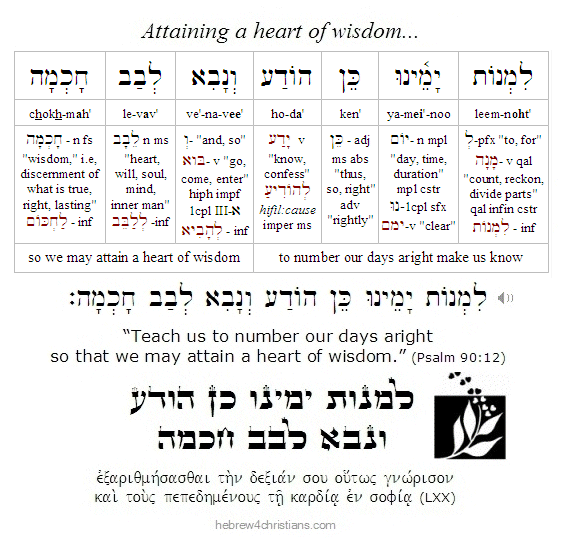 |
O Lord, teach us to die well. Reveal to us the great comforts of the gospel. Help us to step into eternity by surrendering our will and yielding ourselves completely to you, so that whether we live, we live unto you, and whether we die, we die unto you, and therefore whether we live or die we will forever belong to you...
Help us, then, to live in light of eternity, teaching us to number our days aright, so that we may attain a heart of wisdom. Help us to know your Torah, O LORD. Each of us is a cripple, hobbling through our days; each a terminal case, stricken and appointed to one day die. Sanctify our pains, our fears, and our sorrows, that they may draw our hearts closer to you. Help us prepare for the coming day by attending to what is most essential - the heavenly treasure of being in your presence. Amen.
Turn to God's Heart...

04.08.26 (Nisan 21, 5786) Turning to God in teshuvah, or "conversion," is not something you accomplish in your own strength or will. No, it is an act of grace wherein God touches you to make you alive (John 1:11-12). After all, how could it really be otherwise? From our perspective, teshuvah is a matter of trust - first trusting that God loves you and redeems you from the curse of your life, and second, that he will guide you by means of his spirit to know him. Sanctification, then, is the practice of attending to God's presence, seeking him in your heartache and in your hope, walking with him in your sorrows and in your joys....
Doubts may sometimes arise, however. You may hear questions within your soul asking where you are really going, or questions about the choices you have made. You may feel anxious or uncertain about your relationship to "God, the universe, and everything." When this occurs, you must again remember who you truly are. You must recall and reaffirm God's personal and covenantal love for you, even when you feel afraid or lost inside.
God's everlasting love in Yeshua is the foundation, the solid rock, and the place where you will find shelter. It is the very "ground of your being." God's heart is the place where you are never left nor forsaken, even if you have wandered into painful byways of regret, sinfulness, and loneliness. Like the prodigal son, when we "come to ourselves," when we remember who we really are and where we really belong, we will rediscover our Father's outstretched arms welcoming us back home (Luke 15:17-24).
Hebrew Lesson
Isaiah 41:13 Hebrew reading (click):
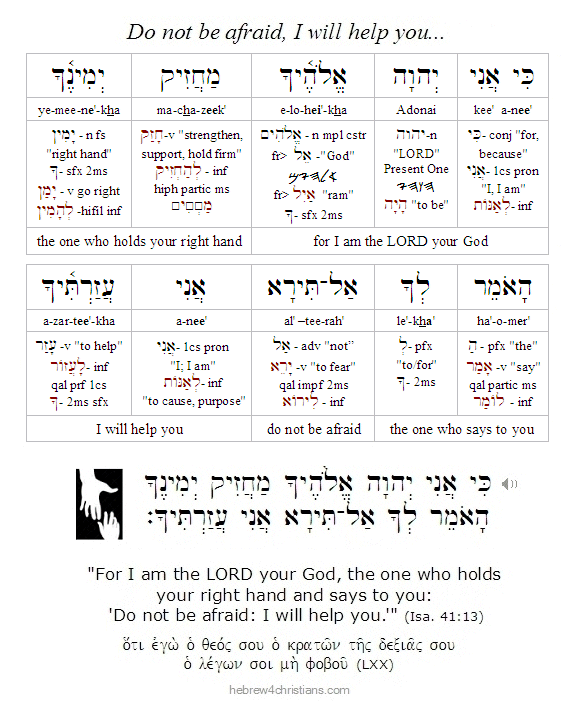 |
The Torah of Aaron...
Consider that the very first High Priest of Israel was marked with the blood of sacrifice on his ear, hands, and feet and was anointed with oil in the sign of a cross upon his forehead... a clear picture of Yeshua as our ultimate High Priest...
04.08.26 (Nisan 21, 5786) Shalom friends. In this week's Torah (i.e., parashat Shemini), we read how Moses' brother Aaron was installed as Israel's first High Priest (Kohen ha-Gadol). Aaron was a great prophet of Israel. "Before I arose," said Moses, "my brother Aaron prophesied to Israel for eighty years" (Shemot Rabbah 3:16). While the Jews were enslaved in Egypt, he went about the people proclaiming that "the Holy One, blessed be He, would soon redeem Israel from bondage" (ibid. 5:10).
When the LORD's anger was kindled against Moses for his reluctance to lead Israel out of Egypt (Exod. 4:14), God told him, "I had said you would be priest and he [Aaron] a Levite; now, however, Aaron will be a priest and you a Levite" (Zevachim 102a). When the LORD later spoke to Moses in Midian, "Go, return to Egypt, for those who seek your life are dead" (Exod. 4:19) the utterance split into two voices. Moses heard "Go, return to Egypt" while Aaron heard, "Go into the wilderness to meet your brother Moses" (Exod. 4:27).
In Pirke Avot 1:12, Aaron is said to "have loved peace and pursed it; he loved people and drew them close to the Torah." Aaron was said never to interrupt his friend's words nor to accuse others of sin. He greeted all men with love and dan l'kaf zechut (דָן לְכַּף זְכוּת) - with the benefit of the doubt. He was a peacemaker, a humble teacher, and healer. Some of the sages have even gone so far as to say that Aaron was greater than Moses himself (Avot d'Rabbi Nosson). Rashi says that Aaron's attribute of being ohev shalom - a lover of peace - therefore qualified him to become Israel's first High Priest.
Aaron's middot ha-lev (qualities of heart) sometimes made him subject to abuse from others. Aaron's pursuit of peace (אוֹהֵב שָׁלוֹם וְרוֹדֵף שָׁלוֹם) caused him to conciliate the unruly mob's demand for an idol to lead them back to Egypt. Aaron had hoped to "buy some time," since he prophetically knew that Moses was returning later that very day from the summit of Sinai. Even though he had at his disposal the army of the Levites to deal with the mob using force, he turned away from the path of violence and temporized instead. Later, after Moses returned and smashed the luchot (tablets), Aaron realized that a terrible thing had come to Israel through his action, and he therefore underwent a period of teshuvah (repentance). "He tied a rope of iron around his waist and circulated throughout the camps of Israel teaching the people. To whoever did not know prayer he taught prayer, to whoever did not know "Keriat Shema" (how to recite the Shema), he taught Keriat Shema, to whoever did not understand the essence of Torah, he taught the essence of Torah" (Yalkut Shimoni).
As mentioned in the summary for Shemini, on each of the seven days of inauguration Moses anointed Aaron with holy oil. "He [Moses] disrobed him, washed him, anointed him between the eyes in the shape of a cross (the Greek letter Chi) with the oil of anointment, and then dressed him again. Moses repeated this for seven days, until the eighth day" (Midrash HaGadol, BaMidbar 7:1). After Aaron offered the sacrifices, however, the Shekhinah Presence (השכינה) did not appear immediately, and Aaron became frightened that his sins were still haunting him. According to the midrash Sifra, Aaron was tormented and thought the altar resembled the shape of an ox, which reminded him of the terrible sin of the Golden Calf, and his fear was preventing the revelation of God's love.
The classical commentator Rashi notes that Moses' commandment to his brother Aaron, "Draw near to the altar" (קְרַב אֶל־הַמִּזְבֵּחַ) on the eighth day (Lev. 9:7), suggests that Aaron was still deeply ashamed over the Sin of the Calf. Though Aaron did not feel worthy to be the High Priest of Israel, Rashi states that Aaron was chosen precisely because of his shame. His reluctance and sense of utter unworthiness was the very reason why he was granted the role of Israel's High Priest. The service of God requires the death of the ego.
In similar measure, some of you might feel utterly unworthy of your high calling in the Messiah Yeshua. After all, you -- no less than Aaron -- are called to come before the Divine Presence and function as God's holy priests. But in similar measure, you -- no less than Aaron -- are unworthy for the role. Nonetheless the Lord has chosen you despite your weakness; you are beloved because of your lowly standing; you are made "pure in heart" because you realize your own inner nothingness and need before the Savior. Indeed, your brokenness is a gift that magnifies God's unending love and grace (see 1 Cor. 1:26-29).
Your avodah (service to the LORD) is one of the sacrifice of praise for the salvation God has bestowed upon you. "Through him [Yeshua] then let us continually offer up a sacrifice of praise to God, that is, the fruit of lips that acknowledge his name" (Heb. 13:15).
Sometimes our praise is offered while in a state of suffering, but "though our outer self is wasting away, our inner self is being renewed day by day. For our light and transient troubles are achieving for us an everlasting glory whose weight is beyond description. We concentrate not on what is seen but on what is not seen, since things seen are temporary, but things not seen are eternal" (2 Cor. 4:16-18). As King David confessed: "It is for my good that I have been afflicted; so that I would learn your decrees" (Psalm 119:71).
On the other hand, As Soren Kierkegaard once said, "God punishes the ungodly simply by ignoring them. This is why they have success in the world the most frightful punishment, because in God s view this world is immersed in evil. But God sends suffering to those whom he loves, as assistance to enable them to become happy by loving him." Amen. "For what does it profit a man if he should gain the whole world but lose his own soul? Or what shall a man give in exchange for his soul?" (Mark 8:36-37).
Hebrew Lesson
Psalm 119:71 reading (click):
The Spirit of Humility...
04.07.26 (Nisan 20, 5786) During the season of Passover we are reminded that we are beloved yet broken people, and that errors and mistakes are part of our daily spiritual life... We journey toward the grace of humility and compassion rather than struggle for perfection; we confess our need for forgiveness and seek reconciliation with all those we might have harmed... During this season it is common enough to hear messages about our need to turn and draw near to God for life, but it is equally important to remember that God turns and draws near to the brokenhearted for consolation. As it is said, the Lord is near to the nishbar lev (נִשְׁבָּר לֵב), the one with a broken heart (Psalm 34:18).
"Truly, truly, I say to you, unless a grain of wheat falls into the earth and dies, it remains by itself alone; but if it dies, it bears much fruit" (John 12:24). Brokenness is the means through which God performs some of His deepest work within our hearts. A.W. Tozer once said, "It is doubtful whether God can bless a man greatly until he has hurt him deeply." Likewise Alan Redpath once wrote, "When God wants to do an impossible task, he takes an impossible individual – and crushes him." William James called this deep work of the spiritual life Zerrissenheit, a term that roughly can be translated as "torn-to-pieces-hood," or a state of being utterly broken and in disarray... We are called to be living sacrifices; the brokenhearted live in day-to-day dependence upon God for the miracle.
"Resolved, to act, in all respects, both speaking and doing, as if nobody had been so vile as I, and as if I had committed the same sins, or had the same infirmities or failings as others; and that I will let the knowledge of their failings promote nothing but shame in myself, and prove only an occasion of my confessing my own sins and misery to God." - Jonathan Edwards
Hebrew Lesson
Psalm 51:17 Hebrew reading (click):
It is hard for the "rich" to enter the kingdom of God; it is hard for those who are self-satisfied, who regard themselves as moral, righteous, and who pray: "Thank you God that I am not like other men" (Luke 18:11). It is hard for those who are "rich" in anger, despair, and bitterness. Yeshua speaks to the "poor in spirit" and to those who mourn over their lost condition. Those who are blessed realize their great need for God's intervention in their lives. They understand that it is in brokenness that we find divine healing; it is in our weakness we find God's strength (2 Cor. 12:10).
The LORD is always near...
04.07.26 (Nisan 20, 5786) Sometimes we may feel overwhelmed in our lives. There's so much going on; troubles, uncertainties, and so on. The world seems out of control; disinformation and "mind games" are the substance of the "postmodern news." We've become alienated, distracted, and anxious; our emotions get the better of us, and we lapse into fearful thinking.... We are tempted to despair over our sins, our sufferings, and our ignorance.
At such times it is essential to redirect our attention by turning to God in "teshuvah" (תְשׁוּבָה) or "repentance." Teshuvah is our response to the question given by our present life circumstances. Deliberately seeking God's presence in the midst of our struggles is sometimes called "kavanah" (כַּוָנָה), a word that means "focus," "attention," or "concentration."
"When the enemy shall come in like a flood, the Spirit of the Lord shall lift up a standard against him" (Isa. 59:19). Set your heart in trust before God and reaffirm that his presence is both with you and for you. Despite the apparent chaos, look up and find your bearings. When we turn to the Lord with all our heart — with "all-that-is-within me" earnestness — then he will guide us and make our paths straight, despite ourselves...
As it written in the Torah: "If from there you will seek the LORD your God, then you will find Him if you seek Him with all your heart and with all your soul" (Deut. 4:29). The "there" mentioned in this pasuk (verse) is the "there" of where we find ourselves, in our exile, awaiting the completion of our redemption... In this context teshuvah means believing that concealed good is present, despite the adversities we face. Our LORD is always near...
Some people think they should turn to God for help only with their big problems but not with their everyday struggles and inner conflicts. This is a serious mistake. If God wants us to seek him be'khol levavkha -- "with all our heart," then understand that God wants all of us — and that includes our daily concerns, our missteps and sins, our sorrows and our joys. We turn to God in all that we are and in all that we do....
Yeshua taught us that the essence of Torah is mercy (Matt. 9:13; Matt. 23:23), and that God is close "in all our calling to Him" (Deut. 4:7), that is, in every appeal of our heart for Him. The Talmud says the central verse of Torah is "Know Him in all your ways" (Prov. 3:6), since by seeking the will of our heavenly Father, we attain the mitzvah (connection) of Torah.
The Hebrew word for trouble is "tzarah" (צָרָה), from the root idea of "constricting" or being bound (i.e., צָרַר). Indeed the land of Egypt, the house of slavery, is called mitzrayim (מִצְרַיִם), from a cognate root (צוּר) that means to "bind." This suggests that a narrow perspective is unable to understanding the "big picture." Of course it is impossible for us to fully fathom God's ways (Isa. 55:8), though we can rely on Him to lead us and to trust that our testing in this life is not in vain. That is why the sages remark that the Hebrew word lamah (לָמָה) "why?" also spells the word le'mah (לְמָה) meaning "for what?" In other words, instead of asking why afflictions befall you, ask how they may help you grow closer to God...
"Relax, nothing is in your control," though everything is in the hands of your Heavenly Father who is faithful and who has has promised to guide your way. Amen.
Hebrew Lesson
Psalm 25:4 reading (click for audio):
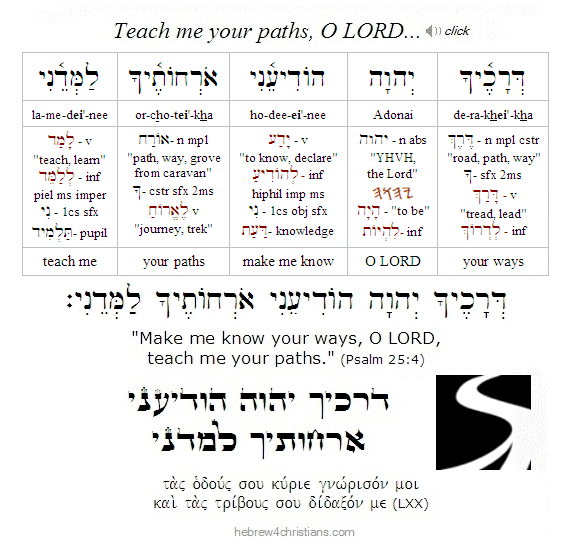 |
<< Return
|