|
Jewish Holiday Calendar
For July 2025 site updates, please scroll past this entry....
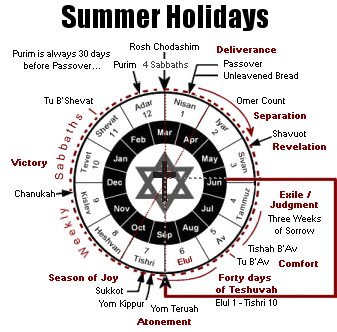
In the summer there occurs a three week period of mourning that begins with the Fast of Tammuz and ends with Tishah B'Av. The last nine days of this three week period (i.e., from Av 1 until Av 9th) are days of increased mourning. However, after this somber time, the romantic holiday of Tu B'Av, the 15th of Av occurs. Summer ends with the 30 days of the month of Elul, a yearly season of teshuvah (repentance) that anticipates Rosh Hashanah and the fall holidays. The 30 days of Elul are combined with the first 10 days of the month of Tishri to create the "Forty Days of Teshuvah" that culminate with Yom Kippur.
Because they occur between the spring and fall holidays, the summer holidays help us prepare for the second coming of the Messiah:
The Summer Holidays:

Note that in accordance with tradition, holiday dates begin at sundown. Moreover, some holidays may be postponed one day if they happen to fall on the weekly Sabbath:
- Month of Tammuz (Wed. June 25th [eve] - Fri. July 25th [day])
- Month of Av (Fri. July 25th [eve] - Sat. Aug. 23rd [day])
- Month of Elul (Sat. Aug. 23rd [eve] - Mon. Sept. 22nd [day])
- Month of Tishri (Mon. Sept. 22nd [eve] - Tues. Oct. 21st [day])
Note: For more about the dates of these holidays see the Calendar pages....
July 2025 Updates
Note: If any page content appears to be missing, please refresh the page...
Whispers of the Heart...
07.31.25 (Av 6, 5785) From our Torah portion this week (i.e., Devarim) we read: "You were not willing to go up but rebelled (i.e., מָרָה, grew bitter) at the word of the LORD your God, and you whispered in your tents and said, 'Because the LORD hates us he has brought us out of the land of Egypt...'" (Deut. 1:26-27). We may decry the childish insolence of the people, we lament their lack of faith, and yet God was still speaking his heart to Israel...
The sages ask whether we can ever be justifiably angry at God, and answer that we can, because otherwise we could never love Him "bekhol levavkha," with all our heart (Deut. 6:5). Indeed, how can we claim to love God if we withhold the truth, lie to ourselves, and attempt to hide who we really are from Him? If you are angry at God, he already knows, so why the pretense? Being angry with God is part of being a real person in a real relationship with Him, and allowing yourself to express the truth of your heart to him is a sign of trust...
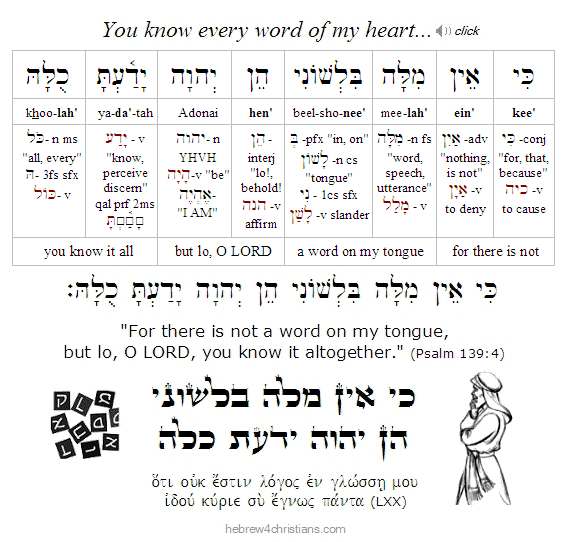
Hebrew Lesson
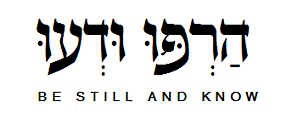
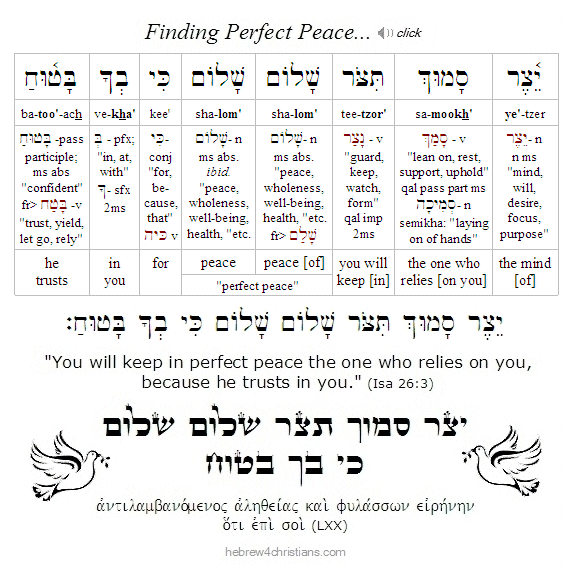
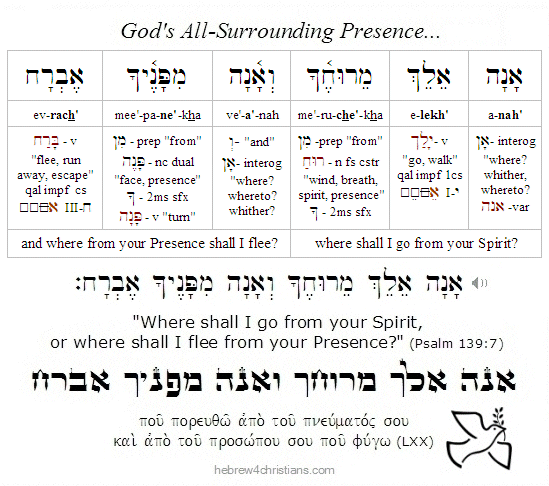
Psalm 139:4 reading (click):
Tishah b'Av and God's Kingdom...
Shalom chaverim. The following is related to the fast of Tishah B'Av, which begins this coming Saturday at sunset (Aug. 2nd, this year). During this time let us remember Israel in our prayers, praying for the peace of Jerusalem and the coming of God's kingdom!
07.31.25 (Av 6, 5785) The somber holiday of Tishah B'Av recalls the tragic anniversary of the "sin of the spies" and God's subsequent decree that the generation redeemed from Egypt would die in exile from the promised land (Num. 14:26-37), though providentially it also marks the date of the destruction Temple in Jerusalem (both the first and second Temple) and the subsequent exile of the Jewish people. Because it remembers the loss of the vision of Zion, this date is observed with fasting, heartfelt lamentation and fervent calls for teshuvah (repentance).
Jerusalem (or Zion) is central to the Jewish heart since it represents all the promises of the Lord spoken by the Hebrew prophets to Israel... When religious Jews pray three times a day, they always turn toward the Holy City (i.e., mizrach: מזרח "east"). Synagogues likewise place the holy ark (the place where Torah scrolls are kept) on the wall closest to Jerusalem. Many observant Jews keep small section of an eastern wall of their house unpainted as a sign of mourning for the destruction of the Temple. Every year we close the Passover Seder with the words, La-Shanah Haba'ah Bi Yerushalayim! ("Next year in Jerusalem"). These same words are invoked to conclude the holiest day of the Jewish year, Yom Kippur. Indeed Yeshua called Jerusalem the "City of the great King" (Psalm 48:2; Matt 5:35): It is the place where He was crucified, buried, resurrected, and from where He ascended to heaven. It is also the birthplace of the true church (כלה של משיח) and the focal point of humanity's eschatological future. At the Second Coming, Yeshua will physically return to Jerusalem to restore the throne of King David. Then all the New Covenant promises given to Israel will be fulfilled as the Kingdom of God is manifest upon the earth.
God loves Zion since it symbolizes His redemptive program in human history. In a sense, Zion is the heart of the Gospel message and the focal point of God's salvation in this world. Zion represents our eschatological future -- our home in olam haba (the world to come). Even the new heavens and earth will be called Jerusalem -- "Zion in her perfection" (Rev. 21). "This is what Adonai Tzeva'ot says: I am very jealous for Jerusalem and Zion, but I am very angry with the nations that feel secure" (Zech. 1:14-15). "For Zion's sake I will not keep silent, for Jerusalem's sake I will not remain quiet, till her righteousness shines out like the dawn, her salvation like a blazing torch" (Isa 62:1). "The builder of Jerusalem is God, the outcasts of Israel he will gather in... Praise God, O Jerusalem, laud your God, O Zion" (Psalm 147:2-12).
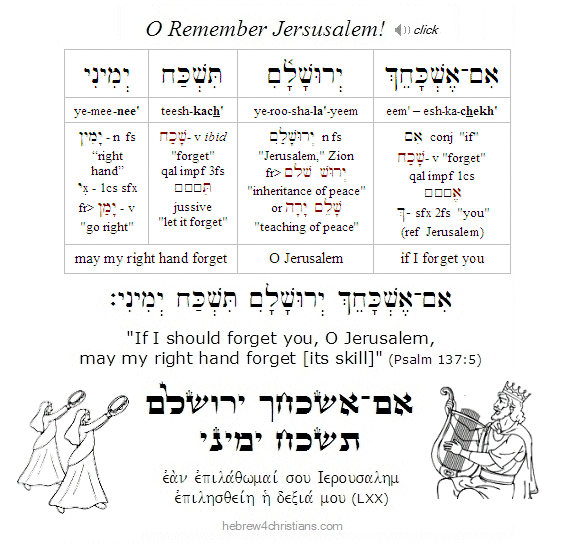
Hebrew Lesson
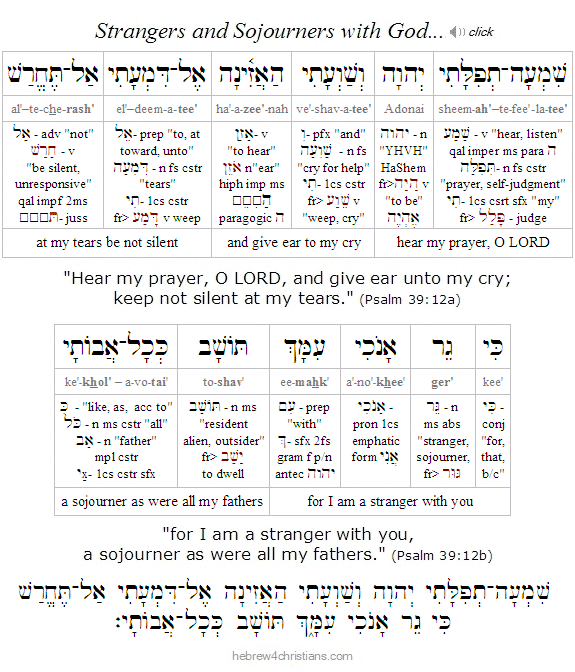
Psalm 137:5 Hebrew reading (click):
For more on this, see "The Significance of Zion and Tishah B'Av."
The Entreaty of Moses...
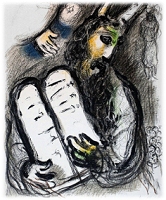
The following entry is related to our Torah portion this week, parashat Devarim...
07.31.25 (Av 6, 5785) Various commentators regard Sefer Devarim (i.e., the Book of Deuteronomy) as Moses' final warning to Israel in light of their repeated failures and setbacks. Some (primarily Christian) commentators even go so far as to say that the book represents an indictment against the Jewish people that warrants regarding them as a God-forsaken people. (This is essentially the unsound doctrine of "replacement theology" that denies ethnic Israel has a future and a hope in God's plan of salvation.)
Many Jewish commentators, however, and among them the notable sage Rashi, seem to focus on Moses' rebuke (i.e., tochachah: תּוֹכָחָה) of Israel and tend to regard the book in a negative light. Because of this, it should be stressed at the outset that Moses' correction of Israel - including his review of the unseemly history of the desert generation - was primarily intended to remind the Jews of their high calling, their new identity, and their preciousness as God's people. Moses wanted the people of Israel to remember their identity as am segulah (עַם סְגֻלָּה), God's "treasured possession among all peoples" (Exod. 19:5).
Moses' admonition (i.e., musar: מוּסָר) functions more like the plea of a father to his children to walk in a manner that is worthy of his name than a stinging rebuke of the sins of his children. "My son, despise not the discipline (musar) of the Lord; neither be weary of his correction (tochachah). For whom the Lord loves he corrects; even as a father the son in whom he delights" (Prov. 3:11; cp. Heb. 12:5-6). Therefore we read, "Know then in your heart that as a man disciplines his son (כַּאֲשֶׁר יְיַסֵּר אִישׁ אֶת־בְּנוֹ), the LORD your God disciplines you (הוה אֱלהֶיךָ מְיַסְּרֶךָּ)" (Deut. 8:5).
To underscore this point, notice that just before Moses began his reproof of Israel, he declared his love and faith in the people. "The LORD your God has multiplied you until you are today as numerous as the stars in the sky (כְּכוֹכְבֵי הַשָּׁמַיִם). May the LORD, the God of your fathers, make you a thousand times more as you are (כָּכֶם), and bless you, as He promised you" (Deut. 1:10-11).
Moses first brought up God's love for the Jews before he began his admonition. Notice he used the word kachem (כָּכֶם, "as you are") in this blessing. May the LORD multiply you - as you are - a thousand times! You are beloved; you are worthy: may the LORD bless you a thousand times over! (How different is this picture of Moses than the typical cartoon made of him by many who envision him smashing the tablets as if that were his "last word" on the subject of the Torah to Israel!)
Were the people perfect then? Obviously not, as would be clear through Moses' later admonition to them. Nonetheless, Moses used a "good eye" to see their potential as God's chosen people. Here was this ragtag group of desert wanderers, descendants of slaves from the "house of slavery," whom the LORD God Almighty personally redeemed to be His own treasured possession. Despite their failures in the past and all that went before, Moses reminded them that they were esteemed as mamlechet kohanim ve'goy kadosh (מַמְלֶכֶת כּהֲנִים וְגוֹי קָדוֹש), a "kingdom of priests and a holy people" (Exod. 19:6).
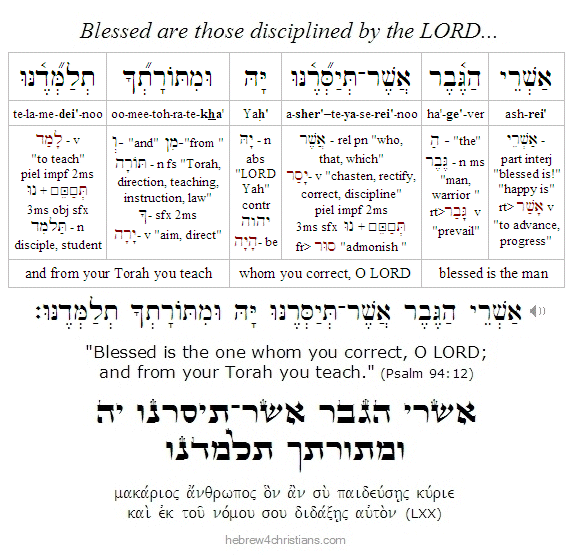
Hebrew Lesson
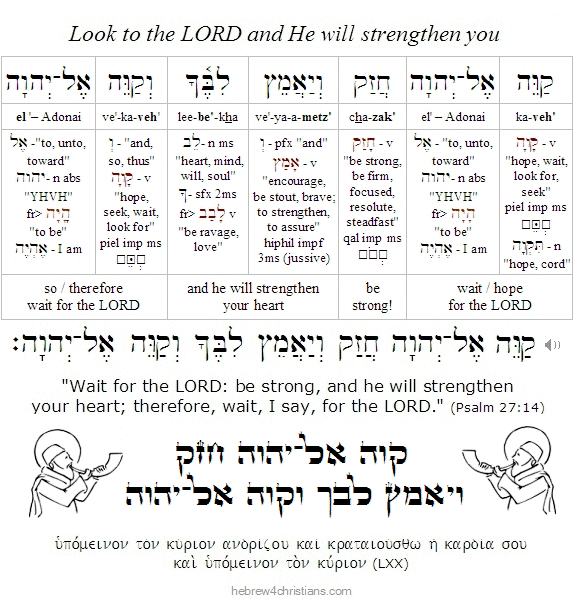
Psalm 94:12 Hebrew reading (click):
 |
Through a Glass Darkly...
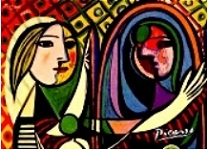
"At every person's birth, there comes into an existence an eternal purpose for that person, for that person in particular. Faithfulness to oneself with respect to this is the highest thing a person can do. Indeed, it is a crime against heaven to disown your own heart." - Kierkegaard
07.31.25 (Av 6, 5785) "We walk by faith, not by sight" - by hearing the Word of God, heeding what the Spirit of God is saying to the heart (2 Cor. 5:7; Rom. 10:17 )... For now we "see through a glass darkly" (1 Cor. 13:12) which literally means "in a riddle" (ἐν αἰνίγματι). A riddle is an analogy given through some resemblance to the truth, though quite often the correspondences are puzzling and obscure. Hence, "seeing through a glass darkly" means perceiving obliquely, looking "through" something else instead of directly apprehending reality.
We see only a reflection of reality, and our knowledge in this life is indirect and imperfect. This is contrasted with the "face to face" (פָּנִים אֶל־פָּנִים) vision and clarity given in the world to come, when our knowledge will be clear and distinct, and the truth of God will be fully manifest and no longer hidden. Being "face to face" with reality means being free of the riddles, the analogies, the semblances, etc., which at best adumbrate our way.. Such reflection should make us humble whenever we share our faith. "Now we know in part, but then shall we know in whole" (1 Cor. 13:12). An honest theology must find a place for mystery, for "seeing through a glass darkly," and for the apprehension of awe and wonder.
Since God is the Infinite One (אֵין סוֹף) whose understanding is without limit (Psalm 147:5), we must use analogies, metaphors, symbols, allusions, parables, figures of speech, poetry, and other linguistic devices to convey spiritual truth and meaning. We compare (συγκρίνω) spiritual things with spiritual (see 1 Cor. 2:13). Some mystics have said the way to God is through the transcendence of words altogether, though most use imagery and poetry about "ineffable" reality. Others, like Soren Kierkegaard, use "indirect communication" to evoke the decision to believe, to find hope, and to walk by faith.
Yeshua regularly used parables and stories to communicate deeper truths about ultimate reality. He likened the human heart to "soil" into which the Heavenly Farmer plants seed; he wanted his followers to know God as their "heavenly Father," the idealization of family love, and so on. Often he was surprised at how dull his own disciples were regarding his use of spiritual analogies (Matt. 15:16, 16:9-11; Mark 8:17; John 6:22-66). Furthermore Yeshua often taught in parables because they simultaneously conceal and reveal the truth. A parable obscures the truth to those who don't really want it; just as it reveals the truth to those who do (Luke 8:9-10). Since Yeshua's whole life was a parable of sorts - a "disguise" that led to the victory of our deliverance (Phil. 2:7) - it is not surprising that he regularly used "figures of speech" to provoke people to examine their own heart attitude and faith...
In this connection note that Yeshua never explained the "mysteries of the kingdom of God" (סודות מלכות אלוהים) directly to the crowds, nor did He ever pander to the crowd's clamor or interests. His message is always meant for the individual soul who was willing to follow Him -- to the one who had "ears to hear." Yeshua will forever be the Face of God to us, our Mediator and Savior, blessed be He (2 Cor. 3:18).
Just as there are hundreds of Names of God revealed in Scripture, so there are many analogies (or stories) given to help us understand His heart. For instance, God is likened to a farmer, a shepherd, a caring neighbor, a tenant, a king, an impartial judge, a pottery maker, an investor, an employer, a jilted husband, a passionate lover, and so on. However, the analogy Jesus used the most was that God is our Father, and we are His children. As it is written in the Psalms, "Like a father pities his children, so the LORD pities those who fear Him" (Psalm 103:13). The most intimate Name of God is simply Abba (אבּא), a term of endearment for a child uses for his father. For those who can believe, the eyes of the LORD are like those of a loving father who greatly rejoices over the presence of his child.
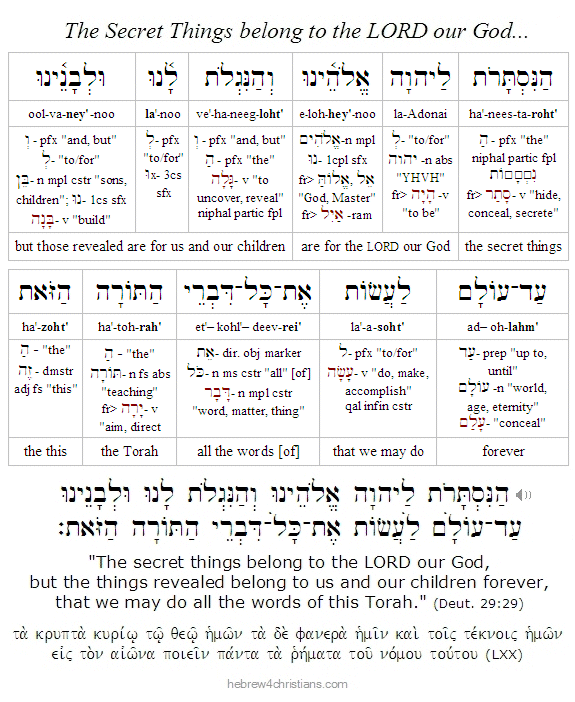
Hebrew Lesson
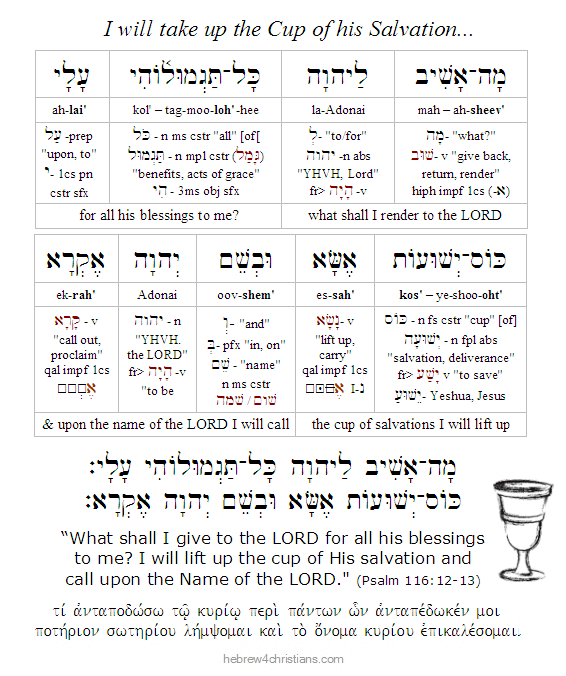
Deuteronomy 29:29 reading (click):
 |
The Irrepressible Witness...
"Truth is so obscure in these times, and falsehood so established, that, unless we love the truth, we cannot know it." - Blaise Pascal
07.30.25 (Av 5, 5785) In our godless and intolerantly irrational age, it is common to encounter people who refuse to believe that God, not because there are any compelling reasons to do so, but simply because they do not want God to exist, and therefore they willfully suppress the intuitions of logic, the apprehension of value, the awareness of glory in creation, and the sentiments of conscience, since all these experiences point to the realm of moral and spiritual reality....
As stated in Scripture: "For that which may be known of God is manifest in them; for God has revealed it to them. For the invisible attributes of him from the creation of the world are clearly seen, being understood by the things that are made, even his eternal power and divinity; so that they are without excuse" (Rom. 1:19-20). The Holy Spirit invites all people to be saved, but tragically so many "refuse to love and accept the truth that would save them" (2 Thess. 2:10).
Atheists and agnostics dogmatically insist that there is no transcendental "moral law" or Moral Lawgiver before whom all moral agents will give account, again, not because reason indicates that this is so, but on the contrary, merely because they demand to be "free" to do whatever they want and to pursue their own selfish desires. In this regard the atheist merely chooses to close his mind because he does not want to see (for an example of this type of madness, read Friedrich Nietzsche). As Rabbi Israel ben Eliezer (בש"ט) once said, "The world is full of majestic wonders and miracles but man takes his little hand and covers his eyes and sees nothing." Indeed the deification of the self makes the soul a stranger to God and myopic to moral and spiritual reality. The postmodern man will split hairs and object to questions of truth and meaning -- all for the sake of justifying a lifestyle that he pleases, on his own terms, without recognizing any moral authority beyond himself....
Everyone has a faith system by which they interpret and make sense of what they believe (or trust) is real... Socrates famously said that "the unexamined life is not worth living," which of course implies that a life worth living is discovered by asking questions, searching for meaning, pursuing truth, celebrating wonder, and living with integrity. "Seek the LORD while He may be found" (Isa. 55:6).
Contrary to the ideals of worldly culture, the meaning of life is not found in the pursuit of personal happiness (or pleasure) but rather in the pursuit of truth and meaning. Apathy about such matters is a symptom of lifelessness: it is to be spiritually dead while seemingly "alive." Indifferent people are likened to those who go through the outward motions of life without ever making inner traction with it... The righteous, even in death, are called "living"; the wicked, even while alive, are called "dead" (Berachot 18a).
A radical "metaphysical" question is "Why is there something rather than nothing at all?" Such a fundamental question strikes at the heart of our assumptions and habitual ways of thinking, jolting us from our sleepy "cave-like" consciousness to face the glaring light of the sun... The natural instinct is to turn away, to pull the covers over our head, and try to go back to sleep. However if pressed, the simple question "why" irresistibly leads to a series or "concatenation" of explanations and a regress of ostensible causes that quickly points to metaphysical properties and realities.
For instance, if a child asks her parent, "Why do people die?" the parent might answer, "Because people get sick or injured or they might grow very old." "But why do people have to grow old?" the child continues. "Because they are born, live for awhile, and eventually pass away... All things change, and that means they come into being, exist for a while, and then pass away. Look around you; everything you see – the people, the animals, the plants, rocks, mountains and seas, the earth and sky, the stars and galaxies, and indeed the whole universe – is constantly changing, coming into being, existing for awhile, and then passing away..." "But why does everything have to pass away?" the child persists...
In this imaginary dialog we see how quickly "why questions" begin pointing to deep metaphysical mysteries such as the nature of being, the phenomenon of time, the ubiquity of change and its existential relationship to human consciousness. The dialectic of asking and answering questions helps us detect the assumptions that underlie our everyday thinking, often revealing wonders that pervade our lives. The failure to seriously ask the "big questions" of life, for instance, "What am I?" "Where did I come from?" "Why am I here?" "Where am I going?" and "What does it all mean?" is to abandon what makes life itself worth living... It is to give up the quest to find meaning, purpose, hope, and a sense of destiny. It is to die inside.
Again categorically everyone has a faith system by which they exercise trust is in what is real... The existential question, then, is not whether someone has faith, but what they are trusting about the ultimate concerns, questions of life and death, and so on... "Multitudes, multitudes in the valley of decision: for the day of the LORD is near in the valley of decision" (Joel 3:14). Let us pray that people wake up, for the hour surely draws near...
Hebrew Lesson
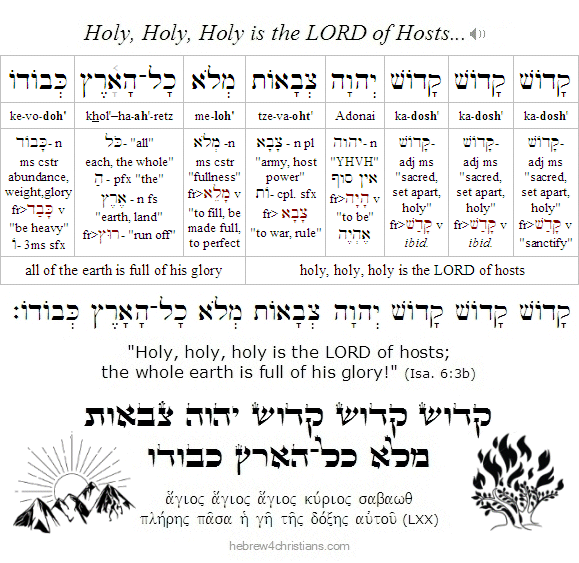
Isaiah 6:3 reading (click):
 |
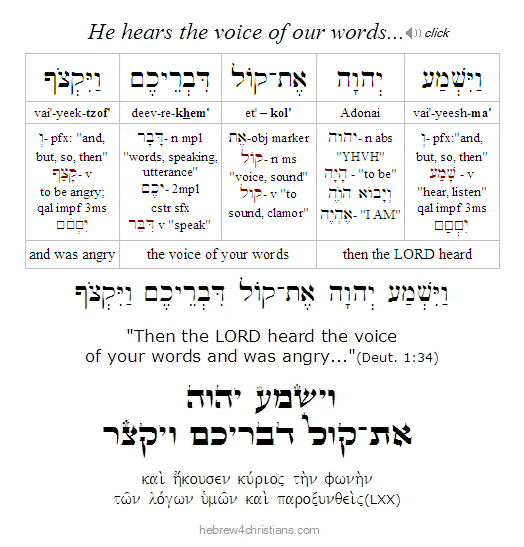
The Voice of our Words...
07.30.25 (Av 5, 5785) According to Jewish tradition, it was on Tishah B'Av (the Ninth of Av) when the people wept over the report of the spies, a lapse of faith so serious that it provoked God to decree that the very generation He redeemed from Egypt would die in the exile of the desert (see Num. 13-14). As Moses later recounted this tragic event, he said something peculiar: "The LORD heard the 'voice of your words' (קוֹל דְבַרִים) and was angry..." (Deut. 1:34). The grammar here is unusual, for the text could have simply said, "the LORD heard your words," but the Torah adds something else, the idea of "emotional tone," or the manner, the words were spoken... Sometimes it is not so much what you say that matters, but how you say it. Words of the heart are expressed more by tone, the "voice of the words," than by the words themselves...
According to midrash when the spies returned after scouting the land, they said "the land is good" in a qualified or even an insincere manner. "Just look at this gigantic fruit we picked -- for gigantic people of that land who are invincible!" The words spoken by the spies were "true" in a sense, but their expression mediated a fearful attitude that rendered them untrue. Instead of saying "the land is good" - and affirming God's promise - their words were nuanced with doubt, and the "sound of their words" belied their testimony.
In themselves words are not "static" things but they live and move within a context to inform a common or shared sense of meaning. The grammar of "truth" assumes good will and correspondence between what is said and what is adjudged as real, "actual" or credible. When words are used deceptively, ambiguously, ironically, disingenuously, or without straightforward intent, however, then common sense does not obtain and the meaning shifts to "meta-linguistic" interpretation. With regard to God, however, the constellation of beliefs, assumptions, intent, and the emotional context is fully known whenever we communicate, as it is written: "There is not a word on my tongue but You, O LORD, know it altogether" (Psalm 139:4), and therefore He entirely understands our true intent -- or the "voice of our words."
In our Torah portion this week (i.e., Devarim) we read: "May he (i.e., the LORD) bless you as He said to you" - וִיבָרֵךְ אֶתְכֶם כַּאֲשֶׁר דִּבֶּר לָכֶם (Deut. 1:11), which the sages read as: "May he bless you as your speech is to you," suggesting that our language will mirror spiritual reality (Psalm 18:25-26; Prov. 23:7). And when we recite Shema, we do so bekhol levavkha (בְּכָל־לְבָבְךָ) - with all our heart, with all our soul, with all our might (Deut. 6:5). This is a cry from the heart that affirms God's truth. Our feelings are important and are meaningful, whether they are feelings of joy, gratitude, and so on, or feelings of doubt, despair, or fear. As Yeshua said: "Would that you were either cold or hot, but because you are lukewarm - neither hot nor cold - I will spew you out of my mouth" (Rev. 3:15-16).
It has been said that if you don't know how to say something, say it loudly... The heart has its own voice regardless of the words we are able to articulate. For instance, if you love someone, then really love them and abhor being halfhearted. Being hot or being cold is better then being tepid, because then you are being honest, you are speaking from the kishkas, and honesty will always evoke a genuine response from heaven...
Hebrew Lesson
Deuteronomy 1:34 reading (click):
In Your Father's Arms...
"God be praised that it is not because of my worthiness that God loves me; otherwise, I might at any moment die of fear lest the next moment I cease to be worthy." - Kierkegaard, Journals
07.29.25 (Av 4, 5785) "Now I lay me down to sleep, I pray the Lord my soul to keep..." After praying with my youngest son Emanuel before he goes to bed, and just after we have said our closing "amens," a moment of silence sets in and he often asks me to pray again so that he won't have scary dreams or be afraid. I get it. The lingering thoughts, the liminal awareness that something went undone today, the fear of the unknown. So we pray some more, asking God to deliver us from our fears and to put "shields of his protection" all around us as we sleep. And I think to myself, and isn't this what we are praying much of the time anyway -- not to be afraid? And not to be angry, which really is the other side of our fears?
We may sometimes feel uneasy over our lives; we may wrestle with "inner demons" that lurk in the shadows of consciousness and seek refuge from them; we may feel fragile, powerless, stupefied, sad, guilty, remorseful, fearful, insecure, lonely... We call out to the Lord for his protection and deliverance. We need reassurance that He is there for us, that he's on the other end of our heart's cry, that he cares. But surely our deepest fear is that of ourselves - our own inner darkness - and whether we will be able to hold it together and not destroy ourselves. As Yeshua said, "If the light that is in you is darkness, how great is that darkness!" (Matt. 6:23).
Our faith in God's love must be greater than the fear of our inner darkness -- those parts of ourselves that seemingly lurk in the shadows. It is not simply trusting God to protect you from external evil but trusting God to deliver you from yourself - trusting him to heal you in the unconscious depths of your soul - the wound that evokes the raw cry of the heart. And more than that, our prayers are a cry for our Abba to be there for us, to take us up in his "everlasting arms," to have him shush away our fears and to quietly say to us: "I love you; I am here with you..." Be at peace my beloved child.
Hebrew Lesson
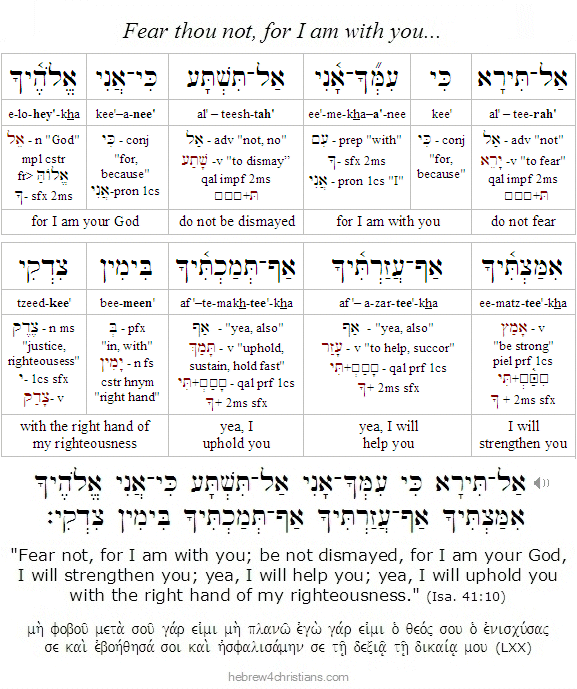
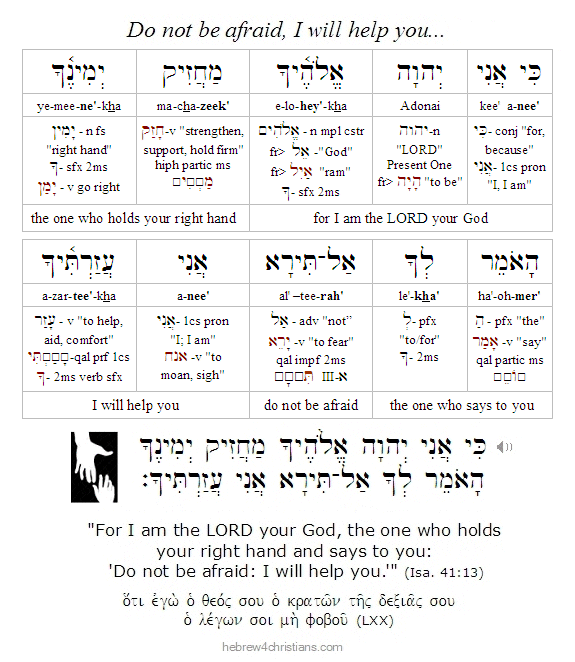
Isaiah 41:13 reading (click for audio):
 |
He carries you through...
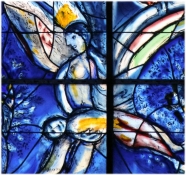
The following entry is related to our Torah portion this week, parashat Devarim...
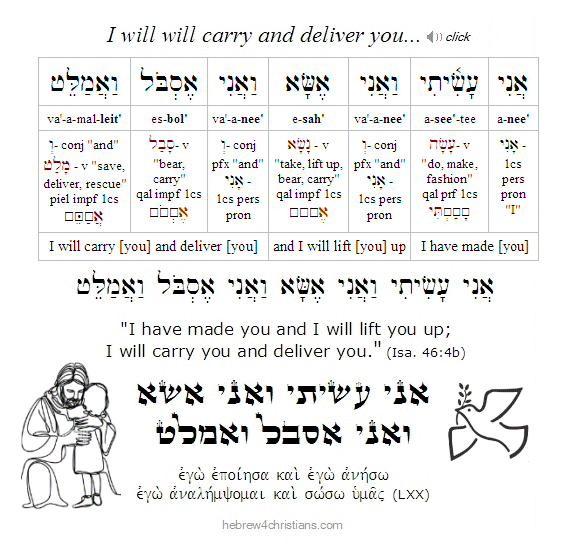
07.29.25 (Av 4, 5785) From our Torah this week (Devarim) we read: "The LORD your God carried you, as a man carries his son, all the way that you went until you came to this place" (Deut. 1:31). Part of the miracle of faith is coming to believe that you matter to God – that you are his child, and that your thoughts, words, and deeds all are of his concern.
You may be tempted to regard yourself as unseen and powerless before the Creator of the universe. How is it possible for anyone to serve the Infinite One, since "even the heavens, and the heaven of heavens, cannot sustain You" (1 Kings 8:27)? Are we not made of clay, whose foundation is but dust? (Job 4:19).
Here the miracle of faith believes that God, the LORD and Source of all life, seeks relationship with you, and that He makes place within Himself to hear you, to engage your life, and to walk with you... Indeed, "the Word was made flesh and dwelt among us:" God emptied himself (κενόω) and clothed himself with human dust so that we could be touched by His love. The LORD carries us through our exile so that we might know and trust him...
Hebrew Lesson
Isaiah 46:4b reading (click):
"And just as we have borne the image of the man of dust,
so we shall also bear the image of the man of heaven" (1 Cor. 15:49).
Words and Healing...
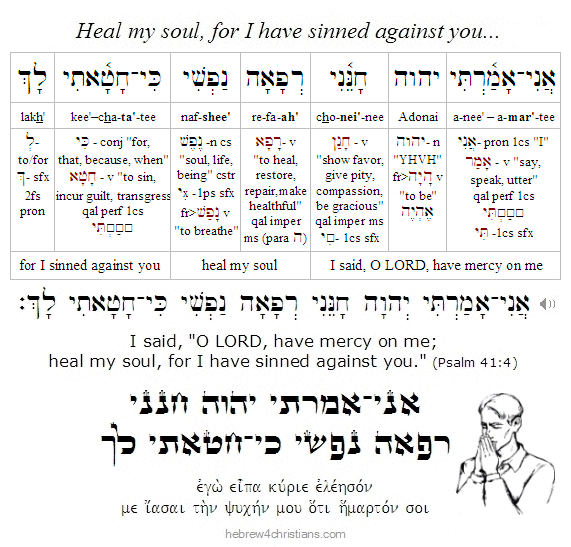
07.29.25 (Av 4, 5785) Just as the body can become sick with illness, so can the soul: "I said, 'O LORD, have mercy on me; heal my soul (רְפָאָה נַפְשִׁי), for I have sinned against you'" (Psalm 41:4). Likewise we understand that fear profoundly affects the way the brain processes images and messages. Fear colors the way we see and hear things. And since the mind and body are intricately interconnected, fear is often the root cause of many physiological problems such as heart disease, high blood pressure, clinical depression, and other ailments. Left unchecked, fear can be deadly...
The targum Onkelos states that God breathed into Adam the ability to think and to speak. In other words, thought and speech are two primary characteristics of the image (tzelem) and likeness (demut) of God. Since our use of words is directly linked to the "breath of God" within us, lashon hara (לָשׁוֹן הָרָה) defaces God's image within us.... Using words to inflict pain therefore perverts the image of God, since God created man to use language to "build up" others in love. This is part of the reason the metzora (i.e., one afflicted with tzara'at) was regarded as "dead" and in need of rebirth.
Lashon hara is really a symptom of the "evil eye" (ayin hara). "Evil comes to one who searches (דָּרַשׁ) for it" (Prov. 11:27). We must train ourselves to use the "good eye" (ayin tovah) and extend kaf zechut - the "hand of merit" to others. Genuine faith is optimistic and involves hakarat tovah, that is, recognizing the good in others and in life's circumstances. Gam zu l'tovah: "This too is for the good" (Rom. 8:28). The Midrash states that God afflicted houses with tzara'at so that treasure hidden within the walls would be discovered. The good eye finds "hidden treasure" in every person and experience.
King David said (Psalm 35:13): "May what I prayed for happen to me!" (literally, tefillati al-cheki tashuv - "may it return upon my own breast"). Some of our prayers are conscious words spoken to God, whereas others are unconscious expressions of our inner heart attitudes. When we harbor indifference, ill will, or unforgiveness toward others, we are only hurting ourselves. It is very sobering to realize that our thoughts are essentially prayers being offered up to God... When we seek the good of others we find God's favor, healing and life. Yeshua spoke of "good and evil treasures of the heart" that produce actions that are expressed in our words (Luke 6:45). A midrash states that if someone speaks well of another, the angels above will then speak well of him before the Holy One.
In light of the enigma of "spiritual impurity" (i.e., tumah) and its ultimate expression revealed in the corruption of death, it is all the more telling that we should heed the cry of the Spirit: "Choose Life!" (Deut. 30:19). Sin is a type of "spiritual suicide" that seduces us to exchange eternal good for the petty and trivial. The nachash (serpent) in the garden of Eden was the first to speak lashon hara. He slandered God and lied to Eve about how to discern between good and evil. He is a murderer and the father of lies. Resist his wiles with the truth of God.
May it please the LORD to help each of us be entirely mindful of the power and sanctity of our words... May it please Him to help us use our words for the purpose of strengthening and upbuilding (οἰκοδομὴν) one another (Eph. 4:29). May God help us take every thought "captive" to the obedience of the Messiah, thereby enabling us to always behold and express the truth of God's unfailing love.
Hebrew Lesson
Psalm 41:4 reading and commentary:
 |
Living in Yeshua's Heart...
07.28.25 (Av 3, 5785) Yeshua likened His relationship with his followers in terms using the metaphor of a vine and its branches: "I am the true Vine (הַגֶּפֶן הָאֲמִתִּית), and you are the branches" (see John 15:1-5). We derive our identity, life and strength from being made part of His life... The purpose of the branch is to be a conduit of the life of the vine. Vine branches by themselves are of little value, apart from the manifestation of fruit; they cannot be used for building things and otherwise are regarded as bramble (Ezek. 15:2-4). Notice further that the vine branch cannot bear good fruit while it remains on the ground: it must "climb" upward and be elevated. And if you look closely at a vine, it is often difficult to see where the vine ends and the branches begin. The life of the branch becomes "entangled" in God's love as it bears spiritual fruit from the sustenance of the True Vine (הַגֶּפֶן הָאֲמִתִּית). When we abide in, or are truly connected with, Yeshua as the Source of life, we bear the fragrance and sweet-smelling savor of heaven itself...
"I am the vine; you are the branches. Whoever abides in me and I in him, he it is that bears much fruit, for apart from me you can do nothing" (John 15:5). Note that the expression "apart from me" (χωρὶς ἐμοῦ) means being in a state of separation from Yeshua, which is likened to spiritual death... It is the death of possibility, the absence of power to yield true good to the world, and so on. This is what is meant by "you can do nothing" (οὐ δύνασθε ποιεῖν οὐδέν), that is, you can do nothing of any lasting significance or worth... There is simply no true life apart from the Savior who is the Source of divine life. May we all find life and peace in Yeshua's heart, friends. Shavuah tov chaverim!
Hebrew Lesson
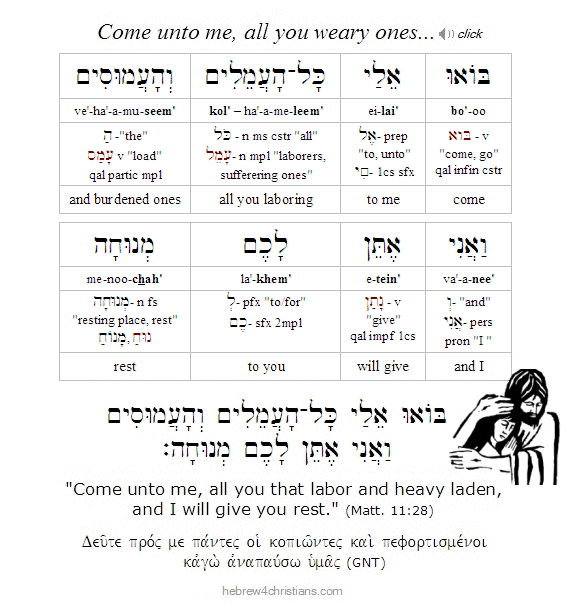
Matthew 11:28 Hebrew reading:
 |
Sanctified by His Grace...

In the midst of darkness and sorrows I am comforted that it is all of grace, that God's hand is upon me, and that therefore I can rejoice from the depths of my heart. Amen.
07.28.25 (Av 3, 5785) Yeshua said to those who trust in Him: "I am the vine; you are the branches. Whoever lives in me and I in him, he it is that bears much fruit, for apart from me you can do nothing" (John 15:5). Note that the spiritual life of Messiah flows from his connection with us, though the very possibility for that connection is grounded in the blessing of his grace...
We cannot attain newness of life by means of moral reformation, since it is a miracle from above and not the result of human agency or aspiration (John 1:13; John 3:6). If we "live in" Yeshua we will bear fruit - our spiritual connection or "union" with him is sufficient for every good work, but only fruit that derives from the life of Messiah will abide (1 John 2:17). Good works are a necessary consequence of regeneration in Messiah, but by themselves they are insufficient and something more is needed (Matt. 7:21-23). Therefore the Scriptures point to the salvation of God and his grace as the efficient cause for the miracle of newness of life: "Not by works of righteousness which we have done, but according to his mercy he saved us..." (Titus 3:5); "for by grace are you saved through faith, and that not of yourselves (τοῦτο οὐκ ἐξ ὑμῶν), it is the gift of God" (Eph. 2:8); "and if it is by grace, it is no longer on the basis of works; otherwise grace would no longer be grace" (Rom. 11:6).
Grace and human effort are mutually exclusive when it comes to life from above: "It is the Spirit that gives life (τὸ πνεῦμά ἐστιν τὸ ζῳοποιοῦν); the flesh (i.e., human nature) is no help at all" (John 6:63). There is a new "center" of identity within the heart: "I is no longer I who live..." (Gal. 2:19-20). We do not appeal to God for mercy based on our best efforts, but like father Abraham we believe that God brings life to the dead. In short we believe that "salvation is of the LORD" (יְשׁוּעָתָה לַיהוָה), that is, that God justifies the ungodly and performs the inner work of salvation on our behalf and for our healing (see Rom. 4:1-5:2).
"The Christian is in a different position from other people who are trying to be good. They hope, by being good, to please God if there is one; or -- if they think there is not -- at least they hope to deserve approval from good men. But the Christian thinks any good he does comes from the Christ-life inside him. He does not think God will love us because we are good, but that God will make us good because He loves us; just as the roof of a greenhouse does not attract the sun because it is bright, but becomes bright because the sun shines on it" (C.S. Lewis: Mere Christianity). Nevertheless we must not mix up cause and effect. The work of God is to believe in Yeshua (John 6:29) and we then learn to "work out" what God has "worked in" to our hearts by faith, as it says, "work out your own salvation with fear and trembling, for it is God who works in you, both to will and to work for his good pleasure" (Phil. 2:12-13). God who has performed a good work in you will "confirm you to the end blameless in the Day of our Messiah Yeshua" (1 Cor. 1:8; Jude 1:24-25).
יהוה תשׁפת שׁלום לנו
כי גם כל־מעשׂינו פעלת לנו

"O LORD, you will ordain peace for us,
for you have indeed done for us all our works." (Isa. 26:12)

Hebrew Lesson
Isaiah 26:12 reading (click):
Shavuah Tov Podcast:
Parashat Devarim...
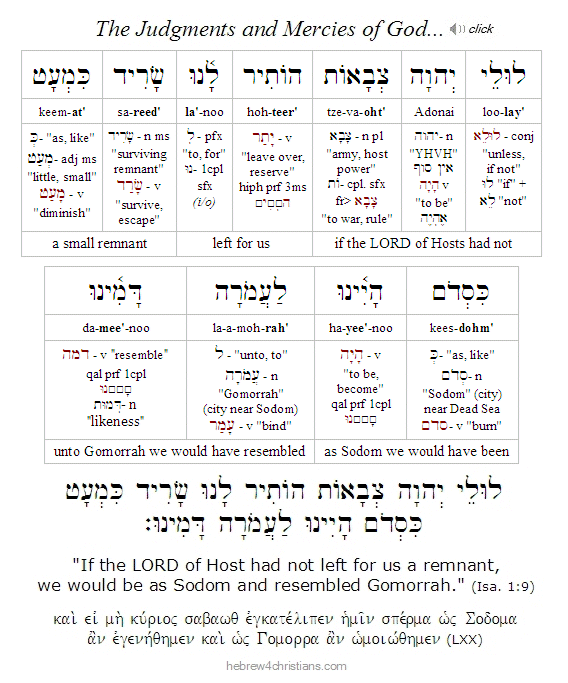
07.27.25 (Av 2, 5785) Our Torah reading this week (Devarim) is the very first portion from the Book of Deuteronomy (ספר דברים), which is always read on the Sabbath that precedes the solemn and somber holiday of Tishah B'Av (תשעה באב). In Jewish tradition, this Sabbath is called "Shabbat Chazon" (שַׁבַּת חַזוֹן), "the Sabbath of Vision," since the Haftarah that is read (i.e., Isa. 1:1-25) comes from the vision of the prophet Isaiah regarding the destruction of the Holy Temple in Jerusalem. In both Jewish tradition and liturgy, teshuvah (repentance) and confession of sin are the themes of this prepatory Sabbath.
Hebrew Lesson
Isaiah 1:9 reading (click):
Parashat Devarim:
The Summary Book of Torah...
"Reviewing a lesson a hundred times cannot be compared with reviewing it a hundred and one times." - Hillel the Elder
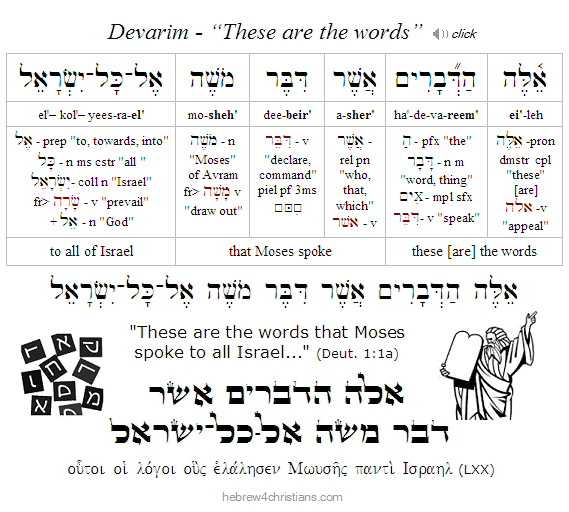
07.27.25 (Av 2, 5785) Shavuah tov v'chodesh tov, friends. The concluding book of the Torah of Moses is called "Devarim" (i.e., דברים, "words" or "things"), from the phrase eleh ha'devarim ("these are the words...") found in its opening verse. In our English Bibles, Sefer Devarim (ספר דברים) is known as the "Book of Deuteronomy," from a Greek word meaning "second (or repeated) law" (δευτερονόμιον), a term used to translate the phrase mishneh ha-Torah ("copy of the Torah," Deut. 17:18).
Generally speaking, the Book of Devarim represents Moses' "farewell address" to Israel, where he reviews and summarizes the history and the laws given to the people and repeatedly warns that obedience will bring blessing while disobedience will bring disaster. The series of personal discourses (or sermons) in the book all have the pleading tone of rebuke and admonition, and indeed some sages say it resembles a sort of "deathbed blessing" not unlike Jacob's blessing given to his sons.
Our Torah portion (i.e., parashah: פרשה) for this week is the very first section of the Book of Deuteronomy, which begins with Moses recounting the journey from Mount Sinai to the edge of the promised land. Moses mentioned the difficulty of personally governing the people and recalled how he set up a system of judges to help him administer justice among the various tribes. Moses then reminded the people of the tragic sin of the spies and the rebellion of the people at Kadesh Barnea, which led to God's decree that no one of that generation would live to enter the land of Canaan (except for Caleb and Joshua). Moses then provided an outline of the 38 year exile of the Israelites back toward the Sea of Reeds, into the desert regions, and then back again until the subsequent generation was ready to enter the promised land. For more information, see the links listed below.
The Month of Av...
07.27.25 (Av 2, 5785) The fifth month of the Hebrew calendar (counting from the month of Nisan) is called the month of Av (i.e., Chodesh Av, "the month of the Father"), which began sundown Friday, July 25h this year (this is also the anniversary of the death of Aaron, the first High Priest of Israel, see Num. 33:38).
The month of Av is regarded as most solemn among the Orthodox. The ninth day of this month (Tishah B'Av) marks the date when the people believed the evil report of the spies and were sent into exile by the LORD (see Num. 14:28-35). Later, the destruction of both the First Temple (in 586 B.C.) and the Second Temple (in 70 AD) occurred on this same date, resulting in the worldwide exile (diaspora) of the Jewish people. In somber recognition of this we observe Tishah B'Av (תִּשְׁעָה בְּאָב), or the "ninth of Av," as a fast day for mourning the lost vision of Zion. This year Tishah B'Av begins Sat. Aug. 2nd at sundown.
Since Rosh Chodesh Av marks the time of mourning for Zion, we humbly ask the LORD to help us prepare for the coming time of teshuvah:
יְהִי רָצוֹן מִלְּפָנֵיךָ יהוה אֱלהֵינוּ
וֵאלהֵי אֲבוֹתֵינוּ שֶׁתְּחַדֵּשׁ עָלֵינוּ חדֶשׁ טוֹב
בַּאֲדנֵינוּ יֵשׁוּעַ הַמָּשִׁיחַ אָמֵן
ye·hee · ra·tzon · meel·fa·ne'·kha · Adonai · e·lo·hey'·noo
vei·lo·hei · a·vo·tey'·noo · she·te·kha·deish · a·ley'·noo · cho'·desh· tov
ba'a·do·ney'·noo · Ye·shoo'·a · ha·ma·shee'·ach · a·men
"May it be Your will, LORD our God and God of our fathers,
that you renew for us a good month in our Lord Yeshua the Messiah. Amen."

Download Study Card
Hebrew Lesson
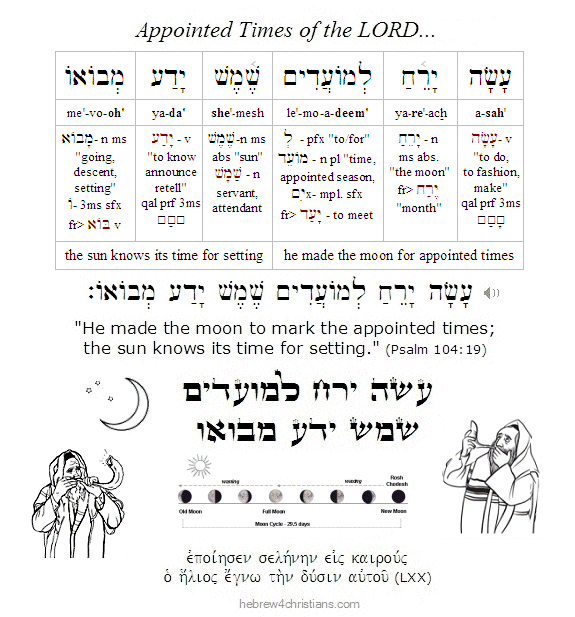
Psalm 104:19 reading (click):
Torah and Holy War...
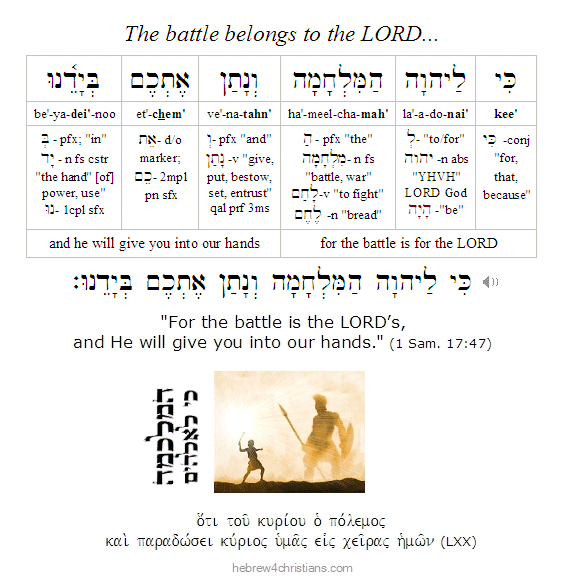
07.27.25 (Av 2, 5785) Our Torah reading last week, parashat Mattot, recounted the war against the Midianites which raiseed some uncomfortable questions about "holy war" and that the idea that God would justify the extermination of people... The Talmud quotes Resh Lakish regarding the question who answered: "Any man who is angry, if he is wise, then his wisdom departs from him, and this applies even to Moses, for the Torah states he was enraged with the officers of the army after the battle in the plains of Moab and it was then that Moses called for the men to exterminate the Midianite people, including the women and children (Num. 31:1-18). Some of the sages also have said that the battle with the Midianites was never intended to be a form of genocide, because the size of the Israeli army was relatively small and the strategy of the battle was to cripple the Midianite army that was still under the guidance of Balaam the son of Beor (Num. 31:8). In other words, if Resh Lakish is right, Moses seemed to have lost sight of God's will and acted without wisdom.
Some branches of traditional Judaism regard Moses as an infallible teacher of Torah, but it is clear that he was a humble man of commom fallibility. Though he was indeed a great prophet and teacher of Israel who was blessed to encounter God "face to face," Moses was veritably human, after all, and he made some serious mistakes in his life. For instance, after he had fled to Midian to escape the wrath of Pharaoh when he had killed an Egyptian taskmaster, Moses wandered in the desert for 40 years before he encountered God at the burning bush. When the LORD spoke to him there and commissioned him to lead the Israelites out of Egypt, Moses resisted God's call, saying was not a good speaker, and he pleaded with God to send someone else. Later on, after the great Exodus had occurred, Moses led the people to Sinai where he smashed the two tablets of the law in anger over the people's idolatry (Exod. 32:1-19). Later, at the time of the dedication of the Mishkan, Aaron's two sons died while offering "strange fire," and Moses rebuked his brother for not eating the sacrificial meat (Lev. 10:16-20), though the Sifra commented that Moses had forgotten the law that it was forbidden to eat meat offered to God in a state of mourning.
To cite a few other examples, consider how the five daughters of Zelophehad had argued about their inheritance rights before Moses and the leaders of Israel, and how Moses had to acknowledge his oversight in this matter (Num. 27:1-7). Finally, at Meribah Moses struck the rock in anger instead of speaking to it and consequently God forbade him from entering into the promised land because of his disobedience (Num. 27:14). And recall that Yeshua explained to the Pharisees that God had never intended for a married couple to divorce, though Moses permitted its practice due to the hardness of people's hearts (Matt. 19:3-8).
The zeal apparently Moses had to exterminate the Midianite people is another matter somewhat difficult to understand. Moses' wife Zipporah was a Midianite, as were his two sons Gershom and Eliezer, and his father in law Jethro was kind to Moses and later even helped him to establish the legal system for the people of Israel at Sinai. Despite the fact that Moses spent a third of his life in the land of Midian and was given shelter there, he sought to destroy the Midianites for their unwillingness to cede to Moses' demand to enter the land. God providentially preserved the Midianites, however, because King David was ordained to descend from the union of Ruth the Moabitess and Boaz of Judah, and from whom would later descend Yeshua the Messiah, the Savior of the world.
Note: The animosity between Israel and the Arab nations surrounding the promised land is long-stranding, of course, going back to Abraham and Hagar and the birth of Ishmael and the twelve princes (שְׁנֵים־עָשָׂר נְשִׂיאִם) that would descend from Ishmael (Gen. 17:20). Moreover, further antagonism was aroused when the blessing of the heir was given to Jacob rather than to Esau, as the descendents of Esau later occupied the area of Edom in the promised land and have remained Israel's enemies to this day....
Hebrew Lesson
1 Samuel 17:47b reading:
 |
The Journey of Journeys...
07.25.25 (Tammuz 29, 5785) From our Torah portion for this week (i.e., parashat Masei) we read: "These are the journeys of the people of Israel (מַסְעֵי בְנֵי־יִשְׂרָאֵל) who went out of the land of Egypt..." (Num. 33:1). The sages ask why the word "journeys" (plural) was used here, since only the first journey – from Rameses to Sukkot – literally marked "yetziat mitzrayim," the going out of Egypt – and all the other journeys were outside of Egypt, in desert regions. They answer that the journey out of Egypt goes beyond the physical land into the spiritual - an exodus from captivity to the world into the realm of the spirit. As has been said, it took the LORD 40 days to get Israel out of Egypt, but it took 40 years to get Egypt out of Israel... The "journey out of Egypt" is therefore a journey of smaller journeys that leads to the full consciousness of deliverance.
Along the way we are repeatedly tested. The "desert experience" reveals what is hidden in our hearts... The murmuring and rebellion of the Israelites in the desert is our own, and our challenge is to find healing from our fears. Anger, doubt, boredom, cravings, and outright rebellion are symptoms of a deeper problem, and to change we must first confess our inner poverty, neediness, and emptiness (James 5:16). When we stop making excuses we can learn to trust in God's provision for our lives; we will taste of the heavenly manna and be satisfied; we will be delivered from our fears by be filled with God's love. The impulses that sought to lead us away from God will no longer be able to pretend to be the truth, since God's peace and love will direct the heart. We will begin to take hold of the promise...
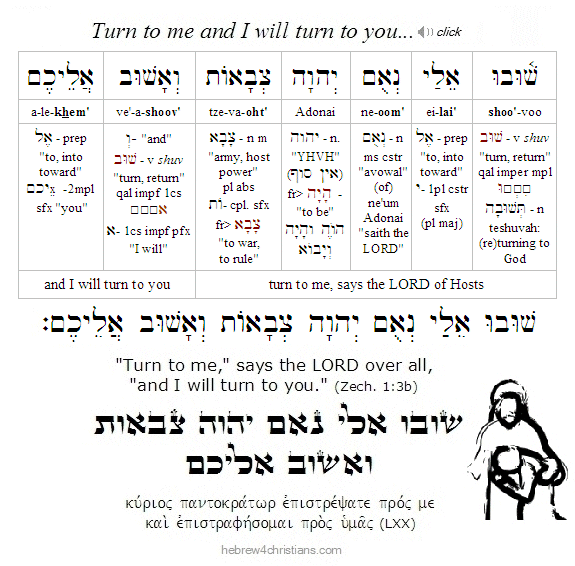
Be encouraged my fellow sojourners walking by faith through the desert of this present world. The Torah uses a repetitious expression, "Sanctify yourselves and you shall be holy" (הִתְקַדִּשְׁתֶּם וִהְיִיתֶם קְדשִׁים) (Lev. 11:44) because when we make a sincere effort -- no matter how feeble at times -- to draw near to the LORD, He will draw near to us (Zech. 1:3; James 4:8; Psalm 145:18). Indeed the walk of faith is one of ascent and descent and ascent again: It's often "two steps forward, one step back..." It is a long road, a process, as we learn to obey and seek to grow closer to God. Authentic repentance doesn't imply that we will never sin or make any mistakes, of course, but rather means that the oscillating pattern of "up, then down, then up" is the basic way we walk. Our direction has changed for good; we have turned to God for life and hope. We now understand our sins in light of a greater love that bears them for us even as we draw ever closer to the One who calls us home...
Hebrew Lesson
Zechariah 1:3 reading (click):
 |
The Breath of God...
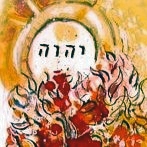
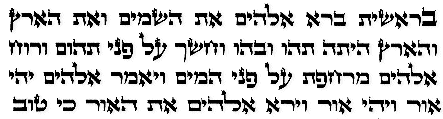
07.25.25 (Tammuz 29, 5785) In the Scriptures God's Name is revealed as YHVH (יְהוָה), which means "He is Present." The Name is formed from the words hayah ("He was"), hoveh ("He is"), and yihyeh ("He will be"): הָיָה הוֶה וְיִהְיֶה, indicating God's omnipresence. Note that all the letters of the Name are "vowel letters," which mean they evoke breath and life. This is the Name revealed to Moses thousands of years before the advent of other religions (Exod. 3:14), and indeed it is the Name associated with the nishmat chayim (נִשְׁמַת חַיִּים), the "breath of life," imparted to Adam in the orchard at Eden (Gen. 2:4). It is therefore the original Name of God "breathed out" to mankind. The Name Yeshua (יֵשׁוּעַ) means "YHVH saves." There is no other Savior beside Him, there is no other Name, there is no other LORD. "For I am the LORD your God, the Holy One of Israel, your Savior." Only Yeshua the Messiah can deliver you from the wrath to come (1 Thess. 1:10).
Many people live in regret over the past or in dread of the future. The Hebrew name of God, the Tetragrammaton (יהוה), means: "He is Present." We can only find God now, today, at this hour. Today if you hear His voice... Yeshua said, "The kingdom of heaven is within you" (מַלְכוּת הָאֱלהִים בְּקִרְבְּכֶם), that is, is to be found within the heart of faith (Luke 17:21). The Name YHVH also means that God is the faithful One (הָאֵל הַנֶּאֱמָן), because all that happens occurs within the immediacy of his Presence. Human logic is based on finite reasoning and how things are connected in time and space (cause and effect), but God's "logic" transcends intermediaries and is immediately certain, not bound by temporal-spatial limitations, and therefore his knowledge is certain (Num 23:19; Eccl. 3:11; Isa. 46:10; Mal. 3:6).
The question is asked why the Torah was written without vowels, punctuation marks, and so on. The lack of vowels implies that we must bring breath (i.e., ruach, spirit) to our reading of the words; the lack of punctuation implies that we must be humble and rely on others to help us read with understanding. In other words, we must bring our heart to the reading and be open-minded to receive revelation.
 |
Ultimately we need the power of the Holy Spirit to read correctly, and the Holy Spirit reveals the Living Word and glory of Yeshua: "It is the Spirit who gives life; the flesh is no help at all. The words that I have spoken to you are spirit and life" (John 6:63).
Hebrew Lesson
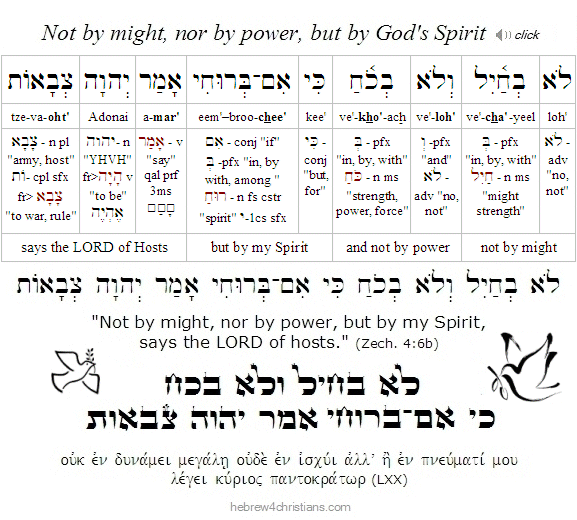
Zech. 4:6 reading (click):
The Prayer of God...
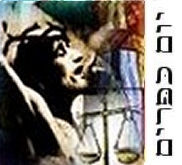
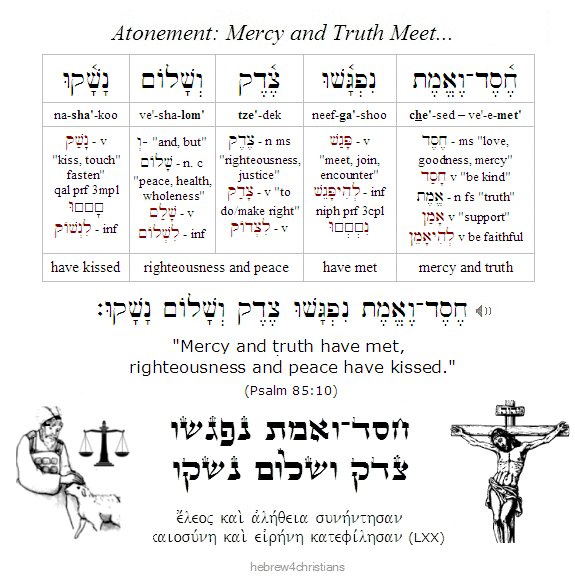
07.24.25 (Tammuz 28, 5785) Man prays to God, but to whom does God pray? And for what does He pray? Or do you think that the Almighty has no desires of His own, no yearning of heart? The sages of the Talmud believed that God indeed addresses himself: Yehi ratzon milfanai, "May it be acceptable before me, may it be My will, that my compassion overcome my anger, and that it may prevail over my justice when my children appeal to me, so that I may deal with them in mercy and in love" (Berachot 6a). This is the deeper unity of the Name YHVH (יהוה), the Savior and LORD, revealed to Moses after the sin of the Golden Calf (Exod. 34:6-7), and this is the essential meaning of the cross of Yeshua, where the LORD passionately "prayed within Himself" so that His compassion would overcome His fearful judgment for our sins.
Only the cross allows God's righteousness and mercy to "kiss" (Psalm 85:10; 89:14); only the cross reveals the true Holy of Holies where the blood was placed over the Ark of the Law; only the cross intimates the Inner Sanctum of God's heart. Because of the cross, a holy God is able to truly love and help the trusting sinner (Rom. 3:26). It is written: "Righteousness and justice are the foundation of your throne (צֶדֶק וּמִשְׁפָּט מְכוֹן כִּסְאֶךָ); steadfast love and faithfulness go before you" (Psalm 89:14). Because of Yeshua, God is vindicated as entirely just - and the Justifier of those who trust in His redemptive love (Rom. 3:24-26). Yeshua is the prayer of God the Father's on behalf of His children...
The will of God - His heart's yearning and desire - is for his children to receive his love (2 Pet. 3:9; 1 Tim. 2:4; John 3:16; Ezek. 18:23). As Yeshua prayed, "Holy Father, keep them in your Name, which you have given me, that they may be one, even as we are one... I in them and you in me, that they may become perfectly one, so that the world may know that you sent me and loved them even as you loved me" (John 17:11,23). Yeshua died on the cross to bear the shame for your sins, to be sure, but he did this so that you could be accepted and securely loved forever.... It is the love of God that is the goal of all things, after all. When Yeshua cried out, "It is finished" and breathed his last breath as He died for our sins upon the cross, the greatest exhalation of the Spirit occurred, the greatest sigh, the greatest utterance was ever declared. The sacrificial death of Yeshua for our deliverance was God's final word of love breathed out to those who are trusting in Him.
 |
Love's Reason for Being...

07.24.25 (Tammuz 28, 5785) During an intense bout of sickness that nearly took her life, Julian of Norwich said that God showed her a "little secret" about an ordinary hazelnut. As she considered the vision of the hazelnut, she wondered, "What may this be?" and God answered her heart's pondering: "It is all that is made..."
Julian then realized that the secret of the thing was not found in what it was, but in how it had its being. "In this little thing I saw three properties. The first is that God made it, the second is that God loves it, and the third, that God keeps it." She then reasoned that if something exists, it is because God loves it into being, and therefore everything that exists is what it is because of the love of God who sustains and upholds it. What makes something real is God's love, for love is the ground and context of all that exists.
This simple yet profound thought applies to our own lives as well. "What is he indeed that is Maker and Lover and Keeper?" We can only know who we really are in God's love for our souls. And we see God's love for us in the passion of the Lord Yeshua who clothed himself in our likeness to touch and to mediate the cry of our hearts before the Father. Amen, Yeshua is the one who brings us into God's heart, "Between God and the soul there is no between."
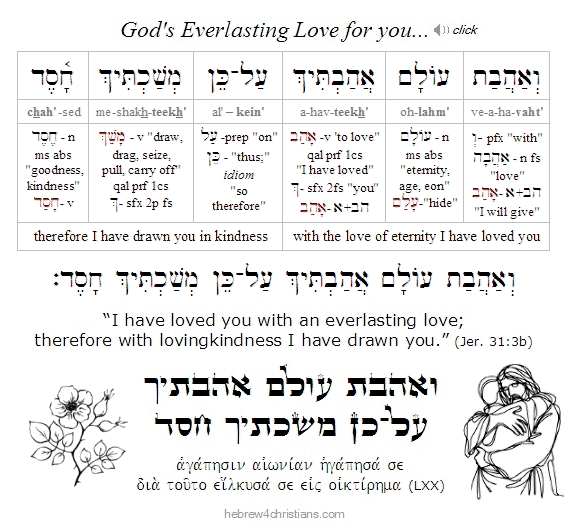
"I saw that He is to us everything that is good: God is our clothing that wraps, clasps and encloses us so as to never leave us, being to us everything that is good." Amen. God loves us "ve'ahavat olam," with an everlasting love, and He draws us to Himself in love:
 |
The Central Thing...
"Distance yourself from a false matter." Exodus 23:7
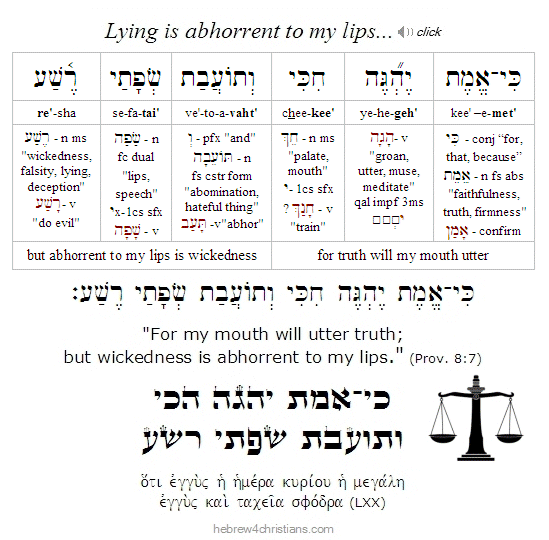
07.24.25 (Tammuz 28, 5785) From our Torah portion this week (i.e., Mattot) we read: "This is the thing the LORD has commanded (זה הדבר אשׁר צוה יהוה): If a man makes a vow to the LORD, or swears an oath to bind himself by some agreement, he shall not break his word; he shall do according to all that proceeds out of his mouth" (Num. 30:1-2). The language used in this passage is emphatic, indicating that the duty to speak truth and to be faithful in our promises is central to God's will for our lives. This is because the sacredness of our word is the foundation for all our other responsibilities. After all, if our word is equivocal, it is unclear, unreliable, undecided, and therefore ultimately meaningless....
Our Lord Yeshua warned us that "every idle word men may speak, they will give account of it in the day of judgment, for by your words you will be justified, and by your words you will be condemned" (Matt. 12:36-37). Insincere words are without genuine commitment, and the lack of decisiveness undermines all Torah. Therefore God commands his people to honor the truth, to keep faith in God's word, and to hold sacred their commitments before God. May the Lord help us be people of righteousness and truth. Amen.
Hebrew Lesson
Proverbs 8:7 Hebrew reading (click):
 |
Comfort from the Shepherd...
07.23.25 (Tammuz 27, 5785) The Spirit of the Lord comforts and reassures those who come to trust in Him: "My sheep hear my voice, and I know them, and they follow me. And I give them eternal life (חַיֵּי עוֹלָם), and they will never perish - no, never! - and no one will snatch them out of my hand" (John 10:27-28).
Note that the Greek grammar in this verse uses a "double negation," which is the strongest way to deny something. In other words, if the question were asked, "Will one of these sheep perish?" the answer is emphatic: "No, no, it will never happen! It is unthinkable!" Indeed all those who belong to Messiah "shall never, ever perish - not into eternity (εἰς τὸν αἰῶνα)." It is an eternal certainty that you who are trusting in Yeshua will never perish, and no power in heaven or earth will be able to take you out of God's hand... "Surely goodness and mercy shall pursue you all the days of your life, and you shall dwell in the Presence of the Lord forever (Psalm 23:6).
Regarding the certainty of salvation Yeshua said: "I tell you the solemn truth, the one who hears my message and believes in the One who sent me has (i.e., ἔχει, present active indicative) eternal life and will not be condemned, but has passed over (i.e., μετά + βαίνω, lit., "crossed over" [עָבַר]) from death to life" (John 5:24).
The verb translated "has passed over" (μεταβέβηκεν) is a perfect active that expresses completed action: "this one has already passed over from death to life." In other words, it is an accomplished reality though it is only experienced as we surrender to the love and grace of God. As the apostle Paul later summarized: "For it is by grace you have been saved (i.e., σεσῳσμένοι, a perfect passive participle that denotes completed action done on your behalf with effects that continue to the present) through faith, and this not from yourselves, it is the gift of God, not a result of works, so that no one may boast" (Eph. 2:9-10). Ultimately, salvation is a question about who you really are, not about what you do.
God does not want us uncertain or unsure of His great love for us. A fearful believer explained that he was anxious about his acceptance before heaven. When he was asked to define "salvation," he answered, "freedom, deliverance, rest, peace." So you think fear will help you do away with your fear? You are fearful of the idea of freedom from fear?
"Be strong and of good courage" - chazak ve'ematz (חֲזַק וֶאֱמָץ). The LORD God promises "never to leave you nor forsake you," and to be with you wherever you go (Josh. 1:5,9; Heb. 13:15, Psalm 139; Matt. 28:20). In the Greek New Testament the wording of Hebrews 13:15 is highly emphatic: "Not ever will I give up on you (οὐ μή σε ἀνῶ); no, not ever will I leave you behind (οὐδ᾽ οὐ μή σε ἐγκαταλίπω)." May you hear the voice of the Good Shepherd calling you, and may He forever keep you under His watchful care. Amen.
Hebrew Lesson
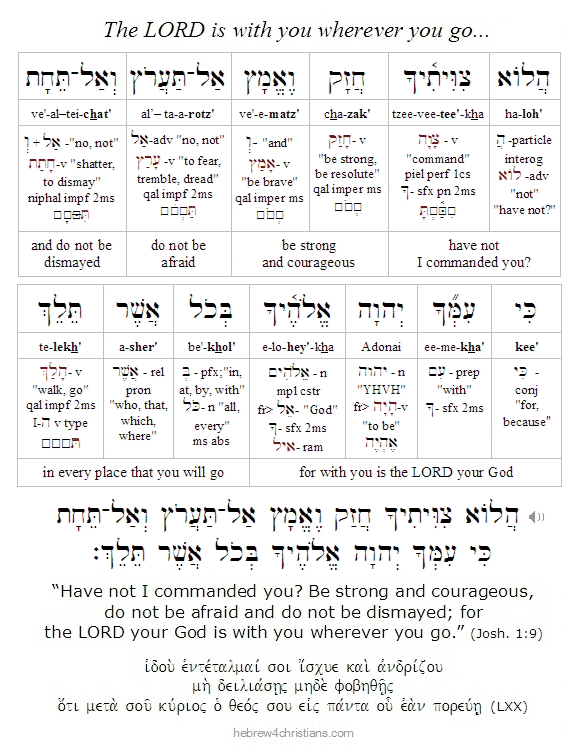
Joshua 1:9 reading (click for audio):
No Followers at Secondhand...
07.22.25 (Tammuz 26, 5785) Soren Kierkegaard reminds us that there are no followers of Yeshua "at secondhand," and that all of us are therefore truly "contemporaries" of the resurrected Messiah. God is not a respecter of persons, and there remains the same proximity between Yeshua's contemporaries and those of us who are living today, near the end of this age. No one can "follow Jesus" by reading the abstract speculations of theologians, just as no one can learn about Him as an archaeologist might study a relic of the past... No, the Name of God, the Tetragrammaton (יהוה), means: "God is Present" (i.e., it is a play on the Hebrew verb hayah [הָיָה], "to be"), and therefore we only come to know God through living faith - just as Yeshua's first disciples came to realize who He was...
The same may be said regarding our spiritual "adoption" in heaven: Each person, whether Jew or Gentile, must be adopted into God's family... Our identity is a matter of faith in God's promises, not on race, DNA, or family lineage. If you are truly one of God's children, understand that God is your Heavenly Father and that relationship takes priority over the seeming way of the flesh in this world... Just as there are no "secondhand" disciples so there are no secondhand children. God doesn't have any grandchildren in heaven, only children: He is not your "heavenly grandfather" but your heavenly Father (אֲבִיכֶם בַּשָּׁמַיִם).
Dwight Moody once said, "God sends no one away empty except those who are full of themselves." Similarly, Matthew Henry observed that "many ask good questions with a design rather to justify themselves than inform themselves, rather proudly to show what is good in them than humbly to see what is bad in them." It is rarely the "professor" or even the "admirer" who evidences real faith, since they are often moved by motives that disclose something other than the heart of the Father:
"Loftiness is naturally an easy thing, and to feel oneself drawn to it is easy enough. But Christ who from on high draws all men to Himself does not take them out of the world where they live, and therefore to everyone who is drawn unto Him in the heights will experience lowliness and humiliation as a matter of course.
This Christ knows very well; and He knows also that the permission to begin with the easiest, or with what seems the easiest, is a necessary deceit in the process of education, and that the fact of it's becoming harder and harder is in order that life may become in truth a probation and examination... A man has to be handled carefully, and hence it is only little by little that his task is made clear to him, little by little he is screwed tighter and tighter by the greater and greater and greater effort of probation and examination. So little by little it becomes for the individual a serious truth that to live is to be examined, and the highest examination is this: whether one will be in truth a Christian or not." (Kierkegaard, Training in Christianity)
While many people may "admire" Yeshua's ethical teachings, they stumble when they are confronted with His cross... Yet this is the heart of the message of God's love: the greatest good is revealed in the suffering of Yeshua for our sins (1 Cor. 2:2). The Master of Life was "despised, rejected of men, a man of sorrows and acquinted with sickness" from whom people turned away their faces in disgust (Isa. 53:3) -- and we are called to take up the cross and follow Him... "When Christ calls a man, he bids him come and die..." We identify with the mission of God's love and smolder through the days and nights under constant self-examination our heart's motivation. Following Yeshua means being a witness to His truth, and retaining the message of His love in a world of ambiguity, pain, and testing...
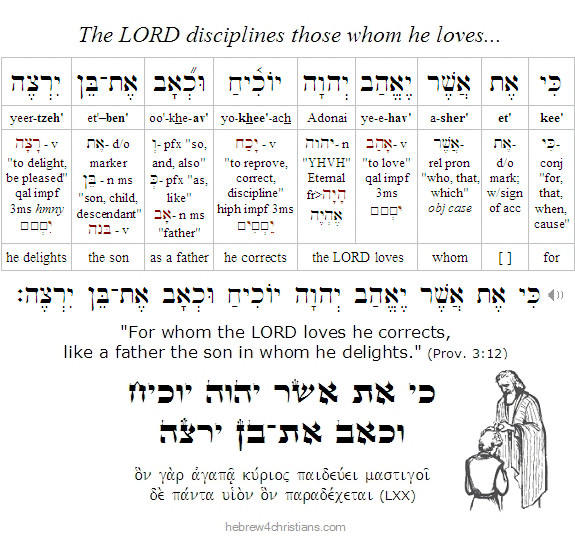
For those who are God's children, testing in this age is designed to impart the character and image of God's son within our hearts. As C.S. Lewis once remarked, "God doesn't love you because you are good, but He will make you good because He loves you." He shows us a "severe mercy..." It is a fearful thing to fall into the hands of the Living God (אֱלהִים חַיִּים), though I would rather be corrected by our LORD than to be judged along with this world.
Hebrew Lesson
Proverbs 3:12 Hebrew reading (with commentary):
 |
His Perfected Strength...
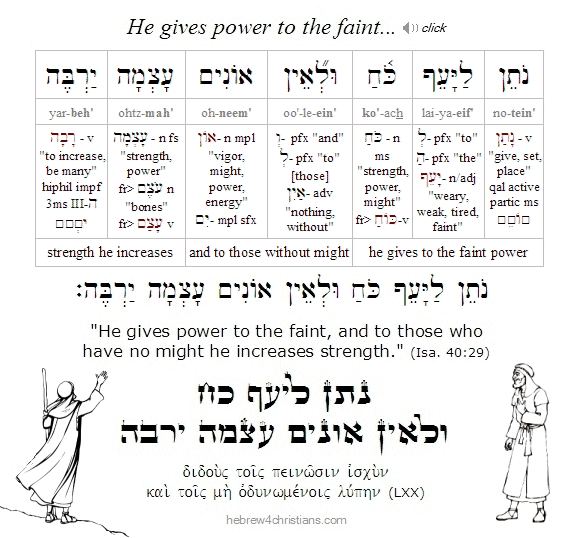
07.22.25 (Tammuz 26, 5785) "Have you not known? Have you not heard? The Eternal One, the LORD, is the Creator of the ends of the earth (בּוֹרֵא קְצוֹת הָאָרֶץ). He does not faint nor grow weary; his understanding is unsearchable. He gives power to the faint, and to him who has no might he increases strength" (Isa. 40:28-29).
Human pride has no objection that God can impart strength, but it objects that strength is found in those who are broken and weary – that is, to those mortally wounded in the battle against evil. The principle of the self-life, the ego, religious observance, "doing the law," etc., is a spiritual dead-end. The word is this: God gives strength to the weary, to the faint, to those who are without potency or power. But this means that they must first be emptied, broken, and stripped of self-sufficiency before the strength of God is manifest in them: "My power is made perfect (τελειοῦται) in weakness" (2 Cor. 12:9). God's way is first to break us, to make us weaker and weaker, so that he can then fill us with the miraculous divine nature.
Like all sacrifices brought to the altar, we must pass through death to life by means of our union with the Messiah at the cross... It is only after the cross that it may be truly said, "It is no longer 'I' who lives; now it is Messiah who lives His life in me" (Gal. 2:20). There is indeed strength, power, and victory – but such comes after the cross, after we reckon carnal energy as useless. "Not by might, nor by power, but by My Spirit, says Adonai Tzeva'ot" (Zech. 4:6).
Hebrew Lesson:
Isaiah 40:29 reading (click):
Where we read, "Messiah who loved me and gave himself for me" (Gal. 2:20), we emphasize the object of God's redeeming love; we stress that this word is being spoken to "me," and that Messiah's love is poured out "for me." But how can we justify doing so, in light of the innumerable souls that have been brought forth in the world? The Mishnah asks, "Why was man created alone?" and answers so that each person must say the world was created for me. "Whoever destroys a soul, it is considered as if he destroyed an entire world; and whoever saves a soul, it is considered as if he saved an entire world..." Amen.
The Most Important Mitzvah...
07.21.25 (Tammuz 25, 5785) The quintessential commandment of all the Scriptures is to trust in Yeshua as your LORD and Savior. Everything else centers on this. The two "great commandments" are the Ve'ahavta ("Love the LORD with all your heart") and the obligation to love others as yourself (Matt. 22:36-40). These two commandments presuppose, however, that: 1) you believe that the LORD is real, personal, loving, and accessible, and 2) you are in fact able to love the LORD and others in the truth. As I mentioned recently, however, apart from genuine spiritual rebirth and the new life imparted through Yeshua (i.e., chayim chadashim: חַיִּים חֲדָשִׁים), it is literally impossible (οὐ δύναται) to fulfill these commandments. Those who are "in the flesh" cannot please God (Rom. 8:8). Indeed, the principle (νόμος) called the "law of sin and death" (תּוֹרַת הַחֵטְא וְהַמָּוֶת) is invoked whenever someone attempts to draw close to the LORD apart from faith in His appointed Sacrifice and Mediator for sin. The idea that your "good deeds" can merit access to the LORD's Presence and favor is ultimately the negation of the cross. The Apostle Paul warned that those who perverted the message of the gospel by adding any form of "works of law" (מַעֲשֵׂי הַתּוֹרָה) were under a divine curse (Gal. 1:8-9). Yes, it's that serious of an issue...
The New Testament states that believers in Yeshua are "declared righteous" (δικαιόω) apart from the works of the law (Rom. 3:28, Gal. 2:16). The "declared righteous one" shall live by faith (Rom 1:17; Gal. 3:11; Heb. 10:38). The Hebrew word for "faith" (i.e., emunah: אֱמוּנָה), occurs for the first time in the Torah in connection with Abraham (Gen. 15:6). But what was the nature of Abraham's faith that God declared him righteous? Was it based on works of the law? After all, Abraham understood the commandments, statutes, and laws of God (Gen. 26:5) yet we know that the law was given to Israel over 400 years after Abraham's day. But what law called for human sacrifice? Could you imagine seeing Abraham on the way to sacrifice Isaac at Moriah? If you were to ask him what he was doing, what would he be able to reply? If you were to later see him slowly raising his knife to slay his son, would you think that he was obeying the law of God or rather that he had gone insane and lost his mind?
(Of course we know - after the fact - that Abraham's hand was stopped by the Angel of the LORD, but remember that he did not know the LORD's intervention was imminent. Abraham traveled three long days to Moriah with the intent to offer his "only begotten son" (בֵּן יָחִיד) as a sacrifice, and surely Isaac understood the purpose of the mission as well. We miss the incredible drama and significance of this test if we forget this.)
As Soren Kierkegaard pointed out, "faith" is its own category or mode of existing: "Faith is the contradiction between the infinite passion of inwardness and objective uncertainty." When Abraham was tested with the Akedah, he was willing to give up his rational understanding of the moral law in obedience to God. He believed God could do the impossible (Matt. 17:20; Luke 1:37). Abraham was declared tzaddik (righteous) because he trusted that God would fulfill his promise made to him, even if he slew his promised heir upon the altar (Heb. 11:17-19). Through his faith, Abraham foresaw the redemption of the world (i.e., the Messiah) and firmly believed in God's promise of salvation (John 8:56). As Paul states, "For the promise to Abraham and his offspring that he would be heir of the world did not come through the law (הַתּוֹרָה) but through the righteousness of faith" (Rom. 4:13). The works of the law (מַעֲשֵׂי הַתּוֹרָה) and the righteousness of faith (צִדְקַת הָאֱמוּנָה) are therefore antithetical and contrary concepts (Rom. 9:32). Those who accept this truth are called "the children of Abraham" and are partakers of his blessings (Gal. 3:7,9). Paul even went further by forcefully saying that "all who rely on works of the law (מַעֲשֵׂי הַתּוֹרָה) are under a curse" (Gal. 3:10). It was solely through the righteousness of Yeshua as Adonai Tzidkenu (יהוה צִדְקֵנו) that we are saved from the curse of the law (Gal. 3:13).
Why, then, was the law at Sinai given? Scripture answers: "It was added (προστίθημι) because of transgressions" (Gal. 3:19). The law was "set forth" to teach us about the holiness of God and to function as a mirror of our inward condition. The "lawful use of the law" is intended to convict us of our sin and thereby lead us to the message of the gospel (1 Tim. 1:8-11). It is only by means of the law's verdict against us that we recognize our need for God's salvation. The law itself is powerless to save, but it does speak the truth about God's righteous demands as our Creator and Judge.
The law was also given to serve as a "tutor" or "guardian" (παιδαγωγός) to lead us to the School of the Messiah (Gal. 3:19-25). Note that the Greek word used here ("paidagogos") referred to a trusted servant who would supervise the life and morals of boys belonging to the upper class. Before arriving at the age of manhood, boys were not allowed to leave their house without being escorted by their "paidagogos." Followers of the Messiah are admonished not to revert to childish thinking but to understand matters maturely (1 Cor. 13:11, 14:20, Heb. 5:12-14). We are now led by the Spirit of God as God's sons and are therefore no longer "subject" to religious regulations (δόγμα) that command us to "touch not, taste not, handle not." We are now called to seek those things that are above, where the Messiah reigns from on high (Col. 2:20-3:1). "Therefore do not be foolish, but understand what the will of the Lord is" (Eph. 5:17). Yeshua came to bear witness to the truth: "Everyone who is of the truth listens to my voice" (John 18:37). The truth sets us free to become co-heirs with the Messiah in the Kingdom of God (Rom. 8:17, Titus 3:7, John 8:32). If we love the Messiah, we will honor His covenant and His Torah (2 Cor. 10:5).
Many of us, I am afraid, don't really want to be free... It's so much easier for us to justify ourselves as pleasing to God on the basis of some litany of rules we are keeping (i.e., 'Torah Observance,' keeping 'kosher,' attending religious services, etc.) or through some ritual acts that we are performing (i.e., 'Shabbat observance,' 'communion,' 'liturgy," and so on). We feel more comfortable in a group, as part of a crowd. We do not want to live as truly free individuals before the LORD because this implies that we are responsible for our individual lives. But genuine freedom only comes through individual and personal faith (אֱמוּנָה). We must inwardly trust that we have direct access to the Throne of Grace (כִּסֵּא הֶחָסֶד) and are accepted by God as His own beloved child (Heb. 4:16, Rom. 8:15). God has made us "graceful" (χαριτόω) in the beloved (Eph. 1:6). This is the first step, and all the rest will take care of itself if we really do business there...
Trusting in the LORD is foundational to all that may rightly be called Torah. The Talmud (Makkot 23b-24a) says, "Moses gave Israel 613 commandments, David reduced them to eleven (Psalm 15), Isaiah to six (Isaiah 33:15-16), Micah to three (Micah 6:8), Isaiah reduced them again to two (Isaiah 56:1); but it was Habakkuk who gave the one essential commandment: tzaddik be'emunato yich'yeh, literally, "the righteous, by his faith, shall live." In the New Testament (long before the compilation of the Talmud), the apostle Paul had first distilled the various commandments of the Torah to this same principle (see Rom. 1:17, Gal. 3:11, and Heb. 10:38).
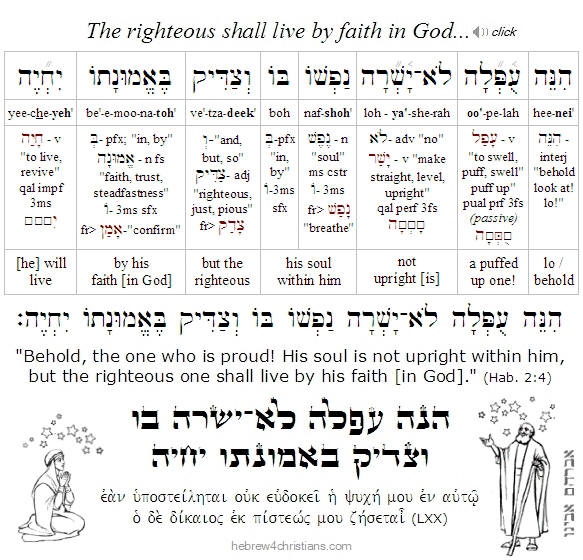 |
"The righteous shall live by his faith" (וצדיק באמונתו יחיה). This small phrase, consisting of only three Hebrew words, is the central axis upon which salvation turns, since it distills the requirement that we are justified by our faith in God's righteousness (צִדְקַת אֱלהִים) and not by "works of righteousness (מַעֲשֵׂי הַצְּדָקָה) which we have done" (Titus 3:5). Regarding the righteousness that comes by faith and its relationship to the works of the law, Paul writes: "To the one who does not work but trusts in him who justifies the ungodly (πιστεύοντι δὲ ἐπὶ τὸν δικαιοῦντα τὸν ἀσεβη), his faith is counted as righteousness" (Rom. 4:5).
There are many false teachers at work today, including many who teach error, even in the name of the "Messianic movement." These teachers invariably claim that something more is needed than simple faith in the truth of the gospel message. The author of the Book of Hebrews states: "For the law made nothing perfect, but now a better hope has taken its place. And that is how we draw near to God (Heb. 7:19). He goes on to warn: "For yet a little while, and the Coming One will come and will not delay; but my righteous one shall live by faith (וְצַדִּיק בֶּאֱמוּנָתוֹ יִחְיֶה), yet if he shrinks back my soul has no pleasure in him" (Heb. 10:37-40). Likewise, the Apostle Paul warned believers not to be seduced with the demands of the law once again: "Did you receive the Spirit by works of the law or by hearing with faith? Are you so foolish? Having begun by the Spirit, are you now being perfected by the flesh?" (Gal. 3:2-3). He goes on to liken those who wish to return to Sinai as slaves, but those who press on to Zion as free (see Paul's Allegory of Sarah and Hagar).
In yet another analogy, Paul says that a widow is released from her obligation to her deceased husband and is therefore free to remarry another: "Likewise, my brothers, you also have died to the law (ὑμεῖς ἐθανατώθητε τῷ νόμω) through the body of Messiah, so that you may belong to another, to him who has been raised from the dead, in order that we may bear fruit for God" (Rom. 7:4). In terms of this analogy, a "return to the law" is like a form of spiritual adultery, since it betrays the new covenant that God has given to us who believe (Rom. 7:1-4).
When the Lord Yeshua came there was a change in the law, because there was a change in the priesthood (see Heb. 7:11-12). This priesthood of Yeshua is said to be after the "order of Malki-Tzedek" (מַלְכִּי־צֶדֶק), based on a direct oath from God, that predates the operation of the Levitical priesthood (for more information about the role of Yeshua as our High Priest, see the article "Yom Kippur and the Gospel"). This is not unlike the office of King/Priest that Moses held when he commanded the sacrifice of the Passover lambs during the Exodus. The korban pesach (sacrifice of Passover) was not originally instituted through the Levitical priesthood (i.e., the Mishkan), but rather predated the giving of the law to the priests. It is no coincidence that Yeshua explicitly referred to this (pre-Levitical priesthood) event to speak of His role as Seh Elohim, the Lamb of God who takes away the sins of the world (John 3:1-12).
Indeed, the Levitical priesthood "made nothing perfect" and therefore a "new priesthood" was required to finally reconcile us back to God (Psalm 110:4). "For when there is a change (μετατιθεμένης) in the priesthood, there is necessarily a change (μετάθεσις) in the law as well" (Heb. 7:12). The word translated "change" here comes from the verb μετατίθημι (from meta, "after" + tithemi, to "set") which would be better translated as "transposed." The idea is the priesthood reverted back to the original priesthood of Zion and therefore required a corresponding "transfer" of authority (μετάθεσις) to the original kingship as well (Heb. 7:12). Yeshua is our great Kohen Gadol (High Priest) after the order of Malki-Tzedek (Heb. 5:10, 6:20; 7:1-28), just as He is our King and the final authority of the Torah. Those who follow Him are called to be mamlekhet kohanim v'goy kadosh, "a kingdom of priests and a holy nation" forever (Exod. 19:6, 1 Pet. 2:9, Rev. 1:6, 5:10). Followers of Yeshua have an altar "from which those who serve in the Tabernacle are not permitted to eat" (Heb. 13:10).
Today we don't offer sheep and goats upon altars in our services because we understand that this is no longer the way to come before the LORD. We have a better hope before the Throne of Grace (Heb. 4:16, 7:19). (For more on this important subject, see the article, Rabbis who Deny Blood Atonement). So what are you going to trust, your religious zeal for righteousness or God's gracious salvation? To put it another way, when you face the coming day of judgment, will you be trusting in your own merit or in the merit of Yeshua?
If you listen to some of the big-name Messianic teachers out there today, you'll hear that the Christian Church is either an entirely self-deceived social institution or else that "Christians" are woefully deficient regarding matters of spiritual truth. In short, these teachers insist that something more needs to be added, some additional knowledge, practice, awareness, insight, and so on. And of course these teachers position themselves as the ones who can "disabuse" you of your pagan misconceptions, etc. We see this trend in both the "Torah observant" schools of Messianic Judaism as well as in the "new wave" of "mystical Messianic Judaism" that is beginning to become more and more commonplace.
Such spiritual pride is insidious, seductive, self-flattering, and therefore dangerous. Indeed, the term itself is an oxymoron (e.g., like "bittersweet"), since genuine spirituality is always rooted in humility. The humble soul understands its finitude and radical contingency -- and therefore understands its absolute need for God's help. The proclamation of the Cross of Yeshua as the sole means of atonement with God is inherently offensive to the idea of "meritocracy" taught in traditional Judaism (and in other religions).
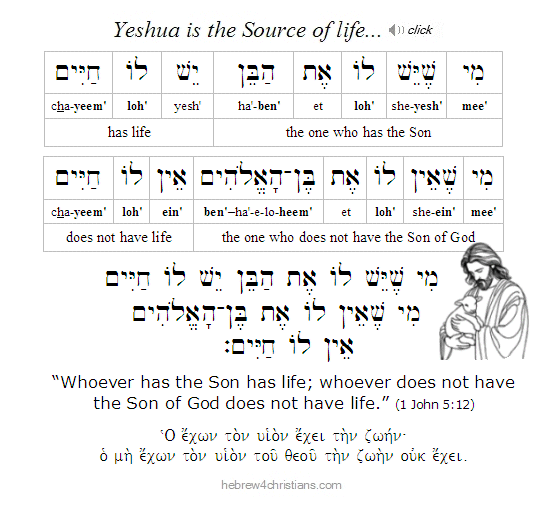
Let me repeat the main point I am trying to make here. The single most important mitzvah of ALL of Scripture is to trust in Yeshua as your LORD and Savior, since He alone is the one who gives us true spiritual life. "Let it be known to you therefore, brothers, that through this man forgiveness of sins is proclaimed to you, and by him everyone who believes is freed from everything from which you could not be freed by the law of Moses (Acts 13:38-39). Yeshua is the way (הַדֶּרֶךְ), the truth (הָאֱמֶת), and the life (הַחַיִּים); no one comes to Father apart from Him (John 14:6, Acts 4:12). As Jesus said, "The Father judges has given all judgment to the Son, so that all may honor the Son, just as they honor the Father" (John 5:23-24). "Whoever has the Son has life; whoever does not have the Son of God does not have life" (1 John 5:12):
 |
It is important to study the whole counsel of Scripture. We do not impugn the Torah when we say that God has made a better covenant based on better promises (Heb. 8:6). The LORD is the same yesterday, today, and forever: He is one.... The revelation and grace of God is manifest at Sinai as it is at Zion. What's changed is the covenant -- and our response to that new covenant in light of the full counsel of the Scriptures. An honest reading of the New Testament shows that Paul was not simply rejecting legalism, but any form of work-based salvationism. Israel should have known this, since the Torah (and prophets) prophesied that a new era of "circumcised hearts" would come. Therefore Paul puts forward the idea that salvation by the grace of God is in perfect harmony with the overall teaching of Torah.
Do not be confused about all this. Torah study is good and Christians are expected to understand the writings of Moses (and the prophets) and how they reveal Yeshua as the Messiah (Luke 24:27; Acts 3:22). When Paul wrote to the Gentile churches, "All Scripture is breathed out by God and profitable for teaching, for reproof, for correction, and for training in righteousness, that the man of God may be competent, equipped for every good work" (2 Tim. 3:16-17), he was of course referring to the Jewish Scriptures, since the New Testament had not yet been compiled at that time. By all means then should followers of the Jewish Messiah study the Torah of Moses and be aware of how it glorifies the LORD. But Torah study must be informed with the Spirit of Truth (רוּחַ הָאֱמֶת). Yeshua is the central character of the story of redemption; he is called the Aleph and Tav, the "Lamb slain from the foundation of the world" (1 Pet. 1:20; Rev. 13:8).
We are commanded to "rightly divide" (ὀρθοτομέω, lit. "cut straight") the "word of truth" (דְּבַר הָאֱמֶת, see 2 Tim. 2:15). Therefore, in order to avoid confusion regarding the relationship between the words of Moses and the words of Yeshua, we must bear in mind that Torah (תּוֹרָה) is a general word that means "instruction" and always is a function of the underlying covenant (בְּרִית, "cut") of which it is part. In other words, Torah is our responsibility to the covenantal actions of the LORD God of Israel. Followers of Yeshua are therefore not "anti-Torah" even if they understand this word in relation to the new and better covenant of God (Heb. 8:6). There is indeed a Torah of the New Covenant, just as there is Torah of the older one. Messianic believers are called to adhere to the instruction of King Yeshua who is the embodiment of all genuine truth from God (John 1:17). The all-important matter is to understand our response to God's covenantal actions as mediated through God's promised Messiah (1 John 5:11-12).
So does all this mean - in practical terms - that we can disregard the Torah and ignore what it teaches? By no means. Consider that we cannot even begin to understand the idea of the New Covenant (בְּרִית חֲדָשָׁה) or even the nature of salvation itself (יְשׁוּעָה) apart from thoroughly understanding the law of Moses (תּוֹרַת משֶׁה). (Psalm 1:1-2, 19:7, 119:97, etc.) Again, Yeshua plainly said that Moses and the prophets wrote of Him (John 5:46, Luke 24:27), and the Apostle Paul stated that faith in the Messiah upholds the "lawful" use of the law (1 Tim. 1:8, Gal. 3:19-24, Rom. 3:27-28, etc.). This is the "law of faith" (תּוֹרַת הָאֱמוּנָה) that precedes and underlies all that was given at Sinai to the Jewish people. It is the "deeper Torah" of trust that Abraham and the prophets understood. As Paul wrote, "Does it follow that we abolish (καταργέω, "make useless") Torah by this trusting? Heaven forbid! On the contrary, we establish (ἵστημι, "make stand") the truth of the Torah" (Rom. 3:31).
Just as there is a deeper sense of Torah that Paul appealed to make his case that he was not teaching "against the law" (e.g., Gal. 3:16-18), so there is a deeper sense of rest (שָׁבַת) that God promised those who are trusting in Him (מְנוּחַת שַׁבָּת, Heb.4:9). This rest comes from trusting in the finished work of Yeshua as our Torah righteousness before the Father. May you turn to Him for life and peace now!
 |
This Week's Torah:
Parashat Mattot-Masei...
07.21.25 (Tammuz 25, 5785) Shavuah tov, chaverim! This week we will read a "double portion" of Torah that concludes Sefer Bamidbar, or "the Book of Numbers." Our first Torah portion, called parashat Mattot (מַטּוֹת, "tribes"), begins with the LORD giving laws and prohibitions regarding the making of vows (nedarim). After this, the Israelites were commanded to wage war against the Midianites for seducing the people to sin at the incident of "Baal Peor." During the ensuing battle, the wicked sorcerer Balaam was killed, as well as five tribal kings of the land of Midian.
The tribes of Reuben and Gad (and half of the tribe of Manasseh) then asked permission to settle in the pasture land of Gilead (on the east of the Jordan), since they had large herds of cattle. At first Moses hotly disapproved of their request, since he feared that the other tribes would lose heart if these tribes stayed behind during the conquest of Canaan. However, when the tribal leaders made a vow to join the fight while their families remained in Gilead, Moses finally agreed.
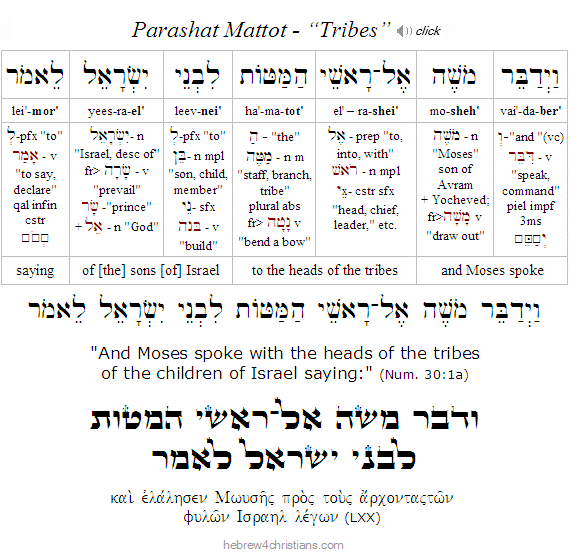 |
In our second Torah portion, called parashat Masei (מַסְעֵי, "journeys"), Moses recounted the various "stations" of the journey, and instructed that when the people crossed the Jordan into the land of Canaan, they were to drive out all the inhabitants and to utterly destroy all traces of their culture and religion. After this, the land would be divided by lot according to tribes of Israel, based on the size of each tribe. God then warned Moses that if the Israelites would not drive out the inhabitants of the land, they would become a "snare" to them, and God would then judge and exile the Israelites as he intended to do to the Canaanites.
The Israelites were then instructed to assign towns with surrounding pasture lands to the Levites. There were to be a total of 42 towns, chosen by lot and distributed throughout the land according to the size of each tribe. In addition, six more cities were to be given to the Levites and designated as "cities of refuge" to which a person who unintentionally killed another may flee to take refuge from an "avenger of blood" (i.e., next of kin). The death penalty required testimony from at least two witnesses and admitted of no "ransom" (plea bargain) to be offered in place of the murderer's execution. On the other hand, a person responsible for involuntary manslaughter of another was required to dwell within the confines of a city of refuge until the death of the High Priest, after which time he was free to return to his home without fear of retribution from an avenger of blood.
The Book of Numbers – and the historical narrative of the Torah itself – concludes with the resolution of the question of legal inheritance in the land just before Joshua would lead the people into the land of Canaan. The book ends with this statement: "These are the commandments and the rules that the LORD commanded through Moses to the people of Israel in the plains of Moab by the Jordan at Jericho."
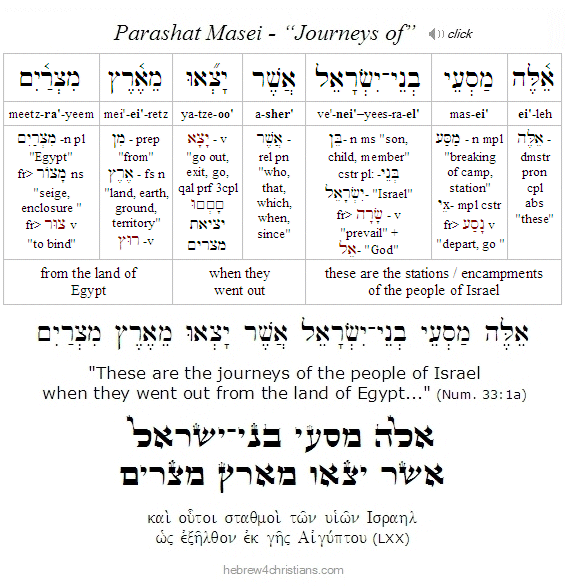 |
The Torah of Zeal...
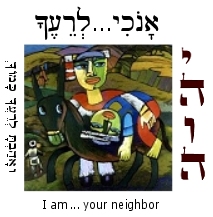
07.20.25 (Tammuz 24, 5785) The world is full of zealots. By default, everyone believes they are justified in their reasoning and in their passions. The "natural man" thus lives by this simple creed: I have a right to think or feel whatever I want. Morality is a matter of individual, subjective, and personal preference. There is no "objective standard" of moral truth in the universe: Values are relative to time and place... If it's true for me, that's all that suffices... In this way, the natural man assumes the posture of a self-styled "free agent" that is answerable only to himself. The zeal of the natural man says, "I am the master of my fate; I am the captain of my soul" (Henley: Invictus).
Note that the only abiding "offense" to the "natural man" is that there is a moral law that pervades the universe, and therefore he is morally accountable to the Lawgiver for his life. The idea that our actions are "under divine examination" is threatening to the supposed liberty of the natural man, who gladly tolerates all manner of sin and willful ignorance but refuses to tolerate anger and the repudiation against sin... The natural man hates the very idea of the moral law of God and all that it implies. It's no wonder that the true prophets of God were often murdered for speaking the truth....
The encounter (or collision) with moral reality (i.e., conscience) leads the natural man to become impassioned and even zealous, though usually this is expressed in some form of self-justification. The world's religions are filled with untold millions of people who seek to assuage their consciences by practicing various rituals or pledging allegiance to some creedal formula. What's common in most of these religions is the centrality of the ego, or the need to "save face" by making excuses of some sort. The Torah of the ego is either advised to become "elevated" through religious practices or rituals (i.e., legalism, including the justification for "jihad" found in Islam), or else it is is encouraged to practice various techniques for "escaping" the world (i.e., mysticism, divine unity, etc.). Hence we see the interplay between legalism and mysticism in so many of the world's religions.
Yeshua, on the other hand, spoke plainly of man's hopeless condition and the need for spiritual regeneration, or "rebirth." The natural man is spiritually dead and without hope apart from a miracle imparted directly from God Himself. As Yeshua said, "Unless you are born again, it is impossible (οὐ δύναται) see the Kingdom of God" (John 3:3). Rebirth comes by means of the Holy Spirit and leads to a new order of creation for the soul (2 Cor. 5:17, Gal. 6:15). Yeshua did not come to extinguish our egos as much as He came to resurrect and recreate us in His image (Rom. 8:29). "For we all, with unveiled face, beholding the glory of the Lord, are being transformed into the same image from one degree of glory to another. For this comes from the Lord who is the Spirit (2 Cor. 3:18). Indeed, since the self is ultimately defined by relationship, it is only after we are reborn in the Spirit that we can be said to have a spiritually real "self" at all. God gives the gift of a true, resurrected self to those whom He regenerates.
Escaping the Legalism Trap...
But what about those who receive the message of the gospel? How do they please God? After coming to Yeshua for life, some people tragically revert to the concept of the law once again. They attempt to "try harder" to please God and saddle themselves with various religious obligations (prescribed prayers, church services, rituals, etc.). They seem to forget that the law is powerless to save. Their logic goes something like this. I was condemned by the law, but because of God's mercy revealed in Yeshua, I am now forgiven. Therefore I am enabled by God's Spirit to keep the law, and therefore I should strive to be kosher, to observe various rituals, etc. This reasoning assumes that the law (i.e., the legal aspects of the covenant made at Sinai) with its verdict against us was not really done away with at the Cross of Yeshua (Col. 2:13-15). The "New Covenant," in other words, is not really all that new, and should be regarded as a "renewed covenant" instead. The upshot of this thinking is that Yeshua died on the cross so that we could all become disciples of Moses!
I've written about this subject before, but I'll say it again here. There is indeed a "Torah" for followers of Yeshua, but it is based on His teaching... Indeed, the word "Torah" (תּוֹרָה) simply means "direction" or "teaching." So what did Yeshua teach regarding doing the "works of God?" Here's his explicit answer: "This is the work of God, that you believe in him whom he has sent" (John 6:29). Without faith it is impossible to please God (Heb. 11:6) since we are literally saved by hope, not by works of righteousness (Rom. 8:24, Titus 3:5). What God requires is authentic faith in His Son (אֱמוּנַת יֵשׁוּעַ). The single most important mitzvah is trusting in Yeshua for life... This is THE central commandment of Scripture. Legalism attempts to find the "key" to open the door into the Presence of God through various forms of self effort ("don't touch this," "don't eat that," etc. Col. 2:20-23). It's underlying hope is that if I do such and such (or abstain from such and so), God will be propitiated and I will be accepted. It is therefore a mode of relating to God based on His conditional acceptance and approval.... But faith is the key that opens the door to true freedom. It is the miracle that makes blind eyes see. When we truly "live in the Presence of the LORD" by faith, we are set free from the trap of legalism. We receive the love of God; we accept that we are accepted; and then we walk in God's zeal and care for our souls (in that order). We do not relate to God as Judge but as our Father, our Abba, our loving Savior.
Guilt, shame, and spiritual death come from relating to God on the basis of our own zeal and supposed merits, but forgiveness, justification, and spiritual life come from trusting in God's zeal and passion for you.... Again, it's not so much a matter of finding the zeal within your heart, but rather receiving the zeal that comes from the LORD. We are sanctified by faith alone, just as we are justified by faith alone (Eph. 2:8-9; 1 Cor. 6:11). There is no "catch" in the contract, no loophole, and no exception to the "Torah of the Spirit of Life" (תּוֹרַת רוּחַ הַחַיִּים). If the Son sets you free, you are free indeed. This is the scandal of grace. Trying to please God through self-effort leads to exhaustion and frustration. Accepting that you are accepted and loved leads to peace and joy. God's love for you is the end of the law for righteousness (Rom. 10:4). In all things Yeshua is preeminent.
"In those who rest on their unshakable faith, pharisaism and fanaticism are the unmistakable symptoms of doubt which has been repressed. Doubt is not overcome by repression but by courage. Courage does not deny that there is doubt, but it takes the doubt into itself as an expression of its own finitude and affirms the content of an ultimate concern. Courage does not need the safety of an unquestionable conviction. It includes the risk without which no creative life is possible." - Paul Tillich
In closing, there is man's zeal, and there is God's zeal. The zeal of the LORD (קִנְאַת יהוה) represents His passion and eagerness to help those who are trusting in Him. Man's zeal is always insufficient, since self-justification - of any sort - invariably leads to the "Torah of sin and death" (תּוֹרַת הַחֵטְא וְהַמָּוֶת). This is precisely why legalism leads us to shame. As long as you think you can merit eternal life by means of your own efforts, you are relating to God as Judge (אֱלהִים) rather than as compassionate Savior (יהוה). You have yet to experience inner brokenness and therefore believe you can "justify yourself." It is the Spirit that gives us life - though always at the price of the death and resurrection of the ego. As Yeshua said, "Truly, truly, I say to you, unless a grain of wheat falls into the earth and dies, it remains alone; but if it dies, it bears much fruit" (John 12:24).
None of what I've attempted to share here implies that we are to be passive in our affections and in the exercise of our will... No, but the principle that governs our passion is to be derived from the "Torah of the Spirit of Life" and no longer from the "Torah of Law and Death." Because of Yeshua, we are free to trust in the zealous, passionate, and irrepressible love of God for our lives. The same passion that led Yeshua to die upon the cross is present for you today, if you have faith enough to receive it... God is the beginning and the end of our salvation: Kinat Adonai Tzeva'ot ta'aseh zot: "The zeal of the LORD of hosts will do this."
Hebrew Lesson
Psalm 103:13 reading (click for audio):
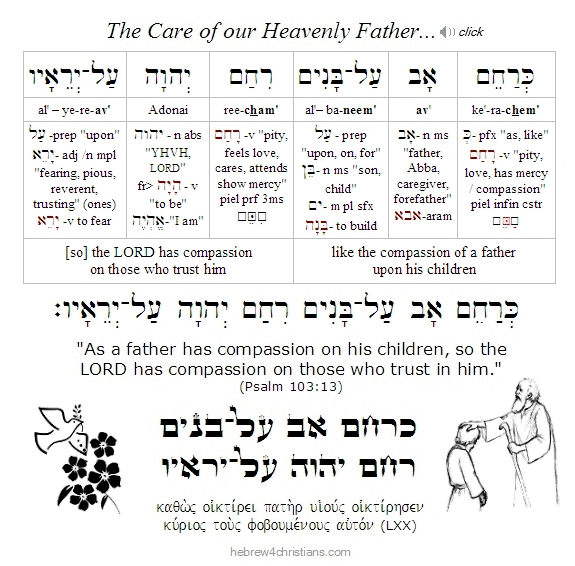 |
What are you dying for?
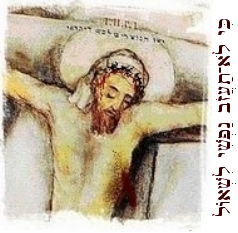
"He is no fool who gives what he cannot keep to gain what he cannot lose." - Jim Elliot
07.18.25 (Tammuz 22, 5785) We might sometimes ask the question, "What am I living for?" though the question could be turned around to ask, "What am I dying for?" for indeed we are given precious and few days during our sojourn here, and every day we live is a day we are deciding that for which we will die. What we are willing to die for reveals what we believe is the reason for our lives....
If you stop and think about it, you realize that you "cannot not" exist; indeed you were "thrown" into this world apart from your conscious consent, and moreover that you cannot escape the inevitability of dissolution, suffering, death. Meanwhile, your life passes quickly as a fleeting vapor, as it says: "As for man, his days are like grass; as a flower of the field, so he flourishes: for the wind passes over it, and it is gone; and the place thereof remembers it no more" (Psalm 103:15-16).
Here today, gone tomorrow... but to what end? Where are you going during your short sojourn here on earth? Do you believe in the spiritual world? If you believe you are on your way to heaven, how are you living today that demonstrates your journey?
Will there be regret when you die? Will there be regret in heaven? Is it possible to lose a measure of blessedness in the world to come through disobedience, faithlessness, and sin? It is a dreadful thought, and many of us feel that much of our life has been regrettable, but how we come to "build" our lives make the difference for eternity: "For no one can lay a foundation other than that which is laid, which is Yeshua the Messiah. Now if any man builds upon this foundation with gold, silver, precious stones, or with wood, hay, stubble, each one's work will become clear; for the Day will declare it, because it will be revealed by fire; and the fire will test each one's work, of what sort it is. If anyone's work which he has built on it endures, he will receive a reward, but if anyone's work is burned, he will suffer loss; but he himself will be saved, yet so as through fire" (1 Cor. 3:15). "For we must all appear before the judgment seat of Messiah, that each one may receive the things done in the body, according to what he has done, whether good or bad" (2 Cor. 5:10).
Yeshua gave us parables admonishing us to make the most of our lives. The "Parable of the Soils" warns us to be receptive to God's presence and to bear fruit (Luke 8:4-8); the "Parable of the Talents" warns us not to squander our lives out of fear or complacency (Matt. 25:14-30). The tragic judgment of the indifferent steward was expressed by Yeshua this way: "From him who has not, even that which he has shall be taken away" (Matt. 25:29). The "Parable of the Rich Fool" warns us to be rich toward God (Luke 12:13-21), and so on.
But what about all the great promises of the Lord that he will remove our transgressions "as far as the east is from the west," and that he will cast our sins to the depths of the sea and remember them no more? The LORD says: "I, even I, am He who blots out your transgressions for My own sake, and I will not remember your sins" (Isa. 43:25). Indeed does not the New Covenant specifically promise us deliverance from our sins? Prophetically Jeremiah spoke on behalf of God: "For they all shall know Me, from the least of them to the greatest of them, says the LORD. For I will forgive their iniquity, and their sin I will remember no more" (Jer. 31:34). And does not the Cup of our Savior represent the blood of the New Testament which is shed for many for the remission of sins (Matt. 26:28)? Amen, yes indeed, the problem of our sins has been taken care of by Yeshua at the cross: "Most assuredly I say to you, the one who hears My word and believes in Him who sent Me has everlasting life, and shall not come into judgment, but has passed from death into life" (John 5:24). God has made us accepted in Yeshua: "In Him we have redemption through his blood, the forgiveness of sins, according to the riches of his grace" (Eph. 1:7).
So it seems there is a difference between being forgiven and being free of regret, for the latter is a feeling of mourning over lost opportunities, a sorrow that, in light of the truth of how wonderful and kind God is, more could have been done for him, that a life of deeper obedience, passion, and fellowship was possible for us but, for was left unlived... "But God, who is rich in mercy, for his great love with which he loves us, even when we were dead in sins, has made us alive together with Messiah - by grace you are saved - and has raised us up together, and made us sit together in heavenly places in Yeshua the Messiah, that in the ages to come He may demonstrate the exceeding riches of his grace in his kindness toward us through Yeshua our Lord" (Eph. 2:4-7). Amen, God's mercy and truth kiss....
When the unnamed woman from Magdala wept and washed his feet with her tears, Yeshua said to the those that were present, "I tell you, her sins, which are many, are forgiven -- for she loved much" (Luke 7:44-48). In other words, she was so lavish in her love because she deeply regretted that she had missed what was most important, what she desperately needed all along... She saw her sin as blindness to God's love... After all, why would she weep over her sins unless she loved him? And how could she love him unless he first revealed his love to her? (1 John 4:19).
Love and regret... It's a bit of a paradox, somewhat like God's commandment to Israel to blot out the name of Amalek so that they would never forget what Amalek did to them! And we will sing a new "Song of Lamb" in heaven that remembers how we were redeemed from our sins by Yeshua's shed blood upon the cross... "And they sung a new song, saying, 'You are worthy to take the book, and to open the seals thereof: for You were slain and have redeemed us to God by Your blood from every kindred, and tongue, and people, and nation" (Rev. 5:9). The scene of the "Lamb that was Slain" sitting upon the throne of God surrounded by innumerable souls who were clothed in white, waving palms, and crying out praise for God's salvation is dramatic and wonderful: "For the Lamb who is in the midst of the throne shall feed them, and shall lead them unto living fountains of waters: and God shall wipe away all tears from their eyes" (Rev. 7:17). And yet all of this glory came at the utmost expense of the dark cloud of the cross; the overwhelming passion; the excruciating agony, the blood poured out in intercession for the forgiveness of our sins...
All this indicates that though we will have remembrance of our sins, they will be remembered only in relation to the unfathomably great sacrifice of Yeshua as our Healer and the lover of our souls. We have peace with God. Ah, a bittersweet and beautiful brokenheartedness! We shall only know our sin in relation to the unending love and tender mercies of our Lord...
I should add that there is a place for godly sorrow, of course, and for genuine remorse over our sins. As we understand God's great desire and love for us, we begin to realize that the essence of sin is the refusal of His heart for us. The underlying issue with sin concerns the question of God's love. Simply abstaining from certain actions does not address the deepest need of the heart. It is not turning away from sin that matters as much as turning toward God. The forgiveness of sin is meant to lead us to the life of love.
So again let us ask ourselves: "What am I dying for?" In this world we have one life to live, a brief time wherein we can come to know God and learn to yield to his love. Every soul shares this same existential position: we are born; we suffer, we die, and then we will face judgment (Heb. 9:27). And though we will suffer and die, how we live today has profound implications for our eternal destiny. If we cling to our suffering and bitterness we will be locked into a prison of hell. Though we all will suffer and we will all die, the answer is not to unthinkingly rage at life for its apparent injustice, for that spreads hatred, bitterness, and despair. Nor are we to pretend that life and death are meaningless, or to seek escape from the vapor of our fears by drugs, sex, pop culture, etc., for these are not solutions to our eternal and spiritual tribulations. Every person needs to be healed from the real the sickness of soul, namely eternal death, and the remedy for this comes only and exclusively through Yeshua and his intercession for us, since there is salvation in no other name (Acts 4:12). His is the Name before whom every knee shall bow and every tongue confess (Phil. 2:9-11; Isa. 45:23). And He alone gives eternal life to those who trust in him (John 10:28). "For there is only one God and one Intercessor who can reconcile God and humanity -- the man Yeshua the Messiah -- who gave himself as a ransom for all" (2 Tim. 2:5-6). There is only one Savior, one Redeemer, and one Healer of the human heart, and that is Yeshua the LORD.
So how shall we then live? What can we do to heal a broken and dying world? Well first of all we must settle the matter and decide to live in the truth of Messiah: we "set the Lord always before us" (Psalm 16:8). Doing teshuvah is always the first step. Then, when opportunity arises, we can confide our heart's convictions with others; we can share our hope and healing with those who are hurting and lost. Our Lord commissioned us to be his representatives or ambassadors of life. We are given the inestimable privilege of sharing the way of salvation to others. There is no higher calling, friends. Physical doctors may heal the body, but only the Lord can heal the soul, and the Lord uses broken people who trust in him to speak words of life by means of the Holy Spirit. As we sojourn our days, the Lord asks us to humbly share our faith with those for whom he died upon the cross and to invite them to come to Him for life (Matt. 28:19-20). The apostle instructs us to "sanctify the Lord God in your hearts, and always be ready to give an answer to anyone who asks you the reason for the hope that is in you, with humility and respect" (1 Pet. 3:15). Helping another soul come to know God and to be reborn by the Spirit of God is the greatest joy we will share throughout eternity to the praise to our great God and Savior. Amen.
Hebrew Lesson
Psalm 63:3-4 reading (click for audio):
Olam Katan - Small World...
07.18.25 (Tammuz 22, 5785) It is written in our Torah portion for this week (i.e., Pinchas), "My offering, my food for my food offerings, my pleasing aroma, you shall be careful to offer to me at its appointed time" (Num. 28:2). Food for God? What need has the LORD for food? But by this is meant "as you have done it to least of these my brethren, you have done it unto Me" (Matt. 25:40). The offerings you make to tzedakah (giving charity, your time, your kindness, etc.) constitute food presented before the secret place of God's altar...
God created Adam alone, as a solitary being, made in the divine image, to teach us that to destroy a single life is to destroy an entire world, and to sustain a single life is to sustain an entire world. Therefore everyone should say: 'For my sake the world was created' (Talmud). Each of us is olam katan (עולם קטן), a small world that represents the large world. Indeed, one righteous human being can sustain the entire world, as it is written (Prov. 10:25), "the righteous is the foundation of the world" (וְצַדִּיק יְסוֹד עוֹלָם).
On the other hand, balance is of course required here. Each of us is olam katan, a small world, though, as Rabbi Noah of Lekhivitz once wisely said, "if we are small in our own eyes, we are indeed 'a world,' but if we are a 'world' in our own eyes, we are thereby made small." This thought obviously echoes Yeshua's teaching: "Whoever exalts himself will be humbled, and whoever humbles himself will be exalted" (Matt. 23:12).
There are assumptions we bring to the reading of Torah that affect how we read and what we will hear... The sages generally agreed that the greatest principle of Torah is to love your neighbor as yourself (Lev. 19:18), though Ben Azzai further said that even greater is the principle that God created man in His likeness (i.e., bid'mut Elohim, בִּדְמוּת אֱלֹהִים, in "outline" or "silhouette," the word demut [דְּמוּת] a synonym of tzelem [צֶלֶם], a "shadow" or semblance) since then one cannot say, 'Since I despise myself I can despise another as well; since I curse myself, let the other be accursed as well.' Being made in God's likeness means how we regard ourselves and others will be the measure we regard God Himself (1 John 4:20). Therefore the first commandment is always, "I am the LORD thy God..." (Exod. 20:2), since apart from faith, there is no Torah of any kind.
Eleazar ha-Kappar used to say: "They who have been born are destined to die. They that are dead are destined to be made alive. They who live are destined to be judged, that men may know and make known and understand that He is God, He is the maker, He is the creator, He is the discerner, He is the judge, He is the witness, He is the complainant, and it is He who will in the future judge, blessed be He, in whose presence is neither guile nor forgetfulness nor respect of persons nor taking of bribes; for all is His. And know that everything is according to the reckoning. And let not your evil nature assure you that the grave will be your refuge: for despite yourself you were fashioned, and despite yourself you were born, and despite yourself you live, and despite yourself you die, and despite yourself shall you are destined to give account and reckoning before the supreme King of kings, the Holy One, blessed be He." (Mishnah Pirkei Avot 4:29)
Hebrew Lesson:
Eccl. 12:13 Hebrew reading:
Seeking what is Above...
07.18.25 (Tammuz 22, 5785) Metaphysical assumptions are basic beliefs (or intuitions) about what things "really" are and how (or why) they exist, and they are implied whenever we communicate or say anything at all. All our language relies on assumptions about time, space, cause and effect, how we perceive things, and so on. This is an inescapable fact, and to even say that metaphysical language makes no "sense" is to say something metaphysical...
For instance, a "materialist" believes that it is "true" that "reality" is solely composed of "matter," and therefore human "consciousness" is the result of "organic" brain activity. The universe is a likened to a gigantic machine that operates according to ineluctable "natural laws." Notice that each of the things that a materialist believes assumes other things, and therefore invite further questions about their meaning and truth status. Materialism is a "religious" perspective, offering a "totalizing" narrative about what is real and why it exists.
A "theist" is a person who believes in God, though the word "God" must be defined carefully since there are various forms of "theism." Without getting into all the nuances, the Torah and Scriptures speak of a personal God, the LORD (יהוה), the Creator of all that exists, who is all-powerful, all-knowing, all-loving, and who became "embodied" as a human being to heal humanity from the sickness of death thereby imparting spiritual life in the Messiah. Metaphysically the universe is the result of divine design, human beings are endowed by God with both a body and a soul, and human consciousness is intuitively aware of logical order, moral truth (i.e., a "conscience"), aesthetic values, a need for connection with God, and so on.
God created us to ask the "big questions" of life (for example, "Who are we?" "Where did we come from?" "Why are we here?" "Where are we going?" and "What does it all mean?") so that we would seek and to find the meaning for our existence (Jer. 29:13). Honestly pursued, such philosophical questions will disclose an inherent dualism in our reflective consciousness wherein we seek an eternal happiness and ultimate good that transcends anything that may be found in this temporal world (Eccl. 3:11). Faith in the revelation of the Divine Presence therefore confesses that reality itself is "two-tiered," corresponding to two different realms of existence, namely, an "upper realm" of the immaterial and spiritual (i.e., heaven) and a "lower realm" of the material and physical (i.e., the natural universe).
Upon reflection we may sometimes feel lonely and bewildered in this duality, not knowing how to "mediate" or bring together the opposite poles of our experience... On the one hand life in this present world is surely fading away, and finitude, dissolution, and the "dust of death" seem omnipresent to our physical senses, nevertheless our hearts yearn for eternity, for unending life, and for the ideal of everlasting significance. We long for meaning, wonder, greatness, and the peace of unconditional love, yet we find ourselves trapped within a diseased and moribund world that is filled with thwarted dreams, painful losses, harrowing vexations, and death... We hunger and thirst for real life, for salvation from our misery, but the cosmological visions of mechanistic science reveal an immense emptiness that has no goal or end, no explanation for its existence, and therefore no meaning or real hope.
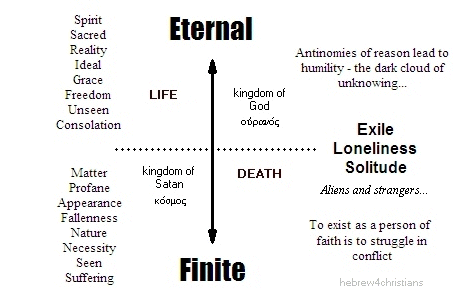 |
Ancient Greek philosophy regarded the soul (i.e., human consciousness) as "imprisoned" within the body, and therefore it advised meditating on intellectual ideals, "forms," and "essences," to transcend the chaos of fate and our natural passions. For them philosophy was really a kind of "recollection" whereby we return to the original Good that has been lost and is presently concealed by the illusion of mere appearances.
Now these ancient Greek philosophers understood the duality of reality, though of course the Torah had implied these ideas long before the advent of Socrates, Plato, and Aristotle... After all, the Torah teaches the experience of dualism and ambiguity is by divine design. Upon earnest reflection the human heart begins to cry out for something more (Eccl. 3:11). Though we understand that we are creatures formed of the dust of the earth, we sense something of the divine within us; we inwardly hear an "echo from Eden" that reminds us of paradise lost... We shrink before our own powerlessness and insignificance yet we dare to believe in the eternal glories of love, beauty, justice, and everlasting life. We simultaneously see ourselves as both physical beings, restricted by time, history, and culture, as well as spiritual beings, transcending the fate of the natural by visions and dreams of the ideal, thereby sensing the glorious and the sacred. Neither of these "polarities" of the soul can be blended or synthesized, however, which leaves us in a state of tension wherein we cling to the vision of the Eternal in the midst of the fleeting shadows of this present realm (Rom. 8:4, Gal. 5:16-17).
Biblical faith refuses to "reduce" the significance, value, worth, and aspirations of the human heart into purely natural categories and terms, and therefore spiritual life constitutes a "protest" against any interpretation of reality that excludes, suppresses, denies, or minimizes the Divine Presence. Life in olam hazeh (this world) is corridor leading to the world to come. Our faith affirms that underlying "natural" phenomena is a deeper and higher reality that is ultimately real and abiding. There is an end or "telos" (goal) that sets the direction or Torah of our dualistic existence. Faith "sees what is invisible" (2 Cor. 4:18) and understands (i.e., accepts) that the "present form (τὸ σχῆμα) of this world is passing away" (1 Cor. 7:31). The heart of faith looks beyond this realm to behold a city whose designer and builder is God Himself (Heb. 11:10). "So we do not lose heart... For the things that are seen are turning to dust, but the things that are unseen endure forever" (2 Cor. 4:16-18). Yes, there is a dualism but God calls us to choose the upper world and to keep our focus there. As it is written, "A double minded man is unstable in all his ways" (James 1:8).
Abraham felt the "metaphysical divide" and homesickness embedded in the everyday language of this world. After his wife Sarah died, he sought a place to inter her body. When he met with some local inhabitants of Canaan, he referred to himself as a "stranger and a visitor" among them. This is because he chose to behold the stars of the vision, which is to say that he chose to identify with spiritual reality over the temporal. "Though I was called by God to come to this land, there is no place for me to lay my head. Yet I need a place to bury my dead. I am here but not really home. I look for a heavenly city whose builder and maker is God." Notice that Abraham was in the midst of the divide, "mediating" the temporal with the eternal and life in this world with the heavenly realm. Though he mourned for his wife, the Torah notes a "diminished" spelling of the word for his mourning because he believed that the LORD would receive his beloved Sarah into his presence and that one day he would be rejoined with her in heaven. As Abraham learned in the sacrifice of his son Isaac, God's love is stronger than death and overcomes it by the power of His resurrection. Amen.
Hebrew Lesson
Psalm 119:19 reading (click):
The dualism of life shows up within our hearts as well, as we wrestle with our own faith and with "double-mindedness," that is, the ambivalence that results from not having our minds made up. On the one hand, we need to confess the truth of our radical sinfulness, our depravity, our brokenness, and so on, while on the other we must learn to know ourselves as the "beloved" and to find faith that God's blessing indeed belongs to us -- that Yeshua gave his life for us -- despite ourselves. We have to be willing to take God's new name for us and believe that God has transformed our deepest nature for eternal good. We have to be renamed from "Jacob" to "Israel," and yet we know ourselves as both... In other words, we must learn to "put on" the new nature and to "put off" the carnal reasoning of our former life. The answer for us is found in the word "miracle," as God in great mercy and compassion regenerates us, comforts us, and then guides our way back to the truth of his salvation. "The light of the body is the eye: if therefore your eye be single (i.e., focused), your whole body shall be full of light" (Matt. 6:22). The "pure in heart" are healed from double-mindedness by keeping focused on the Kingdom of God (Matt. 5:8; Col. 3:1-4).
|
Suffering of Truth...
"One thing my father told me when we were separated, 'Don't forget where you come from. When all this is over, go home.' Those few words were the only reason I survived." - Harry Joseph Feldinger, a survivor of Auschwitz
07.17.25 (Tammuz 21, 5785) We may say that we should bless the Lord for the bad as well as for the good (Job 2:10), we may affirm that God does everything for our ultimate benefit (Rom. 8:28), and we may therefore infer that any affliction we experience is a "messenger" from above provoking us to do teshuvah. If we had greater understanding or more faith, we would receive our troubles and sorrows as disguised "afflictions from love" and we would accept them without protest or bitterness...
That's how we might try to explain or rationalize the troubles and struggles of life, but when we are in the throes of testing, and even if we trust in God's providential plans for our good, we still feel pain, we still get sick, we cry, we get frustrated, angry, and may even feel forsaken at times. However we must not be offended over our frailty, our vulnerability, and our smallness of faith, friends. For God is with us, even when we are confused or unsure...
An old story relates how some disciples wondered why their rebbe wept when he was falsely imprisoned. Didn't he regularly teach them that all trouble is for their ultimate good? Said the rebbe, "When God sends bitterness, we ought to feel it..." Can you imagine someone admonishing Yeshua not to weep during his intercession at Gethsemane saying, "Where is your faith, Master?" Don't you believe that God is working all things for good?" There is very little difference between these sorts of "questions" and the taunts Yeshua received when he bled out on the cross for our sins (Matt. 27:39-45; Luke 23:35-37).
Look, there is "theology" and then there is the passion of living out your faith. Theology offers up the "right answers" while living by faith raises unanswered questions. Theology is cognitive, whereas trust is a matter of the will and of the heart. People who live way up in their heads often forget their hearts. From a "legalistic" point of view Job was wrong to have argued with God; Moses was wrong to have despaired over his mission; Jeremiah was wrong to have lamented over the destruction of Jerusalem; David was wrong to have cried out for justice over his enemies, and John the Baptist was wrong to have doubted the identity of Messiah, to mention just a few instances where we see that passion, hunger and thirst, overruled the doctrines taught in our theology books.
This reminds me of another story. A godly man died and was standing before the bar of the heavenly tribunal, undergoing questioning: "Did you learn Torah, as Moses had commanded?" he was asked. "No," he quietly answered. "Or did you pray with all your heart and soul, seeking God in all your ways?" he was asked. "No," the man again softly replied. "Well then did you do good, as implied by the categorical duty to care for others?" And again the man meekly said no... When the judgment was then given, however, the man was awarded divine favor, since he spoke the truth and appealed only to God's mercy and love. The tzaddik is truthful even in his untruth; he confesses his wayward affections and acknowledges his weakness before God; he accepts the imperfection at the core of his being, and therefore he appeals only to his great need for God's love and mercy to make things right, to heal him, and to bring him home...
Hebrew Lesson
Psalm 73:25-26 reading (click for audio):
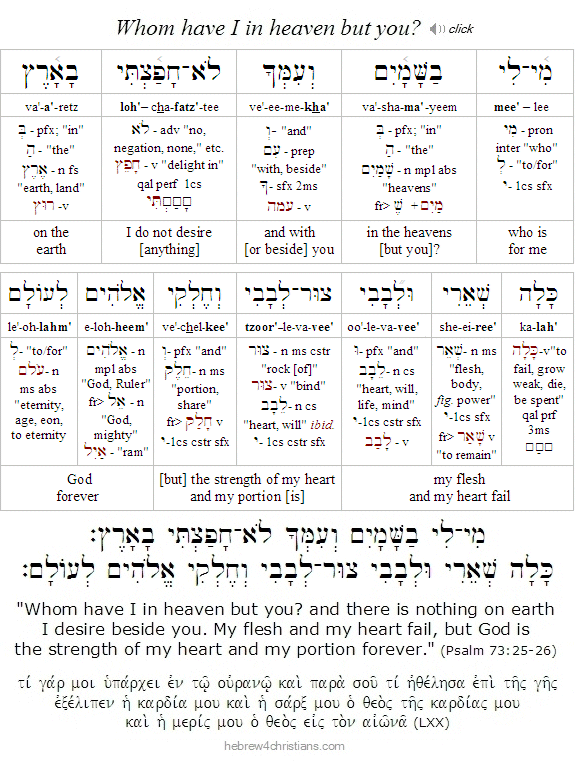 |
Feeding God's Heart...
The following entry concerns this week's Torah reading, parashat Pinchas...
07.17.25 (Tammuz 21, 5785) As I've discussed elsewhere on the site over the years, the climax of the revelation at Sinai was not the giving of the Ten Commandments (עשרת הדיברות) to Israel but was instead the vision of the Altar of the sanctuary (מזבח המשכן). However -- as our Torah portion this week makes clear -- the central sacrifice upon this altar was the daily sacrifice (i.e., korban tamid: קרבן תמיד) of a defect-free male lamb with unleavened bread and wine. The LORD calls this "my offering" (קרבני) and "my bread" (לחמי) [Num. 28:1-8]. In other words, the service and ministry of the Temple constantly foretold the coming of the great Lamb of God (שה האלהים) who would be offered upon the altar of the cross to secure our eternal redemption (John 1:29; Heb. 9:11-12).
The sacrifice of the lamb represents "God's food," a pleasing aroma (ריח ניחחי), for it most satisfied the hunger of God's heart (Eph. 5:2). Indeed, Yeshua's offering upon the cross represents God's hunger for our atonement, our healing from the sickness of death, since it restored what was lost to Him through sin, namely, communion with his children. God could never be satisfied until He was able to let truth and love meet (Psalm 85:10).
Sometimes we say that we "hunger for God," but it is vital to remember that it is God who first hungers for us. God desires our love and fellowship. He comes to seek fruit among the trees - but does He find any? He walks in the cool of the day, calling out to us, but are we attuned to hear His voice? Do we accept the invitation to be in His Presence? When God "knocks on the door of your heart" to commune with you, what "food" will you be serving? (Rev. 3:20). Every day we are given an opportunity to "feed God" through expressing faith, hope, and love. Ultimately it is our obedience to the truth is what "feeds" Him: "Behold, to obey is better than sacrifice, and to hearken than the fat of rams" (1 Sam. 15:22).
Hebrew Lesson
1 Sam. 15:22b reading (click for audio):
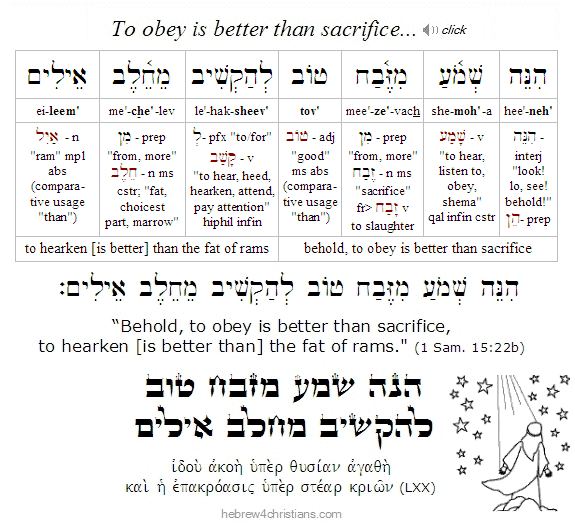 |
We "feed God" by offering heartfelt prayer, by walking in faith, by yearning for Him, by studying Scripture, by participating in corporate worship, by giving tzedakah, by performing acts of kindness (gemilut chasadim) for others, and so on (Heb. 13:15-16). Expressing our love for God is the deepest meaning of teshuvah, which is an "answer" or response to His great love for us (1 John 4:19). Just as God feeds and sustains us through His love, so we "feed Him" by our yearning, our prayers, our praise, and our worship...
For more on this subject, see "The Hunger of God's Heart."
Revelation and Decision...
Every day we make decisions regarding good and evil, and therefore every day we are deciding (i.e., proclaiming, teaching, and revealing) our faith to others...
07.16.25 (Tammuz 20, 5785) Every one of us is a teacher of sorts, proclaiming through our personal choices what we believe to be true. False teachers are those whose choices "teach" that there is no God, no eternal life, no meaning to life, and ultimately, no real hope... It cannot be any other way, for we all teach by our choices; we communicate by our assumptions of what we regard is of "ultimate concern."
Speculative philosophy never successfully answered any of the haunting existential questions of life, such as: What is reality? Why is there something rather than nothing? What is the purpose of life? What happens when we die? Who am I? Do moral choices matter? and so on, but instead merely reinterpreted the hunger for meaning to be about power and control... Nonsense! People may evade the great questions of life by pretending they are unknowable, but Scripture attests that all people are created in God's image and are intuitively aware of God's reality and power: "For His invisible attributes, namely, his eternal power and divine nature, have been clearly perceived, ever since the creation of the world, in the things that have been made; so they are without excuse" (Rom. 1:20).
The Scriptures insist that we are responsible to walk in truth and to reject what is false (1 John 4:6). This implies that we have a moral and spiritual duty to think clearly and not to abuse our minds (Phil. 4:8; Rom. 12:2). The LORD our God will help us to do this, as Yeshua promised: "I will ask the Father, and he will give you a Helper (παράκλητος, someone "called to one's side"), to be with you forever, even the Spirit of Truth (רוּחַ הָאֱמֶת), whom the world cannot receive, because it neither sees him nor knows him" (John 14:16-17).
The Spirit of Truth helps us "discern what is the will of God, what is good, acceptable, and perfect" (Rom. 12:2) and empowers us to take "every thought captive" to the reality of the Divine Presence (2 Cor. 10:4-5). Truth is bound and connected to memory - both in our personal histories as well as the history of God's redemptive actions performed on our behalf. Hence the great Shema commands us to remember what God has done for us and to "diligently repeat" the truth of reality to our children (Deut. 6:4-9). Similarly, the Spirit of Truth brings to remembrance the words of Yeshua to our hearts (John 14:26).
The "ministry of reconciliation" is defined as "the word of truth, by the power of God, through weapons of righteousness" (see 2 Cor. 6:7). Indeed, the word of truth (τὸν λόγον τῆς ἀληθείας) is a synonym for the "gospel of salvation" itself (Eph. 1:13; Col. 1:5; James 1:18). We are saved by Yeshua, who is the "way, the truth, and the life" (John 14:6). God commands all people to believe this truth (Acts 17:30-31; 1 Tim. 2:4). People perish because "they refuse to love the truth and so be saved" (2 Thess. 2:10-12; Hos. 4:6). Therefore we see that the issue of truth is central to salvation itself....
Genuine teshuvah (repentance) implies that we will change our thinking in order to be transformed by God's truth. The follower of Messiah "cannot do anything against the truth, but only for the truth" (2 Cor. 13:8). Amen, and may God help us all to think clearly and to turn our thoughts to Him. May He protect us from the vanity of a darkened mind and from all distractions that attempt to seduce us away from Him. May the LORD give us the purity of heart to know and do His will in the truth. .עֲזוֹר לְעַמְּךָ לָלֶכֶת בְּאוֹרךָ יהוה
Hebrew Lesson
Psalm 25:5a reading (click for audio):
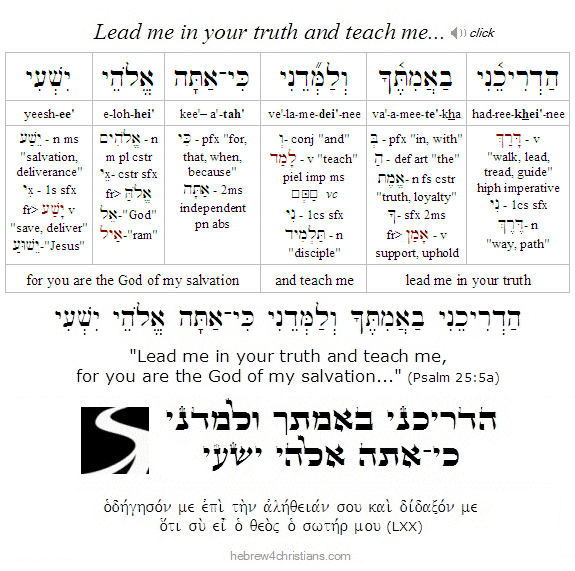 |
Seeing God's Glory...
"To become sober is: to come to oneself in self-knowledge and before God as nothing before him, yet infinitely, unconditionally engaged." - Soren Kierkegaard
07.16.25 (Tammuz 20, 5785) The essence of temptation is distraction. Sometimes it's not the obvious lusts and allurements of the world that tempt us, but something more sinister, namely the slow process of being seduced away from what is most essential to our lives. God's truth should weigh upon our every thought and deed, but through various forms of distraction and self-concern we lose sight of this until he is no longer a primary factor in our daily thinking.
The Hebrew word for "glory" (i.e., kavod: כָּבוֹד) implies "heaviness" and significance. It is of "grave" concern, and regarding the LORD implies fear, awe, respect, honor, and even dread. In some cases it can imply "excessiveness" or "immeasurability." This is what is meant by the "weight of glory": God has infinite worth and value, and we do not know Him as we might know various things in the universe, but as the Holy One (הקדוש), the most important being in our lives (and in any possible world). God is of no significance if he is not of utmost significance, or as C.S. Lewis said: "Christianity, if false, is of no importance, and if true, of infinite importance. The only thing it cannot be is moderately important."
How does the truth of God "weigh in" on your life? Is it a source of magnetic attraction that directs and guides your way, or is divine truth incidental to your thinking? Is God an "afterthought" or a starting point for your decisions? Do you "seek first" the kingdom of God? (Matt. 6:33). How much do you allow God to affect your daily thought life and speech? Is relationship with God the priority of your existence? (Deut. 6:5). Is God the "ultimate concern" of your life, or is God essentially "weightless" or insignificant regarding the course of your life?
The great Commandment not to take the Name of the LORD "in vain" (see Exod. 20:7) implies that we must affirm the sanctity, meaning, significance, and worth of life itself. We must never live as though God does not exist, or, to state this positively, we must "set the LORD" always before us (Psalm 16:8). We must not waste our lives. It is therefore forbidden to ignore the miracle of existence, to scoff at the value of life, or to debase ourselves by refusing to receive the truth. We are to take every thought "captive" to the reality of the Messiah (2 Cor. 10:5). Everything belongs to God, and every moment that we have is beholden to Him...
Finding deliverance from profane thinking requires concentrated focus, or "kavanah" (כַּוָנָּה). As it is written: "We destroy arguments and every lofty opinion raised against the knowledge of God, and take every thought captive to obey Messiah" (2 Cor. 5:10). We are instructed to "bring down reasonings" (λογισμοὺς καθαιροῦντες) and every high thing that is lifted up against the knowledge of God (κατὰ τῆς γνώσεως τοῦ θεου) and to bring every thought "as a captive" to the obedience (ὑπακοὴν, from ὑπό: by, under, + ἀκούω: hear, obey) of Messiah. We can do this negatively by fighting against evil thoughts and censoring the inner evil of our hearts, or we can do this positively by being "captivated" by the words and love of Yeshua, and often we have to do both. This is the deeper meaning of "profanity" - to deny reality, to live in willful ignorance, and to miss the wonder of God's presence. If we sanctify God in our hearts, we will be far less likely to use God's name in vain, of course.
God invites you to come to Him for relationship... Since the LORD is a Person, He wants to know you as a person. He is not interested in formulaic prayers, religious rituals, or your membership at a particular religious organization. God wants to renew your inmost thoughts and heart. Drawing near to God is God's way of drawing near to you... In other words, as you draw near to God, He will draw near and touch you (James 4:8; Psalm 145:18; Isa. 55:6). This is the way of transformation and healing for the depths of our lives.
Hebrew Lesson
Psalm 16:8 reading (click for audio):
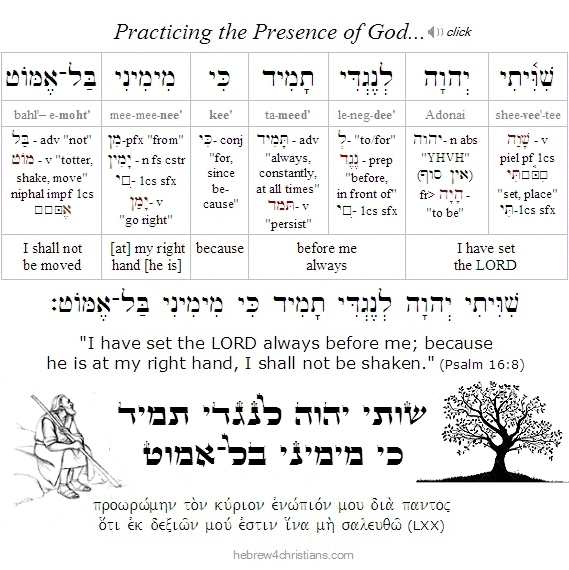 |
Be Still and Know...
07.15.25 (Tammuz 19, 5785) "Be still and know that I am God..." (Psalm 46:10). This is something you must do; you must make sacred space to know the Divine Presence; you must quiet your heart and "set the Lord before you" (Psalm 16:8); you must still those anxious thoughts that weigh in upon you, creating pressure and "dis-ease."
For a moment, let go of your will, your desires, your fears... Confess your frustrated attempts to control the world; abandon the insanity of your self-rule.
Worry is a place of exile and pain. Since God's Name (יהוה) means "Presence" and "Love," being anxious is to "practice the absence of God's presence" instead of practicing his presence...
A divided house cannot stand. Where it is written, "cast all your anxiety on him because he cares for you" (1 Pet. 5:7), the word translated "anxiety" comes from a verb that means to divide into pieces. Bring your brokenness to God – including those distractions that make you distracted, ambivalent and afraid – and receive God's healing for your divided heart.
"Be still and know that I am God..." Notice that the Hebrew verb translated "be still" (i.e., rapha: רפה) means to "let go," to stop striving, stop complaining, and to surrender categorically everything to the care of God (Rom. 8:28).
Breath out a deep sigh and imagine leaning backward into the welcoming arms of God. "Being still" means letting go of your "need" to control things. Relax your hold and rely on God's care for your life instead.
Yeshua taught us to "take no thought" for tomorrow and its concerns (Matt. 6:34). The past is gone, after all, and the future is God's business: all you have is the present moment to call upon our Lord. Be faithful in the present hour, then, asking God for the grace and strength you need to endure yourself and engage the task at hand. In this way you will experience the peace of God "which surpasses all understanding" (Phil. 4:7).
"Be still and know that I am God..." Prayer is a type of listening (shema), a turning back to know the message of God's love and hope in Messiah. The Hebrew word "teshuvah" (תְּשׁוּבָה) means an answer or response to a question. God's love is your question, and your heart's response is the answer. In order to trust him you must push beyond your fear to know him.
Some of us may find it difficult to trust, to open our heart to receive grace and kindness. For those wounded by abandonment, it can be a real struggle to hear the voice of God calling you "beloved," "worthy," "valued," and "accepted." When you find faith to receive God's word of love, however, your heart comes alive and you begin to heal... Yeshua speaks words of comfort: "Blessed are those who have not seen and yet still believe" (John 20:29), and this includes those with secret wounds that remain a source of sorrow: blessed are you when you believe.
Hebrew Lesson
Psalm 46:10 reading (click):
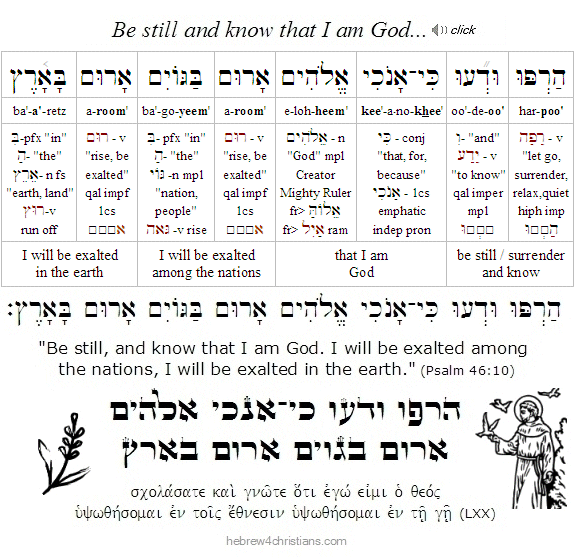 |
Quieting your heart allows you to hear the holy Spirit's whisper: "It is I; do not be afraid..." Once the storm of anxiety dissipates, your heart can access the truth of God. The Spirit asks us to do teshuvah: "In returning and rest you shall be saved; in quietness and in trust shall be your strength" (Isa. 30:15).
True and False Zeal...
The following entry concerns our Torah reading for this week, parashat Pinchas...
07.15.25 (Tammuz 19, 5785) You may be entirely sincere in your convictions, but you may be sincerely wrong... In the time of the Second Temple, for instance, the Zealots despised the rule of Rome. Their political hatred caused them to blindly regard anyone who didn't share their passion as a personal enemy. In one of the great tragedies of Jewish history, these Jewish zealots actually killed more Jews than did the Romans themselves! And how many Christians these days "kill" relationships with other believers because of their particular zeal regarding some doctrinal question? I am not suggesting that doctrine is unimportant, of course, but before you pick up that sword to do the business of Pinchas, you might do well to consider your heart's attitude...
"In this respect fundamentalism has demonic traits. It destroys the humble honesty of the search for truth, it splits the conscience of its thoughtful adherents, and it makes them fanatical because they are forced to suppress elements of truth of which they are dimly aware." - Paul Tillich
We need to be careful with our passions. There is a "false zeal" that leads to estrangement and confusion. Withholding love from others is ultimately grounded in an appeal to God as the administrator of Justice. It is an appeal to God as Elohim (אֱלהִים), not as YHVH (יהוה), the Compassionate Source of Life. If we insist on our rights, we therefore appeal to principles of justice, i.e., to God as the Lawgiver. But if we intend to have God be the Judge of others, we will know Him as our own Judge as well. This is a serious matter, friends: If we have an unforgiving spirit toward others, we will not receive our own forgiveness (Matt. 6:15); if we are judgmental toward them, we ourselves will be put on trial; if we are cruel and ungiving toward them, we will experience life as hellish, miserable and mean. This reciprocal principle of Kingdom life appears throughout Yeshua's teaching. According to your faith, be it done unto you (Matt. 9:29).
Hebrew Lesson:
Psalm 18:26 reading (click):
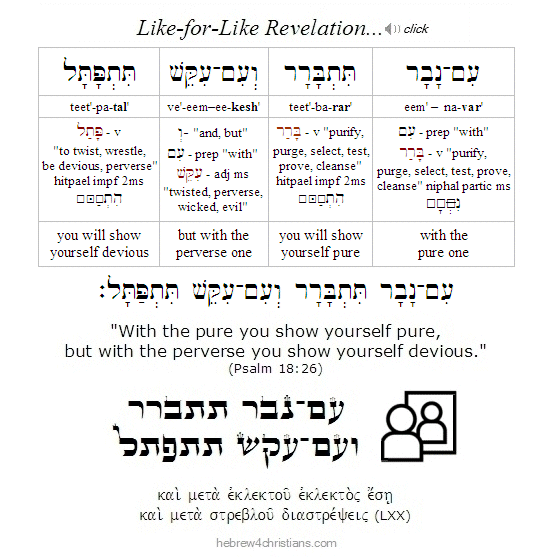 |
Finding the Heart of Life...

07.14.25 (Tammuz 18, 5785) It is written in our Scriptures: "There is no fear in love, but perfect love (i.e. ha'ahavah ha'shelemah: הָאַהֲבָה הַשְּׁלֵמָה) casts out fear" (1 John 4:18), and therefore the Spirit of God encourages us to press forward in trust. When we are afraid, we are believing the lie there is something beyond God's control or reach, and therefore God is "not enough"... In times of testing you must remind yourself of what is real. God formed you in your mother's womb, breathed into you nishmat chayim, the breath of life, and numbers all your days... Every breath you take, every heartbeat in your chest is ordained from heaven, and indeed, there is not a moment of your life apart from God's sovereign and sustaining grace. So what, then, are you afraid of? Dying? Judgment in the world to come? Being left unloved, bereft of home, abandoned, consigned to outer darkness? King David said, "If I make my bed in Hell, behold, you are there" (Psalm 139:8).
The Holy One, the LORD our God, is not only present in your "happy moments," when you feel "put together" and respectable, but he is present in your desperate moments, in your hunger, your thirst, and in your secrets. May we never lose sight of God's love, especially in times of distress and trouble, since we trust that he is always working all things together for our ultimate good (Rom. 8:28). As it is written: "The one who finds [God's] heart loves his soul; the one who guards understanding finds blessing" (Prov. 19:8).
Hebrew Lesson
Proverbs 19:8 reading (click):
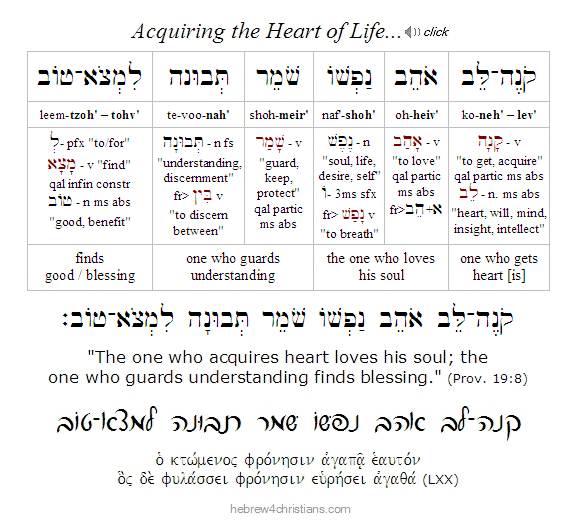 |
Keep the Flame Burning...
07.14.25 (Tammuz 18, 5785) Keep the flame within your heart burning, friend... A sage once told a person struggling with his faith: "It is written that all creation was brought into being because of people like you. God saw there would be people who would cling to our holy faith, suffering greatly because confusion and doubt would plague them. God perceived that such would overcome these doubts and troubles of heart and remain strong in their belief. It was because of this that God brought forth all creation." Indeed, it was because of this that Yeshua our LORD suffered and died for you... Amen. Therefore never yield to despair, since that leads to further darkness and fear.
Press on and keep fighting the "good fight" of faith (1 Tim. 6:12). Remember that you infinitely matter to heaven; your life has great value; you are significant and you are truly loved by our Heavenly Father. There is a "future and a hope" for you; there is "a white stone, and on that stone will be written a new name that no one can understand except the one who receives it" (Rev. 2:17). May "the trial of your faith, being much more precious than of gold that perishes, though it be tested with fire, be found to result in praise and glory and honor at the revelation to come" (1 Pet. 1:7).
"I am sure of this, that he who began a good work in you will bring it to completion (ἐπιτελέω) at the Day of Yeshua the Messiah" (Phil 1:6). The LORD is able to guard you (φυλάξαι) from stumbling and to present you blameless before the presence of His glory with great joy (Jude 1:24). "The LORD upholds all who are falling and raises up all who are bowed down" (Psalm 145:14). "He will sustain you to the end, guiltless in the Day of our Yeshua the Messiah" (1 Cor. 1:8). He who calls you is forever faithful; He will surely do it (1 Thess. 5:24). Yea, "the Lord is faithful (נֶאֱמָן הוּא): He will establish you and guard you against the evil one" (2 Thess. 3:3). The Spirit says, "Fear not, for I AM with you always."
Hebrew Lesson:
Isaiah 41:10 Hebrew reading (click):
Fast of the Fourth Month...
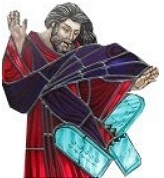
07.13.25 (Tammuz 17, 5785) According to Jewish tradition Moses shattered the tablets on the 17th day of the 4th month, after he came down from Sinai and found the people worshipping the golden calf. Today, this tragic date is commemorated as a fast day (i.e., the "Fast of Tammuz"), which marks the beginning of a three week period of mourning that culminates on Tishah B'Av (i.e., the date when the people tragically believed the evil report of the spies and were sent into exile).
During this three week period of national mourning, the weekly readings from the prophets are all "Haftarahs of Rebuke" that warn the people about imminent judgment from heaven, and therefore the theme of most Jewish religious services is teshuvah (repentance). In addition, weddings or other joyous events are usually not held during this time of year. Indeed, among the very Orthodox, the last nine days of the three weeks are the most rigorous and solemn. Beginning on the first day of the month of Av, traditional mourning customs are practiced in anticipation of the most solemn fast day of Tishah B'Av, when the Book of Lamentations (Megillat Eichah) is plaintively recited during the evening service.
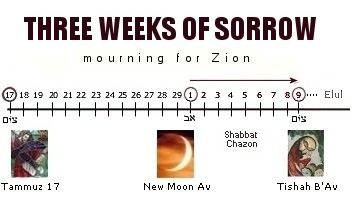 |
This year the Fast of Tammuz begins at dawn Sunday, July 13th and lasts until sunset. The Tishah B'Av fast therefore begins three weeks later at sundown on Saturday, Aug. 2nd and ends after sunset on Sunday, August 3rd.
Dates During the "Three Weeks" of Sorrow:
Hebrew Lesson
Psalm 51:17 reading (click):
This week's Torah:
Parashat Pinchas - פינחס
07.13.25 (Tammuz 17, 5785) Shavuah tov chaverim! Last week's Torah portion (i.e., parashat Balak) introduced us to a man named Phinehas (i.e., "Pinchas"), the son of Eleazar the priest and grandson of Aaron, who, during the tragic rebellion at Baal Peor, zealously removed evil from Israel by driving a spear through a tribal prince who was brazenly cavorting with a Midianite princess in defiance of God's law. On account of Pinchas' zeal for the truth of Torah, God stopped the plague and Israel was delivered from great destruction... This week's Torah portion (i.e., parashat Pinchas) begins with the LORD rewarding Pinchas by granting him a "covenant of peace" (ברית שׁלום) and an everlasting priestly line in Israel (ברית כהנת עולם). As I hope you will see, Pinchas pictures the Messiah Yeshua, and the covenant of priesthood given to him is a picture of the greater priesthood after the order of Malki-Tzedek.
Jewish tradition says that when Aaron and his sons were commissioned as the exclusive priests of Israel (Exod. 40:12-15), the office applied only to themselves and to their future descendants. Since Aaron's grandson Pinchas had already been born at the time the promise was given, however, he did not automatically receive this honor, especially since his father Eleazar (the son of Aaron) was married to an "outsider" -- namely, the daughter of Yitro (also called Putiel, Exod. 6:25). This explains Rashi's statement about why the other tribes mocked Pinchas. How dare this "son of an outsider" kill a nassi (prince) of Israel (i.e., Zimri), especially since Pinchas' mother was regarded as an idol worshipper! The LORD honored Pinchas' zeal, however, and overruled the uncharitable tribalism of the Israelites, and he was therefore elevated to be a priest with special honor before the LORD.
God looks at the heart, chaverim, and is able to make those who have zeal for Him true priests of the LORD! You don't have to be born Jewish to be chosen by the LORD God of Israel, since He's "no respecter of persons" (Rom. 2:11). Not only can He create spiritual children of Abraham "from the stones of the ground" (Matt. 3:9; Luke 3:8), but He can turn someone considered a non-Jew (by the rabbis, anyway) into a highly honored priest of Israel (1 Pet. 2:9-10). Indeed, according to tradition, many descendants of Pinchas later became the most faithful of the High Priests of Israel during the First Temple period.
Note that according to one midrash, when Zimri and Cozbi (the Midianite princess) were cavorting, they actually ran inside the Tabernacle compound itself, directly past Moses and the people who were there weeping at its entrance (Num. 25:6)! Pinchas then took a spear from the Tabernacle guards and courageously followed after them. When he caught up with them within the Tent of Meeting itself, he pierced them through with the spear (Num. 25:7-8). After this, thousands of men from the tribe of Simeon ran in after him, seeking to kill him. Pinchas was in such a state of terror that "his soul left him" and he was reborn as a Kohen.
Parashat Pinchas (like parashat Emor in Leviticus) also mentions of all of the (sacrifices of the) mo'edim (holidays) given to the people Israel (Num. 28). These include the daily (tamid), weekly (Shabbat), monthly (Rosh Chodesh) sacrifices, as well as the sacrifices assigned to the special holidays: Passover, Shavuot, Rosh Hoshannah (Terumah), Yom Kippur, Sukkot and Shemini Atzeret. The sages said that remembering the joys of the Temple and the special celebrations of the Jewish people promote the call to do teshuvah during the otherwise somber time of the Three Weeks of Sorrow.
Curses turned to Blessings...
The following entry is related to this week's Torah reading, parashat Balak...
07.11.25 (Tammuz 15, 5785) Our Torah portion for this week tells the comical story of how a Moabite king named Balak hired a "prophet" named Balaam to curse the Jewish people. After summoning Balaam to do his sorcery, Balak quickly realized that something was wrong, and that the renowned "seer" was an impostor. His scheme to curse Israel was doomed from the start. In one comical mishap after another, Balak finally realized that "there is no evil incantation against Jacob, and no sorcery against Israel" (Num. 23:23).
In this connection note that the antics of Balak and Balaam took place "out of view" of the Israelites, which teaches us the "moral of the story," namely that the LORD will always protect his people - even when they are unaware of the danger - for their blessing and ultimate good... No weapon formed against God's children shall prosper, and every tongue that speaks in judgment shall be made to "stammer out" praise (Isa. 54:17). "He who vindicates us is near; who will contend with us?" Indeed, "who shall bring any charge against God's elect? It is God who justifies. Who is to condemn? Yeshua the Messiah is the one who died -- more than that, who was raised -- who is at the right hand of God, who indeed is interceding for us" (Rom. 8:33-34). Those of faith understand history - including the End of Days - as the expression of God's sovereign and providential hand. The gracious Savior always works "all things together for the good" of those who are trusting in Him.
God can and does turn curses into blessings... For example, Joseph was blessed despite the ill-will of his brothers: "You devised evil against me, but God devised it for good" (Gen. 50:20). Note that the same verb for "devised" (i.e., chashav: חשׁב) is used to describe both the evil intent of the brothers and the good intent of the Lord. This teaches us that God overrules the malice of men to effect his own good purposes, and therefore we can rightfully affirm gam zu l'tovah (גַּם זוּ לְטוֹבָה), "this too is for good" (Rom. 8:28). Like the story of Haman and the ironic holiday of Purim, we celebrate how God confounds the schemes of the wicked and protects his people...
Underlying the surface appearance of life (chayei sha'ah) is a deeper reality (chayei olam) that is ultimately real, abiding, and designed for God's redemptive love to be fully expressed. Resist the temptation, therefore, to judge by mere appearances. Forbid your troubles to darken the eye of faith. Do not unjustly judge God's purposes or try to understand His ways. As the story of Balaam shows, God makes even the wrath of man praise Him (Psalm 76:10). "Then God opened Balaam's eyes, and he saw the Angel of the LORD (מַלְאַךְ יְהוָה) standing in the way, with his drawn sword in his hand. And he bowed down..." (Num. 22:31). Indeed, every knee will bow to the LORD our God and Savior (Isa. 45:22-23; Phil. 2:10-11).
The schemes of the wicked are subject to the sovereign purposes of the LORD. Ein od milvado (אֵין עוֹד מִלְבַדּו) - there is no power that can be exercised apart from God's consent and overarching will... Indeed all authority on heaven and earth belongs to Yeshua, the "the Ruler of the Kings of the earth" (עֶלְיוֹן לְמַלְכֵי־אָרֶץ). As it is written, "All the nations you have made shall come and worship before you, O Lord, and shall glorify your name" (Psalm 86:9).
Hebrew Lesson
Psalm 47:2 reading (click):
The Way of Perfect Peace...
07.11.25 (Tammuz 15, 5785) When we lose sight of the truth that God is in complete control of all things, we tend to grow anxious... Feeling worried comes from focusing on ourselves, a perspective that can make us feel alone, forgotten, and even victimized in this world. Worry moves us to defend ourselves, to seek refuge in our own devices, and to forfeit the will of God according to the dictates of lesser fears...
The sages say it is not permitted to worry: "To worry is a sin; only one sort of worry is permissible; to worry because one worries." We should worry that we worry because this indicates our hardness of heart and our unbelief. God's name YHVH (יהוה) means "Presence," "Breath," "Life," and "Love." So why should we be anxious for "tomorrow"? We really only have this moment, but this moment is entirely sufficient when we walk in the light of God and seek to know him in all our ways (Prov. 3:5-6).
The first part of the Shema (i.e., Deut. 6:4-9) admonishes us to remember the truth of God "when you sit in your house, when you walk in your ways, when you lie down, and when you rise up." "In all your ways know Him," that is, in all that you put your hand to do look for the God's Presence and guidance (Prov. 3:6; 1 Cor. 10:31). This is something you must do: As King David stated, "I have set the Lord always before me, because He is at my right hand, I shall not be moved" (Psalm 16:8). Make up your mind: "Let the peace of God rule in you" (Col. 3:15).
The Name of the LORD is "I-AM-WITH-YOU-ALWAYS," which implies that we always live within His Presence and care, even if we are sometimes unconscious of this truth (Matt. 28:20). As it is written in the prophets, hen al kapayim hachotikh: "Behold I have engraved you on the palms of my hands" (הֵן עַל־כַּפַּיִם חַקּתִיךְ; Isa. 49:16). Remember the One who stretched out his hands and died for your healing; remember that he said, "Do not be anxious about tomorrow... sufficient for the day is its own trouble" (Matt. 6:34). A
Again it is written in our Scriptures: "Do not be anxious about anything, but in everything by prayer and supplication with thanksgiving let your requests be made known to God" (Phil. 4:6). When we worry we heed voices of fear and begin to feel 'double-minded,' (i.e., δίψυχος), unstable, and unable to think clearly; we get restless and find it difficult to deeply breathe. We start to feel out of control, fearful that something bad will happen despite all our efforts or wishes to the contrary; we sense doom; we lose heart; we go dark...
The Scripture here admonishes us to pray when we are tempted to be anxious by focusing on something for which we are grateful. Doing so will instill the "peace of God" (שלום יהוה) that quells all our fears (Phil. 4:7). We gain the "light of life," that is, inner illumination from God, so that we can remain steadfast and unmovable in faith. We will experience complete peace, shalom shaleim (שלום שלם) when we make up our minds to trust in Him (Isa. 26:3).
If you leave everything in God's hands, eventually you will see God's hand in everything....
Hebrew Lesson
Isaiah 26:3 reading (click):
Thoughts about Prayer
God's Voice in the Gospel...
07.11.25 (Tammuz 15, 5785) I've recently been thinking a bit about God's silence during our prayers and how this silence may be properly understood. Normally we pray to God and trust that he is listening even though we do not hear him audibly speaking back to us. Despite the silence, we may sometimes feel a sense of direction however, a "leading" of the heart to do or to refrain from doing something, and on rare occasions we may even receive an inner message or conviction that seems quite authoritative. However most of the time we must discern a response to our prayers based on our faith that our heavenly Father is always present and that he always cares for us. That is the foundation of faith in God, namely that he attentively listens to us when we call upon Him.
Yeshua taught that our heavenly Father sees "in secret" and knows every thought of our hearts. Indeed, our Father knows what we mean even when we express unutterable groans and silent sighs. "There is not a word on my tongue, but lo, you know it altogether," and that also means the words on our tongue that we are unable to fully understand...
Some have said prayer is a sort of "whistling in the dark," an attempt to squelch hidden fears and to assure ourselves that we will somehow be okay... "Here is the world. Beautiful and terrible things will happen. Don't be afraid." Yes, but courage is the crux of the matter, isn't it, and suffering seems to be part of the divine plan. We all experience complexity, ambiguity, and uncertainty; we all have ideals that are eaten up by the real; we experience times of joy and times of sorrow, times of celebration and times of disappointment. To every thing there is a season, and a time to every purpose under the heaven: "a time to weep, and a time to laugh; a time to mourn, and a time to dance." But prayer is a kind of remembering what God has said. "Hearing the Lord" requires the interpretation of life itself.
In light of this, the flow of the "river of life," the ups and downs, point and counterpoint, everyone eventually raises questions about the meaning of life itself. Is it a good story or a tragic one? Is there a purpose to our lives, or is everything "havel havelim," the vanity of vanities? Is there a secret design behind the appearances of daily life? Is the ideal more real than the real? Do we have free will? Can we change the course of our lives? We may say our prayers, but they are often wishes that things be other than they really are. How many of us are fatalists at heart, supposing that nothing is in our control and we are destined by forces that are greater than ourselves? The heart of faith believes that "all things work together" for our ultimate good and that God speaks "through" our experience. The unbeliever likewise has faith that nothing works together for good, or at least that life appears to be random and pointless. Is the cup half full or half empty? How we interpret what we see is a spiritual and theological concern, and therefore how we interpret and find meaning for our lives is a matter of life and death. Some people try to put off making a decision, but that is a decision itself. Many grow bitter while others find hope....
Interpretation requires wisdom more than knowledge. It is a matter of discernment and intuition. It certainly is not based on "empirical evidence" alone, as if any "fact" can be properly understood apart from its context and relationship with everything else. The philosopher asks "why is there something rather than nothing at all?" The Scripture says that the knowledge of the Creator is "manifest within" the human heart, and the existence of reality itself reveals his power and glory (Rom. 1:19-20). "The heavens declare the glory of God, and the skies above his handiwork." The knowledge of God is therefore axiomatic to the apprehension of anything else, and the echo of creation is felt in all things.
Some people think that "reality" is a "construct" or matter of personal interpretation, and they therefore object to "grand narratives" that seek to explain the reason for existence. This is mere sophistry, however, since solipsism and/or "absolute relativism" is a contradiction in terms, an "unlivewithable" theory of knowledge that is logically incoherent. It is not a matter of "personal preference" whether gravity will apply if you were to jump off the roof of a 20 story building, or whether roasting your hand in a roaring fire will burn your skin.
Many judgments or inferences are "preconscious" aspects of human experience. We don't usually ask if we are currently dreaming right now rather than experiencing something "real." We unreflectingly assume that our perceptions of space and time are reasonably accurate so that we can navigate in the world. We further assume that the future will resemble the past, that the sun will rise tomorrow, and that real patterns of existence are discernible to human reason. We assume the laws of logic: that x=x, that something cannot both be entirely red and entirely green at the same time and place, that 1+1=2, that if A is larger than B, and B is larger than C, then A is larger than C, and so on.
Beyond such matters of fact and logical deduction, it's also psychologically necessary to make value judgments. I am not referring to subjective preferences regarding the taste of certain foods, the appreciation of a piece of art or music, and so on, but rather value that is ascribed to the knowing process itself. Why should we care to know something rather than nothing? What makes "truth" valuable and "error" something to be avoided? After all, the empirical science can only be engaged using metaphysical assumptions that 1) there is an external world; 2) the scientific method is useful to understand that world; 3) the laws of logic are applicable to the world; 4) it is good to know rather than not to know, and so on.
So there is such a thing as objective "reality" and it is not known through subjective preference or through any number of imaginary speculations. Likewise reading Scripture is not of "private interpretation" but is based on the illumination of truth revealed by the Holy Spirit (2 Pet. 1:20-21). This truth derives from historical fact that is ratified by consensus of those who have tested its claims and declare them as warranted. In the case of the Bible, for instance, decisions were made through the collective wisdom of God's people of what is or is not to be included in the "canon" of Scripture. The Bible is a book of sacred history, recording historical events that were collated by faithful followers of YHVH, the LORD God Almighty. The Holy Spirit ratifies and sets the seal of God's testimony in the shared conviction of truth (2 John 2:27).
Hebrew is not written using vowels, that is, vocalizations created by breath through the body's airway and therefore it is up to the reader to breathe words to life. But the breath supplied comes from the ruach, the Spirit of God, and therefore words are given life from God's Spirit within us. But it is important to reiterate that this hearing is not of "private interpretation," as a matter of idiosyncratic revelation, but rather by the inspiration, or "breathing in" of God. And it is also important to understand that the manner of "breathing," that is, the how or the way the texts are meant to be read, is something learned from godly traditions of those originally authorized by God. In that sense the written word of God is based on oral tradition, since interpreting the words requires training and education.
Another way to say this is that the Bible is not "reader-centric" but "author-centric," and that means that in order to properly read the Scriptures we must take the time to learn about the historical context and the grammatical/linguistic structures of the time of writing. This implies knowing something about who the author was, who the intended audience was, the usage and vernacular of particular words and ideas during that time period, and so on.
However since God is regarded as the overarching Author of the Bible, we may say that it is "theo-centric" since God imparted special revelation to certain people who faithfully conveyed his message both orally and later in written scrolls. The Bible itself, understood as a collection of scrolls recognized by godly tradition, is marvelous in its continuity of theme and message. It is a "timeless" form of communication that imparts divine truth in various forms, including stories, allegories, parables, historical accounts of the saga of the Jewish people, various songs and poems, the role of sacrificial rituals (and ultimately, the sacrifice of Yeshua for our atonement with God), wisdom literature, didactic letters, and so on.
Many examples of prayer in the Bible use first-person singular speech: "How long will you forget me, O Lord, forever?" (Psalm 13:1). "Save me, O God, for the waters have come up to my neck!"(Psalm 69:1); "I am so troubled that I cannot speak" (Psalm 77:4). and so on. Listening to the cries of David can help us relate to God. As we hear the struggle within his heart and his appeal for God's help, we gain confidence and comfort that we are not alone. "Blessed be God, who has not turned away my prayer nor his mercy from me" (Psalm 66:2)
Besides first first-person singular prayers, first-person plural prayers are common. These "corporate" or group prayers are offered so that we may unite with others in our confession of faith: "Our Father in heaven, sacred is your Name..." "God be merciful unto us, and bless us; and cause your face to shine upon us; Selah." As we listen to these prayers, we unite with others and gain comfort that we are not alone in our struggles and in our hope.
The silence or apparent absence of God is part of our experience of God. "All true knowledge of God begins with the knowledge of his hiddenness," wrote Karl Barth, and this moves the heart to seek communion with him. "As the deer pants for the water brooks, so my soul pants for you, O God" (Psalm 42:1). We come to know God through our need, our poverty, our desperation (Matt. 5:2). The "troubles of love" lead our hearts to the truth of love.
The Hebrew word for "world" or "age" is olam (עולם), which is derived from a root verb (עלם) that means "to conceal" or "to hide." God "hides" His face from us so that we will seek Him, and that means pressing through ambiguity of this world to discern and take hold of the truth. Therefore King David said, בַּקְּשׁוּ פָנָיו תָּמִיד, bakeshu fanav tamid: "Seek His face continually" (Psalm 105:4). Note that the Hebrew gematria (numerical value) for the word "fanav" (i.e., "His face") is the same as that for the word "olam." When we truly seek God's face (i.e., His Presence), that is, do teshuvah, we are able to discern the underlying purpose for our lives in this age... As it says in our Scriptures: "Blessed is the one who endures temptation, for when he is tried, he shall receive the crown of life (עֲטֶרֶת הַחַיִּים) that the LORD has promised to those who love him" (James 1:12). This present age, then, olam ha'zeh, constitutes a test that God providentially designs to lead us to the "crown of life," and when we go through its fires we are not consumed. Indeed, only those who love the Lord are able to withstand the fires... The "crown of life" symbolizes that we have truly received the purpose for which we were created and that we are identified with God's own passion and love. The light of the crown represents the Divine Presence within us, the Life that overcomes despair on our behalf.
In this world the righteous feel the pain of God's absence and long for his presence. Their hearts are grieved over the wickedness within their own hearts, and they lament the wickedness of others in the world. This leads them to heartfelt prayer, "wrestling with the Angel," yearning for deliverance, and trusting in the ultimate vindication of what is truly good. Ironically it is the very struggle with darkness that leads to the awareness of being God's presence, as David proclaimed: "I have set the Lord always before me; because he is at my right hand, I shall not be shaken" (Psalm 16:8).
"The essence of Christian prayer is to seek God," wrote John Stott, and this implies that God hides for us to find him. Notice that the righteous do not deny the absence of God, but they are given comfort by the Holy Spirit to persevere, and their perseverance validates God's presence despite his seeming absence... "The Kingdom of heaven is within you."
Prayer helps us focus on the deeper truth of what we already know and therefore it leads to the confession of God's blessing. It is to join the heavenly chorus, unheard in this world, that rejoices over God's great love and care for all generations. It is a call to remember the truth of who God is and to proclaim the ultimate healing that is to come. "You are worthy, O Lord, O Lord, to receive glory and honor and power, for you have created all things, and for thy pleasure they are and were created."
The first letter of the Hebrew alphabet is Alef (א), a silent letter, and the sages furthermore say that the first word (הדבר הראשון) is always God's. The Lord calls and we do teshuvah, that is, we answer: ה' קורא לנו לענות. Our prayers are therefore part of a conversation that God has begun with mankind of which we participate. Because of Yeshua, the Living Word of God, we are invited to come boldly before the Throne of Grace and to know God's heart (Heb. 4:16). There, in that place, we can express our yearning and our groans without fear, for Yeshua has made the way for us to be accepted as God's beloved children.
So God is not silent, after all. He has revealed himself to this world, both in the call of Abraham and the Jewish people, but also in the incarnation of Yeshua as the mouthpiece of the LORD. Torah is written in the language of men. And especially In light of God's great redemption through his incarnation as the Living Word of God, our prayers have meaning and are contextualized, and the voice of God's message is heard. If we are tempted to think that God is not hearing us, we are forgetting the great story and our place in it. It is our faith that includes our lives as part of the story; it is our trust that receives the truth of God's presence and blessing. Listen again to the voice of God, our Creator, our Savior, our heavenly Father who loves us with everlasting love.
Remember again that as Yeshua was dying on the cross he was thinking of you, mediating your life by absorbing the pain of your sin and releasing you from shame and death. Understand that you are a part of the greatest story ever told, and your life is found in union with him. Yeshua repeatedly prayed that we would be "one" with him, and it is that union that makes our prayers possible. In a sense, our prayers answer his own, and therefore the Holy Spirit intercedes for us with groanings that are unutterable (Rom. 8:26).
Now a few closing thoughts. First, understand that your life itself is a prayer of sorts... Whatever we do, say and desire is a mode of praying. It is our secret thoughts as much as our poetic hymns; it is the grumble of our hearts as much as our creeds or exalted expressions of theology. Prayer reveals what we really are. "Every unthinking word that people speak shall be accounted in the day of judgment, for by your words you will be justified, and by your words you will be condemned" (Matt. 12:36-37). "Where can I go from your Spirit, or where can I flee from your presence?" (Psalm 139:7). We may feel awkward over God's seeming absence, but do we hide from who God is? Do you remember his heart? his sacrifice? his passion? We want God to listen to us, we beg him to serve us and help us, but to what end? Do we listen to him? Do we honor him and seek to do his will?
To pray is "hitpallel" (התפלל) in Hebrew, from the root "palal" (פלל) that means to mediate, to intercede, or to judge. The prefix "hit-" (-הת) before the root often implies reflextive action and is always connected with the root, and therefore hitpallel means judging yourself or mediating your life in light of the truth of God. In this sense it is a form of "cheshbon nefesh" (חשבון נפש) or soul searching and taking personal responsibility for your life.
We don't need to feel or see God's presence to know his reality. Faith is the substance of hope, not a hopeful feeling; it is the conviction of what is real and of ultimate importance. What a tremendous honor and blessing it is to commune with God, to be connected to him as his redeemed child, and to know that your life is eternally significant because of what Yeshua has done for you. What an unspeakably wonderful privilege you have to be made a part of God's very heart and life, and to be forever cherished as his beloved... May you hear that voice, the voice of your Heavenly Father!
Hebrew Lesson
Psalm 39:12 reading (click for audio):
Note: I know this is a longer entry but I hope you will find it provocative and helpful. Please forgive any typos or grammatical errors you may see in this post. I wrote in haste last night to make sure I could share it with you before Shabbat. Anyway, I hope it might help you see the amazing glory we have in our communion with the Lord.
Insiders and Outsiders...
07.10.25 (Tammuz 14, 5785) The parable of the Pharisee and the Tax Collector is a well-known teaching of Yeshua. Two people go to the Temple to pray, one a pious Pharisee, and the other a despised tax collector. During the service, the Pharisee looked around and caught sight of the tax collector which inspired him to thank God that he was "not like other men," whereas the lowly tax collector lamented that he was a wretched sinner and simply appealed to God for mercy. The surprising "twist" to the story, however, is that the tax collector was justified in the eyes of heaven, and not the Pharisee (Luke 18:10-24).
Most people assume Yeshua told this story to teach how pride can deceive the heart, and that humility is essential to be rightly related to God, and while this application may be rightly inferred from the parable, it is important to understand that the Pharisee only did what was expected of him regarding his "religious obligations" at the time. Indeed, the Pharisees (i.e., perushim: פְּרוּשִׁים) were Torah scholars who sought to obey Moses' teaching wholeheartedly, as did the Apostle Paul (Acts 22:3). When the Pharisee of the story thanked God for not being like other men, such as thieves, adulterers, or "even like this tax collector," he was not necessarily being prideful but "honest" -- at least in terms of his devotion for the law: "I fast twice a week; I give a tenth of all my income," the former statement exceeding the law's demand, and the later in full compliance. In fact, this rabbi's speech was typical of pious blessings recorded from the same period of Jewish history.
The tax collector, on the other hand, was an "outsider" to the religious establishment and therefore he stood "afar off" as he made pathetic appeal to God for mercy. His prayer was an unvarnished and heartsore cry to heaven for help. The surprise ending of the story, and what likely unsettled the audience of Yeshua's day, was that the tax collector "went down to his home justified" while the Pharisee did not. In the eyes of heaven, the tax collector was the real "insider" whereas the Pharisee stood "afar off," an outsider to God's heart...
But what's the "moral of the story"? First, of course, is the straightforward lesson regarding the virtue of humility - that is, the importance of knowing "in your kishkas" how much you need God, and therefore abandoning religious traditions (and the praises of men) in heartfelt contrition, looking instead to God for righteousness. But second, Yeshua is teaching that the kingdom of God has come and is no longer to be found in the confines of the Temple. Knowing the Divine Presence and walking in holiness is no longer the domain of religion but is a matter of the heart of the individual who trusts in God's mercy to deliver him from the guilt of his sin. Holiness, or the realm of the sacred, has transcended the confines of the Temple because the one who expresses the heart of the Divine Presence has come to seek and to save the lost. Yeshua was sacrificed "outside the camp," the curtain of the Temple was torn asunder, so that whosoever will believe in God's mercy in Yeshua will be saved.
Hebrew Lesson
Micah 6:8 reading (click):
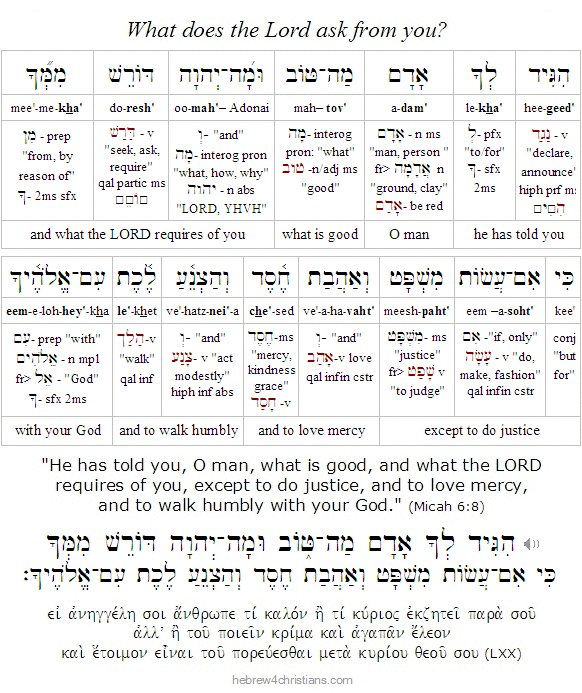 |
It is tragic that some pastors can preach about the pride and self-righteousness of the Pharisees while turning a blind eye to their own preferred interpretations that are often held at the expense of brotherly love and unity among believers... For instance, some teach about how much Jesus loves people and then turn around and condemn (i.e., ostracize) individuals and churches that differ with them regarding matters of "mint and cummin" in the realm of the Spirit. The "weightier matters" of the law, chaverim - the very heart of the Father for the lost - should be our guiding principle, even when we do theology, and perhaps especially when we do so. Shalom.
Note: I want to add that simply knowing yourself as an "outsider" and feeling lost is no virtue, other than as being a necessary condition for receiving God's salvation. And that's the perhaps final point of the parable. The tax collector's consciousness of his brokenness was essential for him to be healed and to find the blessing of grace given by Yeshua....
Look to the LORD...

"Faith endures as seeing Him who is invisible (Heb. 11:27); endures the disappointments, the hardships, and the heartaches of life, by recognizing that all comes from the hand of Him who is too wise to err and too loving to be unkind." - A. W. Pink
07.09.25 (Tammuz 13, 5785) Yeshua told us: "Blessed are those who have not seen and yet have believed" (John 20:29). Despite the struggle of this life - our sorrows, pains, and even death itself - we believe in God's love and promise for us, even if we do not presently see the fulfillment of our hope, just as Abraham believed the promise that he would be the father of an innumerable multitude long before he saw any sign of its fulfillment.
Abraham "believed the impossible" and "hoped against hope" (παρ᾽ ἐλπίδα ἐπ᾽ ἐλπίδι), meaning that hope kindled within him even though there was nothing to see in the realm of the natural -- he believed in an unseen good; he trusted in the One who gives life to the dead and who "calls into existence the things that do not exist" (Rom. 4:17).
The Scripture comments: "He did not weaken in faith when he considered his own body, which was as good as dead (since he was about a hundred years old), or when he considered the deadness of Sarah's womb. He did not stumble over the promise of God through unbelief but was strong in faith, and gave glory to God, fully persuaded that God was able to do what he had promised, and that is why his faith was counted to him as righteousness" (Rom. 4:19-22).
Likewise we are called to believe in an unseen good, an unimaginably wonderful destiny for our lives, as it says, "Things no eye has seen, nor ear heard, nor mind imagined, are the things God has prepared for those who love him" (1 Cor. 2:9). Faith does not use natural reason or the evidence of the senses to see the unseen, but it "believes to see" through "eyes of the heart" to know the hope of God's calling and to attain the blessing (Eph. 1:18).
Faith in God's love comes from a different source and has a different means of apprehension than human wisdom, so that no matter how things might appear in this fallen world, the LORD God may be known and trusted to work all things for our ultimate good. "Blessed are those who have not seen and yet have believed." Amen.
Hebrew Lesson:
Psalm 27:14 reading (click):
Gratitude and Healing...

07.09.25 (Tammuz 13, 5785) It is good to thank and trust the LORD despite our afflictions, and indeed, trouble itself presents an invitation to come before God in prayer (James 5:13). Suffering offers us a nisayon (נִסָּיוֹן), a test, for our hearts to be exercised in ways otherwise rendered impossible should the path of our lives be attended without real struggle...
In this connection I am reminded of a quote from Sadhu Sundar Singh, "Should pain and suffering, sorrow, and grief, rise up like clouds and overshadow for a time the Sun of Righteousness and hide Him from your view, do not be dismayed, for in the end this cloud of woe will descend in showers of blessing on your head, and the Sun of Righteousness rise upon you to set no more for ever" (Wisdom of the Sadhu).
When you accept the afflictions of life as ordained by God, your heartache is sanctified, and your praise becomes more dear to Him. Only the wise and loving LORD knows how bitter waters may be made sweet; only the great Refiner of our souls knows how to bring eternal beauty up from ashes... So heal me, O LORD (even if that means suffering and pain for my life), and I shall be healed; save me, O LORD (do whatever it takes to bring me to the end of myself), and I shall be saved – for you are my praise (Jer. 17:14).
You have a precious opportunity to glorify your Father in Heaven by offering Him your praise.... In light of all of God's blessings given to you in Yeshua, lift up the cup of God's salvation and call upon His Name for communion with his Spirit. Gratitude is the appropriate response to all of reality, and the affirmation of God's glory transforms everything. "Is anyone among you feeling bad? Let him pray. Is anyone feeling good? Let him sing praise" (James 5:13). Remember that regardless of how you presently feel, your emotional life is centered in the truth of the Presence of God... As George Mueller once said, "Be assured – if you walk with Him and look to Him, and expect help from Him, He will never fail you." Amen.
Hebrew Lesson
Psalm 116:12-13 reading:
The Mystery of Spirit...
07.09.25 (Tammuz 13, 5785) The word "spirit" points to wonder, to something extraordinary and beyond our expectation, that is, to the mysterious Divine Presence that pervades all things yet rises above all things. Yeshua likened the Ruach (רוּחַ) with the inscrutable motions of the wind: "The wind blows where it wishes, and you hear its sound, but you do not know where it comes from or where it goes. So it is with everyone who is born of the Spirit" (John 3:8). We see the effect of the wind, but not the wind itself, which illustrates that the wind is ultimately beyond our grasp and control. To be "born of the Spirit" is therefore a mysterious intervention from heaven (John 1:13), just as being "led by the Spirit" implies seeing differently, that is, apprehending God's Presence in the mysterious motions and circumstances of life.
Hebrew Lesson
Psalm 139:7 reading (click):
Soren Kierkegaard connected the movement of the Spirit with a deep sense of longing: "The wind blows where it will; you are aware of its soughing, but no one knows whence it comes or whither it goes. So also with longing, the longing for God and the eternal, the longing for our Savior and Redeemer. Comprehend it you cannot, nor should you; indeed, you dare not even want to attempt - but you are to use the longing. Would the merchant be responsible if he does not use the opportune moment; would the sailor be responsible if he does not use the favorable winds - how much more, then, is the one who does not use the occasion of longing when it is offered" (Kierkegaard: Discourses).
Divine Transposition...
07.08.25 (Tammuz 12, 5785) There is a "transposition" of values, a "holy irony," in the realm of the Spirit. From God's perspective that which considered great in the eyes of men is considered of little account, and that which is considered insignificant in the eyes of men is considered of great importance (Luke 9:48). The wisdom of this world (i.e., pragmatic, self-promoting egotism, etc.) is regarded as folly before God (1 Cor. 1:20, 3:19). Therefore Yeshua "made himself nothing" and disguised himself in the form of a lowly servant (ἀλλὰ ἑαυτὸν ἐκένωσεν μορφὴν δούλου λαβών). Unlike various systems of religion that attach merit and status to those who have attained "respectable levels" of personal sanctity, those who are called "great" in the Kingdom of Heaven will be identified as the servants of all (Mark 9:35; 10:44). Like the hidden light of the menorah within the inner chamber of the Tabernacle, the deeds of the humble are beheld inwardly, where the Heavenly Father "sees in secret" (Matt. 6:4). As Yeshua Himself said, כִּי מַלְכוּת הָאֱלהִים בְּקִרְבְּכֶם / "The Kingdom of God is a matter of your inmost heart" (Luke 17:21).
Spiritual pride is inherently self-flattering, self-exalting, and therefore antithetical to spiritual life. Indeed, the term itself is an oxymoron (e.g., like "bittersweet"), since genuine spirituality is always rooted in humility (i.e., anavah: עֲנָוָה). The humble soul understands its finitude and radical contingency -- and therefore recognizes its absolute need for God's help. Spiritual pride is really a disguised mode of intolerance, a cocksure smugness regarding matters of infinite significance, and therefore represents a state of negation toward others... It is impatient to listen, spurns self-questioning, and refuses to accept uncertainty about some of life's deepest questions. Such pride often pretends to "have the answers" regarding all the riddles and mysteries of life. Humility, on the other hand, confesses that it does not always know and is not always so sure. It is a state of openness, of listening, of being teachable. It is aware of our insufficiency, our frailties, and our limitations...
"You have never talked to a mere mortal. Nations, cultures, arts, civilizations - these are mortal, and their life is to ours as the life of a gnat. But it is immortals whom we joke with, work with, marry, snub and exploit - immortal horrors or everlasting splendors" (C.S. Lewis: The Weight of Glory). Regardless of the outcome of the US presidential election, understand that the LORD is upon the throne forever, and it is God who sets up and dethrones powers and authorities according to His good pleasure (see Psalm 75:6-7; Prov. 16:33; Job 42:2; Lam. 3:37-39; Sam. 2:7; Rom. 9:17, Col. 1:16-17, etc). "All the nations are as nothing before Him; he regards them as nothingness and unreality" (Isa. 40:17).
Hebrew Lesson
Isaiah 40:17 reading with comments (click):
"Blessed are those who weep while the world goes on laughing, for theirs is the kingdom of heaven; blessed are the meek, for they shall overcome; blessed are those who realize they know little, for they shall find treasure; blessed are those who realize they are unrighteous, for they shall find healing; blessed are the misfits who are disowned by the world as fools, for they shall find mansions in heaven; blessed are the weak, for they shall be made strong; blessed are those who weep, for they shall obtain eternal consolation; blessed are those who refuse to assimilate into this world and its idols, for they shall be called victors in the world to come..." These are "beautitudes" of the Kingdom of God.
God turns everything "upside down," and what is esteemed in this world is regarded as vanity in the world to come. The Scriptures teach, "Light is sown for the righteous (tzaddikim), and joy for the upright (yashar) in heart" (Psalm 97:11). May it please the LORD God to renew our courage to live wholeheartedly according to His truth, and to resist the pressure to conform to the idolatry (i.e., fear, rage, and desires) of this world. Amen.
|
Mirrors of Forgiveness...
We regard no one according to the flesh... If anyone is in Messiah, he is a new creation; old things have passed away; behold, all things have become new." - 2 Cor. 5:16-17
07.08.25 (Tammuz 12, 5785) It's tragic that many want to retaliate against those who have hurt them, clinging to their woundedness and allowing bitterness to take root in their hearts. Holding grudges, harboring spite, and seething in anger are common and deadly sins. We must earnestly ask God to deliver us from this evil...
The English word "resentment" literally means the state of "feeling again," alluding to the reliving of an offense, real or imagined, that can fester into an angry and unforgiving attitude of the heart that refuses to let go... "Anger and resentment are like drinking poisoned waters -- and hoping the other person will die." The English word "forgiveness," on the other hand, means just the opposite, that is "giving up" or "letting go" of the desire for retribution or revenge. Of course it is not easy to forgive someone who has hurt you. Often we must repeatedly "give away" our pain by finding a way to let it go. We do not "forgive" by rationalizing or denying our hurt; we learn to surrender it and allow it to become a blessing..
Many wounded people live with "scar tissue" around their heart, making them feel numb and unwilling to open up and trust others. Their affections have become disordered and their ego rationalizes blaming others or seeking various forms of entitlement. "Turning off your heart" can mean suppressing any positive regard for others (empathy) while nurturing anger and self-righteousness, or it may mean withdrawing from others as a lifeless shell (both approaches vainly attempt to defend the heart from hurt). Although Yeshua always showed great compassion, especially to the wounded and broken in spirit (Isa. 42:3), He neverthess regularly condemned the "hardness of heart" ("sclero-cardia," σκληροκαρδία) of those who sought self-vindication and who opposed his message of forgiveness and love.
Yeshua warned that transgressions were inevitable - and he warned of great sorrow that would come to those through whom they come (Luke 17:1) - but he did not fulminate against the deeds of the wicked as much as he focused on our need to forgive others when they sinned against us. Indeed, Yeshua considered our need to forgive to be one of the most crucial matters of life itself, a corollary of the gospel message itself.
Consider Peter's response to Yeshua's teaching about correcting a brother who sins against another (Matt. 18:15-20). When he asked how often he should forgive someone who had sinned against him, wondering if "seven times" was sufficient before he could justifiably "excommunicate" him (see Luke 17:3-4), Yeshua corrected him by saying, "not seven times, but seven times seventy times," in effect saying that forgiveness was an ongoing attitude of the heart, unlimited in its scope and application...
To illustrate what he meant, Yeshua likened the kingdom of heaven to the reign of a king who took account of his servants, discovering one who owed him an enormous sum of money. The debtor was unable to pay so the king then ordered him to be sold, along with his wife, children, and all of his possessions. The servant threw himself to the ground and begged the king for mercy, saying, "O Lord, have patience with me and I will repay you everything." The king, moved with compassion, then graciously forgave him his debt.
Some time later, however, the selfsame servant found a fellow servant who owed him some money and grabbed him by the throat, saying, "Pay me what you owe me!" In response his fellow servant threw himself to the ground and begged the man, saying, "O have patience with me and I will repay you everything." But the man refused the appeal and had him thrown in prison until he repaid the debt.
When the king's other servants understood what had been done, they were grieved and came before the king to tell him what had happened. The king then summoned the man and said, "O you wicked servant! I forgave you all that debt because you pleaded with me. Should you not also have had compassion on your fellow servant, just as I had pity on you?" The king then remanded him to the torturers until he should pay all that was due to him. Yeshua then concluded the parable by saying: "This is how my Heavenly Father will treat each of you unless you forgive your brother from the heart" (see Matt. 18:23-35).
Our Lord was warning us that if we do not forgive our brother "from the heart," that is, sincerely and without dissimulation, we will hold the fires of resentment within us and consign ourselves to grave suffering. This is the "middah keneged middah" principle, "like for like," and measure for measure: "as you do unto others, so will be done unto you." Therefore we see that forgiveness is not "recommended" for a godly life, it is absolutely essential. Forgiving "from the heart" relieves the inner pressure induced by resentment, and the anger will dissipate. Your tension will be gone and you will feel lighter and set free. As it is written: "With the merciful you will show yourself merciful, with the upright you will show yourself upright; with the pure you show yourself pure" (Psalm 18:25-26).
It is important to understand that forgiveness is not an attempt to rationally understand or "explain away" sin; nor does it try to reduce (or "deconstruct") evil in "naturalistic" terms. No, forgiveness deals with spiritual reality, that is, behavior that violates God's moral truth and law, and therefore the doer of moral evil is under divine judgment. God's forgiveness is costly and never cheap. It is a "severe mercy" that cost him the sacrifice of his son to release us from the debt we owe. And it is a gift, a sacrifice freely offered to repay what the sinful person owes. Forgiveness is therefore a conscious decision - an act of the will - that releases the sinful person from their guilt and lets go of any desire for revenge.
Because "we cannot give what we do not have," the ability to forgive comes from something outside of ourselves, namely, the miracle of God's life-giving grace accepted within the trusting heart. As we receive forgiveness from God, so we are obligated (and enabled) to practice forgiveness toward others. This is the "divine reciprocity," the "balance" of a heart that is in genuine communion with Him. How we respond to God is revealed by how we treat others. What we do affects God's heart, just as what God does affects our hearts.
Your forgiveness is your forgiveness: as you forgive, so you reveal your heart. What you do comes from what you are, not the other way around... We are first transformed by God's grace and then come works of love. We are able to judge others mercifully, with the "good eye," because we come to believe that we are beloved by God.
On the other hand, if we refuse to forgive others, we thereby subject ourselves to God's judgment. Our indignation inwardly appeals to God as Elohim (אלהים), the Judge, rather than as YHVH (יהוה), the merciful Savior. But appealing to God for retribution for another's sin is to fall under judgment ourselves (see Rom. 2:1-3). Hardening our heart locks us into a torture chamber of our own choosing. "This is how my Heavenly Father will treat each of you unless you forgive your brother from the heart" (Matt. 18:35). Refusing to be merciful to others is self-destructive and deeply painful. "Hurt people hurt people," and bitterness invariably leads to desolation and hopelessness. "Despair has been called the unforgivable sin - not presumably because God refuses to forgive it, but because it despairs of the possibility of being forgiven" (Frederick Buechner).
Just as God graciously paid the price for our forgiveness, he expects us to pay the price of forgiving others as well. "The discretion of a man defers his anger; and it is his glory to pass over a transgression" (Prov. 19:11). In the parable mentioned above, Yeshua says the refusal to forgive your brother is wickedness: "O you wicked servant! I forgave you all that debt because you pleaded with me. Should you not also have had compassion on your fellow servant, just as I had pity on you?" (Matt. 18:32-33).
The consequences of retaining an unforgiving spirit are dreadful: the prison cell of resentment tortures the heart, extinguishes hope, and ultimately destroys the soul. "See to it that no one comes short of the grace of God, that no one be like a bitter root springing up and causing trouble, and through him many become defiled" (Heb. 12:15).
Deliverance from bitterness requires the miracle of God given in the gospel. What is at stake is the very salvation of your soul. If you find yourself unable to forgive, revisit the cross of Yeshua and behold how he bore your sin and paid for your freedom through his utmost agony and suffering. When we truly receive the miracle of grace it will show up in our interpersonal relationships (as well as in our relationship with ourselves).
Forgiveness is "easy" to those who have little to be forgiven, but the message of the cross is that we are in great need of healing, that our sinful heart is a disaster for us, and that we are desperately ashamed and in need of utmost reconciliation. In your struggle, ask the gracious Lord to increase your faith: "Lord, I believe: help my unbelief." Go to the cross, with your sin and your need before you, and pour out your heart in confession. Trust your Heavenly Father to fulfill his perfect will in your life. The Lord is able and willing to give you a new heart and a new spirit according to his sure promise. Amen.
Hebrew Lesson
Psalm 51:10 reading (click):
Uncovering of Eyes...
07.08.25 (Tammuz 12, 5785) From our Torah portion this week (i.e., parashat Balak) we read: "Then the LORD uncovered Balaam's eyes and he saw..." (Num. 22:31). This implies that the great "seer" had been walking "sightlessly" – blind to reality, closed off, unable to get past his own narrow perspective... Indeed the Hebrew verb for "uncovered" (i.e., galah: גָּלָה) implies captivity and exile (i.e., galut: גָּלוּת), being enslaved to the superficial. Like the man born blind who needed a miracle to see the world around him, so we are delivered from our blindness only when God reaches down and touches us so we can see (John 9). True seeing is receiving revelation from God... "Amazing grace... I once was lost, but now am found; was blind, but now I see."
Hebrew Lesson
Psalm 69:17 reading (click):
This is such an important appeal – to be enabled by the miracle to see God's presence in all things, in every person we encounter, and in every experience we have... Amen.
In this connection note that the Hebrew word for "reality" is metziut (מְצִיאוּת), from the root matza' (מָצָא) meaning to find or discover. Reality is not simply something we encounter, it is something disclosed to us as a form of revelation. Therefore in Hebrew we do not say "I have x" but rather "there is to me x." In other words, reality is something we obtain from God. This idea is summarized by Abraham Heschel: "To the Western man, reality is a 'thing in itself,' but to the biblical man, it is a 'thing through God.' Looking at a thing his eyes see not so much form, color, force and motion, as an act of God. The world is a gate, not a wall" (Heschel: 1955).
Lessons from Balaam...
07.08.25 (Tammuz 12, 5785) In our Torah portion for this week (i.e., Balak), we read how Balaam intended to curse the Israelites, but God "took hold of his tongue" and made him bless the people instead... It is encouraging to realize that despite all of the repeated failures of the Israelites in the desert, the LORD never let go of his people... Indeed, as the story of Balaam reveals, if a spiritual enemy should secretly arise to curse Israel, God would take the sorcerer "by the tongue" to evoke God's blessing instead (Deut. 23:4-5). As Balaam himself later confessed: "there is no sorcery (i.e., nachash: נחש) against Jacob; there is no divination (i.e, kesem: קסם) against Israel" (Num. 23:23).
Unlike scheming Balaam, who was willing to say whatever people wanted to gain temporal reward, God is "not a man that he should lie, nor a son of man, that he should change his mind" (Num. 23:19, 1 Sam. 15:29). Whatever the LORD has promised he will invincibly perform: His word is full of integrity and truth: "The grass withers, the flower fades, but the word of our God will stand forever" (Isa. 40:8). Amen. The God of Israel is forever faithful in his love, and no one can overrule his desire (Num. 23:20; Rom. 11:29; Isa. 40:13).
You can trust in your promised future, friend. As it is written: "No weapon fashioned against you shall succeed, and you shall refute every tongue that rises against you in judgment. This is the heritage of the servants of the LORD (זאת נחלת עבדי יהוה) and their vindication from me, declares the LORD" (Isa. 54:17). "For I know the thoughts that I think toward you, says the LORD, thoughts of peace and not of evil, to give you a future and a hope" (Jer. 29:11).
Hebrew Lesson
Numers 23:23a reading (click):
Keeping your Focus...
07.07.25 (Tammuz 11, 5785) One of the primary strategies of the devil is to induce a sense hopelessness within your soul... The devil entices you to lose sight of what is ultimately real and who you really are. The truth of God is your weapon against the cascade of lies that pours forth from the world system and its various princes (Eph. 6:11-18). The entire venture of teshuvah (repentance) presupposes that you are created "in the image of God," that you are related to him, and therefore your life has infinite value and inherent dignity. This is all the more evident in light of the awesome ransom that Yeshua gave to reconcile your soul with God (2 Cor. 5:21; 1 Pet. 2:24). Therefore hold fast to the truth, friends; da lifnei mi attah omed - "know before Whom you stand!" Turn to what is real, refuse the lies and despair of this fallen world, and review what will abide the test of Eternity...
Amen, where it is written: "For your lovingkindness is before my eyes and I have walked in your truth" (Psalm 26:3), we note that the verb translated "I have walked" (i.e., הִתְהַלַּכְתִּי) is "hithpael," a verb pattern used to express reflexive, intensive action done to oneself. Therefore we could translate this as "I earnestly choose to walk" in the truth, indicating decisiveness of intent, focus, purpose... As King Shlomo said: בְּכָל־דְּרָכֶיךָ דָעֵהוּ - "Choose to know Him in all your ways!" (Prov. 3:6).
If you forget the essence of your soul you begin to lose sight of your reason for being, the "why" that underlies all other whys... This essence, however, is not discovered by means of reason, but by revelation -- it is a divine disclosure that awakens you to newness of life. Teshuvah is a return to the arms of your Heavenly Father...
Hebrew Lesson
Psalm 26:3 Hebrew reading:
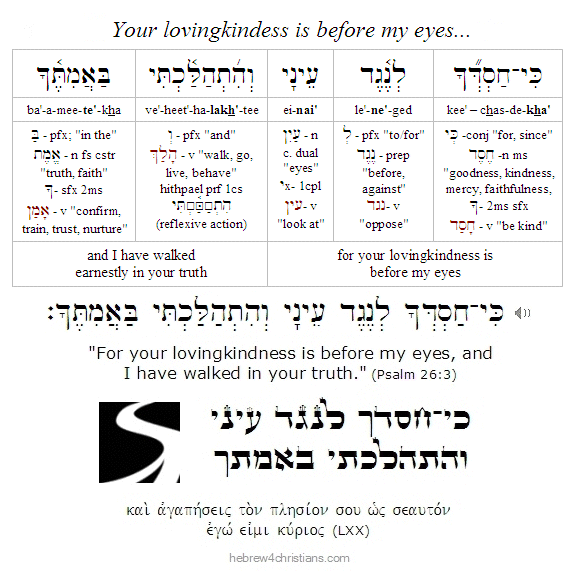 |
<< Return
|