|
|
 |
|
|
|
|
Weekly Torah Reading
|
|
|
|
Parashat Vayeshev ("and he dwelt")
|
|
|
Click on the links to display the Scriptures:
|
|
|
|
|
|
|
|
Torah Reading Overview
|
|
|
Last week's Torah reading (Vayishlach) recounted how Jacob had wrestled with the Angel of the LORD before returning to the Promised Land to be reconciled with his estranged twin brother Esau. No longer named Ya'akov ("heel holder" [of Esau]), but Yisrael ("contender with God"), a transformed Jacob finally returned to Hebron to see his father Isaac, 34 years after he had left home. However, on the way back his beloved wife Rachel died while giving birth to his twelfth son Benjamin.
|
|
|
|
|
|
|
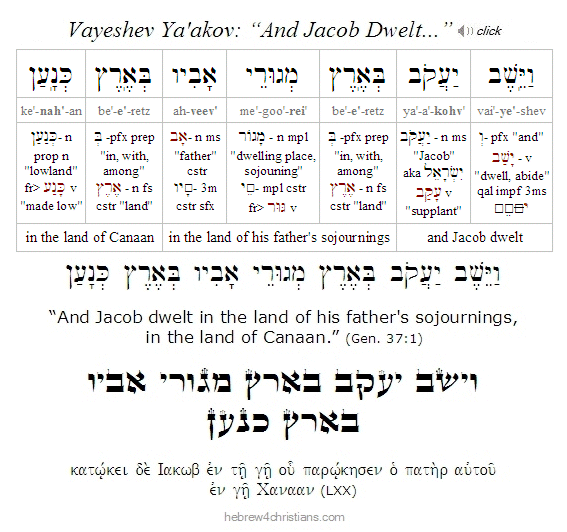
This week's parashah begins with Jacob living back in the land promised to Abraham and Isaac with his 12 sons, but the narrative quickly turns to Jacob's favorite son Joseph, who was seventeen years old at the time. The parashah begins:
|
|
|
|
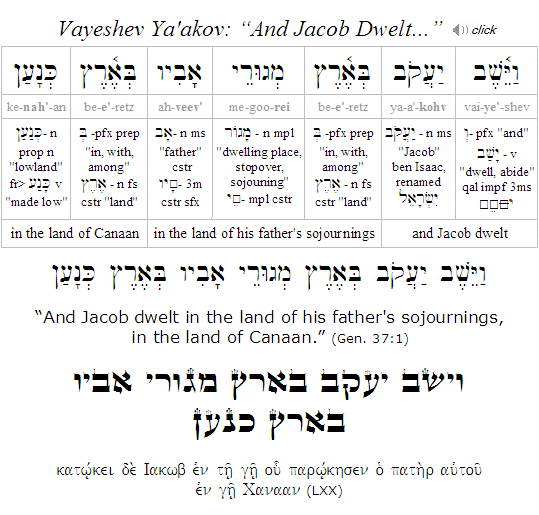
The Torah reading begins, "Jacob settled (vayeshev Ya'akov) in the land of his father's sojourning, in the land of Canaan" (Gen. 37:1), but then immediately turns to the story of Joseph, who was seventeen years old at the time: "And these were the generations of Jacob: Joseph being seventeen years old..." (Gen. 37:2). Why does the toldot (genealogy) of Jacob begin with Joseph rather than Reuben (the firstborn son of Leah) here? Was the Torah suggesting that Joseph was regarded by Jacob as his (chosen) "firstborn" son?
|
|
|
|
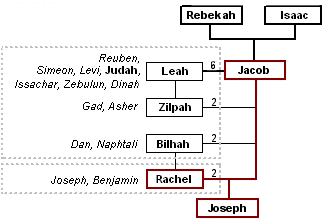
Jacob and Joseph undoubtedly shared a lot in common, and this surely caused Jacob to prefer his firstborn son (of Rachel) over his other sons. For instance, both men had infertile mothers who had difficulty in childbirth; both mothers bore two sons; and both were hated by their brothers. In addition, the Torah states that Jacob loved Joseph more than all his other sons since he was the son of his old age, and was the firstborn son (bechor) of his beloved wife Rachel. Indeed, Jacob made him an ornamented tunic to indicate his special status in the family. (According to midrash, this "coat of many colors," or ketonet passim (כְּתנֶת פַּסִּים), was the same garment Leah and Rachel wore on their wedding nights, and later was set aside for the family heir to possess. After Reuben violated Rachel's handmaid Bilhah, however, Jacob gave the garment to Joseph, thereby designating him as the appointed heir of Israel.)
As the favored son, Joseph's job was to oversee the activities of Jacob's concubines sons (Dan, Naphtali, Gad, and Asher) and to bring "reports" about their activities back to Jacob. However, this role as mashgi'ach (i.e., overseer) and preferred son was too much for the other brothers, and they soon became jealous of him and intractably hated him. To make matters worse, Joseph related several dreams to his brothers that foretold that he was destined to rule over them, increasing their envy and hatred of him (the implication of the dreams was that all of Jacob's family would become subservient to him). Jacob rebuked Joseph for arousing his brothers' hatred, but he inwardly took note and waited for the fulfillment of the dreams.
One day, the brothers took the herds over near Shechem, the place where Simon and Levi, the two hotheaded sons of Leah, had earlier killed all the town's inhabitants on account of the rape of their sister Dinah. Jacob was apparently still concerned about the reputation he had in the area and sent Joseph to check up on their welfare. Joseph, however, learned that his brothers had left for Dothan, and followed them there.
Upon arriving in Dothan, the brothers "saw him from afar, and before he came near to them they conspired against him to kill him." However, Reuben (the disgraced firstborn son) tried to circumvent their plan by suggesting that they merely throw him into a pit to shake him up a bit (secretly planning to come back later to rescue him). When Joseph finally arrived, they stripped him of his ornamented tunic and (as Reuben suggested) threw him into a nearby pit. Then they sat down to eat.
|
|
|
|
|
|
Soon the brothers noticed some of their distant cousins (Midianites, descended from Ishmael) driving a caravan bearing spices to Egypt, and Judah suggested it would be better to sell Joseph as a slave to them. The brothers agreed this new plan, sold Joseph for 20 pieces of silver, and watched as Joseph was bound and taken away to Egypt.
|
|
|
|
|
Reuben, away while this happened, returned to find that Joseph was gone and tore his clothes in horror and dismay. The brothers then decided to fake Joseph's death by dipping his special tunic into goat's blood and bringing it to their father, who (mistakenly) inferred that his son had been killed by a wild animal (note the irony: Jacob had deceived his father with goatskins (Gen. 27:16), and now his sons deceived him with the blood of a goat). Jacob then mourned Joseph for many days. But meanwhile the Midianites had sold Joseph to an Egyptian officer of Pharaoh named Potiphar, the captain of the guard.
Judah and Tamar
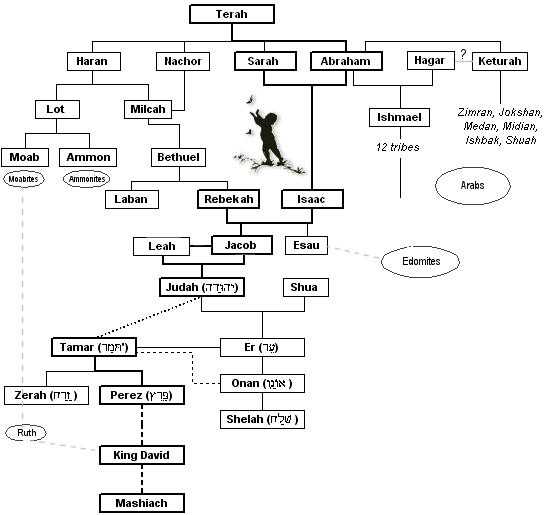
The story of Joseph is then "interrupted" to relate an incident in the life of Judah, who separated from his brothers, married a Canaanite woman named Shua, and had three children: Er, Onan and Shelah. When his eldest son Er came of age, Judah married him to a Canaanite woman named Tamar. However, Er was wicked in the eyes of the LORD and died childless. Judah then promised her his second son Onan (according to the custom of levirate marriage, that is, the brother of a man who dies childless is obligated to give a child to his brother's widow, to be raised in his brother's name with his brother's inheritance of land). Onan sinned by "spilling his seed" in order to avoid the obligation, and the LORD slew him for this. At this point, Judah was reluctant to give his third son marry Tamar, but (misleadingly) told her he would do so as soon as Shelah came of age.
After realizing that Judah was not going to fulfill his promise to give his son Shelah in marriage to her, Tamar disguised herself as a prostitute and seduced Judah himself. Judah heard that his daughter-in-law had become pregnant and ordered her burned alive for harlotry (z'nut), but when Tamar produced his pledge of payment to her for her "services," he publicly confessed that he was the father. Tamar then gave birth to twin sons, Zerah and Perez, the latter being an ancestor of King David (and through him, Yeshua the Messiah):
|
|
|
|
 |
|
|
|
The genealogy of Yeshua
|
|
|
|
|
|
|
|
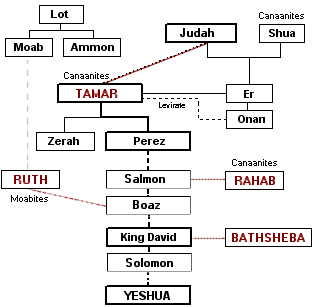
Fascinatingly, the genealogy of Jesus the Messiah therefore includes:
|
|
|
It is interesting to note that in the genealogy of Yeshua given in Matthew (1:1-16), only four women (besides Mary) are explicitly named: Tamar (who seduced the father of her late husband), Rahab (a prostitute), Ruth (a Moabitess), and "the wife of Uriah" (i.e., Bathsheba, an adulteress). Each of these women were justified by their faith in God's promises (Ruth 1:16; 4:12; 1 Kings 1:13-31; Heb. 11:31; James 2:25).
 |
Note: According to the Malbim, the story of Judah represents the axiom that "God creates the cure before the plague." Since the sale of Joseph led to the Egyptian exile (which is considered the paradigm of all exiles), it was necessary to plant the roots of ultimate redemption before the exile began. Thus before the "new Pharaoh" was born who would enslave Israel, the seed of the Messiah, Israel's Redeemer, was planted.
After this account of Judah and Tamar, the Torah portion resumes the saga of Joseph, who was sold to Potiphar (possibly a chief butcher of the Pharaoh). Despite the injustice and treachery of his brothers, the LORD was "with Joseph" and blessed everything he did. In fact, soon he was promoted to be the head of Potiphar's entire household affairs.
The Torah describes Joseph as a handsome "in form and appearance," and soon Potiphar's wife began soliciting him to have an affair with her. Joseph steadfastly refused her repeated advances, but one day she threw herself upon him when no one was in the house. When Joseph tried to flee from her grasp, she caught him by the garment and pulled it off of him before he ran from the house. Humiliated and defeated, she then decided to slander Joseph and falsely accused him of attempted rape to her husband.
Potiphar was outraged and threw young Joseph into the royal dungeon, but again God showed him favor there and he immediately gained the trust and admiration of his jailers, who appointed him to a position of authority in the prison administration. "And whatever he did, the LORD made it succeed."
The parashah ends with events in Joseph's life that eventually would bring him to the attention of Pharaoh himself. While in prison, Joseph met Pharaoh's wine steward and chief baker, both incarcerated for offending their master (according to Rashi, a fly was found in the goblet prepared by the butler, and a pebble in the baker's confection). Both men had disturbing dreams which Joseph correctly interpreted; in three days, he told them, the wine steward would be released but the baker would be hanged. Joseph then asked the wine steward to advocate for his release with Pharaoh. Joseph's predictions were fulfilled, but the wine steward forgot all about Joseph and did nothing for him.
|
|
|
|
Haftarah Reading Overview
|
|
|
|
Amos was a shepherd who tended sycamore trees when he was called by God to be a prophet sometime during the reign of Jereboam II (786-746 BCE). The Northern Kingdom of Israel was very prosperous at the time, and the wealthy lived in palaces and behaved like non-Israelites, while the poor were exploited and sold into slavery if they could not pay their debts. The leadership of the people was entirely corrupt and Amos was called upon to express God's anger at the Israelites, who were no longer living by the mitzvot (commandments) given in the Torah.
In this Haftarah portion, Amos' prophecy against Israel is the climax of seven preceding reproofs directed against the various surrounding nations. His prophecy opens with the formula: "Thus said the Lord: 'For three transgressions of Israel, Even for four I will not revoke it…'" (Amos 2:6a).
Amos railed at the Judges of Israel for their willingness to take bribes of silver, thereby repeating the crime of the brothers of Joseph, "selling the righteous for silver, and the poor for a pair of shoes" (Amos 2:6b). The connection to the parashah is given by the Jewish sages by means of midrash. After throwing Joseph into the pit, his brothers decided to sell him for 20 pieces of silver - two pieces per brother (Reuben was not there), enough to buy a pair of shoes for each of them. The "righteous one" suffered grave injustice - all for a pair of shoes! For this and similar disregard of justice and mercy, the LORD was sure to bring about judgment upon Israel.
|
|
|
|
Brit Chadashah Overview
|
|
|
|
|
The reading from the book of Matthew concerns the Promised Seed of Abraham, the beloved Mashiach Yeshua, whose genealogy is given through the lineage of Jesus' legal father (Joseph) beginning with Abraham, Isaac, and Jacob, then through Judah (and his son Perez) to Jesse, the father of King David, and finally from David to Solomon. Matthew does this in order to demonstrate that Jesus is indeed a descendant of King David and therefore eligible to be the Mashiach of Israel (see the genealogical table above).
Blessing:
|
|
|
|
|
|
For Further Study:
|
|
|
|
|
|
|
Hebrew Audio Files:
|
|
|
|
|
Click the following links to hear the desired chapters read from this week's Torah:
|
|