|
DO YOU KNOW WHICH BOOK of the Bible Yeshua quoted from most? The book of Psalms (תְּהִלִּים) was his top pick, followed next by Sefer Devarim (i.e., Deuteronomy). And regarding Sefer Devarim, parashat Vaetchanan is perhaps the most rich of its portions....
The Hebrew word Vaetchanan (וָאֶתְחַנַּן) comes from the verb chanan (חָנַן), meaning to find favor or grace (חֵן). The gematria (i.e., numerical value) of Vaetchanan is 515 -- the same as the word for prayer (תְּפִלָּה) - which, according to some of the sages, suggests that Moses pled with the LORD no less than 515 times to be allowed into the Promised Land. Finally God said to Moses: רַב־לָך, "enough from you" (Deut. 3:26) and reaffirmed His decree that he would not be allowed to lead Israel into the land. That privilege was given to Yehoshua bin Nun (יְהוֹשֻׁעַ בִּן־נוּן), i.e., "Joshua the son of Nun."
Moses' great transgression that resulted in his exile from the Promised Land was that he "struck the rock twice" (Chukat). But why was this sin so severely dealt with by the LORD? Because the rock was a picture of Him who was stricken for His people (Isa. 53:4 and 1 Cor. 10:4), and Moses' second striking suggested that the Messiah would need to be stricken a second time in order to provide the needs of the people. No! The Rock that was once smitten for the people was now to be spoken to as the Living Rock (1 Cor. 10:4). The entire Exodus was a parable: "As below, so above" (and conversely).
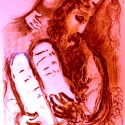
Moses conveyed the wrong message, suggesting that the first striking had been insufficient and that something more was needed. The price he paid for this disobedience was severe: exile from the Promised Land. And so it is to this day: those who attempt to add to the work of the LORD by affecting works of their own righteousness will likewise find themselves in a state of exile from grace....
Midrash on the succession of Yehoshua (Joshua)
According to midrash (ancient Jewish commentary), when the time arrived for Yehoshua to be anointed king, God told Moses it was time for him to die. "If that is what it depends upon," Moses replied, "I would rather be a student of Yehoshua and he be my teacher." Said God: "If you so desire, well and good." Moses then "covered himself" and went to Yehoshua's tent where Yehoshua was teaching Torah. When it was discovered that Moses was there, all the people exclaimed to Yehoshua, "What is this? You sit while your teacher Moses stands?" Yehoshua then tore his garments and wept, saying, "My master, what are you doing here?" Then all the people implored Moses to teach them Torah.
Moses replied that he was no longer permitted to teach the people Torah, but the people prevented him from leaving and pressed upon him. Finally, the Heavenly Voice called out: "Learn Torah from Yehoshua." The people then were quieted while Yehoshua taught with Moses sitting at his right side and Elazar at his left.
After Yehoshua's address, the people came to Moses and asked him to explain what Yehoshua had said. Moses, however, replied, "I myself do not know." At that hour, Moses finally prayed: "Master of the Universe, the time has now come that I wish to die."
Some time afterward, Moses was told from Heaven, "One more hour to your death." He began to bless each tribe separately... Then he was told, "One half-hour to your death," and he began asking forgiveness from the leaders of Israel who in turn asked Moses to forgive them. Moses was then told, "One minute to your death." He then said, ברוך שׁמו חי וקים לעולם ועד, "Blessed is His Name, who lives and abides eternally." He then asked Israel to remember him after they came into the Promised Land. Moses was then told, "One half-minute more to your death." He then put his hands upon his heart and said to Israel: "These hands, which received the Torah, will be buried in the earth." And then his soul left him. The LORD Himself buried Moses in Moab, but no one knows the location.
Yehoshua as a Type of Mashiach
Despite the foregoing midrash, what's important here is that Yehoshua (יְהוֹשֻׁעַ) is seen as a "type" or foreshadowing of Yeshua (יֵשׁוּעַ), the "new anointed son" who would lead Israel into the fullness of God's promises.
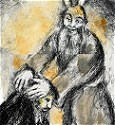
Yehoshua was Moses' faithful companion at Sinai (Exod. 24:13) and overseer of the "Tent of Meeting" (אהל מועד), taking every opportunity to be near God's presence (Exod. 33:11). He was a capable commander of the armies of Israel who regularly routed the enemy in battle (Exod. 17:9, etc.). Yehoshua was humble and of impeccable moral character, a true servant of Israel filled with Holy Spirit (Num. 27:18). Before the catastrophe of the Sin of the Spies, Moses renamed him from Hoshea (הוֹשֵׁעַ) to Yehoshua (יְהוֹשֻׁעַ), appending the letter Yod to make his name begin with a divine prefixive (יָהּ־). Yehoshua (i.e., Joshua) and Yeshua (i.e., Jesus) come from the same Hebrew root yasha (ישׁע) meaning "salvation" (in the Greek LXX, Joshua is spelled Ιησους, the same spelling for Jesus in the New Testament). Yehoshua was steadfast in his faith (Num. 32:12) and willing to be "despised and rejected of men" rather than appease the mob...
There are a number of similarities between Joshua and Jesus given in the Torah. For example, Joshua was a descendent of Joseph from Ephraim (lit., "double fruit"), and Yeshua came as Messiah ben Yosef, the "son of Joseph" who would come from Bethlehem of Ephrata (אֶפְרָתָה), a term that also means "fruifulness." Both Yehoshua and Yeshua loved God's house (Exod. 33:11; Luke 2:49), both were faithful leaders of Israel (Deut. 1:37-38; Matt. 2:6); and both were directly ordained by God. Joshua (i.e., Yehoshua) was tested and found steadfast in his faith (Num. 32:12); he was willing to be "despised and rejected of men" rather than appease the mob, just as was Yeshua. Both Yehoshua and Yeshua appointed 12 men (Josh. 4:4; Mark 3:16-19); both led the people of God to the Promised Land and engaged in warfare for the Kingdom of Heaven; both performed various miracles; both allotted the inheritance of the LORD to God's people (Deut. 1:38, 3:28), both circumcised the people (Yehoshua at Gilgal; Yeshua in the Spirit); both married a Gentile bride (Yehoshua married Rahab, Yeshua married the faithful of the nations), both signified salvation by means of the "scarlet cord," and so on. Moses was the "lawgiver" who was unable to give rest (salvation) to Israel; Yehoshua led the way after the great lawgiver had died, since the people could not enter the land until Moses was dead (see Rom. 7:1-4).
Joshua's full name was "Joshua the son of Nun" (יְהוֹשֻׁעַ בִּן־נוּן). The Talmud notes that the word Nun (נוּן) means "fish," a symbol of activity and life. The first mention of the word is found in Exodus 33:11 in reference to Yehoshua. One application here is to note that Yehoshua, the one who succeeded Moses and was able to enter the Promised Land, was the "Son of Life" - a clear picture of Yeshua our Mashiach, blessed be He...
A midrash says that when Yehoshua was born, no one took note, but when he died, all of Israel took note. Nonetheless, the Israelites did not mourn for him properly. One was busy with his vineyard, the other with his field, yet another with his coal. "The Holy One, Blessed be He, therefore sought to make the whole world quake" (Midrash Shmuel 23:7). This is also an apt description of Yeshua as Mashiach ben Yosef, the Suffering Servant, whose birth went unnoticed, but His death and resurrection indeed shook the world!
לא־יִתְיַצֵּב אִישׁ לְפָנֶיךָ כּל יְמֵי חַיֶּיךָ
כַּאֲשֶׁר הָיִיתִי עִם־משֶׁה אֶהְיֶה עִמָּךְ
לא אַרְפְּךָ וְלא אֶעֶזְבֶךָּ
lo · yit·ya·tzev · ish · le·fa·ne·kha · kol · ye·mei · chai·ye·kha
ka·a·sher · ha·yi·ti · im · Moshe · eh·yeh · i·makh
lo · ar·pe·kha · ve·lo · e·ez·ve·kha

"No man shall be able to stand before you all the days of your life.
Just as I was with Moses, so I will be with you.
I will not leave you or forsake you."
(Joshua 1:5)

Of course the p'shat (plain reading) of this verse refers to the special commission given to Joshua bin Nun as Moses' chosen successor, though it prophetically refers to Yeshua, the greater son of Joseph (i.e., Mashiach ben Yosef) who would arise to lead Israel into the land and to vanquish the enemies of God. Our Lord Yeshua also promised his followers that He would never leave nor forsake them, so this verse indirectly applies to those who trust in Him and take hold of the promises of God...
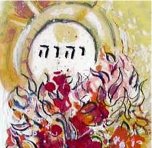
Note also that since God's Name (YHVH) was revealed to Moses as ehyeh (אֶהְיֶה), "I AM," or "I WILL BE" (Exod. 3:14), it is especially wonderful to understand that His Name is also revealed here as ehyeh imakh (אהְיֶה עִמָּךְ), "I WILL BE WITH YOU" (Josh. 1:5).
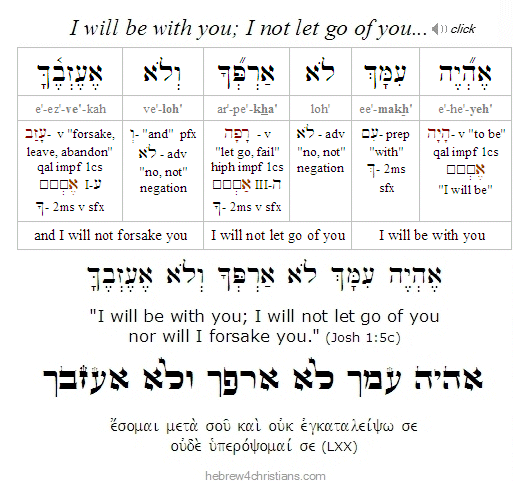
Hebrew Lesson
Joshua 1:5c reading (click):
Chazak ve'ematz: "Be strong and courageous. Do not fear or be in dread of them, for it is the LORD your God who goes with you. He will not leave you or forsake you" (Deut. 31:6).
|