|
When I studied philosophy in graduate school, I took some courses in "epistemology," or the theory of knowledge. These courses would discuss things like "what can we know?" "what is truth?" and the like. In the Greek/Western conception, truth (aletheia) is a property generally ascribed to linguistic states: a proposition p is true if and only if p obtains in the (empirical/observable) world. That is, truth has to do with some sort of correspondence between our thinking (as expressed by language) and states of affairs in the world.
And to some degree, this is surely correct. When we affirm that something is true, we mean that the description we are trying to convey through our language obtains not only for ourselves, but for others who use language in a public way. Language, then, is not a subjective interpretation, but a means of communicating about reality.
The so-called "Greek" conception of truth as a static property that pertains to propositions inevitably led to metaphysical speculations about "essences" and "universals" as something "more real" than the everyday world of particular cats, trees, and water lilies. This perspective found its ultimate expression in Platonism of various kinds. Appearance and reality are two different things, and only by means of abstraction (from the particular to the universal) can the truth about ultimate reality be known.
Philosophers have finessed these ideas over the centuries, but in our postmodern age have largely abandoned the idea that there is an "objective truth" that is uncolored by the bias of the interpreter. Cynically, all truth claims are on par epistemologically, since knowledge (being traditionally understood as "justified, true belief") is never entirely justified (since it always has a "subtext" that disguises the motive for power), nor true (since the appeal to truth is little more than the rationalization of one's interest), and perhaps does not even constitute a belief (since belief is largely an unconscious matter that is not shaped by rational endeavor). This progression can be seen coming from Immanuel Kant (1724-1804) that blossomed into the ruminations of Ludwig Wittgenstein (1889- 1951) and the "deconstruction" of Michael Foucault (1926-1984).
The Hebraic conception of truth, while not denying the importance of correspondence, seems to have a different focus. The Greek conception of truth as a static property that pertains to propositions inevitably led to metaphysical speculations about "essences" and "universals." The Hebrew mind, on the other hand, seemed more focused on the dynamic, the changing, and the idea that truth involved the formation of the character of the person -- and the restoration of the world. Especially in relation to God, to Whom the Jew must give account, the nature of truth becomes grounded in the moments of decision encountered in one's life. Shall I steal? Shall I turn a blind eye to social injustice? etc.
The Seal of Truth
The sages sometimes say "the seal of God is truth," since the final letters of the three words that conclude the account of creation, i.e., בָּרָא אֱלהִים לַעֲשׂוֹת, bara Elohim la'asot ("God created to do" [Genesis 2:3]), spell the word emet:
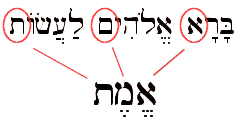
In other words, God created reality "to do" (la'asot), which has come to be interpreted by the sages as meaning that it is our responsibility, as God's creatures, to complete the "doing" of His Creation (tikkun Olam). Truth is about doing, not being...
Note that the "Seal of God" is not just a matter of sincerity. It is rather a matter of being true in the sense that you are living it, you are being with it, you are part of it. You exist inside this truth as a passion and this truth informs all of the decisions you make in life. You therefore embody the truth and follow it in all your endeavors. In this sense Yeshua the Mashiach is the Truth, since in Him there was no mismatch between who He is and what He said. He is utterly trustworthy. His actions and speech are one and are entirely reliable. Jesus is the "Seal of God," the one who authoritatively names of all creation, and His followers likewise should evidence this in their lives.
Truth Encompasses All
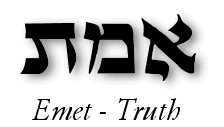
In Hebrew, the word for truth, emet (אֱמֶת), contains the first, middle, and the last letter of the Hebrew alphabet, indicating that truth encompasses all things and endures from the beginning (א) to the end (ת):

But notice that if we remove the letter Aleph from the word, we are left with the word "dead" (i.e., met: מֵת), the opposite of life (i.e., chayim: חַיִּים). The letter Aleph is the ineffable letter that represents oneness and preeminent glory of God. Therefore, if we attempt to ignore or suppress God in our understanding of truth, we end up with death. And since Yeshua told us, "I am the way (הַדֶּרֶךְ), the truth (הָאֱמֶת), and the life (הַחַיִּים); no one comes to Father apart from me" (John 14:6), those who deny His reality are in a state of spiritual death... We simply cannot know the meaning of life apart from the Person and Glory of Yeshua our Messiah!
Since truth is all-encompassing, there is always a place for it to be practiced -- there is literally no place or experience that is exempted from its presence -- and therefore, there is always the demand to live in its light. Indeed, God Himself is called the Spirit of Truth (Ruach HaEmet) (John 14:7, 15:26, 16:13).
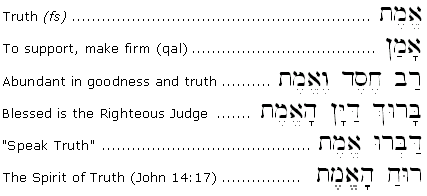
The word emet comes from a verb (aman) that means to support or make firm, and expresses the image of strong arms of a parent supporting the helpless infant. Truth stands in active relation to the one who is supposed to know it and "carries the burden," so to speak, by being the foundation of one's existence in creation.
|