|
|
 |
|
|
Berachot Sukkot
|
|
|
Common Sukkot Blessings
|
|
|
|
|
|
The seventh (and final) feast given to Israel is called Sukkot, or the "Feast of Tabernacles." Sukkot is observed in the fall, from the 15th to the 22nd of Tishri. During this time many Jewish families construct a sukkah, a small hastily built hut in which meals are eaten throughout the festival.
|
|
|
|
|
|
The Yom Tov Blessing
|
|
|
|
|
|
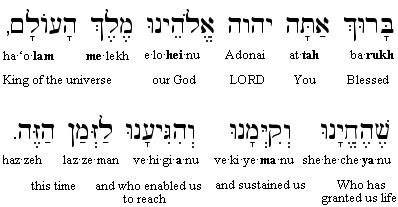
On the first night of Sukkot, it is considered a mitzvah to light two candles, recite Shehecheyanu, and eat a meal inside the sukkah.
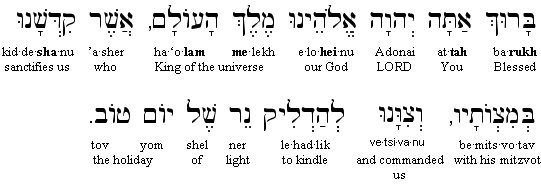
First we light the two holiday candles in the sukkah. Note that unlike Shabbat, we first say the blessing and then light the candles:
|
|
|
|
barukh attah Adonai eloheinu melekh ha-olam, asher kideshanu
bemitzvotav ve-tsivanu lehadlik ner shel yom tov.
|
|
|
|
On the first night of Sukkot (only), we add the following blessing:
|
|
|
|
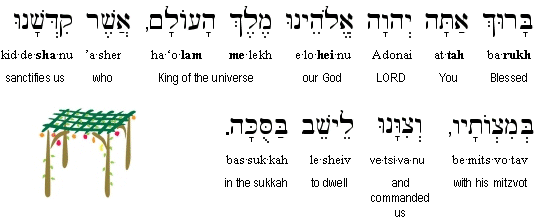
Before eating the holiday meal in the sukkah, we first recite kiddush and then recite the following blessing over the sukkah:
|
|
|
|
We then say the ha-motzi (the blessing over the bread) before partaking of our meal. Traditional foods include stuffed cabbage and kreplach containing fruit or fall harvest vegetables; dishes made with honey and pastries.
There is also a custom of inviting "imaginary guests" (ushpizin) to join us in the sukkah for our meals. On the first night we invite Abraham and for each subsequent night we invite Issac, Jacob, Joseph, Moses, Aaron, and King David.
|
|
|
|
 |
|
|
|
|
Netilat Lulav Blessing
|
|
|
The Four Species
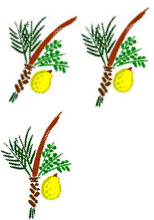
The Four Species, or arba'at ha-minim (אַרְבַּעַת הַמִּינִים), are four types of organic products the LORD commanded to be used (in Leviticus 23:40) for the celebration of Sukkot. Traditionally these are understood to be:
- Etrog (ET-rog) - A lemon-like, citrus fruit referred to as pri etz hadar ["the product of goodly trees"]
- Branches of palm trees - kapot temarim
- Myrtle - Haddas ["Boughs of leafy trees"]
- Willows of the brook - aravot
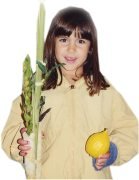
The lulav is a bouquet made of the palm branches, myrtle and willow branches that are bound together and waved / shaken in praise to the LORD.
|
|
|
|
|
|
|
According to the principle of hiddur mitzvah [beautifying the commandment], most Jews will seek excellent specimens for their "four species." At any rate, the lulav and etrog should be keep in good condition throughout the festival, since they are needed everyday (except on the Shabbat that occurs during Sukkot) to perform various ceremonies.
Waving the Lulav
On Sukkot, you will first bind all the branches together -- two willows on the left, one palm branch in the center, and three myrtles on the right.
Next, hold the bundle in your right hand and then lift them together with the Etrog (pointing downward) in your left hand.
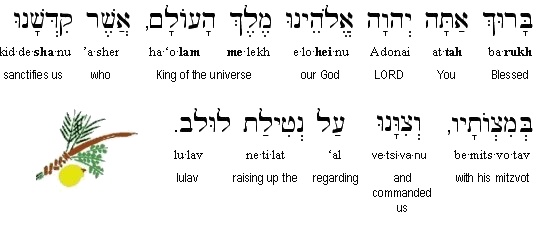
Recite the following blessing:
|
|
|
|
Now, turn the etrog right-side up, put both hands side-by-side, and then shake the lulav three times in each direction: front, right, back, left, up and down. These six directions indicate the surrounding presence of God.
|
|
|
|
Give Thanks to the LORD
In Jewish tradition, after reciting the Hebrew blessing and shaking the lulav around, it is customary to recite (or sing) the following antiphon from Psalm 136:
הוֹדוּ לַיהוה כִּי־טוֹב כִּי לְעוֹלָם חַסְדּוֹ
ho·du la·Adonai ki-tov, ki le·o·lam chas·do
"Give thanks to the LORD, for he is good,
for his steadfast love endures forever."
Download Study Card
Indeed, is there any better reason to give thanks to the LORD than because of His steadfast love, i.e., His chesed (חֶסֶד)? Is there anything greater than the astounding love of God? Can anything overcome it? Can even the hardness of your own heart somehow veto or negate it's purposes? It was because of His great love that God (יהוה) "emptied Himself" of heavenly glory, becoming clothed in human flesh and becoming disguised a lowly slave (δοῦλος). God performed this act of "infinite condescension" in order to "tabernacle" with us as our "hidden King" (John 1:1,14, Phil. 2:7-8). Your neshama (soul) is the "Shulamite woman" he came to woo so that you might "come into His tent" -- willingly, from the heart (Song of Solomon).
When we receive Yeshua as the Lover of our souls (kabbalat Yeshua), we abide in the hope of love that awaits future consummation in the world to come... Meanwhile, we are "suspended between worlds," though the veil of this world has been rent asunder and we may now appear before the LORD in the realm of the spirit by faith. We can come "boldly" before the Throne of Grace (παρρησίας τῷ θρόνῳ τῆς χάριτος) to find help for our lives (Heb. 4:16). Note that the word translated "boldly" in this verse (παρρησίας) comes from πᾶς (all) + ῥέω (to utter), suggesting that we can speak freely to God and share everything within our heart without fear or shame. We do not need to conceal ourselves from the Divine Light -- any more than we need to perform arabesque rituals or offer any "prescribed prayers" to access Him. We who are trusting in God's sheltering love understand the LORD to be our loving Savior and Redeemer. In our brokenness we can bare our souls before Him without fear ("there is no fear in love" - אין פַּחַד בָּאַהֲבָה). We can express "all our heart" to the LORD and be assured that He will help us in our hour of need (Heb. 4:16).
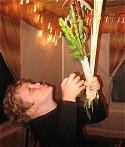
God loves the little children and never prevents them from coming to Him: "for to such belongs the kingdom of heaven" (Matt. 19:14, Mark 10:14). O praise and thank God for Jesus, chaverim! What would we do without Him?
Shalom and blessings to you all in our Lord Yeshua the Messiah - the One who "tabernacles" with us in the Holy Spirit and who graciously invites all to come within the shelter of His everlasting love. וַיְהִי בְשָׁלֵם סֻכּוֹ וּמְעוֹנָתוֹ בְצִיּוֹן / vayehi v'shalem sukko, u'me'onato v'Tzion: "His sukkah is in Shalem; His place in Zion" (Psalm 76:3). The world is under divine judgment, but those who trust in the LORD can say along with King David: יִצְפְּנֵנִי בְּסֻכּה בְּיוֹם רָעָה / yitzpeneni b'sukkoh b'yom ra'ah, "He will conceal me in His sukkah in the day of trouble" (Psalm 27:5).
|
|
|
|
To make things a bit easier for the holiday, I thought I would consolidate the various blessings and customary steps for observing Sukkot into a single (double-sided) page that you can print out for use with your Sukkot celebrations.
|
|