|
In the Hebrew Bible the verb hayah (היה), expresses the idea of being and existence, and that is the root idea indicated by the name "YHVH" (יהוה), which is the personal name of God and his most frequent designation, occurring over 6,800 times. The name is not pronounced by Jewish custom and is substituted with other designations such as "HaShem" (the Name) or "Adonai" (Lord) whenever the Scriptures are recited. In English it is common to translate YHVH as "the LORD" (all caps) to indicate its special sanctity. This is the Mysterious or "Unutterable Name" of the God of Israel. Because it is composed from the four Hebrew letters Yod, Hey, Vav, and Hey, the name is also referred to as the "Tetragrammaton," which simply means "the four letters."
The Name YHVH first appears at the outset of the Torah, in Genesis chapter two, where it is written: "This is the history of the heavens and the earth when they were created, in the day that the LORD God (יְהוָה אֱלֹהִים) made the earth and the heavens" (Gen. 2:4). A few verses later the name appears again when it says "Then the LORD God (יְהוָה אֱלֹהִים) formed man of the dust of the ground, and breathed into his nostrils the breath of life (נִשְׁמַת חַיִּים), and the man became a living being" (Gen. 2:7). So the Name of God, YHVH, was known from the beginning to be the Source and giver of life and existence to all things...
In addition, Torah reveals that the LORD God interacted with people and with angels. For instance, we read that LORD God spoke directly to Adam and Eve (2:19; 3:13), to the Serpent (3:14), to the angels (3:22), to Adam and Eve's son Cain (4:6), to Noah (7:1), and then particularly to Abram (12:1), to Isaac (26:2), and to Jacob (31:3). And we may include the "Angel of the LORD" (מַלְאַךְ יְהֹוָה) as an equivalent name for YHVH, since the Angel is "theophany" or manifestation of the LORD God himself, and indeed it was the Angel of the LORD that appeared to Abraham during the sacrifice of Isaac (22:1), to Jacob at Peniel (32:30), and who later appeared to Moses as YHVH at the Burning Bush (Exod. 3:2-4).
This revelation of the LORD God to Moses at the burning bush is of particular importance for understanding more of the meaning of the name YHVH because it adds information not given earlier to the patriarchs (Exod. 6:3). Recall that when God called out to Moses from the midst of the flame he identified himself by saying: "I am the God of your father, the God of Abraham, the God of Isaac, and the God of Jacob," and then he told Moses that he had seen the affliction and sorrows of his people and had come to deliver them and bring them to the promised land (Exod. 3:6-9). When God then asked Moses to go to Pharaoh and to bring the people out of Egypt, Moses immediately objected that he was unqualified for such a task, but God reassured him by saying: "I will be with you" (כִּי־אֶהְיֶה עִמָּךְ) and I will return you with the people to this very mountain to worship (3:12). Note that the Hebrew word for "I will be" used here (i.e., ehyeh: אֶהְיֶה) is from the same root hayah used in the name YHVH.
Moses then asked God why anyone would believe that he was truly sent on a mission from God: "If I come to the people of Israel and say to them, 'the God of your fathers has sent me to you,' and they ask me, 'What is his name?' what shall I say to them?" (3:13). Note that Moses wanted a description of God's name that would go beyond "the God of Abraham, the God of Isaac, and the God of Jacob." The LORD then said to Moses: "I AM WHO I AM." And he said, "Say this to the people of Israel, 'I AM has sent me to you'"(3:14). Moreover, this special Name of the LORD was forever to be connected with the patriarchs of Israel: "Say this to the people of Israel, 'The LORD (יְהוָה), the God of your fathers, the God of Abraham, the God of Isaac, and the God of Jacob, has sent me to you.' This is my name forever (זֶה־שְּׁמִי לְעֹלָם), and thus I am to be remembered throughout all generations" (3:15).
The phrase ehyeh asher ehyeh (rendered as "I AM THAT I AM" in the KJV) indicates a connection between the Name YHVH and being itself. YHVH is the Source of all being and has being inherent in Himself (i.e., He is necessary Being). Everything else is contingent being that derives existence from Him. The name YHVH also bespeaks the utter transcendence of God. In Himself, God is beyond all "predications" or attributes of language: He is the Source and Foundation of all possibility of utterance and thus is beyond all definite descriptions.
With this background in mind, let us reflect a bit about the significance of the LORD God being identified both as the historical God of the patriarchs as well as "ehyeh," the great "I AM."
To get started, recall that Torah begins with the LORD (i.e., YHVH) named as the Creator of the world (and of mankind) who is also the promised Redeemer from the curse inherited by Adam and Eve. The LORD is also named as the deliverer of Noah and his family, and the one who personally called Abram to go to the promised land to inherit the kingdom of God. The Book of Genesis recounts the generations of Abraham, his son Isaac, and his grandson Jacob who was renamed "Israel" and the progenitor of the Jewish people. The book ends with Jacob's son Joseph foretelling the exodus of the Jewish people from their bondage in Egypt to return to the promised land (Gen. 50:24-25).
The story of the Exodus begins where the book of Genesis left off, with the people in Egypt awaiting the prophecy of Joseph to be fulfilled, and gives the account of the birth of Moses who later would be Israel's deliverer. I will not repeat the details of Moses' early life here, nor of his uprising against the Pharaoh that led him to flee the land of Egypt, but after 40 years of exile in the desert of Midian, Moses one day saw a "burning bush" and heard the voice of the LORD call out to him from the midst of its flames, and it was there that the mystery of who God is in himself, that is, in his "essence," was first articulated. This "deeper" understanding of the name was first intimated in God's promise to Moses, "I will be with you" (אֶהְיֶה עִמָּךְ), though God commissioned Moses to speak these same words to the nation as a whole: "Say this to the people of Israel, 'I AM (ehyeh: אֶהְיֶה) has sent me to you'"(3:14).
At this point let me forewarn you that this discussion may go into some deeper waters. Are you ready to take the plunge? If so then consider that the name YHVH is the expression of God's omnipresence and his incomprehensibility, which is to say that everything is connected to Him and yet everything is profoundly mysterious. "I am that I am" (or "I will be what I will be") signifies the Divine Presence that encompasses all things, "the place" of God's Spirit that hovers over the face of the deep (Gen. 1:2). This means, among other things, that God "in Himself," God qua God, is beyond our comprehension and natural understanding...
If we want to speak about the "life" or "being" of God, what can we truly say? In "natural" terms, that is, using our human language derived from reasoning, we are at best able to say what God is not rather than what God is. This is sometimes called "via negativa," a Latin phrase meaning "the way of negation." For instance, when we say that God is "infinite" we mean that God is not finite, or when we say that God is "omnipresent" (everywhere present) we mean there is no place where God is not... Likewise when we say that God is "omnipotent" (all-powerful) we mean that there is no limitation to what God can do, and that there is no other power that is greater than God.
Such reasoning can disclose a basic understanding of God as the "Supreme Being," or as Anselm stated "a Being that than which nothing greater can be conceived," but this definition suggests an abstract and impersonal idea of the "god of the philosophers" rather than the living and intimately personal God of Abraham, Isaac, and Jacob. If we were left only with Greek speculations that "God" is the "Unmoved Mover" (Aristotle) or the "magnetic" Architect of ideas that seek to "participate" in his Being (Plato), we are left with God being forever "out of reach," ineffable, self-absorbed, and disengaged with our lives.
But God is a Person who speaks and reveals himself in creation and within our hearts. Our faith believes that God is intensely personal and has revealed himself in human terms - both both by using "analogical" language, or the language of resemblance (i.e., metaphor, similes, and so on) but most especially by means of divine "inspiration" -- first through the prophets who "incarnated" the Spirit of God when they spoke in YHVH's name -- but superlatively and most importantly in the incarnation of the true life of God in Yeshua (see Heb. 1).
In most discussions about "theological" language or "God talk," there are three basic approaches about how our words may "map" or correspond to what is real, namely the univocal view, the analogical view, and the equivocal view. The central idea of "univocal" language is the idea that descriptive words and declarative statements about God correspond in the same way with how God really is and even to how God uses these words. This view implies, however, that we can discern the metaphysical meaning of the words found in the Scriptures, that is, how these words are properly translated to correspond with things beyond the realm of natural experience, and moreover that this meaning is identical or shared with the thoughts of God himself. Perhaps one example of "univocal" language in the Bible is God's self-disclosure as "I AM," or ehyeh (אהְיֶה), a self-referential description of God as "Being" or "Presence" itself. However it doesn't take long to realize how difficult it is to interpret this as a direct and literal description of God's nature and self-existence.
At this point I should interject that the language of our prayers, praise, and cries from the heart directed to God are indeed meaningful and are intelligible to God, for the LORD has no problem "interpreting" our language or words. The language we are considering here is more about how we interpret God's words as recorded in the Scriptures, those "descriptive" and "declarative," statements that seek to define or understand the nature of God as God is in himself, and that is a very different thing than the language of prayer...
The study of the Scriptures reveal a "two-tiered" or dualistic structure to reality. There is a "divided line" between this earthly realm (מַמְלֶכֶת הַאֲרַצִית) and the heavenly realm (מַמְלֶכֶת שְׁמִימִית), and likewise between material reality (מְצִיאוּת חוֹמְרִית) and spiritual reality (מְצִיאוּת רוּחֲנִית). God created human beings as "mediators" between the two realms, being composed of both flesh and spirit, and therefore it appears that we must use "analogical" reasoning to understand the resemblance (and differences) between the two realms.
For example, when the prophet Ezekiel saw heaven open he had no earthly language he could use to describe his vision of the "merkavah" (chariot of God) and he therefore described what he saw by attempting compare what was seen in this world with that of the heavenly realm. "Then I looked, and behold, a whirlwind was coming out of the north, a great cloud with raging fire engulfing itself; and brightness was all around it and radiating out of its midst like the color of amber, out of the midst of the fire. And from within it came the likeness of four living creatures. And this was their appearance: they had the likeness of a man. Each one had four faces, and each one had four wings...." (Ezek. 1:4-6).
Likewise the prophet Isaiah saw the Lord seated on a high throne with the hem of his robe filling the Heavenly Temple, surrounded by a number of "seraphim" (winged divine beings) singing "Holy, holy, holy is the Lord of hosts" (Isa. 6:2-3), and the prophet Daniel saw one "like a Son of Man" coming with the clouds to receive an everlasting dominion (Dan. 7:13-14). The prophet Zechariah also had many "night visions," including a mysterious Man on a red horse standing among myrtle trees in a ravine watching over Israel, a golden menorah fed by two olive trees, and a large "flying scroll" of God's judgment on those who swear falsely....
When the Torah says God created us in his own "image and likeness," it does not mean that our physical image corresponds to him, but rather that our "inner image," our self-reflective consciousness and the structure of our soul are analogous or "similar" to God. We are like unto God as "similes"; we resemble God in the depths of our consciousness, for we too are "I am that I am" beings whose essence is both mysterious and wonderful...
Despite this inner resemblance to God, a human being is not a literal "counterpart" to God in terms of God's attributes and glory. Indeed, if we elevate the human soul to the divine we commit idolatry, for we make "god" in our image and likeness rather than understand ourselves as beings God created to connect with him in meaningful ways...
Paradoxically the human soul intuitively "knows that it does not know" God in his essence, and it further "knows that it cannot know" God unless and until God makes himself known to us in "finite" terms. This is the deeper meaning of the "incarnation" or manifestation of God in finitude. The Angel of the LORD is a visible "theophany" (appearance of God) in angelic form so that the angels might see him and "communicate" with him; the prophets saw the Spirit of God hover and appear in a flame of fire, they heard the voice from the whirlwind, and so on, but the greatest revelation was given in the incarnation of Yeshua, God in the flesh and the Living Word of divine truth.
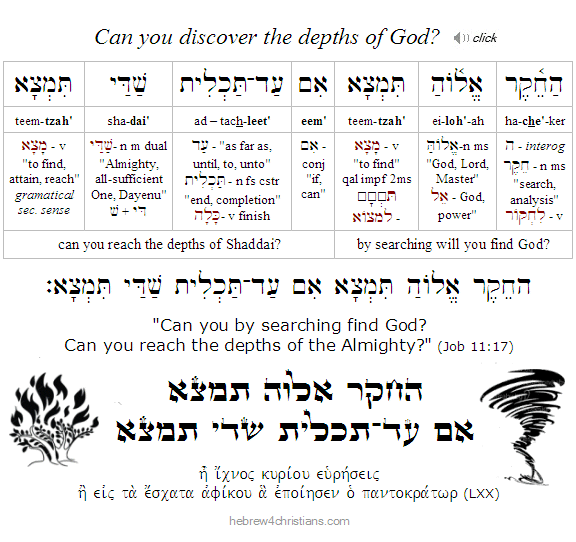
"Can you search out the deep things of God? Can you reach the depths of the Almighty?" (Job 11:17). In the "dark light" of the great mystery of God - who God is and what we can know of Him - we learn that we can only apprehend truth by the agency of the Holy Spirit who reveals Yeshua as "the Word made flesh" (John 1:14; 14:26; 1 Cor. 2:10-11).
God transcends all things, yet he "empties himself" to become known to us in Yeshua. God is also immanent or present in all things, which is what YHVH also means. In this way he fills "heaven and earth" and redeems and sanctifies every sphere of the creation. The mercy and love of God breaks through the veil between heaven and earth in the passion and sacrifice of our Savior. His flesh is the "curtain" torn asunder that completes the way to God's eternal redemption. "It is finished" is the final and triumphant cry from the cross.
Soren Kierkegaard wrote about the "Absolute Paradox" of Christ, by which he meant the "contradiction" that the eternal and infinite God has entered time and became a finite human being, and that the holy and sinless one offers himself to become defiled and sinful for our eternal healing. The "collision" between faith and reason is regarded as a "scandal" that offends the proud sensibilities of worldly assumption. However when a person encounters the truth at the intersection of time and eternity it is the "moment" of decision, and faith may then abandon itself to God in Yeshua. The antithesis between faith and reason is absolute, and the only way to know God is by "pressing forward" by faith in Christ, the narrow gate, by an "infinite passion of inwardness" as imparted by God's Spirit that leads to the life of blessing. All our natural understanding, our "old self," must be left behind...
It is this obscure knowledge of faith - spoken using "equivocal" language - that is inscrutable to worldly wisdom that reveals and expresses the "wings of love," that is, the glorious beautiful and grace of the Beloved One... Such words express the amazing "encounter" with God to be miraculous and beyond language, known in groans of the heart, in sighs of longing, and in the rise of unspeakable joy of God's great love. Even so, God has indeed revealed truths about Himself in the holy Scriptures that we can understand, even if analogically, or "through a glass darkly," and these truths reveal the glory of his character, his attributes, and his will for our lives. Amen. "Thy Word is a lamp for my feet and a light to my path."
Hebrew Lesson
Job 11:17 reading (click for audio):
 |
<< Return
|