|
On the great day that the Mishkan (i.e., "Tabernacle") was consecrated, Aaron and his sons carefully prepared sacrifices upon the brazen altar on behalf of all the people of Israel. After Moses and Aaron went into the tent and prayed, they came out and blessed the people, and the glory of the LORD suddenly appeared as a fire that issued forth and consumed all the sacrifices on the altar. When the people saw this they cried out in awe and "fell on their faces" in worship (Lev. 9:1-24).
But then something terrible happened. In the midst of the glorious revelation of God's presence (Shekhinah), Aaron's two oldest sons, Nadav and Abihu, each picked up a fire pan and offered incense within the tent, something that God had not commanded, and immediately both of them were consumed in a flash of blinding light (Lev. 10:1-2).
We can't imagine the horror Aaron must have felt at that time, the shock, the confusion, the sadness... Moses then tried to explain what happened to his brother, saying "this is what the LORD meant when he said, "In those who are near me I will show myself holy (בִּקְרֹבַי אֶקָּדֵשׁ), and before all the people I will be glorified" (Lev. 10:3). Somehow these "theological" words were meant to rationalize what had happened, but Aaron was muted in his grief; his heart had no words that could sanctify what had happened. "Aaron was silent," though the Hebrew text says more: va'yidom Aharon (וַיִּדֹּם אַהֲרֹן), Aaron was devastated, "cut off" and utterly traumatized by what had happened.
Maybe something like this has happened to you. Someone loved or cherished is suddenly immolated, ripped away from you, and you are unable to feel, to cry, to speak. You are bereft of comfort and any attempt to rationalize your loss is painfully vain and even meaningless... "Whereof one cannot speak, thereof one must be silent" (Wittgenstein).
It all happened so fast, and seemingly at the worst possible time... We don't know what he was thinking or feeling, but perhaps Aaron experienced "derealization," that is, a sense of unreality that all this was a bad dream. Were his two sons really dead? How could they die at the height of the solemn occasion -- and by the very fire of God? It's unthinkable. Aaron was devastated, and we can only speculate what might have been running through his mind at the time. Was he mortified over the mistakes that his sons made? Was he was angry or confused over Moses' strange rebuke? Surely Aaron would have felt alone and afraid, unsure of what he was doing, alienated from the Lord who had brought him into the midst of this whirlwind... Was he not with Moses from the beginning? Did he not go before Pharaoh as God's ambassador? Did he not walk in faith and celebrate God's redemption? Did he not love his sons and hope for their future? Everything in his life led to this climactic moment wherein his sons would serve as God's healers for the people, and yet the furious display of glory suddenly made the Lord seem like strange fire, dangerous and unsafe...
"I have tested you in the furnace of affliction" (Isa. 48:10). "When God wants to bind a person to him properly, he summons his most faithful servant, his trustiest messenger, and that is Grief, and he tells him, 'Hurry after him, catch up with him, don't leave his side!' And no woman can cling more tenderly to what she loves than does Grief..." (Kierkegaard: Journals). It is written in our Scriptures, "Many are the afflictions of the righteous, but the LORD delivers him out of them all" (Psalm 34:19), and this is because God uses affliction as the way of correction to lead us to the truth. God who is the Source of our life is also the end of our life.... If there is consolation to be found in the seemingly inexplicable death of his sons, it was that they died in the presence of God, not in judgment over their misdirected zeal, but to reveal something greater that needed to be known.
We suffer, and life hurts. Often we are afraid. And if suffering is part of God's overarching plan for creation, if it is somehow part of the "divine idea," then how do we learn to emotionally accept it without becoming bitter? We earnestly desire the love and blessing of God, but we are shaken when terrible things happen. We are told not to be afraid, that we are not alone, but we often do feel afraid and alone in our suffering...
First we must find faith that God's decision to create us is for our blessedness rather than for evil, or minimally that it is better for us to have been created than never to have been born (Jer. 29:11). In that sense trusting God represents an affirmation of our life and its value. Whether this is the "best of all possible worlds" is an abstract question for speculative theology, but where we live, in the raw and messy struggles of life, in the midst of our joys and elations, but also in our darkness and pain, we need faith to believe that our existence has some meaning and purpose, that our lives carry some significance, and that not everything is hevel havalim, "vanity of vanities." Asking whether it would have been better had you never been born is not a trivial question, then, and indeed the ancient Hebrew prophets Job, Solomon, Jeremiah, and Jonah each wrestled with it in the course of their lives (Eccl. 4:1-3; Job 3:1-3; 10:19; Jer. 20:14; Jonah 4:3).
The sages asked whether we can ever be justifiably angry at God, and they answer that surely we can, because otherwise we could never love Him "bekhol levavkha," with all our heart (Deut. 6:5). Indeed, how can we claim to love God if we withhold the truth, lie to ourselves, and attempt to hide who we really are from Him? If you are angry at God, he already knows, so why the pretense? Being angry with God is part of being a real person in a real relationship with Him, and allowing yourself to express the truth of your heart to him is a sign of trust... Forgiving God means letting go of your grudges over matters infinitely beyond your control. We need God to even know that we need God...
Of course there is no sin in God for he is the Rock, "all his ways are justice; he is a God of faithfulness, without iniquity, entirely just and upright (Deut. 32:4). Every good and perfect gift comes from Him (James 1:17). We may know this intellectually, but our emotions and our theology may get out of sync. Rightly (and sympathetically) understood, when we "forgive God" we are confessing our own ignorance about what is happening to us while allowing our hearts to give voice to its pain. At bottom, suffering is a type of grieving, a confession of the darkness of our loss. On the other hand, we can find healing through the grieving process. Over time we learn that by "forgiving God" we are able to forgive ourselves, and we are then released from the pain that withholds us from love and blessing in our lives.
Frederick Buechner reminds the heart of faith: "The worst isn't the last thing about the world. It's the next to the last thing. The last thing is the best. It's the power from on high that comes down into the world, that wells up from the rock-bottom worst of the world like a hidden spring. Can you believe it? The last, best thing is the laughing deep in the hearts of the saints, sometimes our hearts even. Yes. You are terribly loved and forgiven. Yes. You are healed. All is well." For more on this topic see the article: "Angry at God..."
Hebrew Lesson:
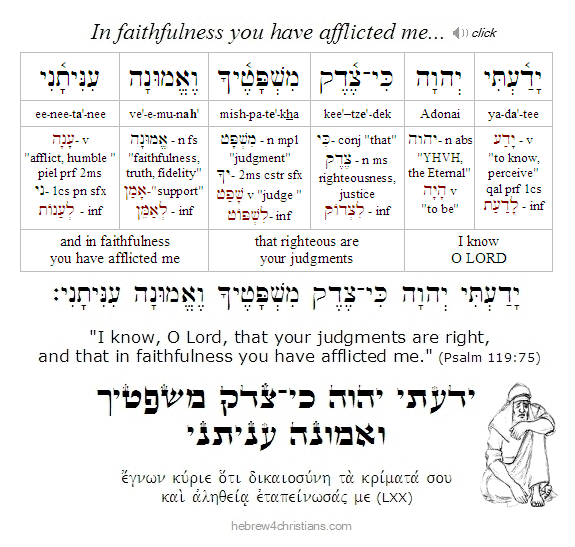
Psalm 119:75 Hebrew reading:
<< Return
|