|
Our Torah reading this week (Naso) mentions the case of the "sotah," or a woman accused of adultery, who was brought before the priest to give account of her behavior (Num. 5:12-31). If she swore to her innocence, the priest prepared a "bitter water" concoction for her to drink. He then took a scroll and wrote a curse of the woman's punishment if she was lying and signed it with the Name of God. The scroll was then immersed in the bitter water so that the words of the oath would dissolve into a drinking vessel.
The accused woman was then set before the altar and the priest again warned her that if she was guilty of adultery, she would die a painful death, but assured her that if she was innocent the waters would impart a special blessing of fruitfulness to her. Only after the woman said "amen, amen" to the terms did she drank from the cup...
In general the sages have regarded the matter of the sotah in allegorical terms. Each of us is "married" to God by covenant, and therefore our relationship with him will be tested. Though we have our ideals, we nevertheless are frail and lose sight of our deepest commitments. It is our responsibility to confess the truth about the condition of our hearts. If we stray (שָׂטָה) from our covenant with God, we will taste the bitter waters of the sotah.
Confession is essential for healing, for truth is what connects us with reality. Unsaid words, suppressed feelings, secret desires, hurtful actions, and so on, are "swallowed" by the soul and inevitably affect the heart. We cannot deny the truth without being haunted and made anxious. Regarding our relationship with God, we cannot go astray without becoming hardened and "depressed" by the weight of our own duplicity. If we persist in our denial, we lose the truth about who we are and become poisoned by the bitter waters we drink. As a "sotah," we take the name of the Lord in vain and suffer the consequences...
When the Israelites came to Marah, "they could not drink the water because it was bitter" (Exod. 15:23). Note that the Hebrew text allows us to read that it was the Israelites themselves who were bitter – ki marim hem (כִּי מָרִים הֵם) – "for they (i.e., the Israelites) were bitter," and their bitterness made the water seem so as well.... After the people complained, God showed Moses a tree and threw it into the water, making it drinkable. Interestingly the Hebrew text literally reads, "the LORD taught him a tree" (וַיּוֹרֵהוּ יְהוָה עֵץ), suggesting elon moreh (אֵלוֹן מוֹרֶה), the "teaching tree of Abraham" (Gen. 12:6). The sages say this tree symbolized Torah, the tree of life (etz chaim), which brings happiness to those who take hold of it (Prov. 3:18), though we see Yeshua, the fallen tree that yields mayim chayim - living water - to revive the hearts of all who will receive his remedy.
If we find ourselves inwardly sick, barren, and lifeless, we need to turn back to the Lord and reaffirm our need for truth and love. Only God can heal the depths of our brokenness. The parable of the sotah is intensely personal, exposing the depths of who we are in relationship with God. It's revelation is meant to lead us back into the blessing of the life of his love.
Hebrew Lesson
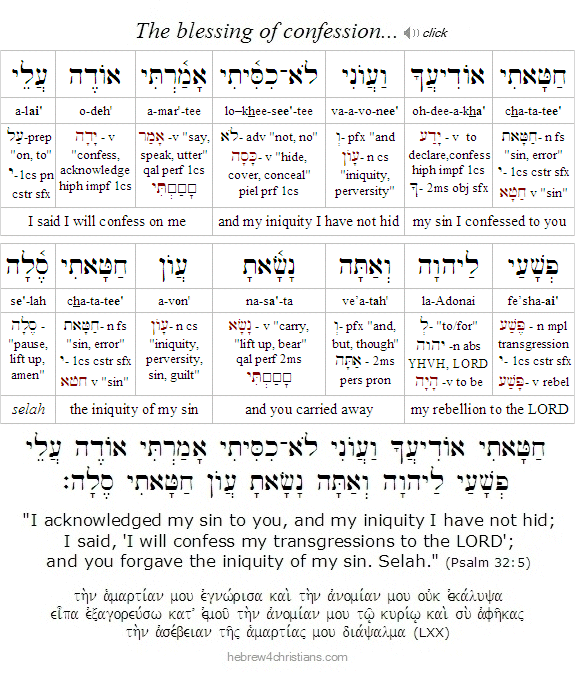
Psalm 32:5 reading (click for audio):
<< Return
|