|
This week we read the dramatic story of Moses' cousin Korah who led a rebellion against Moses after the Israelites were turned away from the promised land and sentenced to wander forty years in the desert of Sinai. God quickly judged Korah's rebellion and vindicated the laws of the priesthood and Moses' leadership of Israel.
This story is a sober one that raises several provocative questions about our responsibility to submit to God's authority. On the one hand, the example of Korah teaches that we should obey God's direction for our lives and accept his will, lest we too should incur divine judgment. As it is written in the Scriptures: "For rebellion is as the sin of witchcraft, and stubbornness is as iniquity and idolatry" (1 Sam. 15:23). The essence of rebellion is pride...
When Korah questioned Moses' role as the divinely appointed leader of Israel, he was actually doubting God's plan of the redemption itself. Apparently Korah thought there was nothing special about his cousin, and indeed any Jew could be a leader. He asked: "Who is Moses? All of the people are holy!" (Num. 16:3). Now Moses likely didn't blame Korah for his wonder. After all, he knew he was a lowly and broken man whom God called during his exile in the land of Midian. God chose him to be his mediator, however, precisely because of this powerlessness and humility. Recall how Moses protested at the vision of the burning bush, reminding God that he was not worthy to lead Israel out of their slavery in Egypt. He even begged the Lord to send someone other than him to be his ambassador to Pharaoh (see Exod. 3:1-4:17).
Moses repented of his fear and submitted to be God's ambassador to the people, though he wrestled with his own inadequacies. Later, after the Exodus, he remained broken and surrendered as he interceded on behalf of the people and proclaimed God's will, both at Sinai - where he was given the Torah and the pattern of the Tabernacle - and later as he communed with God and faithfully directed the journey of the people to the promised land. So it should be clear that Korah's problem with Moses wasn't really about Moses after all. No, it was a problem he had with God. Like the faithless spies, Korah had trouble trusting God. Despite everything he had seen with his own eyes - the miracles of Moses and Aaron, the wonders of the Exodus from Egypt, the deliverance of the people as they crossed the sea, the manna that fell from heaven, the fiery glory at Mount Sinai and the audible witness of God from the midst of the Cloud - despite all this, Korah still questioned: "Is the LORD among us or not?" (Exod. 17:7).
It seems almost incomprehensible that Korah failed to trust in God after all he had seen, which again teaches us that seeing isn't believing, but the other way around. But perhaps he was suffering from post traumatic stress. Maybe many were in shock after all they had been through. The sudden displacement and loss of their homeland in Goshen; the suffering they witnessed during the judgments of the plagues, the terror of the Passover judgment, the frenetic activity to flee from the land of Egypt, and the insanity they must have felt as they saw the dead bodies of Pharaoh's army silently floating in the very waters that they had walked across during their nighttime flight to freedom... Perhaps Korah had trouble accepting Moses' leadership because he was unable to understand all that had happened...
Nevertheless, as difficult as it is to fathom Korah's mindset and lack of faith, it is clear that he wrestled with a desire to control things and to be a "man of power." The Torah introduces us to him by succinctly saying "Korah took..." suggesting the essential character of the man. The Midrash Rabbah notes that Korah was quite wealthy in Egypt, a nobleman accustomed to being respected among his people. The Exodus completely uprooted and changed his life, and perhaps he was anxious that he was no longer a man of worldly prominence. He no longer understood himself or his place in the new world order. Korah's envy was dangerous not because he honestly wanted to serve the Lord and his people, but because he wanted recognition as leader who would significantly contribute to the direction and destiny of the people of Israel....
Eventually Korah appealed to others who likewise felt dejected and displaced. He protested the social order, saying it was unjust and oppressive. He gained the audience of the disaffected crowd and others who fellt marginalized. Eventually Korah and his sympathizers decided it was time to take action and to openly revolt. "Then they united themselves against Moses and Aaron and said to them, 'You take too much upon you, for all the congregation is holy, every one of them, and the LORD is among them. Why then do you exalt yourselves above the congregation of the LORD?" (Num. 16:3). Moses' reaction revealed his surrendered character: "When he heard this, Moses fell on his face" in intercession before the Lord.
The madness of Korah led him to play the part of a "social justice warrior" who wanted to "deconstruct" the status quo that was governed by Moses and to give the "power to the people." Korah became a political opportunist who sought to "democratize" God's will by giving each person the right to vote on matters of the community. His apparent assumption was that the people have the collective wisdom to guide themselves, and that God's voice is disclosed by the will of the people. "Vox populi vox populi," the voice of the people is the voice of God...
The problem with Korah's political philosophy or theory, however, was that "democracy" often reduces to a matter of "majority rule" that leads to "might makes right" decisions... Minorities are often its victims. In many cultures today slavery is still considered "right" by the majority. Prejudice and intolerance for those regarded as "different" has often led to violence, persecution, and even genocide. This is sometimes called the "tyranny of the majority."
The error of thinking that the "majority" can define (or legislate) what is true should be obvious enough. Truth is not something decided by consensus or a popular vote. It is not a construct of social convention but a matter of what is ultimately real. Often it takes a good deal of effort to discern what is true, but the crowd is often lazy and wants quick answers to complex questions. Moreover the crowd can be manipulated by shrewd students of human nature who understand people's weaknesses, for instance, their self-serving interests, their fears, their susceptibility to flattery (the "Barnum Effect"), their willingness to deny or ignore unpleasant facts, and so on. Moreover the crowd is often influenced and controlled by social pressure, by propaganda, by the need to belong ("groupthink"), by misdirection and disinformation, and by other strategies used to cajole and entice them to accept statements without evaluating them.
The logical fallacy known as "argumentum ad populum," or the appeal to popularity, occurs when a something is claimed to be true or good simply because so many people believe it to be so (e.g., "McDonalds has sold billions of hamburgers, so they must be good!"). Common sense realism, however, regards truth as objective and independent of whatever the majority believes. In the Middle Ages, for example, the majority believed the earth was flat and that the sun revolved around it, but neither of these things were true. It was also once thought by that blood "humors" affected people's moods, that personality types were determined by the shape of the skull (or the color of one's skin), that people got sick from cold air, and so on. It was "common knowledge" that that the five elements of earth, fire, water, air and space made up the elements of entire universe. Alchemy, astrology, and magic potions were regarded as valid science, and so on. What's right isn't always popular, what's popular isn't always right.
I don't want to belabor the point, but saying that truth is a matter of majority rule would imply that the report of the faithless spies that the people could not inherit the promised land was "reality," and that Joshua and Caleb's minority report was therefore illusory and false... But again truth is not decided by consensus or popularity, particularly regarding matters of morality, theology and spirituality. For example saying "everybody's doing it" -- taking mind-altering drugs, fornicating, lying, stealing, etc., says nothing about the moral truth of the matter. The Lord is not a "presiding officer" over the consensus of the people but the King before whom every knee shall bow and every soul shall give account. Korah's "idealism" was a form of godless humanism, elevating the interests and desires of the people above that of God himself, and therefore his challenge was met with God's direct intervention and judgment.
The story of Korah raises some other things to consider, however, particularly regarding the question of God's seeking direction for our individual lives. In this connection note that the Torah says that the earth opened up and swallowed Korah and his followers, and that their fire pans were then beaten into "coverings for the altar." There is a hint of redemption here - not simply retributive justice - first because of the connection with the altar, and second because Korah was honored in Jewish tradition by having his name associated with several psalms in the Scriptures (e.g., Psalms 42-48, Psalms 84-88). And though Korah and his co-conspirators were swallowed up by the earth in judgment, in Numbers 26:11 we read that "the line of Korah, however, did not die out," and indeed the teshuvah of his children was later celebrated in Israel.
Some of the sages have said that Korah was honored because of the passion of his conviction. Instead of privately complaining about Israel's plight, he wanted to bring his questions out in the open to be settled. Korah wanted an answer regarding God's right to rule. Rather than letting his doubts fester, he sought to put the question to the test. Does God really "pick favorites" or establish an aristocratic caste system in Israel? If all the people are indeed holy, then why can't anyone offer incense before God's altar? Why were the priests only allowed to do so? Is not every Jew a priest in the eyes of heaven (see Exod. 19:6) ? In this way Korah perhaps sought for a resolution to what he regarded as an offense against egalitarian ideals of justice...
It is difficult to surrender to God's will when we are fearful people. Some people hide their fear by suppressing their questions and doubts, but then their "surrender" to God is not authentic. Doubt, however, is an inherent aspect of faith, since faith involves trusting what is presently not manifest (Rom. 8:24). We believe in the promise of unseen good; we walk in hope that fear will not ultimately destroy us. "Bad faith" refuses to engage doubt and answer its challenge. An honest faith overcomes doubt not by suppressing it but by wrestling its underlying concern.
There is a place for respectfully questioning God's apparent will. After all, did not our father Abraham intercede before the Lord, asking "Would you also destroy the righteous with the wicked? Far be it from You to do such a thing as this, to slay the righteous with the wicked, so that the righteous should be as the wicked; far be it from You! Shall not the Judge of all the earth do right?" (Gen. 18:23-25). And did not Job lament his afflicted estate and make his case before God? "Lo, even if he slays me, I will hope for him; yet I will appeal my ways before him" (Job 13:15). To his "godly" comforters woebegone Job said: "God forbid that I should say you are right; until I die I will not put away my integrity from me" (Job 27:5).
There is also place for lamentation, for anger, and even for reverential protest before God, though we must be careful here, for there is an invisible line that can be crossed that can lead to outright blasphemy. At "Meribah" the people provoked God by asking "Is the Lord with us or not?" They "hardened their hearts," a Hebrew phrase that means they became "kashah" (קָשָׁה) or "difficult." Therefore the psalmist speaks for God saying: "Harden not your heart, as in the provocation (מְֽרִיבָה), and as in the day of provocation (וֹם מַסָּה) in the desert: When your fathers tempted me and challenged me, though they saw my work. Forty years long was I grieved with this generation, and said, 'It is a people that do err in their heart, and they have not known my ways. So I swore in My wrath, They shall not enter My rest'" (Psalm 95:8-11).
In our mourning and in our lament, we appeal to God for solace and consolation; in our questions about God's justice in the face of evil, we return to his essential goodness. But if we fail to make our way back to trust we may accuse God of evil and harden our hearts. This is a real risk, a perilous movement into bitter darkness and sorrow. We do not need to defend or make excuses for God's sometimes inscrutable will, though we must make our way back to knowing the truth of his love and tender mercies. "For I know the plans I have for you, declares the LORD, plans for blessing and not for evil, to give you a future and a hope" (Jer. 29:11).
So the moral of the story of Korah is a bit more complex than then the warning not to defy God's will (though of course that is one application). No, the drama compels us to better define and understand God's righteous authority and will for our lives. But again we must be careful. Our fears and desires drive our convictions; we can fall into self-deception by believing that we are infallibly "in the right"; we can lose sight of God's care and blessing for our lives. The essence of Torah, after all, is mercy, which is to say that God's truth is grounded in his love (Psalm 86:11; Hos. 6:6; Matt. 23:23). The fire pans of zeal must be melted down into coverings for sacrifice...
"Korah took..." These are the opening words of the parasha, but there is no grammatical object given, no mention of what he took. His was an undefined "taking," a greed of the will that did not know what it wanted or really needed. Because of this, his radical questioning and discontent was intolerable and "unlivewithable" - a sort of suffering from which he needed healing. Korah was driven by fear that he was missing something though he didn't know what it was...
Part of teshuvah is realizing how our fears are destructive to both ourselves and to other people. Recall that after the earth swallowed up Korah and his co-conspirators into the pit of "Sheol" (a word that means "to ask or question," from לִשְׁאוֹל), the people complained and God sent a plague that was only remedied when the High Priest stood between the dead and the living, representing God's intervention and care for his people. "And he stood between the dead and the living (וַיַּעֲמֹד בֵּין־הַמֵּתִים וּבֵין הַחַיִּים); and so the plague was stopped" (Num. 16:48).
As a final test to vindicate God's will, each of the twelve tribal heads of Israel, as well as Aaron himself, were instructed to bring their staffs to Moses. Moses then inscribed their tribal names on each staff and brought them into the sanctuary before the Ark of the testimony to leave overnight. "And the staff of the man whom I choose shall sprout. Thus I will make to cease from me the grumblings of the people of Israel, which they grumble against you" (Num. 17:5).
The following day Moses went into the Mishkan ("Tabernacle") and "behold, the staff of Aaron for the house of Levi had sprouted and put forth buds and produced blossoms, and it bore ripe almonds." He then brought out all the staffs and gave them back to each of the tribal leaders. The LORD then told Moses to return Aaron's staff to the Mishkan as a memorial and testimony for the generations to come.
"The fruit of the Spirit is love, joy, peace, longsuffering, kindness, goodness, faithfulness, gentleness, self-control, against such there is no law" (Gal. 5:22-23). Aaron and Moses learned to walk before the Lord. Unlike Korah, they did not seek to take power for themselves but instead humbled themselves before God saying, "Thy will be done," and their surrender was revealed by the marvel and beauty of their fruits. The blessing we find in the story of Korah is that the final test of godly power is whether it is truly life-giving and healing. The power of the Holy Spirit blossoms and brings forth fruit that reveals the sacredness of true life. Amen.
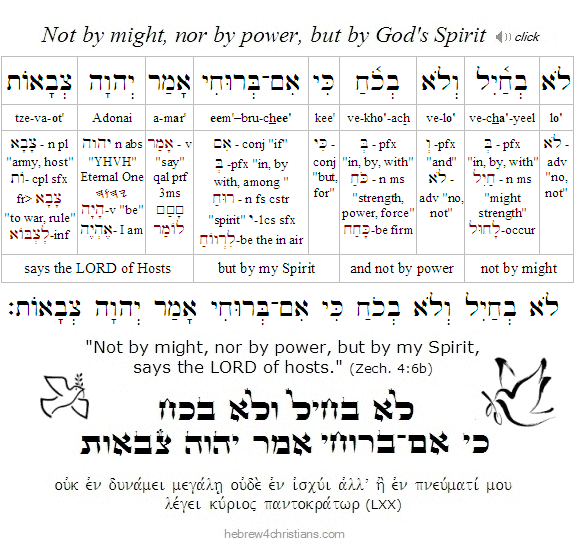
Hebrew Lesson
Zechariah 4:6b reading (click):
<< Return
|