|
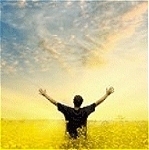
C.S. Lewis once made the helpful distinction between "looking at" and "looking along" a sunbeam (Lewis: "Meditation in a Tool Shed," 1945). In the former case, the mind looks "at" the beam itself, in an "objective" sense, describing light as waves or particles or energy. In the latter case, the mind looks "along" the beam in relationship with it, not focusing on the beam itself but seeing other things through its agency. Now Lewis' point was that modern scientific humanism makes the claim to a "truer" interpretation of experience through the mode of looking "at" things, as for example, when it "reduces" light as a waveform or when it describes religious experience as a matter of anthropology, psychology, or some other "natural" paradigm.
Naturalistic humanism claims that it is able to know the causes and effects of "objective" reality without any bias since it is constrained by the "scientific method" to ensure empirically verifiable (and repeatable) results. However the scientific methodology itself is not without its metaphysical assumptions about time (i.e., that the future will "resemble" the past), about motion (i.e., that natural processes are "uniform"), about space (that there is an external world that is knowable to the human mind); about the capability of the mind to define and represent things (e.g., that measurement "makes traction" with this external world and can be used to predict outcomes); about values (i.e., that it is "better" to know rather than not to know; or that the scientific method is an "good way" to develop inductive inferences, or that a given theory is "elegant," etc.).
Notice that these various axioms are not based on scientific inquiry itself (which is based on evidence and repeatable empirical measurement), but they are brought to science as assumptions used to frame or organize a particular "paradigm." In other words, science is a system of faith about what constitutes "reality," and like any other faith system, it needs to undergo testing to see if its inferences and claims provide the best explanation for what is real. For instance, does the naturalistic view of reality espoused by evolutionary cosmologists best explain the meaning of life? Does it account, for instance, for the electromagnetic pulse of the individual human heart? For the aesthetic wonder of the beauty? For poetry, or the longing of heart for love? for friendship? truth? for eternal life?
Knowledge is defined as "justified true belief," that is belief that is warranted or grounded in first principles of sound reasoning. Notice, however, the belief, or "faith," is a necessary condition of knowledge. This implies that people are bound by necessity to "walk by faith" of one kind or another, and everyone is therefore influenced by the biases and presuppositions they bring to their experience... C.S Lewis illustrated this by saying, "I believe in Christianity as I believe that the sun has risen: not only because I see it, but because by it I see everything else," and by "everything else" Lewis meant the full array of human experience, including intuitions about the big questions of why we exist, what we really are, and where we ultimately are going...
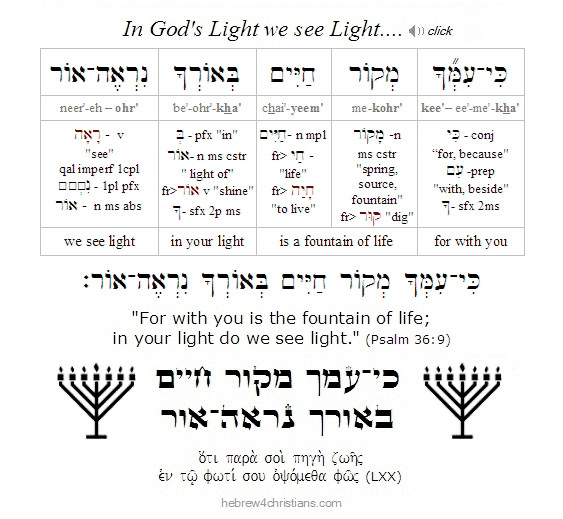
כִּי־עִמְּךָ מְקוֹר חַיִּים
בְּאוֹרְךָ נִרְאֶה־אוֹר

"For with you is the fountain of life;
in your light do we see light."
(Psalm 36:9)

The intuitions of conscience and the revelation of nature itself reveal God's truth (Rom. 1:19-20). "The heart has its reasons that reason knows not of," a quote from Pascal that says that truth is something "given" before reason goes to work. "You can put this another way by saying that while in other sciences the instruments you use are things external to yourself (things like microscopes and telescopes), the instrument through which you see God is your whole self. And if a man's self is not kept clean and bright, his glimpse of God will be blurred - like the Moon seen through a dirty telescope" (Lewis: Mere Christianity).
King David, a man of great and proven faith, said of the LORD: "For with you is the fountain of life; in your light do we see light" (Psalm 36:9). "In Your light we see light..." When we enter a dark room with a lamp, the darkness flees and is overcome by the light. So also with teshuvah: When we turn to the Lord the spiritual darkness is overcome by the Divine Radiance. In Yeshua is life, for He is the light of the world. All those who receive Him will behold ohr ha'chayim (אוֹר הַחַיִּים) - the "light of life."
<< Return
|