|
Much is made over the fact that the book of Esther is the only book of the Bible that does not explicitly mention the Name of God. However, the idea of God's sovereignty and divine providence (i.e., hashgachah, הַשׁגָחָה) is clearly implied throughout the entire story. Indeed the sages teach that the message of Purim concerns the kingship of God (ממלכת האל), with the word "the king" (המלך) appearing over 100 times and the word "kingdom" (מלכות) appearing ten times in the scroll. In most cases the word "king" refers to King Achashverosh, though the sages say that when Achashverosh is not explicitly named, it may also refer to the King of the Universe.
The phrase hester panim (הסתר פנים) means "hiding of the face" and is often used when discussing the Book of Esther. In this sense of the term, hester panim is somewhat like the sun on an overcast day: Just because you don't see it doesn't mean it isn't there. God's providential love is at work at all times, whether we perceive it or not. This is suggested in the name of the scroll itself: the phrase Megillat Esther (מגילת אסתר), literally "the Scroll of Esther," can be rearranged to say megillat ha'seter (מגילת הסתר), "the concealed scroll."
In light of this nes nistar (נס נסתר), or "hidden miracle" of the Jew's deliverance, Esther and Mordecai ordained that Purim should be observed as a "day of feasting and merrymaking" and of sending gifts to the poor (Esther 9:22,28). By the way, Purim (פורים) was so named because Haman had cast lots (purim) to determine the day on which to destroy the Jews.
So what does Purim teach us? Well first of all it teaches that the LORD is in control of everything, even if may seem otherwise. Nothing happens apart from God's sovereign will, and therefore everything works together for the ultimate good for those who trust in Him (Rom. 8:28). The term hashgachah pratit (השׁגחה פרטית) refers to God's personal supervision of our lives (hashgachah means "supervision," and pratit means "individual" or "particular"). Since He is the Master of the Universe (אדון עולם), God's supervision and providence reaches to the smallest of details of creation - from subatomic particles to the great motions of the cosmos. God not only calls each star by its own name (Psalm 147:4), but knows each particular lily and sparrow (Matt. 6:28-30, 10:29). And of course God knows and sees you...
Each person created in the likeness of God is under the direct, personal supervision of God himself, and as Yeshua said, even the hairs on your head are all numbered (Matt. 10:30). The God of Israel is called אלהי הרוּחת לכל־בּשׂר / Elohei ha-ruchot lekhol-basar: "The God of the spirits of all flesh" (Num. 16:22), and that means He is LORD even over those who vainly attempt to suppress His Presence and reality. Second, Purim teaches that God's plans for Israel will never (ever) fail and that those who disregard Israel in their theology do so at their peril. Third, the story of Esther provides a warning for those tyrants and princes of this world who oppress God's people: Like the false usurper Haman, you are likewise doomed to failure, and the LORD will vindicate all who trust in Him for deliverance.
There is great comfort when we understand that God has complete authority over everything in the universe -- including our ultimate welfare (John 10:27-28). When we pray to the LORD God of Israel, we intuitively understand that He is completely sovereign and Lord over all things... All power, glory, authority, and dominion is His alone, and all that is in the heaven and in the earth is His (1 Chron. 29:11-12). We do not worry that He is somehow incapable of handling our troubles or that He is unable to help us. No, we acknowledge that the God most High (אל עליון) sustains all things by the Word of His power (Col. 1:17). He is "the blessed and only Sovereign, the King of kings (מלך המלכים) and the Lord of lords" (1 Tim. 6:15). Whenever we think clearly in light of Scripture, we realize the truth about God's glory and power...
Hebrew Lesson
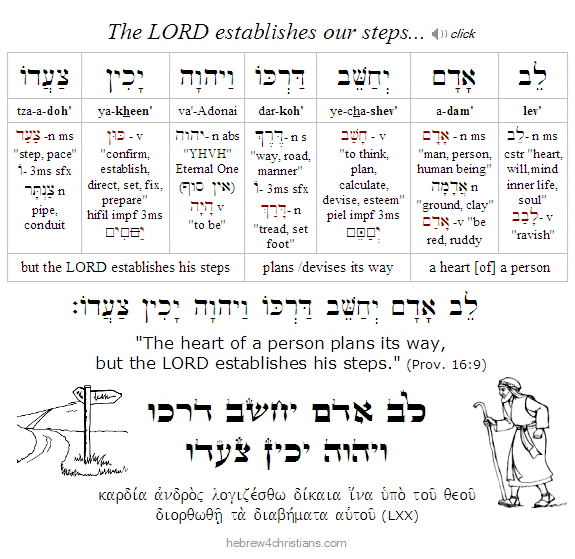
Proverbs 16:9 reading (click):
 |
<< Return
|