|
What are we to make of all the different Bible translations that are available today? How are we to make sense of the many interpretations? In addition to the various "mainstream" versions available (i.e, KJV, ASV, JPS, RSV, NIV, NASB, ESV, NKJ, NLT, TNK, etc.), you can also purchase any number of "Study Bibles" to suit your preferences. For example, you can now read the Sportsman's Study Bible, the "Manga Bible," the "Emergent Bible," the "Bride's Bible," the "Revolve Fashion Bible," the "Duct Tape Bible," the "True Images Bible" (teaches young women about sex and self-esteem), and so on and on and on....
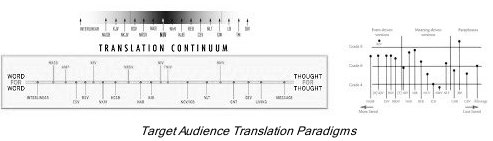
Now while it is true that language gradually changes over time, and that the task of good translation is to communicate the "source" language/culture to a "target" language/culture, it should be clear that in order to do this accurately, the source language/culture (in this case, ancient Hebrew/Jewish culture) must be carefully understood before attempting to communicate its thought to a target culture. Sadly, this has not happened, at least in most translations of the Hebrew Scriptures into English (and into other languages).
For example, the word "church" does not appear in the earliest English translations of the Old Testament. The Greek translation of the OT (called the Septuagint or LXX) uses the word ekklesia (from ek- + kaleo, "to call") for two different Hebrew words that both refer to a "congregation" or "assembly": kahal (קהל) and 'edah (עדה). It appears to be a sizable fault of various English translations of the Christian Bible that the word "church" was coined to translate the word ekklesia in the New Testament, since this suggests an anti-Jewish bias by implying that there is a radical discontinuity between "Israel" and the followers of Yeshua (i.e., the "church"). In other words, if the same Greek word (ekklesia) is used in both the LXX and the NT, then why was a new word invented for its usage in the English translation of the New Testament? Why not rather translate the word as it was used in the LXX, or better still, as it was used in the original Hebrew Scriptures? For more information about this, please my article "Israel and the Church."

Culturally speaking, however, there might be a more insidious reason why we are seeing an explosion of Bible versions and study guides tailored to various subcultural concerns....
Since there is always the temptation for the "Church" to mimic the ways of the world and follow the spirit of the age, perhaps some of the reason we see this multiplicity of Bible translations (and stylized repackaging of the Bible) is the relatively recent rise of the philosophy of "deconstructionism," an anti-authorial literary approach that maintains that the original intent of an author is essentially unknowable (or at least irrelevant). According to this epistemologically cynical theory, a "text" derives its meaning from the reader and not from the intention of the original author. Deconstructionism is perhaps the brainchild of the enormously influential philosopher Ludwig Wittgenstein and his description of a plurality of "language games" that mark an individual's particular "form of life." In a sense, Wittgenstein abandoned the hope of finding "objective meaning" for language and resorted to a polysemous relativism that was limited to natural and particular "organic" usage. Some people argue that Wittgenstein made room for "mysticism" in language, but it is better to regard his thinking, even his "later" thinking, as ultimately relativistic and even nihilistic.

Wittgenstein's philosophy of language implies that the hopelessly classical pursuit to find "the meaning" of a text must be abandoned for observation about how people choose to use it, especially as a means of action, persuasion, power, and especially of politics. "Truth" has become "perspectival," which is just a another way of saying that it is relative to the vision (i.e., reiyah: רְאִיָּה) or opinion of the interpreter (i.e., "reader"). Every story has a "spin," or an "angle" that is somehow self-serving to the storyteller. There is no transcendental, objective, and universally binding truth; no "metanarrative" that tells the story about "God, the world, and everything." Everyone is left alone to develop his or her own linguistic expression of life and values.... Hence we now have "The Manga Bible," the "Queer Bible," the "Atheist Bible," etc., and hence we live in a world of existential alienation and virtual incommunicability with those outside our ghettoized "hermeneutical circle."
Even among orthodox Christians and those who profess to hold to a "high view" of Scripture we see these tendencies (hence it's become rather trendy for "emergent church" types to pooh-pooh the idea of certainty in their understanding of the Scriptures).
In light of this situation of "epistolary agnosticism" (to coin a new phrase), I thought it would be good to remind myself of something Soren Kierkegaard wrote in his work, "For Self-Examination and Judge for Yourself." Kierkegaard used the analogy of a lover's letter written in a foreign language to make the distinction between the often tedious process of translation and the art of reading from the heart... For the lover -- the one for whom the words are addressed -- all the "scholarly preliminaries" of translation are regarded as nothing more than a necessary evil to reach the goal -- that of reading and understanding the question of the lover's message.
Kierkegaard's point is that we can often cop out of our commitment to follow the LORD by pleading that we do not know how to interpret some portions of the Scriptures. Indeed, even Bible scholars are not immune from this risk. The task of busily comparing translations, consulting various commentaries, performing exegetical tasks etc., can lead to an excuse to essentially disregard the message. Ironically enough, Bible scholars can actually study the Scriptures in order to defend themselves from what the Scriptures are clearly saying! If you want to read more, please take a look at the article, "Alone with God's Word."

Indirectly, of course, the foregoing provides yet another reason why it is important to study Biblical Hebrew, especially in light of the Jewish culture that informs the pages of Scripture. Hebrew words, phrases, grammar - when joined with an understanding of the cultural context in which they are embedded - helps us identify tendentious readings of various translators (i.e., interpreters) and commentators. Understanding the Jewish roots of your faith and the Hebraic mindset helps you attune yourself with the source message of Scripture more fully. As our Beloved has said, "The truth (yes, there really is such a thing) shall set you free" (John 8:32).
An additional note
It needs to be remembered that language usage indeed changes over time. The source language (i.e., the original MSS) is a somewhat static thing (subject to ongoing textual criticism) of which we must make serious effort to understand in light of the culture and context of the original authors. Context is the key. This is where a Jewish perspective of the Scriptures is essential, for without this a lot of assumptions may be "read into" the original text and foreign ideas are used to convey what the translators think is an equivalent meaning for a target language/culture. That is why I always aim to understand how the original authors would have understood their own usage before looking at how someone else decided to render their findings in English.
The ideal thing is to study both Hebrew and Greek. Work hard to obtain a rudimentary reading level (i.e., the ability to read the simpler constructions of the text while using original language dictionaries and grammatical tools). Then you can check the translation of a passage of interest and are no longer at the mercy of translators. You can do some of your own investigative work and exegesis. Find a time-tested translation of the original languages (such as the KJV or ESV) and learn how to access the Greek and Hebrew exegetical commentaries to help you interpret the original intent of the text.
Therefore make an effort to study the Scriptures in Hebrew and Greek (but especially in Hebrew, since the Hebrew text underlies the authority of the Greek text). Consider the various translations as guides to help you understand the original writings. We can trust in God's providential guidance and care of his word, as the Dead Sea Scrolls and other ancient manuscripts prove the meticulous preservation of the texts of Scripture over the centuries. "The words of the LORD are pure words: as silver tried in a furnace of earth" (Psalm 12:6). Above all pray and ask the Holy Spirit - who is the ultimate Author of the Word of God - to give you wisdom and insight as you seek God's truth. Yeshua himself has promised that we will know the truth of God by means of his revelation (John 17:17). Shalom chaverim.
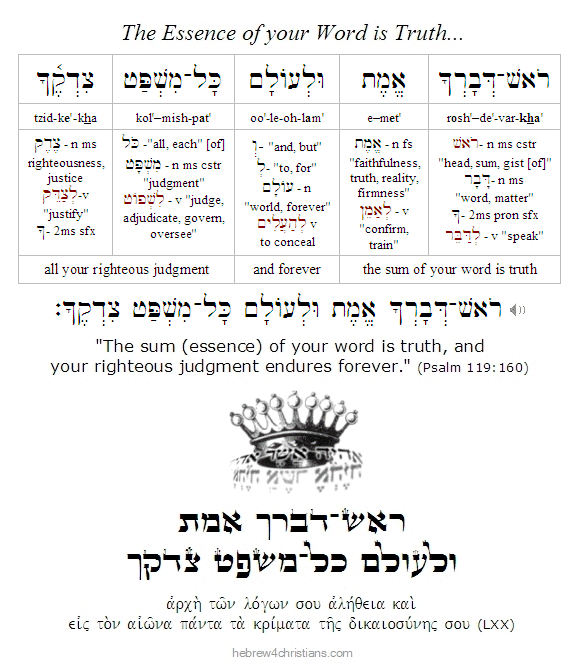
Hebrew Lesson
Psalm 119:160 reading:
<< Return
|