|
May 2025 Updates (continued)
Note: If any page content appears to be missing, please refresh the page...
Blessed Inner Poverty...
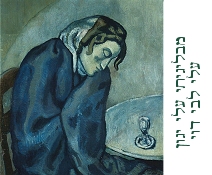
05.07.25 (Iyyar 9, 5785) The word ashrei (אַשְׁרֵי) in Hebrew can mean "the happy ones," from the adjective osher (אוֹשֶׁר), "happy," and the root word ashar (אָשַׁר) meaning to "go straight" or to walk uprightly (i.e., yashar: יָשָׁר). Ashrei can also mean "enriched," favored, or "blessed." Enriched is the man (אַשְׁרֵי־הָאִישׁ) who ... delights in the Torah..." (Psalm 1:1-2). The sages note that ashar is formed from aleph (א), representing the One true God, and sar (שַׂר), meaning ruler, which suggests that when the LORD is the Ruler of your life, you will be enriched and find genuine happiness. Indeed, the word ashrei is embedded in both the first and last words of the Torah scroll itself (i.e., bereshit (בְּרֵאשִׁית) and Yisrael (יִשְׂרָאֵל)), which hints that we are made happy when we submit to God's will (i.e., his Torah) for our lives...
The Torah of the LORD is most clearly manifested in Yeshua, the Living Torah and Messiah of God, the Wisdom of God: "And he opened his mouth and taught them, saying: 'Blessed are the poor in spirit, for theirs is the kingdom of heaven'" (Matt. 5:2-3). Paradoxically we are profoundly enriched by understanding our great inner poverty and our ongoing need for divine intervention... Only when we come to the end of ourselves, when we realize our powerlessness and radical insufficiency, can we come to know Yeshua as moshia (מוֹשִׁיעַ), as our Savior. And this is an ongoing state of dependency: we walk "with a limp" as did Israel. Therefore Paul said, ὅταν γὰρ ἀσθενῶ, τότε δυνατός εἰμι: "for when I am weak, then I am strong." You are made rich indeed when you encounter your spiritual bankruptcy, brokenness, and must entirely depend on God for your daily miracle...
 |
Spirituality often enough involves a sense of irremediable brokenness, a feeling that you are not whole, that you are a mess, and that your need for God's healing is constant and relentless... Contrary to the ideals of proud humanism, spirituality is a state of "blessed neediness," of being "poor in spirit," that aches with inner desperation for God's power of healing. Those who humbly cry out to the LORD understand their great need for deliverance, "Woe is me, for I am ruined..." (Isa. 6:5). As Yeshua said, "Everyone who exalts himself will be humbled, but the one who humbles himself will be exalted" (Luke 18:14).
Our Lord Yeshua testified: "The Son of Man came to seek and to save the lost" (Luke 19:10), and therefore He is found in the midst of the leper colonies of the hurting, the forgotten, and the rejected. As the "Man of Sorrows" (i.e., ish makhovot: אִישׁ מַכְאבוֹת) he understands the language of our pain (Isa. 53:3).
Faith and Offence...

05.06.25 (Iyyar 8, 5785) Some people attempt to share the gospel message by making a "sales pitch" for Jesus... The temptation in evangelism is to make the message seem as attractive as possible and to minimize the difficulties involved in making a genuine decision to walk with the Messiah. Often the appeal is made along the lines of the ego's self-interest. Jesus is put forth as a solution to life's problems, a panacea for the worries of life, a blessing for your love life, etc. "Believe in Jesus -- because it works for you! You'll be amazed by the results! God will bless you and you'll find happiness and contentment at last!"
Unless we are careful, using an approach like this can make a subtle appeal to the flesh, to the all-too-human desire for personal satisfaction, happiness, and even pride. But Yeshua never made a "cheap sale" of His message and mission. He never appealed to the flesh as a reason for following him. On the contrary, he repeatedly stated the cost of discipleship and warned of being hated for his sake. "For the gate is narrow and the way is hard (i.e., τεθλιμμένη, "oppressive") that leads to life, and those who find it are few" (Matt. 7:14). Indeed, Yeshua often intentionally offended people when they encountered him. Far from making it easy to believe, Yeshua regularly put up stumbling blocks when people approached him. He never was a "people pleaser" and he never apologized for speaking the truth, just as he never sought the crowd's approval nor sought a "market" for his mission. Even less did Yeshua seek the approval of the status quo, that is, the religious establishment of the Jews or the political establishment of Rome.
In short, Yeshua's life was scandalous to human beings and their various conceits. Encounters with him were always "tests" that evoked one of two responses: offense or faith. For example, Yeshua scandalized his family (Matt. 12:48), his community (Matt. 13:54-57, John 6:42), the gawking crowd (John 6:26-30), various religious seekers (Mark 10:17-22), the religious establishment (Matt. 15:12), the political establishment (Luke 13:32), and even his own followers (John 6:61). His question is always, "Who do you say that I am?" People either were offended at him or accepted him, but Yeshua made it impossible for them to be indifferent about who he was.
For instance, when a delegation of scribes and Pharisees came up from Jerusalem to meet with him, they immediately asked Yeshua why his followers did not adhere to the "tradition of the elders" by not washing their hands before they ate bread (Matt. 15:2). Yeshua turned the tables on his critics by asking them why the elders transgress the commandment of God by adhering to tradition. God commanded kibbud av ve'em, "Honor father and mother," but the sages decreed that a gift given to the Temple would preempt this obligation, even if the parents were in great need. Yeshua rejected their reasoning as sacrilege and went on to lambast them as hypocrites who put on a show of religion (Matt. 15:8-9). Yeshua then called the crowd over to contradict a prevailing religious dogma of the day: "It's not what goes into your mouth that defiles you, but rather what comes out." After this, the disciples approached Yeshua and said, "Did you know that the Pharisees were offended (i.e., scandalized) when they heard you say this?" Yeshua answered, "Every plant that my heavenly Father has not planted shall be uprooted. Let them alone: they are blind leaders of the blind, and if the blind lead the blind, both shall fall into the ditch" (Matt. 15:13-14). When the religious gatekeepers encountered Yeshua, they were offended because they did not believe. They tripped over the "Stone of Stumbling" (אֶבֶן נֶגֶף) when they encountered the "Rock of Hindrance" (Isa. 8:14, Matt. 21:44, 1 Pet. 2:8). As Yeshua later stated, "whoever falls on this stone will be broken to pieces, but on whomsoever it falls will be ground to powder" (Matt. 21:44).
The encounter with the Pharisees contrasts with the following one, in which a Canaanite woman begged Yeshua to heal her daughter (Matt. 15:21-28). Unlike the Pharisees, this woman came recognizing the identity and authority of Yeshua as the "Lord, Son of David," and believed in His power as healer and deliverer. Despite her repeated appeals, however, Yeshua "did not answer her a word," and finally his exasperated disciples begged him to send her away (Matt. 15:23). The woman finally drew close to Yeshua and prostrated herself before him, saying, "Lord, help me." Yeshua finally answered her directly by saying, "It is not right to take the children's bread and throw it to the dogs." Here is another case of possible offense. When she agreed with his words and chose not to be personally offended, however, Yeshua praised her faith and healed her daughter as she requested.
The underlying issue in these two narratives is not about personal hygiene or defilement, nor even of Yeshua's mission to the house of Israel as opposed to the Gentiles, but rather offense verses faith. As David McCraken wrote, "The opposite of offense is faith, but the only way to faith is through offense" (The Scandal of the Gospels, 19). The "clean" and pious Pharisees lacked faith, whereas the "unclean" Gentile dog showed great faith. As Yeshua reassured John the Baptist: אַשְׁרֵי הָאִישׁ אֲשֶׁר לא־יִכָּשֵׁל בִּי / "Blessed are those who take no offense at me" (Matt. 11:6).
Contrary to modern church growth theorists, Yeshua often deliberately delivered his message in the most offensive way possible. For instance, when Yeshua came to his home town of Nazareth and attended a synagogue service, he was called to recite the Haftarah from Isaiah (Isa. 61:1-2). After the reading, he sat down and said, "Today this Scripture has been fulfilled in your hearing" (Luke 4:16-21). The people were shocked, scandalized, and offended at such audacity, and asked, "Is this not Joseph's son?" (cp. Matt. 13:55-57). Yeshua then warned them to look beyond their natural expectations (i.e., offense) in order to see the truth: "No prophet is accepted in his own hometown." Instead of appealing to the people to consider his claims, however, Yeshua further scandalized their sense of ethnic pride by offering his commentary on the Haftarah reading. First he reminded the congregants that in the time of Elijah the prophet, many widows of Israel suffered during the famine, but God only sent the prophet to a Gentile woman of Sidon (1 Kings 17:9-24). He then continued this theme by reminding them that though there were many lepers in Israel during the time of Elisha the prophet, none of them were cleansed except the Na'aman the Syrian (2 Kings 5:1-16). When the synagogue members heard these words, they were enraged. Their ethnic pride was offended and their sense of identity as God's favored people was threatened. Who is this man to say such things to us? So intense was their outrage that the congregation rose up to murder Yeshua by throwing him over a cliff (a prophetic picture of the scapegoat of the Yom Kippur ritual). Yeshua, however, miraculously "passed through the midst of them" and made his way back to Capernaum (Luke 4:28-31).
Other scandals surrounding the identity and authority of Yeshua are given in the New Testament, such as his claim to be "Lord of the Sabbath," to be able to forgive other people's sins, to be the Voice of YHVH concerning the intent of the Ten Commandments, to be the Judge of the world, to be honored as God, the Savior of the world, the Redeemer of Israel, the Holy One of God, the Good Shepherd, the Way and the Truth and the Life, the First and the Last, the true Light, the Great I AM, the LORD of Glory, and on and on.... In every case of disclosure, the possibility of offense or faith is given.
Undoubtedly the greatest offense of all, however, concerned Yeshua's claim to be none other than YHVH in the flesh. In John's Gospel, following the story of how Yeshua forgave the woman taken in adultery, he announced, "I am the Light of the world; whoever follows me will not walk in darkness, but will have the light of life" (John 8:12). The Pharisees objected that his testimony was invalid since it was based solely on his own authority. When Yeshua appealed to the testimony of his Father, the Pharisees hinted to the crowd that Yeshua might be a bastard (John 8:19). Yeshua was unfazed by their slander and simply stated that they "did not know his Father." He then went on to say, "I am going away, and you will seek me, and you will die in your sin. Where I am going, you cannot come.. Unless you believe that I am, you will die in your sins" (John 8:21-24). Finally, the all-important question is addressed to him: "Who are you?" (this question is in direct response to Yeshua's earlier question, "Who do you say that I am?" (Mark 8:29)). In reply Yeshua said, "Just what I have been telling you from the beginning..." While he was speaking, many believed in Him, and Yeshua then said to them, "If you remain in my word, you are my disciples indeed, and you will know the truth, and the truth will set you free" (John 8:31-32). When these new "believers" objected that they were never in bondage to anyone, Yeshua told them they were slaves to the power of sin and therefore children of the devil, separated from God (John 8:33-47). Yeshua's words again caused offense, and the people began to say he was crazy, a "Samaritan," and possessed by a demon. Yeshua said on the contrary, he honored God, but they were dishonoring him, and that was certainly characteristic of the devil. He continued to preach, "Truly, truly, I say to you, if anyone keeps my word, he will never see death" (John 8:51). This apparently was the last straw, the final offense regarding Yeshua's identity. "Who do you think you are? Abraham died as did the prophets. Who do you make yourself out to be?" Yeshua continued, "Your father Abraham rejoiced that he would see my day. He saw it and was glad." Then the Jews said to Him, "You are not yet fifty years old, and have You seen Abraham?" Yeshua said to them, "Most assuredly, I say to you, before Abraham was, I AM" (John 8:58). When they heard this, the outraged crowd began gathering rocks to stone Yeshua for blasphemy. They understood that Yeshua was claiming to be none other than YHVH in the flesh - a scandal and an outrage to both religious sentiment and to human reason. As Kierkegaard said, this is the "Absolute Paradox," the point at which offense and faith entirely collide. Behold the man! Here was none other than God Himself standing among them clothed in flesh and blood....
The eternal, essential Truth has entered into time; the Infinite Source of life has been joined to the finite, the necessary has been joined with the contingent. "The absurd is that the eternal truth has come into existence in time, that God has come into existence, has been born, has grown up, has come into existence exactly as an individual human being, indistinguishable from any other human being." To the natural mind, the mind that seeks "objective truth" and rational comprehension, this is an impossible offense as well.
Yeshua regularly offended those whom He encountered, including his own followers. When he said that he was the bread of life, and that this "bread" was his flesh given for the life of the world, his followers asked, "How can this man give us his flesh to eat?" Yeshua then amped up his rhetoric by saying, "Truly, truly, I say to you, unless you eat the flesh of the Son of Man and drink his blood, you have no life in you" (John 6:51-59). When his disciples later complained that this teaching was "difficult" (e.g., kosher law forbade the drinking of blood), Yeshua directly asked them, "Does this offend (scandalize) you? It is the Spirit that gives life to His words; human reasoning will not help (John 6:63). Here again the "test" evoked one of two responses: offense or faith. The measure of the offense corresponded with the measure of their faith. The greater the offense, the less faith, and conversely. His question is always, "Who do you say that I am?" Some of his followers could not answer this question and therefore "turned back and no longer walked with him" (John 6:66). Finding offense at the teaching of Yeshua always provides an opportunity for us to discover where we need to exercise faith. If we find ourselves resisting or rationalizing some of the words of our Lord, we are presented with a decision point in our walk with Him.... So where is it with you? Personal suffering? Selling everything you have to follow Him? Taking up the cross and being willing to die for Him? Loving your enemies? Plucking out your eye if it causes you to sin? Nothing less than complete trust is the goal, of course, though often we must wrestle through to the place of surrender in our hearts. Where are you inwardly resisting the message of Yeshua in your life?
Many "postmodern evangelical" churches focus on entertainment, on getting "results," and being "seeker sensitive" in the attempt to "spread the gospel" message. This so-called "gospel" focuses on meeting people's practical needs rather than heeding the message of the Kingdom of Heaven and salvation. The way of Yeshua, however, is anything but pragmatic. His focus entirely turns us around. To be great you must be a slave; to live you must first die to yourself; theology is far more important than mere humanism; you must love your enemies and pray for those who abuse you; you must count the cost before becoming a disciple; you must give up everything in order to follow Him; you must be willing to suffer and even die for the sake of His truth. Indeed, Yeshua taught us that our duty to love God is simply nonnegotiable. After all, though He was offered all the kingdoms of the world with all their "glory" in exchange for merely a "compromise" in His theology, Yeshua adamantly refused (Matt. 4:8-10; Deut. 6:13; 10:20). Yeshua's rebuke of the devil is a rebuke to all idolatrous pragmatists who likewise reason that the end justifies the means.
Indeed, the devil is the ultimate pragmatist, appealing to people to abandon the idea of unchanging truth for the sake of expediency (i.e., "consensus," "tolerance," "ecumenicism," "church growth," "results," "tithes," and so on). Satan is the ultimate liar, the ultimate propagandist, and the ultimate con artist. He is a master at seducing and enslaving people. Yeshua, on the other hand, brings OFFENSE. There is NO GOSPEL MESSAGE apart from offense - first, the offense of the ego's deflation (i.e., being convicted as a law breaker deserving of Hell), and second, the offense of the Cross (i.e., that no human merit can effect the salvation given through Yeshua ALONE). The offense of the gospel is the proclamation that there is no other way to heaven than through the Cross of Yeshua, and there is no other Name than the Name of Yeshua for the salvation of human beings (John 14:6; Acts 4:12; 1 Cor. 1:23; 1 John 2:23). Pragmatists offer up an "inoffensive" gospel that appeals to the "felt needs" of seekers (i.e., pagans). Although good works are commendable, there is no offense in promoting social justice in the world today, just as there no offense in seeking to alleviate the suffering of the world's poor and downtrodden. However there is considerable offense by proclaiming that Yeshua is the ONLY way of salvation, and by stating that His sacrifice upon the cross (alone) is what makes us right with God. That kind of talk will be regarded as closed minded, intolerant, and even as hateful to people who attempt to justify themselves apart from God. The pragmatist is willing to overlook the offense of the gospel for the sake of "unity" that brings the people of the world together. Ecumenicism is therefore the holy grail of the organized church. However, there is NO model for this approach given in Scripture, and especially not in the teaching and ministry of Yeshua our Messiah...
Pragmatists within the organized "church" regard big numbers, big events, big money, "big deals" to be the measure of the success of the Gospel. Nonsense. There is more power in the lowly faithfulness of one surrendered soul working in the vineyard than in a throng of 10,000 Christian dabblers. Drawing a crowd never resulted in large-scale conversions in Yeshua's ministry. On the contrary, Yeshua called individuals to take up the Cross and follow Him. He knew the nature of the crowd, the mob, the power of "groupthink" (John 2:23-25). The fickle crowd that once hailed Him as King of Israel later chanted "crucify him! crucify him!" Indeed, Yeshua understood the nature of the crowd....
Pragmatism and the theology of Yeshua are POLES APART on the continuum of truth. Church leaders who seek to grow the church by pragmatic means are in serious error, since they want to justify sinful means (i.e., manipulation, deception) to promote what they believe to be a greater good (i.e., the perpetuation of "Christian" culture, the growth of the institutionalized church, etc.). However, we know that the LORD God of Israel does not promote or endorse sin, regardless of any supposed benefit given to the world at large. The end never justifies the means. God is not a pragmatist, and there are no "noble lies" for sake of the Kingdom of Heaven. The failure to communicate the truth about the cost of discipleship can lead to disillusionment and despair among those who are seeking the truth. If we do not ground people in true Gospel message, they will become scandalized when they face inevitable difficulties or encounter suffering in their lives (Mark 4:16-17).
 |
Postscript...
It ought to be mentioned that though Yeshua was indeed a "Stone of stumbling" and "Rock of Offense," we are commanded to avoid needlessly offending others (Rom. 12:18; 1 Cor. 10:32; 2 Cor. 6:3). "Follow peace with all men and holiness" (Heb. 12:14). However, in some cases standing up for our Lord will cause others to be offended. Those who live godly lives will suffer persecution (2 Tim. 3:12). When we share the message of salvation, for example, the conscience of others may incite them to anger. We do not need to apologize on behalf of the truth, though of course we must also be careful to speak the truth in humility and genuine love (Eph. 4:15).
Podcast...
A Living Faith...
05.06.25 (Iyyar 8, 5785) Shalom chaverim yikarim. We read in our Torah this week (Kedoshim): "You shall keep my decrees and my judgments, the pursuit of which man shall live: I am the LORD" (Lev. 18:5). The Kotzker Rebbe advised reading this verse as "You shall keep my decrees and judgments to bring life into them," meaning that we should bring all our heart, soul, and strength into the teaching of Torah. The commandments nourish the soul as food does the body. Just as we seek to season our food to make it flavorful, so we seek to observe the truth with conviction and joy.
"All things that are exposed are made manifest by the light, for whatever makes manifest is light. Therefore He says: "Awake, you who sleep, arise from the dead, and Messiah will give you light. Therefore be very careful how you live – not as unwise but as wise, but redeem the time, because the days are evil." (Eph. 5:13-16)
Amen. "May the beauty of the LORD our God be upon us: and establish the work of our hands upon us; yea, establish the work of our hands" (Psalm 90:17).
Hebrew Lesson
Psalm 90:17 reading (click):
The Goal of Holiness....

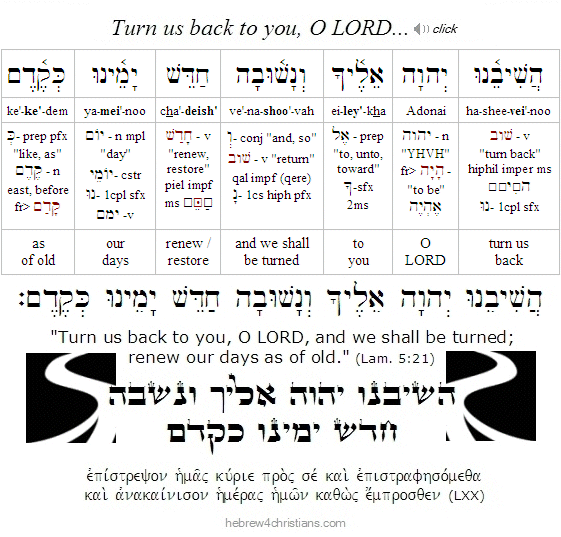
05.06.25 (Iyyar 8, 5785) In our Torah portion for this week (Kedoshim) we read: "Speak to all the congregation of the people of Israel and say to them, 'Be holy as I the LORD your God am holy'" (Lev. 19:2). This doesn't mean wrapping ourselves up in some protective cloak of religious rituals as much as it means accepting our own atonement: reconciling who we are with our past, finding healing and love, and walking in genuine hope...
Holiness isn't as much "separation" from the profane as it is "consecration" to the sacred, and in that sense it is a kind of teshuvah, a turning of the heart back to reality.... Negatively put, "being holy" is turning away from fear, despair, and anger; positively put, it is embracing the worth and value of life, respecting the Divine Presence, and walking in the radiance of God's love. Amen, let is be so. Hashivenu Adonai....
Hebrew Lesson:
Lam. 5:21 reading (click):
Loving the Stranger...
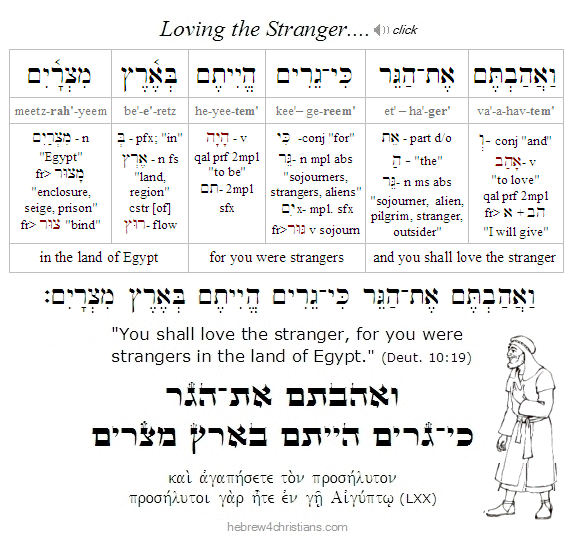
05.05.25 (Iyyar 7, 5785) From our Torah portion this week (Acharei-Kedoshim) we read: "The stranger who dwells among you shall be to you as one born among you, and you shall love him as yourself; for you were strangers in the land of Egypt: I am the LORD your God" (Lev. 19:34). But how is it possible to love someone who is a "stranger" apart from empathy for someone who is lost? The unspoken assumption here is that since we know how it feels to be an outcast, oppressed and without a sense of belonging or home, so we ought sympathize with others who feel that way too.
When we acknowledge the suffering of others we also acknowledge our own. We let go of the weapons of blame and retribution when we give voice to the "stranger" within ourselves, when we realize that others share in our suffering: "Do not oppress a sojourner, for you know the soul of a stranger (וְאַתֶּם יְדַעְתֶּם אֶת־נֶפֶשׁ הַגֵּר), for you were strangers..." (Exod. 23:9). The Hebrew verb used here (i.e., yada, to know), implies intimacy, personal and direct understanding. You "know the soul" of the stranger by reliving their place, and by using the "good eye" to see how they share common our pain, joy, hope, and so on.
Being sensitive to the heartache of others helps us find our own healing: We are brought out of our "inner Egypt" into freedom and wholeness. Remembering what it was like to be a stranger helps us extend compassion to ourselves, and that brings healing to our hearts.
The mitzvah to love the stranger applies not only to someone whom we regard as an "outsider," but even more radically to the "stranger within ourselves," that is, to those aspects of ourselves we censor, deny, or reject...
Like the prodigal son, we have to "come to ourselves" to return home (Luke 15:17) - believing that we are somehow redeemable - yet we will be unable to know how we are unconditionally loved until we venture complete disclosure. That is the great risk of trusting in God's love for your soul: You must accept that you are accepted despite your own unacceptability... Those parts of ourselves that we "hide" need to be brought to the light, atoned for, healed, and reconciled. If we don't love and accept ourselves, then how can we hope to love and accept others?
Hebrew Lesson
Deut. 10:19 reading (click):
Loving our Neighbor...

05.05.25 (Iyyar 7, 5785) Our Torah portion this week, Acharei Mot, contains the verse, "You shall love your neighbor as yourself; I am the LORD" (Lev. 19:18), which is generally regarded as the most fundamental ethical law of the Torah. The Talmud recounts that when challenged by a pagan to teach the meaning of the Scriptures "while standing on one foot," Hillel said, "What is hateful to you, do not do to your neighbor: that is the whole Torah and the rest is commentary; go and learn it." Hillel summed up the Torah as "doing no harm" toward others (i.e., the "Silver Rule"), which agrees with the Apostle Paul's statement, "Love does no wrong to a neighbor; therefore love is the fulfillment (πλήρωμα) of the law" (Rom. 13:10). Of course Yeshua earlier taught His followers, "whatever you wish that others would do to you, do also to them, for this is the Law and the Prophets" (Matt. 7:12; 22:36-40).
Some of the mystics have said that when two people love one another, the Holy One reigns between them, as alluded to by the Hebrew word for "love" (i.e., ahavah: אהבה), the gematria of which is thirteen (1+5+2+5=13), but when shared with another it is multiplied: 13 x 2 = 26, which is the same value for the Sacred Name (יהוה), i.e., (10+5+6+5=26). In other words, when we love, esteem, and respect one another, the LORD's presence is multiplied and revealed among us (1 John 4:7-8). "Where two or three gather in my Name..."
Hebrew Lesson
Leviticus 19:18b reading (click):
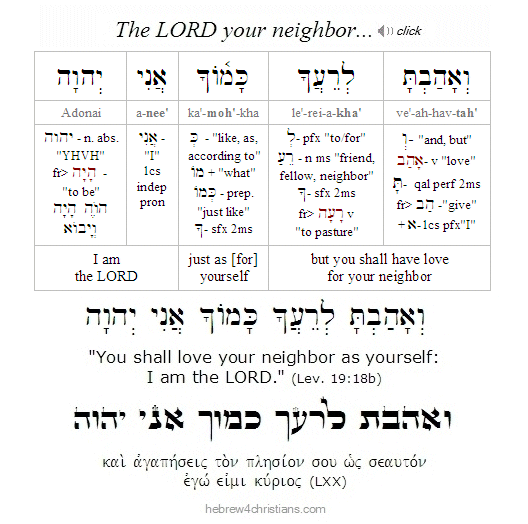 |
In this connection, it is interesting to note that the gematria for the Hebrew commandment, "You shall love your neighbor as yourself" (i.e., וְאָהַבְתָּ לְרֵעֲךָ כָּמוֹך) equals 820, the same value as the word yekidash'ti (וְקִדַּשְׁתִּי), "And I [the LORD] will sanctify" (Exod. 29:44). When God commands us to "love your neighbor as yourself," he graciously includes the addendum: "I am the LORD," which the sages say recalls the revelation of the Name YHVH (יהוה), and that therefore is understood to mean, "I will help you to do this," or (in this case) "I will sanctify you through your acts of lovingkindness."
Of course followers of Yeshua have the ongoing obligation to love and care for one another (see John 13:34, 15:12,17, Rom. 13:8; 1 Thess. 4:9; 1 Pet. 1:22, 1 John 3:11, etc.). After all, in this world the only tangible way we can express our love for God is by extending gemilut chasadim (loving acts) to others (James 2:15-17, 1 John 3:17, 4:20). Indeed, Yeshua taught that our obligation to love and care for others may sometimes even preempt our outward duty to love God Himself. For example, what good is it to "tithe mint and cumin" and yet neglect the needs of those who are suffering? (see Matt. 23:23).
Tragically, the idea of "loving" or "serving" God can even be used as a pretext for rejecting those with whom we might disagree... What else explains religious hatred, hidebound denominational prejudices, and other forms of sanctimonious humbug at work in the various world religions of today? Even in so-called Christian churches we see this sort of bigotry at work. As Yeshua forewarned: "the hour is coming when whoever kills you will think he is offering service to God" (John 16:2). Sadly this sometimes applies even to those who claim to love and worship the very Prince of Peace (שַׂר־שָׁלוֹם). The world's religious zealots are routinely trying to "do God a favor" by hating and even killing others... This is "Jihad-version" of religiosity is a terrible sickness of spirit. In light of the sacrificial love and grace of God, can there really be anything more perverse than this?
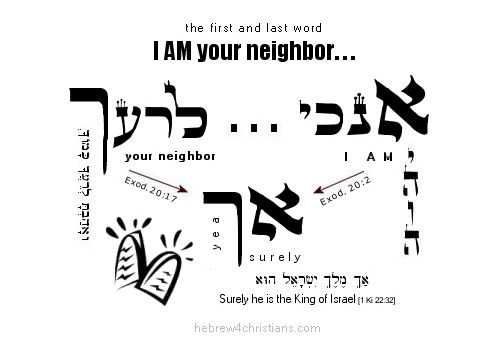
Love is the central idea of all true Torah. Though there are some slight language differences between the Exodus and Deuteronomy versions of the Ten Commandments, both begin with "I AM" (אָנכִי) and both end with "[for] your neighbor" (לְרֵעֶךָ). Joining these together says "I am your neighbor," indicating that the LORD Himself is your neighbor (see diagram below). When we love our neighbor as ourselves (אָהַבְתָּ לְרֵעֲךָ כָּמוֹךָ), we are in effect demonstrating our love for the LORD, while on the other hand, every social transgression is a transgression against God. As our Scriptures teach, "If anyone says, "I love God," but hates his brother is a liar," since "love fulfills the law" (1 John 4:20; Rom. 13:8). When we love our neighbor as ourselves we walk in the Torah of the LORD, which is perfect (Psalm 19:7).
 |
The Heart of Atonement...
05.05.25 (Iyyar 7, 5785) Most of our deepest anxieties come from the fear of death, whether we are conscious of this or not... Death represents fear of the unknown, fear of being abandoned, fear of being rejected, fear of being separated from others, and so on. I am so glad Yeshua gives us eternal life, which for me is not so much about immortality of the soul as it is being loved and accepted by God... That is what "at-one-ment" means, after all (John 17:22-23). Because God loves and accepts us, we trust Him to be present for us, even in the darkest of hours, on the other side of the veil, where he there "prepares a place for us" (John 14:2). As Yeshua said, "I tell you the solemn truth, the one who hears my message and believes the One who sent me has eternal life (חַיֵּי עוֹלָם) and will not be condemned, but has passed (i.e., μετά + βαίνω, lit., "crossed over" [עָבַר]) from death to life" (John 5:24). God's love "crosses over" from death to life and now forever sustains me.
Our Torah reading for this week (Acharei Mot) provides details about Yom Kippur, or the "Day of Atonement," a special service that gave ritual expression of God's love by making purification for our sins. As I've explained before, the word for love (i.e., ahavah: אהבה) equals the number thirteen (1+5+2+5=13), but when shared it is multiplied: 13 x 2 = 26, which is the same value for the Sacred Name (יהוה), i.e., (10+5+6+5=26). Likewise the Hebrew word for "life" is chayim (חַיִּים), is written in the plural to emphasize that life cannot be lived alone but must be shared. Notice that within the word itself are embedded two consecutive Yods (יי), representing unity in plurality (Yod-Yod is an abbreviation for YHVH, also indicating the "deep Akedah" of Father and Son). God gave up His life so that we can be in relationship with Him, that is, so that we can be "at-one" with His heart for us. Whatever else it may mean, then, the Hebrew word for "atonement" (i.e., kapparah, "covering," "protection," "purification," "forgiveness") is about accepting God's heart for you - being unified in his love - and if you miss that, you've missed the point of the Torah's teaching....
Hebrew Lesson
Psalm 118:17 reading (click for audio):
Theodor Herzl Day...
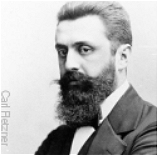
05.04.25 (Iyyar 6, 5785) This coming Thursday, May 8th, is "Herzl Day" in Israel (i.e., Yom Herztl: יום הרצל), a national holiday established by the Knesset to commemorate the achievements and Zionist vision of Theodor Herzl (1860-1904), a man considered by many to be the father of the modern State of Israel (though his mission was fostered by several dispensationalists Christian leaders).
During Herzl Day a memorial service held on Mount Herzl in Jerusalem, the site of Israel's national cemetery, where Herzl's tomb is located. It should be noted that though Herzl was a remarkable man, he was greatly influenced and helped by Bible-believing Christians who foresaw the vision of Zion and the reestablishment of the State of Israel and who therefore assisted him by providing support for his political vision.
For more information about Herzl Day, click here.
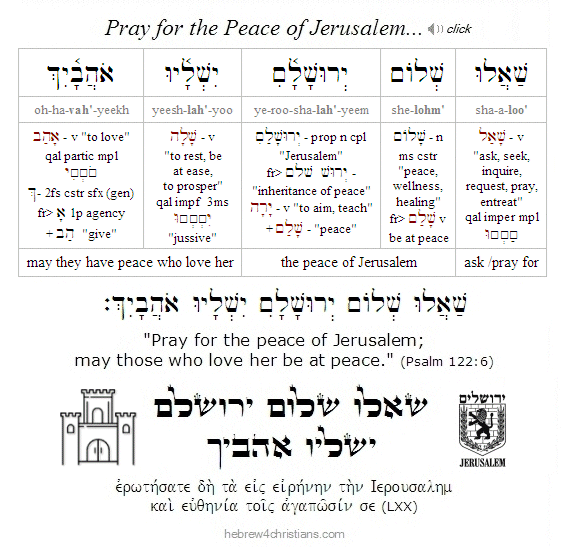
Hebrew Lesson
Psalm 122:6 reading (click):
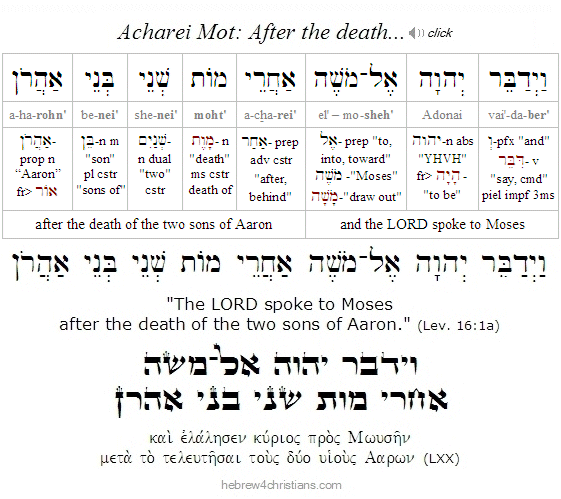
Parashat Acharei-Kedoshim
05.04.25 (Iyyar 6, 5785) Shavuah tov be'Yeshua, chaverim. This week we have another "double portion" of Torah. Our first Torah portion is called "Acharei Mot" (אחרי מות), which transitions from the preceding readings regarding ritual purity (tahora) to recall the tragic incident of Nadab and Abihu, the two sons of Aaron who were killed when they offered "strange fire" upon the Altar of Incense during the dedication of the Tabernacle (see Lev. 10:1-2). Because these priests approached the Holy of Holies in an incorrect manner, the LORD further commanded Moses to instruct Aaron that he should enter the innermost chamber only in a carefully prescribed manner once a year - on the tenth day of the seventh month - during the sacred time called Yom Kippur (i.e., the "Day of Atonement").
On this most solemn day, Aaron was instructed to immerse himself in a mikveh (pool of fresh water) and to dress in all-white linen. He then was instructed to slaughter a bull as a personal sin offering. Aaron then brought some ketoret (incense) to burn within the Holy of Holies before returning to sprinkle the blood of the sin offering seven times before the Ark of the Covenant (i.e., the kapporet or "Mercy Seat"). Aaron repeated this procedure using the blood of one of two goats that was selected (by lot) to be slaughtered as a sin offering on behalf of the people. After this, Aaron took more of the sacrificial blood and purified the Altar of Incense and the other furnishings of the Tabernacle. Later, the fat of these sacrifices was burned on the Bronze Altar, though the hide and the flesh were to be entirely burned outside the camp.
After purifying the Tabernacle, Aaron would go to the gate of the courtyard and lay both hands upon the head of the other goat (designated "for Azazel," a name for the accusing angel) while confessing all of the sins and transgressions of the people. This "scapegoat" was not slaughtered, however, but was driven away into the wilderness, carrying "all their iniquities unto a land not inhabited." Finally, Aaron returned to the Tent, washed and changed his clothes, and offered two more burnt offerings – one for himself and one for the people – to complete the purification process.
This elaborate ritual was ordained to be a decree for Israel, and the day of Yom Kippur was to be observed every year as a time of "affliction and mourning" for all the people. The portion ends with further instructions about making sacrifices, including the prohibition against offering sacrifices apart from the rites of the Tabernacle. The consumption of blood is explicitly forbidden, since blood was reserved for sacrificial purposes upon the altar.
Our second Torah portion, called Kedoshim (קדשׁים), provides a series of social and ethical commandments concerning the practical expression of holiness in daily life: "Speak to all the congregation of the people of Israel and say to them, You shall be holy (קדשׁים תהיו), for I the LORD your God am holy" (Lev. 19:2). Indeed this portion lists more mitzvot (commandments) regarding practical ethics (musar) than any other of the Torah, thereby directly connecting the holiness of the community with obedience to God's moral truth.
 |
After stating the requirement to be holy, the LORD begins to explain, "Each of you must respect (i.e., yirah: יִרְאָה) his mother and his father, and you must keep my Sabbaths. I am the LORD your God" (Lev. 19:3). The duty to revere (or honor) one's parents recalls the Fifth Commandment (Exod. 20:12), which is the starting point of learning to respect other people in our lives. Notice that the word for "my Sabbaths" (שַׁבְּתתַי) implies both the keeping of the weekly Sabbath as well as the "appointed times" of the LORD. As we shall see, sanctifying time is a way we can express practical holiness in our lives...
Various practical commandments are given in this Torah portion through which a Jew is sanctified, or set apart to be kadosh - holy - and therefore fit for relationship with God. God is not only "wholly Other" (i.e., transcendent) but also pervades all of creation (i.e., "immanent"), and those who are called into His Presence must therefore be holy themselves. Such practical holiness results in sanctification obtained through the observance of commandments (mitzvot). These commandments include both mitzvot aseh (commandments to do something) and mitzvot lo ta'aseh (commandments to refrain from doing something). In addition, chukkim, or "statutes" are given that further separate the Jewish people from the customs and profanity of the surrounding nations.
The Ladder of Truth...
"It is not the truth that needs people, but people who need the Truth." - Kierkegaard
05.02.25 (Iyyar 4, 5785) The Hebrew idea of "truth" (i.e., emet: אֱמֶת) is richer than factual description or "correspondence" between language and reality, since it contains moral implications and possibilities: what is true is also right, good, reliable (honest), beautiful, and sacred. The Hebrew word comes from a verb (aman) that means to "confirm" or establish, and the noun form (i.e, emunah: אֱמוּנָה, "faithfulness" or "trustworthiness") expresses the will to live by what is ratified, the "amen" of decision.
The Hebrew concept is therefore existential: truth that is not lived is not really truth. Speaking the truth (dibbur emet) and abhorring dishonesty are considered foundational to moral life, as it says: "Speak the truth (דַּבְּרוּ אֱמֶת) to one another; render true and perfect justice in your gates" (Zech. 8:16). Yeshua said, "Amen, amen I say to you...." throughout his ministry to stress the reliability and certainty of God's truth (Matt. 5:18, 26, etc.). Indeed, Yeshua is called "the Amen, the faithful and true witness" (Rev. 3:14). In that sense truth is not a "what" of correspondence but rather a "who," since reality turns on the magnetism of the divine presence (Col. 1:16).
The ancient Greek word translated "truth" is aletheia (ἀλήθεια), a compound formed from an alpha prefix (α-) meaning "not," and lethei (λήθη), meaning "forgetfulness." Greek scholars say the word lethei itself derives from the verb lanthano (λανθάνω), which means "to be hidden," so the general idea is that a-letheia (i.e., truth) is non-concealment, non-hiddenness, or (put positively) revelation or disclosure. Thus the word of Yeshua - His message, logos (λόγος), revelation, and presence - is both "unforgettable" and "irrepressible." Yeshua is the Unforgettable One that is manifest as the express Word of God (דְּבַר הָאֱלהִים). He is the Light of the world (אוֹר הָעוֹלָם) who imparts the "light of life" (John 8:12). Though God's message can be supressed by evil and darkened thinking, the truth is regarded as self-evident and full of intuitive validation (see Rom. 1:18-21).
Note that the LXX (i.e., the ancient Greek translation of the Jewish Scriptures commonly called the Septuagint) dates from the time of the philosopher Plato, though of course the Hebrew text dates back to the time of Moses (13th century BC) and even earlier. About 300 BC, "Theophrastus," a student of Aristotle, wrote of the Jews that 'being philosophers by race, they converse with each other about the Divine." Abraham, who dates from about 2,000 BC, was the first avowed monotheist who openly repudiated the polytheism and idolatry of ancient Ugaritic culture (Abraham also long predates the rise of Hinduism and the animistic hymns of the Vedas and their priestly commentary found in the Upanishads by a thousand years, just as ancient Judaism predates "Islam" by thousands of years). Similarly, both David and his son Solomon (10th century BC) wrote "existential" works of philosophy, predating the modern world by nearly 3,000 years...
Truth is more of a verb than a noun, chaverim. We must live the truth in order to know it....
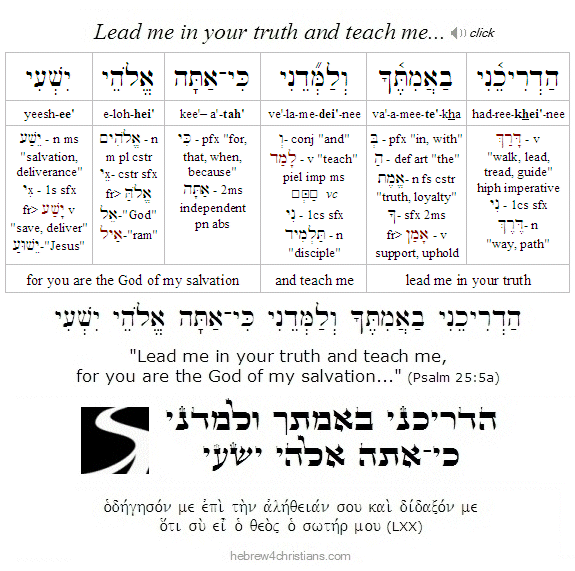
Hebrew Lesson:
Psalm 25:5 Hebrew Reading:
Finding your Greatest Good...
05.02.25 (Iyyar 4, 5785) The heart (הלב) is the center of the will - the locus of desire, affection, and love... However, the heart itself must be constrained by wisdom (חוכמה), since unbridled desire is slavery to the lower nature (יצר הרע), as it says: "The righteousness of the upright will deliver them, but the faithless will be ensnared by their own desires" (Prov. 11:6). The problem for many of us is having "disordered loves," that is, serving various idols of the heart that demand our attention yet divert us from what we really need. The difficultly is not so much that we indulge in lesser loves as much as we do not know the love of God that heals us and sets us free. As C.S. Lewis once said, "God cannot give us a happiness and peace apart from Himself, because it is not there. There is no such thing" (Mere Christianity). The righteous have found the most precious secret: "I shall behold your face in righteousness; when I awake, I shall be satisfied with your likeness" (Psalm 17:15).
It has been said that "there is nothing so whole as a broken heart." We become whole when we discover that the idols of our hearts do not truly satisfy us. Usually this involves a "severe mercy" as we learn that what we thought we "needed" proved to be just another illusion... Then and only then can we begin to believe in and to accept God's love as our highest good. Such "perfect love" casts out the fear induced by the idols of the heart. When we seek first the kingdom of God and His righteousness, the passions of our heart are ordered correctly. As it is also written in our Scriptures: "Delight yourself in the LORD, and he shall give you the desires of your heart. Commit your way to the LORD; trust also in him, and he will bring it to pass. And He shall bring forth your righteousness as the light, and your judgment as the noonday" (Psalm 37:4-6).
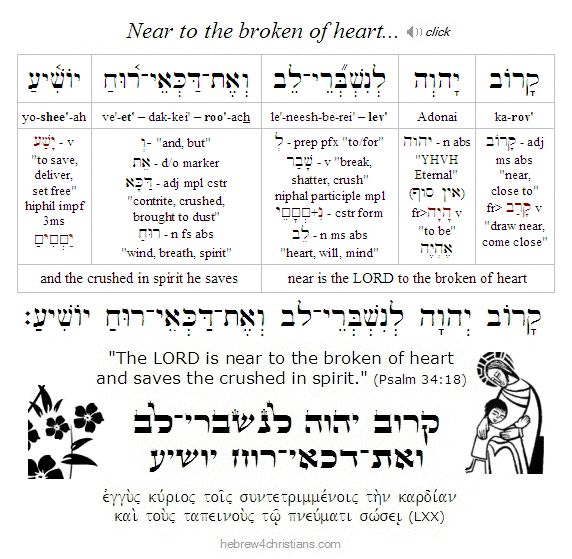
The Lord is near to the shavur lev (שבור לב), the one with a broken heart. The Hebrew word "lev" (לב) metaphorically refers to our inner life, that is, our affections, mind, and will. This is revealed in the letters of the Hebrew word itself: the Lamed (ל) depicts a "staff" used to direct something (i.e., the will), and the Bet (בּ) depicts the "house" of the physical body. Lev then represents our inner life of thought and feeling expressed in our actions. Those who are broken in heart – the nishberei lev (נִשְׁבְּרֵי־לֵב) – have discovered that they cannot control their own lives, that they are inwardly "shattered," and therefore they need divine help. Contrary to conventional wisdom, God helps those who cannot help themselves; He prefers to use broken vessels in His service (Psalm 51:19). As A.W. Tozer observed: "Beware of any Christian leader who does not walk with a limp."
Yeshua taught, "Blessed are the pure in heart, for they shall see God" (Matt. 5:8). As I've mentioned before, the Greek word translated "pure" is katharos (καθαρός), sometimes used describe the cleansing of a wound (catharsis), or to describe the unalloyed quality of a substance revealed through refining fire. Metaphorically, then, purity of heart refers to separation from the profane - singleness of vision, wholeheartedness, passion, and focused desire for the sacred. Faith is a great trembling of love: "With this ring I do worship thee..." As we center our affections on Yeshua, we become pure in heart -- i.e., unified, made whole, and healed of our inner fragmentation. We see the Lord both in this world, through his effects, and then panim el panim (פָּנִים אֶל־פָּנִים), "face to face," in the world to come. Our hope purifies us for that coming great day of full disclosure (1 John 3:2-3; Heb. 12:14). That day is surely drawing near, friends.
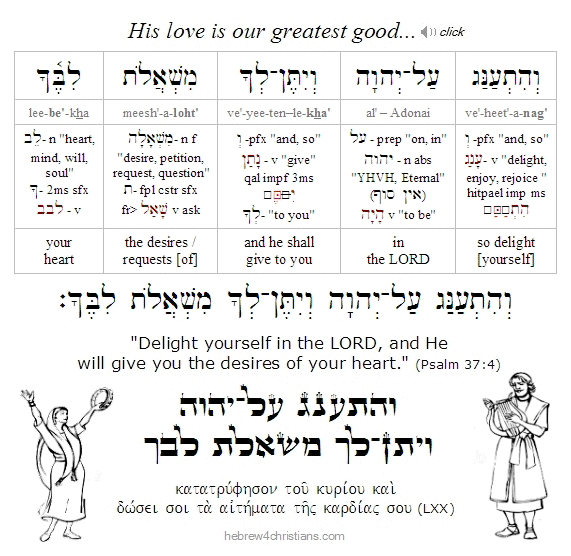
Hebrew Lesson
Psalm 37:4 reading (click):
Leprosy of Ingratitude...
The following is related to our Torah reading this week, parashat Tazria...
05.02.25 (Iyyar 4, 5785) Tazria, or "leprosy," is a spiritual sickness brought about by sinful thinking and faithlessness... In this connection Kierkegaard notes: "The gospel about the Ten Lepers (Luke 17:11-19) is about how the nine were healed of their leprosy – and then caught, so to speak, an even worse leprosy: their ingratitude and unthankfulness.
Herein lies the difference between sickness of the body and sickness of the spirit." Ten metzorot (lepers) were healed in body, but only one was healed both in body and soul -- the "stranger" who recognized God's kindness and who made an effort to offer his thanks...
Hebrew Lesson:
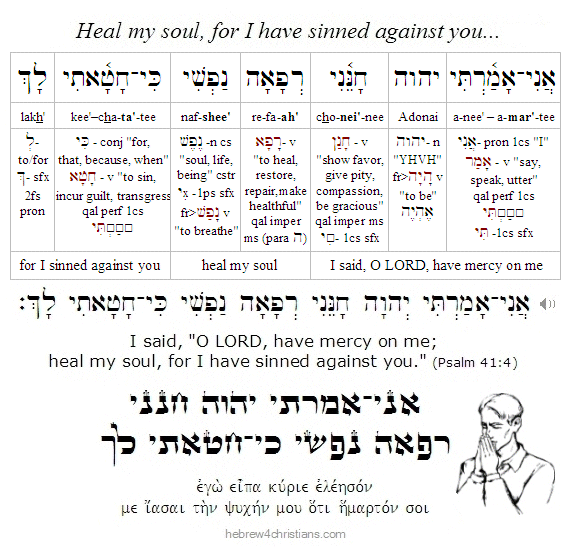
Psalm 41:4 reading (click):
Why Torah Matters...

"The word of God is always most precious to the man who most lives upon it." - Spurgeon
05.02.25 (Iyyar 4, 5785) Where is it written, "All Scripture is breathed out by God and profitable for teaching, for reproof, for correction, and for training in righteousness, that the godly one may be complete, equipped for every good work" (2 Tim. 3:16-17), it is to be noted that "the Scriptures" referred to here are the Jewish Scriptures (i.e., the Torah, the Prophets, and the Writings), since they are the foundation, the context, and the overarching matrix for the later New Covenant revelation... These were the Scriptures Yeshua used to contextualize and explain his ministry to his followers: "And beginning with Moses and all the Prophets, he interpreted to them in all the Scriptures the things concerning himself" (Luke 24:27). Indeed when Paul wrote these words to Timothy the "New Testament" Scriptures had not yet been compiled by the leaders of the first-generation followers of Messiah.
How important is the Torah, friends? It is essential as the foundation for all that follows, including the very meaning of the gospel message! In other words, the Torah has both a logical, a linguistic, and a theological priority regarding our understanding of the New Testament, and the failure to read in context invariably leads to faulty interpretations and doctrinal errors of various kinds. "To the Jew first, and [then] to the Greek" (Rom. 1:16) is a principle not only of how the gospel message would transcend ethnic Israel to be offered to all the nations, but also about how we should approach the subject of Biblical hermeneutics. God "breathed out" (θεόπνευστος) his revelation in order, and the message itself must be understood in light of that order (Gal. 4:4-5). Moreover, since all of the New Testament finds its semantic roots in the Torah of Moses and the other Hebrew Scriptures, it is important to study Biblical Hebrew first before studying the Greek New Testament, since the Greek words were translated from the ideas originally given in the Hebrew texts of the Torah.
All of the Torah is amazingly wonderful; it is an inestimably great blessing! After all, what would we know of the creation of the universe and of humanity apart from its pages? What would we know of the reason for sin, sickness and death -- and therefore our need for salvation itself apart from the account of the fall of man as described in Book of Genesis? Or what we know of God's moral truth apart from the revelation of the law at Sinai? Or how could we understand the need for sacrificial blood atonement apart from the sacrificial laws given in Leviticus? Or how would we understand the struggle of the journey of faith apart from the Book of Numbers? Or how would we appreciate the essential duty to love God with all our hearts -- the great Shema -- and the corresponding duty to love others as we love ourselves apart from the Book of Deuteronomy?
So the Torah provides the framework by which we read the Gospels, and apart from this framework we miss much of the original intent and meaning of the Bible... Again, that was Yeshua's approach to the Scriptures, after all. He repeatedly explained to his followers that would have to suffer and die, according to the Scriptures (see Luke 9:22, 9:44; Matt. 16:21; Mark 8:31). He told the disciples on the road of Emmaus: "All things had to be fulfilled, which were written in the law of Moses, and in the prophets, and in the psalms, concerning me (Luke 24:44). Indeed Yeshua chided the rabbis of his day saying: "You search the Scriptures because you think that in them you have eternal life; but it is they that bear witness about me" (John 5:39), and he also said, "If you would have believed Moses, you would believe in me, because he wrote about me" (John 5:46).
So love the Torah, friends; learn its message and study its passages carefully. That's good New Testament theology, after all: "For everything that was written in former times was written for our instruction, so that through endurance and through encouragement of the Scriptures we may have hope" (Rom. 15:4). The Holy Spirit still speaks to the heart of those who love Yeshua, the everlasting King of the Jews: "Oh how I love your Torah (תּוֹרָה); it is my meditation all the day" (Psalm 119:97).
Hebrew Lesson
Psalm 119:79 commentary (click to listen):
 |
The Mercies of God...
"For thus saith the high and lofty One that inhabiteth eternity, whose name is Holy; I dwell in the high and holy place, with him also that is of a contrite and humble spirit, to revive the spirit of the humble, and to revive the heart of the contrite ones... I have seen his ways, but I will heal him; I will lead him and restore comfort to him and his mourners..." (Isa. 57:15, 18)
05.02.25 (Iyyar 4, 5785) It is written in our Scriptures: "The sacrifices of God are a broken spirit (i.e., ruach nishbarah: רוח נשברה); a broken and contrite heart, O God, you will not despise" (Psalm 51:17). Yet how are our hearts broken unless we know the heartache of heaven shared on our behalf? That we feel ourselves lost within ourselves, in despair over our lives, in desperate need for the healing touch from God that brings us to comfort...
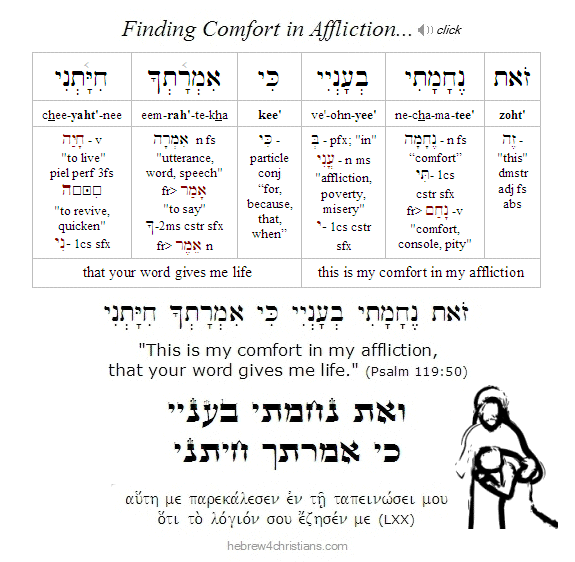
We are "in" but not "of" the world, so that means that we share in the common hardships and sorrows of this world. However, the difference is this: We do not suffer alone, for God's love surrounds us with comfort. For those who know Yeshua, suffering does not demand an intellectual answer to "why" we suffer as much as it evokes the heart's cry for God's presence... In the midst of our troubles the Spirit groans within us: "My soul clings to you and your right hand upholds me" (Psalm 63:8). We come to God in our brokenness, holding fast to his promise of comfort, and God upholds us with his hand. "This is my comfort in my affliction, that your word gives me life" (Psalm 119:50).
Hebrew Lesson:
Psalm 51:17 Hebrew Reading (click):
God is not indifferent to our sufferings, chaverim, and indeed, that is the basic message of the cross... Indeed how can we believe in God's love apart from the cross? How can we know the truth of his heart? God knows those who are broken and contrite (Isa. 57:15). The LORD is full of comfort; he loves the afflicted, he has grace for the humble, he forgives the fallen, and he revives the heart. The Lord says: "I have seen his ways, but I will heal him; I will lead him and restore comfort to him and his mourners..." Compassion is his nature - as the cross of Yeshua reveals - and therefore we can come to him in our need, in our affliction, and as those who are "poor in spirit" (Matt. 5:3).
God loves us even when we feel forsaken, all alone in our private struggles. The Spirit impels us to cry out for deliverance and experience consolation in our distress. This is a common experience in God's people: in our sorrows we seek him, and then we rediscover his mercies and great compassion. Great is his faithfulness (Lam. 3:23). "I have seen his ways, but I will heal him; I will lead him and restore comfort to him and his mourners..."
Hebrew Lesson:
Psalm 119:50 Hebrew Reading (click):
Witness of the Spirit...

05.01.25 (Iyyar 3, 5785) "Because you are his children, God has sent the Spirit of his Son into your hearts, crying, "Abba! Father!" (Gal. 4:6). Note here the Spirit does not cry out using "esoteric" or magical names for God, nor does the Spirit refer to one of God's many titles based on the divine attributes, but instead uses a term of intimacy and profound trust. After all, the word "abba" (אַבָּא) is not so much a name for God as it is a claim about who you are -- it is a confession that you belong to the Lord as his beloved child...
Throughout his ministry Yeshua referred to the LORD simply as his "Father," though he used the intensive address "Abba, Father" (Ἀββᾶ, ὁ πατήρ) just before his arrest and crucifixion, that is, during his intercession at Gethsamane (גַּת שְׁמָנִים), near the olive oil press on the Mount of Olives where the anointing oil for the Temple (שֶׁמֶן הַמִּשְׁחָה) was made, and therefore he called upon "Abba, Father" while in deep suffering and tribulation of heart (Mark 14:36). "Take this cup away from me. Yet not what I will, but what you will..."
The mixed dialect of Hebrew and Greek here (i.e., Ἀββᾶ, ὁ πατήρ) may indicate identification with both the Jewish people and the Gentiles who would be united in his passion, as it says, שָׁלוֹם שָׁלוֹם לָרָחוֹק וְלַקָּרוֹב - shalom shalom la'rachok vela'karov: "Peace, peace, to him who is far off and to him who is near," says the LORD; oo'refativ: "and I will heal him" (Isa. 57:19, Eph. 2:15).
Knowing God as your heavenly "father" is an intimate matter of the heart, an inner cry or groan coming from the miracle of spiritual rebirth. "The Spirit himself bears witness to our spirit that we are God's children" (Rom. 8:16). Amen, may we know who we are in Him.
Hebrew Lesson
Isa. 12:2 Hebrew reading (click):
Priests and Lepers...
05.01.25 (Iyyar 3, 5785) In our Torah portion for this week (Tazria) we read: "When a person (i.e., adam: אָדָם) has on the skin of his body a swelling (שְׂאֵת) or a scab (סַפַּחַת) or a bright spot (בְּהֶרֶת)... he shall be brought to the priest" (Lev. 13:2). Here the sages note three common afflictions that befall the "children of Adam," namely, 1) swelling (i.e., שְׂאֵת), representing arrogance; 2) scabs (סַפַּחַת), representing worldly vanity (from a root (סָפַח) that means to "join together"); and 3) bright spots such as moles or macula (i.e., בַּהֶרֶת), from a root (בָּהָר) meaning to enlighten, representing carnal reasoning to regard the ways of God.
When we see only the affliction, we must go to the priest – to one who helps mediate the Divine Presence – to see how deep the affliction is and what its root might be... Symbolically, since we are all priests to one another (see Exod. 19:6; 1 Pet. 2:5,9; Rev. 1:6), we share our afflictions with one another, allowing ourselves to be seen, and to confess our need for healing. "Therefore, disclose (ἐξομολογέω, lit. 'confess out') your sins to one another and pray (εὔχομαι) for one another, that you may be healed..." (James 5:16).
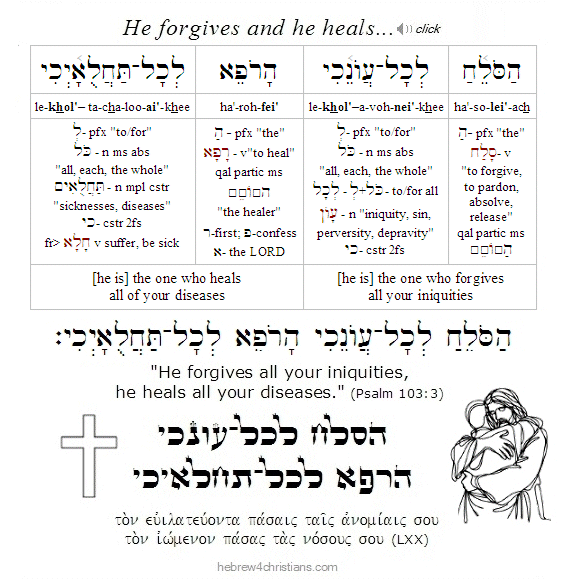
Followers of Yeshua are intended by God to be healers (Luke 9:1). The most common word for healing in the New Testament is therapeuo (θεραπεύω), a word that means to serve, to care for, and to restore to health. Unlike some ministers who draw crowds to demonstrate the power of miraculous "faith healing," true spiritual healers take the time to listen to others, to hear their inward pain, and to extend compassion and grace to them. They help open the inner eyes of the heart by extending hope and a new vision about what is real... Indeed, lasting healing focuses less on being cured than on finding hope that will never die.
Hebrew Lesson:
Psalm 103:3 reading (click for audio):
 |
<< Return
|
|