|
June 2025 Updates (continued)
Note: If any page content appears to be missing, please refresh the page...
Faith in the Unseen Good...
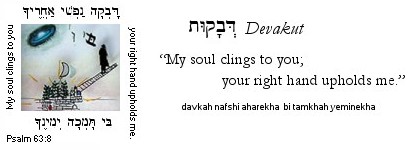
06.09.25 (Sivan 13, 5785) From our Torah portion this week (i.e., Beha'alotekha) we read: "At the command of the LORD they camped, and at the command of the LORD they set out" (Num. 9:23). This teaches us that God's Name is to be heeded every step of the way.
Whenever we journey someplace, near or far, say, "With God's help (i.e., be'ezrat ha'shem: בעזרת השם) I am going to this place, and I will stay for so long, if it pleases God (i.e., im yirtzei ha'shem: אם ירצה השם)." As James reminds us, "You do not know what tomorrow will bring. For what is your life? You are a mere mist that appears for a little time and then vanishes (James 4:14-15). Likewise Tehillim affirms: "Man is like a breath; his days are like a passing shadow" (Psalm 144:4).
We share exile with the LORD in this age, as strangers and sojourners with Him; indeed, our lives are "hidden with Him," waiting to be revealed (Col. 3:1-4; Psalm 17:15). "The present form (τὸ σχῆμα) of this world is passing away" (1 Cor. 7:31), and the heart of faith looks for a city whose designer and builder is God Himself (Heb. 11:10). "So we do not lose heart, though our outer self is wasting away... For the things that are seen are turning to dust, but the things that are unseen shall endure forever" (2 Cor. 4:16-18).
Hebrew Lesson:
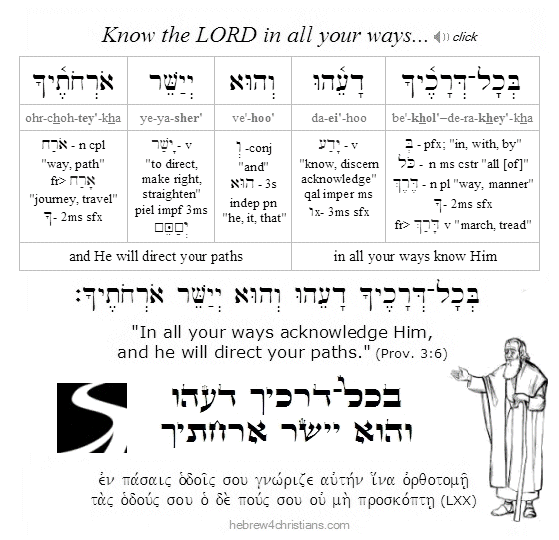
Proverbs 3:6 reading (click):
"In all your ways know Him," that is, in all that you put your hand to do respect the Lord and ask for divine guidance (1 Cor. 10:31). As King David stated, Shiviti: "I have set the Lord always before me, because He is at my right hand, I shall not be moved" (Psalm 16:8). "Do do be wise in your own eyes, fear the LORD and turn away from evil" (Prov. 3:7).
Parashat Beha'alotekha - בהעלתך
"I believe that God will give us all the strength we need to help us to resist in all time of distress. But he never gives it in advance, lest we should rely on ourselves and not on him alone." — Dietrich Bonhoeffer
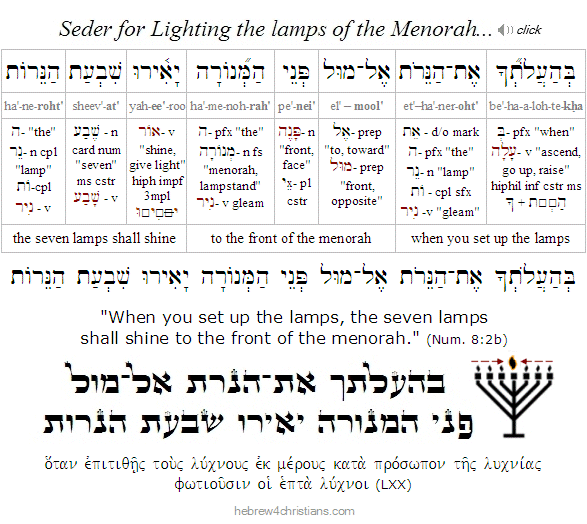
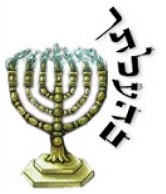
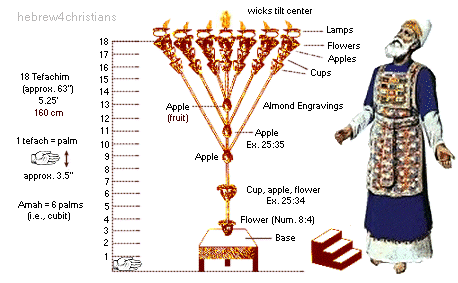
06.08.25 (Sivan 12, 5785) Our Torah for this week, called "Beha'alotekha" (i.e., Num. 8:1-12:16), begins with God giving instructions about how Aaron was to attend to the lamps of the Menorah within the Holy Place of the Tabernacle (Num. 8:1-4). Each day Aaron was to clean each of the seven lamps and to refill them with the very purest olive oil. The wicks were then to be bent so that the six outer lamps shined toward the seventh (and central) shaft. The lamps were to be lit daily, "from evening until morning," in a specific sequence - starting from the central lamp (the shamash) and then moving right to left (Exod. 27:21).
According to the Talmud (Shabbat 22b), while all the lamps received the same amount of olive oil, the central lamp miraculously never ran out of oil, even though it was kindled first in the sequence. This miracle is also reported to have occurred during the Temple period, though it abruptly ended about 40 years before the destruction of the Second Temple (c. 30 AD), after the death of Yeshua the Messiah, the true Servant and Branch of the LORD. As attested in the Talmud: "Our Rabbis taught: During the last forty years before the destruction of the Temple the lot ['For the Lord'] did not come up in the right hand; nor did the crimson-colored strap become white; nor did the centermost light shine" (Yoma 39a).
 |
The portion then describes how the Levites were to be set apart for service at the Tabernacle (Num. 8:5-12). In a ritual ceremony that signified a sort of "rebirth," the Levites were first sprinkled with mei chachatat (מי חטאת), literally, "the waters of sin" (Num. 8:7), that is, holy water mixed with the ashes of the red heifer sacrifice that was used to purify from contamination with death (Num. 19:13). Next they shaved off all their hair and were completely immersed in a mikveh (i.e., a bath containing flowing or "living" water). Notice that the steps of being sprinkled with purifying water, shaving off of all the hair, and being completely immersed in a mikveh were similar to the ritual for the cleansing of the metzora, or "leper" (Lev. 14:2-32), suggesting that a qualified priest was a "healed leper" of sorts.
The medieval commentator Rashi notes that each member of the community was required to place their hands on the Levites' heads, just as the hands were placed on the head of a sacrificial animal as it was slaughtered before the altar (Num. 8:10; Lev. 1:4, 3:2). The "waving" of the Levites by the High Priest likewise simulated the ritual of "tenufah" (תנופה), that is, the waving of the guilt sacrifice (asham) that was offered by a leper after his or her cleansing (Lev. 14:12). Finally, the Levites themselves laid their hands on the sin and whole burnt offerings for atonement before the LORD (Num. 8:12).
The portion continues with a restatement of law of Passover (Num. 9:1-14), followed by a description of the Cloud of the LORD (i.e., anan Adonai: עֲנַן יְהוָה) that covered the Tabernacle by day and appeared as a pillar of fire (עַמּוּד אֵשׁ) by night. When the Cloud lifted the people would break camp and go to their next location en route to the promised land; when the Cloud settled the people would stop and encamp again (Lev. 9:15-23).
God commanded that two silver trumpets (i.e., chatzortzrot kesef: חֲצוֹצְרֹת כֶּסֶף) were to be made for various purposes, including signaling the people to break camp, assembling the elders of Israel, to signal the arrival of appointed times, as alarms for battle, and so on.
The Cloud of the LORD (ענן יהוה) lifted and the people of Israel then decamped from Sinai on the 20th day of the second second month of the second year after the Exodus from Egypt (Num. 10:11-35). The Ark of the Covenant went out first to scout a location followed by a specific camp order and formation.
Soon after many began to complain of the hardship of the journey, and the Fire of the LORD (אֵשׁ יְהוָה) broke forth and consumed people on the outer parts of the camp. The name of the place was subsequently commemorated as "Taberah" (תַּבְעֵרָה)- "the burning."
Despite the judgment of the LORD, some time later the eirev rav (mixed multitude) craved for Egyptian food and the people of Israel joined them by recalling the "free fish" they ate in Egypt. The people also complained of the monotony of the manna that fell like dew from heaven to feed the people during their journey (Num. 11:1-15). Moses then lamented to the Lord about how hard it was to lead the people, and God then instructed him to appoint 70 elders of Israel to help him lead the people (Num. 11:16-17). As for the people's complaint over the divine menu, the LORD sent an enormous swarm of quail that brought a plague upon the people. Because so many died from the plague, the place was called Kibroth-hattaavah (קִבְרוֹת הַתַּאֲוָה), or the "Graves of Craving" (Num. 11:18-33).
The portion ends with the mutiny of Miram and Aaron regarding Moses' role as the exclusively chosen leader of the people of Israel. They secretly consulted and asked: "Has the Lord indeed spoken only through Moses? Has he not spoken through us also?" The LORD heard their secret conversation and intervened by calling them to appear with Moses before the Tent of Meeting. There the LORD vindicated Moses as the sole leader of Israel because only he speaks "mouth-to-mouth" with God. Miriam was then stricken with tzaarat ("leprosy") and exiled from the camp. Moses prayed for his sister to be healed (אֵל נָא רְפָא נָא לָהּ) but God delayed healing to correct her and to be an object lesson to Israel.
Parashah Themes...
Some themes for this week's reading include the symbolism of the Menorah and the Divine Light; the ongoing need for purification from sin; the role being a priest to one another; the call for holiness in the divine service; the Shekhinah Glory and Presence of God; the direction and leading of God; the tests we face as we journey through desert places; the problem of our complaining hearts; the requirement to live by "daily bread"; the importance of respecting elders; tzaarat and exile from the camp, among others.
The Thirst of Hope...
06.06.25 (Sivan 10, 5785) It sometimes feels like the "samsara" of the desert, a place of exile, the matrix of the world. There is no place I really want to go anymore... I walk with a limp, friends. The Mount of Olives is an enormous cemetery with over 150,000 tombs. Devout Jews think it is a "segulah" to be buried there so that at the time of the resurrection they will be at the center of the action... "In that day His feet will stand on the Mount of Olives, which faces Jerusalem on the east" (Zech. 14:4). That's the focus, to come back to life in the presence of of our beloved Lord Yeshua the Messiah!
The sages say that our father Isaac went blind because the angel's tears fell into his eyes as he lay bound upon the altar... I wonder if he might have later asked himself what use is there to see any more of this world? Nevertheless, and surprisingly, God used his blindness to allow the blessing to be given to Jacob, after all.
Some wounds seem incurable in this present life... God can and does do miracles, but more often he allows us the blessing of learning to endure in our struggles. It can get dark at times, and we can't outrun ourselves. "Cursed be the day wherein I was born!" exclaimed both Job and Jeremiah (Job 3:3; Jer. 20:14). "If this is how you are going to treat me, please go ahead and kill me -- if I have found favor in your eyes -- and do not let me face my own ruin" said Moses (Num. 11:15). The prophet Elijah likewise prayed that he might die: "I have had enough, Lord," he said. "Take my life; I am no better than my ancestors" (1 Kings 19:4).
There is the ideal and the real. Though it is a universal experience, personal suffering can be especially poignant, I think, to souls that seek God's presence and love above all things, for these people are bound to be misfits in this world of vanity and conceit. Soren Kierkegaard is such an example, and he once wrote: "What is a poet? An unhappy man who hides deep anguish in his heart, but whose lips are so formed that when the sigh and cry pass through them, it sounds like lovely music.... And people flock around the poet and say: 'Sing again soon' - that is, 'May new sufferings torment your soul but your lips be fashioned as before, for the cry would only frighten us, but the music, that is blissful."
Jewish philosopher Martin Buber wrote about the loneliness that results from Modern society, which he called an "It-world" that is marked by the prevalence of "I–It" rather than "I–Thou" relationships. The realm of the "institution" objectifies or "thingifies" people, and this bureaucratic "system" creates a sense of existential angst. Trapped in the "It-world," people begin to feel that life is meaningless, as they are numbered among the "faceless crowd" and are enthralled in a Kafkaesque prison of loneliness...
The statistics today are shocking. In a recent poll, nearly 40% of the people surveyed reported that they did not have a close friend. Not one. The "internet" has replaced human intimacy and authentic connection. The "pornogrification" of sexuality is linked to increased rates of depression, loneliness, and feelings of hopelessness. "Artificial Intelligence" and Chatgpt have become robotic surrogates for communion with others. "Is there any body out there?" is the plaintive cry of the postmodern soul. The way out for Buber - and this is surely right - is first to be in a life-transforming relationship with God, the ultimate "I-Thou" connection that will sustain our way despite the hardness of the "It-world." Yeshua taught this truth to use when he said "Seek first the Kingdom of God..." (Matt. 6:33).
Our Lord said: "Blessed are those who hunger and thirst for righteousness..." (Matt. 5:6). Yes, blessed are those who suffer such desperate need, who know inner emptiness, who are not made numb to the ache, and who cry from the heart for deliverance. Blessed are those who are in dread over themselves, who fall as one dead before the Divine Presence, who know they are undone, ruined, and dying for life... The great danger, spiritually speaking, is to become complacent, untouched by poverty of heart, to be lulled asleep, lost within a dream, made comatose, living-yet-dead. The gift of faith first reveals our own lostness and then imparts courage to live with ourselves despite ourselves as we seek God's healing and life...
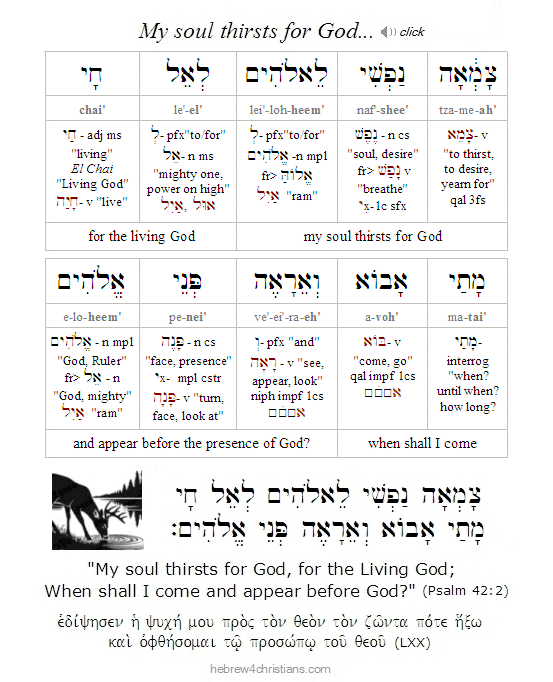
"Blessed art Thou, LORD our God, who never leaves nor forsakes us, and who draws us close through hunger and thirst." We are truly blessed when we ache with heartfelt longing for the Divine Presence... This is not some form of masochistic spirituality. Feeling content, unconcerned, satisfied, numb, etc., may be a sign of a dreadful condition of heart. "You, God, are my God, earnestly I seek you; I thirst for you, my whole being longs for you, in a dry and parched land where there is no water" (Psalm 63:1).
Hebrew Lesson
Psalm 42:2 reading (click):
Truth and Passion...
06.06.25 (Sivan 10, 5785) During the prophesied "end of days" (אַחֲרִית הַיָּמִים) many people will have an outer "form" (μόρφωσιν) of godliness but will deny its inner power, since their hearts will be turned away from the truth: "And because lawlessness (i.e., ἀνομία, lit. a=without; nomos=Torah) will be increased, the love of many will grow cold" (Matt. 24:12).
In this connection we note that the Hebrew word for "falsehood" (or "lie") is sheker (שֶׁקֶר), which can also be read as shekar (שֶׁקַר), meaning "that which" (-שׁ) makes you cold (קַר). The truth of God can't be known apart from His passion, inner fire, desire.
Indeed, the Hebrew word for "sin" (חֵטְא) means "missing the mark," though that essentially means missing the revelation of God's glory because lesser fears consume the heart and cool the passion for the truth... Let us ask the LORD to better know His heart by kindling his fire within our hearts!
"Be still and know that I Am..." Prayer is a type of listening (shema), a turning back to heed the message of God's love and hope in Messiah. Indeed, the word "teshuvah" (תְּשׁוּבָה), often translated as "repentance," also means an answer or response to a question. God's love is the question, and the heart's response is the answer.
Some of us may find it difficult to trust, to open our heart to receive grace and kindness. For those of us wounded by abandonment, it can be a great struggle to hear the voice of God calling you "beloved," "worthy," "valued," and "accepted." When you find faith to receive God's word of love, however, your heart comes alive and you begin to heal...
 |
Torah of the Sotah...
06.06.25 (Sivan 10, 5785) Our Torah reading this week (Naso) mentions the strange matter of the "sotah," or a woman suspected of adultery, who was taken before the priest to give account of her behavior (Num. 5:12-31). If she formally swore to her innocence, the kohen was to prepare a "bitter water" concoction that the woman would be required to drink. The priest would then write a scroll with a curse that prophesied the woman's punishment if she lied, signed the scroll with the Name of God, and immersed it in the water so that the words of the oath would dissolve into the the drinking vessel.
The sotah was then set before the LORD and the priest again warned her that if she was guilty of adultery, she would die a painful death, but if she was innocent the waters would impart a special blessing of fruitfulness to her. Only after the woman said "amen, amen" to the terms did she drank from the cup...
In general the sages have regarded the matter of the sotah in allegorical terms. Each of us is "married" to God by covenant, and therefore our relationship with him will be tested. Though we have our ideals, we nevertheless are frail and lose sight of our deepest commitments. It is our responsibility to confess the truth about the condition of our hearts. If we stray (שָׂטָה) from our covenant with God, we will taste the bitter waters of the sotah.
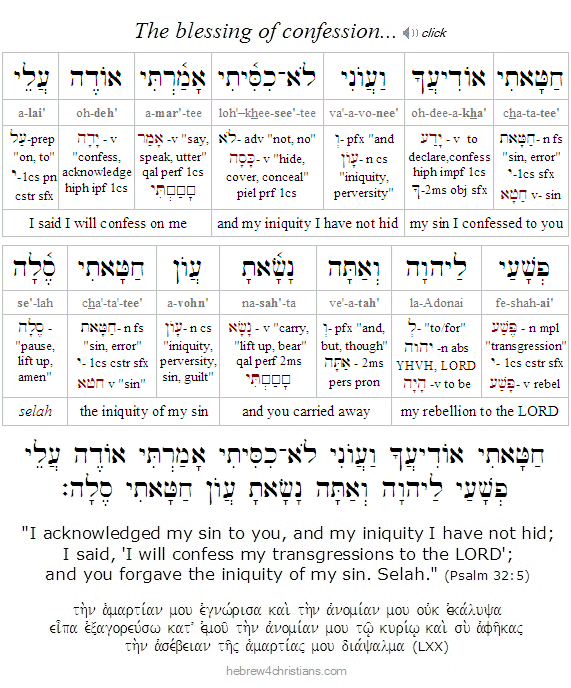
Confession is essential for healing, for truth is what connects us with reality. Unsaid words, suppressed feelings, secret desires, hurtful actions, and so on, are "swallowed" by the soul and inevitably affect the heart. We cannot deny the truth without being haunted and made anxious. Regarding our relationship with God, we cannot go astray without becoming hardened and "depressed" by the weight of our own duplicity. If we persist in our denial, we lose the truth about who we are and become poisoned by the bitter waters we drink. As a "sotah," we take the name of the Lord in vain and suffer the consequences...
When the Israelites came to Marah, "they could not drink the water because it was bitter" (Exod. 15:23). Note that the Hebrew text allows us to read that it was the Israelites themselves who were bitter – ki marim hem (כִּי מָרִים הֵם) – "for they (i.e., the Israelites) were bitter," and their bitterness made the water seem so as well.... After the people complained, God showed Moses a tree and threw it into the water, making it drinkable. Interestingly the Hebrew text literally reads, "the LORD taught him a tree" (וַיּוֹרֵהוּ יְהוָה עֵץ), suggesting elon moreh (אֵלוֹן מוֹרֶה), the "teaching tree of Abraham" (Gen. 12:6). The sages say this tree symbolized Torah, the tree of life (etz chaim), which brings happiness to those who take hold of it (Prov. 3:18), though we see Yeshua, the fallen tree that yields mayim chayim - living water - to revive the hearts of all who will receive his remedy.
If we find ourselves inwardly sick, barren, and lifeless, we need to turn back to the Lord and reaffirm our need for truth and love. Only God can heal the depths of our brokenness. The parable of the sotah is intensely personal, exposing the depths of who we are in relationship with God. It's revelation is meant to lead us back into the blessing of the life of his love.
Hebrew Lesson
Psalm 32:5 reading (click for audio):
The Ultimate Reality...
06.05.25 (Sivan 9, 5785) The revelation of God in Yeshua means that Ultimate Reality -- that is, the transcendental Source of all that exists -- is intensely personal, intimately knowable, and full of love. "Metaphysics" (i.e., that which is "really real") is therefore not about an impersonal force known in objective relationship (i.e., a "what") but a personal agency and creative mind known in subjective relationship (i.e., a "who"). The Scriptures teach that what is ultimately real (אהיה אשׁר אהיה) is the Ultimate Person of the LORD (אני יהוה). In Him we "live and move and have our being" (Acts 17:28).
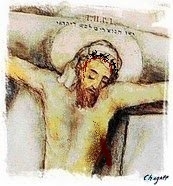
The LORD who is the Most High, the possessor of heaven and earth, is not only the Creator and Sustainer of all possible worlds, but the Lover and Redeemer of our very souls -- the One who empties himself to become "with us" and who overcomes the sickness of death for us... The climactic expression of the character of Ultimate Reality is revealed at Golgotha, the "place of the skull," where God's sacrificial life in Yeshua destroyed death by the greater power of divine love (Psalm 85:10). The heart of our Lord as he suffered and died for our sins reveals the great compassion of God; it is "ha'makom" (הַמָּקוֹם) the place of his atonement for us; his hidden dark cloud, and his resurrection glory reveals our deliverance for death. God loves us despite knowing all of our sins and yet redeems us from its curse...
We "connect" with the truth of who God is by the instrumentality of faith, and the essential question is whether we are in a "trusting relationship" with God or not, for if we do not truly know God as our loving Savior, we remain lost, in darkness, and alienated from the life of God. Faith is self-authenticating as we experience grace in the exercise of our trust in God.
Practically speaking, our relationship with God "shows up" in our lives by means of the various choices we make, though particularly in our moral choices. That's because righteousness is "ontological," or grounded in what is real. Since God is righteous, doing acts of righteousness enables us to partake in God's life and passion (1 John 2:29). On the other hand the practice of sin deadens us and turns us away from God's Presence...
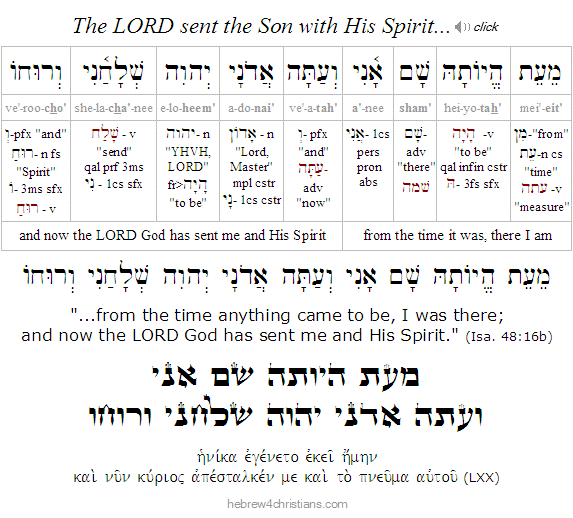
Love is essentially relational, and therefore the Scriptures reveal God as being in relationship both with others within creation, but also within himself - the One God is unity in plurality of relationship: Father, Son, and Holy Spirit (John 17:24). The "I AM" of God (Being) is also known in the "Thou Art" of God (Doing). God is not only the Eternal Lover but also the Eternal Beloved, and the bond of that love is the Spirit of God "hovering above the depths." "Draw near to me, hear this: from the beginning I have not spoken in secret, from the time anything came to be there I AM, and now the Lord GOD has sent me, and his Spirit" (Isa. 48:16). Note in this verse the transpersonal unity of the Godhead....
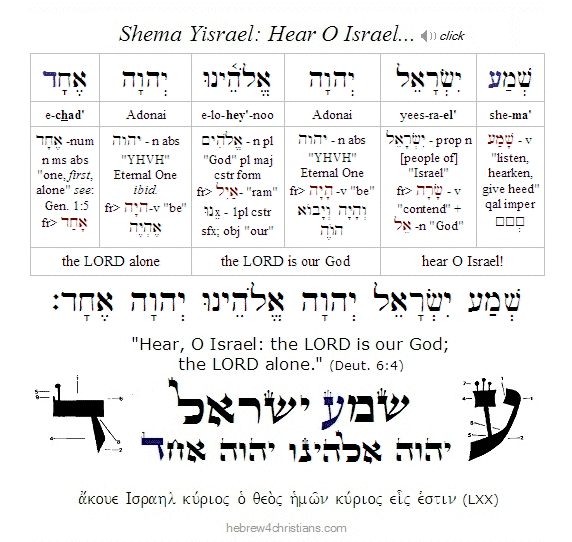
Now while the Torah certainly affirms that "God is one" (יהוה אחד), note that the word "one" (i.e., echad: אֶחָד) means something more than merely numerical identity (i.e., yechidut: יְחִידוּת) but instead unity in plurality, a "transcendental oneness" that points to the unfathomable mystery of the Name YHVH (יהוה) and the ineffable Godhead (אֵין סוֹף). Moreover, echad primarily means "first" in order or preeminence, for example when the Torah describes the "first day" of creation not as "yom ha'rishon" (יום ראשון), but as "yom echad" (יוֹם אחד; Gen. 1:5). That is why the Shema is not an affirmation of the "mystical pantheistic unity of all things" but rather that the LORD our God is preeminent and alone worthy of our worship and trust. "Hear, O Israel, the LORD our God is one LORD (i.e., unity of the godhead) the LORD alone (i.e., God is first, primary, central, and our greatest good). "God is love" means that he is the Lover, the Beloved, and the Communion of true love
The doctrine of the tripartite-yet-one divine nature (השילוש הקדוש) is not known apart from the revelation of Yeshua, and it is an essential part of His message of redemption to us (see John 17:3). In other words, if you believe that Yeshua embodies and reveals the "Who" of Ultimate Reality, then you will accept his teaching that God is expressed in relationship - the Son in relation to the Father and to the Holy Spirit, and that these three are "echad," or one... "The Father has borne witness of me; whoever has seen me has seen the Father" (John 5:37; 14:9); "I and the Father are one"; "before Abraham was, I am..." "who is the liar but he who denies that Yeshua is the Messiah? This is the antichrist, he who denies the Father and the Son" (1 John 2:22). Believers in the Lord are commissioned to go and make students or learners (תלמידים) of all the nations, baptizing them (i.e., identifying them) in the name of the Father, and the Son and the Holy Spirit" (Matt. 28:19).
Hebrew Lesson
Isaiah 48:16 reading (click):
Truth of the Inward Being...
"Strive to enter in (᾽αγωνίζεσθε εἰσελθεῖν) at the narrow gate: for many, I say to you, will seek to enter in, and shall not be able." - Yeshua (Luke 13:24)
06.05.25 (Sivan 9, 5785) It is written in our Scriptures: "As a man thinks in his heart, so is he." We often see what we want to see more than what is really there. That's called wishful thinking. We overlook much, and we often ignore what might challenge our own preferred interpretations. For example, we may think that we are trusting God for our lives, but we worry, we fret, we attempt to control others, we get angry, and so on. We have a blind spot regarding the question whether we are really trusting God, perhaps because earnestly questioning what we actually believe seems too threatening (John 16:31-32). After all, what if we were to discover that don't really know what it is that we believe? Or what if we struggle to believe beyond our prejudices? What if we are confused? What does that say about who we are? So we ignore the real problem (namely, our lack of truth, our deficient faith in God, the fear of what we really are) and go one thinking we are something we are not. In short, we fool ourselves at the expense of truth.
This is a tragic and common failing of human nature. During the Nazi years, many ordinary Germans flatly refused to believe reports of atrocities at the death camps because it was too costly to discover the truth (the same might be said about any patriotic citizens who rationalize the actions of their government regardless of the moral issues involved). By willfully hiding from the facts, we pretend we are not responsible, and therefore we justify passivity in the face of injustice and evil.
Yeshua warned that the time would come when those who kill others will delude themselves into thinking they are doing God a favor (John 16:2). Think of how massively self-deceived such a thing is as that -- to murder someone as a so-called service to God! Many of the biggest enemies of the truth are often those who think they are doing God such "favors."
Hebrew Lesson
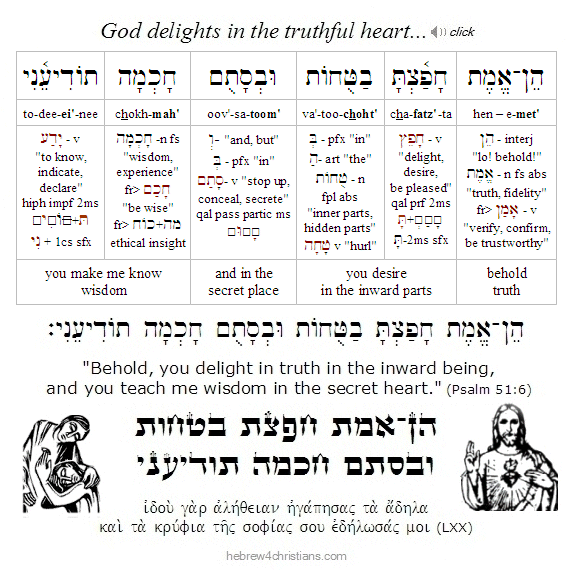
Psalm 51:6 reading (click):
Often, however, the truth "of the inward being" is gained at the expense of heartache, for surely the heart must ache, tremble, and despair before it comes to accept the truth about its condition. This sort of truth is "existential," meaning that it is known only through the process of living life itself. As Kierkegaard said, "There are many people who reach their conclusions about life like schoolboys: they cheat their master by copying the answer out of a book without having worked the sum out for themselves." Yes, and they cheat themselves, too, since they somehow believe that "knowing the answer" given by another is the same thing as "knowing the answer" of their own inward being... Kierkegaard continues this thought: "The truth is lived before it is understood. It must be fought for, tested, and appropriated. Truth is the way... you must be tried, do battle, and suffer if you are to acquire truth for yourself. It is a sheer illusion to think that in relation to truth there is an abridgment, a short cut that dispenses with the necessity of struggling for it."
A man who was afflicted with a terrible disease complained to Rabbi Israel that his suffering interfered with his learning and praying. The rabbi put his hand on his shoulder and said, "How do you know, friend, what is more pleasing to God - your studying or your suffering?" (Buber: Hasidim).
In Biblical Hebrew the idea of "inward being" (i.e. tuchot: טֻחוֹת) refers to the "kidneys" which were thought to be "the reins" or the concealed source of the will within the person (i.e., te'ach: טִיחַ). Interestingly, the word te'ach comes from the verb tachah (טָחָה) that means to "shoot with a bow," alluding to the idea of inner Torah as a directive power. God wants purity of the heart – passion, singleheartedness, and earnestness – as we live and practice the truth. God wants "the inner parts," the concealed parts of the soul, to be filled with his Torah, and therefore David asks God to make him to know wisdom there - in the "secret heart" - so that he might apprehend God's truth and do teshuvah that purifies the heart.
Sin and Insanity...
06.04.25 (Sivan 8, 5785) From our Torah reading this week (i.e., parashat Naso) we read, "If any... goes astray and breaks faith..." (Num. 5:12). The sages comment that the Hebrew for "goes astray" (i.e., tisteh: תִשְׂטֶה) is written so it may also be read as "goes insane" (i.e., tishteh: תִשְׁטֶה), and concludes that sin is a form of insanity, that is, a denial of what is real, and therefore a state of delusion.
We are required, as a matter of our faith in the truth of Holy Scripture attested by the Holy Spirit, to believe that God is knowable (Rom. 1:19-20), that we are always in His presence (Prov. 15:3; Psalm 94:9; 139), that He is all-knowing or omniscient (Psalm 147:5), and that nothing can be hidden from Him (Isa. 40:28; Jer. 23:24; Heb. 4:13), but when we sin, we "break from" this reality and deny the divine Presence by a perverse act of self-exaltation.
Whenever we imagine that we are unseen by God or whenever we "forget" that we live, move, and have our being in His presence, we are denying reality (Psalm 14:1). Our sin causes us lose sight of what's real: we forget who God is; we forget who we are; and we exile ourselves from the Source of life... Surely sin is a form of insanity, and therefore we have a moral and spiritual obligation to think clearly and to value truth.
As Rabbi Judah would say, "Contemplate three things, and you will not come to the hands of transgression: Know what is above from you: a seeing eye, a listening ear, and all your deeds being inscribed in a book" (Pirke Avot 2:1). Therefore "fear God and keep his commandments, because this is the whole duty of man. For God will bring every deed into judgment, with every secret thing, whether good or evil" (Eccl. 12:13-14).
Friends, may we "set the LORD always before us" so that we will not be shaken by losing sight of what is real (Psalm 16:8).
Hebrew Lesson
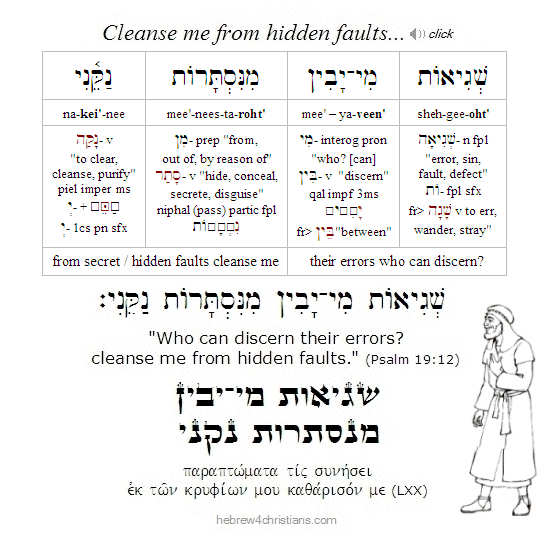
Psalm 19:12 reading (click):
The Paradox of Moses...
06.03.25 (Sivan 7, 5785) Our Torah portion for this week (i.e., parashat Naso) ends with these amazing words: "And when Moses went into the Tent of Meeting (i.e., the Mishkan) to commune with the LORD, he heard the Voice (הַקּוֹל) speaking to him from above the mercy seat (i.e., kapporet: כַּפּרֶת) that was upon the Ark of the Testimony, from between the two cherubim; and there the LORD spoke to him" (Num. 7:89).
Now Moses was truly an extraordinary and wonderful person -- Israel's first great prophet, priest, and king. His life can be divided into three great distinct periods of 40 years each. First, he was raised as an Egyptian and lived as a prince of Egypt (the Egyptian period); second, he fled to the land of Midian where he became a shepherd and encountered God in the desert (the Midianite period); and third, after the great deliverance from Egypt, Moses led the people back to Sinai where he 1) became the mediator (priest) of the covenant between God and Israel, 2) legislated the various laws of the Torah, and 3) received the prophetic vision of the Tabernacle, the future exile, and the ultimate glory of Zion.
Notice, however, that Moses was extraordinary in the sense that he transcended the entire system of religion that was later established as "Judaism." First, as the great legislator, Moses stood outside of the law, serving as its voice of authority. Second, as the high priest of Israel, Moses instituted various sacrificial rites before the laws of sacrifice were enacted. For example, he instituted the Passover sacrifice in Egypt (Exod. 12:1-11), and when the people later reached Sinai, he offered blood sacrifices to ratify the terms of the covenant (Exod. 24:8). Moreover, he ascended the mountain and received the prophetic vision of the Sanctuary before the priesthood had been instituted in Israel (Exod. 25:8-9). And even after the laws of the priests were enacted and the Tabernacle was erected, Moses was allowed to go before the very Holy of Holies to hear the Voice of the LORD, even though technically speaking this was forbidden, since Moses was not a kohen (i.e., descendant of Aaron).
I mention this because some Jewish people stumble over the fact that Yeshua, who was from the tribe of Judah, served as Israel's High Priest of the New Covenant. Of course this issue is addressed in the Book of Hebrews, where the role of the Malki-Tzedek priesthood is ascribed to King Yeshua (Heb. 5:6-11; 7:1-19), but it is important to realize that Moses himself foresaw the coming of the Messiah as Israel's great prophet, priest and King (Deut. 18:15-19; John 5:36). Indeed, just as Moses himself was "outside" the law by serving as Israel's priest but nevertheless was commissioned by God Himself, so also with Yeshua, who instituted the sacrifice of His blood as the Lamb of God and who went directly before God's Throne to intercede on our behalf.
Like the patriarch Joseph before him, Moses was a "picture" of Yeshua in various significant ways. Though he was a Jew from the tribe of Levi, he appeared as a "prince of Egypt" to his own people and was educated in all the wisdom of the Egyptians (Acts 7:22). And though he was God's chosen deliverer, Moses was initially rejected by the Israelites and then turned to the Gentiles, taking a "foreign" bride. After being severely tested in the desert, he was empowered by God's Spirit to become Israel's deliverer for their hour of great tribulation. Indeed, both Moses and Yeshua were "sent from a mountain of God" to free Israel; both revealed the meaning of God's Name; both spoke with God "face to face." Moses was sent from (physical) Mount Sinai in Midian; Yeshua was sent from a spiritual "Mount Zion" in Heaven (Heb. 12:22). The New Testament relates that Moses and Elijah later met with Yeshua to discuss His "departure," literally, "His Exodus" (τὴν ἔξοδον αὐτοῦ) that he would accomplish at Jerusalem to redeem the entire world (Luke 9:30-31).
Hebrew Lesson
Deut. 18:15 reading (click):
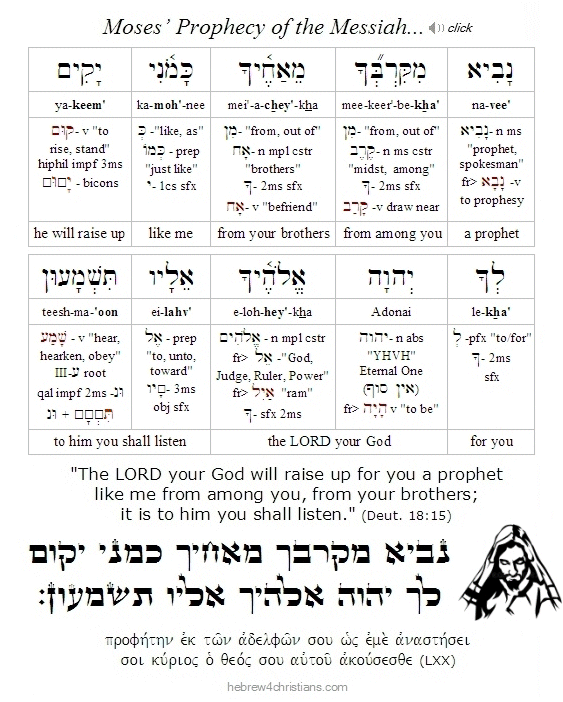 |
Moses foretold of the coming Messiah who would resemble him in many distinctive and remarkable ways. For more on this subject, see:
Teach us to Pray...
Prayer is not what is done by us, but rather what is done by the Holy Spirit in us.
06.03.25 (Sivan 7, 5785) There is only once place in the New Testament where the disciples asked Yeshua to teach them something, and that was when they said, "Lord, teach us to pray" (Luke 11:1). Yeshua then responded by giving them a pattern of prayer that's been called "the Lord's Prayer," though it's better to think of it as a model for prayer instead of a formulaic petition to recite. After all, the disciples asked "Teach us to pray," not "teach us a prayer," as if a special prayer could serve as a sort of incantation to propitiate God.
Yeshua points us to the Father. He did not suggest using Pharisaical expressions such as "Barukh attah Adonai," "Ribbono shel Olam," or "Elohei Avoteinu," nor did he endorse praying three times a day as decreed by the elders of the Great Assembly. No, Yeshua taught us to come to God using the simple word "Father." This is the language of familiar intimacy that expresses the trust a young child has for his earthly father.
So Yeshua teaches us to pray in heartfelt confidence that God is our caring heavenly Father, and this implies that we understand and regard ourselves as his beloved children. We have access to God's heart in a direct and meaningful way.
As God's beloved children, we are to honor and our heavenly Father and to esteem his will and vision for our destiny. "Holy is Thy name"; "Thy will be done"; "Thy kingdom come" - all these matters come before requests for our "daily bread" -- and even before matters of our need for forgiveness of sin. Our course God cares for our daily needs, our forgiveness, our deliverance from evil, and so on, but Yeshua concentrates our focus on the Father and our identity as his children first of all. Da lifnei mi attah omed: "Know before whom you stand."
Regarding our personal petitions, it is wise to understand that your Heavenly Father gives what you need, not what you may want at the time. "Ask and it shall be given you" means "keep on asking" (Luke 11:9). If a recurring request seems to go unanswered, remember that initial barriers are not necessarily refusals but are meant to yield what is best for you (Rom. 8:28). We can be confident, however, that God hears us when we pray and that he gives "good gifts" to those who ask Him (Matt. 7:11) -- in particular, gifts of the Holy Spirit (Luke 11:13). God gives wisdom to those who ask for it (James 1:5) and imparts the "spirit of wisdom and revelation to know him better" (Eph. 1:17). If we ask in accordance with his will, we have confidence that he will act on our behalf (1 John 5:14-15). These are "spiritual blessings in heavenly places" representing the deepest need of our hearts.
We are instructed to "present ourselves to God as those who are alive from the dead" (Rom. 6:13), indicating that we are to come confident of his acceptance because of what Yeshua has done on our behalf. We are "crucified with Christ" (Gal. 2:20) and share in his resurrection life. In the Torah the "daily sacrifice," or korban tamid (קָרְבַּן תָּמִיד), was offered to the LORD every morning and evening upon the altar, which corresponds to being a "living sacrifice" (i.e., korban chai: קָרְבָּן חַי) to the LORD (Rom. 12:1-2). We are to "pray without ceasing," which means living what we believe in all that we do. We take up our cross daily (Luke 9:23). We come "boldly" before the throne of grace. We are made "alive from the dead" to access God's presence and heart for us at all times. We have been made new creations, members of God's household, esteemed, eternally beloved....
Take my soul and body's powers;
take my memory, mind and will;
All my goods, all my hours;
All I know, and all I feel;
All I think, or speak, or do;
take my heart - and make it new.
- Charles Wesley
Hebrew Lesson
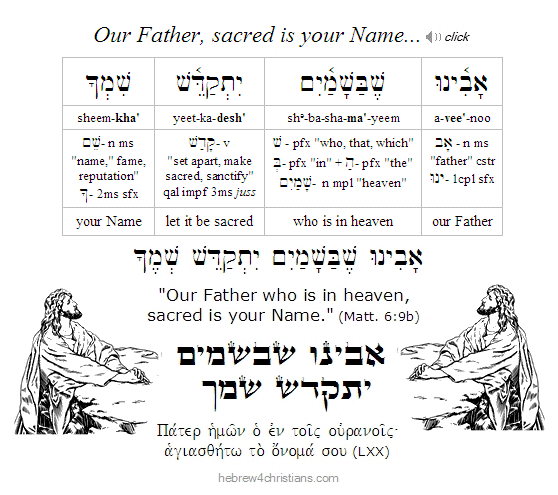
Matthew 6:9b reading (click):
Finding the Path of Life...

06.03.25 (Sivan 7, 5785) Consciously or not, every day billions of people all over the world are seeking that which will satisfy their heart's deepest longings for unending life, unbounded joy, and abiding pleasure. As philosopher C.S. Lewis pointed out, however, this ultimate longing for life is a "message" from another world.
Some believe that life consists of a series of sensual pleasures – eating, drinking, romance, sexual relations, etc., while others attempt to "lose themselves" in various kinds of entertainment. However, such fleeting moments of pleasure invariably cause an inward fragmentation of the soul, thereby weakening the will and inducing a state of forgetfulness regarding the deepest needs of life.
Others are deluded into attempting to find life by means of creating a "legacy" for themselves. To earn respect, to experience fame, or to be heroically remembered is considered the goal of life. However, as Shakespeare poignantly reminds us, human history is at best a "tale told by an idiot, full of sound and fury, signifying nothing."
Still others hope to find life through various placating religious rituals and practices. In Orthodox Judaism, for example, the Orach Chayim is a handbook that meticulously provides a set of rules and regulations regarding sleeping, waking, wearing clothes, reciting blessings, observing Sabbath and the holidays, and so on. The path of life, according to the religionist, is the performance of various ritual acts in order to attain God's approval and blessing.
In Psalm 16:11 we read: "You will show me the path of life; in your presence is fullness of joy; at your right hand are pleasures forevermore." The verb translated "you will show me" is a hiphil (causative) form of yada' (to know) and could better be translated "you will cause me to know," indicating that God is active in the knowing process. Here King David, despite the anxiety he felt regarding death, voiced his trust that God's love would personally intervene to deliver him from the prospect of physical corruption in the grave (v10).
From the New Testament, we know that this verse ultimately refers not to David (who eventually died), but to Yeshua the Messiah, the greater Son of David (Mark 12:35-6, Psalm 110:1). Peter cited this verse in his Pentecost sermon (Acts 2:25-28), as did Paul at Antioch (Acts 13:35-37). Despite the grisly prospect of the crucifixion, Yeshua trusted that God, by raising him from the dead, would not allow him to suffer corruption (Matt. 16:21).
Interestingly, the Hebrew word netzach ("forevermore") denotes both "victory" and "eternity," and reveals that Yeshua's resurrection provides the everlasting victory over the sting of death itself. Yeshua is forever enthroned at the very side of the Majesty on High as the "Key Holder" to life and death (Rev. 1:18).
The ultimate longing we have in our hearts is really a message from God – to come to Him to have our deepest needs met. The true orach chayim is only found in a personal, trusting relationship with the resurrected Savior - Yeshua the Messiah (John 14:6). When we receive the message of His gracious love, our heart's deepest longings will be truly satisfied. We will experience fullness of joy in God's loving presence, and we will enjoy abiding pleasures in our communion with God. Amen.
Hebrew Lesson:
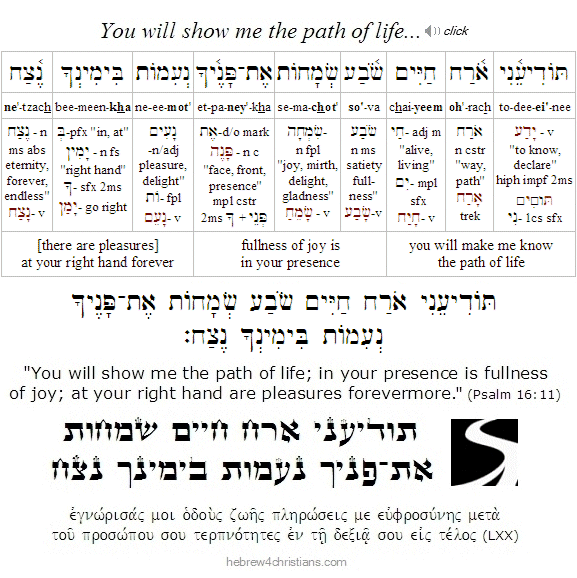
Psalm 16:11 reading (click):
The Fruit of Spirit...
06.02.25 (Sivan 6, 5785) Traditional Jewish chinuch (education) identifies various middot ha-lev (qualities of heart) that attend to a genuinely Jewish life. These include Talmud Torah (studying Scripture), ahavat Adonai (loving God), gemilut chasidim (doing works of compassion), bikkur cholim (visiting the sick), and so on. The follower of Yeshua likewise is intended to evidence middot hav-lev, though the Source for such comes directly from the power of the Ruach Ha-Kodesh (Holy Spirit) working within the heart of faith. The peirot (fruits) listed in Galatians 5:22-23 represent nine visible attributes of a follower of Yeshua, namely: love (אהבה), joy (שׂמחה), peace (שׁלום), patience (סבלנות), generosity (נדיבות לב), kindness (חסד), loyalty (נֶאֱמָנוּת), humility (ענוה), and self-control (שְׁלִיטָה עַצְמִית).
Note that these fruits are decidedly not realized through self-effort or attempts at human "reformation," but rather are a supernatural outgrowth of the grace of God in the life of one who puts their trust in Yeshua as Savior. They are fruits "of the Spirit" (פּרי הרוח), not the result of human effort (see John 15:1-8, Mark 4:26-29). Our lives are sanctified in the manner in which they were justified: entirely by faith in the love and grace and power of God.
The question we must searchingly ask ourselves is whether our lives give evidence to the power and agency of the Holy Spirit within us. Strictly speaking, these nine attributes are qualities that only the LORD God Himself possesses, since He alone is perfectly loving, perfectly joyful, and so on. But since we are created be'tzelem Elohim (in the image of God) and were given the Holy Spirit to help us walk as did our Teacher (Luke 6:40), spiritual fruit should be evident in our own lives (John 14:12; 15:1-8; 26-7). But again, obtaining such fruit is invariably a matter of faith – trusting that God will help us live our lives in truthful union with Him. This is the "work of God" (John 6:28-29).
Let's remember to pray for one another and ask the LORD to make each of us fruitful le'shem shamayim - for the sake of the Name of our beloved One Yeshua.... Amen.
Hebrew Lesson
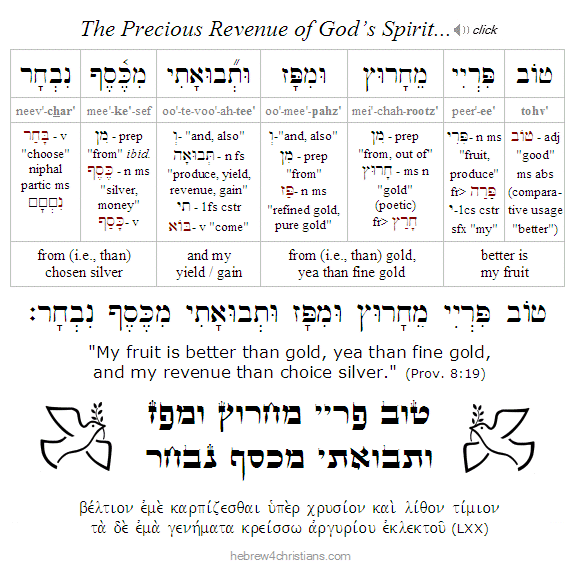
Proverbs 8:19 reading (click):
 |
The Kingdom Within You...
"I will not leave you orphans; I will come to you..." - Yeshua
06.02.25 (Sivan 6, 5785) "And I will ask the Father, and He will give you another Helper, that He may abide with you forever, namely, the Spirit of truth (רוּחַ הָאֱמֶת), whom the world cannot receive, because it neither sees Him nor knows Him; but you know Him, for He dwells with you and will be in you. I will not leave you orphans; I will come to you..." (John 14:16-18). Note that Yeshua asks the Father for the parakletos (i.e., the one "called alongside"), whom he calls the "Spirit of Truth," to "dwell within" the hearts of his followers so they will be fortified in their mission, and he furthermore identifies himself with the Spirit by saying that he would not leave us as orphans but would come to come to be with us...
I recently mentioned that Shavuot is called "Atzaret Pesach" (עצרת פסח) or the "culmination of Passover." Just as the Passover reveals "God with us" (עִמָּנוּ אֵל), as the Word made flesh, and "God for us" (אֱלהִים לָנוּ), as the sacrificial Lamb of God, Shavuot adds yet another dimension by revealing "God within us" (אֱלהִים בְּתוֹכֵנוּ), as the indwelling Presence, the "breath of God" that forever abides in our hearts. Yeshua was eager for us to partake of this miracle: "I tell you the truth: it is to your advantage that I go away, for if I do not go away, the Helper (i.e., ὁ παράκλητος, one "called alongside to help) will not come to you. But if I go, I will send him to you" (John 16:7).
As it is written, "By this we know that we live in him and he in us, because he has given us of his Spirit" (1 John 4:13). Or don't you know that your body is a temple of the Holy Spirit within you (רוּחַ הַקּדֶשׁ בְּתוֹכֵנוּ), whom you have from God? "For all who are led by the Spirit of God are the children of God" (Rom. 8:14). Thank God for the help we attain through the Spirit's heartfelt ministrations: "For the Spirit also helps in our weaknesses. For we do not know what we should pray for as we ought, but the Spirit Himself makes intercession for us with groanings which cannot be uttered" (Rom. 8:26).
Amen, thank you Lord Yeshua for the gift of the Holy Spirit within our hearts...
Hebrew Lesson:
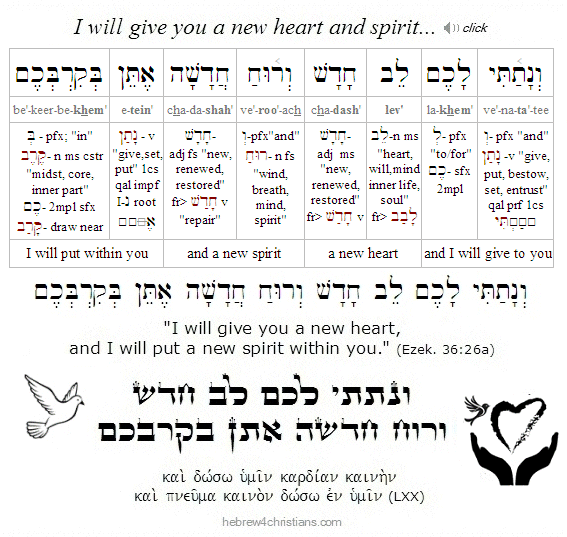
Ezekiel 36:26a reading (click):
This week's Torah:
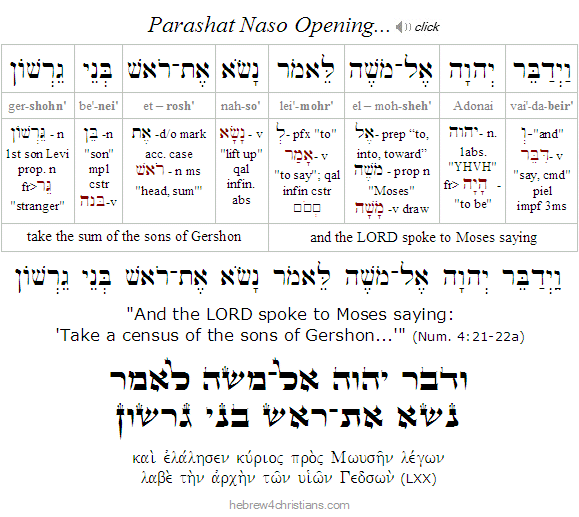
Parashat Naso (פָּרָשַׁת נָשׂא)
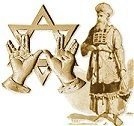
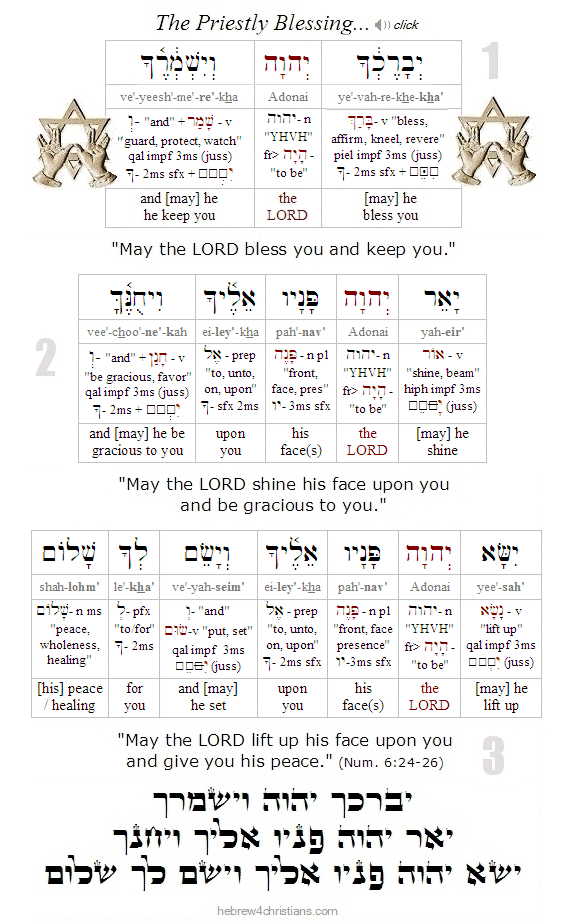
06.01.25 (Sivan 5, 5785) Chag Shavuot Sameach, friends... Among other things, our Torah portion for this week, parashat Naso ("lift up!"), includes the cornerstone blessing that Aaron and his sons (i.e., the priests) were instructed to declare over the people of Israel: "May the LORD bless you and keep you; may the LORD shine his face upon you and be gracious to you; may the LORD lift up his face upon you and give you his peace" (Num. 6:24-26).
Notice that the Hebrew text of the blessing (see below) begins with three words, is comprised of three parts, invokes the divine Name three times, and is therefore appropriately called "the three-in-one blessing" (שלוש בברכה אחת). Notice also that the words are spoken in the grammatical singular rather than plural because they are meant to have personal application, not to be a general benediction over a crowd of people. The phrase, "May the LORD lift up his face upon you..." (ישא יהוה פניו אליך) pictures the beaming face of a parent lifting up his beloved child in joy...
The repetitive construction of God "lifting up His face" (יהוה פניו אליך) indicates that he gazes upon you in love and in blessing. Undoubtedly Yeshua recited this very blessing over his disciples when he ascended back to heaven on Mem B'Omer, though He would have spoken it in the grammatical first person: "I will bless you and keep you (אני אברך אותך ואשמור לך); I will shine upon you and will be full of grace toward you; I will lift up my face toward you and give you my shalom" (see Luke 24:50-51).
יברכך יהוה וישמרך
יאר יהוה פניו אליך ויחנך
ישא יהוה פניו אליך וישם לך שׁלום
ye·vah·re'·khe·kha' · Adonai · ve·yeesh'·me·re'·kha
yah·eir · Adonai · pah·nav · e·ley'·kha · vee·khoon·ne'·kah
yees·sa · Adonai · pah·nav · e·ley'·kha · ve·yah·seim · le·kha · shah·lohm

"May the LORD bless you and keep you;
May the LORD shine his face upon you and be gracious to you;
May the LORD lift up his face upon you and give you his peace."
(Num. 6:24-26)
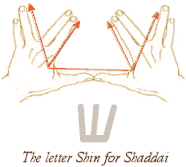
Nesiat Kapayim (Raising of the hands)
Note: The verbs in this blessing are all "jussive," which means they express a wish, desire, or a command, though understood in context (i.e., as part of the blessing recited by the kohanim during ceremonial occasions), the verbs should be regarded as declarative or oracular. To learn more about this blessing, click here.
Parashat Naso Links:
Why Shavuot Matters...
The holiday of Shavuot ("Pentecost") begins Sunday, June 1st at sundown...
06.01.25 (Sivan 5, 5785) The holiday of Shavuot (חג השבועות) is called "Pentecost" in Christian tradition. The Greek word Pentecost (πεντηκοστή) means "the holiday of fifty days" referring to the 50th day after the resurrection of Yeshua when the Holy Spirit descended upon the disciples and when Peter first proclaimed the truth of salvation in Jerusalem (Acts 2:1-43). The Torah teaches that Shavuot is a major biblical holiday (one of the three "required appointed times" of the LORD, see Exod. 23:14-17; Deut. 16:16) and moreover that it is regarded as the climax of Passover itself -- 'the endpoint' of the redemptive experience. Indeed, just as the blood of the lambs smeared on the door posts led directly to Sinai 50 days later, so the crucifixion of Yeshua led directly to the descent of the Holy Spirit to empower His followers to serve God under the new covenant of Zion.
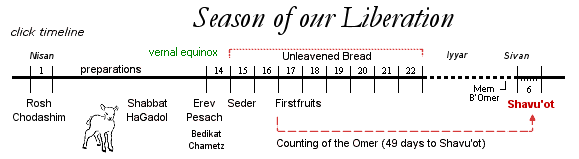 |
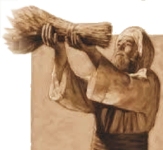
As I've mentioned before, there are two essential priestly rituals commanded for the holiday of Shavuot: 1) the waving (i.e., tenufah: תנופה) of the two loaves of (new) wheat bread (called shtei ha'lechem: שתי הלחם), and 2) the offering of peace sacrifices (i.e., korban shelamim: קורבן שלמים). Both of these aspects of the priestly service (avodah) were fulfilled in the greater sacrifice of Yeshua made on our behalf. Moreover, just as worshipers at the Temple would present bikkurim (בכורים) - their choicest first fruits - and attest to God's faithfulness before the altar (Deut. 26:3), so we are called to walk in the fruit of the Spirit (פרי רוח הקודש) and to proclaim the message of God's faithful love for us.
Though it is not explicitly mentioned in the five books of the Torah, the earliest Jewish sages have long connected the revelation of the Torah at Sinai (מתן תורה) with the holiday of Shavuot. This comes from a careful study of the chronology of the exodus itself, calculating the time of the Passover from Egypt (i.e., Nisan 15) to the arrival of the Israelites at Sinai exactly 45 days later, on Sivan 1 (see Exod 19:1). The earliest extrabiblical source that explicitly links Shavuot with the revelation of the Torah at Sinai is the apocyphal Book of Jubilees (i.e., Sefer ha'Yovelim: ספר היובלים), dating from the 2nd century BC. Extant manuscripts of this book were found among the Dead Sea Scrolls (מגילות ים המלח), indicating that the Shavuot-Sinai connection was made before the advent of Yeshua. The Book of Jubilees provides a parallel account of Genesis and certain parts of Exodus, and mentions the observance of Shavuot by Noah before the time of the Flood. In the book Noah is told to observe the Festival of Weeks (shavuot) and to offer Firstfruits (bikkurim) every year as a commemoration of God's covenant to renew the earth (Jubilees 6:15;22). Likewise Abraham and the original patriarchs were said to observe it, though it was forgotten by the Jews in Egypt until Moses was said to have reinstated it at Sinai. Shavuot is also mentioned in the apocryphal Book of Tobit (טוביה) and the Book of Maccabees, c. 2nd century BC.
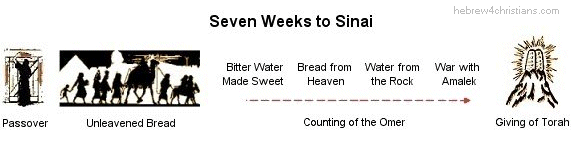 |
The Talmud (i.e., traditional teaching of the Torah ) also connects Shavuot with the giving of the Torah. The earliest Talmudic statement on the date of the revelation at Sinai is found in Tractate Shabbat 86b. According to these sages, the Israelites left Egypt on Friday, Nisan 15, and the Torah was given exactly 50 days later on Saturday, Sivan 6th. This corresponds exactly with God's instructions to count 50 days from the day after Passover (Lev. 23:15-16). This date later became fixed in the Jewish calendar, and was further supported by reference to Exodus 19:1: "On the third new moon after the people of Israel had gone out of the land of Egypt, on that day they came into the wilderness of Sinai." (For details about the exact timing for this event, see the main Shavuot article here.) The Midrash Rabbah also explicitly makes the Shavuot-Sinai connection as well. The later rabbis refer to Shavuot as "Atzeret" (עצרת), a word that means "withdrawal" (i.e., to the desert to receive the law) and "conclusion" (or the goal of the Passover redemption). Today Jewish tradition regards Shavuot as Zman Mattan Torateinu (זמן מתן תורתנו) - "the anniversary of the giving of the Torah." Shavuot is also called Yom Ha'Kahal (יום הקהל) - the "Day of Assembly," based on the assembly of all the people of Israel to hear the Voice of God at Sinai (Deut. 18:16).
During the Passover Seder we reaffirm our connection with God's saving deeds by saying that "in every generation each person should consider himself as having personally received the Torah at Sinai." The climax of the Shavuot morning service is the recitation of the famous Akdamut poem followed by the recitation of the Ten Commandments, when all the congregation stands to "relive" the experience at Sinai. A second Torah scroll is then taken out of the ark and the portion is read (Num. 28:26-31) that describes the sacrificial offerings made at the Temple during Shavuot, and the Haftarah (Ezek. 1:1-28; 3:12) concerns the stunning revelation of God in the form of the Throne/Chariot.
The Scroll of Ruth (מגילת רות) - a beautiful story about God's redemptive love - is read on the second day of Shavuot. As the "kinsman redeemer" (i.e., go'el karov: גואל קרוב), Boaz was a wealthy man of the tribe of Judah (Bethlehem) who married a Gentile bride. Boaz's name (בועז) means "in Him [בו] is strength [עז]," a picture of Yeshua the Messiah, his greater Descendant, who also redeemed for himself a bride from among the nations. Among traditional Jews, the Book of Ruth is is read since the events recounted took place during the time of the spring harvest (linking it to the agricultural aspect of Shavuot), and Ruth is a picture of willing acceptance of a Jewish lifestyle (linking it to the events of Sinai).
Paradoxically, the conversion of Ruth was actually against the law given in the Torah itself! According to the Torah (Deut. 23:3), an Ammonite (or Moabite) was forbidden to enter into the family of Israel, and therefore the question arose regarding how Ruth was accepted. Indeed, not only was Ruth accepted, she became the great grandmother of King David through whom the Messiah Yeshua would come (Ruth 4:17). There is a profoundly wonderful message hidden here!
Shavuot is portrayed metaphorically as a marriage ceremony (קִדוּשִׁין) between God and the children of Israel. The LORD is the Heavenly chatan (groom) who said, "Accept Me"; the Jewish people represent the beloved kallah (bride); and the Torah represents the ketubah (marriage contract). In some Sephardic traditions, a ketubah is literally read under the traditional chuppah (חוּפָּה) or wedding canopy, that is set up in the synagogue. Some of the sages note that the idea of marriage comes from the resemblance of the word Shavuot with shevuot (שבועות), the word for "oaths." On Shavuot two oaths were taken. One was from God who pledged that He would not exchange the children of Israel for another people, and the other was from the Jews who pledged they would not exchange God for another deity...
This is analogous to the wedding cup that Yeshua offered us in the upper room, before His crucifixion. The Holy Spirit was given to escort us into the heavenly bridal chamber... Collectively, the followers of the Messiah are called Kallat Mashiach (כלת המשיח) - the Bride of Messiah (Rev 21:2,9), and we eagerly await the marriage supper to come (Rev 19:9).
Shavuot marks the time when God entered into covenant with the Jewish nation. During the first Shavuot at Sinai, God instituted the Mosaic covenant and gave the Torah in written form, but during the Shavuot at Zion, after the resurrection of Yeshua, God established the New Covenant (הברית החדשה) when He wrote the Torah on the hearts of Yeshua's followers.
- Shavuot at Mount Sinai is sometimes considered the day on which Judaism was born. Shavuot in Jerusalem (Mount Zion) is the day on which the church was born when the Holy Spirit was poured out upon the followers of the Messiah Yeshua.
- Just as the resurrection of Yeshua represents the Firstfruits of those who have died (1 Cor. 15:20) and fulfills the prophetic ritual of the waving of the omer on the festival of First Fruits, so the giving of the Holy Spirit to the followers of Yeshua fulfills the wave offering of the leavened wheat loaves on the day of Shavuot.
- At Mount Sinai the Ten Commandments were written on tablets of stone by the "finger of God" (Exod. 31:18), but at Mount Zion, the Torah is written on tables of the heart by the Spirit of God (2 Cor. 3:3; Heb. 8:10).
- Just as the Israelites were affirmed as God's chosen people on Shavuot with the giving of the Torah, so the followers of the Messiah are affirmed as God's chosen people at Shavuot after Yeshua's ascension into heaven as the Mediator of a Better Covenant (Hebrews 8:6). The 3,000 that were added to the church that day were firstfruits of the redeemed people of God.
Again, the holiday of Shavuot is one of the shelosh regalim (three pilgrimage festivals) given in the Torah (Exod. 23:14-17; Deut. 16:16) and therefore reveals profound spiritual truth for followers of Yeshua (Luke 24:44; 2 Tim. 3:16). God did not want us to miss the significance of this holiday, since it expresses the freedom and truth of the New Covenant of Zion. Friend, may this be a time of renewal and great joy in your life....
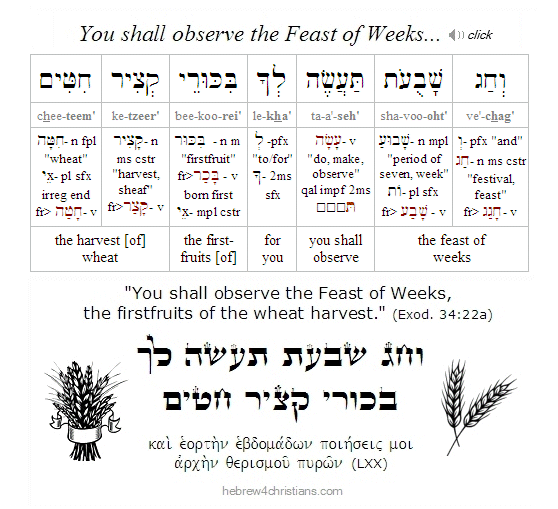
Hebrew Lesson
Exod. 34:22a reading (click):
Eschatology and Shavuot...
The festival of Shavuot (חג השבועות) begins at sundown... Happy Shavuot Holiday, friends!
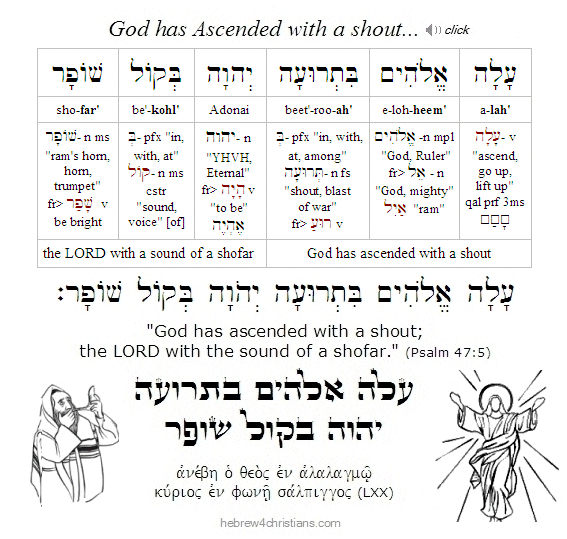
06.01.25 (Sivan 5, 5785) Some people see the ultimate fulfillment of the holiday of Shavuot (i.e., "Weeks" or "Pentecost") to be found in the mysterious catching away (ἁρπάζω, harpazo) of believers before the time of the "Great Tribulation" and the Great Day of the LORD (1 Thess. 4:17; John 14:3; 1 Cor. 15:51-52). They reason that since Shavuot marked the day of dramatic revelation, with signs of fire and the sounds of a heavenly shofar blast, an appointed time that marks the jubilee fulfillment of Passover, it can therefore be seen as the rapturous end of redemption for those who believe, symbolic of a wedding day, when God betrothed Israel as His own people, separate from all others. Both Jew and Gentile will be "waved" before the LORD (as symbolized by shtei ha-lechem, the two loaves), representing the "one new man" of kallat Mashiach, the "bride of Messiah," or the assembly of those called out from every tribe and tongue to be a part of God's heavenly kingdom.
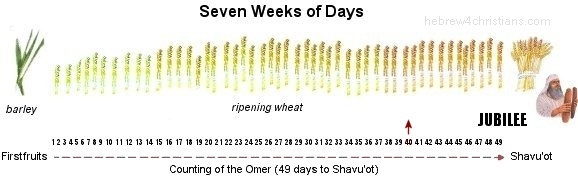 |
Though no one knows the day or hour of the return of Yeshua our Messiah (see Matt. 24:36; Acts 1:7), there are clues given in Scripture about the conditions of the world before His return, and Yeshua himself gave us parables admonishing us to actively be looking (Matt. 24:2-14; 25:1-13). The Apostle Paul said that followers of the Lord can know the "season" of Messiah's return, and warned that He will come "as a thief in the night" - not in the revelation of great power and overwhelming glory at the end of the age (1 Thess. 5:2-6). Moreover, Paul forewarned of the rise of worldwide godlessness (2 Tim. 3:1-7) and even of the flagrant apostasy of the "institutionalized" church (1 Tim. 4:1-3), which is of course evident today... Other Scriptures foretell of a coming One World Government, the rise of the "Messiah" of evil (Antichrist) who will enforce a worldwide "security state" (Dan. 11:38), the persecution of the national Israel (a nation that had been miraculously restored to the promised land), the rebuilding of the third Temple, the coming Great Tribulation, and so on. "When these things begin to take place, straighten up and lift up your heads, because your redemption is drawing near" (Luke 21:28).
Regarding the destiny of the "world system," however, we have quite a different vision... The LORD God Almighty has vowed to break the pride of the "kings of the earth" with a rod of iron and dash them in pieces like a potter's vessel, and the shattering will be so ruthless that among its fragments not a shard will be found with which to take fire from the hearth, or to dip up water out of the cistern (Psalm 2:9; Isa. 30:14). For from His mouth comes a sharp sword with which to strike down the nations, and He will rule them with a rod of iron. He will tread the winepress of the fury of the wrath of God the Almighty (Rev. 19:15). Nebuchadnezzar's great dream will soon be fulfilled: "As you looked, a Stone was cut out by no human hand, and it struck the image on its feet of iron and clay, breaking them in pieces. Then the iron, the clay, the bronze, the silver, and the gold, all together were broken in pieces, and became like the chaff of the summer threshing floors; and the wind carried them away, so that not a trace of them could be found. But the stone that struck the image became a great mountain and filled the whole earth" (Dan. 2:34-35). "And the God of heaven will set up a kingdom that shall never be destroyed ... and it shall stand forever" (Dan. 2:44). One day the edifice of man's godless pride will come crashing down, and there will be no trace left of its rubble... Amen; even so, come quickly, Lord!
Hebrew Lesson
Psalm 47:5 Hebrew reading:
 |
<< Return
|