|
Note that there are no reduced forms for the I or U type vowels and that unchangeably long vowels are always "mixed vowels" or "full vowels."
The Sheva
This nikkud mark is the toughest for the beginner to get right. And with good reason: it's somewhat more difficult than the other vowel marks.
The vocal sheva (sheva na, or moving sheva) represents the sound of a letter without a vowel. When it opens a syllable it sounds almost as if you were trying to pronounce the letter by itself (usually I will transliterate a vocal sheva with an "e" (or sometimes with an apostrophe); we will not transliterate the silent sheva (sheva nach, or resting sheva) at all. A sheva at the end of a word is always considered silent.
There are four cases when the Sheva is vocal (na):
- When it begins a word (or syllable)
- When it is the second of two shevas in a row
- When it appears under a letter with a Dagesh Forte
- When it follows a syllable that contains a long vowel.
Correlatively, there are four cases when the Sheva is silent (nach):
- When it ends a word (or syllable)
- When it is the first of two shevas in a row
- When it closes a syllable
- When it follows a syllable that contains a short vowel.
Some grammars do not treat the vocal sheva as a separate syllable, but include its sound with the following syllable (as a sort of slurred vocalization before the next syllable). Normally I will treat the vocal sheva as a separate syllable in transliterations (using either an apostrophe character or an "e").
Hebrew Diphthongs
A diphthong is a cluster or combination of vowels acting as a unit and producing a unique sound. From the point of view of word division, a diphthong represents a distinct syllable in Hebrew. Note also that diphthongs are considered long vowels.
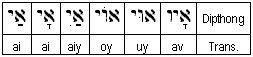
The Complete Hebrew Vowel List
You can click here to view the complete Hebrew vowel list in Table Format.
Other Learning Resources
You may also download Hebrew vowel flashcards or the entire Vowel Chart as a PDF file:
- Hebrew Vowel Flashcards
(zipped PDF files)
- Hebrew Vowel Chart
Nu, What's Next?
If this material is now clear, you may go ahead to Unit Three and begin learning about Hebrew syllables. You may also perform a self-check by working through Unit Two exercises.
|


